Thursday, December 31, 2015

Bank of America is trying to load up on patents for the technology behind bitcoin

by Thomas Dishaw
Banksters gangsters who haven’t did anything innovative since the ATM are loading up on patents hoping to capitalize on the future cryptocurrency trend according  to this QZ report.

Bankers may not think bitcoin will ever go fully mainstream, but they clearly believe there is value in the technology that powers such cryptocurrencies, known as blockchain.
On Dec. 17, the US Patent office published 10 blockchain-related patents filed by Bank of America in July 2014. The patents haven’t been granted yet, but the filings demonstrate the bank’s interest in using blockchain technology to revamp its backend operations, which, like other financial institutions, are largely paper-based.
The wide-ranging patents cover everything from a “cryptocurrency transaction payment system” which would let users make transactions using cryptocurrency, to risk detection, storing cryptocurrencies offline, and using the blockchain to measure fraudulent activity. (The blockchain is essentially a publicly available ledger that’s distributed to everyone within a network.)
Bank of America had no comment.
Financial institutions are quickly ramping up their research efforts around blockchain technology. Last week, IBM, JPMorgan, the London Stock Exchange, and Wells Fargo announced the Open Ledger Project, a new consortium that will focus on allowing businesses to easily build their own blockchain technology. Bank of America is a part of a consortium led by blockchain startup R3 that’s developing blockchain technology to be used in financial markets. The Aite Group estimates that banks have invested $75 million this year on blockchain tech, a figure the research firm forecasts will grow to $400 million in 2019.
Other financial institutions have been building up their blockchain-related intellectual property. Goldman Sachs filed a patent for its own cryptocurrency, SETLCoin, that would allow traders to execute and clear trades in real time.
It’s hard to speculate what Bank of America will do with these patents, if anything. But Coindesk notes these patents could be hinting at BofA working on a complete network based on blockchain.

The real-life genius from ‘The Big Short’ thinks another financial crisis is looming…

From Jessica Pressler at New York Magazine:
If The Big Short, Adam McKay’s adaptation of Michael Lewis’s book about the 2008 financial crisis, got you all worked up over the holidays, you’re probably wondering what Michael Burry, the economic soothsayer portrayed by Christian Bale who’s always just a few steps ahead of everyone else, is up to these days. In an e-mail, which readers of the book will recognize as his preferred method of communication, the real-life head of Scion Asset Management answered some of our panicked questions about the state of the financial system, his ominous-sounding water trade, and what, if anything, we can feel hopeful about.
The movie portrays all of you as kind of swashbuckling heroes in some ways, but McKay suggested to me that you were very troubled by what happened. Is that the case?
I felt I was watching a plane crash. I actually had that dream again and again. I knew what was happening, but there was nothing I, or anyone else, could do to stop it. The last day of 2007, I couldn’t come home. I was in the office till late at night, I couldn’t calm down. I wrote my wife an email and just said, “I can’t come home; it’s just too upsetting what’s happening, and I didn’t want to come home to my kids like this.” As for punishment of those responsible, borrowers were punished for their overindulgences — they lost homes and lives. Let’s not forget that. But the executives at the lenders simply got rich.
Were you surprised no one went to jail?

I am shocked that executives at some of the worst lenders were not punished for what they did. But this is the nature of these things. The ones running the machine did not get punished after the dot-com bubble either — all those VCs and dot-com executives still live in their mansions lining the 280 corridor on the San Francisco peninsula. The little guy will pay for it — the small investor, the borrower. Which is why the little guy needs to be warned to be more diligent and to be more suspicious of society’s sanctioned suits offering free money. It will always be seductive, but that’s the devil that wants your soul.
When I spoke to some of the other real-life characters fromThe Big Short, I was surprised to hear that they thought that financial reform was pretty effective and that the system was much safer. Michael Lewis disagreed. In your opinion, did the crash result in any positive changes?
Unfortunately, not many that I can see. The biggest hope I had was that we would enter a new era of personal responsibility. Instead, we doubled down on blaming others, and this is long-term tragic. Too, the crisis, incredibly, made the biggest banks bigger. And it made the Federal Reserve, an unelected body, even more powerful and therefore more relevant. The major reform legislation, Dodd-Frank, was named after two guys bought and sold by special interests, and one of them should be shouldering a good amount of blame for the crisis. Banks were forced, by the government, to save some of the worst lenders in the housing bubble, then the government turned around and pilloried the banks for the crimes of the companies they were forced to acquire. The zero interest-rate policy broke the social contract for generations of hardworking Americans who saved for retirement, only to find their savings are not nearly enough. And the interest the Federal Reserve pays on the excess reserves of lending institutions broke the money multiplier and handcuffed lending to small and midsized enterprises, where the majority of job creation and upward mobility in wages occurs. Government policies and regulations in the postcrisis era have aided the hollowing-out of middle America far more than anything the private sector has done. These changes even expanded the wealth gap by making asset owners richer at the expense of renters. Maybe there are some positive changes in there, but it seems I fail to see beyond the absurdity.
Where do we stand now, economically?
Well, we are right back at it: trying to stimulate growth through easy money. It hasn’t worked, but it’s the only tool the Fed has got. Meanwhile, the Fed’s policies widen the wealth gap, which feeds political extremism, forcing gridlock in Washington. It seems the world is headed toward negative real interest rates on a global scale. This is toxic. Interest rates are used to price risk, and so in the current environment, the risk-pricing mechanism is broken. That is not healthy for an economy. We are building up terrific stresses in the system, and any fault lines there will certainly harm the outlook.
What makes you most nervous about the future?
Debt. The idea that growth will remedy our debts is so addictive for politicians, but the citizens end up paying the price. The public sector has really stepped up as a consumer of debt. The Federal Reserve’s balance sheet is leveraged 77:1. Like I said, the absurdity, it just befuddles me.
Read the full interview (including Burry’s top idea today) right here…

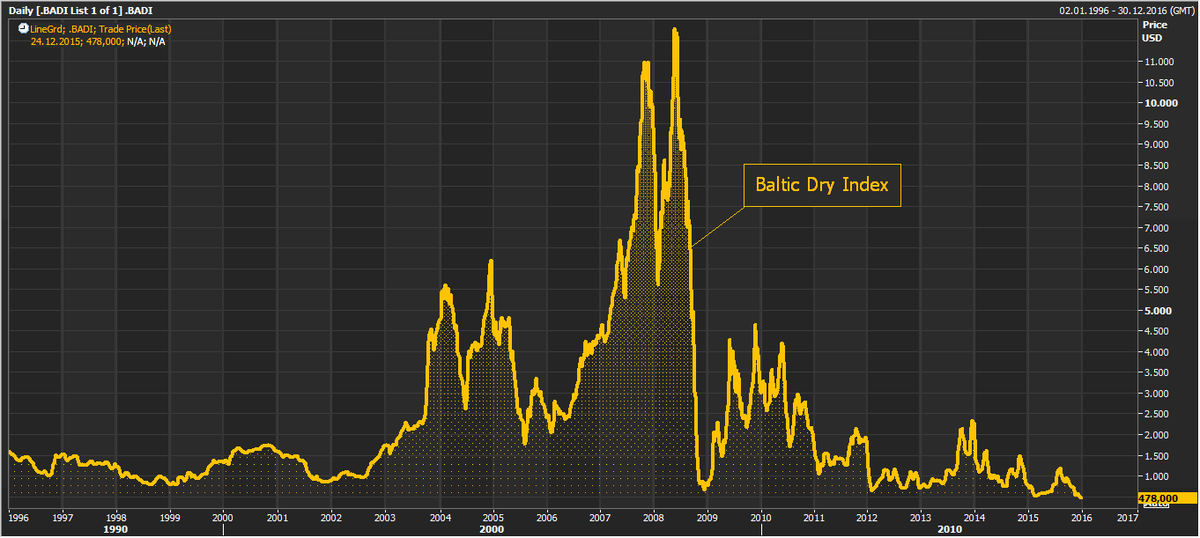
Gloomy omen for 2016: Baltic Dry, a measure of shipping rates for everything from coal to ore, fell to historic low.

Gloomy omen for 2016: Baltic Dry, a measure of shipping rates for everything from coal to ore, fell to historic low.

The Confiscation of Bank Savings to “Save the Banks”: The Diabolical Bank “Bail-In” Proposal

The Crisis in Greece: Will it result in a Haircut “Bail-in” as applied in 2013 in Cyprus? 
This article was first published by Global Research in April 2013. 
*      *     *
Is the Cyprus Bank “Bail-in” a “dress rehearsal” for things to come?
Is  a “Savings Heist” in the European Union and North America envisaged which could result in the outright confiscation of bank deposits?
In Cyprus, the entire payments system has been disrupted leading to the demise of the real economy.
Pensions and wages are no longer paid. Purchasing power has collapsed.
The population is impoverished.
Small and medium sized enterprises are spearheaded into bankruptcy.
Cyprus is a country with a population of one million.
What would happen if similar ‘hair cut” procedures were to be applied in the U.S. or the European Union?
According to the Washington based Institute of International Finance (IIF) (right) which represents the consensus of the global financial establishment, “the Cyprus approach of hitting depositors and creditors when banks fail, would likely become a model for dealing with collapses elsewhere in Europe.” (Economic Times, March 27, 2013).
It should be understood that prior to the Cyprus onslaught, the confiscation of bank deposits had been contemplated in several countries. Moreover, the powerful financial actors who triggered the bank crisis in Cyprus, are also the architects of  the socially devastating austerity measures imposed in the European Union and North America.
Does Cyprus constitute a “model” or scenario?
Are there “lessons to be learned” by these powerful financial actors, to be applied elsewhere, at some later stage, in the Eurozone’s banking landscape?
According to the Institute of International Finance (IIF), “hitting depositors” could become the “new normal” of this diabolical project, serving the interests of the global financial conglomerates.
This new normal is endorsed by the IMF and the European Central Bank.  According to the IIF which constitutes the banking elites mouthpiece,  “Investors would be well advised to see the outcome of Cyprus… as a reflection of how future stresses will be handled.”  (quoted in Economic Times, March 27, 2013)
“Financial Cleansing”. Bail-ins in the US and Britain

What is at stake is a process of  “financial cleansing” whereby the “too big to fail banks” in Europe and North America (e.g. Citi, JPMorgan Chase, Goldman Sachs, et al ) displace and destroy lesser financial institutions, with a view to eventually taking over the entire “banking landscape”.
The underlying tendency at the national and global levels is towards the centralization and concentration of bank power, while leading to the dramatic slump of the real economy.
Bail ins have been envisaged in numerous countries. In New Zealand  a “haircut plan”   was envisaged as early as 1997 coinciding with Asian financial crisis.
There are provisions in both the UK and the US pertaining to the confiscation of bank deposits.  In a joint document of the Federal Deposit Insurance Corporation (FDIC) and the Bank of England, entitled Resolving Globally Active, Systemically Important, Financial Institutions, explicit  procedures were put forth whereby “the original creditors of the failed company “, meaning the depositors of  a failed bank, would be converted into “equity”. (See Ellen Brown, It Can Happen Here: The Bank Confiscation Scheme for US and UK Depositors,Global Research, March 2013)
What this means is that the money confiscated from bank accounts would be used to meet the failed bank’s financial obligations. In return, the holders of the confiscated bank deposits would become stockholders in a failed financial institution on the verge of bankruptcy.
Bank savings would be transformed overnight into an illusive concept of capital ownership. The confiscation of savings would be adopted under the disguise of  a bogus “compensation” in terms of equity.
What is envisaged is the application of  a selective process of  confiscation of bank deposits, with a view to collecting debt while also triggering the demise of “weaker” financial institutions. In the US, the procedure would bypass the provisions of the Federal Deposit Insurance Corporation (FDIC) which insures deposit holders against bank failures:
No exception is indicated for “insured deposits” in the U.S., meaning those under $250,000, the deposits we thought were protected by FDIC insurance. This can hardly be an oversight, since it is the FDIC that is issuing the directive. The FDIC is an insurance company funded by premiums paid by private banks.  The directive is called a “resolution process,” defined elsewhere as a plan that “would be triggered in the event of the failure of an insurer . . . .” The only  mention of “insured deposits” is in connection with existing UK legislation, which the FDIC-BOE directive goes on to say is inadequate, implying that it needs to be modified or overridden. (Ibid)
Because depositors are provided with a bogus compensation, they are not eligible to the FDIC deposit insurance.
Canada’s Deposit Confiscation Proposal
The most candid statement of confiscation of bank deposits as a means to “saving the banks” is formulated in a recently released document of the Canadian government entitled “Jobs, Growth and Long Term Prosperity: Economic Action Plan 2013″. 
The latter was submitted to the House of Commons by Canada’s Minister of Finance Jim Flaherty on March 21 as part of a so-called “pre-budget” proposal.
A short section of the 400 report entitled “Risk Management Framework for Domestic Systemically Important Banks” identifies bail-in procedure for Canada’s chartered banks. The word confiscation is not mentioned. Financial jargon serves to obfuscate the real intent which essentially consists in stealing people’s savings.
Under the Canadian “Risk Management” project:
 The Government proposes to implement a ‘bail-in’ regime for systemically important banks.
 This regime will be designed to ensure that, in the unlikely event that a systemically important bank depletes its capital, the bank can be recapitalized and returned to viability through the very rapid conversion of certain bank liabilities into regulatory capital.”
This will reduce risks for taxpayers. The Government will consult stakeholders on how best to implement a bail-in regime in Canada.
What this signifies is that if one or more banks (or credit unions) were obliged to “systemically deplete their capital” to meet the demands of their creditors, the banks would be recapitalized through “the conversion of certain bank liabilities into regulatory capital.” 
The  “certain bank liabilities” pertains (in technical jargon) to the money they owe their customers, namely to their depositors, whose bank accounts would be confiscated in exchange for shares (equity) in a “failing” banking institution.
“This will reduce risks for taxpayers” is a nonsensical statement. What this really means is that the government will not provide funding to compensate depositors who are victims of a failed banking institution, nor will it come to rescue of the failed institution.
Instead the depositors will be obliged to give up their savings. The money confiscated will then be used by the bank to meet their liabilities contracted with major financial creditor institutions. In other words, this entire scheme is “a safety net” for too big to fail banks, a mechanism which enables them as creditors to overshadow lesser banking institutions including credit unions, while precipitating either their collapse or their takeover.
Canada’s Financial Landscape
The Risk Management Bail in initiative is of crucial significance for Canadians across the land: once it is adopted by the House of Commons as part of the budget package, the Bail-in procedures could be applied.
The Conservative government has a parliamentary majority. There is a good likelihood that the Economic Action Plan 2013″  which includes the Bail-in procedure will be adopted.
While Canada’s Risk Management Framework intimates that Canada’s banks “are at risk”, particularly those which have accumulated large debts (as a result of derivative losses), a generalised across the board application of the “Bail in” is not contemplated.
The likely scenario in the foreseeable future is that Canada’s “big five” banks, Royal Bank of Canada, TD Canada Trust, Scotiabank, Bank of Montreal and CIBC (all of which have powerful affiliates operating in the US financial landscape) will consolidate their position at the expense of  lesser (provincial level) banks and financial institutions.
The Government document intimates that the Bail-in could be used selectively “in the unlikely event that one [bank] becomes non-viable.” What this suggests is that at least one or more of  Canada’s  “lesser banks” could be the object of a bail-in. Such a procedure would inevitably lead  to a greater concentration of bank capital in Canada, to the benefit of the larger financial conglomerates.
Displacement of Provincial Level Credit Unions and Cooperative Banks
There is an important network of over 300 provincial level credit unions and cooperative banks including the powerful Desjardins network in Quebec, the Vancouver City Savings Credit Union (Vancity) and the Coastal Capital Savings in British Columbia, Servus in Alberta, Meridian in Ontario, the caisses populaires in Ontario (affiliated to Desjardins), among many others, which could be the target of selective “Bail-in” operations.
In this context, what is likely to occur is a significant weakening of provincial level cooperative financial institutions, which  have a governance relationship to their members (including representative councils) and which, in the present context, offer an alternative to the Big Five chartered banks. According to recent data, there are more than 300 credit unions and caisses populaires in Canada which are members of  the “Credit Union Central of Canada”.
New Normal: International Standards Governing the Confiscation of Bank Deposits
Canada’s Economic Action Plan 2013″  acknowledges that the proposed Bail-in framework “will be consistent with reforms in other countries and key international standards”. Namely, the proposed pattern of confiscating bank deposits as described in the Canadian government document is consistent with the model contemplated in the US and the European Union.  This model is currently a “talking point” (behind closed doors) at various international venues regrouping central bank governors and finance ministers.
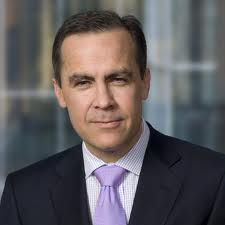
The regulatory agency involved in these multilateral consultations is the Financial Stability Board (FSB) based in Basel, Switzerland and hosted by the Bank for International Settlements (BIS) (image right). The FSB  happens to be chaired by the governor of the Bank of Canada, Mark Carney, who was recently appointed by the British government to head the Bank of England starting in June 2013.
Mark Carney, as Governor of the Bank of Canada, was instrumental in shaping the provisions of the Bail-in for Canada’s chartered banks. Before his career in central banking, he was a senior executive at Goldman Sachs, which has played a behind the scenes role in the implementation of the bank bailouts and austerity measures in the EU.
The FSB’s mandate would be to coordinate the bail-in procedures, in liaison with the “national financial authorities” and “international standard setting bodies” which include the IMF and the BIS. It should come as no surprise: the deposit confiscation procedures in the UK, the US and Canada examined above are remarkably similar.
Bank “Bail-ins” vs. Bank “Bail-outs”
The bailouts are “rescue packages” whereby the government allocates a significant portion of State revenues in favor of failed financial institutions. The money is channeled from the coffers of the State to the banking conglomerates.
In the US in 2008-2009, a total of $1.45 trillion was channeled to Wall Street financial institutions as part of the Bush and Obama rescue packages.
These bailouts were considered as a De facto government expenditure category. They required the implementation of austerity measures. Together with massive hikes in military expenditure, the bailouts were financed through drastic cuts in social programs including Medicare, Medicaid and Social Security.
In contrast to the Bailout, which is funded from the public purse, the “Bail-in” requires the (in-house) confiscation of bank deposits. The bail-ins are implemented without the use of public funds. The regulatory mechanism is established by the central bank.
At the outset of Obama’s first term in January 2009, a bank bailout of the order of $750 billion was announced by Obama, which was added on to the 700 billion dollar bailout money allocated by the outgoing Bush administration under the Troubled Assets Relief Program (TARP).
The total of both programs was a staggering 1.45 trillion dollars to be financed by the US Treasury. (It should be understood that the actual amount of cash financial “aid” to the banks was significantly larger than $1.45 trillion. In addition to this amount defence allocations to fund Obama’s war economy (FY 2010) was a staggering $739 billion. Namely the bank bailouts plus defence combined ($2189 billion) eat up almost the totality of the federal revenues which in FY 2010 amounted to $2381 billion.
Concluding remarks
What is occurring is that the bank bailouts are no longer functional. At the outset of Obama’s Second term, the coffers of the state are empty. The austerity measures have reached a deadlock.
The bank bail-ins are now being contemplated instead of  the “bank bailouts”.
The lower and middle income groups which are invariably indebted will not be the main target. The appropriation of bank deposits would essentially target the upper middle and upper income groups which have significant bank deposits. The second target will be the bank accounts of small and medium sized firms.
This transition is part of the evolution of the global economic crisis and the impasse underlying the application of the austerity measures.
The purpose of the global financial actors is to wipe out competitors, consolidate and centralize bank power and exert an overriding control over the real economy, the institutions of government and the military.
Even if the bail-ins were to be regulated and applied selectively to a limited number of failing financial institutions, credit unions, etc, the announcement of a program of confiscation of deposits could potentially lead to a generalized “run on the banks”. In this context, no banking institution would be regarded as safe.
The application of Bail-in procedures involving deposit confiscation (even when applied locally or selectively) would create financial havoc. It would interrupt the payments process. Wages would no longer be paid. Purchasing power would collapse. Money for investment in plant and equipment would no longer be forthcoming. Small and medium sized businesses would be precipitated into bankruptcy.
The application of a Bail-In in the EU or North America would initiate a new phase of the global financial crisis, a deepening of the economic depression, a greater centralization of banking and finance, increased concentration of corporate power in the real economy to the detriment of regional and local level enterprises.
In turn, an entire global banking network characterized by electronic transactions (which govern deposits, withdrawals, etc), –not to mention money transactions on the stock and commodity markets– could potentially be the object of significant disruptions of a systemic nature.
The social consequences would be devastating. The real economy would plummet as a result of the collapse in the payments system.
The potential disruptions in the functioning of an integrated global monetary system could result in a a renewed global economic meltdown as well as a drop off in international commodity trade.
It is important that people across the land, in the European Union and North America, nationally and internationally, forcefully act against the diabolical ploys of their governments –acting on behalf of dominant financial interests– to implement a selective process of  bank deposit confiscation.

ORDER DIRECTLY FROM GLOBAL RESEARCH
original

The Global Economic Crisis: The Great Depression of the XXI Century

Michel Chossudovsky and Andrew Gavin Marshall, Editors $16.00
Save 38%

Prime Minister Dmitry Medvedev built upon President Putin's earlier suggestion and formally proposed a grand multilateral economic partnership during his trip to China.

Russia has historically been known for thinking big, so what the Prime Minister proposed is totally in line with the country's political culture. While in the Chinese city of Zhengzhou to partake in the SCO Council of Heads of Government, Medvedev ambitiously stated that:
"Russia proposes starting consultations with the Eurasian Economic Union and Shanghai Cooperation Organization, including the counties joining the alliance, and with countries of the Association of Southeast Asian Nations on the creation of an economic partnership based on the principles of equality and mutual interests."
This suggestion corresponds to what President Putin said during his 3 December Address to the Federal Assembly, when he announced that:
"I propose holding consultations, in conjunction with our colleagues from the Eurasian Economic Union, with the SCO and ASEAN members, as well as with the states that are about to join the SCO, with the view of potentially forming an economic partnership."
In the blink of an eye, and at a time when the Western mainstream media is barking about Russia's purported lack of economic opportunities and "isolation", Moscow just proposed the world's most far-reaching economic partnership and took the West completely off guard.
From Minsk to Manila
Russia's idea is very similar in concept to Charles de Gaulle's famous quip about a Europe "from Lisbon to Vladivostok". Taking into account current geopolitical realities and the fact that they're likely symptomatic of new long-term trends, Putin updated the former French leader's multipolar vision and essentially made it about a ‘Eurasia from Minsk to Manilla' instead. This reiteration represents the western-most and southeastern-most capitals of the proposed multilateral economic partnership and is an accurate way of describing the vast continental space contained within its borders. Let's review the membership of each organization that's envisioned to be party to what could eventually become a Grand Eurasian Free Trade Area (GEFTA): Eurasian Economic Union:
This nascent organization brings together the economies of Russia, Belarus, Armenia, Kazakhstan, and Kyrgyzstan and stretches over most of the former Soviet Union. While still in its infancy, its members are working hard to coordinate their common economic space and standardize related legal procedures within it. Unlike the EU to which it's often and misleadingly compared, there is no political component to the bloc and it is strictly an economic group that focuses on equitable shared interest.
SCO:
Originally known as the "Shanghai Five" and created in 1996 to assist with delineating the boundaries that five former Soviet states inherited with China, it gained its present name after the 2001 inclusion of Uzbekistan. The organization is now a multi-sectoral cooperative platform for its members and has grown past the shared former Soviet-Chinese space. India and Pakistan are currently ascending into the organization, while Afghanistan, Belarus, Iran, and Mongolia have observer status
ASEAN:
The oldest of the three organizations, it was created in 1967 in order to bring the Southeast Asian states closer together in all respects. The founding members were Indonesia, Malaysia, the Philippines, Singapore, and Thailand, but the group later incorporated Brunei in 1984, Vietnam in 1995, Laos and Myanmar in 1997, and finally Cambodia in 1999. Since its pan-regional expansion, the bloc has been one of the fastest-growing regions in the world, and its members just declared the ASEAN Economic Community (AEC) in late November in order to strengthen their integrational efforts.
Intersecting Interests
GEFTA is a very clever suggestion that seeks to benefit from the intersecting economic interests of its proposed partners. As it currently stands, here's what the macroeconomic arrangement looks like:
In Force:
India-ASEAN FTA
China-ASEAN FTA
China-Pakistan FTA
South Asian Association for Regional Cooperation (SAARC, a FTA stretching from Afghanistan to Bangladesh)
Proposed:
Eurasian Union-ASEAN FTA
Eurasian Union-China FTA
SCO FTA
Eurasian Union-India FTA
Eurasian Union-Iran FTA
India-Iran Free FTA
The Challenges Ahead
GEFTA is a long-term vision that will probably take some time to actualize, but in the meantime, there are two primary challenges standing in the way of its full proposed implementation. These are India's suspicion of China and the US-driven TPP:
India's Issues:
It's no secret that India and China are friendly competitors, but it might be more apt to describe them as geopolitical rivals at this point. While they publicly get along well in large-scale multilateral institutions such as the AIIB, BRICS, and the SCO, they fare a lot worse when it comes to indirect bilateral relations. They have lukewarm ties in dealing with each other one-on-one, but relations are considerably colder when they indirectly deal with the other via their policies with third-party states.
For example, India and China are in a heavy competition for influence over Nepal at this very moment, despite both sides publicly denying it, and it's aggravating the security dilemma between both of them. Also, Japanese Prime Minister Shinzo Abe just paid a landmark visit to India where it was announced that Japan will help build India's first high-speed rail project, share military secrets with it and sell related equipment, and help India in the field of nuclear energy. Suffice to say, India isn't behaving too friendly towards China, and when it comes to GEFTA, New Delhi might understandably be reluctant to partner with Beijing if it sees no tangible benefit in doing so. To reference the list in the second section, India has the potential to enter into free trade relations (or is already in them) with all of GEFTA's proposed members with the exception of China, Mongolia, and Uzbekistan, and it might not see Ulaanbaatar and Tashkent as suitable economic compensation for agreeing to the multilateral deal with China. From India's perspective, its leaders might instead choose to seal a raft of bilateral trade agreements instead of a massive multisided one that includes China.
TPP:
Fulfilling its role as the ultimate spoiler, the US is pushing the TPP partly because it knows that this could disrupt any independent free trade negotiations between ASEAN and its prospective Eurasian Union partners. While only a few of the group's members are officially party to this forthcoming agreement (Brunei, Malaysia, Singapore, and Vietnam), Indonesia's President Joko Widodo said in late October that his country intends to join, which if it happens, would decisively shift the bloc's economic gravity towards the US.
ASEAN has now begun an intensified process of self-integration through the AEC, and it's foreseeable that it will eventually seek to standardize its myriad FTAs. The problem arises when one considers that the TPP's ‘economic governance' precepts could seriously hinder the independent policies of some of its members and place them under the de-facto proxy control of the US and its transnational corporations. In the event that the TPP is finalized, the AEC states that are signatories to it would become institutionally loyal pro-American subjects that would have legally waived their right to a sovereign economic policy outside of Washington's purview. Considering the New Cold War geopolitical tensions between the unipolar and multipolar worlds, it's possible that the US might use its TPP influence within the AEC to find a way to revise ASEAN's existing FTA with China (and Vietnam's one with the Eurasian Union) on the grounds that they contradict one of the more than two million words absurdly contained in the TPP. The US' goal is to pry ASEAN away from all economic influences outside of the Pentagon's control (obviously including Russia and China) and entrap the burgeoning economies in an American-centric net of control.
The Verdict:
Even in the unfortunate scenario of India's non-participation in GEFTA and the US being successful in using the TPP to entice the AEC away from China and Russia, Moscow and Beijing could still shake the economic foundations of the Old World Order by deepening their bilateral trade relations, perhaps through a Eurasian Union-China FTA. India and ASEAN's multilateral cooperation in this framework would greatly assist in the economic development of a New Eurasia but they're not absolutely necessary, and Russia and China can still prevail in building an equitable Eurasian future on their own if need be.
The views expressed in this article are solely those of the author and do not necessarily reflect the official position of Sputnik.

IMF Chief Pours Cold Water On Optimistic Yellen, Says Growth "Will Be Disappointing"

Over the past six or so months, the OECD, the WTO, and the ADB have all come out with rather grim assessments of global growth and trade.
Back in September for instance, the WTO warned that the rate of growth in global trade is set to trail the expansion of the worldwide economy for the third year running. As WSJ noted at the time, “before the recent slump, the last time trade growth underperformed the rate of an economic expansion was 1985.”
“We have seen this burst of globalization, and now we’re at a point of consolidation, maybe retrenchment,” WTO chief economist Robert Koopman said. “It’s almost like the timing belt on the global growth engine is a bit off or the cylinders are not firing as they should.”
“Global growth prospects have weakened slightly and the outlook is clouded by important uncertainties,” the OECD said later in September. “Emerging economies have vulnerabilities that could be exposed by rising US interest rates and/or a sharper-than-expected slowdown in China, giving rise to financial and economic turbulence that could also exert a significant drag on advanced economies,” the organization continued.
Bloomberg Sponsored Content
Finally, the ADB weighed in, noting that “softer growth prospects for the People’s Republic of China (PRC) and India, and a slow recovery in the major industrial economies, will combine to push growth in developing Asia for 2015 and 2016 below previous projections.”
Those assessments came just as the Fed adopted the “clean relent” in September and make no mistake, the outlook hasn’t changed since then. Just ask IMF chief Christine Lagarde.
In a guest article for Handelsblatt, Lagarde lays bare the risks facing global trade on the way to painting a rather depressing picture for 2016.
“Global economic growth will be disappointing next year and the outlook for the medium-term has also deteriorated,” Reuters says, recounting Lagarde’s comments. “The prospect of rising interest rates in the United States and an economic slowdown in China [are] contributing to uncertainty and a higher risk of economic vulnerability worldwide.”
Lagarde warns of the “spillover effects” from the Fed hike, including the possibility that fragile emerging markets may be shaken further at a time when myriad risk factors are already weighing on the space.
China’s transition from a smokestack, investment-led economy to a consumption and services led model as well as Fed policy normalization are “necessary” but should be executed carefully with a mind towards mitigating shocks, she continues.
Specifically, Lagarde is concerned about the nightmare scenario that occurs when EM corporates borrow heavily in dollars only to see their currencies depreciate rapidly, the so called "original sin" that's been largely avoided at the sovereign level, but not by corporates. For an example of what can happen in such instances, see Empresas ICA SAB.
As a reminder, EMEs have over $3 trillion in USD-denominated debt:

"Most highly developed economies except the USA and possibly Britain will continue to need loose monetary policy but all countries in this category should comprehensively factor spillover effects into their decision-making," she goes on to say, underscoring the fact that there are risks both to hiking and to remaining suspended in the Keynesian Twilight Zone.
Ultimately, the takeaway is the the head of the IMF, who supposedly knows about such things, has just delivered a decisively negative outlook for global growth and trade in 2016 and that assessment seems to be at odds with the FOMC. That is, Lagarde is warning on economic growth and the dangerous "spillover effects" of a Fed rate hike cycle just as Janet Yellen is using stronger economic growth as an excuse and a justification for liftoff.
Of course such "truthiness" is tantamount to heresy in today's world, so perhaps this is why Lagarde's criminal case was reopened.

Will The New Swiss Referendum Reign in the Banking Beast, or Create a New Monster?

by The Wealth Watchman
Swiss
Another Shake-Up Attempt
As we head into 2016, the global financial system continues to teeter all around us. Years of virtually zero-percent interest rates in the US, along with stagnant rates the world over(accompanied by chronic unemployment), have made many do a complete rethink of what money and currency is, what it should be, and how it should be created.
These questions must be considered by any populace longing to be free, and who wish to determine their own destiny. For too long, the oligarchs in our world have called the shots, and determined those things for us, without ever asking us if that’s what we wanted. That’s why when I recently read this headline about how a European country is attempting some very serious banking & monetary reforms, I was very encouraged.

“Switzerland to vote on banning banks from creating money“

Swiss 4
If you think that this headline sounds like a big deal, it would be in some ways. Here’s what it would do.
Swiss Sovereign Money Initiative
The proposal that the Swiss people will be voting on(at a time yet to be determined) would seek to wrest the disastrous control that commercial banks have over creating currency, and put 100% of it in the hands of the Swiss National Bank.
The Swiss Sovereign Money Initiative’s(SSMI) reasoning for this referendum can be found at the link here, and I do encourage shield brothers to go and read it.  The SSMI’s main goals would be to:
1) End fractional reserve banking, by requiring all the private banks to keep 100% of deposits in reserve.
2) Give the Swiss National Bank total control over the creation/issuance of debt-free currency instead.
As many shield brothers know, in the modern, fractional-reserve banking system, the private banks largely control the issuance of new currency. These banks create new credit/currency out of thin air as they draw upon the customer loans in their vaults, to back new bank loans with.  They’re able to do this because they’re only required to keep a small percentage of customer deposits in their vaults, to satisfy depositor demands.  Sometimes banks carry as little as 10% of their cash deposits on hand(or even less) to backstop all their loans. In other words, this means they often loan(and thus, create) 10 times as much capital as they have in the vaults…from nothing!
It’s an utter scam, that creates a parasitical merchant class, which drains the rest of society, by causing booms and busts.  It also means the banking sector ends up being the receiver of very lopsided subsidies from the government, in order to keep it paid and propped up.
Subsidizing private banks, at the expense of a nation’s people, is one of the most wicked social ills in our world today.  It is this subsidy, this monopoly, which causes the speculative lending, the market rigging, the wars, the economic booms and crashes….and most importantly…has led to the rampant globalism(and erosion of freedom and sovereignty) we now see.
This problem has led to an extremely powerful banking class in Switzerland, where, according to the SSMI, roughly 90% of Swiss currency(which is digital), is created by those commercial Swiss banks.
90%!  This gives ridiculous power to the UBS’s, and the Credit Suisses across their landscape, to dominate everything.
This SSMI voter initiative would strip much of that power away from those private banks, by requiring them to maintain 100% deposit reserve ratios.  In other words, commercial banks could not create “deposits/credit” from thin air, but would be restricted to the deposits they have on hand from savers, or from other banks.  
Forcing banks back to a 1 to 1 ratio would certainly take the bite out of predatory lending practices, it would do much to reign in the boom/bust cycles in their economy, and it would reduce the banking class back to a manageable power and influence within their society.  Those would be huge positives.
I like the ideas of eliminating fractional reserve banking.  At the very least, commercial banks should be able to discover what the market’s tolerance of reserve ratios would be without central banks to backstop them(as Scotland’s banking system once did). However, in order to prevent a new banking cartel from emerging, a 100% reserve ratio would likely work best.
However, though there’s alot to like about this voter initiative,there’s just one big problem with the entire proposal, and you may have guessed what it is…
Out of the Frying Pan, Into the Fire
The Swiss National Bank, whom the Swiss people are now trying to give 100% control over their nation’s currency issuance to…is also a private bank!
If you remember nothing else I ever tell you, please remember that one of the greatest illusions/lies in our world today, is that:
Central banks are non-profit organizations with deep hearts, who only care about charity and the ‘greater good’ of their constituencies.
Believe me, nothing could be further from the truth!
For instance, the Federal Reserve in the United States is as “Federal” as the Federal Express(FedEx)! It is a private, for profit bank, which loans currency into existence to the US Government(who borrows it, with interest attached). This means the Federal Reserve ends up owning the government, owning the economy, owning the labor of the citizens(as collateral to repay the loans), and owning the entire political system itself.
For crying out loud…the Federal Reserve has shareholders(as does the SNB)! Most of those shareholders are….you guessed it….the largest private, commercial banks in the world!
  The Federal Reserve exists to backstop and rubberstamp whatever loathsome, criminal activities its primary banks are engaged in, and those commercial banks(in return) exist to help steer economic & monetary policy, as well as rig markets, in order to keep the monopoly power of issuing US dollars(as a public debt) firmly in the Federal Reserve’s control.
It’s a symbiotic relationship of utter toxicity, only made possible through government-enforced monopoly, war, and a massive crime spree.
The exact same is true of the Swiss National Bank(SNB)! The SNB only came into a limited existence around 1907, but(just like the Fed) didn’t receive its first mandate to create small-denominated currency notes in a serious way until roughly 1914.
Why 1914?
Because World War I was being fought, and wars of that size cannot be fought without massive debts! No government had the capital to pay for such wars up front, with cash on the barrel-head.
Thusly, the banking class stepped in to accommodate rival governments in their bid to blow up as much as possible for as long as possible.
The “Great War” was made possible by “public banks” like the Fed(created in 1913) and the SNB. Ron Paul once correctly noted:
“It is no coincidence that the century of total war coincided with the century of central banking”.
Truer words are seldom spoken. Think about it:
These central banks made the carnage possible. 
They amplified the scale in which wars could be fought.
They indebted the besieged peoples of those wars to the very same powers that enabled those wars in the first place.
If the problem of monetary issuance is a lack of ‘moral authority’, believe me, central banks have the least moral authority on earth! They’re all neck-deep in criminality and only serve the most demonic individuals in our world.
Don’t get me wrong. I want to say up front, that there’s alot to like about the SSMI plan:
I do think banks should be reigned in.
I do think that they should be literally tied to the earth, with realistic monetary restrictions, based in reality.
I do think commercial banks should be stripped of money-creating powers.
All those problems are addressed in this proposal. That’s good!
What’s not good is that the well-meaning folks at SSMI are about to strip one financial demon of currency creation powers, and hand it to another demon which is just as bad!  Of all the institutions that might be given this power, the Swiss National Bank is one of the worst you could pick!
For those who don’t believe me, lemme refresh your memory as to the recent criminal shenanigans the SNB was involved with!
Who Calls the Monetary Shots
Swiss 5
That picture above was advertising for the recent Swiss gold initiative that the Swiss people voted on in 2014.  It was called “Save Our Swiss Gold”(SOSG).  It was meant to address the people’s concerns over the Swiss National Bank selling Swiss gold onto the open market for years.
Until the year 2000, the Swiss Franc was partially backed by gold, roughly 20% or so, at least on paper.  That all began to change afterward though, as the Swiss National Bank began unloading quantities of gold which it considered to be “superfluous”, reducing the gold reserves behind the Swiss Franc from 20% down to 7%!
The initiative would’ve forced the gold sales by the SNB(which were only conducted to help the banking cabal suppress the price of gold) to stop, and would’ve reversed the process.  It would’ve forced the SNB to go onto the open market to buy up sufficient gold tonnage to replace the lost tonnage needed, in order to raise the gold reserve ratio back to 20%.  It would’ve also repatriated any Swiss gold held abroad by other central banks.
What’s not to like, right?  Who wouldn’t want that?
The Swiss National Bank, that’s who!  
The Swiss National Bank literally went nuclear on the proposal. They bought up TV advertising against the initiative, they trotted out all the bankers, all the writers, all the pundits, who all condemned SOSG…saying it would literally mean the end of “adaptive” monetary policy in Switzerland if the people voted yes.
The propaganda blitz worked, as the Swiss people were scared into rejecting it, with roughly 78% voting no.
In other words, the greatest opponent of returning Swiss gold to the Swiss people, and of returning Swiss monetary sovereignty to Switzerland…was the Swiss National Bank! The SNB was directly using its money-power, and its influence to overturn or sway the will of the Swiss electorate!
That in itself is highly problematic, but WHY the SNB did it is absolutely beyond the pale…
It’s now been reported that the reason why the SNB staunchly stood against the referendum, is that the SNB had a huge short position against gold in the futures market! They established that short position the moment they announced that the Swiss Franc would be “capped” or fixed to the Euro! Controlling gold was necessary if the “safe haven” Swiss Franc was going to be fixed to the much larger Euro currency pool.
The SNB knew that if they had to go out and directly buy thousands of tonnes of gold on the open market, and repatriate other gold held by other central banks(to help rig the gold price lower), its short position(it was using to RIG a world commodity market) would’ve shortly gone underwater!
It would’ve blown up their short gold position.
It would’ve severely, and instantly damaged their balance sheet.
It would’ve jeapordized the international banking scheme to rig gold(and silver), thusly jeapordizing the global debt-based ponzi lending scheme(that the SNB fully supports and participates in).
And these are the folks the Swiss people are seeking to entrust with 100%, monopoly powers, to create and control Swiss currency?
I don’t think so.
Conclusion
The problematic scenario for the SSMI voter referendum(in a nutshell) is that it’s trying to solve the problem of “a morally/fiscally bankrupt class of private bankers having total control over currency creation” by handing that power to another morally/fiscally bankrupt, private, criminal banking institution.
Here’s what I suggest the Swiss do.  If they insist on giving any institution the sole power to create currency:
1) Utterly abolish the SNB. It is a tainted institution, which has no moral authority to lead, even if it were totally reorganized.
2) Create a new institution for the task, which would truly be a government entity, having the power to create debt-free currency.
3) Ensure all commercial banks have ZERO shareholder ownership of that institution, and instead make EVERY Swiss citizen each an equal shareholder!(Radical, I know, right?)
4) Ensure that any and all surpluses in profit were either, a)kept in a fund for the purpose of loaning to Swiss citizens in times of need, or b) paid to Swiss citizens in a regular cash distribution.
Now THAT would be a truly revolutionary solution, akin to something like the “Bank of North Dakota” solution! While still flawed, it would be unbelievable improvement to what they’re pursuing, and what exists in Switzerland now.
  It’s good for a nation to debate who should create currency.  It’s good that they have the power to vote and decide such things.  It’s good to ensure that any future currency is created debt-free.
But, in the name of God, do not give the unbelievable power of sole currency-creation to privately-controlled central banks:
No one on earth has more blood on their hands than these people…
Swiss 2