Thursday, November 5, 2015

Is San Francisco Housing Suddenly Going on Sale?

Wolf Richter wolfstreet.com, www.amazon.com/author/wolfrichter

During the worst time of the year?

This is anecdotal evidence – a personal observation, numbers I counted myself. So it’s reliable, and you know the source. But it is not statistical data. It doesn’t cover the entire city, just a small part of it. Yet it’s so unusual, so striking, that I decided to share it.
I advise caution using this observation. It needs to be confirmed by data. But if it is confirmed, San Francisco’s crazy Housing Bubble 2, which is so much crazier than the prior housing bubble that blew up in 2007 with such spectacular results, is going to have a problem.
Today I walked to the Kaiser medical facility, 8 miles round-trip, from where we live near the bottom of Russian Hill facing Fisherman’s Wharf to Geary and Divisadero. I chose a loop to avoid walking the same way twice. On the way back, I crossed Pacific Heights near the highest point because it’s a gorgeous area, with splendid views, and some of the most expensive housing in the city.
Minus the two stretches of the route at the beginning and at the end that I walked out-and-back, I pounded 7 miles of different sidewalks. There were also some commercial strips with few or no residences, and two schools. So that’s the route: about 6 miles through different residential areas.
The first realtor sign was on our block. When I saw the second realtor sign a few minutes later, I started counting. I walk everywhere in San Francisco. I see realtor signs from time to time but I might go weeks without seeing any. Sometimes I see two or three on the same walk.
I walked this route many times, for years. I know it inside-out and notice things that are different. And today it was different.
By the time I got back, I’d seen 14 realtor signs, advertising 15 units. San Francisco is on sale.
Last time I’d seen that many units for sale in such a short time span was during the Great San Francisco Housing Bust in 2008-2011. And even then, it wasn’t often that I’d seen that many in such a short span.
At the top end today was a property at 2505 Divisadero, at the top of Pacific Heights, with an asking price of $11.85 million.
These were just the units with realtor signs in front. Not all units are sold via realtors. And not all units sold via realtors have signs in front of them. So these 15 units are just the visible part of what is for sale on that stretch of sidewalk.
Today’s route went through older neighborhoods. They’ve been untouched by the phenomenal construction boom that is currently snarling traffic in other areas of the city where condo and apartment high-rises and medium-rises pop out of the ground like mushrooms. Those units are new supply. They’ve been hitting the market this year. Many more will hit next year. And even more in 2017.
On the leasing side, we’re suddenly seeing – once again – promos with giveaways to entice people to grab one of these units. Here’s a screenshot I took of an ad that ran right here on WOLF STREET on October 25, offering a “limited time leasing special,” namely “up to 12 months free parking or $3,600 off your 2nd month’s rent”:
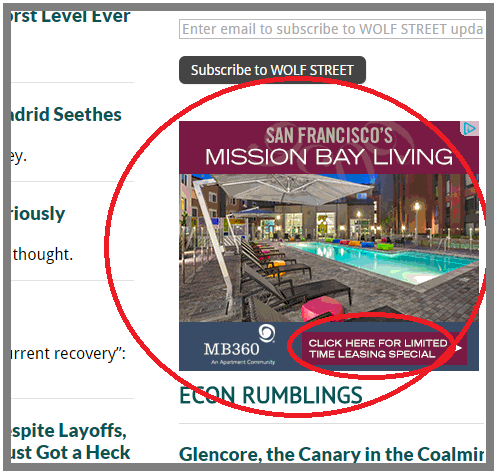
US-San-Francisco-Apt-promo-Mission-Bay360-2015-10-25
This is a sea change.
But November isn’t a great time to sell. The housing market usually peaks in late spring or early summer, and then declines, with prices coming down often sharply in the fall and winter. This year, the median sale price of all types of homes peaked in May at $1,255,000, based on San Francisco MLS. By September, the median price was down to $1,150,000, an 8% decline. January is often the low point.
So why are they suddenly trying to dump all these homes on the market, during the worst time of the year?
Perhaps they’re seeing the writing on the wall. Layoff announcements have started to burst into the headlines. San Francisco’s darling, Twitter, which even extorted a payroll tax exemption from the city by threatening to leave when it was looking for larger digs, has started to axe people. Others are moving to Oakland and elsewhere because office space and housing are getting too expensive in the city. And suddenly, all this new supply of housing is coming on the scene – and for years to come.
Clearly, from what I’ve seen today, some folks who’ve been through this before want to get out of their properties at peak bubble prices while they still can.
It’s time for people who can’t afford to live here to make room for those who can, says the “real estate rock star” who is prominently and hilariously featured in this haunting video about Housing Bubble 2, and what it does to the people caught up in it… “Million Dollar Shack” In Silicon Valley (Video)

Alaska's already high health insurance rates set to get even higher in 2016


Polly Hess got a letter last month from her health insurance company saying that the premium for her and her husband’s health insurance plan would increase next year by more than 30 percent -- from $1,648 to about $2,500 a month.
Their deductibles would also increase by about $600 -- to $6,850 each, she said.

The letter from Moda Health went on to tell Hess that if she was OK with the hike, she didn't have to do anything else, recalled Hess, who lives in Homer and owns a small business with her husband.
“It was almost comical, really,” she said, “because the first thing I thought is, ‘I don’t care what I have to do but I’m not paying this.’”
Hess, 60, and her husband own Puffin Electric, an electrical contracting company. They earn more than $79,600 a year -- the cutoff for a family of two to get a federal subsidy toward a monthly premium on the online health insurance marketplace set up by President Barack Obama’s signature health care law.
The Hess couple falls into a group of several thousand Alaskans who buy insurance on the individual market and who will see their premiums increase in 2016 at one of the highest rates in the country, according to the Kaiser Family Foundation. Alaska already had the country's most expensive premium costs this year, Kaiser reported.

Most Alaskans get subsidy but those who don't pay big

Open enrollment in the federal health insurance marketplace started Sunday and runs through Jan. 31.
Most Alaskans enrolling in plans on the individual market won’t pay the high premiums. That’s because those who make between one and four times the federal poverty level can get subsidies, which have kept pace with premium increases.
But others, like Hess, who earn too much for a subsidy have seen their premiums go up year after year without sign of reprieve.
Insurers blame the increases on factors that include high medical costs in Alaska paired with a relatively small market and a small group of people in that market with very high medical bills. Only two insurance companies -- Premera Blue Cross Blue Shield and Moda Health -- offer insurance on the online marketplace in Alaska.
Melanie Coon, a Premera spokeswoman, said insurers saw many members of the state's high-risk pool enroll in insurance through the online marketplace once it opened. There, they could get a subsidy toward their premiums. Premiums had been high outside the marketplace, she said.
Obama’s health care law barred insurers from turning people away because of pre-existing conditions.
Between the start of January and the end of September of this year, Coon said, 37 Premera members enrolled in individual health insurance plans generated $17.5 million in medical bills. In total, Premera had about 7,400 members during that time in the individual market with $68.3 million in claims.
“You have less than 1 percent of the pool generating a quarter of medical claims,” Coon said. She described the marketplace in Alaska as “unsustainable.” Coon said Premera lost millions of dollars last year in Alaska.
In August, the state Division of Insurance approved average rate increases for next year of nearly 40 percent for Premera and Moda. That came on top of double-digit increases this year.
“Since the beginning of the metallic plans in 2014, rates have increased by 91 percent,” Coon said. “That’s why we can’t keep going on at this point.”
On average in the United States, premiums for the second-lowest Silver plan (also called the benchmark plan) will increase by 7.5 percent in 2016 compared to this year. In Alaska, that plan will go up by 31.5 percent, Kaiser reported.
Hess said that while she supports Obama’s health care law and getting more people insured, she could only hang on to her health insurance plan for so long.
“You can only take one for the team to a certain extent and then you have to look at your own personal situation and say, ‘This is crazy. I can’t do this,’” she said.
She said she considered trying to become a resident of Washington state to get into that state’s health insurance pool. In Seattle, the second lowest-cost Silver plan for a 40-year old cost $227 a month compared to $719 a month in Anchorage, according to a Kaiser analysis.
Hess said she eventually decided to join an Ohio-based health care sharing ministry, which a group of healthy people pay into across the country and essentially share one another's medical bills.
For now, Hess and her husband no longer participate in Alaska’s health insurance market.

Health officials work on legal fix

Lori Wing-Heier, director of the state’s Division of Insurance, said in an email that several groups, including the state, the Alaska Primary Care Association, the University of Alaska and AARP, among others, are working on health reform in the state.
“The goal is healthier Alaskans with reduced cost for health care and, consequently, insurance,” she said.
Coon said Premera is working with Moda and other stakeholders to craft legislation for the upcoming legislative session. The bill in the works would spread the costs of high medical bills across the state’s entire insurance population instead of only across those enrolled in the individual marketplace, she said.
“By spreading the high-cost claims among a larger pool, individual market rates are expected to stabilize without significant swings year over year,” she said. “Employer groups would experience an increase in their premiums, through the high-risk pool assessment, but how much depends on how the program is implemented.”
She said the goal is to strike a balance that gives those in the individual market some relief.
Wing-Heier said the division cannot comment on if it would support the bill until it sees a draft.

Fed’s Yellen: December is ‘live possibility’ for first interest-rate increase

by BenLeubsdorf

Reuters
Federal Reserve Board Chairwoman Janet Yellen testifies before the House Financial Services Committee on the "Federal Reserve's Supervision and Regulation of the Financial System."
WASHINGTON--Federal Reserve Chairwoman Janet Yellen said the U.S. central bank may raise short-term interest rates at its mid-December meeting, but emphasized no decision has yet been made.
The Fed expects “the economy will continue to grow at a pace that’s sufficient to generate further improvements in the labor market and to return inflation to our 2% target over the medium term, and if the incoming information supports that expectation, then our statement indicates that December would be a live possibility,” Yellen said Wednesday while testifying before the House Financial Services Committee. “But importantly, we’ve made no decision about it.”
See MarketWatch’s live blog of Yellen hearing
The Fed has kept its benchmark short-term interest rate, the federal-funds rate, pinned near zero since December 2008. Yellen said in late September that she and most other policy makers “anticipate that it will likely be appropriate to raise the target range for the federal-funds rate sometime later this year and to continue boosting short-term rates at a gradual pace thereafter as the labor market improves further and inflation moves back to our 2% objective.”
Yellen said Wednesday that “moving in a timely fashion, if the data and the outlook justify such a move, is a prudent thing to do because we will be able to move at a more gradual and measured pace. We fully expect that the economy will evolve in such a way that we can move at a very gradual pace, and of course, after we do so, we will be watching very carefully whether our expectations are realized.”
An expanded version of this story is available at WSJ.com

IS TESLA DOOMED? “Tesla’s showing all the signs of a company in trouble: bleeding cash, securitized assets, and mounting inventory…

IS TESLA DOOMED?
Tesla’s showing all the signs of a company in trouble: bleeding cash, securitized assets, and mounting inventory. It’s the trifecta of doom for any automaker, and anyone paying attention probably saw this coming a mile away. Like most big puzzles, the company’s woes don’t have just one source.
It’s true that the world may be running light on buyers who will spring for a big-dollar electric vehicle that can’t make the hike from Detroit to Chicago without stopping for a long charge. And cheap gasoline isn’t helping Tesla’s case. Right now, prices around the country are hovering close to $2 a gallon. If that’s bad news for the Prius and the Volt, it’s worse for the Model S.
In addition, there’s never been any secret sauce to the company’s battery technology. The automakers that bought into Tesla’s tech early did so to avoid having to pony up development dollars on first-generation battery packs of their own. Now that Audi has announced it’s getting into the EV game, Tesla should be even more concerned. If you’re a luxury buyer, which car would you rather have?
Moments ago, the most hyped stock in the market announced Q3 results… and missed while burning a record amount of cash; however Musk’s contagious optimism once again dominated the outlook and as a result the stock is up by 7% after hours.
The quarter highlights:
  • Telsa delivered 11,603 vehicles in Q3
  • Q3 non-GAAP gross margin 25.1%, dropping from 29.4% a year ago; adding “we expect non-GAAP Automotive gross margin to decline slightly from Q3″
  • The company trimmed its own guidance for full year deliveries from 50,000-55,000 to 50,000-52,000
  • Non-GAAP Revenues of $1.24 billion came in line with estimates, although something strange emerged: while non-GAAP revenue rose from Q3 by about $50MM, its GAAP revenue actually declined by $18 million to $937MM. The difference: a surge in “revenue deferred due to lease accounting” which soared from $242MM in Q2 to $307MM in Q3.
  • Non-GAAP EPS of $(0.58) missed expectations of a ($0.56) print. GAAP EPS was a disastrous (1.78)
  • But most troubling, as usual, was the ongoing cash burn from a company which appears allergic to generating any positive cash flow. At ($595) million in free cash flow, this was the worst cash burning quarter in Tesla history, which supposedly was to be expected with the rollout of the Model X.
The results in charts:
Revenue: both GAAP and non-GAAP:

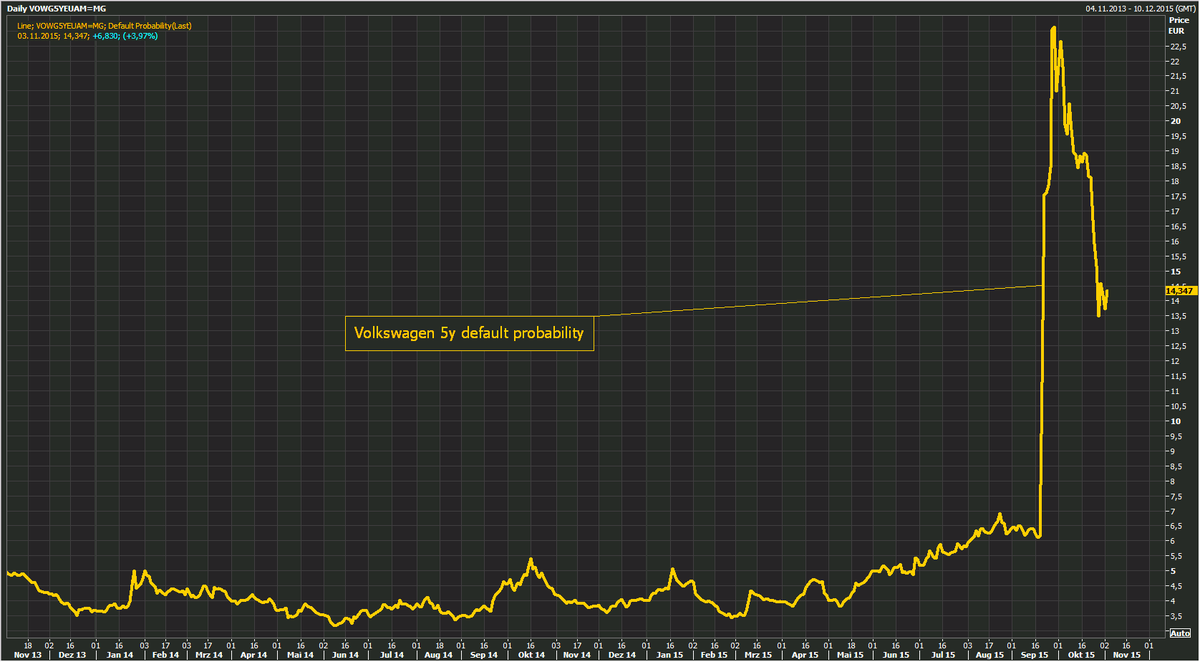
Volkswagen 5y default probability rises as Diesel scandal widens.

5y default probability rises as Diesel scandal widens.

FHFA Head Warns Fannie Mae and Freddie Mac May Need a Capital Injection from the U.S. Treasury

Source: Michael Krieger, Liberty Blitzkrieg


Earlier today, we learned that Fannie Mae recently rolled out a new program known as “Home Ready,” which would allow borrowers to obtain a 3% downpayment mortgage with no minimum cash contribution.
Now we learn this.
From MarketWatch:
WASHINGTON (MarketWatch) — Fannie Mae and Freddie Mac are at risk of needing an injection of Treasury capital after the latter reported its first quarterly loss in four years, the director of the Federal Housing Finance Agency said Tuesday.

FHFA Director Mel Watt issued a statement following mortgage-finance company Freddie Mac’s $475 million third-quarter loss, its first quarterly loss in four years.
“Volatility in interest rates coupled with a capital buffer that will decline to zero in 2018 under the terms of the senior preferred stock purchase agreements with Treasury will likely make both Enterprises increasingly susceptible to the possibility of quarterly losses that could result in draws going forward,” Watt said.
Freddie Mac said its loss was driven by interest rate changes that soured the value of derivatives it holds.
You really can’t make this stuff up.
That said, this should come as no surprise to Liberty Blitzkrieg readers…
Government Watchdog Warns – Fannie, Freddie Could Need Another Bailout
Mel Watt, Federal Housing Finance Agency Head, is Pushing Banks to Make Extremely Risky Home Loans
Leverage in PE Deals Soars Despite Fed Warnings; Amidst Insatiable Demand for Risky Fannie Mae Debt

Share This Article...

Stockman On Fox–Get The Fed Out Of Wall Street

By Fox Business
Former Reagan Budget Director David Stockman argues we need to get the Fed out of Wall Street and replace it with the free market.
Click here to watch.
 
 Source: Replace the Fed with the Free Market – Fox Business