Thursday, September 17, 2015

World Holds Breath, Waits for “Death of the Dollar”

Wolf Richter wolfstreet.com, www.amazon.com/author/wolfrichter

Dismantling the dollar hegemony one yuan at a time.

I’ve been asked many times about the impending “death of the dollar.” I know some folks who expect the dang thing to die. They’re already envisioning the spectacle. An entire industry has sprung up to prepare and equip people for the moment when the dollar dies. It’s like insurance, the theme goes: hopefully you’ll never need it.
But the dollar is a human creation, a fiat currency. It doesn’t have a life of its own. It’s managed, rigged, and manipulated. It’s an accounting entity, a (lousy) store of value, and a means of handling transactions so you don’t have to barter your first-born for a Lexus.
As longs as it’s useful, the powers that be are going to keep it around. But over the long term, the dollar will do what it has done since the Fed was put in charge of it 100 years ago: it will lose value.

And the “strong dollar” these days? Ah, the irony!

It’s causing mayhem in the emerging markets where governments, corporations, and even consumers borrowed in dollars to save on interest. Now that their currencies are collapsing against the dollar, it’s getting very expensive to service these dollar debts, and they’re going to explode, and the holders of these debts are going to eat some big losses, unless they get bailed out again.
This “strong dollar” dents US exports and boosts imports. US corporations use it liberally as an excuse for their sorry revenues and earnings.
This is the value of the dollar in relationship to other currencies. These relationships are rigged to the nth degree. They go up and down and react to a million things, including central bank jawboning and monetary policies.

The actual value of the dollar? Don’t look!

It’s expressed in what the dollar can still buy in the US. And it’s terrible.
In terms of consumer goods and services, a single dollar isn’t buying much anymore. It used to buy a night in a hotel. After decades of inflation, Motel 6 came along and offered standard rooms for $6 a night. That was in the seventies. Now people don’t even remember where the name came from.
In my entire life, there were only three quarters – during the Financial Crisis – when the published data indicated that the dollar actually gained value in terms of consumer goods and services. The rest of my life, the dollar lost value, sometimes at a breath-taking pace, other times more leisurely.
In terms of assets, the dollar is more quixotic. It can lose value even faster. It now takes $1.2 million to buy a median home in San Francisco, likely a two-bedroom apartment in a so-so neighborhood. In 1993, the same median home in the same neighborhood cost around $250,000. It’s not that apartments have gotten bigger or better. It’s that the dollar has plunged in value against other assets.
Same thing happened in stocks, bonds, classic cars, art: the dollar buys hardly anything anymore.
But the dollar has a vicious way of suddenly reversing course and soaring in value against assets such as stocks or real estate. This makes people nervous. They call it a “crash,” and they try to get out of these assets, and in the process, the dollar becomes the most desirable asset out there, and suddenly you can buy stuff with it again [The Bull Market in Cash Is On].

Waning dollar hegemony in international trade.

The dollar has dominated the world as an international trading currency. The Petrodollar is an example. Suffice it to say that the euro was created in part to break the dollar’s hegemony and knock it off its pedestal as sole trading-currency superpower.
In 2005, the Eurozone was still abuzz with possibilities. Soon, it would price the oil it would buy from Saudi Arabia in euros. Trade would be de-dollarized. It didn’t take all that long before the euro debt crisis put the kibosh on those ambitions, but the euro has nevertheless become the second-largest trading currency in the world.
In its September 1 report, SWIFT noted that in July, 43.6% of global payments were in dollars; 28.5% were in euros. These percentages are very volatile, and there were months when the euro beat out the dollar. Number three was the UK pound at 8.7%. Number four, the Japanese yen at 2.9%. And number five, the Chinese yuan at 2.3%. Yuan use has been climbing, particularly in Asia, but it’s still just a tiny speck.
So the “de-dollarization” of trade is happening. But it’s happening at a glacial pace. Even when the dollar gets knocked off its perch as the number-one trading currency years down the road, it will remain, given the size of the US economy, among the top three.

The buck was never the sole reserve currency.

Reserve currencies are those that are held in large enough quantities by governments and central banks as part of their foreign exchange reserves. The IMF tracks this, and there are many of them. The dollar is number one and the euro number two.
The currency composition of official foreign exchange reserves in Q1 2015 put the dollar at 64.1% and rising from its recent low of 61% in 2013. But in the halcyon days of the mid to late 1990s at the eve of the euro, it accounted for about 71%.
The euro dropped to 20.7% in Q1, down from its peak in 2009 of 27.6%. The debt crisis did more than just destroy the economy of Greece. It destroyed the once growing confidence in the euro among central banks! If the debt crisis hadn’t happened – if pigs could fly – the euro would by now be at rough parity with the dollar. That was the pipedream of the euro architects.
The Japanese yen rose to 4.2%, highest since 2002, somewhat ironically as the Bank of Japan has vowed to devalue the yen, and then has proceeded to do so very successfully. In 1995, the yen still accounted for 6.8%. The UK pound was in fourth position at 3.9%. The Canadian dollar and the Australian dollar share fifth place, at 1.9% each.
The Chinese yuan is not among them. But it will eventually be anointed a serviceable reserve currency. Gradually, it will begin to show up on central bank balance sheets. These changes happen at a glacial pace. But they do happen, and eventually, inevitably, the yuan will play a major role as reserve currency.
One thing is certain: in the foreseeable future, neither the euro nor the yuan can knock the dollar off its perch as number one reserve currency.

But the buck stops here.

Real cash-in-fist, however, is on the way out. The war on cash has been declared. And younger folks don’t even carry cash. Electronic payments dominate. The anonymity of paying with cash, so dear to folks like me, means nothing to them. And putting hundred-dollar bills under the mattress makes the bed uneven. So someday, the dollar as cash-in-fist will be truly dead.
But for the remainder? A former colleague called me during the market turmoil in August, apparently to network. It’s been a while, so I asked her how she’s doing. “Like the Dow,” she said. “Everything’s still there, but a lot lower.”
And that will be the long-term fate of the dollar.

The Biggest Silver & Gold Scam In History

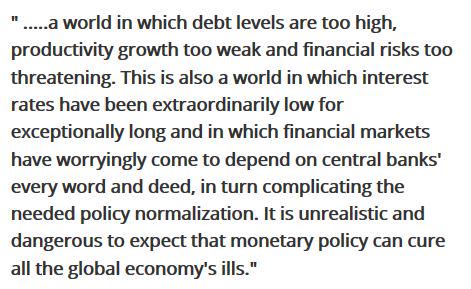
From the Bank of Int’l Settlements Qrtly report: “…a world in which debt levels are too high, productivity growth too weak and financial risks too threathening… It is unrealistic and dangerous to expect that monetary policy can cure all the global economy’s ills.”

From the Bank of Int'l Settlements Qrtly report (!!)

China Liquidated A Record $83 Billion In Treasurys In July

Back in May, when we first reported the "The Identity Of The Mystery "Belgian" Buyer Of US Treasurys" we made it clear that i) China was using Belgium as an offshore proxy for Treasury buying and - as of this year - selling and ii) that more selling was imminent.
Then, when we last updated this analysis on July 17, 3 weeks before the market was shocked by China's announcement, we explicitly said that "putting all of this together, it reveals that China has already dumped a record total $107 billion in US Treasurys in 2015 to offset what is now quite clear capital flight from the mainland, and the most aggressive attempt to keep the Renminbi stable."
All of this was confirmed on August 11, and over the past month when not only China devalued its currency but proceeded to dump a record amount of Foreign Reserves, some $94 billion in the month of August.
There was some question how much of these reserves was US Treasurys, and whether the liquidation via "Belgium" that we first reported in May, had continued. Moments ago, thanks to the latest TIC update, we got the answer. And boy was it a doozy.
First, we look at "Belgian" holdings which, as a reminder are not Belgian at all, but mostly Chinese, as a result of Euroclear allowing China to transact out of the European country anonymously. It is here that the massive build up started in late 2013 is now officially over, and after a another massive sale of $53 billion in US paper via Euroclear, Belgian holdings are back to just $155 billion, the lowest in over two years.

What does this mean for total Chinese holdings? Well, as disclosed mainland Chinese holdings decline by "only" $30 billion, the biggest monthly sale since December 2013.
But as we first pointed out, one has to combine Belgium and China to get the true picture.
Here is how said picture looks, when also superimposing China's total disclosed foreign reserve on the chart.

The answer: according to TIC, China, between its mainland and Euroclear holdings, sold a record $83 billion in Treasurys in the month of July. It also means that China has liquidated a whopping $184 billion notional in US Treasurys in 2015.
And since the current Belgian liquidation has brought Belgium's holdings to levels pre the Chinese buying spree, it likely means that China is all out of "Euroclear" holdings, and the residual Chinese holdings are only those held by China as of this moment, which according to TIC amounted to about $1240 billion.
Finally, and here it the punchline: the sale of ~$83 billion took place in July. This is before China announced its devaluation on August 11 and before, as we also first reported, it sold another $100 billion in Treasurys in August.
One can see why suddenly even PBOC official Jiao Jinpu said, earlier today, that the Chinese central bank sees "callenge from FX reserves drop."
Should this unprecedented pace of reserve liquidation - read Treasury dumping - continue, the Fed will have no choice but to engage QE4 in very short notice just to absorb the now confirmed record selling of US paper by China.
Source: TIC

Cameron and Osborne quietly pay the £1.7BILLION bill from Brussels which they dismissed as 'totally unacceptable'

  • Prime Minister said he was 'downright angry' at the demand in October
  • Cameron banged lectern and vowed not to 'to get out our cheque book'
  • But European Commission says Britain has now 'paid the amount due'

Britain has quietly paid in full a £1.7billion European Union surcharge that David Cameron described as 'appalling'.
The Prime Minister said he was 'downright angry' and said the British public would find the 'vast sum 'totally unacceptable' when the EU revised membership contributions last October.
But the European Commission has revealed that Britain has now 'paid the amount due' with two instalments on 1 July and 1 September.
David Cameron and George Osborne, pictured in the Commons today, condemned the demand from Brussels last year but Britain has now paid up
The EU made the massive demand after recalculating the income of member states dating back almost 20 years.
After Mr Cameron was told about the surcharge at an EU summit in Brussels, he angrily denounced it as 'not an acceptable sum of money'.
In a lectern-thumping speech, he said: 'We are not going suddenly to get out our cheque book and write a cheque for two billion euros. It is not going to happen.
'You didn't need to have a Cluedo set to know someone has been clubbed with the lead piping in the library.'
The EU agreed to move the deadline for payment from last December to the beginning of this month – after the general election – but it has not reduced the sum.
A fortnight after the bill was revealed, Chancellor George Osborne claimed to have halved it at negotiations in Brussels.

As he emerged from an Ecofin meeting with fellow EU finance ministers he declared Britain would pay just £850 million, telling reporters: 'We have halved the bill ... it's a result for Britain.'
However, a cross-party House of Commons Treasury Committee report published earlier this year found Mr Osborne's claim was 'not supported by the facts'.
British contributions to the EU are subject to a rebate, which means the UK receives a proportion of the amount it pays back a year in arrears.
The rebate was famously won by Margaret That‎cher because a significant proportion of the EU's budget is spent of agricultural subsidies and the UK has a relatively small farming sector.
Treasury officials claimed that Mr Osborne had negotiated that the rebate would apply to the bill, but the Commons report said he would have known this would happen automatically.
The framework set out in official EU documents 'does not appear to leave a great deal of room for uncertainty' that the rebate would 'inevitably' apply, the report said.
'This should have been clear to HM Treasury' as soon as it received the revised figures for gross national income (GNI) which gave rise to the surcharge.
The chart shows the monstrous bill handed to the UK in October last year by the EU in comparison with other member states

Addressing the House of Commons days after the Ecofin meeting, Mr Osborne said that it was 'not clear' that the rebate would apply to the surcharge to the extent that it did.
But the committee said it found Mr Osborne's argument 'unpersuasive', adding: 'The specific claim to have halved the bill through negotiation is difficult to support.'
Britain was asked to pay more after the EU's statistical body Eurostat reviewed the way it asked member states to calculate the size of their economy.
After the Office for National Statistics provided new figures, which included a revaluation of the size and contribution of the UK's charity sector, the British economy was found to be larger than previously determined.
When the revised numbers from all countries were compiled it was decided Britain had been underpaying towards the EU, while others had paid too much.
France received £801million, while Germany had £614million returned.
Ukip MEP Jonathan Arnott, who is a member of the European Parliament's budget committee, said it was 'unthinkable' that the surcharge had been paid in full.
'For Cameron to label this bill as 'appalling' and 'completely unacceptable' and yet pay it in full shows the sort of politics this man is willing to deal in,' he said.
'It is deceitful, hypocritical and it stinks of the old politics of which people are sick.'
'It truly is a case of the EU saying 'pay up' and Cameron saying 'how much?' 

S&P: Japan govt’s strategy to revive econ growth & end deflation appears unlikely to reverse fiscal deterioration.

Gold Is Manipulated, Economy Is An Illusion, There Will Be Riots In The Streets: Craig Hemke