Comexodus: JPMorgan’s Vault Is One Withdrawal Away From Running Out Of Deliverable Gold
One week ago, when we reported the record plunge in registered gold
held by the various Comex gold warehouses in general, and JPMorgan in
particular, which saw the “gold coverage” ratio, or the number of paper
claims through open futures interest for every ounce of deliverable
gold, soar to what we then thought was a record, and unsustainable 207x,
we thought this situation would be promptly rectified as a few hundred
thousand ounces of eligible gold would be “adjusted” back into the
“registered” category.
Not only has this not happened, but with every passing day the situation is getting progressively worse.
…there was a record 252 ounces of gold paper claims to every gold physical ounce of currently available and deliverable gold..
IF YOU DON`T WANT TO READ TOO MUCH, READ HERE:
To summarize: last week we were confident that JPM would promptly adjust
a few hundred thousands ounces of Eligible gold back into Registered
status to silence growing concerns about Comex distress. A week later we
are not as concerned by the relentless surge in paper gold dilution, as
we are that JPM still has not even bothered to do this. Especially
since with just 335 kilograms of gold, or less than 27 bricks, JPMorgan
is now just one withdrawal request away from running out of deliverable
physical gold.
http://www.zerohedge.com/news/2015-09-15/comexodus-jpmorgans-vault-one-withdrawal-away-running-out-deliverable-gold
And apparently the gold in London is gone too.
http://www.silverdoctors.com/its-virtually-impossible-to-get-physical-gold-in-london/
UPDATE 2: IS THE US ALREADY BROKE AND NOBODY IS LENDING US GOV money from months?!?!? : go here and answer here:
IT`S REAL. US GOVERNMENT IS BANKRUPT AND NOBODY IS LENDING TO THE US GOVERNMENT FOR MONTHS! THEY AR BROKE!?!??!?!
150 Days: Treasury Says Debt Has Been Frozen at $18,112,975,000,000
(CNSNews.com)
– The portion of the federal debt that is subject to a legal limit set
by Congress closed Monday, August 10, at $18,112,975,000,000, according
to the latest Daily Treasury Statement, which was published at 4:00 p.m.
on Tuesday.
That, according to the Treasury’s statements, makes 150 straight
days the debt subject to the limit has been frozen at
$18,112,975,000,000.
$18,112,975,000,000 is about $25 million below the current legal debt limit of $18,113,000,080,959.35.
http://www.cnsnews.com/news/article/terence-p-jeffrey/150-days-treasury-says-debt-has-been-frozen-18112975000000
SS
Thursday, September 17, 2015

Thursday, September 10, 2015
BREAKING: Explosions Reported As Hazardous Material Fire Rages At Tar Plant In Phoenix
“Explosions have been reported in Phoenix, Arizona, where a massive
fire involving hazardous material has engulfed a structure and triggered
evacuations in the area, according to local media.
The cause of the fire is not known at the moment, but the flames are burning at a local tar plant, according to CBS News.
“Multiple explosions” were generated by the fire, AZ Family reported. Fire officials also stated that multiple storage tanks were destroyed.
Additionally, fire officials said barrels have flown through the air as projectiles, according to local ABC 15.”
Read More: https://www.rt.com/usa/314868-phoenix-fire-explosions-hazardous-material/
This Is EXACTLY What The Early Phases Of A Market Meltdown Look Like
By Michael Snyder
 There
is so much confusion out there. On the days when the Dow goes down by
several hundred points, lots of people pat me on the back and tell me
that I “nailed” my call for the second half of this year. But on the
days when the Dow goes up by several hundred points, I get lots of
people contacting me and telling me that they are confused because they
thought the stock market was supposed to go down. Well, the truth is
that if there is going to be a full-blown market meltdown, we would
expect for there to be wildly dramatic swings in the market both up and
down. A perfect example of this is what we experienced during the
financial crisis of 2008. 9 of the 20 largest single day declines in stock market history happened that year, but 9 of the 20 largest single day increases in stock market history also happened that year. If we are moving into another great financial crisis, there should be massive ups and massive downs, and that is precisely what we are witnessing right now.
On Tuesday, the Dow surged several hundred points. There was much celebrating in the mainstream media over this, but what they failed to realize was that this was another big red flag. And we saw this volatility carry over into Wednesday. The Dow was up 171 points early in the day before ending down 239 points.
By themselves, those two days don’t mean a whole lot. The key is to look at them in context. And in context, we have already witnessed the most dramatic stock market crash since the last financial crisis.
There will be more days when the stock market absolutely plummets and there will be more days when it absolutely soars. No stock market crash in U.S. history has ever gone in just one direction continually. There are always giant waves of momentum that cause panic selling and panic buying.
There is one thing that could change that. A major “black swan event” such as a historic natural disaster, an unprecedented terror attack, or the outbreak of war could potentially be enough to chase all of the buyers out of the marketplace. And considering the times that we are moving into, those things should not be ruled out.
But minus some type of event like that, we should expect lots of wild swings in both directions.
Over the past couple of years, I have repeatedly attempted to explain the general principle that markets tend to go up when they are calm and they tend to go down when they are volatile.
If you want the bull market to return, you should be rooting for lots of really, really boring days on Wall Street.
When things are boring, investors make money.
Days that are “exciting” are really bad for Wall Street. Investors like a world that is predictable, and when conditions start changing rapidly they get very, very nervous.
In the months ahead, trillions of dollars are going to be lost in stock markets all over the planet. Feel bad for the retirees and the hard working families that are going to get wiped out by this, but don’t feel bad for the banksters. They have been laughing it up while most of the country has been suffering during our ongoing economic decline. If you don’t believe me, just check out this YouTube clip.
A lot of people are going to be paralyzed during this time, because they won’t know what to do. They didn’t heed the warnings up until now, and they thought that they would be able to safely get out of the market when things started getting crazy. The big ups and big downs in the markets will confuse them, and the mainstream media will be telling them that everything is just fine.
If you have been waiting for the market to send you “warning signals”, then you can stop waiting because it is happening right in front of your eyes.
Now is not a time for fear. Personally, I seek to live my live in a constant state of peace without any fear even though I write about some very hard realities almost every day.
This is part of the reason why I so adamantly encourage people to prepare for what is ahead. Knowledge and preparation can help eliminate fear.
If you already know what is coming and you are already prepared for it, you won’t be freaking out like the rest of the general population will be when things start really going crazy.
I want to share something with you that Brandon Smith wrote recently…
Do you have some specific tips on getting prepared for what is coming that you would like to share with the rest of us? Please feel free to join the discussion by posting a comment below…
==========================================================================
There
is so much confusion out there. On the days when the Dow goes down by
several hundred points, lots of people pat me on the back and tell me
that I “nailed” my call for the second half of this year. But on the
days when the Dow goes up by several hundred points, I get lots of
people contacting me and telling me that they are confused because they
thought the stock market was supposed to go down. Well, the truth is
that if there is going to be a full-blown market meltdown, we would
expect for there to be wildly dramatic swings in the market both up and
down. A perfect example of this is what we experienced during the
financial crisis of 2008. 9 of the 20 largest single day declines in stock market history happened that year, but 9 of the 20 largest single day increases in stock market history also happened that year. If we are moving into another great financial crisis, there should be massive ups and massive downs, and that is precisely what we are witnessing right now.On Tuesday, the Dow surged several hundred points. There was much celebrating in the mainstream media over this, but what they failed to realize was that this was another big red flag. And we saw this volatility carry over into Wednesday. The Dow was up 171 points early in the day before ending down 239 points.
By themselves, those two days don’t mean a whole lot. The key is to look at them in context. And in context, we have already witnessed the most dramatic stock market crash since the last financial crisis.
There will be more days when the stock market absolutely plummets and there will be more days when it absolutely soars. No stock market crash in U.S. history has ever gone in just one direction continually. There are always giant waves of momentum that cause panic selling and panic buying.
There is one thing that could change that. A major “black swan event” such as a historic natural disaster, an unprecedented terror attack, or the outbreak of war could potentially be enough to chase all of the buyers out of the marketplace. And considering the times that we are moving into, those things should not be ruled out.
But minus some type of event like that, we should expect lots of wild swings in both directions.
Over the past couple of years, I have repeatedly attempted to explain the general principle that markets tend to go up when they are calm and they tend to go down when they are volatile.
If you want the bull market to return, you should be rooting for lots of really, really boring days on Wall Street.
When things are boring, investors make money.
Days that are “exciting” are really bad for Wall Street. Investors like a world that is predictable, and when conditions start changing rapidly they get very, very nervous.
In the months ahead, trillions of dollars are going to be lost in stock markets all over the planet. Feel bad for the retirees and the hard working families that are going to get wiped out by this, but don’t feel bad for the banksters. They have been laughing it up while most of the country has been suffering during our ongoing economic decline. If you don’t believe me, just check out this YouTube clip.
A lot of people are going to be paralyzed during this time, because they won’t know what to do. They didn’t heed the warnings up until now, and they thought that they would be able to safely get out of the market when things started getting crazy. The big ups and big downs in the markets will confuse them, and the mainstream media will be telling them that everything is just fine.
If you have been waiting for the market to send you “warning signals”, then you can stop waiting because it is happening right in front of your eyes.
Now is not a time for fear. Personally, I seek to live my live in a constant state of peace without any fear even though I write about some very hard realities almost every day.
This is part of the reason why I so adamantly encourage people to prepare for what is ahead. Knowledge and preparation can help eliminate fear.
If you already know what is coming and you are already prepared for it, you won’t be freaking out like the rest of the general population will be when things start really going crazy.
I want to share something with you that Brandon Smith wrote recently…
Panic betrays and fear kills. The preparedness culture is built upon the ideal that one must defeat fear in order to live. How a person goes about removing uncertainty from the mind is really up to the individual. For me, combat training and mixed martial arts is a great tool. If you get used to people trying to hurt you in a ring, it’s not quite as surprising or terrifying when it happens in the real world. If you can handle physical and mental trauma in a slightly more controlled environment, then fear is less likely to take hold of you during a surprise disaster.Life in America in the years ahead is going to look dramatically different from what life in America looks like right now.
Six months may be enough time to enter a state of mental preparedness, it may not be, but more than anything else, this is what you should be focusing on. All other survival actions depend on it. Your ability to function personally, your ability to work with others, your ability to act when necessary, all rely on your removal of fear. Take the precious time you have now and ensure you are ready to handle whatever the future throws at you.
Do you have some specific tips on getting prepared for what is coming that you would like to share with the rest of us? Please feel free to join the discussion by posting a comment below…
==========================================================================
New Record Comex Paper Leverage Ratio!! Go Paper!
Nothing to see here.. move along.
==========================================================================
http://investmentresearchdynamics.com/the-comex-is-now-a-100-artificial-…Jim
The Comex Is Facing A Gold Crisis
Sure, you can’t eat a bar of gold and it just sits in storage like a Pet Rock that’s been cast aside by its bored owner. But try selling the Indians or Chinese a paper gold bar and see how far you get. You might end up with a knife in your forehead.
The stench has been growing stronger by the day. Many of us have been writing for years about the extreme imbalance between the paper futures open interest vs. the underlying amount of gold being reported as available for delivery. The latest disclosure from the CME is that the ratio of paper gold vs. the amount of deliverable ounces has spiked to over 200:1.
As of last Friday, JP Morgan had 89.4k ounces withdrawn from the “customer”/ eligible account in its vault and it moved 122k ounces of gold from its “deliverable”/ registered account into its customer account. What the true nature of those transactions were – i.e. who the counterparties were and did in fact any real gold actually leave JP Morgan’s gold vault – is anyone’s guess due the intentional opacity of disclosure on the Comex.
But the bottom line is that, as of last Friday, the Comex vaults collectively now show 202k ounces of gold in the “registered” / deliverable accounts of the Comex vault custodians. As of today’s trading, the “preliminary” gold futures open interest rose to 419k contracts representing 41.9 million ounces of paper gold. This would, preliminarily, put the ratio of paper gold to deliverable physical gold at an astonishing 207:1 ratio.
The amount of “deliverable” gold on the Comex is the lowest that I’ve seen it in the time I’ve been following the Comex data avidly since 2002. Please note that the preliminary open interest is almost always revised, most typically a bit lower, by the time the Final report is issued the next day. But based on many years of tracking this data, it is likely that any revision will not move the “needle” on that 207:1 ratio by much in either direction.
Nothwithstanding all the other information contained in this disclosure, this number represents the confirmation that the Comex is nothing more than a pure paper gold market. It’s nearly 100% derivatives. It’s the imposition of derivatives by the Fed and the U.S. Treasury – via their agent bullion banks – on the gold market in order to control the pricing discovery mechanism.
In other words, the Comex gold market is now a 100% artificial gold market.
I find it it quite interesting that the elitists overseeing this operation on the Comex are willing to advertise the 200:1 paper:gold ratio when they have the means at their disposal to hide that number or to make it look a lot smaller.
There’s some kind of message they’re sending to anyone who cares about this sort of thing. It’s either “f*ck you” we’re in control” or “help, we’re in trouble on our paper gold short position.” Or a combination of both.
The implications embedded in all three of those possibilities are quite horrifying to contemplate.
It’s quite obvious that there’s a problem with the supply of physical gold that is readily available for delivery. The same is true of the retail silver market, in which available supply at the retail level shrinks by the day. Premiums on a simple roll of 20 silver eagles are now over $5 at big coin dealers claiming to have inventory. Most dealers have been wiped out of most if not all of their entire inventory of silver SKU’s.
In my opinion, that head-splitting 200:1 ratio of paper to deliverable gold on the Comex is the surest sign that the market for gold and silver is in crisis mode. The term “crisis” also describes the state of condition of the U.S. stock market and, ultimately, the entire current U.S. financial and economic system.
==========================================================================
The government admits its own statistics are phony

(Simon Black) In an article that first appeared in Fortune magazine on December 10, 2001, Warren Buffett penned a great letter about falling prices:
“When hamburgers go down in price, we sing the ‘Hallelujah Chorus’ in the Buffett household. When hamburgers go up in price, we weep. For most people, it’s the same with everything in life they will be buying– except stocks. When stocks go down and you can get more for your money, people don’t like them anymore.”
He’s right. Any rational human being actually LIKES falling prices.
We enjoy getting a great deal, and we like it when our money goes further.
To Buffett’s point, investors are a major exception and prefer investing when prices go up, i.e. their money buys less of a high quality asset.
But there’s one more giant exception that Buffett didn’t mention: economists.
Economists quiver in fear at the prospect of falling prices.
They call it ‘deflation’, and it’s a force so dreaded that central bankers have threatened to drop bricks of cash from helicopters in order to prevent it.
Instead, economists prefer INFLATION, i.e. that the things you buy become more expensive.
We can look at official statistics to get a sense of inflation, but these numbers are totally meaningless.
When I was a kid, my father earned enough money to support his family with a single salary.
We had a house, a car, an occasional vacation, and we never missed a meal. All on one income.
But those days are long gone. Now it’s almost obligatory to live in a dual-income household just to make ends meet.
The official statistics never paint this picture.
They focus on some palatable number, telling us the inflation rate is 2%, and then adjust their computational methods to derive that figure.
In fact, the US federal government has changed the way it calculates inflation at least twenty times since the mid 1980s.
And it’s obvious that they have a huge incentive to do so.
The #1 expense of the federal government today is the mandatory entitlement programs that are paid out to seniors in the US– primarily Social Security.
It’s nearing $1 trillion annually and eats up a third of all tax revenue.
The government is required by law to increase the amount of money paid to Social Security recipients each year through what’s called a COLA, or cost of living adjustment.
Essentially they’re adjusting your monthly Social Security payment to keep up with inflation. Or at least, the inflation that they’re willing to admit.
This is where they have a huge incentive to fudge the numbers.
If the real rate of inflation is 5%, but they only give a 2% COLA, the government saves 3%. That’s almost $30 billion.
(Ironically this is 3x the size of the annual budget for the Department of Labor, which is responsible for calculating the inflation statistics.)
But by doing this the government is effectively stealing from seniors.
There’s actually been a new law proposed in Congress to prevent this from happening anymore.
It’s known as HR 3074, and it was written “for the purpose of establishing an accurate Social Security COLA. . .”
So even the government admits that their inflation numbers are a bunch of baloney.
But sadly, according to the legislative watchdog GovTrack.us, this bill has a 0% chance of being passed. So I wouldn’t expect a solution anytime soon.
In fact, this problem will likely get worse given how transfixed economists are on the deflation threat.
Their concern is that the Chinese economic slowdown and currency devaluation will cause a wave of falling prices around the world.
But there’s a very curious effect at work here that most people forget:
It’s entirely possible (and now very likely) to have BOTH inflation AND deflation. At the same time.
Assets and investments can fall, while at the same time the prices of retail goods and services rise.
In other words, the value of your investment portfolio goes down, but your grocery bill goes up.
It’s also important to point out that not all prices rise and fall equally.
Gas prices may be down from a year ago in the US. But as the recently-released Hotels.com Hotel Price Index shows, hotel prices are up sharply.
Salt Lake City: 8%. Raleigh: 5%. Portland: 9%. Washington DC: 5%. Los Angeles: 8%.
I’ve seen the effects of this dual inflation/deflation phenomenon as I’ve traveled around the world in places like Argentina, Greece, and Indonesia.
It is a very real threat. And it may now be coming to US shores.
But everyone is focused exclusively on the deflation side.
You’ll get laughed at in financial circles if you mention the word ‘inflation’ anymore. It’s being completely ignored… even denied.
They’re pretending like half the problem doesn’t even exist, which is seriously foolish.
Inflation is a long-term disease. Quarter by quarter the numbers may change. But over the long run it’s like a cancer, slowly eating away at your lifestyle.
It’s not a question of either/or. It’s not a debate over inflation VS. deflation. It’s only a matter of WHEN we’ll end up with BOTH. And how well you’re prepared for it.
Record shattering 94 Million Americans not in the labor force
(MB 360)
The employment numbers released a few days ago left much to be desired
right before entering into the nationally celebrated Labor Day holiday.
Not many people can enjoy the “labor” part of the holiday since those not in the labor force has hit another stunning record. The latest gloomy figures show that 94 million Americans are not in the labor force.
This category added a stunning261,000 people while overall jobs added came in at a lackluster 173k. When we dig into the employment figures we find that many of the jobs being added are also coming in the form of low wage jobs. The market is coming to the grim realization that something is fishy with how the employment figures are reported.
We supposedly have the lowest unemployment rate in seven years yet somehow we now have 94 million Americans not in the labor force with hundreds of thousands of people dropping out each month. Those finding work are largely in McJobs with low pay, no benefits, and job security that resembles the lifespan of a fly. The army of non-working Americans continues to grow.
Those not in the labor force
The unemployment rate is a tricky number since it is derived by the total pool of potentially available workers. So if you continue shrinking the pool, the unemployment rate continues to look better despite the reality that many are dropping out because they are unable to find work or are going into massive debt with going to college. We aren’t counting kids or those unable to work. This is coming from larger structural changes.
Just look at the trend here:

These are insane figures. Let us break it down for you:

Is it any surprise the unemployment rate is at a seven year low even though we just expanded those not in the labor force by 14.9 million? Then we have many older Americans becoming fully dependent on Social Security as their primary source of income and relying on a smaller employment base for support. These are issues that will continue to put a strain on the system short of the market adding millions of new jobs. That would be the rosy scenario. So far, that has yet to materialize.
I think the big difference we have seen over the last decade or so is the proliferation of alternative sources of media. If it were not for the internet, people would be echoing the shallow drivel that comes out of the mainstream press. When in the past has the “not in the labor force” category ever been covered? Never. The media has become a shell of its former self and has lost a sizeable portion of its power.
We have a major crisis unfolding. We have millions of Americans saddled with $1.36 trillion in student debt. We have a large number of current workers employed by low wage jobs that seem to be the top employment fields. On this Labor Day, it matters that we actually count those that are in the labor force and those that are not. Numbers do matter and when you have 94 million Americans not in the labor force, we have to dig deeper.
Not many people can enjoy the “labor” part of the holiday since those not in the labor force has hit another stunning record. The latest gloomy figures show that 94 million Americans are not in the labor force.
This category added a stunning261,000 people while overall jobs added came in at a lackluster 173k. When we dig into the employment figures we find that many of the jobs being added are also coming in the form of low wage jobs. The market is coming to the grim realization that something is fishy with how the employment figures are reported.
We supposedly have the lowest unemployment rate in seven years yet somehow we now have 94 million Americans not in the labor force with hundreds of thousands of people dropping out each month. Those finding work are largely in McJobs with low pay, no benefits, and job security that resembles the lifespan of a fly. The army of non-working Americans continues to grow.
Those not in the labor force
The unemployment rate is a tricky number since it is derived by the total pool of potentially available workers. So if you continue shrinking the pool, the unemployment rate continues to look better despite the reality that many are dropping out because they are unable to find work or are going into massive debt with going to college. We aren’t counting kids or those unable to work. This is coming from larger structural changes.
Just look at the trend here:
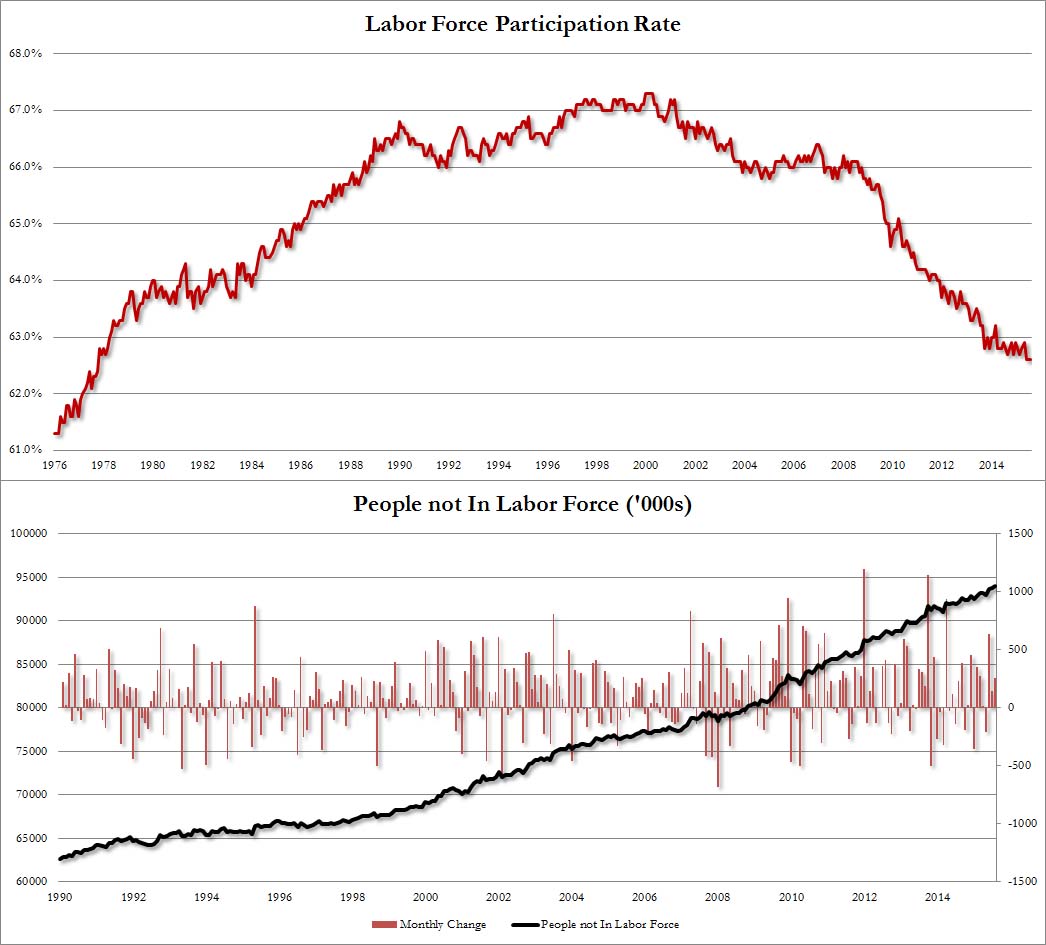
These are insane figures. Let us break it down for you:
Not in the labor forceOver this period only 4 million new jobs have been created:
Year-over-year increase: 1.8 million
Increase since December 2007: 14.9 million
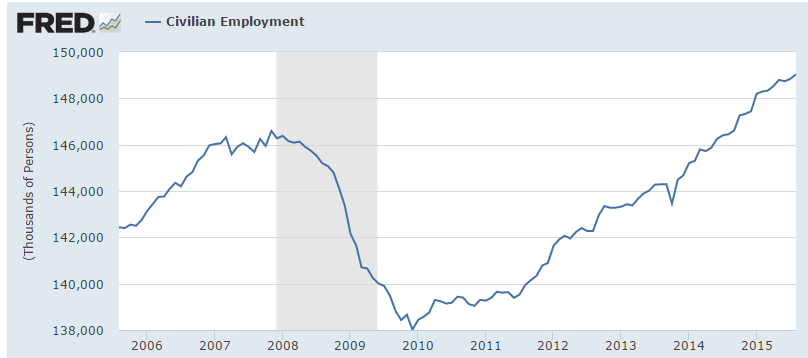
Is it any surprise the unemployment rate is at a seven year low even though we just expanded those not in the labor force by 14.9 million? Then we have many older Americans becoming fully dependent on Social Security as their primary source of income and relying on a smaller employment base for support. These are issues that will continue to put a strain on the system short of the market adding millions of new jobs. That would be the rosy scenario. So far, that has yet to materialize.
I think the big difference we have seen over the last decade or so is the proliferation of alternative sources of media. If it were not for the internet, people would be echoing the shallow drivel that comes out of the mainstream press. When in the past has the “not in the labor force” category ever been covered? Never. The media has become a shell of its former self and has lost a sizeable portion of its power.
We have a major crisis unfolding. We have millions of Americans saddled with $1.36 trillion in student debt. We have a large number of current workers employed by low wage jobs that seem to be the top employment fields. On this Labor Day, it matters that we actually count those that are in the labor force and those that are not. Numbers do matter and when you have 94 million Americans not in the labor force, we have to dig deeper.
Major US retailer will close 35 to 40 stores in early 2016

(New York) Macy’s says it will close 35 to 40 stores in early 2016, as much as 5% of its namesake department stores.
Macy’s said Tuesday it hasn’t selected all of the stores that will be closed yet. It expects the locations will have about $300 million in combined revenue. The company says employees who work at the closing stores may be offered positions at nearby locations, and workers who are laid off will be offered severance benefits.
The Cincinnati-based company says it closes a few under performing stores every year. The company runs 770 Macy’s stores and has closed 52 locations over the last five years while opening 12.
Macy’s and other retailers are looking for new ways to boost their sales as middle-class customers try to keep their spending down, looking for deals and doing more of their shopping online. The company is preparing to open six lower-priced Macy’s Backstage stores later this year and intends to open more of them in 2016.
Over the last few quarters Macy’s has been hurt by the strong U.S. dollar, which has cut into spending by tourists, as well as a labor dispute that slowed down ports on the West Coast. The company reported $28.11 billion in revenue in 2014, up less than 1% from the year before.
Macy’s is also getting ready to test selling goods online in China through a joint venture with a retailer based in Hong Kong.
Macy’s Inc. also runs the Bloomingdale’s chain, and earlier this year it bought upscale beauty retailer Bluemercury. It has a total of 885 locations.
On Tuesday the company said it will experiment with selling consumer electronics, as it will open Best Buy shops inside 10 of its stores in November. Those departments will be staffed by Best Buy employees.
Subscribe to:
Posts (Atom)