As the saying goes, “Fool me once, shame on you. Fool me twice, shame on me.”
(… to which George W. Bush famously added after flubbing the aphorism on live TV, “can’t fool me again!”)
For months, despite every shred of data pointing to a weaker economy, China’s currency has been strengthening.
This was really counterintuitive. When an economy is weak, its currency tends to suffer.
But that didn’t happen in China.
Even when China’s stock market suffered one of the biggest crashes in history a few weeks ago, the currency barely moved.
None of this made any sense.
Just look at Greece-- problems in that single nation, one of the
smallest economies in Europe, dragged down the currency used by 18 other
nations in Europe to its lowest level in more than a decade.
But when problems broke in China, the renminbi actually got stronger.
And party bosses insisted that they would not devalue their currency.
Fool me once.
Yesterday they showed the world what their promises really mean:
nothing. And in a surprise announcement, they devalued the renminbi by
roughly 2%.
2% might not sound like very much. But in currency markets, especially for a major one like China’s, 2% is a huge move.
Curiously, in the very same announcement, Chinese officials stated that
they would not devalue the currency again, and that Tuesday’s move was a
one-time thing.
Fool me twice.
Less than 24-hours later they did it again -- a second devaluation that
saw the renminbi tumble to as low as 6.57 per US dollar, a 6% decline in
roughly 36 hours.
Again, this is a steep drop for a currency, and I expect that there’s more to come.
All of this raises an interesting question about the future of the US dollar.
Because if an economy as large and powerful as China’s has had to
concede defeat, does this mean that “King Dollar” will rule forever?
No chance.
Remember that the dollar’s strength is derived from its status as the primary global reserve currency.
Nearly every government, commercial bank, and central bank in the world
holds US dollars in reserve, and the dollar is used as the primary
currency in global trade.
Whether in Saudi Arabia or South Africa, a barrel of oil is priced in US
dollars. Even jets manufactured in France and sold to European airlines
are priced in US dollars.
But this status is by no means written in stone. The US dollar is not
the first global reserve currency, and it won’t be the last.
We can go back in time to the Byzantine solidus, or the Venetian gold
ducat, or the Spanish dollar, or the British pound, and see that no
reserve currency lasts forever.
Especially when its fundamentals are so poor.
The US government is insolvent. Its major institutions and pension funds
are insolvent. The central bank is borderline insolvent.
These are not any wild assertions; their own financial statements admit their insolvency.
Which means that there’s nothing underpinning the dollar’s reserve status except confidence.
And confidence is very fickle. Like a high school popularity contest, it wanes and it booms.
Right now that confidence is on an upswing, primarily because every other major option looks really bad.
The euro is acting out its Oedipal complex. Japan is a complete fiscal
disaster spending over 25% of tax revenue just to pay interest. And
China is rapidly deteriorating.
Sure there are some outliers like the Swiss franc that are in better
shape. But the market for Switzerland’s currency is far too small to
absorb trillions of dollars in global capital flows.
In the beauty pageant of major currencies, the US dollar is clearly the least ugly at the moment.
And I think anyone owning dollars should look at this as a gift.
Right now we have a tremendous opportunity to sell what’s expensive and buy what’s cheap.
The dollar hasn’t been this expensive in years. And many non-dollar assets haven’t been this cheap… ever.
Here in Turkey, the lira is at its lowest level in history. The South
African rand is at its lowest level in history. We wrote about
Indonesia’s rupiah on Monday.
I’m looking at real estate in Colombia at the moment where US dollar
buyers can pick up high quality property for less than the cost of
construction.
In Chile, the cheap exchange rate and slowing economy helped our fund to
recently close on a farm at $4.3 million that cost $10 million less
than two years ago.
In Australia there are a number of junior mining stocks that are trading
for less than the amount of cash that they have in the bank.
There are countless deals like this all over the world... especially if you’re buying in US dollars.
It’s foolish to expect that any reserve currency will last forever.
And it’s even crazier to expect a reserve currency with such pitiful fundamentals as the US dollar to last forever.
But markets are not orderly and efficient. They are chaotic.
Which means that, on rare occasions, enormous opportunities present themselves to buy high quality assets on the cheap.
(Charles Hugh Smith)
If our government can’t destroy all the private-sector jobs directly,
it will do so indirectly by borrowing so much money the system
collapses.
Conventional economists and pundits are puzzled why jobs growth has been so anemic in this “recovery.”
Here’s one factor they overlook: our government.
In theory, our government is supposed to encourage private sector job
growth. In reality, all the hundreds of pages of regulations are
killing job growth, one small business and one job at a time.
Correspondent/entrepreneur Ray Z. was kind enough to share his experience of trying to open a bagel shop and create six jobs:
“For many years, many of my friends and family who have come to my
home and experienced my cooking, have told me that I should “open a
restaurant”. Of course, I took this with a grain of salt, since many
people say this exact phrase, to many other people. There are a lot of
people who are able to create very delicious meals.
About five years ago, there was a restaurant for sale, not too far
from my home and business. I thought about buying the restaurant, but at
that time, the economy was not doing well and I wanted to take a wait
and see attitude before I committed to anything. Eventually, the
restaurant closed down and a different type of business opened up in the
space that had been a restaurant.
That business went under in the middle of 2014 and I decided it might
be time to open a retail food establishment in the space that used to
be a restaurant. How hard could it be?
I signed a lease with the property owner for his 1000 square foot
space. I contracted with a general contractor and designed the
restaurant floor space on a CAD program I have on my office machine.
Having boot-strapped two seven figure companies from the ground up
over the past 25 years, I knew all of the permits needed in order to
open a regular business. First, I had to have my attorney file for
incorporation in my state.
Then, I secured my FEIN (Federal Employer Identification Number) from
the IRS, opened a bank account, got my sales and use tax permit (to
collect sales taxes) from the State and contacted the person at the
state level who is responsible for food establishments at the state
level. The department that handles such things is the Nevada Health
Department.
The inspector who is responsible for my geographic area (since I live
in a sparsely populated county, we don’t have a county health
department) at the state level told me that since the space had not been
a restaurant for a few years, I would need to pay additional fees the
first year and my endeavor would be treated as a “new” retail food
establishment.
The cost was an additional $500, but that’s just the way it is. The
property already had a grease interceptor (1500 gallons), floor drains, a
mop sink, air exchanger on the roof and was mostly plumbed. I’ll get
back to this later.
I submitted plans to the state contact person and was told that my
symbology was not standard for the plumbing and electrical. The
suggestion was made that I seek the services of an architect. Very well.
I did. I found an architect who has done some restaurants in the area
and we got to work. I submitted my floor plan to him, which he said was
very detailed and seemed to use the space to its maximum potential.
However, he did mention that if I were going to serve one single
person as a dine-in customer, I would have to have at least one ADA
compliant bathroom. The space had two existing bathrooms that were ADA,
but not the latest version. So, those would have to be upgraded.
Next, he told me that if I served, in-house, I would need to provide
two ADA compliant bathrooms. I was going to remove one of the ADA
bathrooms, so I could have more seating, but if I had more seating, I
would need two bathrooms. Catch-22.
My architect submitted to the state for review and was told that I
would need to expand the hallway. That means that the current hallway
walls would need to be completely gutted, with plumbing removed and
drains moved.
I guess it really did not matter though, since according to the State
of Nevada, I was required to have EIGHT (8) sinks in my 1,000 square
foot space. I needed two bathroom sinks (which I had), one dirty sink
with three wells, clearly labeled “wash, rinse, sanitize”; this sink
needed to have two side-boards of not less than 18 inches etc.
I also had to have one prep sink, with a wand facet, one dedicated
mop sink, two hand wash stations (that could not be near any other
sinks) and a bar sink for smoothies. This meant I had to have an extra
floor drain put in, while the others needed to be moved. Great. 8 sinks.
Cost to bring the plumbing to code and provide engineered drawings and
system? $20-25 thousand.
After six revisions to the plans (to make the state happy), I finally
gave the plans to a general contractor. He sent it to his electrical
and plumbing sub-contractors. They informed the general that due to code
issues, they would have to quote an engineered HVAC system that
provided balanced air for the replacement needed by the hood exhaust.
The hood exhaust would need to be tied into the HVAC, so that my
customers would be in an environment that met the state standards for
air quality.
OK. The plumber also said that I needed a brand new, engineered waste
pipe system, one that could only be installed by jack hammering the
entire plumbing system, since the state was requiring a detailed drawing
of the pipes in the floor, and since it was put in before they had
these requirements, they would want it all dug up and put into a plan.
Great. Engineered HVAC cost? $40,000 (even though the place seemed to
work fine for 25 years with an evaporative cooler and a gas heater).
Next, I was told that since I would need a 200 amp electrical service
panel (which I knew), the power company would have to replace the
transformer on the pole outside, since new construction (the buildings
are 30 years old, but hey, it’s a restaurant) requires new EPA compliant
transformers. The power company fee alone would be 12-15 thousand
dollars. Cost to upgrade electrical to code? $20,000, including power
company costs to install EPA approved transformer.
Next, I was told that I would have to have the gas pipe dug up, jack
hammered and replaced with a larger diameter gas line. This would be
$20,000 or so dollars. The reason is, of course, that the new code
requires a minimum pipe diameter for gas; even though I was only going
to have one appliance on gas; the range. Everything else is electric.
Keep in mind that all of this was taking time. In point of fact, from
the time I signed the lease in late December, until just this past
week, I was doing nothing but getting my paperwork ready and trying to
comply with government mandates. Essentially, I spent 7 months trying to
not only figure out what I needed to do, while I was paying rent and
utilities, but I also spent many hours trying to figure out the
complexities of what the state required.
For instance: Each food establishment is required to have at least
one Food Service Handling Manager. Each person who serves or prepares
food has to take a Food Handler Course. The manager course is about 500
dollars, when all is said and done. The food handler course is about
half of that. This is an annual fee.
Aside from what I was being required to do for the construction, the state also required the following:
— A complete list of vendors. Said vendors must be USDA certified
wholesale food suppliers. No farmer’s markets, supermarket or home
grown.
— A complete menu, listing calories of each ready-made product.
— A sample of my labels for prepackaged product showing nutritional
data, ingredients, warnings about any allergens (peanut etc).
— My estimate of how many employees I thought I would need (so they can
tax me on each employee, annually, something the county does too)
— Certificates for any employees who would be handling food, including any managers. My Federal EIN and my State tax ID.
— Complete plans, contractors, amount of estimated business (so they can PRE TAX me on estimated sales taxes)
It just goes on and one.
The law in Nevada is called the Nevada Revised Statutes, or NRS. The
statutes for retail food are about 500 pages thick. That’s just the
codes that cover food. This does not cover the building, electrical,
plumbing and service codes (such as ADA compliance, handicap parking,
etc.)
So, I quit. They beat me.
It always amazes me when politicians use the sound bite of how they
will “create jobs”. Well, I am an entrepreneur and have created
thousands of jobs over the past 25 years. I have also be responsible for
over 500 million in savings to my customers over that time period. This
means that 500 million dollars of wealth that was saved, could be put
into new technologies, new business ventures for into savings.
I am a job creator. But here are at least six jobs that I won’t be creating.
Government is not a creator of jobs. It’s a destroyer.”
Thank you, Ray, for this detailed account of what creating a job entails in the real world.
Government economists, think-tank pundits and Big Media talking heads
prattle on about creating jobs, but they have zero experience in
creating even one job.
Were they pushed away from the state-cartel trough, they would be
clueless about how to start, fund, and profitably operate an enterprise
that created jobs.
Every statute, code and regulation has a justification. I’ve sat in
on meetings of engineers and government officials tasked with dreaming
up “improvements” to the building codes. Cost never comes up, and
neither does cost/benefit analysis.
Yes, a hallway that’s a few inches wider might be beneficial. But
what are the odds of someone losing their life because the hallway only
meets previous codes?
Yes, a 1-inch gas line might have some small advantage over a
3/4-inch gas line, but is that advantage worth $20,000 to a small
business or its customers?
Government regulation is supposed to address life safety and the
exploitation of workers and the public. But unbeknownst to the status
quo, it’s supposed to do so with an eye on cost-benefits and diminishing
returns.
Would the bagel shop have been demonstrably less safe if it had four sinks instead of eight sinks?
The irony here in over-regulating small business food establishments
is the vast majority of the tainted food scandals originate in the
factory-meat processing plants of Big Ag.
The government’s solution to absurdly high costs of opening a small
business is: borrow more money. Never mind that the benefits of blowing
$120,000 are so marginal they cannot even be calculated; we make the
rules, you follow them, and if you can’t afford to follow the rules,
then don’t open the business.
This is how you get an economy of bureaucrats justifying their
existence with 500-page manuals regulating private enterprise and
abandoned Main Streets and malls.
The government assumes private enterprise will jump through an
endless number of hoops to operate a business, and that there is an
endless supply of willing entrepreneurs who will volunteer to put
themselves at risk of bankruptcy.
Back in reality, there is not an endless supply of people willing to
jump through an insane number of hoops and risk their capital and health
on starting a risky enterprise. (Memo to state regulators: unlike your
job, every enterprise is risky. It’s called capitalism. You can look it
up.)
When the costs of starting and operating a business soar, the odds of succeeding drop accordingly.
Guess what, our government: you forgot that ultimately you live off
the private sector. Yes, let’s pile on another 500 pages of
regulations–no problem–nothing could be easier for those in secure jobs
funded by taxpayers.
But if the private-sector jobs go away, who’s left to pay for state
employees to shuffle thousands of pages of regulations and enforce
countless “improvements”?
There are ways to ensure public safety and make it straightforward to
start a business and create jobs. A few cities/counties have one-stop
systems where those willing to start a business can get all the permits
and paperwork at one counter.
Officials actually work with the entrepreneur to figure out how to
meet codes or pehaps get a variance to skirt regs that offer little
benefit but would kill the business.
Many others have phony facsimiles of one-stop counters, fake props
set up for PR purposes. The process isn’t really simplifed; nobody cares
if you succeed or not; the purpose was to make the local government
appear as if it cares. It doesn’t.
Government has the answer, of course: just borrow more money from our
kids and grandkids. If taxes aren’t enough, just borrow more money.
If our government can’t destroy all the private-sector jobs directly,
it will do so indirectly by borrowing so much money the system
collapses.
Good job, regulators; forget costs and cost-benefit analyses; go
ahead and add another 500 pages of regs without any regard for costs or
consequences. We’ll all end up paying for your blindness and cupidity.
Plenty of people out there don’t
understand Bitcoin. This is understandable, as Bitcoin is not a concept
that is easily understood by the layman. The problem is people tend to
fear and dismiss things they don’t understand, which creates a caldron
of myths and half-truths that are designed to wither away that thing
they wish into the cornfields. Bitcoin also has no direct marketing team
or leadership to defend its name against such barbs, so it is fairly
vulnerable.
So today, I’ll step to its defense
against common attacks from those outside of the ecosystem looking to
throw stones through Bitcoin’s decentralized and transparent windows.
Most arguments have a layer of truth covering a thin argument at best.
Here are some common issues disseminated from the anti-Bitcoin position,
and then I can provide the pro-Bitcoin side of the digital ledger if
you will.
“Bitcoin’s drop in price since Mt. Gox
– Since Bitcoin has no underlying value, the decline is price versus
the US Dollar equals a loss of its overall confidence and popularity.
People holding bitcoin today are those who purchased bitcoins at the top
and are waiting to recoup their investment, or just suckers who believe
that Bitcoin will one day go mainstream.”
The simple converted price of a Bitcoin
is only one metric of Bitcoin market value, used by default since the
world has never had such an innovative asset before. The price before
the fall of Mt. Gox, and as it entered the Chinese market for the first
time, was obviously a massive bubble. Bitcoin was still up over $100
versus its position two years ago, before the rise and fall of Mt. Gox.
Regarding its popularity, while the
Bitcoin price was dropping throughout 2014, Bitcoin transactions
increased on a consistent basis all year long and are now back at their
peak all-time levels of late 2013. This easily dispels the lack of
popularity argument. People use it now more than ever. Plus the
endorsements of major mainstream players like Paypal, Microsoft and
Wikipedia are not signs of a broader market interest? The rapid increase
in venture capital in 2015, already surpassing 2014’s total year in six
months time, should be ignored? Also, during the recent “Grexit” crisis last month, worldwide transactions in Bitcoin doubled. Explain that away?
Price is definitely down from its peak,
but a lower price also makes entry into the market much easier for new
investors. If the price moved from $1000 in 2013 to $2-3000 today, how
many people would really be able to enter the market at those prices?
Meanwhile, how many media pundits would be screaming “Bubble” every day,
almost wishing for a market correction? The mainstream media would rail
against Bitcoin either way.
“Mining Is Bitcoin’s real weakness. The price decline has also led to a serious blow to Bitcoin production or “mining.”
A number of mining operations have gone
under since Mt. Gox, so this argument has some foothold in truth. Also,
many of those started their operations when Bitcoin was a $700-1000
product. When you start there, and the value drops all year, you aren’t
trained in how to run a mining operation at more realistic market
levels. The miners who were successful when the Bitcoin price was
$100-150 two years ago are still around. Those short-term players fade,
and only the strong survive. If you were mining two years ago when
Bitcoin sold for much less than it does today, you would know how to
make money during bubbles and after a market correction.
Miners, by and large, aren’t going
anywhere. Mining is not for newbies or people out for a quick hit. Only
the strong survive, and this ride has made them stronger in the
long-run.
“Consumers are vulnerable when they
use Bitcoin over established payment systems. The biggest reason Bitcoin
will never take hold is because there is no insurance against theft,
loss or even if you send your coins to the wrong person. Once the coins
leave your account, you have no more claim to them.”
If the Bitcoin technology never grows
from now on, and we still send public keys instead of a less onerous
transaction code, there may be a point here. Where some see flaws, I see
a billion-dollar opportunity for an entrepreneur to improve Bitcoin.
Over the coming years, we won’t use a mess of characters to send funds
to each other, just like we do not use computer IP addresses anymore. A
fair point, but by no means a death sentence for Bitcoin. It’s an
opportunity.
“People aren’t using Bitcoin! The goal
to have every merchant accept Bitcoin as payment is a lofty dream, but
the reality is, that many businesses are not considering adopting
Bitcoin in the near future.”
Meanwhile, the reality is many businesses
are joining “The Future of Money”. Microsoft, Expedia, and CNN have
joined the fold, as the number of merchants has passed 100k worldwide.
Plenty of large retailers have already passed on digital alternatives
like Apple Pay already, including Wal-Mart. Outside of the cabal of
usual suspects who came up with that plan, adoption has been slower than
they expected. Bitcoin has been on a consistent rise worldwide for
years. Apple Pay, for example, spiked last fall and has fallen on its
face every since.
“Bitcoin is a Passing Trend and will
fail. Not from lack of trying, but rather its status will never be more
than an interesting concept championed by those in the techie or
libertarian camp. Holding Bitcoin is more of a political expression
rather than a sound economic investment.”
If new technology is “a passing trend”,
that would make sense, but history does not support his argument. This
was a common refrain twenty years ago when the Internet started to gain
market traction. The Internet was just a toy for nerds to send messages
25 years ago. How did that turn out? He didn’t jump on that bandwagon?
He didn’t rail against that?
In a global society that has gravitated
to every new tech product from the Game Boy to the Apple Watch, Bitcoin
hasn’t been a hit? The facts don’t support your argument. Five years
ago, it was that nerdy tech toy nobody used. Today, it has since gone
global, and governments are holding meetings every day on how to deal
with Bitcoin.
Bitcoin is not just a currency, but a new
technology that spans the globe, and helps improve many current
centralized systems that need upgrading, or replacing. It’s not here to
be quickly adopted, or as some quick fix. That’s it’s greatest strength.
It is a bevy of technological apps, and its currency is just the first
of many to come. It is here to change, and improve, many mainstream
protocols we use today, but could be much better with the Bitcoin
technology.
The only question is when will it happen
They seem to have an inverse
relationship. As one obsolete form of fiat currency fails, a new digital
technology rises to replace it, in The Technology Age. Bitcoin was only
a few cents five years ago, traded between Satoshi Nakamoto and Hal
Finney. Now it’s worth hundreds of dollars and is traded on global
exchanges. Critics like to ignore these facts.
The Internet started to gain popularity
primarily based upon its ability to send an email, but we’ve all learned
it was far more than just a digital message service. Bitcoin is the son
of the Internet, and will show naysayers things they’ve never seen
before, and will use in their future if they’re smart. Comparing Bitcoin
to a US Dollar is like comparing the Internet to a mailed letter. One
is the standard, and one is the future. Since I don’t have any plans on
going anywhere for the next thirty or forty years, I’ll bet on
technology’s future, over obsolete centralized 20th-century systems.
Everything in this world is changing
based on new technologies, and Bitcoin will be at the heart of this
brave new world. It is changing things right now. the local Bitcoin
critic or mainstream pundit doesn’t see it as being a major factor
because he chooses not to. You see what you want to see. Maybe that’s
the whole problem. Bitcoin cannot be held in your hand, so maybe critics
believe it doesn’t exist because it can’t be held like a dollar bill.
Older critics like Warren Buffett use this defense mechanism.
Then air in your lungs, the thoughts in
one’s mind, the information sent online or by smartphone also must be
figments of our imagination. They must be irrelevant because they are
intangible in the physical plane. The evolution of mankind has moved us
beyond all of these mundane talking points, from race, to size, to
gender being seen as limitations by the establishment.
These naysayers always lose in the end. Just like you cannot measure
the impact of the human spirit, or the Internet’s influence tangibly,
Bitcoin’s future of growth won’t be found on any ruler. The 21st century
is ready for this.
The only real question is: Are you ready for Bitcoin?
I think this is an interesting
article because, well …. I never think about what condition Hawaii will
be in when the shit hits the fan. Do you? Paradise might have some
serious problems.
Hawaii’s government launched
the Aloha+ Challenge … ““to at least double local food production” to
where 30% of food consumed in Hawaii is grown locally by 2030. Reading
between the lines, that means Hawaii cannot become food independent. Why? There simply is not enough
land to support the current, and growing, population. From government
tables …. the total land in Hawaii is 4.1 million acres of which 1.9
million of those acres being used for agriculture. The rest is urban,
conservation, or rural land. In other words, just about half of all the
available land in Hawaii is being used for agriculture yet, over 90% of
Hawaii’s food is imported. In the book “Value of Hawaii”,
Charles Reppen (a taro farmer) writes about the problems related to
sustainable agriculture in Hawaii and how urbanization is increasing and
it being a major problem. With more and more people that occupy the
island, that equates to more mouths that will have to be fed. Reppen
estimates that Hawaii would need to have over SIX Million acres of land
dedicated to farming to feed Hawaii’s growing population. Since Hawaii does not have that
much land, he advocates a change in diet. If beef were removed from the
picture then the number of acres needed would be much lower. And the
enormous pineapple plantations (and banana, coffee, etc) can be
converted to grow useful calories. However, that would put a severe dent
in Hawaii’s GDP. When the SHTF, Hawaiians might have to become mostly
vegetarians (I assume they’ll still be able to fish). No bacon for you!!
=========================================== HONOLULU—When my Airbus touched down at Honolulu
International Airport, I was one of 30,843 people to arrive in Hawaii on
a June day. As a crush of tourists mobbed rental car counters and taxi
stands, massive container ships steamed into the Port of Honolulu just
across the harbor, carrying some of the 6 million pounds of food shipped to Hawaii every day
to feed the state’s 1.4 million residents and 8 million annual
visitors. On nearby runaways, cargo planes landed packed with fresh
fruit and other perishable items that wouldn’t survive the 2,500-mile
ocean voyage. The world’s most isolated chain of islands, Hawaii imports
nearly 90 percent of its food at a cost of more than $3 billion a year.
There’s a high environmental price to be paid for relying on a
747 or 40,000-ton ship as your food truck. The largest cargo vessels
can emit as much pollution as 50 million cars in a year, according to a
2009 study,
and shipping accounts for about 4 percent of global greenhouse gas
emissions. Just consider the carbon footprint of putting a Hawaiian
steak on local plates: Tens of thousands of calves are raised on the Big
Island of Hawaii every year and then loaded on barges to the mainland.
There they’re fattened, slaughtered, shrink-wrapped, and shipped back
across the Pacific to the islands. Meanwhile, pests and parasites that
hitch a ride on this nonstop caravan of cargo ships are decimating
Hawaiian wildlife, forests, and farm fields at a cost of hundreds of
millions of dollars a year. But if the status quo is bad, what happens if the ships stop coming could be far worse. “I think there’s a sense here in Hawaii that if we have a
hurricane or a tsunami, how long could we last with our food supply?”
said Jenai Wall, chief executive of Foodland, Hawaii’s largest
supermarket chain, which relies on imports for about 80 percent of its
sales. She paused. “Not very long.” Probably less than a week, actually. “If something catastrophic happened on the mainland, we’d
have about three days of food in the stores,” said Una Greenaway, a
farmer on the Big Island. “We’re very, very food insecure here, but we
don’t have to be.” Greenaway, who grows coffee, cacao, apples, bananas, and
pineapples on a five-acre farm, is part of a burgeoning local food
movement in Hawaii that’s attempting to reverse decades of deepening
dependence on imports. In recent years, there’s been a flowering of
farms, farmers markets, and eat-local campaigns across the islands. Not
all that different, in other words, from what’s going on in the
crunchier parts of the mainland. But this is no foodie fad. It’s state
policy. As globalization and climate change upend worldwide food
production, Hawaii is moving to foster homegrown agriculture in a way
that could be a model for others. One key: kicking the state’s severe
addiction to another carbon-intensive import—oil.
The Sustainable Past The first food imported to Hawaii arrived in the canoes of
ancient Polynesians, who began to colonize the uninhabited islands
between 500 and 700 C.E. Onboard were the starchy staple taro,
sugarcane, sweet potatoes, coconuts, breadfruit, bananas, pigs, and
chickens. Those crops and others became the staples that, by the time of
European contact in 1778, supported a population historians estimate was between 150,000 and 1 million. Without access to draft animals, wheels, or metal tools, the ancient Hawaiians developed the ahupua’a, a
sophisticated and sustainable agricultural system that ran from the
ocean to upland valleys. The Hawaiians harvested the bounty of the sea
and grew taro and other crops on irrigated inland fields. The ahupua’a produced enough food to leave even commoners the leisure time to surf. Diseases introduced by Europeans decimated the native Hawaiians, and by the mid-19th century the ahupua’a
had been supplanted by vast American-owned sugarcane and pineapple
plantations and cattle ranches, a trend accelerated by the U.S.-backed
overthrow of the Hawaiian monarchy and annexation of the islands in the
1890s. By 1936, only 37 percent of Hawaii’s food supply was locally
grown, according to University of Hawaii researchers. Food imports soared in the ’60s when the advent of jet travel
triggered a tourism boom that would become the mainstay of the Hawaiian
economy. Between 1960 and 2005, Hawaii lost half its farmland as Big Ag
began to abandon sugarcane and pineapple plantations, unable to compete
against growers elsewhere. “Although the decline in farm acreage to
present has not yet reached the ‘critical point’ where Hawaii’s food
security would be threatened, the trend is a warning sign for Hawaii’s
future food security,” said a 2007 report issued by the Hawaii Department of Agriculture. By 2010, Hawaii was producing only 30.1 percent of the fresh
vegetables, 38.1 percent of the fresh fruits, and 9.3 percent of the
protein consumed on the islands, according to a 2013 study
by University of Hawaii researchers PingSun Leung and Matthew Loke.
Local dairies supplied all of Hawaii’s milk in the early 1980s; by 2010,
most were out of business after a federal court ordered the state to allow imports.
Today, 86 percent of milk on store shelves comes from the mainland.
Seafood has sustained Hawaiians for millennia, and people here consume
nearly twice as much fish per capita as those on the mainland. Yet,
Hawaii flies in about half of its seafood, mainly from overseas. Even taro is imported. A staple food of the ancient Hawaiians, the starchy tuber
played a central role in their creation myths and spirituality. “The
latest data we have for taro is that we’re consuming 332,000 pounds of
fresh taro a year but are only producing 100,000 pounds, so we import
the rest,” said Leung. Hanalei Valley taro field, Kauai. (Photo: Getty Images)
Powered by Water So why doesn’t Hawaii grow more of its own food? For one
thing, huge swaths of agricultural land remain locked up in now-defunct
plantations or are controlled by companies that grow genetically
engineered seeds, one of the state’s largest exports—the pineapple of
the 21st century. What farmland is available comes with hard-to-get and
high-priced leases. Farmworkers are also difficult to find and command
higher wages than on the mainland, according to Leung, who studies the
economics of Hawaiian agriculture and food imports. And just about
everything else used in farming—energy, fertilizer—costs more here and
must be imported. Globalization and free trade agreements, meanwhile,
have made some imported food cheaper than homegrown, even if it does
have to be shipped across the world. You can see those challenges—and the future of local
agriculture—on the Big Island of Hawaii, the cradle of ancient Hawaiian
civilization. The ahupua’a fed Hawaiians for more than a
thousand years, but sugarcane’s reign lasted fewer than 150. The last of
the single-crop plantations that dominated this island for much of the
19th and 20th centuries shut down in 1994. A cornucopia of crops has blossomed on the Big Island since
the collapse of big sugar. As I drove through a vast former plantation
north of Hilo, the main town on the wet east side of the island, I
passed fields planted with cucumbers, bell peppers, taro, and other
fruits and vegetables. Off a one-lane road is Hamakua Springs Country
Farms, where Richard Ha and three generations of his family grow bananas
on 600 acres carved from the plantation. When oil prices skyrocketed in
the summer of 2008 before the global financial crash, Ha said he
realized it would be impossible to foster sustainable agriculture
without sustainable energy. Hawaii burns imported oil to generate 70 percent of its
electricity, which is not only a dirty way to produce power but also
makes the state—and farmers—extremely vulnerable to wild swings in
energy costs. “Electricity prices were scary,” said Ha, dressed in
shorts and a rumpled polo as we stood in the open-air packinghouse at
Hamakua where workers clean and package bananas. “Fertilizer prices went
up, and my workers were asking to borrow money for gas so they could
get to work. Anything we can do to lower our cost by moving away from
oil is going to start to give us more of an advantage in agriculture.”
I think there’s a sense here in Hawaii that
if we have a hurricane or a tsunami, how long could we last with our
food supply? Not very long.
– Jenai Wall, chief executive of Foodland supermarkets
He gestured across the floor toward a forklift and a pile of pallets. “Even moving a pallet around the farm is based on diesel.” These days, though, the power lies in Ha’s hands. From his
iPhone he controls a small hydroelectric power plant that he installed
on the farm last year. We climbed into Ha’s pickup and drove up a red
dirt road that winds up the windward slopes of Mauna Kea. Past fallow
fields at the top of the farm lies a tributary of a river that flows
down the volcano. Back in plantation days, a flume carried harvested
sugarcane down the mountain to a mill. The flume is still here but now
channels water to an underground pipe that flows into a small building
where the constant stream powers a turbine that generates 100
kilowatt-hours of electricity. That’s enough energy to run the entire farm, including
power-hogging refrigerated storage rooms, with 60 kilowatt-hours left
over. “Our electricity bill used to be $12,000 a month,” Ha said. “The
payment on the hydro is only $6,000.” With all that extra carbon-free electricity on tap, Ha said
he’s considering how to expand his farm, perhaps to raise tilapia,
mushrooms, and more. He argues that if the Big Island made more use of
its geothermal resources—the world’s largest active volcano, Mauna Loa,
sits to the southwest—that would result in lower agricultural costs and
encourage more people to farm. “Things are changing,” Ha said. “We were at an Italian
restaurant yesterday, and it was all sourced locally. It makes you so
happy to see that.” Indeed, before meeting Ha, I stopped for a late lunch at the
Sweet Cane Café in Hilo, where the ingredients come straight from the
owners’ organic farm. There was a line out the door as surfers,
soldiers, and security guards queued up for taro burgers and
blueberry-coconut-sugarcane smoothies. Harvested bananas at Hamakua Springs Country Farms.
(Photo: Todd Woody)At the Hamakua packinghouse, bunches of newly picked bananas
hung from a conveyor built from parts salvaged from a slaughterhouse
that shut down as ranchers began to ship their calves to the mainland
for processing. “It sounds unreasonable, but it’s more profitable from
the ranchers’ point of view,” Leung said of the long trip “local” beef
has to make. That’s because Hawaii’s climate is not hospitable to growing
hay and corn for cattle, and importing cow chow is actually more
expensive then exporting cows. But the Big Island’s pasture does grow
year-round, and one of the state’s biggest ranches has launched a joint
venture to raise grass-fed cattle, no barge required. The growing taste for homegrown food could help alleviate
environmental disasters spawned by Hawaii’s dependency on imports. As we
drove across the upper reaches of the farm, Ha pointed out stands of
dead Ohia trees. The native trees, which shelter birds and other
wildlife and are a keystone of the Hawaiian ecosystem, have been dying
in droves from what scientists have identified as a fungal disease.
“Although we can’t be 100 percent certain that the strain is nonnative,
all evidence currently suggests that it must be a nonnative introduction
to Hawaii,” Flint Hughes, an ecologist with the U.S. Forest Service in
Hilo, said in an email. Reducing food imports could lower the risk of
such epidemics, he continued, though he noted that pests could also
arrive on the island in a shipment of nonfood plants and soil.
A Silicon Valley for Ag The day before I arrived in Hawaii, Gov. David Ige signed
legislation committing the state, which pays the nation’s highest
electricity rates, to obtain 100 percent of its energy from solar, wind,
and other renewable sources by 2045. That target dovetails with another
state policy to promote independence by expanding and diversifying local agriculture and reducing the islands’ reliance on imported food. Some 20 miles north of Honolulu, the government is attempting
to create a Silicon Valley of agriculture by buying up abandoned
pineapple plantations and transforming the former company town of
Wahiawa into an ag-tech hub for central Oahu. Bullit Hatcheries on Oahu. (Photo: Todd Woody)“When I was a kid, this place was bustling,” said state Sen.
Donovan Dela Cruz, 41, as he piloted his gray Toyota pickup around the
town of 18,000 where his grandfather worked as a truck driver for the
Dole pineapple plantation after emigrating from the Philippines. The agricultural estate began withering away decades ago, and
the last big plantation shut down in the early 1990s. For the past
several years, Dela Cruz has been the driving force behind what is
called the Whitmore Project,
named after a former plantation workers’ camp on the outskirts of town.
State and local agencies pitched in $25 million to buy 1,700 acres of
former pineapple land bordering Wahiawa that will be subdivided and
leased to Oahu farmers. The state also bought 24 acres in Whitmore
Village, the former workers’ camp, and a 30,000-square-foot warehouse in
Wahiawa that will be retrofitted for food packing and processing. “The industry to revitalize the economy is ag,” said Dela
Cruz, who wears shorts and a T-shirt and talks a mile a minute as we
pull into Whitmore Village. “The idea here is to have this be a hub for
all the packing and processing you need, as well as to be a retail hub.
If you’re a farmer who leases the ag land we’re starting to buy, your
operations would be here, and there would be no need to build new
infrastructure.” One of the first tenants at Whitmore Village is Bullit
Hatcheries. On the day we visited, Austin Kanamu, son of owner Alex
Kanamu, was tending large white tanks of tilapia. Other tanks were
overflowing with hydroponically grown watercress and strawberries.
Blueberries grow elsewhere on the property. A warehouse next to the
tilapia farm is set to become a processing plant, which would allow
Bullit to sell packaged fish to supermarkets and government agencies.
“One reason we came here is that right now there’s no place that has
processing for fish,” said Austin. Dela Cruz’s vision is to create more earning potential for
Hawaiian agriculture by encouraging farmers to produce value-added
products, such as the juices, jams, and syrups that are now almost
entirely imported. Dole, for instance, grows 40 acres of cacao nearby
but ships the beans to the mainland to be processed into chocolate. “It’s all about the margin,” he said as we stopped by an area
coffee grower’s retail outlet that sits surrounded by vacant farmland.
The place was packed with tourists sipping Hawaiian-grown and -roasted
coffee while shopping for souvenirs. “When you do this, you help to
start to help other industries,” Dela Cruz said as he picked up a small
blue-glazed coffee mug handmade by a local artisan. “It’s $25! Oh my
god.” He spied a jar of jam. “Look at that—fifteen bucks,” he said. “A
police officer in Whitmore Village makes this in his spare time. They
can’t keep it in stock. You can’t get that kind of margin at a farmers
market.”
Grown Here, Not Flown Here One thing Hawaiian farmers don’t have to worry about is
demand for local food. “We try to source everything we can local, and if
we can’t find it here, then we bring it in from the mainland,” Wall,
Foodland’s chief executive, said at the supermarket chain’s Honolulu
headquarters. “Our produce team has worked with a lot of local farmers,
even asking them to grow things for us that we have historically had to
buy from mainland sources.” More than 20 percent of the items on Foodland store shelves
are locally grown or made. At the company’s Aina Haina store in
Honolulu, a banner that reads “Locally Grown in Hawaii” flies over a
produce section featuring taro, cassava, peppers, okra, turnip, string
beans, red cabbage, and asparagus. An orange tag tells shoppers that the
luau leaves, for instance, came from Twin Bridge Farms on Oahu, while
the long beans were grown on the North Shore at Ho Farms, which plans to
start farming at Whitmore. Throughout the store, orange tags identify
every Hawaiian product, from soy sauce and bread to chocolate-covered
macadamia nuts. More than 200,000 people have pledged to eat homegrown
food one day a week as part of Foodland’s “Eat Local Tuesday” campaign. Locally grown produce displayed in a grocery store.
(Photo: Willy Blackmore)“It’s good for the economy,” said Wall, “and we also feel
that Hawaii depends so much on food from elsewhere that the more we can
get here, the more sustainable we’ll help our community to be.” How self-sufficient can Hawaii become? The University of
Hawaii’s Leung said the state now produces about 80 percent of its
tomatoes and all of its watercress, and other homegrown vegetables are
cost-competitive with mainland varieties. “I think we’re doing quite well, because there’s a lot of
momentum and people are aware of local food and are willing to support
that,” he said. “But when people talk about being 100 percent food
self-sufficient, that’s pie in the sky. There has to be a balance in
reality. Hawaii is part of a country, and we don’t set import rules.” “Some food we’re never going to grow, like wheat and rice,” he added. Who needs wheat and rice, asks Greenaway, who has been
farming on the Big Island for nearly 40 years. (Disclosure: Greenaway’s
daughter is a contributor to TakePart.) Taro and breadfruit, which
sustained the ancient Hawaiians, can serve as locally grown substitutes,
she argued. “We can grow all our food here, but we need to teach people how to grow food for themselves and also how to eat it,” she said.
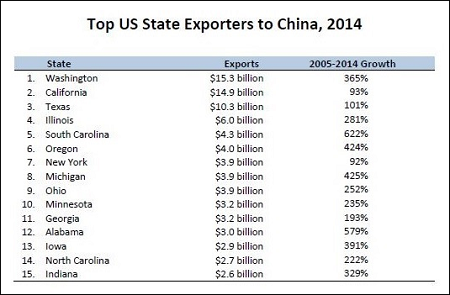
Top U.S. State Exporters to China (Graph Courtesy of US-China Business Council)
By Pam Martens and Russ Martens: August 12, 2015
The Standard & Poor’s 500 stock index was down a meager -0.96
percent at the close yesterday on the news of China’s devaluation of its
currency, the Yuan, but some noteworthy individual stocks took a more
dramatic pounding. Apple lost 5.20 percent; Micron Technology was in the
red by 4.99 percent; Yum! Brands closed down 4.87 percent while General
Motors lost 3.48 percent. All of these companies rely on China as a
major export market.
According to a March report from FactSet, “companies in the S&P
500 in aggregate generate about 10 percent of sales from the Asia
Pacific region, most of which comes from China and Japan.” Some U.S.
companies, however, derive a far greater percentage of their sales from
China. According to Sue Chang,
a MarketWatch reporter using data from FactSet, 52 percent of Yum!
Brands sales come from China while 40 percent of Micron Technology’s are
derived from China.
A slowdown in economic growth in China could also see individual U.S.
states licking their wounds as well. The following statistics come from
the US-China Business Council:
Forty-two states experienced at least triple-digit export growth to
China since 2005, and five states saw export growth of more than 500
percent over the same period.
China was among the top three export markets for 39 states in 2014.
That includes states that are not usually associated with strong China
trade ties, including Minnesota, Michigan, New York, Alabama, Ohio, and
South Carolina.
In 2014, thirty-one states exported more than $1 billion to China.
The chart above shows the U.S. states that could be most dramatically
impacted should China’s economic slump worsen. Washington state saw its
exports to China grow from $3.3 billion in 2005 to a whopping $15.3
billion in 2014. Washington state’s major exports to China include
transportation equipment, forestry products, computers and electronics,
primary metal manufacturing, mineral and ores. In the span of one
decade, the state’s exports to China grew by 365 percent versus its
export growth rate to the rest of the globe of 148 percent.
South Carolina is another state that has experienced an outsized
boost from exporting to China. From 2005 through 2014, its exports to
China skyrocketed from $590 million to $4.2 billion. One of the popular
exports to China is BMW cars and SUVs made at its Greer, South Carolina
plant. BMW, a German automaker, last year announced that it would be
investing another $1 billion in the Greer plant and add 800 additional
workers, boosting total employment at the plant to 8,800 workers. South
Carolina is also home to a sprawling Boeing campus in North Charleston
where the 787 Dreamliner is made. In 2014, $2.8 billion of South
Carolina’s exports to China were in the category of transportation
equipment.
As foreign currencies decline in value to the U.S. Dollar, the
ability of U.S. exporters to compete against foreign domestic goods
priced in the cheaper currency becomes more difficult. An additional and
serious risk to the U.S. economy is that these currency wars, which are
actually trade wars to sustain or grab market share (think Saudi Arabia
and oil) lead to a pricing war race to the bottom with the inevitable
outcome of the U.S. importing deflation.
As we reported in January:
“Plunging yields on U.S. Treasury notes
and bonds, record low yields on the sovereign debt of countries in the
European Union, together with plunging industrial commodity prices, are
sending a crystal clear message to stock markets: there is a glut of
supply and too little demand from consumers.
“Such a supply-demand imbalance brings
about price wars. Thus we have Saudia Arabia slashing prices on oil to
its customers in an attempt to grab market share, triggering a global
price war in oil; supermarket pricing wars in Britain; gas station pricing wars in the U.S.; mutual fund fee pricing wars; magazine price wars. There is even a chicken nuggets pricing war.”
And we further explained:
“There is a delicate equilibrium of
income distribution that sustains growing economies. When income
distribution becomes insanely skewed to the top 10 percent, deflation is
the inevitable outcome. To express it another way, when workers are
stripped of an adequate share of the profits of their productive labors
on behalf of the corporation, they can’t consume an adequate amount of
the corporate output. Supply gluts develop and deflation follows.”
But don’t expect most members of Congress, whose campaigns are
financed by the 1 percent, to open their eyes to the reality of this
dangerous and growing problem. Even after the worst economic crash since
the Great Depression in 2008, they’re still wearing their blinders.
Massive explosions have hit China's northern city of Tianjin, leaving at least 17 people dead and hundreds more injured.
State media said the blasts happened in a warehouse storing "dangerous and chemical goods" in the port area of the city.
Pictures and video on social media showed flames lighting up the sky, and buildings are said to have collapsed.
Hospitals are reported to be overwhelmed with casualties.
President Xi Jinping has urged "all-out efforts" to rescue victims and contain the fire, Xinhua state news agency said.
Workers' dormitories in the port area were also destroyed
Buildings and hundreds of cars in the port area were destroyed
Daylight revealed the extent of the devastation in Tianjin
State broadcaster China Central Television (CCTV) said a shipment of explosives had detonated but this was not confirmed.
State
media also said senior managers of Ruihai Logistics, which owned the
warehouse where the explosion took place, were being questioned by
authorities.
The first explosion at about 23:30 (15:30 GMT) on
Wednesday was followed by another, more powerful blast, seconds later.
Shockwaves were felt several kilometres away.
BBC Chinese Service editor Raymond Li says all indications are that it was an industrial accident.
At the scene: John Sudworth, BBC News, Tianjin
The apartment complex closest to the explosion has eight rows of high-rise tower blocks.
In
every one of them, almost every window has been blown out. On the
ground outside are the signs of the many families who have fled from
their beds in a hurry - a woman's shoe, children's toys, mangled
bicycles.
There would have been many injured here. Inside the
homes, furniture has been picked up as if by a whirlwind and interior
doors lie at angles, ripped off their hinges.
It may be a long
time before the cause of the explosion is known. Such is the scale of
this disaster that for now, the authorities are simply struggling to
achieve an accurate account of the numbers of dead and injured. Travelling into Tianjin blast zone Blast 'like end of the world' Tianjin pictures reveal devastation The
China Earthquake Networks Centre said the magnitude of the first
explosion was the equivalent of detonating three tons of TNT, while the
second was the equivalent of 21 tonnes of the explosive.
Further blasts were subsequently triggered nearby, Xinhua said.
CCTV said four firefighters were among the dead and that more than 400 people had been injured, at least 32 of them critically.
Media captionDebris is seen amidst billowing smoke at the explosion site in Tianjin
Media captionThe BBC's Rico Hizon reports on how social media spread the news about the Tianjin explosion
BBC producer Xinyan Yu, who is in Tianjin, said workers' dormitories were among the buildings destroyed.
Hours later, fires were still burning and 100 fire engines were at the scene, reported CCTV.
One
witness, named only as Ms Yang, told local media she was out shopping
when "suddenly from behind there was a big fireball and explosion".
Fires were still burning hours after the explosions
The initial fireball lit up the sky above Tianjin
People went down on to the streets seeking shelter after the blasts
Some seemed dazed, others distraught
The force of the blasts shook buildings and set parked vehicles alight
"At the time of the explosion the ground was shaking fiercely, nearby
cars and buildings were shaking, glass from a few buildings all broke
and everyone started to run," she said.
"Now all the residents are gathered in the street."
Another witness, Canadian teacher Monica Andrews, told how she woke in panic after what she thought was an earthquake.
Media caption"The amount of light the explosion lit up was crazy"
"I...
looked out the window and the sky was red. I just watched a second
explosion go off and [it was] just pure chaos, everyone leaving their
apartment buildings thinking it's an earthquake, cars trying to leave
the complex. It was crazy," she told the BBC.
China National Radio said cracks were visible in buildings near the site of the blast.
Several tower blocks near the port area are without power, CCTV added.
Tianjin, home to some 15 million people, is a major port and industrial area to the south-east of the Chinese capital, Beijing,




 The Sustainable Past