Thursday, August 13, 2015

China blasts: Tianjin port city rocked by explosions

Massive explosions have hit China's northern city of Tianjin, leaving at least 17 people dead and hundreds more injured.
State media said the blasts happened in a warehouse storing "dangerous and chemical goods" in the port area of the city.
Pictures and video on social media showed flames lighting up the sky, and buildings are said to have collapsed.
Hospitals are reported to be overwhelmed with casualties.
President Xi Jinping has urged "all-out efforts" to rescue victims and contain the fire, Xinhua state news agency said.

Workers dormitories destroyed in Tianjin. 13 Aug 2015
Workers' dormitories in the port area were also destroyed 


Widespread damage from blasts in Tianjin. 13 Aug 2015
Buildings and hundreds of cars in the port area were destroyed  


Widespread damage from blasts in Tianjin. 13 Aug 2015
Daylight revealed the extent of the devastation in Tianjin  

State broadcaster China Central Television (CCTV) said a shipment of explosives had detonated but this was not confirmed.
State media also said senior managers of Ruihai Logistics, which owned the warehouse where the explosion took place, were being questioned by authorities.
The first explosion at about 23:30 (15:30 GMT) on Wednesday was followed by another, more powerful blast, seconds later. Shockwaves were felt several kilometres away.
BBC Chinese Service editor Raymond Li says all indications are that it was an industrial accident.

At the scene: John Sudworth, BBC News, Tianjin

The apartment complex closest to the explosion has eight rows of high-rise tower blocks.
In every one of them, almost every window has been blown out. On the ground outside are the signs of the many families who have fled from their beds in a hurry - a woman's shoe, children's toys, mangled bicycles.
There would have been many injured here. Inside the homes, furniture has been picked up as if by a whirlwind and interior doors lie at angles, ripped off their hinges.
It may be a long time before the cause of the explosion is known. Such is the scale of this disaster that for now, the authorities are simply struggling to achieve an accurate account of the numbers of dead and injured.
Travelling into Tianjin blast zone
Blast 'like end of the world'
Tianjin pictures reveal devastation
The China Earthquake Networks Centre said the magnitude of the first explosion was the equivalent of detonating three tons of TNT, while the second was the equivalent of 21 tonnes of the explosive.
Further blasts were subsequently triggered nearby, Xinhua said.
CCTV said four firefighters were among the dead and that more than 400 people had been injured, at least 32 of them critically.
Media caption Debris is seen amidst billowing smoke at the explosion site in Tianjin
Media caption The BBC's Rico Hizon reports on how social media spread the news about the Tianjin explosion
BBC producer Xinyan Yu, who is in Tianjin, said workers' dormitories were among the buildings destroyed.
Hours later, fires were still burning and 100 fire engines were at the scene, reported CCTV.
One witness, named only as Ms Yang, told local media she was out shopping when "suddenly from behind there was a big fireball and explosion".

Damage in Tianjin after blasts. 13 Aug 2015
Fires were still burning hours after the explosions  


Smoke and fire erupt into the night sky after an explosion in the Binhai area, photo released by Xinhua 12/08/2015
The initial fireball lit up the sky above Tianjin 

People take shelter on the street after Tianjin explosion 12/08/2015
People went down on to the streets seeking shelter after the blasts 


People stand in the street in Binhai, in the Tianjin area 12/08/2015
Some seemed dazed, others distraught 

Vehicles can be seen burning at Binhai after huge explosions 12/08/2015
The force of the blasts shook buildings and set parked vehicles alight 

"At the time of the explosion the ground was shaking fiercely, nearby cars and buildings were shaking, glass from a few buildings all broke and everyone started to run," she said.
"Now all the residents are gathered in the street."
Another witness, Canadian teacher Monica Andrews, told how she woke in panic after what she thought was an earthquake.
Media caption "The amount of light the explosion lit up was crazy"
"I... looked out the window and the sky was red. I just watched a second explosion go off and [it was] just pure chaos, everyone leaving their apartment buildings thinking it's an earthquake, cars trying to leave the complex. It was crazy," she told the BBC.
China National Radio said cracks were visible in buildings near the site of the blast.
Several tower blocks near the port area are without power, CCTV added.
Tianjin, home to some 15 million people, is a major port and industrial area to the south-east of the Chinese capital, Beijing,

Map
 

What China’s Devaluation Means to the U.S. Economy

Getty photographer Scott Olson arrested at Ferguson protest, 18 August 2014. (Ryan J. Reilly/@ryanjreilly)
Markets received a seismic jolt from China on Tuesday as it devalued its currency, the Yuan, by the most in two decades, cutting its daily reference rate by 1.9 percent. The move sparked instant selloffs in stocks, commodities, and emerging market currencies as well as a drop in the yield of the 10-year U.S. Treasury Note, which is trading early this morning at a yield of 2.16 percent.
The devaluation was interpreted in the markets as a sign of capitulation by China to forego a stable currency policy in a last-ditch effort to revitalize sluggish export growth. On Friday, China reported that its exports had plunged by 8.3 percent overall in July with dramatic declines of 12.3 percent to the European Union and 13 percent to Japan. Exports to the United States fell by 1.3 percent.
While China announced that the currency devaluation was a one-off move, the prevailing fear in global markets is that it marks a new round in the raging currency wars where countries are now competing to debase their currencies in hopes of making their exports more competitively priced in global markets.

The move spells trouble for the U.S. on a number of fronts. As of 8:39 a.m. in New York, stock futures on the Dow Jones Industrial Average were in the red by 147 points.
The U.S. imports more goods from China than any other country. Through June of this year, the U.S. had imported $226.7 billion in goods from China versus $150.4 billion from Canada and $145.1 billion from Mexico, according to the U.S. Census Bureau. The Federal Reserve has been struggling to avoid importing deflation into the U.S.; this devaluation move now means that Chinese goods flowing into the U.S. just got cheaper and the ability of U.S. exporters to compete in global markets just got a lot harder.
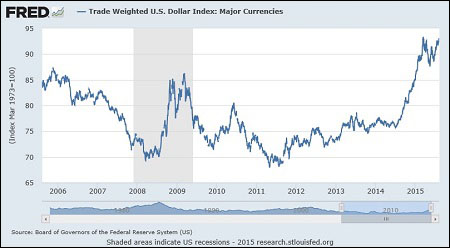
According to a Federal Reserve report released on July 17, the rising value of the U.S. Dollar is having a significant negative impact on large U.S. based multinationals. The report noted that “The dollar’s strength likely explains roughly a third of the recent decline in profits earned from foreign subsidiaries” and that “Firms with high foreign sales tend to be larger and account for almost 75 percent of S&P 500 nonfinancial earnings excluding oil and utilities.”
As we have reported before, this global currency race to the bottom cannot be solved by central banks. The problem is directly rooted in the unprecedented levels of income and wealth inequality that plague this era. In the U.S., that problem springs directly from Wall Street’s institutionalized wealth transfer system.
Read more

Thursday, August 6, 2015

Sieren's China: Ukraine is China's breadbasket

After more than a year of sanctions against Russia, the Chinese have been increasing their investments in Ukraine. They're having the last laugh, writes DW columnist Frank Sieren.
More than a year has gone by since the European Union imposed sanctions against Russia. While Russia and the West have scarcely approached each other, Beijing has been active.
Ever since Russia annexed Crimea in March 2014, Kyiv has increased its agricultural trade with Beijing by more than 50 percent. The crisis-stricken country has become the world's largest supplier of grain to the Chinese in the first half of this year, as the Russians purchase very little and the Europeans don't need anything.
Frank Sieren Kolumnist Handelsblatt Bestseller Autor China DW columnist Frank Sieren
In fact, Ukraine has overtaken the US, traditionally China's largest grain supplier. In their difficult situation, Ukrainians have had to offer favorable prices, sometimes giving discounts of up to 50 percent on purchases from agricultural companies.
But Beijing isn't just interested in food: China also aims to work more closely with Ukraine in the fields of technology, real estate and science. In March, Beijing pumped $15 billion (13.6 billion euros) in loans into Ukraine's devastated real estate market, and also enhanced its economic cooperation with the Ukrainian aviation industry. The first China-Ukraine Forum on Science and Technology was held on July 8. There, Beijing announced its aim to support Ukraine in the development of information technology.
No political preconditions
It's quite plausible that Ukrainians will not be quick to forget Beijing. Unlike the US and the EU, China separates investments from political conditions, as it has for several years in Africa, Latin America, Southeast Asia and Australia. And Beijing hasn't taken sides in the Ukraine conflict, even bearing with Kyiv's occasional impertinence - it recently banned the Communist Party in Ukraine. The country is simply too important strategically.
To Beijing, Ukraine is more than just an important food supplier and technology partner: It is also China's main arms supplier. The only Chinese aircraft carrier, for example, comes from Ukraine.
For the moment Beijing is benefiting from the last laugh. However, there is a risk that shouldn't be underestimated: If the conflict escalates, Chinese commitments will have been made in vain.
DW columnist Frank Sieren has lived in Beijing for 20 years.

The Number Of Potential Claims Per Deliverable Ounce On The Comex Has Risen To A Record High Of 121 To 1

by Jesse
As you can see from the first chart below, the number of potential claims per deliverable ounce on the Comex has risen to a record high of 121 to 1.
That can be corrected by higher prices for bullion that will prompt more legitimate sellers of actual bullion to take their stored gold and put it in the ‘registered’ for delivery category.
Or the trading desks of the banks and funds can continue to pummel the price with paper short selling, in the hopes of knocking down the open interest and the longs.
In the short term a fraud is relatively easy to sustain if you can compromise the ‘cops on the beat’ and you have powerful friends in the game with you.
In the longer term all such schemes collapse. But con men and other criminal sorts are rarely thinking about the longer term consequences.
And it is the character of our time that those who say they are for reform, and vigilantly seek out injustice in their own case, will so often not only ignore, but join in on the taunts and misery of others less fortunate, who are suffering their own injustices, often from the same perpetrators.
There is no real merit in acting solely out of self-interest. Even the worst of people will do this. But since this has become the guiding principle of our age, having sacrificed the notions of duty and honour on the altar of expediency and greed, so the virtue of the people is found wanting.
It is all too easy to act out of the self-interest, with your mind, and not for what is right out of a principled stand for what is just, with the heart.
Have a pleasant evening.


Retail Demand for Physical Gold and Silver Surged 135% in the Past 45 Days


by moneymetals

Top National Dealer Reports Startling Sales Figures

image: http://www.moneymetals.com/uploads/content/1651516514.jpg
Public demand for gold and silver coins, rounds, and bars suddenly skyrocketed in mid-June – particularly among first-time customers – to multiples of earlier demand levels, according to Money Metals Exchange, a national precious metals dealer in the U.S.
From June 16 to July 31, Money Metals Exchange experienced a 135% surge in gold and silver sales over the prior 45-day period (which was representative of the early months of 2015). Since June 16, the number of first-time customers rose even more dramatically, with 365% more new purchasers than the prior period.
“As the Greece default debacle unfolded in late June, something clicked in investors’ minds, and many have since bought whatever physical gold or silver they could get their hands on,” said Stefan Gleason, president of Money Metals Exchange. “In particular, we experienced a dramatic and unprecedented surge in first-time customers clamoring to obtain the financial insurance that gold and silver represent.”
“Paper” gold and silver prices set by the future markets have fallen since mid-June, and a bifurcation has emerged. The overwhelming demand for actual physical metal has led to significant strains on the supply chain, particularly in silver.
Many government and private mints, including the U.S. Mint and the Royal Canadian Mint, have been unable to keep up with demand and have either temporarily halted silver sales or rationed out their insufficient supply of silver coins.
Private mints have scrambled for raw silver to keep production running at full tilt. Major national depots, such as Los Angeles, have run dry while some users and investors sought physical delivery of silver (and gold) from Comex warehouses.
Premiums (i.e., amount paid above the metal’s melt value) have risen on all silver products except 100 and 1,000 ounce silver bars, and delivery delays have lengthened as suppliers and retailers scramble to fill orders.
“We’re seeing more buying interest than at any time since the 2008 financial crisis. If we see a further spike in demand, the whole supply chain could be cleaned out,” said Gleason. “In that event, customers will face long lead times and limited product choices. Gold supply is showing some signs of strain, but silver could become completely unavailable.”

May 1 – Jun 15 Jun 15 – Jul 31 Increase
Total Sales ($) $11,943,241 $28,041,070 135%
Silver (Oz Sold) 369,268 797,711 116%
Gold (Oz Sold) 4,645 12,929 178%
First-Time Orders 598 2,778 365%
Repeat Orders 9,069 9,839 8%


Greece requires even more debt relief than that suggested by the NIESR

by Shaun Richards
It was only on Monday that I analysed the grim survey that Markit had undertaken on manufacturing in the Greek economy. Its analysis of the situation in July led to the lowest reading it has so far calculated for it (30.2 on a scale where 50 is unchanged) which is quite something when you consider the economic depression which has been raging there. This morning the UK NIESR (National Institute for Economic and Social Research) has released its view on what will happen next in the Greek economy.
The economy is expected to contract sharply again this year and next, with GDP falling 3 per cent in 2015 and 2.3 per cent in 2016. We expect the recession to end in mid-2016.
It does not make for happy reading especially if we put it into the overall context.
 At this point the economy will be more than 30 per cent smaller than at its peak in 2007 and smaller than when it joined the Euro Area in 2001.
Actually the Greek economy fell below the level it had entered the Euro a couple of years ago so it would be more accurate to say even further below the level at which it joined the level. Also the NIESR omits to point out that under its own definition of a depression Greece is not only trapped in one but escaping it seems unlikely this decade and maybe beyond that.
The economic effect of raising VAT
I have been very critical of the new austerity plan partly because the recessionary effect of raising indirect taxes such as VAT is now known because of what has happened. The NIESR has investigated this.
“The changes to the VAT system will hit already weak consumer spending, shrinking the economy even further this year and next. It will also mask some of the underlying deflationary pressure this year and next.”
Putting this into numbers they estimate that consumer spending will see a small nudge lower this year but the main impact will be falls on 1 to 1.5% in both 2016 and 2017 and 1% in 2018. Actually this will make the deflation problem worse and it is the disinflation which will be reduced by price rises which may add as much as 2.5% to consumer inflation in 2016. The ordinary Greek consumer facing higher prices is likely to consume even less and the whole downwards spiral starts one more time.
What about debt relief?
The IMF suggested that a large effort would be required in this area.
If Europe prefers to again provide debt relief through maturity extension, there would have to be a very dramatic extension with grace periods of, say, 30 years on the entire stock of European debt, including new assistance.
However the NIESR has gone further suggesting that even such a move would not be enough.
According to our modelling, restoring debt sustainability requires a debt write-off equivalent to at least 55 per cent of GDP, higher than the IMF’s estimate of 30 per cent……Restructuring, or writing off, €95 billion (55 per cent of Greek GDP) provides Greece with, at least, a chance of lowering its debt stock to the target levels of the original bailouts (around 120 per cent of GDP in 2020). More could be done.
Thus we see that just as the Euro area plans a new bailout of 85 billion Euros it faces the prospect of having to write-off an even larger amount! Actually they are more likely to do anything like this by fulfilling one of my themes from the beginning that the maturity dates of the Greek date will head towards infinity. Or to use my financial lexicon they will be “temporary”.
Monetary Union
The NIESR touches on another theme of this blog which is how monetary unions normally behave. If we look at the UK as one I have pointed out in the past that the weaker areas (or our equivalent to Greece) are supported by regional policies where funds are switched to support them and investment there is encouraged. For example the Nissan plant in Sunderland is a successful example of this. Actually even in relatively successful currency unions like the UK the amount of regional policy is invariably not enough to solve the problem but in one where national identities and treasuries are still strong it is even less likely.
The NIESR suggest that the following would be a better solution than those suggested so far.
The fiscal transfer from Euro Area members required to achieve this would represent 1 per cent of Euro Area GDP in one year. As it would be spread over many years and across the membership, we argue the impact on other Euro Area members would be minimal, and that this fiscal transfer is necessary if Euro Area membership is to be maintained.
Except we are back in the usual mess of trust and honesty and doubt over how much reform Greece has actually undertaken. Also such a move would have a real cost and have to be accounted for rather than being kicked to off-balance sheet organisations like the ESM and EFSM. I checked the situation for the UK’s involvement in the EFSM and we do not account for any funds guaranteed unless it is lost, so one day we may get a “Surprise,Surprise” type announcement.
The Banks
The opening of the Athens Stock Exchange has led to this for the Greek banks. From Kathimerini.
Greek banks extended a rout that has wiped out more than half their value this week, sending the nation’s stocks lower for a third day….An index of Greek banks has fallen to its lowest level since at least 1995.
I note one comment being Simply Red. The short-selling ban is not going so well is it? But if we look at the impact of this on the Greek economy we see that it continues to be a noose around its neck. From Macropolis.
More than half of small Greek businesses saw turnover dive by at least 50 pct due to capital controls.
Ironically the bank deposit situation has now stabilised and even improved a little according to leaks which suggest a 1 billion Euro net inflow since July 20th re-opening of the banks.
Comment
There is one rather odd part of the NIESR report.
While the establishment of a new currency in Greece is clearly fraught with risks, there may come a point where the calculus simply no longer favours remaining within the Euro Area.
Fraught with risks yes and the current situation is not? Also there is the risk of success! But the oddity is that the fact is that due to the continuing economic destruction being inflicted on Greece it is a case of the sooner the better in my opinion rather than waiting for some better day to leave the Euro.
Also whilst the NIESR analysis require more debt relief than published elsewhere the truth is that even it does not go far enough. The 120% target for the debt to GDP ratio only existed to avoid embarassing Italy and Portugal and Greece needs to get back to 100% as a maximum.

The Care and Feeding of a Financial Black Hole

[En français] [En español] [По-русски] [In italiano]

A while ago I had the pleasure of hearing Sergey Glazyev—economist, politician, member of the Academy of Sciences, adviser to Pres. Putin—say something that very much confirmed my own thinking. He said that anyone who knows mathematics can see that the United States is on the verge of collapse because its debt has gone exponential. These aren't words that an American or a European politician can utter in public, and perhaps not even whisper to their significant other while lying in bed, because the American eavesdroppers might overhear them, and then the politician in question would get the Dominique Strauss-Kahn treatment (whose illustrious career ended when on a visit to the US he was falsely accused of rape and arrested). And so no European (never mind American) politician can state the obvious, no matter how obvious it is.

The Russians have that pretty well figured out by now. Yes, maintaining a dialogue and cordial directions with the Europeans is important. But it is well understood that the Europeans are just a bunch of American puppets with no will or decision-making authority of their own, so why not talk to the Americans directly? Alas, the Americans too are puppets. The American officials and politicians are definitely puppets, controlled by corporate lobbyists and shady oligarchs. But here's a shocker: these are also puppets—controlled by the simple imperatives of profitability and wealth preservation, respectively. In fact, it's puppets all the way down. And what's at the bottom is a giant, ever-expanding, financial black hole.

Do you like your black hole? If you aren't sure you like it, then let me ask you some other questions: Do you like the fact that your credit cards still work, or that you can still keep money in the bank and even get cash out of an ATM, or that you are either receiving or hope to eventually receive a pension? Do you like the fact that you can get useful things—food, gas, airline tickets—for mere pieces of paper with pictures of dead white men on them? Do you like the fact that you have internet access, that the lights are on, and that there is water on tap? Well, if you like these things, then you must also like the financial black hole, because that's what's making all of these things possible in spite of your country being bankrupt. Perhaps it's a love-hate relationship: you love being able to pretend that everything is still OK even though you know it isn't, and you wish to enjoy a bit more of the business-as-usual before it all goes to hell, be it for a few more days or another year or two; but you hate the fact that eventually the black hole will suck you in, after which point things will definitely... suck.

In the United States, so far the black hole has been sucking in individual families (although it does sometimes suck in entire cities, like Detroit, Michigan, or Bakersfield, California, or Camden, New Jersey). With the help of the fraudulent mortgage racket, it sucks in houses, and spits them out again encumbered with bad debt. With the help of the medical industry, it sucks in sick people and spits them out again, bankrupt. With the help of the higher education racket, it sucks in hopeful young people, and spits them out as graduates, with worthless degrees and saddled with mountainous student debt. With the help of the military-industrial complex, it sucks in just about anything and spits out corpses, invalids, environmental damage, terrorists and global instability. And so on.

But the black hole can also suck in entire countries. Right now it's busy trying to suck in Greece, but it's having a hard time with it, because Greece is, of all things, a democracy. This has the black hole's puppets in quite a state at the moment, and starting to clamor for “regime change” in Greece, so that Greece can be made to capitulate before the black hole gets hungry.

The way the black hole sucks in entire countries is as follows. If the black hole doesn't have enough to suck in for a period of time, it gets hungry and makes the financial markets go into free-fall. The financial instruments of countries that happen to be farther away from the black hole—out on the periphery—fall faster. In search of a “safe haven,” money floods out of these countries and into the “core” countries that are clustered tightly around the black hole—the US, Germany, Japan and a few others. The black hole gobbles up this money, but is then hungry for more. But since the periphery countries are now financially too weak to resist, they can easily be turned into black hole fodder. This is done by saddling the country with a foreign debt it can never repay, then forcing it to keep making payments against this debt by making it a condition for maintaining a financial lifeline—keeping the banks open, the ATMs stocked, the lights on and so on. To be able to make the payments, the country is forced to dismantle its society and economy through the imposition of austerity, to privatize everything in sight turning it into collateral for more loans, and to surrender its sovereignty to some transnational organizations, such as the IMF and the ECB, which are directly involved in the care and feeding of the black hole.

Who is in charge of all this? you might ask. If all there is is the black hole, the puppets charged with its care and feeding, and its hapless victims, then who is making the decisions? Well, it turns out that the black hole is sentient. But it is also very, very stupid. And the way is enforces its will is by destroying the minds of its puppets—by making them unable to understand certain things. However, stupidity is a double-edged sword, and in enforcing its will in this manner the black hole also thwarts its own purpose.

For example, some time ago the black hole happened upon a rather large item it wanted to suck in, but couldn't. The item is called Russian Federation. It controls a huge territory that is full of all sorts of natural resources the black hole would love to turn into loan collateral and suck in. The problem is that it is full of Russians, who are a difficult people for the black hole's puppets to deal with. They keep telling the puppets to please keep their toes on the other side of that red line over there, and if they don't then click goes the safety on their guns, precluding further discussion.

This situation calls for negotiation, but the black hole, which, as I mentioned, is very, very stupid, has just one negotiating tactic. It makes its demands, and then waits for the other side to capitulate. If that doesn't work, it applies pressure: imposes sanctions, attacks the currency, complicates financial transactions, arrests the country's foreign assets and so on—and waits for the other side to capitulate. And if that doesn't work either, then the country gets bombed to rubble by NATO or, if NATO doesn't want to come along, by the US alone. That generally works, but in the case of Russia it doesn't. But the black hole, if you recall, is very, very stupid, so it keeps trying anyway. As it does, the minds of its puppets get really warped, to a point where they don't understand what's going on at all.

For example, everybody knows by now that pressuring Russia doesn't work: according to Newton's Third Law, every action produces an equal and opposite reaction, and Russia is big enough that pushing it doesn't cause it to move at all—it just causes whoever is pushing it to hurt themselves. It's like trying to shift the Earth's orbit by jumping off a chair while keeping your knees locked—which is a good ploy if you are clamoring for medical attention. In fact, the Russians are rather grateful for the sanctions, because now they have a reason to finally get serious about investing in domestic economic development and self-sufficiency. But the puppets, having had their minds warped by the black hole, cannot see that, so they just keep pushing, wrecking their own economies in the process.

Since the sanctions don't work, it is time to exercise the military option. Doing so requires concocting a casus belli—a reason to go to war. The black hole does this by hallucinating: Russia invaded Crimea!—sure, a few hundred years ago, and has been there ever since, most recently based on an international agreement, but never mind! (Oh, and legally Crimea was never actually made part of the Ukraine because Nikita Khrushchev botched the paperwork when handing it over.) OK, never mind that, but then Russia invades the Ukraine!—on every day that has the letter “D” in it, but it's very sneaky and withdraws its troops before anybody can snap a single picture of them there. OK, never mind that either, but then Russia is poised to invade Estonia, Latvia and Lithuania, and maybe Poland too. Invade how? You mean like take a bus to the music festival in Jūrmala? Consider it done, but the festival is already over and the invading music fans are back home. OK, never mind that either. But the puppets keep saying “Russian aggression!” over and over again. It's the brain damage caused by proximity to the black hole. Look at this poor guy, for instance. He keeps flapping his lower jaw, going “Russian aggression! Russian aggression!” while trying to self-soothe by fondling the rump of his imaginary pet cow. God help him.

Back to the real world: the poor puppets are unable to understand that there is no military option when it comes to Russia: it's a nuclear power with an excellent strategic deterrent, a well-defended territory, and no aggressive intentions against anyone. But the puppets, with their warped minds, cannot see that, and so they pile various kinds of obsolete military junk along Russia's borders, and are even threatening to bring into Europe the entirely obsolete Pershing medium-range nuclear missiles. They are obsolete because the Russians now have the S-300 system with which to shoot them all down. The military option just isn't going to work, but don't tell that to the puppets—they cannot absorb such information without sustaining further neurological damage.

Back to Greece: tiny Greece certainly isn't mighty Russia, but it nevertheless refused to capitulate to the demands of the black hole. It was asked to completely wreck its society and its economy as a condition for maintaining its financial lifelines from the IMF and the ECB. Most inconveniently for the black hole and its puppets, Greece is not some obscure “third world” country peopled by dark-skinned people you wouldn't want your daughter to marry, but a European nation that is the cradle of European civilization and democracy. Greece managed to elect a government that tried to negotiate in good faith, but the puppets don't negotiate—they demand, threaten and cause damage until they get their way—or until their heads explode.

This one will be interesting to watch. If the black hole does succeed in sucking in Greece, then which country is next? Will it be Italy, Spain or Portugal? And, as that process continues, at what point will enough people say that enough is enough? Because when they do, the black hole will shrivel up. It's not a real black hole that's made up of incredibly dense matter—so dense that its gravitational field traps even light. It's a fake black hole, made up of everyone's combined greed. It has greed at its core, and fear all around it, and it sustains itself by feeding on fear. If it can continue sucking in people, families and entire countries, it can keep the greed at its core alive, but if it can't, then the greed will also turn to fear, and it will shrivel up and die. And I hope that when it dies all of its brain-damaged puppets will snap out of it, realize how deluded they have been, and go find something useful to do—farm sheep, grow vegetables, dig for clams...