Wednesday, July 1, 2015
Canary in the coal mine Puerto Rico defaults on $72 Billion in bonds
http://www.washingtonpost.com/busines…
Puerto Rico’s governor on need to postpone debt payments for years: ‘It’s about math’
The governor of Puerto Rico said in a televised address Monday that the island cannot pay back more than $70 billion in debt, setting up an unprecedented financial crisis that could rock the municipal bond market and lead to higher borrowing costs for governments across the United States.
“This is not about politics,” said Puerto Rico’s governor, Alejandro Garcia Padilla. “It’s about math.”
Garcia Padilla said the country needed to postpone for several years its debt payments.

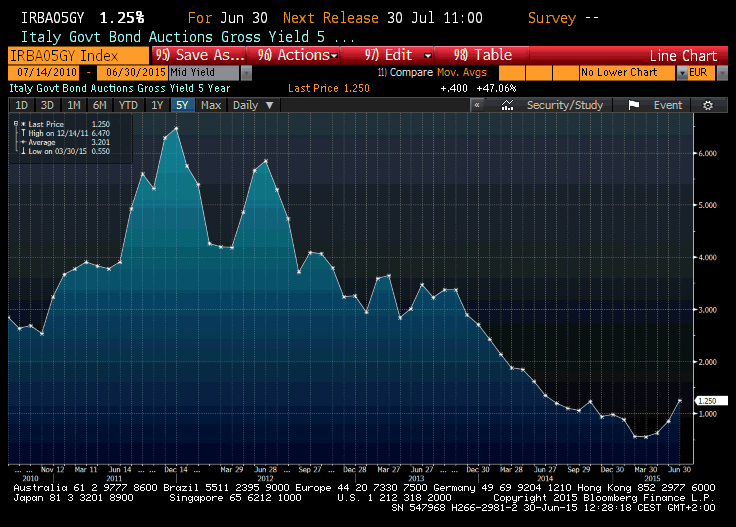
Greece is becoming more expensive by the minute: Italy’s 5Yr funding cost rises to highest since June 2014 auction.

Surprise!: U.S. manufacturing costs are now as cheap as China’s
From Harold L. Sorkin, Bloomberg:
An entire generation of Americans has come of age laboring under the assumption that the U.S. can’t compete in the manufacturing arena with low-cost competitors such as China and Brazil. That may have been true a decade ago, but it’s no longer true today.
I recently completed a review of manufacturing costs in the top 25 export economies with my colleagues Justin Rose and Michael Zinser. Our research shows that when the most important economic factors are considered—total labor costs, energy expenses, productivity growth, and currency exchange rates — Brazil is one of the highest-cost manufacturing nations in the world, Mexico is cheaper than China, China is virtually even with the U.S. (as are most of the traditionally “low-cost” countries of eastern Europe), and the low-cost leader in western Europe is none other than the country that launched the Industrial Revolution: the United Kingdom.
So throw away the old playbook. Welcome to the new era.
The country with the lowest manufacturing costs, we found, is not China. It’s Indonesia, then India, Mexico, and Thailand. China comes next — with Taiwan’s costs just a tad higher and the U.S.’s a bit more than that, ranking America No. 7 in our study.
As Chinese labor costs rise, American productivity improves, and U.S. energy expenses fall, the difference in manufacturing costs between China and the U.S. has narrowed to such a degree that it’s almost negligible. For every dollar required to manufacture in the U.S., it now costs 96¢ to manufacture in China, before considering the cost of transportation to the U.S. and other factors. For many companies, that’s hardly worth it when product quality, intellectual property rights, and long-distance supply chain issues are added to the equation.
For the record, the countries with the highest manufacturing costs of the 25 nations we studied were Australia, Switzerland, Brazil, France, Italy, Belgium, and Germany — all of which have costs 20 percent to 30 percent higher than the U.S.’s.
Previous cheaper havens, including Brazil, China, the Czech Republic, Poland, and Russia, experienced a significant increase in relative manufacturing costs since 2004 because of some combination of sharp wage increases, lagging productivity growth, unfavorable currency swings, and dramatic increases in energy costs.
Several countries that were relatively expensive a decade ago, most in western Europe, have become more expensive compared with America. Manufacturing costs in Belgium and Sweden rose 7 percentage points from 2004-2014 relative to the U.S., and in France and Italy they rose 10 percentage points. Largely because of productivity gains, the U.K. held its own.
The two countries making the greatest strides in manufacturing competitiveness were Mexico and the U.S. The key reasons were stable wage growth, sustained productivity gains, steady exchange rates, and the big energy advantage the U.S. has captured since the shale-gas boom began.
The new data are more than food for thought; they’re food for action.
Many companies continue to make manufacturing investment decisions based on conditions from a decade or more ago. They still see North America as high cost and Latin America, eastern Europe, and Asia, especially China, as low cost. The new data show there’s a competitive marketplace of manufacturing opportunities today, with high-cost and low-cost countries virtually everywhere.
When companies build new manufacturing plants, they’re typically placing bets for 25 years or more. They need to carefully consider how relative cost structures are changing and how these changes are likely to continue in the future.
An entire generation of Americans has come of age laboring under the assumption that the U.S. can’t compete in the manufacturing arena with low-cost competitors such as China and Brazil. That may have been true a decade ago, but it’s no longer true today.
I recently completed a review of manufacturing costs in the top 25 export economies with my colleagues Justin Rose and Michael Zinser. Our research shows that when the most important economic factors are considered—total labor costs, energy expenses, productivity growth, and currency exchange rates — Brazil is one of the highest-cost manufacturing nations in the world, Mexico is cheaper than China, China is virtually even with the U.S. (as are most of the traditionally “low-cost” countries of eastern Europe), and the low-cost leader in western Europe is none other than the country that launched the Industrial Revolution: the United Kingdom.
So throw away the old playbook. Welcome to the new era.
The country with the lowest manufacturing costs, we found, is not China. It’s Indonesia, then India, Mexico, and Thailand. China comes next — with Taiwan’s costs just a tad higher and the U.S.’s a bit more than that, ranking America No. 7 in our study.
As Chinese labor costs rise, American productivity improves, and U.S. energy expenses fall, the difference in manufacturing costs between China and the U.S. has narrowed to such a degree that it’s almost negligible. For every dollar required to manufacture in the U.S., it now costs 96¢ to manufacture in China, before considering the cost of transportation to the U.S. and other factors. For many companies, that’s hardly worth it when product quality, intellectual property rights, and long-distance supply chain issues are added to the equation.
For the record, the countries with the highest manufacturing costs of the 25 nations we studied were Australia, Switzerland, Brazil, France, Italy, Belgium, and Germany — all of which have costs 20 percent to 30 percent higher than the U.S.’s.
Previous cheaper havens, including Brazil, China, the Czech Republic, Poland, and Russia, experienced a significant increase in relative manufacturing costs since 2004 because of some combination of sharp wage increases, lagging productivity growth, unfavorable currency swings, and dramatic increases in energy costs.
Several countries that were relatively expensive a decade ago, most in western Europe, have become more expensive compared with America. Manufacturing costs in Belgium and Sweden rose 7 percentage points from 2004-2014 relative to the U.S., and in France and Italy they rose 10 percentage points. Largely because of productivity gains, the U.K. held its own.
The two countries making the greatest strides in manufacturing competitiveness were Mexico and the U.S. The key reasons were stable wage growth, sustained productivity gains, steady exchange rates, and the big energy advantage the U.S. has captured since the shale-gas boom began.
The new data are more than food for thought; they’re food for action.
Many companies continue to make manufacturing investment decisions based on conditions from a decade or more ago. They still see North America as high cost and Latin America, eastern Europe, and Asia, especially China, as low cost. The new data show there’s a competitive marketplace of manufacturing opportunities today, with high-cost and low-cost countries virtually everywhere.
When companies build new manufacturing plants, they’re typically placing bets for 25 years or more. They need to carefully consider how relative cost structures are changing and how these changes are likely to continue in the future.
16 Facts About The Tremendous Financial Devastation That We Are Seeing All Over The World
As we enter the second half of 2015, financial panic has gripped most of the globe

As we enter the second half of 2015, financial panic has gripped most of the globe.
Stock prices are crashing in China, in Europe and in the United States. Greece is on the verge of a historic default, and now Puerto Rico and Ukraine are both threatening to default on their debts if they do not receive concessions from their creditors. Not since the financial crisis of 2008 has so much financial chaos been unleashed all at once. Could it be possible that the great financial crisis of 2015 has begun? The following are 16 facts about the tremendous financial devastation that is happening all over the world right now…
1. On Monday, the Dow fell by 350 points. That was the biggest one day decline that we have seen in two years.
2. In Europe, stocks got absolutely smashed. Germany’s DAX index dropped 3.6 percent, and France’s CAC 40 was down 3.7 percent.
3. After Greece, Italy is considered to be the most financially troubled nation in the eurozone, and on Monday Italian stocks were down more than 5 percent.
4. Greek stocks were down an astounding 18 percent on Monday.
5. As the week began, we witnessed the largest one day increase in European bond spreads that we have seen in seven years.
6. Chinese stocks have already met the official definition of being in a “bear market” – the Shanghai Composite is already down more than 20 percent from the high earlier this year.
7. Overall, this Chinese stock market crash is the worst that we have witnessed in 19 years.
8. On Monday, Standard & Poor’s slashed Greece’s credit rating once again and publicly stated that it believes that Greece now has a 50 percent chance of leaving the euro.
9. On Tuesday, Greece is scheduled to make a 1.6 billion euro loan repayment. One Greek official has already stated that this is not going to happen.
10. Greek banks have been totally shut down, and a daily cash withdrawal limit of60 euros has been established. Nobody knows when this limit will be lifted.
11. Yields on 10 year Greek government bonds have shot past 15 percent.
12. U.S. investors are far more exposed to Greece than most people realize. The New York Times explains…
13. The Governor of Puerto Rico has announced that the debts that the small island has accumulated are “not payable“.But the question of what happens when the markets do open is particularly acute for the hedge fund investors — including luminaries like David Einhorn and John Paulson — who have collectively poured more than 10 billion euros, or $11 billion, into Greek government bonds, bank stocks and a slew of other investments.Through the weekend, Nicholas L. Papapolitis, a corporate lawyer here, was working round the clock comforting and cajoling his frantic hedge fund clients.“People are freaking out,” said Mr. Papapolitis, 32, his eyes red and his voice hoarse. “They have made some really big bets on Greece.”
14. Overall, the government of Puerto Rico owes approximately 72 billion dollars to the rest of the world. Without debt restructuring, it is inevitable that Puerto Rico will default. In fact, CNN says that it could happen by the end of this summer.
15. Ukraine has just announced that it may “suspend debt payments” if their creditors do not agree to take a 40 percent “haircut”.
16. This week the Bank for International Settlements has just come out with a new report that says that central banks around the world are “defenseless” to stop the next major global financial crisis.
Without a doubt, we are overdue for another major financial crisis. All over the planet, stocks are massively overvalued, and financial markets have become completely disconnected from economic reality. And when the next crash happens, many believe that it will be even worse than what we experienced back in 2008. For example, just consider the words of Jim Rogers…
“In the United States, we have had economic slowdowns every four to seven years since the beginning of the Republic. It’s now been six or seven years since our last stock market problem. We’re overdue for another problem.”Of course Rogers is far from alone. A recent article by Paul B. Farrell expressed similar sentiments…
In Rogers’ view, low interest rates caused stock prices to increase significantly. He believes many assets are priced beyond their fundamentals thanks to the ultra-easy monetary policies by the Federal Reserve. Fed supporters argue such measures are good for investors, but Rogers takes a different view.
“The Fed might tell us we don’t have to worry and that a correction or crash will never happen again. That’s balderdash! When this artificial sea of liquidity ends, we’re going to pay a terrible price. When the next economic problem occurs, it will be much worse because the debt is so much higher.”
America’s 95 million investors are at huge risk. Remember the $10 trillion losses in the crash and recession of 2007-2009? The $8 trillion lost after the dot-com technology crash and recession of 2000-2003? This is the third big recession of the century. Yes, America will lose trillions again.Things have been relatively quiet in the financial world for so long that many have been sucked into a false sense of security.
Especially with dead-ahead predictions like Mark Cook’s 4,000-point Dow correction. And Jeremy Grantham’s warning of a 50% crash around election time, with negative stock returns through the first term of the next president, beyond 2020. Starting soon.
Why is America so vulnerable when the next recession hits? Simple: The Fed’s cheap-money giveaway is killing America. When the downturn, correction, crash hits, it will compare to the 2008 crash. The Economist warns: “the world will be in a rotten position to do much about it. Rarely have so many large economies been so ill-equipped to manage a recession,” whatever the trigger.
But the underlying imbalances were always there, and they have been getting worse over time.
I believe that we are heading into a global financial collapse that will make what happened in 2008 look like a Sunday picnic by the time it is all said and done.
Global debt levels are at all-time highs, big banks all over the planet have been behaving more recklessly than ever, and financial markets are absolutely primed for a huge crash.
Hopefully things will calm down a bit as the rest of this week unfolds, but I wouldn’t count on it.
We have entered uncharted territory, and what comes next is going to shock the world.
FULL ARTICLE
Unprepared: What Do You Think Would Happen If A Greek-Style Crisis Hit America?
By Michael Snyder
image: http://endoftheamericandream.com/wp-content/uploads/2015/06/Despair-And-Depression-Public-Domain-460x345.jpg
 In
this article, I am going to share with you some statistics that prove
that most Americans are completely and totally unprepared for a
Greek-style economic crisis. According to one recent survey, an
all-time high 72 percent
of all Americans are concerned about an economic downturn, and yet the
amount of actual preparation that is taking place for the next economic
downturn is very low. As 2008 has faded into our memories, most
Americans have been lulled into a false sense of security. Most people
seem to be far more concerned about the latest exploits and scandals of
their favorite celebrities than they are about the very real problems
that this nation is steamrolling toward. Hopefully what is going on in
Greece right now will serve as a wake up call, because the truth is that
similar things could happen in the United States much sooner than most
of us would dare to imagine.
When a major financial crisis strikes, what is one of the first things that usually happens?
In
this article, I am going to share with you some statistics that prove
that most Americans are completely and totally unprepared for a
Greek-style economic crisis. According to one recent survey, an
all-time high 72 percent
of all Americans are concerned about an economic downturn, and yet the
amount of actual preparation that is taking place for the next economic
downturn is very low. As 2008 has faded into our memories, most
Americans have been lulled into a false sense of security. Most people
seem to be far more concerned about the latest exploits and scandals of
their favorite celebrities than they are about the very real problems
that this nation is steamrolling toward. Hopefully what is going on in
Greece right now will serve as a wake up call, because the truth is that
similar things could happen in the United States much sooner than most
of us would dare to imagine.
When a major financial crisis strikes, what is one of the first things that usually happens?
People start pulling their money out of the banks.
A few years ago when problems erupted in Cyprus, photos of long lines at ATMs rapidly circulated all over the Internet. And now the same thing is happening in Greece. The following is just one example…
This is why it is so important to not put all of your eggs into one basket and to always have some emergency cash at home. Most Americans just assume that the money that they have in the banks will always be available, but that is not necessarily true. When a major emergency erupts, you don’t want to end up like this guy…
When things get bad, food becomes an extremely high priority for most people. During a major emergency, you won’t necessarily be able to rely on being able to go to your neighborhood store to get the things that you need. That is why it is so alarming that 53 percent of all Americans do not have a minimum three-day supply of nonperishable food and water at home.
Just think about that. If they were not able to resupply themselves at the stores, more than half of the country would start running out of food and water within days.
And let’s not forget about medicine either. During a major emergency, people still need to take their daily medicines, and this is becoming a significant problem in Greece right now…
Do you have extra medicines stored up for an emergency?
And what would you do if a family member sustained a major injury and you were not able to get to the hospital?
One survey found that 44 percent of all Americans don’t even have first-aid kits in their homes.
To say that we are woefully unprepared as a nation would be a massive understatement.
We don’t think ahead, we don’t plan, and we are exceedingly dependent on the system. If the system fails, we are going to be in a massive amount of trouble. Here are some more numbers that come directly from the official FEMA website…
Other potential dangers include civil unrest, terror attacks, EMP shockwaves, major pandemics and drought.
Even if you are not a “prepper“, it only makes sense to do certain common sense things to prepare yourself and your family for a major emergency.
Sadly, most Americans will not listen until it is far too late. And then once a major crisis strikes, they will be forced to rely on the kindness of others because they have not made any preparations themselves.
image: http://endoftheamericandream.com/wp-content/uploads/2015/06/Despair-And-Depression-Public-Domain-460x345.jpg
In
this article, I am going to share with you some statistics that prove
that most Americans are completely and totally unprepared for a
Greek-style economic crisis. According to one recent survey, an
all-time high 72 percent
of all Americans are concerned about an economic downturn, and yet the
amount of actual preparation that is taking place for the next economic
downturn is very low. As 2008 has faded into our memories, most
Americans have been lulled into a false sense of security. Most people
seem to be far more concerned about the latest exploits and scandals of
their favorite celebrities than they are about the very real problems
that this nation is steamrolling toward. Hopefully what is going on in
Greece right now will serve as a wake up call, because the truth is that
similar things could happen in the United States much sooner than most
of us would dare to imagine.
When a major financial crisis strikes, what is one of the first things that usually happens?People start pulling their money out of the banks.
A few years ago when problems erupted in Cyprus, photos of long lines at ATMs rapidly circulated all over the Internet. And now the same thing is happening in Greece. The following is just one example…
This is why it is so important to not put all of your eggs into one basket and to always have some emergency cash at home. Most Americans just assume that the money that they have in the banks will always be available, but that is not necessarily true. When a major emergency erupts, you don’t want to end up like this guy…
On Monday, cash machines remained closed until midday, and then opened for withdrawals of no more than 60 euros a day. “I’ve got five euros in my pocket, I thought I would try my luck here for some money. The queues in my neighbourhood were too long yesterday,” said plumber Yannis Kalaizakis, 58, outside an empty cash machine in central Athens on Monday.Sadly, a lot of Americans don’t have any money saved up for emergencies at all, so they wouldn’t even have any reason to line up at the ATMs. According to a survey that was just recently released, 29 percent of all Americans do not have a single penny in emergency savings. That was the highest level that has ever been recorded. An additional 21 percent of all Americans have less than 3 months of expenses saved up. Those are some incredibly disturbing numbers. A different study posed the following question to people…
“Do you have 3 months emergency funds to cover expenses in case of sickness, job loss, economic downturn?”Incredibly, 60 percent of all respondents could not answer that question affirmatively. In addition, another recent survey found that 57 percent of all Americans do not consider themselves to be ready for a “sudden financial setback”. So what will all of those people do when things start melting down? Yes, there are a few people that are trying to financially prepare for the hard times that are coming, but they represent only a small percentage of the U.S. population. It has been estimated that less than 10 percent of all Americans own any gold or silver for investment purposes. To me, that is an absolutely frightening number. But of course it isn’t just money that we need to be concerned about when a major crisis strikes. In many U.S. cities, even the threat of a major storm can cause people to storm the supermarkets and clear the shelves of essential supplies. So what would happen if there was actually a major national crisis? In Greece, supermarkets are doing a booming business at the moment as people feverishly stock up for the coming days. Right now, Twitter is being flooded with pictures like this one…
When things get bad, food becomes an extremely high priority for most people. During a major emergency, you won’t necessarily be able to rely on being able to go to your neighborhood store to get the things that you need. That is why it is so alarming that 53 percent of all Americans do not have a minimum three-day supply of nonperishable food and water at home.
Just think about that. If they were not able to resupply themselves at the stores, more than half of the country would start running out of food and water within days.
And let’s not forget about medicine either. During a major emergency, people still need to take their daily medicines, and this is becoming a significant problem in Greece right now…
Drugmakers said they would continue to ship medicines to Greece in coming weeks despite unpaid bills, but warned that supplies could soon be in jeopardy without emergency action.So what about you?
Do you have extra medicines stored up for an emergency?
And what would you do if a family member sustained a major injury and you were not able to get to the hospital?
One survey found that 44 percent of all Americans don’t even have first-aid kits in their homes.
To say that we are woefully unprepared as a nation would be a massive understatement.
We don’t think ahead, we don’t plan, and we are exceedingly dependent on the system. If the system fails, we are going to be in a massive amount of trouble. Here are some more numbers that come directly from the official FEMA website…
A recent Federal Emergency Management Agency (FEMA) survey found that nearly 60 percent of American adults have not practiced what to do in a disaster by participating in a disaster drill or preparedness exercise at work, school, or home in the past year. Further, only 39 percent of respondents have developed an emergency plan and discussed it with their household. This is despite the fact that 80 percent of Americans live in counties that have been hit with a weather-related disaster since 2007, as reported by the Washington Post.In the final analysis, a Greek-style economic crisis is not the only threat that we need to be prepared for. In the United States, we also face the threat of natural disasters such as hurricanes, tornadoes, earthquakes, tsunamis and evenvolcanic eruptions.
Other potential dangers include civil unrest, terror attacks, EMP shockwaves, major pandemics and drought.
Even if you are not a “prepper“, it only makes sense to do certain common sense things to prepare yourself and your family for a major emergency.
Sadly, most Americans will not listen until it is far too late. And then once a major crisis strikes, they will be forced to rely on the kindness of others because they have not made any preparations themselves.
Tuesday, June 30, 2015
Puerto Rico Bonds Are Collapsing
With all eyes focused on Greek ATM lines, collapsing Chinese ponzi
schemes, and European bank implosions, one could be forgiven for
forgetting about another crisis occurring closer to home. As we detailed here, Puerto Rico is now "in a death spiral" and PR bonds are collapsing this morning...
"Surprise"

Puerto Rico's debt is nearly half that of California for a population one-tenth the size... (via WSJ)

As we explained previously,
What happens next is unclear: "Puerto Rico, as a commonwealth, does not have the option of bankruptcy. A default on its debts would most likely leave the island, its creditors and its residents in a legal and financial limbo that, like the debt crisis in Greece, could take years to sort out."
So without the "luxury" of default, what is PR to do? Why petition to be allowed to file Chapter 9 naturally: after all everyone is doing it.
We wonder how long before Tsipras, who earlier was quoting FDR, steals this line too.
And speaking of Prexit, how long before Puerto Rico exits the Dollarzone... and will there be a Preferendum first or will the governor, in his can kick-less stampede, just make a unilateral decision to join Greece, Ukraine, Venezuela and countless other soon to be broke countries in the twilight zone of Keynesian sovereign failures?
"Surprise"

Puerto Rico's debt is nearly half that of California for a population one-tenth the size... (via WSJ)

As we explained previously,
What happens next is unclear: "Puerto Rico, as a commonwealth, does not have the option of bankruptcy. A default on its debts would most likely leave the island, its creditors and its residents in a legal and financial limbo that, like the debt crisis in Greece, could take years to sort out."
So without the "luxury" of default, what is PR to do? Why petition to be allowed to file Chapter 9 naturally: after all everyone is doing it.
García Padilla said that his government could not continue to borrow money to address budget deficits while asking its residents, already struggling with high rates of poverty and crime, to shoulder most of the burden through tax increases and pension cuts. Where have we heard that before...In Washington, the García Padilla administration has been pushing for a bill that would allow the island’s public corporations, like its electrical power authority and water agency, to declare bankruptcy. Of Puerto Rico’s $72 billion in bonds, roughly $25 billion were issued by the public corporations.
Some officials and advisers say Congress needs to go further and permit Puerto Rico’s central government to file for bankruptcy — or risk chaos.
“There are way too many creditors and way too many kinds of debt,” Mr. Rhodes said in an interview. “They need Chapter 9 for the whole commonwealth.”
And the punchline:He said creditors must now “share the sacrifices” that he has imposed on the island’s residents.
“If they don’t come to the table, it will be bad for them,” said Mr. García Padilla, who plans to speak about the fiscal crisis in a televised address to Puerto Rico residents on Monday evening. “What will happen is that our economy will get into a worse situation and we’ll have less money to pay them. They will be shooting themselves in the foot.”
And this one: any deal with hedge funds, who are desperate to inject more capital in PR so they can avoid writing down their bond exposure in case of a default, "would only postpone Puerto Rico’s inevitable reckoning. “It will kick the can,” Mr. García Padilla said. “I am not kicking the can.”“My administration is doing everything not to default,” Mr. García Padilla said. “But we have to make the economy grow,” he added. “If not, we will be in a death spiral.”
We wonder how long before Tsipras, who earlier was quoting FDR, steals this line too.
And speaking of Prexit, how long before Puerto Rico exits the Dollarzone... and will there be a Preferendum first or will the governor, in his can kick-less stampede, just make a unilateral decision to join Greece, Ukraine, Venezuela and countless other soon to be broke countries in the twilight zone of Keynesian sovereign failures?
Subscribe to:
Posts (Atom)