Monday, April 27, 2015

Bill Bonner: This global debt “binge” is far worse than you imagined

From Bill Bonner, Chairman, Bonner & Partners:
Today, we plunge into the sublime.
That’s right: We are leaving the ridiculous behind. Instead, it’s headfirst into the dark pool of things we will never understand and probably never should try to.
First, we pause to take note of the latest debt binge. Reports Bloomberg:
Just when debt-addicted American companies were starting to worry that Federal Reserve Chair Janet Yellen was going to take their proverbial punch bowl away, along came Mario Draghi.
The European Central Bank president has made borrowing so cheap in the region that foreign corporations are selling record amounts of debt. Forget the deeper, bigger US corporate-bond market. Borrowing in euro is all the rage these days because it’s about 2 percentage points less expensive to do so.
About 65% of the record 60 billion euro of investment-grade bonds sold in March came from overseas companies, according to a March 27 Bank of America report. And a lot of those sellers are based in the U.S. […]
The trend comes down to basic math. 
Yields on investment-grade bonds in Europe have fallen to 0.99%, compared with 2.9% on those in the U.S., according to Bank of America Merrill Lynch index data.
Like all borrowing binges, this one is likely to end badly…
Poor Bankruptcy Lawyers!
Last week, we looked at the glass half-empty – at the fall off in new start-up businesses in America.
Today, we look at the glass bone dry!
Yes, for every business
image: http://images.intellitxt.com/ast/adTypes/icon1.png
not started in America, there is at least one that also doesn’t go broke. In 2014, the number of U.S. corporate bankruptcies dropped to less than half the number in 2009.
The poor bankruptcy lawyers!
Imagine them sitting in their offices, with spiders spinning cobwebs in their doorways. Lonely, bored… on edge of desperation.
But whence comes this big drop in bankruptcy rates? Why can’t businesses go broke like they used to? And how come there are so few new business
image: http://images.intellitxt.com/ast/adTypes/icon1.png
start-ups? Look no further than Yellen, Draghi, et al. Thanks to them, borrowers can score money at less than 1% interest from apparently compos mentis lenders.
Or even more into the realm of the sublime, imagine you are borrowing at negative interest rates. JP Morgan says there is as much as $3.7 trillion worth of debt outstanding for which the lender gets no more than a poke in the eye.
Dead Wood
We pose the question not as a financial matter, but as a philosophical one.
The world works (the financial world certainly and maybe the rest of the world, too) by rewarding effort, self-discipline, and forbearance… while punishing error, sloth, and impatience.
These verities are written down somewhere:
The person who works steals a march on the layabout.
The person who takes the time to study and learn is able to do what the ignoramus cannot.
The person who saves his money can lend it out, thus earning more money.
But what if the saver is punished… what if, for his trouble, he earns a negative yield?
Or look at the other side… look at the borrower.
Imagine a restaurateur whose cuisine is so repulsive and whose kitchen is so dirty that diners regularly need to be rushed to the hospital
image: http://images.intellitxt.com/ast/adTypes/icon1.png
to have their stomachs pumped. He might borrow money to set up his restaurant, but in a normal world he would soon be unable to pay the interest on his loan. He would default and be out of business. Diners would be spared.
But imagine if he could borrow below the rate of inflation?
The worse his business did the more he’d need to borrow. And the more he borrowed, the more money he’d make!
When would he default on his loan? When would he be forced out of business?
Hell would close for business before he does.
In what universe does this work?
“Creative destruction” was the term used by Austrian-American economist Joseph Schumpeter to describe how a healthy
image: http://images.intellitxt.com/ast/adTypes/icon1.png
capitalist system works. It clears out the deadwood from time to time by destroying businesses
image: http://images.intellitxt.com/ast/adTypes/icon1.png
that can’t make a profit. Now, thanks to Mario Draghi, the wood just gets deader.
Regards,
image: http://www.bonnerandpartners.com/wp-content/uploads/2013/09/Bill-Bonner_sig.png
Bill
NACM’s Chief Economist: Plunge in Business Loans Shows U.S. at Inflection Point


Apr 21 – Cris Sheridan welcomes Chris Kuehl PhD, Chief Economist for the National Association for Credit Management. If you visit Zerohedge or other popular financial news sites, you’ve probably seen headlines warning of a U.S. recession based on…

There will be a MAD RUSH out of paper assets and into physical to protect wealth. When this occurs, silver will probably outperform gold due to it being more rare and more affordable.

by
There are 105 trillion reasons to own silver.  Very few investors in the world realize this, which makes it one of most undervalued assets in the world.  While the paper price of silver could go a bit lower, it’s forming a bottom while the major stock indexes are developing the BIGGEST TOPS in history.
You see, investors no longer understand what a “Store of Value” is anymore.  Back in the day, if a person wanted to save something for retirement, they would put away gold and silver coins.  So when they retired, they would cash in these gold or silver coins for goods and services.
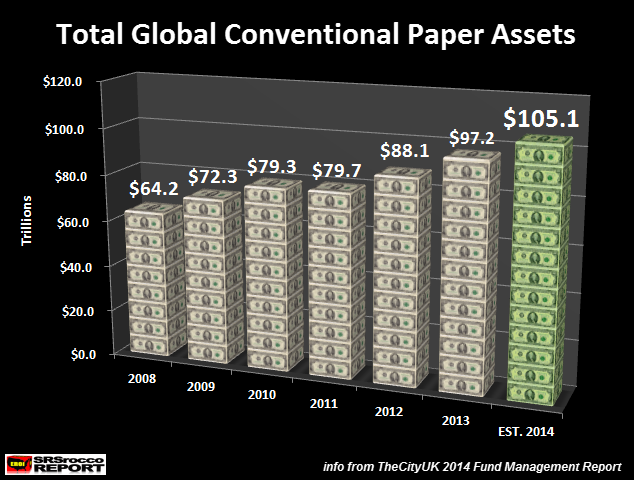
Today, the overwhelming majority of individuals have their funds invested in DIGITS or PAPER ASSETS in one form or another.  Just how large is the total Global Conventional Paper Assets under management??  Look at the chart below:
image: http://srsroccoreport.com/wp-content/uploads/Total-Global-Conventional-Paper-Assets-2014.png
Total Global Conventional Paper Assets 2014
According to the CityUK 2014 Fund Management Report, total global conventional assets under management increased from $97.2 trillion in 2013 to an estimated $105.1 trillion in 2014.  That’s a lot of paper and digits.
Investors have switched their faith from owning physical stores of value such as gold and silver to a more sophisticated highly leveraged system based on paper a digits.  The institutions that create, package and sell these supposed financial products (garbage) label them as ASSETS. Unfortunately for the naive masses, these are not assets, but rather future IOU’s.
On the other hand, a real asset is a silver coin.  Here’s why.

The Two Ways To Value Silver

I’ve explained the two ways to value silver in several of my past interviews.  Unfortunately, most precious metal investors today do not want to listen to long interviews as they don’t have the patience for it.  I know this is true due to the views I receive on my articles compared to my interviews.
Furthermore, when I put out a tweet for one of my top articles, I might receive 1,500 tweet views.  Guess how many folks who view that tweet actually hit the twitter link to read the article?  Oh, about 30-50 on a good day… LOL.  Individuals today don’t even have the time to read more than few sentences, much less an article… forget about a 30 minute interview.
Regardless, there are two ways to value silver:
1) It’s Just-In-Time supply chain price mechanism based on supply-demand-cost
2) It’s true Store of Value
Currently, the price of silver is valued based upon the present supply demand fundamentals including its production cost.  If the cost to produce silver from primary silver mines was $50, the price would be closer to that figure.  As I stated in my recent article, 2014 FULL YEAR RESULTS: Top Primary Silver Miners Lost $1.9 Billion the average estimated breakeven for the group was $19 in 2014.  I would imagine with the cost of oil down significantly, the breakeven should fall a little further in 2015.
So, the market calculates silver consumption and investment demand versus the supply.  While this market pricing mechanism is manipulated, that’s basically how it’s done.  It’s based on the degree of CONSUMPTION, not VALUE.
The second more important way to value silver is its STORE OF VALUE.  Gold and silver have been the best stores of value and money over the past 2,000 years except for the nearly 45 years worth of fiat monetary insanity ever since Nixon cancelled the convertibility of the U.S. Dollar to gold in 1971.
Investors have been brainwashed to believe their monthly flow of funds into their retirement or IRA accounts are a store of value.  Little do they know, the financial institutions take these INFLOWS to guarantee the OUTFLOWS to individuals who have retired or are cashing in on their paper investments.
It’s basically the BIGGEST PONZI SCHEME in history.  Why is that so?  Because if everyone asked to cash in on their paper assets (even with penalties), there isn’t the available capital or funds to do so.  We must remember energy has to be burned and economic activity generated to create the surplus capital to pay the retiree or individual cashing out.
Folks, we just can’t BURN ENOUGH ENERGY in a given time or year to pay back all these digit based paper assets.  However, if you own physical silver, you already have stored ECONOMIC ENERGY in that one ounce silver coin.  The energy and labor were already burned to create that coin.
The SILVER COIN is the highest form of value because it already contains stored economic energy while the $105 trillion in global conventional assets under management are ENERGY IOU’S.  This would be fine if the world planned on expanding its oil supply.  However, the opposite will occur in the future.
Very few realize if the United States expensive tight oil production was removed from the global supply, world oil production has declined since 2011.  Individuals who believe Shale oil will make the U.S. energy independent, will be in for a rude awakening when we start to see production dropping like a rock by midyear.
image: http://srsroccoreport.com/wp-content/uploads/World-Oil-production-minus-USA-1.jpg
World Oil production minus USA Whether or not the precious metal investor wants to hear it, ENERGY DRIVES THE MARKETS.  Gold and silver would be nothing without labor or energy.  The 1.2 grams per ton of gold which is the average yield of the top five gold mining companies would stay in the ground if it wasn’t for ENERGY… in all forms and in all stages.
When the world finally realizes that the peak of unconventional oil production is here (conventional peaked in 2005), the NET PRESENT VALUE of most paper assets will head south down the toilet and into the cesspool.  This is when the second and more important way to value silver will occur.
There will be a MAD RUSH out of paper assets and into physical to protect wealth.  When this occurs, silver will probably outperform gold due to it being more rare and more affordable.
I will explain this in more detail in my first two PAID REPORTS on the Silver Market and Industry.  I will be publishing the first one next month.

The Death of Cash: Could negative interest rates create an existential crisis for money itself?

JPMorgan Chase recently sent a letter to some of its large depositors telling them it didn’t want their stinking money anymore. Well, not in those words. The bank coined a euphemism: Beginning on May 1, it said, it will charge certain customers a “balance sheet utilization fee” of 1 percent a year on deposits in excess of the money they need for their operations. That amounts to a negative interest rate on deposits. The targeted customers—mostly other financial institutions—are already snatching their money out of the bank. Which is exactly what Chief Executive Officer
image: http://images.intellitxt.com/ast/adTypes/icon1.png
Jamie Dimon wants. The goal is to shed $100 billion in deposits, and he’s about 20 percent of the way there so far.
Pause for a second and marvel at how strange this is. Banks have always paid interest to depositors. We’ve entered a new era of surplus in which banks—some, anyway—are deigning to accept money only if customers are willing to pay for the privilege. Nick Bunker, a policy analyst at the Washington Center for Equitable Growth, was so dazzled by interest rates’ falling into negative territory that he headlined his analysis after a Doors song, Break on Through (to the Other Side).
In recent months, negative rates have become widespread in Europe’s financial capitals. The European Central Bank, struggling to ignite growth, has a deposit rate of –0.2 percent. The Swiss National Bank, which worries that a rise of the Swiss franc will hurt trade, has a deposit rate of –0.75 percent. On April 21 the cost for banks to borrow from each other in euros (the euro interbank offered rate, or Euribor) tipped negative for the first time. And as of April 17, bonds comprising 31 percent of the value
image: http://images.intellitxt.com/ast/adTypes/icon1.png
of the Bloomberg Eurozone Sovereign Bond Index—€1.8 trillion ($1.93 trillion) worth—were trading with negative yields. (Although dollar interest rates are higher, JPMorgan Chase’s balance sheet utilization fee fits the pattern: In today’s low-rate world, the only way it can shed deposits in response to new regulations is to go all the way to less than zero.) It’s not unusual for interest rates to be negative in the sense of being lower than the rate of inflation. If the Federal Reserve pushes interest rates below inflation to stimulate growth, it becomes cheaper to borrow and buy something now than to wait to make the purchase. If you wait, inflation could make prices go up by more than what you owe on the loan. You can also think of it as inflation reducing the effective
image: http://images.intellitxt.com/ast/adTypes/icon1.png
amount you owe.

Eric Sprott gives his latest analysis of precious metals & the economy


Why the Fed CAN’T Raise Interest Rates Without COLLAPSING the Global Economy!


Sources:
“Chase Bank to restrict cash payments on credit cards and loans after restricting cash deposits a year ago: Money Matters | cleveland.com”
http://www.cleveland.com/business/ind…
“Economists have discovered how bad the economy really is – The Washington Post”
http://www.washingtonpost.com/blogs/w…
“Why the Fed May (Almost) Never Raise Interest Rates – TheStreet”
http://www.thestreet.com/story/131194…
“How the fall of Qaddafi gave rise to Europe’s migrant crisis (+video) – CSMonitor.com”
http://www.csmonitor.com/World/Securi…
“Health Law Brings Growth in Food Stamps in Some States – ABC News”
http://abcnews.go.com/US/wireStory/he…
“NHS cold ration joint replacements and IVF to save money | Daily Mail Online”
http://www.dailymail.co.uk/health/art…
“Feds urge eating expired food, even if 18 months past throwaway date | WashingtonExaminer.com”
http://www.washingtonexaminer.com/fed…
“Rocco Galati in court to challenge how Bank of Canada does business | Toronto Star”
http://www.thestar.com/news/canada/20…

Hog and Cattle at critical price points, impact S&P 500 again?

by kimblechartingsolutions
image: http://blog.kimblechartingsolutions.com/wp-content/uploads/2015/04/hogcattlesupporttestsapr21-675x294.jpg
hogcattlesupporttestsapr21CLICK ON CHART TO ENLARGE
HOG (Harley Davidson) has remained inside of steep rising channel the past 4 years. At this time it is testing rising support of this channel.
Live Cattle futures pattern looks very much like Hog’s pattern, as steep rising support is being tested at this time.
In the 2008-2009 time period, HOG and Cattle both fell over 30% in price as the S&P was falling hard as well.
The chart below looks a potential bullish pattern in the S&P 500.
image: http://blog.kimblechartingsolutions.com/wp-content/uploads/2015/04/spxbullishascendingtriangleatfibresistanceapr21-675x316.jpg
spxbullishascendingtriangleatfibresistanceapr21CLICK ON CHART TO ENLARGE
The S&P 500 has been like a rocking chair this year, keeping people busy, going nowhere! A potential bullish ascending triangle pattern could be forming with the top of the pattern being Fibonacci 161% Extension level resistance. A push above resistance would be a positive price message for the S&P 500.
Should the S&P 500 break support, sellers might step forward in S&P 500, Hog and Cattle at the same time.  Keep a close eye on this trio, it could be important for where each will be a few months from now!