Monday, April 13, 2015

THE COMING GOLD RUSH: There’s A Lot Less Gold In The World
by SRSrocco
The Western U.S. Dollar based monetary system is headed for a train wreck. This isn’t a matter of IF, it’s a matter of WHEN. Investors lulled to sleep by the low paper price of gold are losing out on the best buying opportunity of a lifetime. The precious metals will be one of the best insurance policies to own when the U.S. Dollar finally catches on fire and burns down the entire system.
There’s this notion put forth by some very intelligent people that the world has a great deal more gold than stated by official sources stashed away, hidden in vaults around the world. All we have to do is take this gold and back the U.S. Dollar…. and then everything will be OKAY.
I have read estimates from 500,000 to 1,000,000 metric tons (mt) of gold stored in different vaults throughout the world. I find this claim simply astonishing as a bit of 3rd grade math would totally destroy this lousy conspiracy theory. Let’s take a look at the next two charts:
image: http://srsroccoreport.com/wp-content/uploads/World-Gold-Production-1493-2014.png

We must remember, gold was still the King Monetary Metal prior to 1930, and countries with high production saw it as bragging rights to share this data. So, I believe the estimates of world gold production put forth by that report is very trustworthy… even though the figures may not be 100% accurate.
In addition, there just weren’t many places in the world that had a great deal of easy to find and extract gold before 1900. It wasn’t until Americans expanded to the west of the country did we find a lot of gold and silver. One such place and event was the Great California Gold Rush.
This following chart came from the article The Bakken Boom: Modern Day Gold Rush, which compared peak production during the California Gold Rush to what would take place in North Dakota Bakken oil production:
image: http://srsroccoreport.com/wp-content/uploads/California_Gold_Production.png

Folks, there just weren’t that many big gold discoveries in the world prior to the 1900’s. Of course the huge gold discovery in the late 1800’s in South Africa was another, but again… these were few and far in between.
It wasn’t until oil was discovered in the late 1800’s were we able to seriously ramp up gold production. Here is the breakdown since 1900:
1900-1960 = 47,242 mt
1960-2014 = 104,240 mt
In the first six decades, the world produced 47,242 mt of gold, but it more than doubled in the next 54 years to 104,240 mt. I discussed this in a recent interview titled, “Mad Rush Out of Paper Assets Coming “The Data to Prove It!” You can find this topic in PART 2 towards the last third of the interview.
The official sources such as GFMS state there were a total of 170,000 mt of gold mined in the world, and this to me is pretty accurate assuming about 15-20,000 mt were mined before 1493. I say this is pretty accurate because if we make a plot on a chart over the past 2,000 years and input world population, gold, silver, lead, copper and oil production, they will all look flat up until the 1700’s. Yes, of course oil production did not come in the picture until the late 1800’s… but you will catch my drift here in a minute.
And….. when the Dollar finally does die, I would imagine there will even be a great deal less to buy.
The Western U.S. Dollar based monetary system is headed for a train wreck. This isn’t a matter of IF, it’s a matter of WHEN. Investors lulled to sleep by the low paper price of gold are losing out on the best buying opportunity of a lifetime. The precious metals will be one of the best insurance policies to own when the U.S. Dollar finally catches on fire and burns down the entire system.
There are several gold theories circulating around
the alternative media on how the global financial situation will play
out going forward. While it’s impossible to really know how events will
turn out in the future, there are some that I can guarantee, WILL NOT
TAKE PLACE.
I will not get in to the particulars in this article, but rather
provide two charts and a bit of common sense that will destroy some of
what I label as FAULTY GOLD CONSPIRACIES.There’s this notion put forth by some very intelligent people that the world has a great deal more gold than stated by official sources stashed away, hidden in vaults around the world. All we have to do is take this gold and back the U.S. Dollar…. and then everything will be OKAY.
I have read estimates from 500,000 to 1,000,000 metric tons (mt) of gold stored in different vaults throughout the world. I find this claim simply astonishing as a bit of 3rd grade math would totally destroy this lousy conspiracy theory. Let’s take a look at the next two charts:
image: http://srsroccoreport.com/wp-content/uploads/World-Gold-Production-1493-2014.png

According to the figures put out by the U.S. Bureau
of Mines in their 1930 Summarized Gold Production data, the world
produced 714 mt of gold from 1493-1600, 897 mt from 1600-1700, more than
doubled to 1,904 mt during the next century, and went completely
exponential from 1900-2014 at a staggering 151,482 mt. Thus, 98% of all the gold mined since 1493 came after 1900.
Some readers may think this information was manipulated by the
so-called POWERS THAT BE. However, if governments were manipulating
gold production data prior to 1930, I would imagine they were INFLATING
the figures, rather than underestimating them. Why? If you read over
some of these older U.S. Bureau of Mines reports, you will see just how
detailed and meticulous they were.We must remember, gold was still the King Monetary Metal prior to 1930, and countries with high production saw it as bragging rights to share this data. So, I believe the estimates of world gold production put forth by that report is very trustworthy… even though the figures may not be 100% accurate.
In addition, there just weren’t many places in the world that had a great deal of easy to find and extract gold before 1900. It wasn’t until Americans expanded to the west of the country did we find a lot of gold and silver. One such place and event was the Great California Gold Rush.
This following chart came from the article The Bakken Boom: Modern Day Gold Rush, which compared peak production during the California Gold Rush to what would take place in North Dakota Bakken oil production:
image: http://srsroccoreport.com/wp-content/uploads/California_Gold_Production.png
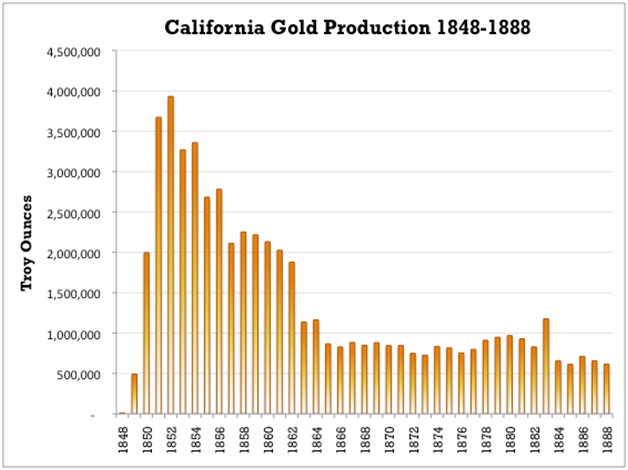
Gold production in California started in 1848 and
peaked just four years later at 3.9 million ounces (Moz). Production
continued to decline, even with using high-tech techniques of hydraulic
mining by using massive amounts of water to wash away mountain sides to
get the gold.
The California Gold Rush from 1848 to 1888 yielded approximately 57 Moz of gold. How much is this in metric tons? It turns out to be 1,773 mt. This
was one of the biggest gold discoveries in the world at the time, but
it only accounted for 1.1% of the total 155,000 mt of gold mined in the
world since 1493.Folks, there just weren’t that many big gold discoveries in the world prior to the 1900’s. Of course the huge gold discovery in the late 1800’s in South Africa was another, but again… these were few and far in between.
It wasn’t until oil was discovered in the late 1800’s were we able to seriously ramp up gold production. Here is the breakdown since 1900:
1900-1960 = 47,242 mt
1960-2014 = 104,240 mt
In the first six decades, the world produced 47,242 mt of gold, but it more than doubled in the next 54 years to 104,240 mt. I discussed this in a recent interview titled, “Mad Rush Out of Paper Assets Coming “The Data to Prove It!” You can find this topic in PART 2 towards the last third of the interview.
The official sources such as GFMS state there were a total of 170,000 mt of gold mined in the world, and this to me is pretty accurate assuming about 15-20,000 mt were mined before 1493. I say this is pretty accurate because if we make a plot on a chart over the past 2,000 years and input world population, gold, silver, lead, copper and oil production, they will all look flat up until the 1700’s. Yes, of course oil production did not come in the picture until the late 1800’s… but you will catch my drift here in a minute.
By the 1800’s world population, gold and
silver production started to move up higher and it wasn’t until the
1900’s did ALL OF THEM GO EXPONENTIAL. Why? You can thank the
exponential rise in oil production that impacted the same rate of
increase in world population, gold, silver, lead and copper production.
So, don’t count on some group to magically save the system by taking
the supposed 100,000’s mt of gold hidden in vaults around the world to
back the soon to be worthless Dollar. There’s a hell of a lot less gold
in the world than we realize.And….. when the Dollar finally does die, I would imagine there will even be a great deal less to buy.
Martin Armstrong: We are headed into a control-alt-delete reset
By 2020, according to our models based
upon rising interest rates that will unfold, the total interest
expenditure on an annual basis will exceed the total defense spending.
The current monetary system is unsustainable. Even if we leave interest
rates and assume the impractical that they will flat-line and not rise,
total interest expenditures will exceed total defense spending by 2024.
We may even see this hit by 2017 if interest rates double.
We can survive. Yes you should have some gold coins as a HEDGE against a reset in the monetary system that is coming. But that is for diversification – not to exclusion of everything else. We are headed into a control-alt-delete reset. There is no avoiding this outcome for the system is being run by lawyers who are as corrupt as they come. We need a hedge fund manager
image: http://images.intellitxt.com/ast/adTypes/icon1.png
 at this point to reset the economy – not more lawyers.
We can survive. Yes you should have some gold coins as a HEDGE against a reset in the monetary system that is coming. But that is for diversification – not to exclusion of everything else. We are headed into a control-alt-delete reset. There is no avoiding this outcome for the system is being run by lawyers who are as corrupt as they come. We need a hedge fund manager
image: http://images.intellitxt.com/ast/adTypes/icon1.png
at this point to reset the economy – not more lawyers.
We can do this. It is like
watching the weather reports and seeing a hurricane is coming. You board
up the windows and ride it out. Just get ready – that’s all. No need to
be doom and gloom. This is just one of those times that tries the soul
and forges courage and wisdom through experience. When the economy turns
down in the USA, then people will listen to you. So don’t waste your
breath now. I will be on tour in Europe for six weeks with a grueling
schedule from Poland to Barcelona. Every day I am getting another
request to speak in another city. Why? They already feel the pain. The
USA is just not quite ready for prime time. Don’t worry – it’s coming.
http://armstrongeconomics.com/2015/04/10/even-flowers-know-when-to-follow-the-sun/“There Will Be a More Volatile Crisis”: JPMorgan Chief Signals Coming Financial Tsunami
Mac Slavo
April 10th, 2015
SHTFplan.com
image: http://shtfplan.com/wp-content/uploads/2015/02/dollar-collapse-th.jpg

But JPMorgan Chase chairman and CEO Jamie Dimon is positioning his firm to pick up the pieces after it hits.
A loud warning from a person who may be considered a de facto spokesman for the insiders who prevail on Wall Street, Dimon’s comments are more than just precautionary and foreboding – they spell out the mechanism with which the big banks and the technocratic controllers will seize and concentrate power during the next crisis.
Problem-reaction-solution… and the new rules of the game.
Another crisis event is coming in the financial markets. That much is clear.
How bad it will be depends upon how well you withstand the new rules of engagement.
Dimon writes in his April 8, 2015 shareholder letter:
In the meantime, the entire playing field has been changed. Consumers and little guy institution stand to be engulfed in the aftermath of the next crisis. Problem-reaction-solution is a game the bankers know well, and have a crafted strategy for, just as a coach holds a playbook.
These “reaction” transactions of the next financial crisis will be intensified by the new financial terrain:
Good collateral will dry up; credit will be slow to extend and tough to come by; there may not be enough treasuries to soak up bad assets – and most pointedly, banks may not even accept deposits.
And many will suffer, panic and turn to the arms of JPMorgan Chase and its peers, and into the safe harbor of treasuries and government-backed instruments and institutions. The central banks and the obscured insider syndicate hold all the cards and remain in control of the solution.
image: http://shtfplan.com/wp-content/uploads/2015/03/atm-bank-financial-unavailable.jpg

The gravity will tend towards the big banking institutions – that much Dimon is assured of – and the data firms who give it “leveraged power” through technological monitoring and authorization systems. Transactions that are approved and controlled through this system will be speedy and secure; others will be slower, marginalized and perhaps even prohibitory:
What is not said in these shareholder letters is that the agreements, under the table and above board, between Wall Street, the Federal Reserve, the political circles of Washington and the various levers maintaining the status quo is that the tidal wave of corruption and criminality that triggered and consumed the 2008 Financial Crisis has been swept under the rug; the reforms have set it in, the bad players have been scolded and punished, and the game will go on.
Nothing will ever be done to hold into account the real offenses which led up to a near-total economic disaster last time. None dare call the looting, fleecing and confiscation of wealth for what it is. Not inside the system.
Throughout Dimon’s 39-page letter from April 8, he repeatedly admits that his bank never had an unprofitable quarter during the actual 2008-2009 crisis. Through the typical corporate gloating and positive spin for share holders, Dimon underscores the fact that the banking interests that he represents are admittedly stronger than ever after more than six years, and better equipped to “manage” the reactions of the next crisis, which he has admitted is sure to come.
The new system of banking – reformed from the all but the worst problems of the last crisis – retains power over its own affairs, and knows the ropes, rules and regs as only a participant in building that system could.
April 10th, 2015
SHTFplan.com
image: http://shtfplan.com/wp-content/uploads/2015/02/dollar-collapse-th.jpg
Earth shaking words from a giant on Wall Street.
The insiders know the next collapse is coming. What form it takes may
remain a surprise to account holders and investors who are not on
guard.But JPMorgan Chase chairman and CEO Jamie Dimon is positioning his firm to pick up the pieces after it hits.
A loud warning from a person who may be considered a de facto spokesman for the insiders who prevail on Wall Street, Dimon’s comments are more than just precautionary and foreboding – they spell out the mechanism with which the big banks and the technocratic controllers will seize and concentrate power during the next crisis.
Problem-reaction-solution… and the new rules of the game.
Another crisis event is coming in the financial markets. That much is clear.
How bad it will be depends upon how well you withstand the new rules of engagement.
Dimon writes in his April 8, 2015 shareholder letter:
Some things never change — there will be another crisis, and its impact will be felt by the financial market.
The trigger to the next crisis will not be the same as the trigger to the last one – but there will be another crisis. Triggering events could be geopolitical (the 1973 Middle East crisis), a recession where the Fed rapidly increases interest rates (the 1980-1982 recession), a commodities price collapse (oil in the late 1980s), the commercial real estate crisis (in the early 1990s), the Asian crisis (in 1997), so-called “bubbles” (the 2000 Internet bubble and the 2008 mortgage/housing bubble), etc. While the past crises had different roots (you could spend a lot of time arguing the degree to which geopolitical, economic or purely financial factors caused each crisis), they generally had a strong effect across the financial markets
Dimon, the consummate insider who held a board position on the powerful New York branch of the Federal Reserve
during and after the near-collapse, thinks his institution will do far
better than last time, hinting at some observations and scenarios
war-gamed by his firm’s research consultants that could be triggered by
geopolitical and currency flashpoints
Regarding the Eurozone, we must be prepared for a potential exit by Greece. We continually stress test our company for possible repercussions resulting from such an event (even though, in our opinion, after the initial turmoil, it is quite possible that it would prompt greater structural reform efforts by countries that remain).The recent volatility of oil, dropping to historic lows and setting in new tensions in global affairs and finance, while destroying jobs, may be enough to set it off. The full effects of pump prices and economic warfare via oil prices aimed at the economies of Russia, Iran and other potentially hostile nations is still very much in motion, and clearly a tinderbox.
Also regarding geopolitical crises, one of our firm’s great thinkers, Michael Cembalest, reviewed all of the major geopolitical crises going back to the Korean War, which included multiple crises involving the Soviet Union and countries in the Middle East, among others. Only one of these events derailed global financial markets: the 1973 war in the Middle East that resulted in an oil embargo, caused oil prices to quadruple and put much of the world into recession. We stress test frequently virtually every country and all credit, market and interest rate exposures; and we analyze not only the primary effects but the secondary and tertiary consequences. And we stress test for extreme moves – like the one you recently saw around oil prices. Rest assured, we extensively manage our risks. (p. 16)
Whatever the cause of the crisis, the weight of
historically unprecedented market interventions by central banks and
changing technology and practices is creating ruptures in the structure
of society that have the potential to explode during the next turn of
events, directly threatening personal wealth.
The aftermath of the 2008 crisis has slowly crippled average
Americans, sharpening the decline of the middle class, creating fierce
new waves of poverty and evaporating hopes for new opportunities and
stable jobs. Its effects have been blunted by government “reform” to
pacify the masses and media coverage to bolster optimism, and a
psychologically healing band-aid was placed over the wounds.In the meantime, the entire playing field has been changed. Consumers and little guy institution stand to be engulfed in the aftermath of the next crisis. Problem-reaction-solution is a game the bankers know well, and have a crafted strategy for, just as a coach holds a playbook.
These “reaction” transactions of the next financial crisis will be intensified by the new financial terrain:
• automated, rapid via computers, algorithms, big data;
• “shallow markets” and threatened with “illiquidity”;
• positioned to charge for deposits and transactions while less likely to lend and returning little or no interest;
• vulnerable to cyber theft and subject to account freezes;
• market “depth” limited by gravity of actions of big fish in the pond – big banks, Federal Reserve bond purchases, derivatives moved by enormous players and rapid computerized trades; dark pools of billionaires steering big deals from the shadows;
Dimon’s JPMorgan Chase has hired the tech necessary
to follow completely the actions of the entire financial spectrum –
right down to individual accounts, while “leveraging” data with 3rd
party companies using it for their own purposes and adding on a layer of
complexity to purchaser, depositor, customer data profiles.
According to Dimon, the likely mass movements of capital and
desperate players when the next run on the market sets in are fairly
predictable.Good collateral will dry up; credit will be slow to extend and tough to come by; there may not be enough treasuries to soak up bad assets – and most pointedly, banks may not even accept deposits.
And many will suffer, panic and turn to the arms of JPMorgan Chase and its peers, and into the safe harbor of treasuries and government-backed instruments and institutions. The central banks and the obscured insider syndicate hold all the cards and remain in control of the solution.
Many things will be different — for example, there will be far more risk residing in the central clearinghouses, and non-bank competitors will have become bigger lenders in the marketplace. Clearinghouses will be the repository of far more risk than they were in the last crisis because more derivatives will be cleared in central clearinghouses. It is important to remember that clearinghouses consolidate – but don’t necessarily eliminate – risk.
There already is far less liquidity in the general marketplace: why this is important to issuers and investors. […] For issuers, it reduces their cost of issuance, and for investors, it reduces their cost when they buy or sell. Liquidity can be even more important in a stressed time because investors need to sell quickly, and without liquidity, prices can gap, fear can grow and illiquidity can quickly spread – even in supposedly the most liquid markets.
[…]Market depth is far lower than it was, and we believe that is a precursor of liquidity. For example, the market depth of 10-year Treasuries (defined as the average size of the best three bids and offers) today is $125 million, down from $500 million at its peak in 2007. The likely explanation for the lower depth in almost all bond markets is that inventories of market-makers’ positions are dramatically lower than in the past. For instance, the total inventory of Treasuries readily avail – able to market-makers today is $1.7 trillion, down from $2.7 trillion at its peak in 2007. Meanwhile, the Treasury market is $12.5 trillion; it was $4.4 trillion in 2007.
The determination of markets around Federal Reserve
policy is critical. “Hints” of the Fed slowing its bond purchases
caused such an “unprecedented” and significant disturbance in the
market, that statisticians claimed it was a once-in-3-billion-years
event:
Recent activity in the Treasury markets and the currency markets is a warning shot across the bow.Dimon notes many factors that are different from the 2008 era and which will determine the outcome of emergencies to come.
Treasury markets were quite turbulent in the spring and summer of 2013, when the Fed hinted that it soon would slow its asset purchases. Then on one day, October 15, 2014, Treasury securities moved 40 basis points, statistically 7 to 8 standard deviations – an unprecedented move – an event that is supposed to happen only once in every 3 billion years or so (the Treasury market has only been around for 200 years or so – of course, this should make you question statistics to begin with). Some currencies recently have had similar large moves. Importantly, Treasuries and major country currencies are considered the most standardized and liquid financial instruments in the world.
image: http://shtfplan.com/wp-content/uploads/2015/03/atm-bank-financial-unavailable.jpg
Today, banks are starting to charge customers for deposits, a reflection on the insane effects of negative interest rates.
Tomorrow, when the next crisis hits, megabanks like JPMorgan Chase may not accept deposits at all, according to Jamie Dimon’s assessment:And now, a thought exercise of what might be different in the next crisis
In a crisis, weak banks lose deposits, while strong banks usually gain them. In 2008, JPMorgan Chase’s deposits went up more than $100 billion.It is unlikely that we would want to accept new deposits the next time around because they would be considered non-operating deposits(short term in nature) and would require valuable capital under both the supplementary leverage ratio and G-SIB.
In a crisis, everyone rushes into Treasuries to protect themselves. In the last crisis, many investors sold risky assets and added more than $2 trillion to their ownership of Treasuries (by buying Treasuries or government money market funds). This will be even more true in the next crisis. But it seems to us that there is a greatly reduced supply of Treasuries to go around – in effect, there may be a shortage of all forms of good collateral.[…]
It is my belief that in a crisis environment, non-bank lenders will not continue rolling over loans or extending new credit except at exorbitant prices that take advantage of the crisis situation.
[…]
The markets in general could be more volatile — this could lead to a more rapid reduction of valuations
Moreover, JPMorgan and other big banks are expanding their policies of charging customers to hold deposits, validate funds and make transactions – charges that JPMorgan sees as the “true cost of moving money.”
With new measures for cybersecurity, fraud protection and payment
verification in mind, JPMorgan is slated to tack on new processing fees
and add costs for all transactions, and especially ‘outmoded’ payments
like cash and checks and the loafing “free riders” who use them:For example, it costs retailers 50-70 basis points to use cash (due to preventing fraud and providing security, etc.). And retailers often will pay 1% to an intermediary to guarantee that a check is good. A guaranteed check essentially is the same as a debit card transaction for which they want to pay 0%. For some competitors, free riding is the only thing that makes their competition possible. Having said that, we need to acknowledge our own flaws. We need to build a real-time system that properly charges participants for usage, allows for good customer service, and minimizes fraud and bad behavior.Technology is changing your access to financial markets, loans and ultimately your own money.
The gravity will tend towards the big banking institutions – that much Dimon is assured of – and the data firms who give it “leveraged power” through technological monitoring and authorization systems. Transactions that are approved and controlled through this system will be speedy and secure; others will be slower, marginalized and perhaps even prohibitory:
Big, fast data. We continue to leverage the data generated across JPMorgan Chase, as well as data that we purchase to create intelligent solutions that support our internal activities and allow us to provide value and insights to our clients. For example, we are monitoring our credit card and treasury services transactions to catch fraudulent activities before they impact our clients, we are helping our clients mitigate costs by optimizing the collateral they post in support of derivatives contracts, and we are highlighting insights to our merchant acquiring and co-brand partners.
[…]Moreover, Silicon Valley is moving into Wall Street to use big data in making big changes in traditional banking practices. Loans and other instruments can be approved and move faster, while start up tech firms gain the position of underwriting loans with data-based practices and steering the development of the new system. Dimon writes: Silicon Valley is coming. There are hundreds of startups with a lot of brains and money working on various alternatives to traditional banking. The ones you read about most are in the lending business, whereby the firms can lend to individuals and small businesses very quickly and – these entities believe – effectively by using Big Data to enhance credit underwriting. They are very good at reducing the “pain points” in that they can make loans in minutes, which might take banks weeks.
Tech firms are admittedly steering this brave new system of banking.
As for the unspoken levels of funny business that invariably go on
during crisis of all types – in finance, in wars and in social upheavals
– Dimon naturally says very little.What is not said in these shareholder letters is that the agreements, under the table and above board, between Wall Street, the Federal Reserve, the political circles of Washington and the various levers maintaining the status quo is that the tidal wave of corruption and criminality that triggered and consumed the 2008 Financial Crisis has been swept under the rug; the reforms have set it in, the bad players have been scolded and punished, and the game will go on.
Nothing will ever be done to hold into account the real offenses which led up to a near-total economic disaster last time. None dare call the looting, fleecing and confiscation of wealth for what it is. Not inside the system.
Throughout Dimon’s 39-page letter from April 8, he repeatedly admits that his bank never had an unprofitable quarter during the actual 2008-2009 crisis. Through the typical corporate gloating and positive spin for share holders, Dimon underscores the fact that the banking interests that he represents are admittedly stronger than ever after more than six years, and better equipped to “manage” the reactions of the next crisis, which he has admitted is sure to come.
The new system of banking – reformed from the all but the worst problems of the last crisis – retains power over its own affairs, and knows the ropes, rules and regs as only a participant in building that system could.
In the new world, in order to improve the consistency of controls, regulators have demanded that most risk and control functions be centralized, including Risk, Compliance, Finance, Oversight & Control, Audit and Legal. In doing this, we have given huge amounts of additional authority to functions at our corporate headquarters.
The possibility of “rigging markets” and
manipulating economic events not only remains in the hands of the
largest banking corporations, but it is stronger than ever with a firm
partnership between Silicon Valley and Wall Street that is directing the
course of events.
Stand by for rough seas.Obama lands in Latin America while ‘China is running away with the gold’ in the region
Obama lands in Latin America while ‘China is running away with the gold’ in the region
Opening a three-day trip to the Caribbean and Central America, US President Barack Obama hopes to capitalize on mutual needs in the face of expanding Chinese influence and weakening power by Venezuela, once the energy juggernaut of the Americas.
And for the US, this is an opportunity to get back in the game.
Venezuela can’t afford this anymore. The country’s inflation rate has soared to more than 60%, people wait in line for days to find basic goods like milk and toilet paper, President Maduro’s approval rating has collapsed to below 30%, and his opposition — though fragmented — is still taking to the streets.
The culprit for Venezuela’s woes is economic mismanagement as much as it is falling oil prices.
Shuffling cash from here to there
While oil makes up 95% of the country’s exports and over 60% of its revenue, Venezuela has done nothing to solve these problems.
What it has done, however, is delay disaster by moving some money around and asking for a little help from the friends Chavez made. For example, the Dominican Republic managed to throw Venezuela some cash by selling debt it owed Venezuela to Goldman Sachs.
Opening a three-day trip to the Caribbean and Central America, US President Barack Obama hopes to capitalize on mutual needs in the face of expanding Chinese influence and weakening power by Venezuela, once the energy juggernaut of the Americas.
Obama’s arrival Wednesday
evening in Kingston, Jamaica, was low-key compared with the excitement
he stirred in the Caribbean upon his election in 2008. Greeted at the
airport tarmac by dignitaries including Prime Minister Portia Simpson
Miller, Obama slipped into a motorcade that ran through mostly quiet,
empty streets.
The visit comes amid a perception that Obama’s
interest in the region has failed to materialize. Yet his travels —
first to Jamaica, then to the Summit of the Americas in Panama — follow a
year of increased attention to the region by the US president. His
immigration executive orders, his efforts to slow the influx of Central
American minors to the US border, and his diplomatic outreach to Cuba
have put a foreign policy spotlight on US neighbors to the south.
Obama on Thursday will meet with Simpson Miller
and with other leaders in the 15-member Caribbean Community. He also
plans to speak to young regional leaders in a town-hall setting,
continuing a tradition of engaging new generations in foreign political
and civil society institutions.
The president promptly paid tribute to the
island’s cultural hero, the late reggae star Bob Marley, making an
unscheduled visit Wednesday night to the legendary singer’s museum. He
toured Marley’s former home as Marley’s hit “One Love” played through
the building’s sound system.
Venezuela is betraying its friends to survive
To make it through 2015 without going into crippling default,
Venezuela must break promises that made it possible for late President
Hugo Chavez to build a strong relationship with Latin American and
Caribbean nations largely forgotten by the Obama Administration.And for the US, this is an opportunity to get back in the game.
The fundamental promise Venezuela must break is a program called Petrocaribe.
The initiative sold Venezuelan oil to countries like Jamaica and the
Dominican Republic at rock-bottom prices with almost no interest. It’s
part of what led countries that don’t share the ideals of Venezuela’s
unique brand of socialism to call Hugo Chavez and current President
Nicolas Maduro friends.Venezuela can’t afford this anymore. The country’s inflation rate has soared to more than 60%, people wait in line for days to find basic goods like milk and toilet paper, President Maduro’s approval rating has collapsed to below 30%, and his opposition — though fragmented — is still taking to the streets.
The culprit for Venezuela’s woes is economic mismanagement as much as it is falling oil prices.
Shuffling cash from here to there
While oil makes up 95% of the country’s exports and over 60% of its revenue, Venezuela has done nothing to solve these problems.
What it has done, however, is delay disaster by moving some money around and asking for a little help from the friends Chavez made. For example, the Dominican Republic managed to throw Venezuela some cash by selling debt it owed Venezuela to Goldman Sachs.
Thursday, April 2, 2015
My Invite Pay
MyInvitePay is a new innovating and internet job site, where you will be hired to do some tasks, different in type and number. and you will be paid a estimated reward for that instant in your account, after it the job poster will review the service and approve the status for your payout, then you will be paid for your work via Cheque. Other Payment options are also coming soon. You have to create a account with us to start and login to your member area, and do daily your jobs and you will be really great after using our service.
We guarantee you that you will earn 1500$ in your first week by simple task of 5 - 10 minute
Please register on the below link is free, after register u get USD25
http://myinvitepay.com/?ref=281868
Subscribe to:
Posts (Atom)