Tuesday, March 10, 2015

Top Asset Manager Warns Of Risks In Banking System: “It’s The Biggest Reason To Own Precious Metals”

Mac Slavo
March 10th, 2015
SHTFplan.com

Top alternative asset manager Eric Sprott, whose company has $10 billion in assets under management, sounds the alarm about the day everyone in America finally realizes that the real economy has collapsed.
In a highly informative interview from one of the most respected financial analysts in the world, Sprott explains why he believes gold, silver and hard asset investments are the only way to prepare for the risks associated with a highly leveraged banking system and out of control monetary policy.
I think they’ll just keep running it along until some day something gives. What that giving thing is I’m not exactly certain… Maybe it’s we end up with job losses… people just don’t have the income and all of a sudden you continue to get these weak reports… whether it’s McDonald’s or Caterpillar or HP… and they keep announcing layoffs and so on… it becomes apparent to everyone that there is no recovery…
I think if we look back these last five years, other than the stock market there’s been very little that happened in the real economy that would give anybody confidence. People  have real issues to deal with… when you realize 60% of the population is living paycheck to paycheck it doesn’t take much to tip them over the edge.

(Watch Interview at Future Money Trends)
We have a very insane financial situation going here where the savers are punished and the borrowers get the benefit of it all.
…
In my mind the biggest reason to own precious metals is because of the risks in the banking system… you get nothing for putting your money in the bank… and yet when you have your money in the bank you take on all the risks of a leveraged bank… and I’ve always thought it’s the risks in the banking system that would cause people to go to gold…
And now you have another level of concern out there and that is, of course, the currency risk. We’ve seen so many currencies that have been incredibly weak…
The reasons to own gold are now two-fold.
The reasons to have those assets, which protect you in an economic decline… knowing that an economic decline causes financial problems, which is what’s going to happen here.
…
I continue to be a buyer here… I’ve had a couple of announcements out this week where I’ve taken on significant interest in some of the smaller Canadian producers… I just think that the reasons to think that gold and silver could rally here are higher… the returns on these things could be staggering.
While Eric Sprott is well known for his successful investments in precious metals equities, including his own gold and silver backed Exchange Traded Funds, the Forbes billionaires list  suggests that he also holds as much as 90% of his assets in physical gold and silver.
Sprott, like many others, realizes that the “extend-and-pretend” policies being implemented by the financial and political elite will one day end in disaster for the majority of the population. It’s for this reason that high net worth individuals and others who understand the consequences have been buying up land outside of major cities and preparing emergency strategic relocation plans.

Top Asset Manager Warns Of Risks In Banking System: “It’s The Biggest Reason To Own Precious Metals”

Top alternative asset manager Eric Sprott, whose company has $10 billion in assets under management, sounds the alarm about the day everyone in America finally realizes that the real economy has collapsed.
In a highly informative interview from one of the most respected financial analysts in the world, Sprott explains why he believes gold, silver and hard asset investments are the only way to prepare for the risks associated with a highly leveraged banking system and out of control monetary policy.
I think they’ll just keep running it along until some day something gives. What that giving thing is I’m not exactly certain… Maybe it’s we end up with job losses… people just don’t have the income and all of a sudden you continue to get these weak reports… whether it’s McDonald’s or Caterpillar or HP… and they keep announcing layoffs and so on… it becomes apparent to everyone that there is no recovery…
I think if we look back these last five years, other than the stock market there’s been very little that happened in the real economy that would give anybody confidence. People  have real issues to deal with… when you realize 60% of the population is living paycheck to paycheck it doesn’t take much to tip them over the edge.

(Watch Interview at Future Money Trends)
We have a very insane financial situation going here where the savers are punished and the borrowers get the benefit of it all.
…
In my mind the biggest reason to own precious metals is because of the risks in the banking system… you get nothing for putting your money in the bank… and yet when you have your money in the bank you take on all the risks of a leveraged bank… and I’ve always thought it’s the risks in the banking system that would cause people to go to gold…
And now you have another level of concern out there and that is, of course, the currency risk. We’ve seen so many currencies that have been incredibly weak…
The reasons to own gold are now two-fold.
The reasons to have those assets, which protect you in an economic decline… knowing that an economic decline causes financial problems, which is what’s going to happen here.
…
I continue to be a buyer here… I’ve had a couple of announcements out this week where I’ve taken on significant interest in some of the smaller Canadian producers… I just think that the reasons to think that gold and silver could rally here are higher… the returns on these things could be staggering.
While Eric Sprott is well known for his successful investments in precious metals equities, including his own gold and silver backed Exchange Traded Funds, the Forbes billionaires list  suggests that he also holds as much as 90% of his assets in physical gold and silver.
Sprott, like many others, realizes that the “extend-and-pretend” policies being implemented by the financial and political elite will one day end in disaster for the majority of the population. It’s for this reason that high net worth individuals and others who understand the consequences have been buying up land outside of major cities and preparing emergency strategic relocation plans.

McDonald’s Same Store Sales Drop 4% As Customer Demand Healthier Options

(Bruce Horovitz‘)  February was an ice-cold month for McDonald’s, with same-store sales dropping 4% in its troubled U.S. stores and 1.7% globally.
The burger giant announced the worse-than-expected results Monday, but its stock still posted a gain, closing up 0.6% to $97.71.
The monthly report will be the last to trace back to former CEO Don Thompson. He was replaced by Steve Easterbrook on March 1, and all sales reports going forward will technically fall under Easterbrook’s leadership, who already is under tremendous pressure to quickly right the ship.
The company seemed to concede as much in its statement that went out with Monday’s poor results. “Consumer needs and preferences have changed and McDonald’s current performance reflects the urgent need to evolve with today’s consumers, reset strategic priorities and restore business momentum,” the company said.
Beyond the disappointing U.S. numbers for stores open at least 13 months, monthly sales for the Asia/Pacific, Middle East and Africa region were down 4.4%. The only ray of light was Europe, where sales were up 0.7%.
“While changes are in the works, we cannot identify a near-term catalyst to spur sales,” says Sterne Agee analyst Lynne Collier in a note to investors.

The February results follow a strategic “Turnaround Summit” that executives held with franchisees last week in Las Vegas. The company made news at the summit by announcing plans to curtail the use of human antibiotics in its chicken over the next two years. At an investors’ conference last week, McDonald’s also said it planned to launch a mobile app this summer that may also be part of a loyalty program — a move the chain conceded some key fast-food rivals already have made.
One analyst says McDonald’s is admitting that its troubles run long and deep.
“It’s interesting that McDonald’s had a ‘Turnaround Summit’ last week in an effort to address its U.S. sales decline. The focus for the fast-food chain will be on enhancing the restaurant experience, which it hopes will help curb the decline,” says Joshua Raymond, chief market strategist at City Index UK. “The fact that the firm has openly stated this in their monthly sales statement and used the word ‘turnaround’ gives greater weighting to the issues they are facing.”
One large investment group, which last month sent a letter to McDonald’s directors calling for new membership and leadership of its board, said that beyond new management, McDonald’s still needs to revamp its board.
“We are hopeful Easterbrook can reverse this trend, but believe new vision must be injected at the board-level, too, if McDonald’s is to reposition itself to succeed globally and generationally,” said Dieter Waizenegger, executive director of the CtW Investment Group, in a statement.
In its own statement, McDonald’s spelled out its goal in no uncertain terms: “To be a true destination of choice around the world and reassert McDonald’s as a modern, progressive burger company.”

“47 percent” of U.S. jobs are at risk because of advancing technologies

(Daniel Rivero)  Somewhere out there, a robot is scheming to take my job. About a year ago, a breaking news story about a Los Angeles earthquake was fully written by a robot. Gathering data it received from the U.S. Geological Survey, an algorithm wrote and published the story on the Los Angeles Times’ website less than three minutes after the trembling began.
News organizations freaked out, some labeling the event as the “rise of the robot reporter,” sending all of us into a soul-searching quest to defend ourselves in the face of such a formidable adversary. “But my writing is original, and it oozes with style,” many a reporter defiantly told themselves. “A data-crunching robot could never fill my position!”
At The WorldPost Future of Work conference in London, a similar anxiety has begun to emerge—if not with workers, then with the economists who study them.
“According to our research, 47 percent of jobs in the U.S. are at risk from technology over the next 20 years,” Michael Osbourne, a co-director of the Oxford Martin Programme on Technology and Employment, told me. The group’s research combined U.S. Bureau of Statistics data with a complex machine-learning algorithm of its own to draw its conclusions.
For example, in retail, an algorithm might be a better predictor of customer preferences than a human salesperson thanks to the amount of data companies collect, he said. Logistics will be impacted by fast-moving advancements in autonomous vehicle technology that few took seriously just a few years ago.
“Forklift drivers, truck drivers, agricultural vehicle drivers,” Osbourne listed. “Those jobs could be gone very soon.”
There are some recent trends experts are sharing which show how this new world might look like, when the small percentage of individuals or corporations that own machines (the means of production) are the only ones able to make money, and as the rest of us (the middle class) lose our jobs for the simple fact that #RobotsDoItBetter.
Take the most-talked-about slide of the day (seen below), courtesy of Anthony McAfee, associate director of the Center for Digital Business at the MIT Sloan School of Management. The line that has been going up since about 2002 represents total gross domestic product (GDP) in the U.S. The line that is going down represents wages paid as a percentage of that GDP:
B_UtzHeW8AAQHX9

“This is not just an American phenomenon, it is not even a rich world phenomenon. This same decline in labor share is happening in most countries where we have data across the world, including places like China, India and Mexico,” McAfee said.
“China is not offshoring to find cheaper labor,” he added. “There is obviously something else going on here.”
“It’s a societal problem,” Dr. Laura Tyson, professor of Business Administration and Economics, at Berkeley-Haas School of Business told me.
In the U.S., she notes, most job growth is already happening towards the bottom of the pay scale, much of which is driven by people whose traditional middle income manufacturing jobs have been lost to increasingly productive robots in the factory.
“I tend to worry about the quality of the job that will be available for them in the long run,” she said.
Few feel that governments are adequately preparing for the shift. Some, however, feel that increased productivity thanks to machines will let humans focus on something we are infinitely better at doing than robots: creative thinking.
“The remaining jobs will be increasingly creative and increasingly social,” said Osbourne, the Oxford researcher who says 47 percent of jobs are at risk. “I actually think it will be better for society, because these are tasks that we tend to do in our spare time as hobbies, and as we are more displaced by machines it will leave these more fundamentally human tasks to perform.”
Which sounds pretty good for people like me, who would love to refine the craft we feel most passionate about. Except… Osbourne’s final take on my question if this shift might benefit the arts in the long run left me feeling pretty dismal:
“Benefit? Hmmm,” he started. “I think there will be new kinds of art, and more people will be freed up to make art, but wages will probably get less competitive in the arts, especially because there’s going to be a lot more supply.”

When wheelbarrows are filled with useless paper. Commodities historically become the accepted medium of exchange.


When wheelbarrows are filled with useless paper. Commodities historically become the accepted medium of exchange. A stalwart of this basic reality, Alan Greenspan was a full blown laisezz faire capitalist. A direct disciple of Ayn Rand’s objectivist fundamental philosophy. He was very close with Rand. Even inviting her to his swearing in to Gerald Ford’s Council of Economic Advisors before eventually becoming The Chairman of the Federal Reserve from 1987 to 2006. His oversight on tax cuts and Social Security privatization were largely blamed as the catalyst that created the subprime mortgage crisis.
Now the Wall Street Journal Reports The Federal Reserve Bank of New York, once the most feared banking regulator on Wall Street, has lost power in a behind-the-scenes reorganization at the nation’s central bank. Jon Bowne reports on the warning signs leading up to the Fed’s apparent implosion.
“Laissez-faire capitalism is the only social system based on the recognition of individual rights and, therefore, the only system that bans force from social relationships. By the nature of its basic principles and interests, it is the only system fundamentally opposed to war.” Ayn Rand

Did HSBC Just Close All 7 of Its Gold Vaults?


Only a few weeks ago, HSBC announced that it was imposing restrictions on large cash withdrawals. The BBC reported how some HSBC customers were not allowed to withdrawal large amounts of cash, fueling fears of a bank run, or worse.

Zero Hedge reported: “HSBC admitted it has not informed customers of the change in policy, which was implemented in November for their own good: “We ask our customers about the purpose of large cash withdrawals when they are unusual… the reason being we have an obligation to protect our customers, and to minimise the opportunity for financial crime.” As one customer responded: “you shouldn’t have to explain to your bank why you want that money. It’s not theirs, it’s yours.”

Now there’s more trouble. Now we’re told that HSBC is “closing” its gold vaults.

Question: Was there anything in them to begin with?

1-Gold-Vault

Who Smashed Gold Today And Why As HSBC Shocks Clients By Closing All London Gold Vaults


King World News

Today London metals trader Andrew Maguire spoke with King World News about who smashed the price of gold today and why as HSBC just shocked clients by announcing the closure of all gold vaults in London!
Maguire also discussed what is happening in the physical gold market as well as what the bullion banks are up to.

Today’s Gold Smash Is Western Government Intervention

Andrew Maguire:  “Eric, here we are again after another heavily gamed Non-Farm Payrolls (NFP) report week that evidences just how ‘managed’ the paper markets are. Given the strong Indian and Chinese demand above $1,200 and the currency crosses related to gold that were net-positive all week, there was no reason to paint gold down ahead of today’s NFP. Given that the physical market is strong, the Comex-centric selling has all the hallmarks of ‘official’ selling.

Massive Physical Demand

What I am saying is that there was massive physical buying above $1,200.  So there was no reason for today’s takedown other than to flush the paper markets of some weak-handed longs, and for the commercials to cover shorts and add to their long positions.

Bank Of England And Fed Fingerprints

Real Comex open interest has declined by some 250,000 contracts in the last 4 years, leaving what remains in the hands of a few directional high-frequency trading algorithms controlled by a few CME insiders, who also happen to be the same 6 market-making bullion banks that have gold accounts with the Bank of England. Considering the FED had the NFP data days ahead of the release, it is highly unlikely these agent banks were not privy to the data as well.

What this synthetic gaming has done is drive out almost all ‘real’ open interest into an increasingly liquid physical market outside the tendrils of a handful of collusive banks. This migration has now reached an inflection point and reverse leverage is about to run these banks over.

Physical Demand Exceeds Mine Supply – Takedown Is Naked Short Selling

The downside manipulations have become so embarrassingly obvious to anyone connected to the strong physical markets. There is no way of hiding that these sales are conducted in the face of a market where physical demand continues to exceed mine supply, meaning these sales can only be effected by way of high leveraged naked short selling.

Bullion Banks’ 100/1 Leveraged Paper Positions

These too-big-to-fail banks are once again playing a high-risk game with taxpayer money. They are so obviously mismatched to their underlying physical holdings that large institutional entities are unwinding their fractional gold and silver risks…

Continue this story at King World News

How America Added 17 Million People In 7 Years… And Zero Full-Time Jobs

View image on Twitter
How America Added 17 Million People In 7 Years... And Zero Full-Time Jobs http://www.zerohedge.com/news/2015-03-07/amazing-math-bls-how-america-added-17-million-jobs-7-years-and-zero-full-time-jobs …

Amazing Math from the Bureau of Labor Statistics
According to the most recent Bureau of Labor Statistics release, the UE (unemployment) rate fell to 5.5% as of February.  The last time the UE rate was this low was May of 2008.
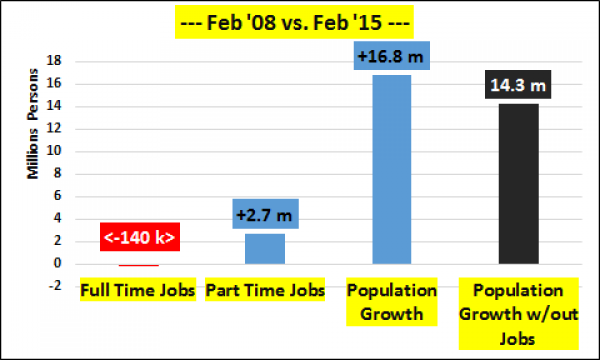
What I’m fascinated by is the fact that the US population grew from February 2008 to February 2015 by 16.8 million persons, or a 5.5% increase in total population, and on a net basis, not a single one of those 16.8 million persons got a FT (full time) job… while a net 2.7 million were lucky enough to get a (or multiple) PT (part time) job.
This means that 14.3 million persons, or 4.4% of the current US population, were added without a single job among them (chart below).  This makes for fascinating math when a 4.4% increase of the total US population without jobs can nearly halve the UE rate down to 5.5%, equal to 2008’s UE rates?!?
http://www.zerohedge.com/news/2015-03-07/amazing-math-bls-how-america-added-17-million-jobs-7-years-and-zero-full-time-jobs