Friday, March 6, 2015

Mainstream Financial Experts Recommend: Take Out A Loan And Invest In Stock Markets

shoeshineboy(Pictured: Shoeshine Boy In New York City Circa 1924)
The anecdote goes that avid investor Joe Kennedy was on his way to work in the winter of 1928 and stopped to have his shoes shined. When the shoeshine boy finished he offered up a tip to Kennedy.
“Buy Hindenburg,” he told the millionaire.
Kennedy soon unloaded most of his holdings. When pressed by friends and associates about his reason for selling, Kennedy quipped:
“You know it’s time to sell when shoeshine boys give you stock tips. This bull market is over.”
Less than a year later stock markets around the world collapsed, leaving tens of millions of people impoverished for decades to come.
Kennedy knew something was wrong when everyone, including a shoeshine boy, was talking about the stock market as some sort of magical money making tree.
While the circumstances today may not be exactly like those of the 1920′s, one can’t help but see the similarities.
And though we don’t know of any shoeshine boys giving stock tips today, the following CNBC segment offers a similar warning of market exuberance and irrationality.  In it, several well known financial pundits discuss a new strategy that can help you generate serious gains.
As we all know it takes money to make money. But where do you get your investment capital?
Take out a loan, of course, because stock market prices, like real estate values, can only go up from here.
Watch below as Bill Griffeth and Kelly Evans host WSJ’s Jonathan Clements and Premier Financial Advisors’ Mark Martiak for a discussion on what we’re calling the car-stock arbitrage wherein you are (literally) encouraged to take out a 7 year loan with a rapidly amortizing asset as collateral in order to buy stocks. (Zero Hedge)

Wall Street Journal financial columnist Jonathan Clements explains how you, too, can make money in a stock market that has reached all-time highs:
I think it’s a reasonable trade-off. You know, borrow at three or four percent and then go up and invest in the stock market. I wouldn’t actually really be that concerned about whether the car is going to depreciate or not. Yeah, we know the car is going to lose half of its value in the first four years…
The question is ‘what is the better financial transaction to do?’
And if you take a holistic view of your finances, yeah you probably want to take out that loan and invest in equities.
There you have it.
Oh, and when you do get that low interest loan, don’t forget to “Buy Hindenburg.”

US tech companies have stashed over $420 billion overseas


Google Ireland
It's no secret that the US government wants companies to bring more of their offshore profits back home for the sake of taxes, and it's now exceptionally clear as to why. Bloomberg has sifted through financial filings and discovered that the top eight American tech firms, including Apple, Google and Microsoft, are keeping more than $420 billion overseas -- $69 billion of it added in just the past year. That's over a fifth of the $2.1 trillion held abroad by American companies, and would easily cover a lot of government expenses. A tax on Microsoft's recent profits alone ($29.6 billion) would cover NASA and the Commerce Department for a year; Apple ($23.3 billion) could take care of the Transportation Department and Social Security, and Oracle could foot the bill for the Labor Department.
The reasoning for this creative accounting is the same as always: the companies don't want to pay the full US corporate tax rate (including repatriation taxes) when they know that they can easily shuffle that money elsewhere and shell out much less. It may be tough to keep this income out of the States forever, though. While President Obama didn't have much luck this year with a measure that would slap taxes on both past and ongoing foreign earnings, he's continuing to talk with executives in hopes of reaching a compromise. It's hard to imagine officials simply walking away from a huge potential revenue source.
[Image credit: AP Photo/John Cogill]
Source: Bloomberg More Coverage: Joshua Topolsky (Twitter)

Minority Groups Rally Outside Fed

Victoria speaks at the rally outside the Federal Reserve today (Photo: Will Bredderman/New York Observer).
Minority activist organizations demonstrated in the snow outside the Federal Reserve Bank of New York, insisting that the institution keep interest rates low until stubbornly high unemployment rates in nonwhite communities drop further.
Immigrant advocacy group Make the Road NY and neighborhood organizers New York Communities for Change joined other left-leaning groups outside the lower Manhattan headquarters of the New York Fed, a branch of the national system that controls the interest rates at which lending institutions may borrow money from the United States government. The Fed has left the rates near zero since the financial crisis of 2008 in order to encourage investment, but it has indicated it might raise them this summer amid an improving economy.
The protesters, however, argued that black and Hispanic communities in New York City are still languishing in an economic doldrums, with jobless rates sitting at 11.2 percent and 5.7 percent respectively.
“These unemployment rates are not going to be better by this summer. We’re not a couple months away from a recovery,” said Shawn Sebastian from the Center for Popular Democracy, arguing that the Fed is looking only at a general joblessness picture that averages in the relatively low unemployment rates among whites. “They’re trying to look at the aggregate levels of unemployment and ignore how it’s disproportionately affecting minority communities to push this narrative about a recovery that we’re not experiencing.”
http://observer.com/2015/03/minority-groups-rally-outside-fed-against-interest-rate-hike/

Mr. Ponzi – Patron Saint


Mr. Ponzi was a charming con-artist who operated about a century ago in the United States and Canada.  He enticed investors to contribute new money to his investment scheme (100% return in 90 days), skimmed a portion for his luxurious needs, and used the remaining money to pay off prior investors.  The system worked marvelously until it collapsed and people realized that his postal reply coupon investments could not produce the profits that supposedly paid off early investors.
More recent “Ponzi” examples include Bernard Madoff as well as hundreds of others, plus the Alan Harper character in season 8 of “Two and One Half Men.”  However Ponzi schemes are not limited to private investments.  Governments engage in similar plans and have the advantage of declaring them legal.  As with private plans, they work until they collapse, although their government granted legality increases their longevity.
Perhaps Charles Ponzi deserves recognition as the patron saint of central bankers and politicians.  Consider these systems that are similar to Ponzi schemes:
  • SOCIAL SECURITY: Current workers contribute a percentage of their wages into the Social Security system.  Retiring workers collect benefits paid by current contributions from existing workers.  If there were no current workers there could be no payout since all previous contributions have been spent.  Is this a retirement system or a Ponzi scheme?
  • SOVEREIGN DEBT: For example, a government annually spends a trillion currency units more than its income.  It borrows the difference (deficit spending).  A portion of the annual expenses is used to pay interest on debt accrued in previous years.  Debt is never retired, but always rolled over as new money repays older investments.  Since 2008 much of the new money has been “printed” and not collected as tax or other revenue due to the weak economy.  The total debt has increased rapidly.  Unfortunately, there are consequences from the creation of trillions of currency units – eventually the cost of living for all who must use the currency units is increased.
  • FRACTIONAL RESERVE BANKING – a simple example: A bank receives a deposit of 1 billion currency units and creates from nothing 10 billion currency units.  The bank lends those 10 billion units to a hedge fund, who deposits 1 billion currency units back into an account at the bank.  The bank collects interest on 10 billion units and repeats the process with other depositors and other loans.
The old investor (original deposit) has been repaid with new money created in the fractional reserve banking scheme.  This works until too many depositors want their deposits returned about the same time (bank run), or the loans can’t be repaid.  (Think 2008 crisis, Cyprus 2013, or Greece today).  Unfortunately, the depositor will discover that he is an unsecured creditor of the bank and that his deposit is not “his money” but a liability of the bank which might not be repaid.  FDIC and government guarantees only go so far.

IN THE END …
Ponzi schemes work until they can no longer continue since they are based on a shaky business model.  Ask yourself:
  1. Can enough new investors be found such that ever increasing old investments plus supposed earnings will be paid back – forever?
  2. If the number of workers supporting retirees is declining, can new contributions from those workers support an increasing number of retirees – forever?
  3. If currency units can be created practically without limit in a fractional reserve fiat banking system, can we expect the value of currency units to remain constant – forever? Instead we know the increased number of currency units in circulation increases prices.  For instance, a cup of coffee might cost 5 cents before massive currency increases and $2 or $5 or $50 after such massive currency creation.
What should we do to hedge against the massive increase in the number of (Ponzi-like) currency units?  Hard assets such as gold, silver, diamonds, land, and real estate may protect you from the devaluation of currency units.
Gold and silver are long-term insurance to help protect from Ponzi economics and devaluing currency units.

Gary Christenson
The Deviant Investor

Leave a Reply

Your email address will not be published. Required fields are marked *
You may use these HTML tags and attributes:

FY 2014 Silver Eagle Dollar Sales Surpass Gold Eagles By Wide Margin

by SRSrocco
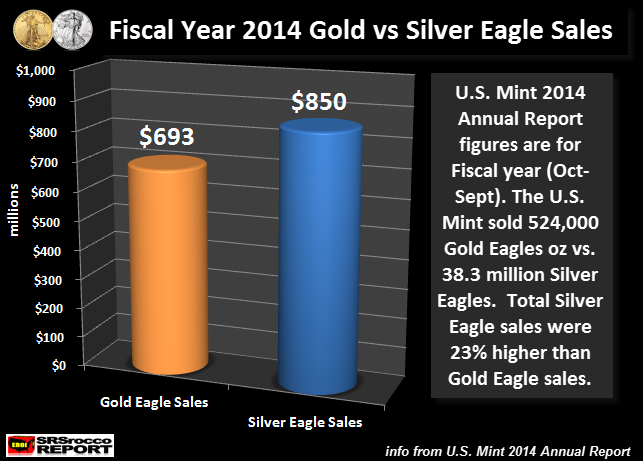
The U.S. Mint just released its FY 2014 Annual Report and the total Dollar sales of Silver Eagles surpassed Gold Eagles by a wide margin.  Unfortunately, the U.S. Mint’s Annual Reports are based on Fiscal Year accounting, so their figures do not correspond to the data released on their website.
For example, the U.S. Mint sold 44 million ounces (Moz) of Silver Eagles in 2014, and 524,500 Gold Eagle oz.  However, the Fiscal Year figures are from Oct 2013 to Sept 2014, which only show 38.3 Moz of Silver Eagles versus 524,000 Gold Eagles.
According to the data put out in the U.S. Mint 2014 Annual Report, total sales of Silver Eagles were $850 million compared to $693 million in Gold Eagle sales. 
image: http://srsroccoreport.com/wp-content/uploads/Fiscal-Year-2014-Gold-vs-Silver-Eagle-Sales.png
Fiscal Year 2014 Gold vs Silver Eagle Sales
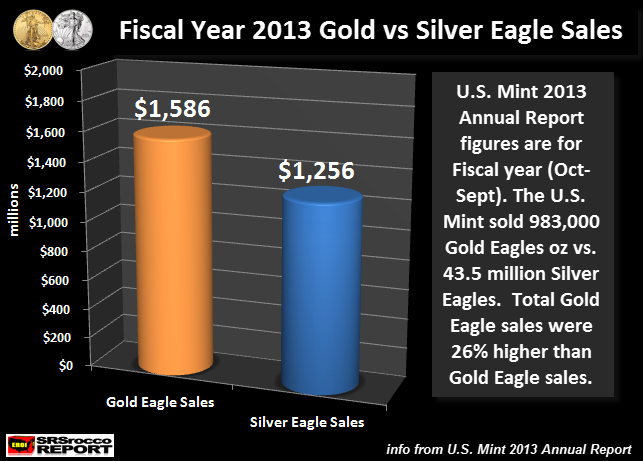
Thus, Silver Eagle Dollar sales were 23% higher than Gold Eagles in FY 2014.  Now, if we look at the figures for FY 2013, we see a much different picture.  In FY 2013, the U.S. Mint sold 983,000 oz of Gold Eagles at $1.58 billion compared to 43.5 Moz of Silver Eagles at $1.2 billion:
image: http://srsroccoreport.com/wp-content/uploads/Fiscal-Year-2013-Gold-vs-Silver-Eagle-Sales.png
Fiscal Year 2013 Gold vs Silver Eagle Sales Even though total Eagle sales are down considerably in FY 2014 compared to FY 2013, Gold Eagles fell off a cliff.  Here are the net change in Gold and Silver Eagle sales:
Net Change FY 2014 vs FY 2013
Gold Eagle Dollar sales= -$893 million (-56%)
Silver Eagle Dollar sales = -$406 million (-32%)
Gold Eagle Dollar sales fell 56%, while Silver Eagle sales declined 32%.
While FY 2014 Silver Eagle Dollar sales surpassed Gold Eagles, if we add Gold Buffalo sales, then total gold bullion sales were higher than silver sales.  Again, according to the U.S. Mint, 178,000 Gold Buffalos were sold at a value of $234 million.  If we add this to the $693 million of Gold Eagles, we get a total of $927 million for these to official gold coins.
Regardless, sustained lower prices of the precious metals in 2014 impacted sales of Gold Eagles a great deal more than Silver Eagles.  Which proves the point… investors find more value in purchasing Silver Eagles as an excellent store of wealth in the future compared to Gold Eagles.

Billionaire Warns Of Total Collapse, Time To Prepare For The Inevitable


Website: shtfplan.com
Author credit: Mac Slavo, SHTFplan.com
Link: http://www.shtfplan.com/headline-news…
Video: Swiss Billionaire “The Fed Has No Way Out”
Credit: VictoryIndependence (you tube)
Link: https://www.youtube.com/watch?v=iJxWD…

Silver Miners Have No More Wiggle Room At Current Prices – Geoff Burns


Continuing our coverage of PDAC at CPM’s Silver Reception, Kitco News speaks with Pan American Silver chief Geoff Burns to see how his company is holding up with lower silver prices. “At current prices, there’s not a lot of deposits that make money,” he says. “It can’t stay at this price very long.” According to Burns, gold and silver prices should be headed higher given current market conditions and continued easing by central banks around the world. “At the end of the day, when you print currency, commodities have to be worth more,” he says. “When you have more money, then things of value like silver and like gold eventually have to go up.” Burns also comments on recent changes made to senior managements at his company and what it means for the business. Tune in now for more coverage from the world’s largest mining conference. Kitco News, March 2, 2015.