Wednesday, December 10, 2014

Rothschild Bankers Lobby Congress To Force Taxpayers To Insure $TRILLIONS$ Of Fraudulent Bank Derivatives!!


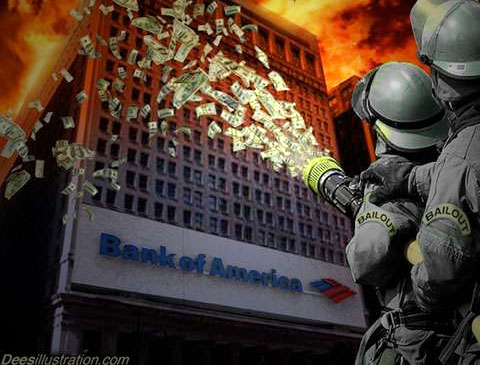
boa-derivatives-david-dees
Editor’s Note: As Michael Snyder notes, JP Morgan Chase, Goldman Sachs, Citibank, Bank of America, Morgan Stanley, and plenty of others have manipulated the market with these derivative bets, and have at least $40 trillion in derivatives exposure. If Congress passes FDIC protection for these controversial and complex financial instruments, it could dwarf existing debt held by the federal government and cost taxpayers an absolutely insurmountable sum, all while letting the bankers walk away free, and with their other winnings in hand.
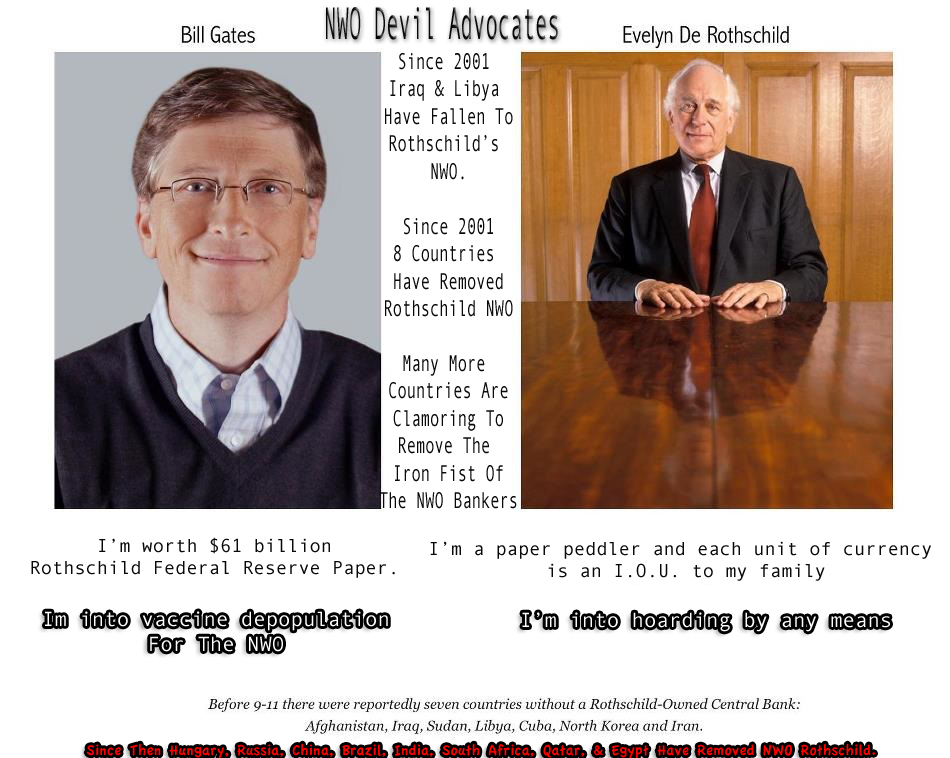
Gates Rothschild NWO
CLICK TO ENLARGE

Back in 2011, the Federal Reserve quietly stepped up to the plate to back Bank of America in attempting to park more than $75 trillion in European derivatives exposure in a division covered by FDIC (Federal Deposit Insurance Corporation) loss insurance – meant for ordinary consumers to promote general confidence in the banking system!
Bank of America is shifting derivatives in its Merrill investment banking unit to its depository arm, which has access to the Fed discount window and is protected by the FDIC.
This means that the investment bank’s European derivatives exposure is now backstopped by U.S. taxpayers. Bank of America didn’t get regulatory approval to do this, they just did it at the request of frightened counterparties. Now the Fed and the FDIC are fighting as to whether this was sound. The Fed wants to “give relief” to the bank holding company, which is under heavy pressure.
The FDIC objected, and the deal stalled, but the gesture has been attempted on other occasions as well, and the banks are now seeking to make this a general protection for derivatives at large. This is the ultimate in letting American taxpayers hold the bag, while the real criminals speed off in the proverbial get away vehicle – all with the Federal Reserve in the driver’s seat, mind you.
Wow! The mantra of private gains, public losses has never been more true; meanwhile, the American people are serious trouble if this passes through.

CORRUPT BANKERS & BOEHNER SPECIALIZE IN PAPER HANGING HANDCUFFS!

New Law Would Make Taxpayers Liable For TRILLIONS In Derivatives Losses
If the quadrillion dollar derivatives bubble implodes, who should be stuck with the bill? Well, if the “too big to fail” banks have their way it will be you and I. Right now, lobbyists for the big Wall Street banks are pushing really hard to include an extremely insidious provision in a bill that would keep the federal government funded past the upcoming December 11th deadline.
This provision would allow these big banks to trade derivatives through subsidiaries that are federally insured by the FDIC. What this would mean is that the big banks would be able to continue their incredibly reckless derivatives trading without having to worry about the downside.
If they win on their bets, the big banks would keep all of the profits. If they lose on their bets, the federal government would come in and bail them out using taxpayer money. In other words, it would essentially be a “heads I win, tails you lose” proposition.
Just imagine the following scenario. I go to Las Vegas and I place a million dollar bet on who will win the Super Bowl this year. If I am correct, I keep all of the winnings. If I lose, federal law requires you to bail me out and give me the million dollars that I just lost.
Does that sound fair?
Of course not! In fact, it is utter insanity. But through their influence in Congress, this is exactly what the big Wall Street banks are attempting to pull off. And according to the Huffington Post, there is a very good chance that this provision will be in the final bill that will soon be voted on…
According to multiple Democratic sources, banks are pushing hard to include the controversial provision in funding legislation that would keep the government operating after Dec. 11.
Top negotiators in the House are taking the derivatives provision seriously, and may include it in the final bill, the sources said.
Sadly, most Americans don’t understand how derivatives work and so there is very little public outrage.
But the truth is that people should be marching in the streets over this. If this provision becomes law, the American people could potentially be on the hook for absolutely massive losses…
The bank perks are not a traditional budget item. They would allow financial institutions to trade certain financial derivatives from subsidiaries that are insured by the Federal Deposit Insurance Corp. — potentially putting taxpayers on the hook for losses caused by the risky contracts.
This is not the first time these banks have tried to pull off such a coup. As Michael Krieger of Liberty Blitzkrieg has detailed, bank lobbyists tried to do a similar thing last year…
Five years after the Wall Street coup of 2008, it appears the U.S. House of Representatives is as bought and paid for as ever. We heard about the Citigroup crafted legislation currently being pushed through Congress back in May when Mother Jones reported on it. Fortunately, they included the following image in their article:
Derivatives-Bill-From-Liberty-Blitzkrieg
CLICK TO ENLARGE
Unsurprisingly, the main backer of the bill is notorious Wall Street lackey Jim Himes (D-Conn.), a former Goldman Sachs employee who has discovered lobbyist payoffs can be just as lucrative as a career in financial services. The last time Mr. Himes made an appearance on these pages was in March 2013 in my piece: Congress Moves to DEREGULATE Wall Street.
Fortunately, it was stopped in the Senate at that time.
But that is the thing with bank lobbyists. They are like Terminators – they never, ever, ever give up.
And they now have more of a sense of urgency then ever, because we are moving into a period of time when the big banks may begin losing tremendous amounts of money on derivatives contracts.
For example, the rapidly plunging price of oil could potentially mean gigantic losses for the big banks. Many large shale oil producers locked in their profits for 2015 and 2016 through derivatives contracts when the price of oil was above $100 a barrel. As I write this, the price of oil is down to $65 a barrel, and many analysts expect it to go much lower.
So guess who is on the other end of many of those trades?
The Rothschild banks.
Their computer models never anticipated that the price of oil would fall by more than 40 dollars in less than six months. A loss of 40, 50 or even 60 dollars per barrel would be catastrophic.
No wonder they want legislation that will protect them.
And commodity derivatives are just part of the story. Over the past couple of decades, Wall Street has been transformed into the largest casino in the history of the world. At this point, the amounts of money that these “too big to fail” banks are potentially on the hook for are absolutely mind blowing.
As you read this, there are five Wall Street banks that each have more than 40 trillion dollars in exposure to derivatives. The following numbers come from the OCC’s most recent quarterly report (see Table 2)…
VIOLATORS OF ANTITRUST LAWS MERGING CONGLOMERATES INTO FASCIST DICTATORS!
VIOLATORS OF ANTITRUST LAWS
MERGING CONGLOMERATES INTO FASCIST DICTATORS! ~ CLICK TO ENLARGE
JPMorgan Chase
Total Assets: $2,520,336,000,000 (about 2.5 trillion dollars)
Total Exposure To Derivatives: $68,326,075,000,000 (more than 68 trillion dollars)
Citibank
Total Assets: $1,909,715,000,000 (slightly more than 1.9 trillion dollars)
Total Exposure To Derivatives: $61,753,462,000,000 (more than 61 trillion dollars)
Goldman Sachs
Total Assets: $860,008,000,000 (less than a trillion dollars)
Total Exposure To Derivatives: $57,695,156,000,000 (more than 57 trillion dollars)
Bank Of America
Total Assets: $2,172,001,000,000 (a bit more than 2.1 trillion dollars)
Total Exposure To Derivatives: $55,472,434,000,000 (more than 55 trillion dollars)
Morgan Stanley
Total Assets: $826,568,000,000 (less than a trillion dollars)
Total Exposure To Derivatives: $44,134,518,000,000 (more than 44 trillion dollars)
Those that follow my website regularly will note that the derivatives exposure for the top four banks has gone up significantly since I last wrote about this just a few months ago.
Do you want to be on the hook for all of that?
Keep in mind that the U.S. national debt is only about 18 trillion dollars at this point.
So why in the world would we want to guarantee losses that could potentially be far greater than our entire national debt?
Only a complete and utter fool would financially guarantee these incredibly reckless bets.
Please contact your representatives in Congress and tell them that you do not want to be on the hook for the derivatives losses of the big Wall Street banks.
When this derivatives bubble finally implodes and these big banks go down (and they inevitably will), we do not want them to take down the rest of us with them.
SHTFPLAN
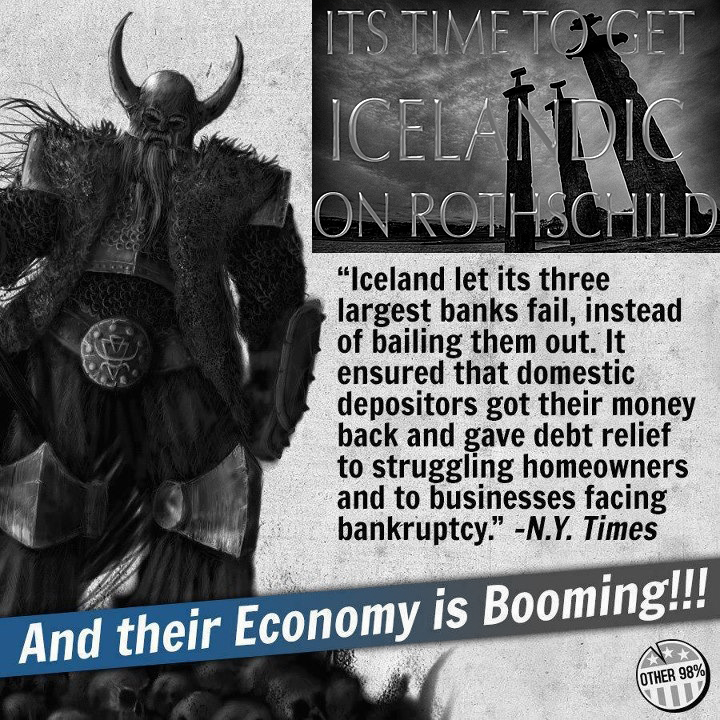
Icelandic Rothschild2


The elite of the world (exposed on video)

For decades, a shadowy and secret elite organization called the Bilderberg Group has plotted policy together that subjugates humanity under the cover of darkness.
Now WeAreChange.org expose them, this is real journalism you won’t see anywhere else.

WeAreChange proves Tony Blair lied to parliament about Bilderberg


MSNBC Lawrence O’Donnell too lazy to research Bilderberg

 Former Fed Chairman Alan Greenspan confronted on Bilderberg, Bohemian Grove

Clinton adviser Vernon Jordan on Bilderberg: “We don’t want any press”

FOX’s Lou Dobbs on Bilderberg, New World Order

CNN’s Paula Zahn completely ignorant of Bilderberg group

Lord Jacob Rothschild confronted

If you want to continue to hold these politicians accountable and make sure the elites continue to hear the voice of the people, donate @ http://www.WeAreChange.org/donate
We Are Change logo


You’re Likely to Be a Lot Poorer Than You Were a Few Years Ago—And It’s All By Design

The typical American is even poorer than his or her equivalent in Greece. The median Australian is four times wealthier. The Canadians are twice as wealthy. The U.S. continues to lead the world in billionaires (571 in 2014, with China a distant second at 190). But after decades of financial deregulation and attacks on employee rights, Americans rank 26th in median wealth (defined as assets owned, minus debts owed for the person on the middle rung of the wealth ladder).
All by Design
During the Cold War, our working class was the envy of the world. We argued that our free-enterprise system, not communism, created the best conditions for a rising standard of living for all. Indeed, there was much to boast about. Real wages were increasing year after year. American workers were free to go on strike and did. Most importantly, the children of working people could climb the economic ladder—upward mobility was real.
Today, by almost every measure, none of this is true. Not only do we rank 26th in median wealth, we also are the most anti-employee country in the developed world. Actually, the two go together, because rising inequality results from our pro-Wall Street and anti-worker policies.
The Organization for Economic Cooperation and Development (OECD) ranks 43 nations by the degree of employee protection provided by government. The 21 indicators used include such items as laws and regulations governing unfair dismissals, notifications and protections during mass layoffs, the use and abuse of temporary workers, and the provision of severance based on seniority. Countries are ranked on a scale of 0 to 6 with 6 going to those who provide the most legal protections for employees and zero for those with the least. As the chart below reveals, we’re second to last, meaning that we have among the fewest regulations to protect employees—union, non-union, management, full-time and temporary workers alike.
Read more

Hard Times in a Boom Town: Pennsylvanians Describe Costs of Fracking

Sharon Kelly, DeSmogBlog
Waking Times
If you’re looking for the shale gas boom, northeastern Pennsylvania is the place to start.
The Marcellus is the largest and fastest growing shale gas play in the U.S. and more than half of its 50 most productive wells were drilled in Susquehanna County in the northeast. Susquehanna and neighboring Bradford County produced 41 percent of all Marcellus gasthis June.
While drilling is down in other shale gas plays across the US, with major oil companies selling off their stakes and CEO‘s expressing regret for buying in, the Marcellus has bucked some of the downward trends so far.
A recent report from the Post Carbon Institute, “Drilling Deeper: A Reality Check on U.S. Government Forecasts for a Lasting Tight Oil and Shale Gas Boom,” has grave warnings about the Energy Information Administration’s figures nationwide, concluding that two-fifths of the shale gas the agency expects to be produced between now and 2040 will likely never materialize. While many high-profile shale gas plays have already peaked in terms of gas production per well, the Marcellus appears to be an outlier in terms of productivity, researcher David Hughes concludes.
Enormous amounts of shale gas are being produced in Pennsylvania. In the first six months of this year, drillers here pumped 2 trillion cubic feet of gas. And much of this gas came from the Marcellus shale’s twin sweet spots, in the Northeast and Southwest corners of the state.
In the whirlwind of activity, some locals in here struck it rich – those who owned large tracts of land and negotiated their deals at exactly the right moment. Driving through the county, it seems like every back road has a red-and-white permit sign marking a shale gas well, a water impoundment, or other Marcellus-related infrastructure.
059
New drilling sites are a common sight in northeast Pennsylvania’s Marcellus shale region.  © 2014 Laura Evangelisto
Expectations ran high when the boom first began. In 2010, 60 Minutes introduced a new word to the national media – “shale-ionaires,” or landowners who made millions simply by leasing their land for drilling.
“Once a well is built and producing, royalty checks start popping up in the mailbox,” explained 60 Minutes anchor Leslye Stahl. “It can last years and add up to many more millions.”
But even in the most productive shale play in the country, these early hopes have often been dashed, with some landowners reporting that leasing has already wound up costing them money.
In Litchfield Township, Glenn Aikens, a member of the Bradford County Planning Commission, also has three shale gas wells on his land. Signing a lease brought a host of unexpected costs, Aikens says : $22,000 to set up an L.L.C. to make sure that his children could inherit the farm’s suddenly valuable acreage in spite of estate taxes, pre-drilling water testing for the farm’s seven wells (“He charged me $14,500 dollars, but I wouldn’t have had a leg to stand on had I not,” says Aikens. “If they ruin the water, what do I do with this farm?”), and perhaps most painfully, the permanent loss of a valuable tax credit for farmland, now that the leased land is considered commercial property instead. Land that was assessed at $500 an acre was now assessed at $2,500 – and taxes were due retroactively.
GA02
Litchfield Township’s Glenn Aikens was paid $0.10 in royalties by a division of Chesapeake Energy, after the company deducted costs from his royalty check.  © 2014 Laura Evangelisto
Aikens pulls a tattered photocopy of a ten cent check from his wallet, emblazoned with the logo of a division of Chesapeake Energy. It’s the royalty check for the gas produced on his 359 acre farm, after post-production expenses were deducted from the check. Under state law, property owners are supposed to be guaranteed a minimum of 12.5 percent of the value of the gas produced on their land, but a 2010 state Supreme Court ruling opened up a loophole. Gas companies started deducting a broad variety of costs – at times retroactively.
“I signed a contract and I’ll live by it, but I want my 12.5 percent,” said Aikens. “It’s been an ongoing battle with them and not getting paid.”
Even without post-production deductions, many landowners have found that oil wealth falls far short of the millions they first hoped. Property owners in the U.S.get an average of less than $500 a month from oil and gas wells that have been drilled on their property, David Sikes, a past president of the National Association of Royalty Owners, told the Wall Street Journal.
For Aikens, the calculations are unforgiving.
“It really wasn’t worth it,” Aikens says about his own lease.
The boom has brought other hidden costs, not only environmental but also economic for Northeastern Pennsylvania’s counties and their residents.
“Most people are still poor, most people are still struggling,” explained Vera Scroggins, an opponent of fracking from Susquehanna County, adding that even large landowners “complain to me privately, ‘people think we’re millionaires, but we’re not.”

© 2014 Laura Evangelisto
Driving down the streets of Montrose, PA (popualtion 1,500), Scroggins points out what’s changed (a new hotel, the warehouse for an oilfield services company) and what hasn’t – the empty store fronts, the “for rent” and “for sale” signs.


Anyone That Believes That Collapsing Oil Prices Are Good For The Economy Is Crazy

By Michael Snyder
Oil - Public Domain
Are much lower oil prices good news for the U.S. economy?  Only if you like collapsing capital expenditures, rising unemployment and a potential financial implosion on Wall Street.  Yes, lower gasoline prices are good news for the middle class.  I certainly would rather pay two dollars for a gallon of gas than four dollars.  But in order to have money to fill up your vehicle you have got to have an income first.  And since the last recession, the energy sector has been the number one creator of good jobs in the U.S. economy by far.  Barack Obama loves to stand up and take credit for the fact that the employment picture in this country has been improving slightly, but without the energy industry boom, unemployment would be through the roof.  And now that the “energy boom” is rapidly becoming an “energy bust”, what will happen to the struggling U.S. economy as we head into 2015?
At the start of this article I mentioned that much lower oil prices would result in “collapsing capital expenditures”.
If you do not know what a “capital expenditure” is, the following is a definition that comes from Investopedia…
“Funds used by a company to acquire or upgrade physical assets such as property, industrial buildings or equipment. This type of outlay is made by companies to maintain or increase the scope of their operations. These expenditures can include everything from repairing a roof to building a brand new factory.”
Needless to say, this kind of spending is very good for an economy.  It builds infrastructure, it creates jobs and it is an investment in the future.
In recent years, energy companies have been pouring massive amounts of money into capital expenditures.  In fact, the energy sector currently accounts for about a third of all capital expenditures in the United States according to Deutsche Bank…
US private investment spending is usually ~15% of US GDP or $2.8trn now. This investment consists of $1.6trn spent annually on equipment and software, $700bn on non-residential construction and a bit over $500bn on residential. Equipment and software is 35% technology and communications, 25-30% is industrial equipment for energy, utilities and agriculture, 15% is transportation equipment, with remaining 20-25% related to other industries or intangibles. Non-residential construction is 20% oil and gas producing structures and 30% is energy related in total. We estimate global investment spending is 20% of S&P EPS or 12% from US. The Energy sector is responsible for a third of S&P 500 capex.
These companies make these investments because they believe that there are big profits to be made.
Unfortunately, when the price of oil crashes those investments become unprofitable and capital expenditures start getting slashed almost immediately.
For example, the budget for 2015 at ConocoPhillips has already been reduced by 20 percent…
ConocoPhillips is one of the bigger shale players. And its decision to slash its budget for next year by 20% is raising eyebrows. The company said the new target reflects lower spending on major projects as well as “unconventional plays.” Despite the expectation that others will follow, it doesn’t mean U.S. shale oil production is dead. Just don’t expect a surge in spending like in recent years.
And Reuters is reporting that the number of new well permits for the industry as a whole plunged by an astounding 40 percent during the month of November…
Plunging oil prices sparked a drop of almost 40 percent in new well permits issued across the United States in November, in a sudden pause in the growth of the U.S. shale oil and gas boom that started around 2007.
Data provided exclusively to Reuters on Tuesday by industry data firm Drilling Info Inc showed 4,520 new well permits were approved last month, down from 7,227 in October.
If the price of oil stays this low or continues dropping, this is just the beginning.
Meanwhile, the flow of good jobs that this industry has been producing is also likely to start drying up.
According to the Perryman Group, the energy sector currently supports 9.3 million permanent jobs in this country…
According to a new study, investments in oil and gas exploration and production generate substantial economic gains, as well as other benefits such as increased energy independence. The Perryman Group estimates that the industry as a whole generates an economic stimulus of almost $1.2 trillion in gross product each year, as well as more than 9.3 million permanent jobs across the nation.
The ripple effects are everywhere. If you think about the role of oil in your life, it is not only the primary source of many of our fuels, but is also critical to our lubricants, chemicals, synthetic fibers, pharmaceuticals, plastics, and many other items we come into contact with every day. The industry supports almost 1.3 million jobs in manufacturing alone and is responsible for almost $1.2 trillion in annual gross domestic product. If you think about the law, accounting, and engineering firms that serve the industry, the pipe, drilling equipment, and other manufactured goods that it requires, and the large payrolls and their effects on consumer spending, you will begin to get a picture of the enormity of the industry.
And these are good paying jobs.  They aren’t eight dollar part-time jobs down at your local big box retailer.  These are jobs that comfortably support middle class families.  These are precisely the kinds of jobs that we cannot afford to lose.
In recent years, there has been a noticeable economic difference between areas of the country where energy is being produced and where energy is not being produced.
Since December 2007, a total of 1.36 million jobs have been gained in shale oil states.
Meanwhile, a total of 424,000 jobs have been lost in non-shale oil states.
So what happens now that the shale oil boom is turning into a bust?
That is a very good question.
Even more ominous is what an oil price collapse could mean for our financial system.
The last time the price of oil declined by more than 40 dollars in less than six months, there was a financial meltdown on Wall Street and we experienced the deepest recession that we have seen since the days of the Great Depression.
And now many fear that this collapse in the price of oil could trigger another financial panic.
According to Citigroup, the energy sector now accounts for 17 percent of the high yield bond market.
J.P. Morgan says that it is actually 18 percent.
In any event, the reality of the matter is that the health of these “junk bonds” is absolutely critical to our financial system.  And according to Deutsche Bank, if these bonds start defaulting it could “trigger a broader high-yield market default cycle”…
Based on recent stress tests of subprime borrowers in the energy sector in the US produced by Deutsche Bank, should the price of US crude fall by a further 20pc to $60 per barrel, it could result in up to a 30pc default rate among B and CCC rated high-yield US borrowers in the industry. West Texas Intermediate crude is currently trading at multi-year lows of around $75 per barrel, down from $107 per barrel in June.
“A shock of that magnitude could be sufficient to trigger a broader high-yield market default cycle, if materialized,” warn Deutsche strategists Oleg Melentyev and Daniel Sorid in their report.
If the price of oil stays at this level or continues to go down, it is inevitable that we will start to see some of these junk bonds go bad.
In fact, one Motley Fool article recently stated that one industry analyst believes that up to 40 percent of all energy junk bonds could eventually go into default…
The junk bonds, or noninvestment-rated bonds, of energy companies are also beginning to see heavy selling as investors start to worry that drillers could one day default on these bonds. Those defaults could get so bad, according to one analyst, that up to 40% of all energy junk bonds go into default over the next few years if oil prices don’t recover.
That would be a total nightmare for Wall Street.
And of course bond defaults would only be part of the equation.  As I wrote about the other day, a crash in junk bonds is almost always followed by a significant stock market correction.
In addition, plunging oil prices could end up absolutely destroying the banks that are holding enormous amounts of energy derivatives.  This is something that I recently covered in this article and this article.
As you read this, there are five “too big to fail” banks that each have more than 40 trillion dollars in exposure to derivatives.  Of course only a small fraction of that total exposure is made up of energy derivatives, but a small fraction of 40 trillion dollars is still a massive amount of money.
These derivatives trades are largely unregulated, and even Forbes admits that they are likely to be at the heart of the coming financial collapse…
No one understands the derivative risk positions of the Too Big To Fail Banks, JP Morgan Chase, Citigroup, Bank of America, Goldman Sachs or Morgan Stanley. There is presently no way to measure the risks involved in the leverage, quantity of collateral, or stability of counter-parties for these major institutions. To me personally they are big black holes capable of potential wrack and ruin. Without access to confidential internal data about these risky derivative positions the regulators cannot react in a timely and measured fashion to block the threat to financial stability, according to a National Bureau of Economic Research study.
So do we have any hope?
Yes, if oil prices start going back up, much of what you just read about can be averted.
Unfortunately, that does not seem likely any time soon.  Even though U.S. energy companies are cutting back on capital expenditures, most of them are still actually projecting an increase in production for 2015.  Here is one example from Bloomberg…
Continental, the biggest holder of drilling rights in the Bakken, last month said 2015 output will grow between 23 percent and 29 percent even after shelving plans to allocate more money to exploration.
Higher levels of production will just drive the price of oil even lower.
At this point, Morgan Stanley is saying that the price of oil could plummet as low as $43 a barrel next year.
If that happens, it would be absolutely catastrophic to the most important industry in the United States.
In turn, that would be absolutely catastrophic for the economy as a whole.
So don’t let anyone tell you that much lower oil prices are “good” for the economy.
That is just a bunch of nonsense.

Europe should decide its fate without using US ‘disservices’ – Russian Duma speaker

Russian State Duma speaker Sergei Naryshkin.(RIA Novosti / Mihail Mokrushin)


State Duma chairman, Sergey Naryshkin, has reiterated his advice to European countries to rule themselves and stop heeding meddlesome US advice that does more harm than good.
Naryshkin told reporters that currently various US representatives are taking active part in a number of European political organizations, where they enjoy full members’ rights. In this capacity, the US is affecting decisions concerning the fates of people and states thousands of kilometers from its borders.
“Isn’t it time for European countries to take their fate into their own hands and stop applying for the “services” of those who can only instigate conflicts ending in violence, destruction,humanitarian disasters and human casualties,” said the Duma speaker, as cited by RIA Novosti.
He also added that Russia is a European state and so it is concerned by US attacks on international law and fundamental European values. “We will ask our European colleagues to draw practical conclusions from this whole situation for the sake of peace and security on our common continent - the European continent,” Naryshkin promised.
The Lower House head also commented on his recent call for NATO countries to evict the United States from the bloc. He admitted that the statement was a joke, but noted that such measures, if they were real, would strengthen stability and security on the continent.
In a separate statement made in late October, Naryshkin said he believed the United States wanted to end mutual dialogue between Russia and Europe. He also noted this would not happen, as Russia would keep looking for every opportunity to mend ties with its neighbors.
Naryshkin’s comments came after the visit to the State Duma by PACE rapporteur on Ukrainian refugees, Jim Sheridan. The official discussed the humanitarian situation in the eastern and southern parts of Ukraine as part of preparations for his report at the assembly’s January session that will, among other issues, consider the restoration of the Russian delegation’s powers.
Russian lawmakers said the information Sheridan collected in Kiev and Kharkov was very one-sided and contained factual mistakes, even as to the number of refugees who had fled the war zone to Russia. They also invited the rapporteur to visit the self-proclaimed republics of Donetsk and Lugansk, as well as the Crimean Republic which seceded from Ukraine and joined the Russian Federation.

Sunday, December 7, 2014

新西兰原装本土正品 ALPHA LIPID LIFELINE 牛初乳粉


Alpha LipidTM Lifeline 初乳是众多初乳中最顶级的产品,含有丰富的免疫球蛋白、生长因子以及经过强化的脂質如神经节苷脂和磷脂,有效于促进脑部发育及维持脑部功能。

1.    牛初乳是牛犊诞生的第一份礼物,因分泌量有限而极其珍贵。乳牛产犊后3天内所分泌的初乳汁,是牛犊在新生环境下抵抗外来病毒侵袭的重要保证,它包含了牛犊成长最重要的免疫因子和生长因子,可以帮助抵抗外来病原和促进生长发育。

2.  神经节苷脂也能有效地保护消化管道如胃和肠,以免受到病菌感染。神经节苷脂也是人体细胞的表层(质膜)当中很重要的元素之一,更是整个神经系统的关键元素。神经节苷脂在细胞认知,信号发送及接收和细胞成长中,更扮演着不可替代的角色。Alpha LipidTM Lifeline 
含有了神经节苷脂GD3,是一种能够帮助幼儿脑部成长的主要营养。

3.  牛初乳不仅含有丰富蛋白质、乳钙、牛磺酸、维生素、矿物质等乳类营养,且天然含有大量免疫球蛋白IgG、乳铁蛋白、溶菌酶、类胰岛素生长因子、表皮生长因子等,具有免疫调节、抑制多种病原微生物等重要生理功能。
牛初乳的最重要的核心成分是-IgG(免疫球蛋白),IgG有6个主要功能:
1.帮助新生命防御大多数外来病原的侵害;
2.促进抗体生成,提高人体免疫力;
3.刺激细胞生长及修复;
4.促进儿童生长发育;
5.可加速疾病恢复者及手术康复者机体恢复健康。
6.改善胃肠道健康;


Alpha Lipid Lifeline 初乳的好处:


1. 维持日常生活规律
2. 方便饮用
3. 适合一家大小
4. 适合高血压以及糖尿病患者
5. 孕妇补充元气的最佳选择。它包含了益生菌,钙质,维他命以及矿物质,有效于促进母子的免疫系统。一杯Alpha Lipid Lifeline 初乳含有1000毫克的钙质,相等于4杯的Anlene奶粉。


牛初乳的适宜人群:
1.易感冒生病、偏食、厌食、磨牙、发育迟缓的婴幼儿童。
2.处于免疫功能不全期的婴幼儿。
3.需增强体质,养胎优生的孕产妇。
4.免疫系统功能衰退的中老年人。
5.胃肠道功能失调、营养失衡、易疲劳的亚健康人群。
6.体质虚弱的疾病康复者。


主要成分:

初乳、Alpha Lipid脂质、钙、肠道益生菌
【「生命营养素」内含维生素矿物质、强力生长因子、免疫因子、抗体、抗氧化因子、抗炎因子、Alpha Lipid脂质、钙、肠道益生菌】葡萄糖(右旋)、磷酸钙、脱脂奶粉、初乳粉、关华豆胶、玉米糖胶、α脂质、乳酸杆菌、双歧乳酸杆菌、维生素-A,B1,B2,B6,B12,C,D3,E、烟碱酸、本多酸钙、叶酸、生物素、丁烯二酸亚铁、氧化镁等等...


美容功效:
1. 抗衰老
2. 刺激受创皮肤的生长和修复细胞
3. 拥有粉嫩美白肤色(刺激DNA和RNA生长)
4. 促进排毒
5. 调理内分泌平衡
6. 消除暗疮
7. 去除黑斑
8. 增进脸部紧致和弹性
9. 提高新陈代谢,燃烧脂肪
10. 生头发


保健功效:

1.帮助新生命防御大多数外来病原的侵害
2.促进抗体生成,提高人体免疫力
3.刺激细胞生长及修复
4.促进儿童生长发育
5.可加速疾病恢复者及手术康复者机体恢复健康。
6.改善胃肠道健康


初乳有以下的好處:
-增加骨密度,防止骨質疏鬆
-消除脂肪,增加肌肉組織
-補充精力,抗老化
-加強抵抗致病病毒和病菌的能力
-藉由減少情緒波動來改善情緒穩定性
使用方法:
成人2匙(16公克)水大約250cc(請勿以熱水沖泡)
        小孩1匙,水大約150cc(可以添加巧克力醬或果汁)
        小嬰兒:0.5匙,水大約80cc(可加入原本的配方奶中或扮成泥狀餵食)
泡法:
長溫開水35度,先加入水,後加初乳粉,以搖泡沫紅茶方式沖泡
一般人,建議用量:一天飲用1~2次(早, 晚)
想快速改善者,建議用量:一天飲用3~4次
注意事項:有下列症狀用者
高齡長者、高血壓160以上、高血糖200以上、腎功能障礙、心臟病、氣喘、痛風,建議用量:第一星期,每日半匙開始,之後每隔三天增加半匙
(上午半匙,下午半匙)慢慢增加到成人用量

RM150/一罐
欢迎爱美一族,爱惜您家人一族,健康一族 & 正在患病一族致电询问面谈
0173396376 vivian

服用Alpha Lipid Lifeline 初乳也能够有效帮您预防以下疾病:


  • 青春痘
  • 老化
  • 皮肤敏感
  • 关节炎
  • 哮喘
  • 脓肿
  • 癌症
  • 水痘
  • 过于疲劳
  • 糖尿病
  • 湿疹
  • 子宫肌瘤


  • 胃痛
  • 痛风症
  • B/C 型肝炎
  • 高血压
  • 病菌感染
  • 失眠
  • 肠胃不适
  • 血氧不足
  • 肺部感染
  • 麻疹
  • 经痛
  • 偏头痛


  • 帕金森
  • 痔疮
  • 疱疹
  • 鼻窦炎
  • 皮肤问题
  • 压力
  • 中风/麻痹
  • 甲状腺炎
  • 肿瘤
  • 溃疡