Sunday, June 15, 2014

Good Riddance To Rep. Eric Cantor: Bagman For Wall Street And The War Party
Its
possible to describe Rep.Eric Cantor as a serial sell-out. But that
would be giving an unprincipled politician driven by an unalloyed
ambition to climb the greasy pole of Washington power too much
credit. In truth, Cantor never campaigned for any recognizable
principle; he merely maneuvered his way to the top of the House GOP
hierarchy by following in the tawdry footsteps of modern GOP bagmen
like Tom DeLay and Roy Blunt.
One
commentator had Cantor pegged right on the money, as it were, years ago.
One the heels of the 2010 GOP landslide, it was evident that Cantor’s
true ambition was to accumulate a massive war chest to further his own
ambitions, not to seize on the tea party momentum to fundamentally
reverse the tide of Big Government:
Hand-picked by Majority Whip Roy “Abramoff-R-Us” Blunt early
in his tenure to be a deputy whip, sort of an official water-carrier,
Cantor moved up swiftly through the ranks as a Blunt protégé, because he
was cheerfully obedient when sitting in the room with Friends of
Abramoff and because he was unusually good at the money. “He’s about the money,” one wag offers admiringly.
But he
was never about conservative principles. Instead, Cantor is one of those
post-Reagan Republicans who have managed to reduce conservative policy
to such grandiose, content-free platitudes that there is never any
danger that their stump speeches at home, or even on the floor of the
House, will get in the way of doing Washington business as usual.
There
are certain litmus tests that cogently demonstrate the difference
between platitude and principle—-and one of them pertains to the matter
of crony capitalist subsidies and tax breaks for big business. On that
score, I once heard Cantor give a stem-winder in behalf of free markets
at a conference full of business and financial types who nodded,
applauded and whooped it up. But that was just a pro forma sermon.
The next day he was back in Washington making sure that the Ex-Im bank
authorization was extended for another 3-years.
In this
case, Washington business as usual amounts to salving the spurious
complaint of Boeing and General Electric lobbyists that the Brits, EU
and Japan subsidize export finance for aircraft, jet engines and heavy
capital equipment—-so American taxpayers need to level the playing
field. Well, yes, if US policy is to be driven by the statist and
socialist mistakes of foreign governments then by all means tax American
farmers and bus drivers so that Boeing will make its quarterly EPS.
There
is an alternative. Let Boeing and GE suffer a hairline reduction in EPS
by providing their own concessional pricing to customers,
while shielding millions of innocent US taxpayers and business from
being dunned for the tab on April 15. Then let the free market decide
where to allocate capital; and let America’s businesses, not Washington
bureaucrats, discover where they have the greatest competitive advantage
in both domestic and foreign markets, including the ones that are
rigged by foreign governments which have an addiction to wasting
taxpayer money.
What
the beltway statists like Cantor do not understand is that there is no
magic level of GDP, or Washington enabled quarterly rate of growth to
get there. And most certainly there is no reason to believe that higher
taxes on most of the economy to boost a thin but politically noisy
sub-segment— commercial aircraft and jet engines—will make the GDP
bigger and the nation wealthier.
The
true conservative touchstone, therefore, is to let the free market
decide how much GDP and how much growth. These should be an unplanned
outcome on the free market, not a consequence of
Washington-divined targets and beltway-directed policy interventions.
And
the political rhetoric that goes with that proposition would intuitively
resonant with the American public. Namely, that Washington meddling,
regulating, subsidizing and taxing will make things worse, not better;
and that the job of generating economic growth and employment belongs to
the collectivity of American business, labor, entrepreneurs, savers and
investors, not a handful of fixers inside the beltway. That is, twin
peas-in-a-pod like Senator Chuck Schumer on the Left and Rep. Eric
Cantor on the Right.
So his
record speaks for itself. Rep. Cantor was a statist who had learned to
lip-sync the platitudes of the modern Republican right. But
on the defining issues of our times, he did not trust the free market
for a moment, and did not have the slightest clue as to what fiscal
rectitude requires after decades of Keynesian borrow and spend.
The
fraught moment came on October 3, 2008 when he helped Hank Paulson,
the Goldman Sachs plenipotentiary then occupying the 3rd floor of the
Treasury Building, force the House GOP rank-and-file into a catastrophic
retreat. That is, after properly rebuking the White House demand to
bail-out the Wall Street gambling houses by voting “no” on the first
TARP consideration, House Republicans were forced into a shameful about
face on the second vote.
As much
as anyone else, Eric Cantor bears the blame for this final and
irreversible triumph of Big Government. It marked the full-dress return
of the Keynesian policy model—-the prior defeat of which had been
the one and only victory that the Reagan era actually accomplished on
the battlefield of ideas. But Cantor’s platitudinal conservatism was so
shallow that in the hour of crisis when principle actually matters, he
could not recognize that he was being led down the primrose path by an
out-and-out Keynesian money printer at the Fed and an economically
illiterate Wall Street front-man at the Treasury.
And
this goes to the heart of the phony economic conservatism of the Eric
Cantor’s and Paul Ryan’s. Both voted for TARP and the auto bailouts
because they are complete ignoramuses about the elephant in the
room which is leading the Washington policy assault on free markets and
fiscal rectitude. Namely, the Federal reserve and the monetary central
planning model that has become national policy since the Greenspan era.
But
that’s why we had the September 2008 crisis. It did not reflect a
fundamental flaw of capitalism, or an outbreak of unusual greed, or
insufficient regulation of investment banks—and most especially not a
once-in-a-hundred-years outbreak of something called “contagion” that
required throwing away the rules of the free market to save it, as the
clueless occupant of the White House then phrased it.
No, it
was just another central bank enabled financial bubble bursting. That is
the inherent and inexorable result of destroying honest price
discovery on Wall Street and placing “puts”, props and pegs under the
price and yields of securities in the capital and money markets.
In
short, the Fed has turned Wall Street into a dangerous gambling casino
and Washington into ceaseless fiscal auction. And that’s where Cantor’s
real sin comes into play. Not once after the financial crisis did Cantor
or the so-called establishment GOP leadership take on the elephant in
the room. Never did he even remotely recognize that the monetary
politburo ensconced in the Eccles Building has accomplished what amounts
to an economic coup d tat.
Stated
differently, financial repression, ZIRP, QE, wealth effects and the
Greenspan/Bernanke/Yellen “put” under the stock market and risk assets
generally are not just a major policy mistake; they are a full-throttle
assault on the heart and soul of conservative economics.
You can
not expect to have fiscal rectitude in a modern democracy, for example,
when the central bank since the year 2000 has monetized nearly $4
trillion of public debt—and once Paulson’s “bazooka” failed in September
2008, the GSE securities among that total most surely are de facto
public debt. Indeed, financial repression makes the carry cost of the
public debt so painless—-that is, probably about $400 billion per year
less than it would be under a regime of free market interest rates—that
not one in a hundred politicians can see they virtue of fallen on the
fiscal sword in the here and now in behalf of unborn generations of
taxpayers who will carry the burden of today’s fiscal folly.
So it
has been Keynesian central bankers, ironically, that have enabled
platitudinous conservatives like Cantor to have their cake and eat it,
too. To be sure, the latter have never missed an opportunity to scold
the self-avowed big spender currently in the White House for his sorry
fiscal record, but look what they have done instead.
Year
after year they have proposed phony baloney budgets based on accounting
fairy dust and pie-in-the sky economic assumptions two or more decades
down the road that give constituents not a single clue as to the
sacrifices and pain that will be needed to tame the endless profligacy
of the nation’s Welfare State and Warfare State. At the same time, they
have folded like a lawn chair every time push has come to shove on
continuing resolution and debt ceiling crises in the here and now.
Cantor’s
record on this score is so horrendous that he ought to spend the next
decade in sackcloth and ashes doing penance to the god of fiscal
rectitude, if there is one. On the first point, he has been an avid
backer of the serial “Ryan” budgets, but each and every one of these
dopey plans have significantly increased defense spending and given a
free pass to the nation’s massive social insurance system. Yet the
latter costs $1.5 trillion per year and embodies the sheer myth that
social security and Medicare are earned retirement insurance and are
funded out of “assets” that have been accumulated over decades.
In
fact, there is nothing in those trust funds except Treasury IOUs. And
there are few things more destructive of job creation in the high-cost
American economy than the 15% payroll tax that currently underfunds the
system, and which will inexorably become even more economically
destructive as it rises in the future.
So
there is no alternative accept to call the social insurance Ponzi for
what it is and to impose a sweeping means test on the millions of
affluent retires getting combined social security/Medicare benefits of
upwards of $50,000 per year which they didn’t earn. That could then be
accompanied with a switch to general revenue funding from a consumption
tax—so that the onerous payroll levy which parades as an “insurance
premium” could be sharply reduced or eliminated.
Yet
Cantor and Ryan just pretended that social insurance didn’t matter:
Social Security got a free pass forever and Medicare was always to be
fixed after a decade into the future—a point which never comes. Instead,
they made their numbers add up with savage cuts in the means tested
safety net, but even these cuts were phony. They were to occur by block
granting food stamps, Medicaid and other welfare programs and then
returning them to the states with a 20-25% haircut.
House
Republicans invented that ploy way back in the early 1980s in order to
duck voting for real reforms, but the political scam was immediately
self-evident. Not a single GOP governor wanted the task of being the
“out-sourced” budget cutter!
The
same has been true ever since. So the Ryan-Cantor position on the entire
$2.5 trillion domestic budget is to punt on the huge social insurance
portion and to scam on the rest. Yet once actual defense increases are
thrown into the budget pot, the fraudulence of the Cantor-Ryan fiscal
position becomes all the more evident.
Without
providing an iota of honest disclosure or even a semblance of a
credible outline for shrinking a Federal budget which will spend upwards
of $50 trillion over the next decade, they insist that taxes are too
high and that the secret to the fiscal challenge is even more tax cuts
so that we get even more rosy scenario economic growth than is built
into the CBO’s Keynesian economic forecasts to begin with.
In
short, this is just kidstuff. Cantor and Ryan have effectively removed
the GOP from the field of fiscal battle by serving up budgetary
platitudes for home consumption by the rank and file. At the same time,
they have whiffed each and every time they have faced an action forcing
deadline. In the spring of 2011, for example, in connection with the CR
expiration crisis, the served up $39 billion in “cuts” that were so
transparently phony that the CBO scored them as saving $4 billion at
best. And then spending as usual resumed.
In the
summer of that year they caved again—this time on the debt ceiling
crisis. The solution of the budget super-committee and the automatic
sequester speaks for itself. The latter never had any possibility of
producing a real budget shrinkage plan. And when the sequester
threatened to actually bite into spending, it was Ryan and Cantor who
lead the charge in behalf of a compromise to restore $22 billion of
spending for defense by giving the liberals $22 billion in higher
spending for domestic programs.
At the
end of the day, that ignominious Ryan-Murray compromise goes to the very
heart of Cantor’s betrayal of the cause of free markets and small
government. He has been an unabashed servant of the Washington War Party
during his entire career. Time and time again, he helped whip the GOP
rank and file into a frenzy of militaristic bombast about imaginary
threats to America’s security in places all over the globe which are
none of our business. That absolute nonsense of sanctions and
unrelenting hostility to the regime in Tehran is perhaps the most
egregious example.
So Eric
Cantor made a career of milking the Warfare State and pandering to Wall
Street. This brought him nearly to the top of the Washington heap. But
in the end, it did not fool his constituents. And most certainly it set
back the conservative cause immeasurably.
Spot The Troubling Signs Behind The Market Records
We’re all saps in the stock market’s shell game
Insight: Investors’ exuberance will end badly, as it always does
…And
just like in Three-Card Monte, investors are looking in the wrong
places for information. Instead of being mesmerized by the all-time
highs, investors should be focused on the market’s deteriorating
internal conditions.
For example, as the
market climbs higher on lower volume, fewer and fewer stocks are
participating (i.e. making new highs). This is a red flag.
Also, sentiment indicators are reaching extreme levels. The VIX VIX +3.36% is
at a six-year low; the RSI (relative strength indicator) has surpassed
70 (meaning the market is overbought), Investor’s Intelligence is over
60% bullish (the second-highest ever). So many large cap stocks have
gone parabolic, there has to be a day of reckoning.
Moreover, margin balances are at record levels. When the market goes south, the excess margin will accelerate the downturn.
All of this translates into a stealth market bubble that keeps growing, but is happening so slowly few see it.
Everyone’s a winner
As the market makes
all-time highs, more investors are lured into the game. One exuberant
host on a financial program boldly stated: “This is a market that will
never go down!” Another guest recently predicted that the stock market
won’t go down for another two years.
Read more:
May Retail Sales Miss, Core Retail Sales Unchanged, Control Group Declines
Another swing and a miss for the so-called Q2 GDP surge.
After
April data was revised higher, with headline retail sales pushed from
0.1% to 0.5%, and core retail sales ex-autos and gas boosted from -0.1%
to 0.3%, May showed a big drop in whatever momentum may have resulted
from the March spending spree. As a result May headline retail sales
missed expectations of a 0.6% increase, printing at 0.3%, with the
entire positive print due to auto and gas sales. Indeed, when looking at
core retail sales excluding autos and gas, these were unchanged from
April, printing at 0.0%, far below the 0.4% expected.
As
the table below shows, segments that saw a decline in May were
Electronics stores (again), as well as food and beverage stores, health
and personal care, clothing stores, sporting goods stores, restaurants,
as well as general merchandise stores. In other words a decline across
the board.
IMF Warns Of Housing Crashes- World Bank Says ‘Now Is The Time To Prepare For Next Crisis’
Yesterday, the IMF and World Bank issued warnings about the global economy.
The International Monetary Fund
(IMF) warned that the world must act to contain the risk of another
devastating housing crash. The World Bank warned that the anticipated
rise in interest rates will hit global growth this year – and presumably
house prices too.
“We are not totally out of the
woods yet,” Kaushik Basu, the World Bank’s Senior Vice President and
chief economist and he warned that “now is the time to prepare for the
next crisis.”
The warning from the IMF came
as it published new data showing house prices are well above their
historical average in many countries as covered in theFinancial Times today.
The data shows how an acceleration in house prices in many countries
from already high levels has emerged as one of the major threats to
global economic stability.

The Winter Was So Cold No One Got Sick! Lower Health Spending To Push Q1 GDP To -2%
The U.S. economy may have contracted more than previously thought during the first three months of 2014, private economists said Wednesday based on new health care-sector data from the government.Some analysts said economic output may have contracted at a 2% pace in the first quarter. That would be its worst performance since the recession.The Commerce Department’s latest estimate of gross domestic product, the broadest measure of output across the economy, said GDP shrank at a seasonally adjusted annual rate of 1% in the first quarter. A revised estimate will be released June 25, and it could show an even larger contraction.…
Goldman Slashes Q1 GDP Estimate To -1.9%
Global Death Cross Accelerates As World Bank Slashes Growth

IMF: Housing Markets Are ‘Overheating’ Again
Three charts you need to see before you buy another stock
Wall Street’s “fear gauge” flashed a sell signal at the end of May.
But
since then, the stock market has continued to work even higher. The
S&P 500 hit a new all-time high last Friday. And some folks might be
wondering if the sell signal is a bust.
It’s not.
As you can see from the following chart, the Volatility Index (“VIX”) once again closed below its lower Bollinger Band last Friday…

Once
the VIX rallies and closes back inside its Bollinger Bands, it’ll
generate another broad stock market sell signal. That will be its second
sell signal in about two weeks.
And this time, a couple other indicators are shouting “sell” as well…
12 Numbers About The Global Financial Ponzi Scheme That Should Be Burned Into Your Brain
When
Americans think about the financial crisis that we are facing, the
largest number that they usually can think of is the size of the U.S.
national debt. And at over 17 trillion dollars, it truly is massive.
But it is actually the 2nd-smallest number on the list below. The
following are 12 numbers about the global financial Ponzi scheme that
should be burned into your brain…
-$1,280,000,000,000 -
Most people are really surprised when they hear this number. Right
now, there is only 1.28 trillion dollars worth of U.S. currency floating
around out there.
-$17,555,165,805,212.27 - This is the size of the U.S. national debt. It has grown by more than 10 trillion dollars over the past ten years.
-$32,000,000,000,000 - This is the total amount of money that the global elite have stashed in offshore banks (that we know about).
-$48,611,684,000,000 - This is the total exposure that Goldman Sachs has to derivatives contracts.
-$59,398,590,000,000 -
This is the total amount of debt (government, corporate, consumer,
etc.) in the U.S. financial system. 40 years ago, this number was just a
little bit above 2 trillion dollars.
-$70,088,625,000,000 - This is the total exposure that JPMorgan Chase has to derivatives contracts.
-$71,830,000,000,000 - This is the approximate size of the GDP of the entire world.
-$75,000,000,000,000 - This is approximately the total exposure that German banking giant Deutsche Bank has to derivatives contracts.
-$100,000,000,000,000 - This is the total amount of government debt in the entire world. This amount has grown by $30 trillion just since mid-2007.
-$223,300,000,000,000 - This is the approximate size of the total amount of debt in the entire world.
-$236,637,271,000,000 -
According to the U.S. government, this is the total exposure that the
top 25 banks in the United States have to derivatives contracts. But
those banks only have total assets of about 9.4 trillion dollars
combined. In other words, the exposure of our largest banks to
derivatives outweighs their total assets by a ratio of about 25 to 1.
-$710,000,000,000,000 to $1,500,000,000,000,000 -
The estimates of the total notional value of all global derivatives
contracts generally fall within this range. At the high end of the
range, the ratio of derivatives exposure to global GDP is about 21 to 1.
Most
people tend to assume that the “authorities” have fixed whatever caused
the financial world to almost end back in 2008, but that is not the case
at all.
In
fact, the total amount of government debt around the globe has grown by
about 40 percent since then, and the “too big to fail banks” have
collectively gotten 37 percent larger since then.
Our “authorities” didn’t fix anything. All they did was reinflate the bubble and kick the can down the road for a little while.
I don’t
know how anyone can take an honest look at the numbers and not come to
the conclusion that this is completely and totally unsustainable.
How much debt can the global financial system take before it utterly collapses?
How recklessly can the big banks behave before the house of cards that they have constructed implodes underneath them?
For the
moment, everything seems fine. Stock markets around the world have
been setting record highs and credit is flowing like wine.
But at
some point a day of reckoning is coming, and when it arrives it is going
to be the most painful financial crisis the world has ever seen.
If you plan on getting ready before it strikes, now is the time to do so.
This $1 Trillion M&A Quarter Is “Different”: What Turnip Truck Did Bloomberg Reporter McCracken Ride To Wall Street!
If
Bloomberg weren’t shilling for the Fed/Wall Street bubble economy— then
Reuters, the WSJ and countless others would pick up the slack. But the
article below by Bloomberg’s Jeffrey McCracken needs no pointers from
Rupert Murdoch’s Cool-Aid drinkers.
Noting
that we have at last gotten back to a trillion dollar global M&A
quarter and have thereby reached the peak financial engineering insanity
of Q3 2007, McCracken spends the bulk of the article quoting a Wall
Street M&A dealster explaining why “this time is different”.
Exactly which turnip truck did McCracken ride down to Wall Street? Of course, this time is different. Its always different!
Here’s
the line from McCracken’s M&A peddler. It amounts to the proposition
that last time it got out of hand because the mountains of cheap debt
were used to fund going private transaction—that is, LBO’s. This time,
by contrast, corporate America is not bothering to claim “hidden” value
which can only be unlocked under private ownership. They are going to do
it directly by investing in “compelling” growth plans that have a
“strategic foundation” in their own public enterprises.
In
truth, this time they are just loading up the corporate wagons
with mountains of debt to fund an alternative form of financial
engineering—that is, cash M&A deals and share buybacks. So
McCracken’s source didn’t bother to acknowledge that it doesn’t take
monster LBOs to have a debt spree in today’s Wall Street casino:
“The last time we had this kind of run rate, back in 2007, a good amount of those deals involved private-equity buyers and the transactions were highly leveraged,” said Andrew Bednar, M&A partner at Perella Weinberg Partners LP inNew York. “These more recent deals are on a better foundation, more compelling and more strategic.”
Not
on your life! Here’s the point about the corporate debt spree. At the
peak of the prior cycle in Q4 2007 and right before the Wall Street
meltdown, total non-financial business debt outstanding was $11
trillion. But as of Q1 2014 that giant figure had exploded by 26% to
$13.9 trillion.
What
the Bernanke/Yellen experiment in ZIRP and QE has actually produced,
therefore, is one of the greatest 5-year sprees of corporate debt
issuance in American history—nearly $3 trillion worth. Not only
are today’s Wall Street journalistic shills totally unaware of this
fact, but they have actually embraced its opposite—the hoary notion that
corporate America is drowning in cash:
Instead, confident chief executives and shareholders who are rewarding risk-taking have companies tapping more than $4 trillion of cash on corporate balance sheets and low interest rates to fund deals.
In
fact, cash on the balance sheet of US non-financial business has risen
from $2.7 trillion in Q4 2007 to $3.0 trillion in Q1 2014. Not only is
this a rounding error in the scheme of things and dwarfed by the massive
simultaneous build-up of debt obligations (i.e. 10X more), but it is
being used to make a completely invalid point.
It is
not an upwelling of CEO “confidence” that is causing “surplus cash” to
be put to work in M&A deals. What this modest gain represents is
simply cash that is being hoarded because the Fed has made the carry
cost of debt so cheap that corporations cannot restrain themselves from
loading up on gifts from the Eccles Building.
In
truth, nearly all the massive corporate borrowing is going to the same
place is did last time. Namely, to the Wall Street gamblers and hedge
funds who chase “merger Monday” stocks and shares being boosted by
record stock buybacks. But such uses of debt do not lead to economic
growth; they simply result in the inflation of existing stock prices and
windfalls to the adept gamblers who buy on leverage, trade on rumors
and move along quickly to the next allegedly “undervalued” play.
But
here are the real facts of the matter. Virtually none of this massive
increase in business debt since the last crisis has gone into productive
investment in plant and equipment. We are now 77 months on from the
last peak in December 2007, yet real investment in business plant and
equipment is still $70 billion or 5% lower than before the crisis!
Needless to say, this has never happened before.
In every cycle going back to the 1950s, business investment had fully
recovered by the 77 month mark and was higher by double digit amounts.
But then, in none of those earlier cycles was the Fed run by out-and-out
Keynesian money printers determined to gift the 1% with “wealth
effects” under the misbegotten notion that this would goose job growth
and the main street economy.
So,
yes, ironically, this time is different. The Fed is so far off the
deep-end that today’s trillion dollar M&A quarter surely represents a
ticking time bomb that will dwarf the LBO blow-up last time around.
By Jeffrey McCracken at Bloomberg News
The $1 trillion M&A quarter, not seen since before the global financial crisis, is back.Global deal volume this quarter is $992 billion, according to data compiled by Bloomberg that includes pending, completed and proposed transactions. That number puts this three-month period on pace to be the biggest for M&A since the third quarter of 2007 — the best year ever for deals — before Lehman Brothers Holdings Inc.’s 2008 bankruptcy gave Wall Street a near-death experience.Unlike 2007, the tail end of history’s biggest leveraged buyout boom, this time the private-equity buyers are sitting things out. Instead, confident chief executives and shareholders who are rewarding risk-taking have companies tapping more than $4 trillion of cash on corporate balance sheets and lowinterest rates to fund deals.“The last time we had this kind of run rate, back in 2007, a good amount of those deals involved private-equity buyers and the transactions were highly leveraged,” said Andrew Bednar, M&A partner at Perella Weinberg Partners LP inNew York. “These more recent deals are on a better foundation, more compelling and more strategic.”There were three $1 trillion-plus quarters in 2007 — a year in which total M&A hit $4.8 trillion. Since then, the quarterly average has been about $650 billion, for annual volume of around $2.6 trillion. According to data compiled by Bloomberg going back 12 years, the $1 trillion in quarterly value was only breached six times, all in 2006 and 2007.Ill-Fated
The 2007 rush marked a time when deals of questionable value were completed. The biggest was the $48 billion buyout of Energy Future Holdings Corp., formerly known as TXU, the Texas power company taken private in the biggest ever leveraged buyout. It filed for bankruptcy in April. Also announced in 2007 was the $20 billion buyout of Lyondell Chemical Co. and the Tribune Co. buyout led by real estate developer Sam Zell for more than $13 billion including debt. Both filed for bankruptcy.Lehman Brothers and a partner bought apartment-complex company Archstone Inc. for more than $20 billion that year — to sell it later at about a $6 billion loss.In contrast, global deal volume this year can’t be attributed to private-equity deals. Instead, the year so far has been characterized by large corporate hook-ups, often cross-border in nature, many of which had been contemplated or discussed in previous years.M&A volume in 2014 has reached $1.8 trillion.AT&T, Lafarge
The driver, dramatically so, is corporate purchases of at least $10 billion. The largest announced transaction of the quarter was AT&T Inc.’s purchase of DirecTV for about $67 billion, including debt. There was also the merger of Lafarge SA with Holcim Ltd., the biggest cement deal ever, and General Electric Co.’s proposed $17.1 billion purchase of Alstom SA’s energy assets, which would be its largest acquisition.Additionally, a slew of large pharmaceutical deals has been announced since April, including Valeant Pharmaceuticals International Inc.’s $54 billion offer for Allergan Inc.; Bayer AG’s $14.2 billion purchase of Merck & Co.’s consumer-health products business; and Novartis AG’s $14.5 billion acquisition of GlaxoSmithKline Plc’s oncology unit.This quarter’s numbers are skewed slightly by Pfizer Inc.’s so-far stifled effort to acquire AstraZeneca Plc for $117 billion, which is included in the data compiled by Bloomberg. Even without it, the second quarter of 2014 is still the strongest since before Lehman Brothers failed — with three weeks left in the period.CEO Confidence
The large deals compensate for a notable drop in the actual number of deals. So far this quarter there have been 5,626 transactions. In 2007, each $1 trillion quarter required more than 9,000 deals to hit that figure.A different mindset in the boardroom is at play. The CEO Confidence Index — a measure of confidence in the economy a year from now — registered at 6.09 in April, according to Chief Executive Magazine. That’s near where it stood in late 2006 and double the level of early 2009. The index has been on a steady increase for three years.
Saturday, June 14, 2014
You Know Things Are Bad When Even Lloyd Blankfein Warns of Impending Financial System Reset!
In an interview with CNBC, Goldman Sachs CEO Lloyd Blankfein advises the CNBC host that at some point, some event will happen that will reset portfolios.
Blankfein states that interest rates will rise, which will be a shock to the market, and states that I have a lot of bad dreams at night, liquidity is one of them.
Lloyd Blankfein’s full interview with CNBC is below:
CNBC Transcript:
I mean, is there something coming that we don’t know about? well, joe, there is always something coming that we den foe about because nobody know what is the future is. and, you know the second we assume there is not going to be any volatility.
it’s not just happenstance, you usually get shocks after, in fact, it’s the very complacency that always leads to that kind of aing sho you know at the end of the day markets are very calm. i think, given the calm in the market, we can look for explanations. i don’t really understand it fully. i don’t think anybody understands it fully. some exgogenous thing will happen. eventually, people acknowledge higher growth. money is a commodity will start to cost something again and that, in itself, will produce a shock to the mark as again a lot debt has been issued, acquired. those portfolios will be market-to-market when interest rates rise, that, in itself, will be a shock to the market.
do you wake up in the middle of the night and say to yourself, liquidity? your former cfo? i have a lot of bad dreams at night, liquidity is one of them.
that’s your watch word? it still? it certainly was in ’08 i would say that most, there are a lot of problems, with the way problems manifest themselves in a financial services firm ultimately is liquidity dries up. we are remote from a session like that. but we keep a very watchful eye on our liquidity as every financial institution should.
lloyd, it’s been unprecedented the volatility seems unprecedented. you never see — how difficult the environment is to trade with no volatility. if something is coming, it just seems like it could be a doozy. but when we are taught to think we’ve already had the doozy the next doozy is we paid the piper.
i mean, is it really, are we looking at something that could be quite it fromening coming up our not?
well, joe, one has to always be prepared. the answer is, i don’t know, so i wouldn’t, given enough time everything happens. it’s not difficult to trade. in fact, when nothing is moving, it’s quite easy to trade. a lot of trading isn’t going on, a lot of policency in the market for that. this could go on a while or change. can i tell you, it won’t go on forever. we should are the luxury of a steady, calm, quiet market forever. its just not our lot in life to have that. i mean, i almost wish it would be like that. we’ve accommodated our business to the levels of flow, now you can see what our returns on equities, you know, we’ve had for the past couple of years, low double digit returns in the markets we have now. i’ll tell you, we’re an intermediary in the market. we are scaling ourselves with the current mark. we are preserving our optionality to play our role in the market when volatility picks up, some say when volatility picks up, i don’t want to quibble with that. i think in the long run, we can’t lack on a volatility in the market. we’re not that lucky.
URL:http://video.cnbc.com/gallery/?video=3000283358

Blankfein states that interest rates will rise, which will be a shock to the market, and states that I have a lot of bad dreams at night, liquidity is one of them.
Lloyd Blankfein’s full interview with CNBC is below:
CNBC Transcript:
I mean, is there something coming that we don’t know about? well, joe, there is always something coming that we den foe about because nobody know what is the future is. and, you know the second we assume there is not going to be any volatility.
it’s not just happenstance, you usually get shocks after, in fact, it’s the very complacency that always leads to that kind of aing sho you know at the end of the day markets are very calm. i think, given the calm in the market, we can look for explanations. i don’t really understand it fully. i don’t think anybody understands it fully. some exgogenous thing will happen. eventually, people acknowledge higher growth. money is a commodity will start to cost something again and that, in itself, will produce a shock to the mark as again a lot debt has been issued, acquired. those portfolios will be market-to-market when interest rates rise, that, in itself, will be a shock to the market.
do you wake up in the middle of the night and say to yourself, liquidity? your former cfo? i have a lot of bad dreams at night, liquidity is one of them.
that’s your watch word? it still? it certainly was in ’08 i would say that most, there are a lot of problems, with the way problems manifest themselves in a financial services firm ultimately is liquidity dries up. we are remote from a session like that. but we keep a very watchful eye on our liquidity as every financial institution should.
lloyd, it’s been unprecedented the volatility seems unprecedented. you never see — how difficult the environment is to trade with no volatility. if something is coming, it just seems like it could be a doozy. but when we are taught to think we’ve already had the doozy the next doozy is we paid the piper.
i mean, is it really, are we looking at something that could be quite it fromening coming up our not?
well, joe, one has to always be prepared. the answer is, i don’t know, so i wouldn’t, given enough time everything happens. it’s not difficult to trade. in fact, when nothing is moving, it’s quite easy to trade. a lot of trading isn’t going on, a lot of policency in the market for that. this could go on a while or change. can i tell you, it won’t go on forever. we should are the luxury of a steady, calm, quiet market forever. its just not our lot in life to have that. i mean, i almost wish it would be like that. we’ve accommodated our business to the levels of flow, now you can see what our returns on equities, you know, we’ve had for the past couple of years, low double digit returns in the markets we have now. i’ll tell you, we’re an intermediary in the market. we are scaling ourselves with the current mark. we are preserving our optionality to play our role in the market when volatility picks up, some say when volatility picks up, i don’t want to quibble with that. i think in the long run, we can’t lack on a volatility in the market. we’re not that lucky.
URL:http://video.cnbc.com/gallery/?video=3000283358
Gold, Silver, Oil, Gas Jump On Middle East “Powder Keg” Concerns
by GoldCore
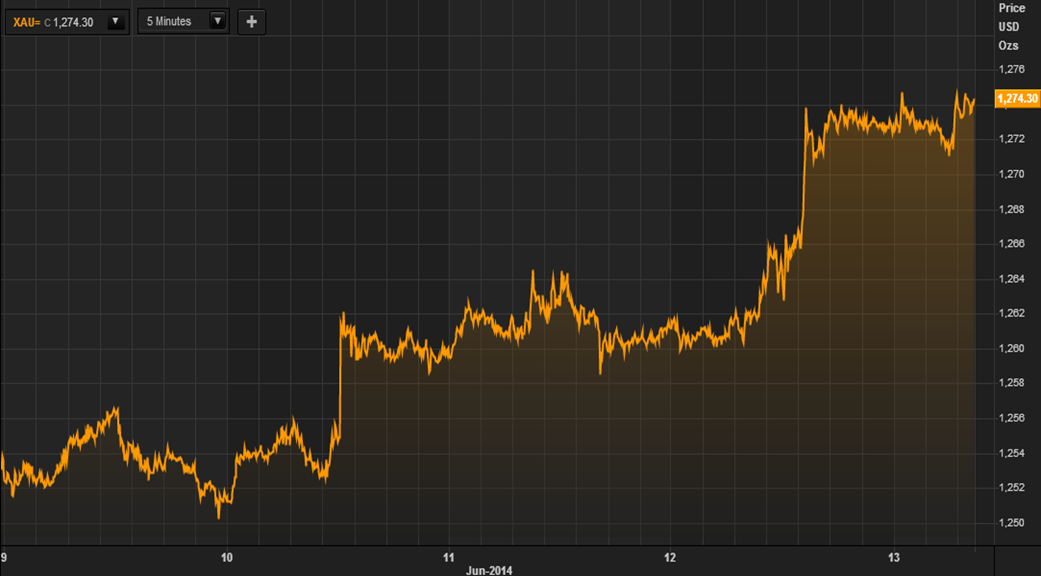
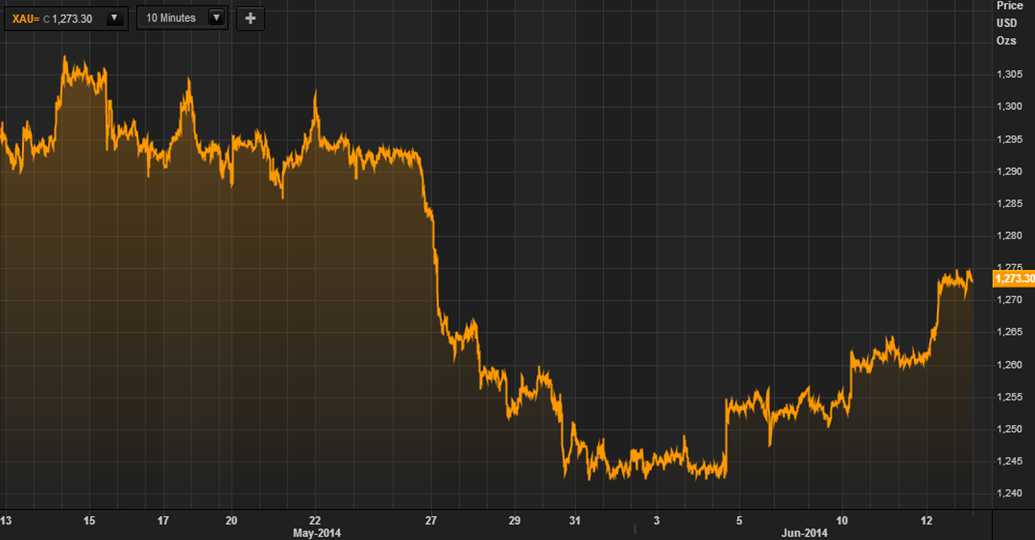
Today’s AM fix was USD 1,273.00, EUR 938.17 and GBP 750.06 per ounce.
Yesterday’s AM fix was USD 1,261.75, EUR 932.90 and GBP 749.66 per ounce.
Yesterday’s AM fix was USD 1,261.75, EUR 932.90 and GBP 749.66 per ounce.
Gold jumped $12.80 or 1.02% yesterday to $1,273.80/oz. Silver surged $0.35 or 1.82% to $19.56/oz.
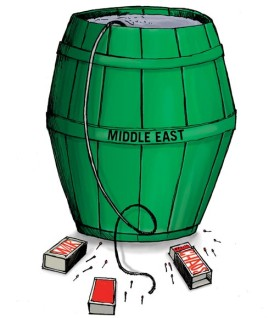
Middle East ‘Powder Keg’
Gold consolidated near a
two-week high today and is set for the first back to back weekly advance
since April, as concerns that a U.S. recovery may be stalling and
geopolitical risks in the Middle East led to safe haven demand.
Gold is 1.6% higher this week,
after rising 0.3% last week. Silver is also poised for the second week
of gains. In the physical gold market, premiums on gold bars are quoted at 80 cents to $1.20 an ounce in Singapore and Hong Kong.
The unrest in Iraq drove oil to
an eight-month high and sent stocks tumbling globally. U.S. crude
touched an intraday high of $107.68, and was up 75 cents at $107.28,
extending the previous session’s $2.13 gain on concerns about oil
supplies.
After a long period of
consolidation, oil prices look like they could be on the verge of
breaking out of their range and moving higher (see chart).
Gold in U.S. Dollars – 1 Week (Thomson Reuters)
Iraq and disappointing U.S.
economic data propelled gold and silver higher yesterday. Disappointing
U.S. retail sales and an uptick in weekly jobless claims led to investor
buying of haven assets.
The Commerce Department
reported a gain in retail sales of 0.3% in May. Economists were
expecting a gain of 0.6% last month. Jobless claims rose 4,000 to a
seasonally adjusted 317,000 according to the Labor Department. This is
7,000 more than economists were expecting.
Uncertainty has returned and in
a big way. This is favouring safe haven assets such as gold and
weakness in toppy looking risk assets such as many stock markets.
The combination of poor
economic data along with the risk of war in Iraq could be the catalyst
that gold needs to get out of its recent funk.

NYMEX Light Sweet Crude Oil (WTI) – 20 Years (Thomson Reuters)

NYMEX Light Sweet Crude Oil (WTI) – 20 Years (Thomson Reuters)
Violence in Iraq exploded as
Iraqi separatists, the Islamic State of Iraq and al-Sham (ISIS), took
over the second largest city in Iraq. ISIS forces are just 50 miles from
Iraq’s capital, Baghdad.
Sunni Islamist militants gained
more ground in Iraq overnight, moving into two towns in the eastern
province of Diyala. U.S. President Barack Obama is considering military
strikes to halt their advance towards the capital Baghdad.
Gold in U.S. Dollars – 1 Month (Thomson Reuters)
To the north, a Kurdish militia
known as Peshmerga took over key government installations in
strategically important, oil hub of Kirkuk. The situation in Iraq has
deteriorated significantly in a very short period of time and an
all-out sectarian conflict is looking more likely as each day goes by.
With Syria’s Kurds already
exploiting civil war there to run their own affairs, Iraqi Kurdish
expansionism is worrying U.S. ally Turkey, which has its own large
Kurdish minority and fears a renewed attempt to redraw borders and
create a Kurdish state.
Iraqi President Maliki’s army
already lost control of much of the Euphrates valley west of the capital
to ISIS last year, and with the evaporation of the army in the Tigris
valley to the north, the government could be left with just Baghdad and
areas south – home to the Shi’ite majority in Iraq’s 32 million
population.

Gold in U.S. Dollars – 5 Year (Thomson Reuters)
The Wall Street Journal is
reporting that Iran sent two battalions of Iranian Revolutionary Guards
to help the Iraqi government in its battle against ISIS. This is an
important development. Iran has already intervened in Syria and has the
power to crush ISIS in open combat.
Iran, which it is believed
funds and arms Shi’ite groups in Iraq, could be brought deeper into the
conflict, as could Turkey to the north. In Mosul, 80 Turks were held
hostage by ISIS after Ankara’s consulate there was overrun.
Iranian or Turkish intervention
would make the conflict inside Iraq much worse. Israel wants to see a
continuation of the tough line against Iran which it continues to see as
an existential threat.
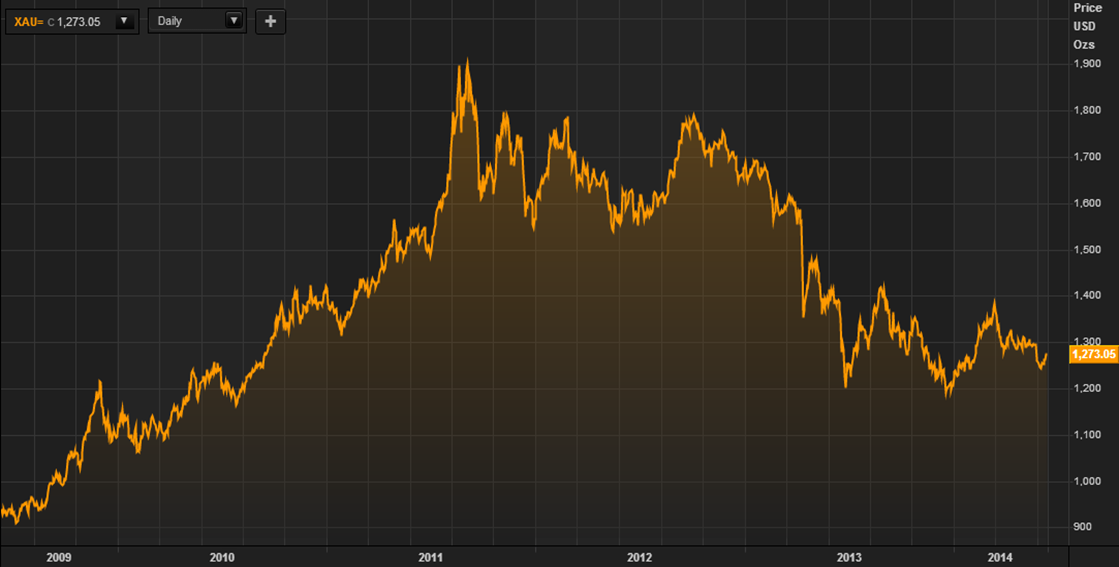
Gold bullion has increased 6%
this year in part as tension between Russia and the U.S. and EU led to
some haven demand. Developments in the Middle East are likely to deepen
geopolitical tensions between Russia and the West and this should
support gold and indeed lead to higher gold prices in the coming months.
There is still the potential
for a wider Middle East conflict as the region remains a ‘powder keg.’
Iraq may be the match that sees the region explode into chaos and war –
with attendant effects on global oil prices and the global economy.
Read more at http://investmentwatchblog.com/gold-silver-oil-gas-jump-on-middle-east-powder-keg-concerns/#uPRcoPg6syKxtFlj.99
Subscribe to:
Posts (Atom)