Frank Holmes kicks off the week on Kitco
News with this latest edition of “Gold Game Film.” Holmes talks about
weaker gold prices and whether he sees this as an opportunity for
investors. “Economic GDP rising in Asia is so important for gold prices
to rise,” he says. “I think the touchdown pass is to get resolution in
South East Asia [...] having their political stability come back in
place, we’ll see an increase in gold consumption.” Looking specifically
at China, Holmes comments on the recent news regarding the Shanghai Gold
Exchange, which he thinks is just a way for the Chinese to show that
they want to become ‘price-makers’ rather than ‘price-takers.’ Holmes
looks at the US dollar as well as gold import restrictions in India as
potential opportunities and threats in the marketplace. Tune in now to
get his latest comments on the gold market and where he expects the
metal is headed. Kitco News, June 2, 2014.
Wednesday, June 4, 2014

Here’s What 60 Minutes Didn’t Tell You About the F-35

Fortunately, a new video from Brave New Films does just that. The Jet that Ate the Pentagon, released along with a new website, explains how the F-35 became a $1.5 trillion burden on American taxpayers. Winslow Wheeler, the director of the Straus Military Reform Project at the Project On Government Oversight, is featured in the video. He answered a few of our questions about how and why the F-35 program got so out of control.
POGO: Why are you focused on informing the public about the F35?
 |
Winslow Wheeler
|
In the 1990s the Pentagon’s aviation bureaucracy in the Clinton administration put together a plan for the Joint Strike Fighter that was bound to fail at great cost. The building’s senior leadership—Secretary of Defense Les Aspin, acquisition Czar William Perry and others--failed to recognize the fundamental problems in both the physical design of the F-35 and its buy-first, test-later acquisition plan. In fact, they willfully advocated those horrendous ideas. Then, both the White House and Congress did nothing but cheer the whole thing on. They were warned by some experts, and they ignored the warnings.
Because the people who claim to be our national security leadership failed so miserably in the Clinton and George W. Bush administrations to recognize the problems, let alone take any appropriate action, it became necessary in the mid-2000s to raise the volume of the complaints and make the public aware.
In a functioning democratic system, public pressure on the politicians in the Pentagon, the White House and Congress should force them to find a solution. It remains to be seen, however, just how functional our system is: the public now is far more fully aware of the many and serious problems in the F-35, but there is no sign yet that any real action will be taken by the national security decision-makers. I fear that Congress is too fixated on the pork the F-35 brings to states and congressional districts; the White House is scared of the tough-minded politics needed to reverse course on the F-35, and most, but not all, Pentagon managers are too happy to keep on drinking—and passing out—the F-35 Kool Aid.
Nonetheless, making the public aware of the issues and its complaining to decision makers in Washington is our only viable way to bring this disaster to an end.
POGO: What are some of the F35s most shocking failures?
Wheeler: The most stunning failure in the F-35 is the level of complexity and contradiction in the basic design. Starting out as a plan to make a short take off and vertical landing (STOVL) aircraft supersonic (two inherently contradictory design characteristics), it only went further downhill after that. They then made it a multi-role aircraft, piling on the additional contradictory characteristics of an air to air fighter and an air to ground bomber; then they made it “stealth” making even fatter the aerodynamic design and making it all more complex by an order of magnitude. And finally, they made it multi-service adding further contradictory complexities demanded separately by the Air Force, Marine Corps and Navy. All this insanity made high cost inherent to the design, just as it also made low performance (performing many roles, all of them poorly) intrinsic.
Thus, the most shocking thing is that some think the solution is to cancel the Marine Corps and or the Navy’s version of this aircraft, but not the Air Force’s: ignoring all the basic characteristics of all three versions, these faux critics opt for a politically convenient non-solution which will mean that our Air Force and any remaining foreign purchasers will be strapped with an incompetent design of an astoundingly expensive aircraft.
That to me is the most shocking thing of all: after all the lessons, some of those pretending to be critics, simply don’t, or refuse to, get it.
POGO: Do you think the story of the F35 is a paradigm of larger issues in the American government?
Wheeler: Absolutely yes! The obsessive complexity of the physical design and the buy-it-then-fly-it acquisition plan are absolutely typical of American weapons acquisition. Those characteristics don’t occur by accident. Technologists who consider combat lessons an afterthought control the beginning design, and advocates in industry, Congress and the Pentagon seek to commit the entire government to the program by spending $billions and $billions before any empirical data becomes available from testing to show what the actual cost and performance are. They call it “concurrency,” but it is really bait and switch political engineering. Chuck Spinney has written about this many times, especially in “Defense Power Games.”
POGO: How has Lockheed Martin been able to continue with the program, despite the cost overruns and delays?
Wheeler: Lockheed-Martin cannot design effectively performing, affordable combat aircraft, but they are without peer in designing a greasy plan to foist the aircraft on the US and multiple foreign buyers. I am in awe of their skill in doing that; they successfully convince otherwise rational people to ignore empirical data, to believe that press releases spout biblical truth and to embrace new promises in the face of scores of broken ones. Those are awesome powers.
POGO: What do you hope the video will add to the F35 conversation?
Wheeler: The video covers a lot of territory in just a few minutes, but people who want to check the data behind the many statements in the video will find there are piles of evidence to back them up. I hope people do exactly that: check on the facts. Then, armed with the data, they may want to make noise—however they so choose—to give the politicians in Congress, the White House and the Pentagon a choice: Do the right thing on the F-35 or be replaced.
See the video from Brave New Films below.
‘Two Weeks’ To Prepare For Cyber Attack On Bank Accounts – UK Government
by GoldCore
Yesterday’s AM fix was USD 1,244.75, EUR 915.26 and GBP 743.49 per ounce.
Gold fell $7.70 or 0.62% yesterday to $1,243.10/oz. Silver slipped $0.06 or 0.32% to $18.75/oz.

Gold fell to the lowest since February 3 and prices completed a sixth day of declines for the longest losing run since August. Gold bullion in Singapore traded sideways around the $1,244/oz level prior to ticking slightly higher to over $1,246/oz at the open in London (0800 BST).
Silver for immediate delivery
rose 0.5% to $18.849 an ounce after sliding to $18.635 on May 30, the
lowest since June 2013. Platinum traded at $1,437.75 an ounce from
$1,435.56 yesterday, when prices fell to a three-week low of $1,433.
Palladium added another 0.2% to
$833.74/oz. The metal climbed to a 34 month high of $845.24 an ounce on
May 28 amid a strike in South Africa and prospects of further sanctions
against Russia, the world’s biggest producers.
Gold held near a four-month low
as risk appetite saw advances in the dollar and global equities. The
Standard & Poor’s 500 Index reached a new record high and the dollar
climbed to a two-month high against 10 major counterparts.
Gold declined 3.3% in May, the
biggest monthly drop this year, despite quite strong fundamentals. The
euro also weakened 1.7% versus the dollar in May and there is
speculation that the European Central Bank will become even more dovish
when policy makers meet this Thursday, June 5. Goldman alumni Draghi
adopting an even loose monetary policy should support gold prices.

Gold in U.S. Dollars – 5 Years – (Thomson Reuters)
On Friday, the U.S. nonfarm
payrolls data will be watched for signs regarding the fragile U.S
recovery. As usual, a good jobs number should see gold sold by traders
and a poor jobs number should see gold buying.
Gold remains 3.6% higher this year partly due to robust global demand and due to heightened geopolitical risk.
Since May 29, the 14 day
relative-strength index has been below the level of 30 that suggests a
potential impending rebound to technical analysts.
‘Two Weeks’ To Prepare For Cyber Attack On Bank Accounts - UK Government
Computer users are being urged to protect their machines from malware which could allow hackers to steal financial data, access banks accounts and withdraw savers funds.
Computer users are being urged to protect their machines from malware which could allow hackers to steal financial data, access banks accounts and withdraw savers funds.
British investigators have been
working with the FBI to trace the hackers behind an attack, which they
expect to take place in the next fortnight.
Between 500,000 and one million machines have so far been infected worldwide, according to court documents.
U.S. officials have accused a
Russian hacker of masterminding the scam – and prosecutors say those
involved have already raked in more than $100 million (£60 million).
The National Crime Agency (NCA)
is now warning of a “powerful computer attack”. It is urging people to
back up important files and make sure their security software and
operating system are up to date.
Two pieces of malware software known as GOZeuS and CryptoLocker are responsible for the alert.
They typically infect a
computer via attachments or links in emails. If a user clicks on GOZeuS,
it silently monitors activity and tries to capture information such as
bank details.
“(The links or attachments) may
look like they have been sent by genuine contacts and may purport to
carry invoices, voicemail messages, or any file made to look innocuous,”
the NCA warned.
“These emails are generated by other victims’ computers, who do not realise they are infected, and are used to send mass emails creating more victims.”
“These emails are generated by other victims’ computers, who do not realise they are infected, and are used to send mass emails creating more victims.”
The Cryptolocker malware is
activated if the first attack is not profitable enough. It locks a user
from their files and threatens to delete them unless a “ransom” of
several hundred pounds is paid.
Some 234,000 machines were hit
by Cryptolocker – bringing in $27m (£16m) in payments – in its first two
months, the US Justice Department said. More than 15,500 computers in
the UK are infected and “many more” are at risk, according to the NCA.
Stewart Garrick, a senior
investigator with the NCA, told Sky News the threat was mainly against
individuals or businesses running Windows-based computers.
We have long warned of the
vulnerability of having all your investments and savings in electronic
format. The nature of our modern financial and banking system exposes
investors and savers to new risks that were not there a generation ago.
Prudent diversification today, involves owning some actual physical gold and
silver coins and bars in your possession or in allocated, segregated
accounts that can be taken delivery of with a phone call.
War Makes Us Poor … And Drags the Economy Down Through the Floor
Top Economists Say War Is Bad for the Economy
Preface: Many Americans – including influential economists and talking heads - stillwrongly assume that war is good for the economy. For example, extremely influential economists like Paul Krugmanand Martin Feldstein promote the myth that war is good for the economy.
Many congressmen assume
that cutting pork-barrel military spending would hurt their
constituents’ jobs. And talking heads like senior Washington Post
political columnist David Broder parrot this idea.
As demonstrated below, it isn’t true.
Nobel-prize winning economist Joseph Stiglitz says that war is bad for the economy:
Stiglitz wrote in 2003:War is widely thought to be linked to economic good times. The second world war is often said to have brought the world out of depression, and war has since enhanced its reputation as a spur to economic growth. Some even suggest that capitalism needs wars, that without them, recession would always lurk on the horizon. Today, we know that this is nonsense. The 1990s boom showed that peace is economically far better than war. The Gulf war of 1991 demonstrated that wars can actually be bad for an economy.
Former Federal Reserve chairman Alan Greenspan also said in that war is bad for the economy. In 1991, Greenspan said that a prolonged conflict in the Middle East would hurt the economy. And he made this point again in 1999:
Societies need to buy as much military insurance as they need, but to spend more than that is to squander money that could go toward improving the productivity of the economy as a whole: with more efficient transportation systems, a better educated citizenry, and so on. This is the point that retiring Rep. Barney Frank (D-Mass.) learned back in 1999 in a House Banking Committee hearing with then-Federal Reserve Chairman Alan Greenspan. Frank asked what factors were producing our then-strong economic performance. On Greenspan’s list: “The freeing up of resources previously employed to produce military products that was brought about by the end of the Cold War.” Are you saying, Frank asked, “that dollar for dollar, military products are there as insurance … and to the extent you could put those dollars into other areas, maybe education and job trainings, maybe into transportation … that is going to have a good economic effect?”Greenspan agreed.
Economist Dean Baker notes:
It is often believed that wars and military spending increases are good for the economy. In fact, most economic models show that military spending diverts resources from productive uses, such as consumption and investment, and ultimately slows economic growth and reduces employment.
Professor Emeritus of International Relations at the American University Joshua Goldstein notes:
Recurring war has drained wealth, disrupted markets, and depressed economic growth.***War generally impedes economic development and undermines prosperity.
And David R. Henderson –
associate professor of economics at the Naval Postgraduate School in
Monterey, California and previously a senior economist with President
Reagan’s Council of Economic Advisers - writes:
Is military conflict really good for the economy of the country that engages in it? Basic economics answers a resounding “no.”
The Proof Is In the Pudding
Mike Lofgren notes:
Military spending may at one time have been a genuine job creator when weapons were compatible with converted civilian production lines, but the days of Rosie the Riveter are long gone. [Indeed, WWII was different from current wars in many ways, and so its economic effects are not comparable to those of today's wars.] Most weapons projects now require relatively little touch labor. Instead, a disproportionate share is siphoned into high-cost R&D (from which the civilian economy benefits little), exorbitant management expenditures, high overhead, and out-and-out padding, including money that flows back into political campaigns. A dollar appropriated for highway construction, health care, or education will likely create more jobs than a dollar for Pentagon weapons procurement.***During the decade of the 2000s, DOD budgets, including funds spent on the war, doubled in our nation’s longest sustained post-World War II defense increase. Yet during the same decade, jobs were created at the slowest rate since the Hoover administration. If defense helped the economy, it is not evident. And just the wars in Iraq and Afghanistan added over $1.4 trillion to deficits, according to the Congressional Research Service. Whether the wars were “worth it” or merely stirred up a hornet’s nest abroad is a policy discussion for another time; what is clear is that whether you are a Keynesian or a deficit hawk, war and associated military spending are no economic panacea.
The Washington Post noted in 2008:
A recent paper from the National Bureau of Economic Research concludes that countries with high military expenditures during World War II showed strong economic growth following the war, but says this growth can be credited more to population growththan war spending. The paper finds that war spending had only minimal effects on per-capita economic activity.***A historical survey of the U.S. economy from the U.S. State Department reports the Vietnam War had a mixed economic impact. The first Gulf War typically meets criticism for having pushed the United States toward a 1991 recession.
The Institute for Economics & Peace (IEP) shows that
any boost from war is temporary at best. For example, while WWII
provided a temporary bump in GDP, GDP then fell back to the baseline
trend. After the Korean War, GDP fell below the baseline trend:
 IEP notes:
By examining the state of the economy at each of the major conflict periods since World War II, it can be seen that the positive effects of increased military spending were outweighed by longer term unintended negative macroeconomic consequences. While the stimulatory effect of military outlays is evidently associated with boosts in economic growth, adverse effects show up either immediately or soon after, through higher inflation, budget deficits, high taxes and reductions in consumption or investment. Rectifying these effects has required subsequent painful adjustments which are neither efficient nor desirable. When an economy has excess capacity and unemployment, it is possible that increasing military spending can provide an important stimulus. However, if there are budget constraints, as there are in the U.S. currently, then excessive military spending can displace more productive non-military outlays in other areas such as investments in high-tech industries, education, or infrastructure. The crowding-out effects of disproportionate government spending on military functions can affect service delivery or infrastructure development, ultimately affecting long-term growth rates.***Analysis of the macroeconomic components of GDP during World War II and in subsequent conflicts show heightened military spending had several adverse macroeconomic effects. These occurred as a direct consequence of the funding requirements of increased military spending. The U.S. has paid for its wars either through debt (World War II, Cold War, Afghanistan/Iraq), taxation (Korean War) or inflation (Vietnam). In each case, taxpayers have been burdened, and private sector consumption and investment have been constrained as a result. Other negative effects include larger budget deficits, higher taxes, and growth above trend leading to inflation pressure. These effects can run concurrent with major conflict or via lagging effects into the future. Regardless of the way a war is financed, the overall macroeconomic effect on the economy tends to be negative. For each of the periods after World War II, we need to ask, what would have happened in economic terms if these wars did not happen? On the specific evidence provided, it can be reasonably said, it is likely taxes would have been lower, inflation would have been lower, there would have been higher consumption and investment and certainly lower budget deficits. Some wars are necessary to fight and the negative effects of not fighting these wars can far outweigh the costs of fighting. However if there are other options, then it is prudent to exhaust them first as once wars do start, the outcome, duration and economic consequences are difficult to predict.
We noted in 2011:
This is a no-brainer, if you think about it. We’ve been in Afghanistan for almost twice as long as World War II. We’ve been in Iraq for years longer than WWII. We’ve been involved in 7 or 8 wars in the last decade. And yet [the economy is still unstable]. If wars really helped the economy, don’t you think things would have improved by now? Indeed,the Iraq war alone could end up costing more than World War II. And given the other wars we’ve been involved in this decade, I believe that the total price tag for the so-called “War on Terror” will definitely support that of the “Greatest War”.
Let’s look at the adverse effects of war in more detail …
War Spending Diverts Stimulus Away from the Real Civilian Economy
IEP notes that – even though the government spending soared – consumption and investment were flatduring the Vietnam war:

The New Republic noted in 2009:
Conservative Harvard economist Robert Barro has argued that increased military spending during WWII actually depressed other parts of the economy.
(New Republic also points out that
conservative economist Robert Higgs and liberal economists Larry
Summers and Brad Delong have all shown that any stimulation to the
economy from World War II has been greatly exaggerated.)
How could war actually hurt the economy, when so many say that it stimulates the economy?
Because of what economists call the “broken window fallacy”.
Specifically, if a window in a
store is broken, it means that the window-maker gets paid to make a new
window, and he, in turn, has money to pay others. However, economists
long ago showed that – if the window hadn’t been broken – the
shop-owner would have spent that money on other things, such as food, clothing, health care, consumer electronics or recreation, which would have helped the economy as much or more.
If the shop-owner hadn’t had to
replace his window, he might have taken his family out to dinner, which
would have circulated more money to the restaurant, and from there to
other sectors of the economy. Similarly, the money spent on the war
effort is money that cannot be spent on other sectors of the economy. Indeed, all of the military spending has just created military jobs, at the expense of the civilian economy.
Professor Henderson writes:
Money not spent on the military could be spent elsewhere.This also applies to human resources. The more than 200,000 U.S. military personnel in Iraq and Afghanistan could be doing something valuable at home.Why is this hard to understand? The first reason is a point 19th-century French economic journalist Frederic Bastiat made in his essay, “What Is Seen and What Is Not Seen.” Everyone can see that soldiers are employed. But we cannot see the jobs and the other creative pursuits they could be engaged in were they not in the military.The second reason is that when economic times are tough and unemployment is high, it’s easy to assume that other jobs could not exist. But they can. This gets to an argument Bastiat made in discussing demobilization of French soldiers after Napoleon’s downfall. He pointed out that when government cuts the size of the military, it frees up not only manpower but also money. The money that would have gone to pay soldiers can instead be used to hire them as civilian workers. That can happen in three ways, either individually or in combination: (1) a tax cut; (2) a reduction in the deficit; or (3) an increase in other government spending.***Most people still believe that World War II ended the Great Depression …. But look deeper.***The government-spending component of GNP went for guns, trucks, airplanes, tanks, gasoline, ships, uniforms, parachutes, and labor. What do these things have in common? Almost all of them were destroyed. Not just these goods but also the military’s billions of labor hours were used up without creating value to consumers. Much of the capital and labor used to make the hundreds of thousands of trucks and jeeps and the tens of thousands of tanks and airplanes would otherwise have been producing cars and trucks for the domestic economy. The assembly lines in Detroit, which had churned out 3.6 million cars in 1941, were retooled to produce the vehicles of war. From late 1942 to 1945, production of civilian cars was essentially shut down.And that’s just one example. Women went without nylon stockings so that factories could produce parachutes. Civilians faced tight rationing of gasoline so that U.S. bombers could fly over Germany. People went without meat so that U.S. soldiers could be fed. And so on.These resources helped win the war—no small issue. But the war was not a stimulus program, either in its intentions or in its effects, and it was not necessary for pulling the U.S. out of the Great Depression. Had World War II never taken place, millions of cars would have been produced; people would have been able to travel much more widely; and there would have been no rationing. In short, by the standard measures, Americans would have been much more prosperous.Today, the vast majority of us are richer than even the most affluent people back then. But despite this prosperity, one thing has not changed: war is bad for our economy. The $150 billion that the government spends annually on wars in Iraq and Afghanistan (and, increasingly, Pakistan) could instead be used to cut taxes or cut the deficit. By ending its ongoing wars … the U.S. government … would be developing a more prosperous economy.
Austrian economist Ludwig Von Mises points:
That is the essence of so-called war prosperity; it enriches some by what it takes from others. It is not rising wealth but a shifting of wealth and income.
We noted in 2010:
You know about America’s unemployment problem. You may have even heard that the U.S. may very well have suffered a permanent destruction of jobs.But did you know that the defense employment sector is booming?[P]ublic sector spending – and mainly defense spending – has accounted for virtually all of the new job creation in the past 10 years:The U.S. has largely been financing job creation for ten years. Specifically, as the chief economist for BusinessWeek, Michael Mandel, points out, public spending has accounted for virtually all new job creation in the past 1o years:Private sector job growth was almost non-existent over the past ten years. Take a look at this horrifying chart:Between May 1999 and May 2009, employment in the private sector sector only rose by 1.1%, by far the lowest 10-year increase in the post-depression period.It’s impossible to overstate how bad this is. Basically speaking, the private sector job machine has almost completely stalled over the past ten years. Take a look at this chart:Over the past 10 years, the private sector has generated roughly 1.1 million additional jobs, or about 100K per year. The public sector created about 2.4 million jobs.But even that gives the private sector too much credit. Remember that the private sector includes health care, social assistance, and education, all areas which receive a lot of government support.***Most of the industries which had positive job growth over the past ten years were in the HealthEdGov sector. In fact, financial job growth was nearly nonexistent once we take out the health insurers.Let me finish with a final chart.Without a decade of growing government support from rising health and education spending and soaring budget deficits, the labor market would have been flat on its back. [120]***So most of the job creation has been by the public sector. But because the job creation has been financed with loans from China and private banks, trillions in unnecessary interest charges have been incurred by the U.S.And this shows military versus non-military durable goods shipments:[Click here to view full image.]
So we’re running up our debt (which will eventually decrease economic growth), but the only jobs we’re creating are military and other public sector jobs.PhD economist Dean Baker points out that America’s massive military spending on unnecessary and unpopular wars lowers economic growth and increasesunemployment:Defense spending means that the government is pulling away resources from the uses determined by the market and instead using them to buy weapons and supplies and to pay for soldiers and other military personnel. In standard economic models, defense spending is a direct drain on the economy, reducing efficiency, slowing growth and costing jobs.A few years ago, the Center for Economic and Policy Research commissioned Global Insight, one of the leading economic modeling firms, to project the impact of a sustained increase in defense spending equal to 1.0 percentage point of GDP. This was roughly equal to the cost of the Iraq War.Global Insight’s model projected that after 20 years the economy would be about 0.6 percentage points smaller as a result of the additional defense spending. Slower growth would imply a loss of almost 700,000 jobs compared to a situation in which defense spending had not been increased. Construction and manufacturing were especially big job losers in the projections, losing 210,000 and 90,000 jobs, respectively.The scenario we asked Global Insight [recognized as the most consistentlyaccurate forecasting company in the world] to model turned out to have vastly underestimated the increase in defense spending associated with current policy. In the most recent quarter, defense spending was equal to 5.6 percent of GDP. By comparison, before the September 11th attacks, the Congressional Budget Office projected that defense spending in 2009 would be equal to just 2.4 percent of GDP. Our post-September 11th build-up was equal to 3.2 percentage points of GDP compared to the pre-attack baseline. This means that the Global Insight projections of job loss are far too low…The projected job loss from this increase in defense spending would be close to 2 million. In other words, the standard economic models that project job loss from efforts to stem global warming also project that the increase in defense spending since 2000 will cost the economy close to 2 million jobs in the long run.The Political Economy Research Institute at the University of Massachusetts, Amherst has also shown that non-military spending creates more jobs than military spending.So we’re running up our debt – which will eventually decrease economic growth – and creating many fewer jobs than if we spent the money on non-military purposes.


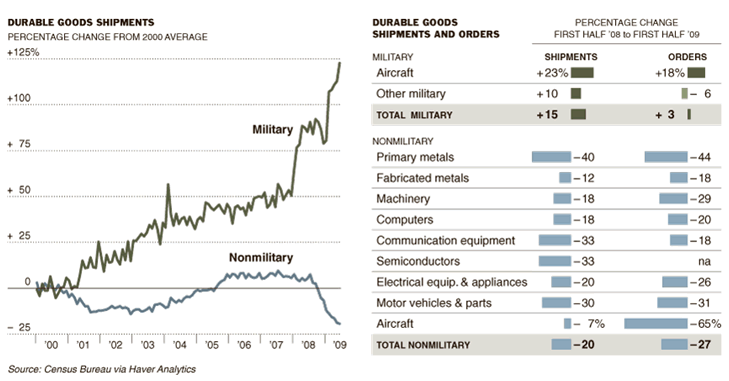
High Military Spending Drains Innovation, Investment and Manufacturing Strength from the Civilian Economy
Chalmers Johnson notes that high military spending diverts innovation and manufacturing capacity from the economy:
By the 1960s it was becoming apparent that turning over the nation’s largest manufacturing enterprises to the Department of Defense and producing goods without any investment or consumption value was starting to crowd out civilian economic activities. The historian Thomas E Woods Jr observes that, during the 1950s and 1960s, between one-third and two-thirds of all US research talent was siphoned off into the military sector. It is, of course, impossible to know what innovations never appeared as a result of this diversion of resources and brainpower into the service of the military, but it was during the 1960s that we first began to notice Japan was outpacing us in the design and quality of a range of consumer goods, including household electronics and automobiles.***Woods writes: “According to the US Department of Defense, during the four decades from 1947 through 1987 it used (in 1982 dollars) $7.62 trillion in capital resources. In 1985, the Department of Commerce estimated the value of the nation’s plant and equipment, and infrastructure, at just over $7.29 trillion… The amount spent over that period could have doubled the American capital stock or modernized and replaced its existing stock”.The fact that we did not modernise or replace our capital assets is one of the main reasons why, by the turn of the 21st century, our manufacturing base had all but evaporated. Machine tools, an industry on which Melman was an authority, are a particularly important symptom. In November 1968, a five-year inventory disclosed “that 64% of the metalworking machine tools used in US industry were 10 years old or older. The age of this industrial equipment (drills, lathes, etc.) marks the United States’ machine tool stock as the oldest among all major industrial nations, and it marks the continuation of a deterioration process that began with the end of the second world war. This deterioration at the base of the industrial system certifies to the continuousdebilitating and depleting effect that the military use of capital and research and development talent has had on American industry.”
Economist Robert Higgs makes the same pointabout World War II:
Yes, officially measured GDP soared during the war. Examination of that increased output shows, however, that it consisted entirely of military goods and services. Real civilian consumption and private investment both fell after 1941, and they did not recover fully until 1946. The privately owned capital stock actually shrank during the war. Some prosperity. (My article in the peer-reviewed Journal of Economic History, March 1992, presents many of the relevant details.)It is high time that we come to appreciate the distinction between the government spending, especially the war spending, that bulks up official GDP figures and the kinds of production that create genuine economic prosperity. As Ludwig von Mises wrote in the aftermath of World War I, “war prosperity is like the prosperity that an earthquake or a plague brings.”
War Causes Inflation … Which Keynes and Bernanke Admit Taxes Consumers
As we noted in 2010, war causes inflation … which hurts consumers:
Liberal economist James Galbraith wrote in 2004:Inflation applies the law of the jungle to war finance. Prices and profits rise, wages and their purchasing power fall. Thugs, profiteers and the well connected get rich. Working people and the poor make out as they can. Savings erode, through the unseen mechanism of the “inflation tax” — meaning that the government runs a big deficit in nominal terms, but a smaller one when inflation is factored in.***There is profiteering. Firms with monopoly power usually keep some in reserve. In wartime, if the climate is permissive, they bring it out and use it. Gas prices can go up when refining capacity becomes short — due partly to too many mergers. More generally, when sales to consumers are slow, businesses ought to cut prices — but many of them don’t. Instead, they raise prices to meet their income targets and hope that the market won’t collapse.Ron Paul agreed in 2007:Congress and the Federal Reserve Bank have a cozy, unspoken arrangement that makes war easier to finance. Congress has an insatiable appetite for new spending, but raising taxes is politically unpopular. The Federal Reserve, however, is happy to accommodate deficit spending by creating new money through the Treasury Department. In exchange, Congress leaves the Fed alone to operate free of pesky oversight and free of political scrutiny. Monetary policy is utterly ignored in Washington, even though the Federal Reserve system is a creation of Congress.The result of this arrangement is inflation. And inflation finances war.Blanchard Economic Research pointed out in 2001:War has a profound effect on the economy, our government and its fiscal and monetary policies. These effects have consistently led to high inflation.***David Hackett Fischer is a Professor of History and Economic History at Brandeis. [H]is book, The Great Wave, Price Revolutions and the Rhythm of History … finds that … periods of high inflation are caused by, and cause, a breakdown in order and a loss of faith in political institutions. He also finds that war is a triggering influence on inflation, political disorder, social conflict and economic disruption.***Other economists agree with Professor Fischer’s link between inflation and war.James Grant, the respected editor of Grant’s Interest Rate Observer, supplies us with the most timely perspective on the effect of war on inflation in the September 14 issue of his newsletter:“War is inflationary. It is always wasteful no matter how just the cause. It is cost without income, destruction financed (more often than not) by credit creation. It is the essence of inflation.”Libertarian economics writer Lew Rockwell noted in 2008:You can line up 100 professional war historians and political scientists to talk about the 20th century, and not one is likely to mention the role of the Fed in funding US militarism. And yet it is true: the Fed is the institution that has created the money to fund the wars. In this role, it has solved a major problem that the state has confronted for all of human history. A state without money or a state that must tax its citizens to raise money for its wars is necessarily limited in its imperial ambitions. Keep in mind that this is only a problem for the state. It is not a problem for the people. The inability of the state to fund its unlimited ambitions is worth more for the people than every kind of legal check and balance. It is more valuable than all the constitutions every devised.***Reflecting on the calamity of this war, Ludwig von Mises wrote in 1919One can say without exaggeration that inflation is an indispensable means of militarism. Without it, the repercussions of war on welfare become obvious much more quickly and penetratingly; war weariness would set in much earlier.***In the entire run-up to war, George Bush just assumed as a matter of policy that it was his decision alone whether to invade Iraq. The objections by Ron Paul and some other members of Congress and vast numbers of the American population were reduced to little more than white noise in the background. Imagine if he had to raise the money for the war through taxes. It never would have happened. But he didn’t have to. He knew the money would be there. So despite a $200 billion deficit, a $9 trillion debt, $5 trillion in outstanding debt instruments held by the public, a federal budget of $3 trillion, and falling tax receipts in 2001, Bush contemplated a war that has cost $525 billion dollars — or $4,681 per household. Imagine if he had gone to the American people to request that. What would have happened? I think we know the answer to that question. And those are government figures; the actual cost of this war will be far higher — perhaps $20,000 per household.***If the state has the power and is asked to choose between doing good and waging war, what will it choose? Certainly in the American context, the choice has always been for war.And progressive economics writer Chris Martenson explains as part of his “Crash Course” on economics:If we look at the entire sweep of history, we can make an utterly obvious claim: All wars are inflationary. Period. No exceptions.***So if anybody tries to tell you that you haven’t sacrificed for the war, let them know you sacrificed a large portion of your savings and your paycheck to the effort, thank you very much.The bottom line is that war always causes inflation, at least when it is funded through money-printing instead of a pay-as-you-go system of taxes and/or bonds. It might be great for a handful of defense contractors, but war is bad for Main Street, stealing wealth from people by making their dollars worth less.
Given that John Maynard Keynes and former Federal Reserve chair Ben Bernanke both say thatinflation is a tax on the American people, war-induced inflation is a theft of our wealth.
IEP gives a graphic example – the Vietnam war helping to push inflation through the roof:

War Causes Runaway Debt
We noted in 2010:
All of the spending on unnecessary wars adds up.The U.S. is adding trillions to its debt burden to finance its multiple wars in Iraq, Afghanistan, Yemen, etc.
Indeed, IEP – commenting on the war in Afghanistan and Iraq – notes:
This was also the first time in U.S. history where taxes were cut during a war which then resulted in both wars completely financed by deficit spending. A loose monetary policy was also implemented while interest rates were kept low and banking regulations were relaxed to stimulate the economy. All of these factors have contributed to the U.S. having severe unsustainable structural imbalances in its government finances.
We also pointed out in 2010:
It is ironic that America’s huge military spending is what made us an empire … but our huge military is what is bankrupting us … thus destroying our status as an empire.
Economist Michel Chossudovsky told Washington’s Blog:
War always causes recession. Well, if it is a very short war, then it may stimulate the economy in the short-run. But if there is not a quick victory and it drags on, then wars always put the nation waging war into a recession and hurt its economy.
Indeed, we’ve known for 2,500 years that prolonged war bankrupts an economy (and remember Greenspan’s comment.)
It’s not just civilians saying this …
The former head of the Joint Chiefs of Staff – Admiral Mullen – agrees:
The Pentagon needs to cut back on spending.“We’re going to have to do that if it’s going to survive at all,” Mullen said, “and do it in a way that is predictable.”
Indeed, Mullen said:
For industry and adequate defense funding to survive … the two must work together. Otherwise, he added, “this wave of debt” will carry over from year to year, and eventually, the defense budget will be cut just to facilitate the debt.
Former Secretary of Defense Robert Gates agrees as well. As David Ignatius wrote in the Washington Post in 2010:
After a decade of war and financial crisis, America has run up debts that pose a national security problem, not just an economic one.***One of the strongest voices arguing for fiscal responsibility as a national security issue has been Defense Secretary Bob Gates. He gave a landmark speech in Kansas on May 8, invoking President Dwight Eisenhower’s warnings about the dangers of an imbalanced military-industrial state.“Eisenhower was wary of seeing his beloved republic turn into a muscle-bound, garrison state — militarily strong, but economically stagnant and strategically insolvent,” Gates said. He warned that America was in a “parlous fiscal condition” and that the “gusher” of military spending that followed Sept. 11, 2001, must be capped. “We can’t have a strong military if we have a weak economy,” Gates told reporters who covered the Kansas speech.On Thursday the defense secretary reiterated his pitch that Congress must stop shoveling money at the military, telling Pentagon reporters: “The defense budget process should no longer be characterized by ‘business as usual’ within this building — or outside of it.”
While war might make a handful in the military-industrial complex and big banks rich, America’s top military leaders and economists say that would be a very bad idea for the American people.
Indeed, military strategists have known for 2,500 years that prolonged wars are disastrous for the nation.
War Increases Terrorism … And Terrorism Hurts the Economy
Security experts – conservative
hawks and liberal doves alike – agree that waging war in the Middle
Eastweakens national security and increases terrorism. See this, this, this, this, this, this and this.
Terrorism – in turn – terrorism is bad for the economy. Specifically, a study by Harvard and the National Bureau of Economic Research (NBER) points out:
From an economic standpoint, terrorism has been described to have four main effects (see, e.g., US Congress, Joint Economic Committee, 2002). First, the capital stock (human and physical) of a country is reduced as a result of terrorist attacks. Second, the terrorist threat induces higher levels of uncertainty. Third, terrorism promotes increases in counter-terrorism expenditures, drawing resources from productive sectors for use in security. Fourth, terrorism is known to affect negatively specific industries such as tourism.
The Harvard/NBER concludes:
In accordance with the predictions of the model, higher levels of terrorist risks are associated with lower levels of net foreign direct investment positions, even after controlling for other types of country risks. On average, a standard deviation increase in the terrorist risk is associated with a fall in the net foreign direct investment position of about 5 percent of GDP.
So the more unnecessary wars
American launches and the more innocent civilians we kill, the less
foreign investment in America, the more destruction to our capital
stock, the higher the level of uncertainty, the more counter-terrorism
expenditures and the less expenditures in more productive sectors, and
the greater the hit to tourism and some other industries. Moreover:
Terrorism has contributed to a decline in the global economy (for example, European Commission, 2001).
So military adventurism increases terrorism which hurts the world economy. And see this.
Postscript: Attacking a country
which controls the flow of oil has special impacts on the economy. For
example, well-known economist Nouriel Roubini says that attacking Iran would lead to global recession. The IMF says that Iran cutting off oil supplies could raise crude prices 30%.
The World Is Nine Meals From Widespread Revolution
Dave Hodges
June 2, 2014

The World Bank is
boldly proclaiming that extreme food shortages and subsequent food
riots will take place in the near future largely due to the rapid
increase in food prices.
In their recent report, only released a few days ago, the World Bank cites the disturbing fact that there have been 51 food riots in
37 countries in recent memory due to high food prices and the further
escalation of food prices has no end in sight. The World Bank
further speculates that the present state of food prices could lead to
political instability and this is the kind of stuff that wars are made
of. And what is the number one cause of rising food prices according to
the World Bank? It is the increasing demand (see
attached PDF) for food from a growing population inside of China. The
future military implications should be self-evident.
The staple crop of wheat has risen 18% in the past year.
Are Food Prices Being Artificially Being Manipulated for Purposes of Political Control?
Before answering this question,
it might be more prudent to ask if the food distribution system can
survive the economic catastrophe’s which are poised to ravage the
world’s economies and subsequent money supplies. If the dollar ever
collapses, the rest of the world currencies will fall like a row of
dominoes. If the multinational corporations are broke, how will food be
shipped? Remember, the United States has a $17 trillion dollar deficit, a
$240 trillion unfunded set of liabilities and the derivative debt is
placed at about $1.5 quadrillion dollars! Setting aside your cognitive
dissonance for a moment, what does your common sense tell you about the
long-term viability of the dollar?
There are even more dire factors to consider.The elite are busy buying up the world’s water supply as evidenced by T. Boone Pickens and
his continuing acquisition of the Ogallala underground water aquifer
which dominates water supplies from Texas to South Dakota. The Bush
family has purchased water rights of a similar proportion in Paraguay
and the globalist beat goes on. The bottom line is that there are too
few people controlling a disproportionate amount of the world’s water
supplies. And without the proper distribution of water, there is no food
cultivation. Add to this concern is the fact that GMO’s are highly
vulnerable to devastation because it is a genetic mono-crop..
Some have speculated that food
prices are being artificially being manipulated upward, through hording,
in order to create a food shortage issue which could result in desired
political instability and could result in a large scale war. This may or
may not be true. However, what is undeniable is that the world is
poised to experience a monumental food crisis that could kill off a
significant number of the world’s population.
The Historical Precedent of Using Food As a Weapon
The two most notable examples
of dictators using food as a weapon in order to destroy the free will of
their people, comes from the regimes of Stalin and Hitler.
Josef Stalin engaged in his own
Soviet-style Holocaust when, in 1932 and 1933, an estimated six to 20
million people in the Ukraine died from starvation when Stalin
implemented his prescription of “hope and change” policies in order to
eliminate the Ukrainian’s desire for becoming their own nation-state.
Upon assuming power, the
Stalinist Communist regime rapidly nationalized the food industry and
forced all of the region’s farms into collectives. This is exactly what
is happening under the Obama administration and the dramatic rise of
corporately owned farms.
Stalin’s version of the Holocaust came to fruition in what history has dubbed, the “Holodomor,”
in which millions perished in only a two year period when the Soviet
government began to exterminate the Ukrainian population by taking
control of food and food production. And why would Stalin do such a
thing to his own people? The Ukrainians were discussing and publicizing
some very dangerous ideas about freedom, liberty and the ability to act
on their desire for political autonomy. Americans would be wise to heed
this warning as despots hate freedom. The parallel between Stalin and
collectivist farms and American corporately owned farms is very
disturbing.
Hitler proclaimed that food could be used as a tool “…to discipline the masses” and he did not hesitate to use the control of food as a type of carrot and stick in which he would reward accomplishment and punish failure as well as to ferment preferential class distinctions in which his armed forces received the largest food ration cards. Skilled workers who were engaged in industries critical to the building of the German war machine, received food ration cards which were slightly less in value. And, finally, the prisoners and the Jews received the lowest valued Nazi food ration cards. Food ration cards were also utilized as incentives to increase industrial production and were also increased in value when productive Nazi workers would be promoted. Food ration cards were diminished in value for the failure to meet Nazi production goals. Hitler’s use of what psychologists refer to as classical conditioning techniques reduced the will of the German population to a pack of Pavlovian dogs who were conditioned to be totally dependent upon the government for their survival. The presence of 50 million Americans on food stamps would certainly make an applicable parallel to Hitler’s practices and the potential for Obama, or another future president to follow in Hitler’s footsteps with regard to food management.
Hitler proclaimed that food could be used as a tool “…to discipline the masses” and he did not hesitate to use the control of food as a type of carrot and stick in which he would reward accomplishment and punish failure as well as to ferment preferential class distinctions in which his armed forces received the largest food ration cards. Skilled workers who were engaged in industries critical to the building of the German war machine, received food ration cards which were slightly less in value. And, finally, the prisoners and the Jews received the lowest valued Nazi food ration cards. Food ration cards were also utilized as incentives to increase industrial production and were also increased in value when productive Nazi workers would be promoted. Food ration cards were diminished in value for the failure to meet Nazi production goals. Hitler’s use of what psychologists refer to as classical conditioning techniques reduced the will of the German population to a pack of Pavlovian dogs who were conditioned to be totally dependent upon the government for their survival. The presence of 50 million Americans on food stamps would certainly make an applicable parallel to Hitler’s practices and the potential for Obama, or another future president to follow in Hitler’s footsteps with regard to food management.
The United States Recent Role in Promoting Food Instability
As last November’s controversy surrounding the $36 reduction in food stamp entitlements
continues to settle in, reports covering the past six months, regarding
the government spending over $80 million to protect its own buildings
from food stamp rioters, continues to concern those who are following
the rapid increases in food prices across the planet. Is this the way
that this administration is preparing for food riots?
Although it is possible that
the controversy surrounding the food stamp program will not spread
beyond the 50 million Americans that are affected, but that is not
likely. I am convinced that the government’s spending of over $80
million protect its buildings was merely an excuse to pre-position
security forces on the street in anticipation about what’s coming, which
is full-blown martial law. Food and the distribution of food, will play
a central role in the administration and application of of any potential martial law declaration. And why would I entertain an idea that is so outrageous?
The Government’s Historical Overview of the Control of Food
In December, 1974, National Security Council directed by Henry Kissinger completed a classified study entitled, “National Security Study Memorandum 200: Implications of Worldwide Population Growth for U.S. Security and Overseas Interests.”The
study was based upon the unproven claims that population growth in
Lesser Developed Countries (LDC) constituted a serious risk to America’s
national security.
In November of 1975, President
Ford, based upon the tenets of NSSM 200 outlined a classified plan to
forcibly reduce population growth in LDC countries through birth
control, war and famine. Ford’s new national security adviser, Brent
Scowcroft, in conjunction with CIA Director, George H. W. Bush, were
tasked with implementing the plan and the secretaries of state,
treasury, defense, and agriculture assisted in the implementation of
these insane genocidal plans. Today, we also see the manifestation of
NSSM 200 through Bill Gates’ eugenics policies of mass sterilizations
and vaccinations on the continent of Africa.
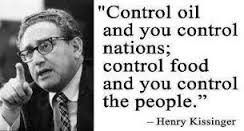 NSSM
200 formally raised the question, “Would food be considered to be an
instrument of national power? … Is the U.S. prepared to accept food
rationing to help people who can’t/won’t control their population
growth?” Kissinger has answered these questions when he stated that he
was predicting a series of contrived famines, created by mandatory
programs and this would make exclusive reliance on birth control
programs unnecessary in this modern day application of eugenics in a
scheme that would allow Henry to have his cake and eat it too in that
the world would finally be rid of the “useless eaters!”
That Was Then and This Is Now
 Third world population control, using food as one of the primary weapons, has long been a matter of official covert national policy and a portion of President Obama’s Executive Order (EO 13603), National Defense Resources Preparedness is
a continuation of that policy. Only now, the intended targets are not
the LDC’s but, instead, the targets are the American people. With one
out of six Americans on food stamps, and a reduction of these benefits
under way, the policy of using food as a weapon against the American
people already has a significant beachhead.
With the stroke of his pen, Obama has total and absolute control over all food where his EO 13603 states:
e) “Food resources” means all
commodities and products, (simple, mixed, or compound), or complements
to such commodities or products, that are capable of being ingested by
either human beings or animals, irrespective of other uses to which such
commodities or products may be put, at all stages of processing from
the raw commodity to the products thereof in vendible form for human or
animal consumption. “Food resources” also means potable water packaged
in commercially marketable containers, all starches, sugars, vegetable
and animal or marine fats and oils, seed, cotton, hemp, and flax fiber,
but does not mean any such material after it loses its identity as an
agricultural commodity or agricultural product.
(f) “Food resource facilities”
means plants, machinery, vehicles (including on farm), and other
facilities required for the production, processing, distribution, and
storage (including cold storage) of food resources, and for the domestic
distribution of farm equipment and fertilizer…”
This unconstitutional EO is
particularly disturbing in that it clearly states that the government
has control over anything that is “capable of being ingested by either
human beings or animals…” If you thought that you and Fido were going
to get through the coming food crisis by storing and consuming dog food,
think again.
How will farmers maintain the
nation’s food supply when all fertilizer, their farm equipment and all
of their vehicles are under the control of one power-hungry President?
Conclusion
If food is controlled by the few, can we count on them to be so altruistic so as to hesitate to use food shortages to manipulate the many? Or, can we blindly trust this administration to never behave like Stalin?
In summary, the World Bank has
declared a global food shortage from which they predict widespread
violence. The World Bank further states that there is no end in sight
for the crisis. Historically, food has been used as a weapon to starve
millions to death as a means to politically control overpopulation or
political dissent. The United States has shown historical interest in
creating food shortages in the past. President Obama has created an EO
which will give him total control over food and food production in a
self-declared crisis. Corporate farms are increasingly replacing family
farms in a case of putting all of our agricultural eggs into just a few
baskets. Finally, the currencies of the world are on the verge of
collapse, so how would food be moved to where it is needed if the
corporations cannot monetize food production and shipment?
Most Americans do not have 30
days of food supplies in their pantry. Many do not have three days. We
are indeed nine meals removed from revolution. A starving man is not a
cooperative citizen.
Some of you understand the
significance of the phrase, “out of chaos comes order”. The resi of you
may soon learn the meaning of this phrase on a very personal level.
Whether this unfolding crisis is contrived or not, you tell me, do we have anything to worry about?
Subscribe to:
Posts (Atom)