Wednesday, May 28, 2014

Government Plan Would Transform Israel Into The World’s First Cashless Society

Will Israel be the first cashless society on the entire planet?  A committee chaired by Israeli Prime Minister Benjamin Netanyahu’s chief of staff has come up with a three phase plan to “all but do away with cash transactions in Israel”.  Individuals and businesses would still be permitted to conduct cash transactions in small amounts (at least initially), but the eventual goal is to force Israeli citizens to conduct as much business as possible using electronic forms of payment.  In fact, it has been reported that Israeli officials believe that “cash is bad” because it fuels the underground economy and allows people to avoid paying taxes.  It is hoped that requiring most transactions to be conducted in cash will reduce crime and help balance the national budget.  And once 98 or 99 percent of all transactions are cashless, it will not be difficult for the Israeli government (or any other government) to go the rest of the way and ban cash transactions altogether.  But is a cashless society actually desirable?  This is a question that people all over the world will have to start asking as governments increasingly restrict the use of cash.
Back in September, it was announced that the Israeli government had formed a committee to “examine ways to eliminate cash from the Israeli economy”…
The government on Tuesday authorized establishment of a committee that will examine ways to eliminate cash from the Israeli economy – the better to prevent citizens from cheating on their taxes. The committee will be chaired by Harel Locker, director of the Prime Minister’s Office.
This committee had the full backing of Prime Minister Benjamin Netanyahu, and some of the goals of the committee included finding ways to increase tax revenue and prevent money laundering…
Officials in the Prime Minister’s Office declared that “around the world, it is recognized that cash is a key element of the illegal economy and money laundering. It allows a wide gap between reported and actual incomes, with the corresponding effect on tax revenues.” By eliminating cash, the PMO said, “it will be possible to expand the tax base, and prevent money laundering.” The committee will study the issue from all its perspectives and make recommendations, the PMO said.
The committee has had quite a few months to examine these issues, and now they have come back with their recommendations.  Just this week we learned that a three phase plan is being proposed…
A special committee headed by Prime Minister Benjamin Netanyahu’s chief of staff, Harel Locker, has recommended a three-phase plan to all but do away with cash transactions in Israel.
The motivation for examining a cash-less economy is combatting money laundering and other tax-evasion tactics, thereby maximizing potential tax collection and greatly expanding the tax base. This is important considering the enormous strain put on Israel’s national budget by the army, healthcare system and other public services.
The committee estimated that the black market represents over 20 percent of Israel’s GDP, and cash is the facilitating factor. Cash enables tax evasion, money laundering and even financing terrorism.
So what do the specifics of the plan look like?
Well, there will be very strict limits on the use of cash for individuals and businesses, any violations will be considered criminal offenses, and all Israeli banks will be required to issue debit cards to all account holders…
What the committee would like to see happen, pending government approval, is greater restriction on the use of cash, limiting the use of checks as a means of payment and exchange for cash, and promotion of the use of electronic (and therefore verifiable) means of payment.
The following guidelines were set out by the committee for the short-term:
  • Limit business transactions done in cash or by check to NIS 7,500 ($2,150) immediately, and reduce that further to NIS 5,000 ($1,433) one year from the date of legislation;
  • Limit private transactions done in cash or by check to NIS 15,000 ($4,300);
  • Any violation of these limits would be a criminal offense warranting a stiff fine.
In conjunction with these new restrictions, Israeli banks would be required to provide all account holders with debit cards to further promote electronic payments.
But of course this move toward a cashless society is not just happening in Israel.
In Sweden, it is estimated that just 3 percent of all transactions involve cash at this point.  In fact, according to an article in the Washington Post, some Swedish banks do not handle cash at all anymore…
In most Swedish cities, public buses don’t accept cash; tickets are prepaid or purchased with a cell phone text message. A small but growing number of businesses only take cards, and some bank offices — which make money on electronic transactions — have stopped handling cash altogether.
“There are towns where it isn’t at all possible anymore to enter a bank and use cash,” complains Curt Persson, chairman of Sweden’s National Pensioners’ Organization.
And the U.S. is starting to move in that direction as well.
According to a study conducted by MasterCard, approximately 80 percent of all consumer transactions in the United States are now cashless.
But isn’t there a downside to all of this?
Just about everything that we do in life involves money.  So yes, a government can track electronic payments to make sure taxes are being paid and money laundering is not happening, but it would also enable a government to do so much more.
If a government can track all of your transactions, it will essentially be able to monitor everywhere you go and pretty much keep track of virtually everything that you do.
If you doubt this, just try to live without any money some time.
You won’t get very far without putting some gas in your vehicle.
And without being able to buy food, you will get hungry pretty quickly.
Are you starting to understand?
This is why governments love the idea of moving toward a cashless society.  It would give them an immensely powerful surveillance tool.
So let us hope that this does not happen in Israel or anywhere else in the world either.
Delivered by The Daily Sheeple

US House approves $600 million in military aid for Israel

‘The US House of Representatives has approved a bill that would grant Israel over $600 million of American taxpayers’ money in military aid.
The military aid package is part of the National Defense Authorization Act for 2015 adopted Thursday by members of the House, which is controlled by a pro-Israel Republican majority.
The legislation authorizes $350.9 million for Israel’s Iron Dome missile system and $268.7 million for its David’s Sling and Arrow 3 missile programs.
According to an amendment to the NDAA, the adoption of the act by US lawmakers stresses that it is “the policy of the United States to take all necessary steps to ensure that Israel possesses and maintains an independent capability to remove existential threats to its security and defend its vital national interests.”’

West To East For Gold


“The Market’s Not There” – One World Trade Center Lowers Asking Rents By 10%

With the housing purchase market for everyone but the wealthiest stagnating (confirmed by today’s sliding “plans to buy a home” indicator), forcing Americans to scramble for rental properties and pushing residential asking rents to fresh record high quarter after quarter, the same can not be said for the commercial sector. In fact quite the opposite: according to the WSJ the owners of the towering 3.1 million square foot One World Trade Center, which at last check was 55% leased, have been forced to cut asking rents by 10% from 75% to $69. Why? “The market’s not there,” said Mr. Durst, whose Durst Organization bought a stake in the tower from the Port Authority in mid-2011. “When we started in 2011, everybody expected the economy to take off, and obviously that hasn’t happened.”

As WSJ reports, things are not going well for One World Trade Center…
No private office tenant has signed a lease at One World Trade Center in nearly three years. The 3.1-million-square-foot skyscraper, formerly named the Freedom Tower, is 55% leased.

The owner—a venture of developer Douglas Durst and the Port Authority of New York and New Jersey—is cutting asking rents nearly 10% to $69 a square foot for larger tenants on the building’s middle floors, down from $75 a square foot, Mr. Durst said in an interview Friday.
The reason appears to be a total lack of real demand despite all the mal-investment -driving indicators of economic health that a trillion dollars here and there can create…
“The market’s not there,” said Mr. Durst, whose Durst Organization bought a stake in the tower from the Port Authority in mid-2011. “When we started in 2011, everybody expected the economy to take off, and obviously that hasn’t happened.”

“We have a lot of people looking at the space, but because of the asking rent, we are not able to really put anything over the finish line,” Mr. Durst said.

…

But leasing has been slow. One World Trade has one major private tenant, Condé Nast, which took about 1 million square feet in 2011. Meanwhile, 4 World Trade is 51% leased to two government agencies. Mr. Silverstein has been asking in the $70s and $80s a square foot, comparable to the rents at One World Trade, before the latest price cut.
If you build it – they will come… unless the entire recovery is a mirage… in whch case you roll your debt once again and keep your fingers crossed…
original link

China Launching “Global Gold Exchange” In Shanghai

Today’s AM fix was USD 1,283.00, EUR 940.48 and GBP 762.87 per ounce.
Yesterday, U.S. & UK markets were closed yesterday for a national holiday.
Friday’s AM fix was USD 1,292.00, EUR 948.61 and GBP 767.18 per ounce.
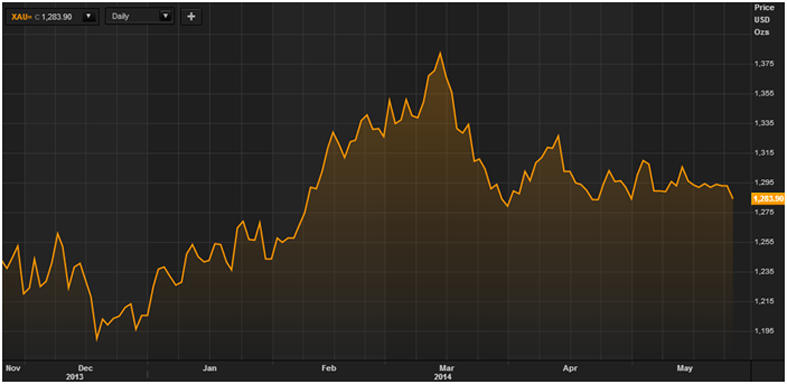
Gold in U.S. Dollars, Daily, 6 Months – (Thomson Reuters)
Gold is testing the lower level of support of the unusually tight range seen in recent days between $1,284/oz and $1,306/oz. Below that the next level of support is at $1,250/oz and below that the low seen on December 31st at $1,190/oz. Overnight,gold in Singapore gradually traded lower from a high of $1,293/oz to a low of $1,282.81/oz.
The price weakness comes despite continuing bullish developments for the gold market. These  include geopolitical risk as Ukraine lurches into a civil war, tensions between Vietnam and China in the Far East and China’s push to make Shanghai a “Global Gold Exchange.”
Ukraine launched air strikes and a paratrooper assault against pro-Russian rebels who seized an airport on Monday. Its newly elected leader rejected any talks with “terrorists” and said a robust military campaign in the east should be able to put down a separatist revolt in “a matter of hours”.
Even as the fighting was getting under way, Poroshenko held a news conference in Kiev and said that  the government’s military offensive needed to be “quicker and more effective”.
A Vietnamese fishing vessel capsized in disputed waters in the South China Sea on Monday after “harassing and colliding” with a Chinese fishing boat, the official Xinhua news agency said on Tuesday.
China has approached foreign banks and gold producers to participate in a global gold exchange in Shanghai, as the world’s top producer and importer of gold seeks greater influence over pricing and  the global gold market.
Shanghai Gold Exchange – China Foreign Exchange Trade System
The Shanghai Gold Exchange got the go ahead from the central bank last week to launch a global trading platform in the city’s pilot free trade zone. SGE is looking to launch physical contracts of gold, silver and platinum group metals denominated in Chinese yuan on the international exchange.
According to Reuters:
“For gold, they are looking to launch three yuan-denominated physical contracts, of 100 grams, 1 kg and the bigger London good delivery bar weighing 12.5 kg.
Beijing’s plans to open up gold trading comes at a time when the benchmark price-setting process for precious metals is under scrutiny. Barclays Plc became the first bank to be fined over manipulation of the 95-year-old benchmark London gold market daily “fix” last week.
State-backed SGE has asked bullion banks such as HSBC , Australia and New Zealand Banking Group (ANZ), Standard Bank, Standard Chartered and Bank of Nova Scotia to take part in the global trading platform, two people approached by the exchange said.
SGE, the world’s biggest physical gold exchange, where domestic banks, miners and retailers buy and sell gold, could also open up the international platform to foreign brokerages and gold producers, they said.
“China wants to have more voice in gold prices,” said Jiang Shu, an analyst with Industrial Bank, one of 12 banks allowed to import gold into China. “The international exchange is the first step towards gaining a say in gold pricing.”
“If you don’t allow foreign players to participate in your market actively, or do not push Chinese financial institutions to participate in the international market, then China’s strong gold demand is only a number, not a power,” he said.
HSBC and Standard Bank declined to comment, while the other banks and SGE were not immediately available for comment.
The global platform will first host spot physical contracts for gold and other precious metals, before aiming to launch derivatives down the line, said a third source who is directly involved in the launch of the international exchange.
“We are not just encouraging foreign banks but also producers and other entities,” added the source.
China, the world’s biggest buyer of raw materials from copper to coal, is pushing hard to establish pricing benchmarks for a number of commodities.
Gold, along with oil, could be among the first to be opened up to foreign players. The free trade zone in Shanghai is set to see international energy trading by hosting the country’s first crude oil futures.
Contract specifications for silver, platinum and palladium were also being discussed, though the sources said specifications and participants had not yet been finalized. The exchange is expected to be launched by the fourth quarter.
Even if China lures foreign players, the exchange would still need to see full convertibility of the yuan and enough liquidity on the exchange before it can be considered to operate on a par with other hubs.
Currently, the London gold “fix” is the benchmark for spot prices, while New York’s COMEX contract sets the futures’ benchmark. SGE prices are tracked to gauge Chinese demand as reflected in premiums or discounts to spot rates.
Earlier this year, China’s ICBC – in conjunction with its acquisition target Standard Bank – indicated interest in buying Deutsche Bank’s seat on the London gold fix but it is not interested anymore, sources previously told Reuters.
The influx of gold has made SGE the biggest physical exchange, with a turnover of 10,000 tonnes for its immediate and deferred delivery contracts, according to Thomson Reuters GFMS.
The Shanghai Futures Exchange has the world’s second-most traded gold futures contract, though trading is largely limited to the domestic market with volumes of about 41,176 tonnes last year, still well behind COMEX’s 147,083 tonnes.
The SGE’s international board and the main exchange could eventually be merged when the yuan is fully convertible, Albert Cheng, managing director of the World Gold Council’s far east region, said.
“That would become a very important exchange in the world, and Shanghai will truly become one of the three international gold centres after New York and London,” he said. “No doubt, the participation in the international market is the key effort of the SGE and the current administration.”Read the full story here.
ConclusionBanks, global producers, refineries and mints will be hesitant to embrace the new Chinese exchange, especially in the short term. However, once the new exchange achieves critical mass in China and Asia, the exchange will be embraced by western institutions and could become the most important gold exchange in the world.
The move will challenge the dominance of New York and London as global precious metal hubs, as centres of the gold trade. It will also challenge their influence on pricing. Physical demand provides underlying support to gold prices and ultimately dictates the price.  Speculative trading and manipulation can and has affected prices in the short term.
With China’s push for an international physical exchange, physical demand will begin to have a stronger influence, thereby ending gold manipulation. This will allow gold to rise to a more appropriate price given the scale of macroeconomic, systemic, geo-political and monetary risks of today.


Gold Manipulation Is Out In the Open

How Long Can It Continue?

We’ve noted for years – for example here, here and here- that gold prices are manipulation.
We pointed out in January and February that gold manipulation is going mainstream.
And public television channel 3sat – broadcast throughout Europe, and especially popular in Germany, Austria and Switzerland – addressed the issue head on:

Jim Rickards was asked how long the gold manipulation could continue now that the cat is out of the bag. He basically answered: until the physical shortage of gold leads to a large buy order not being filled; especially given the demand shock coming from China and India:

Outcry as David Cameron says ‘Let’s extend the EU towards Asia’

DAVID Cameron triggered a backlash yesterday after suggesting the European Union should open its doors to new members “from the Atlantic to the Urals”.

David Cameron wants to see the EU get even bigger David Cameron wants to see the EU get even bigger
The Prime Minister made the hugely provocative pro-EU speech on the day Croatia became the Union’s 28th member state as he toured the former Soviet republic of Kazakhstan.
Talking to Kazakh students in the capital Astana he said: “Britain has always supported the widening of the EU.
“Our vision of the EU is that it should be a large trading and co-operating organisation that effectively stretches, as it were, from the Atlantic to the Urals.
“We have a wide vision of Europe and have always encouraged countries that want to join.”
The Urals mark the unofficial border between Europe and Asia in Russia.
His remarks indicate that he believes that Ukraine, once known as the bread basket of the USSR, should be admitted to the EU.
They come as British MPs prepare for a crunch vote on an in/out referendum this Friday.
They also appear to ignore fears about a huge influx of Romanians and Bulgarians when the restrictions on their rights to work in Britain are lifted early next year.
I am sure the thought of hundreds of thousands and millions of Kazakhs and Ukrainians coming to Britain under the EU’s freedom of movement rules will help people decide in an in/out referendum
Douglas Carswell MP
Conservative MP and eurosceptic Douglas Carswell said: “I am sure the thought of hundreds of thousands and millions of Kazakhs and Ukrainians coming to Britain under the EU’s freedom of movement rules will help people decide in an in/out referendum.
“I think the Prime Minister should be talking about swapping places with these countries.
“We leave the EU and they can have our empty space.”
UK Independence Party leader Nigel Farage warned that millions of extra migrants would get access to the UK if Mr Cameron’s “dreams” came true.
nigel, farage, ukipUkip leader Farage was quick to criticise David Cameron's 'dreams' of the EU
He said: “People in the past have had dreams of a Europe that stretched from the Atlantic and the Urals.
“It is not a dream that this country, rightly, has ever shared.”
Mr Cameron has been a staunch advocate of Turkey joining the EU and last week welcomed interest by Serbia. Adding Turkey (70 million), Ukraine (45 million), Kazakhstan (17 million), and Serbia (7 million) would add 139 million to the EU’s population.
Coalition tensions also flared yesterday, with Deputy Prime Minister Nick Clegg saying the Lib Dems would always be “the party of ‘in’” in any referendum battle, while the Tories looked increasingly like “the party of ‘out’”.
Lib Dem and Labour MPs are set to abstain on Friday’s Tory backbench bill which require a referendum by the end of 2017.
Meanwhile Lib Dem Business Secretary Vince Cable said yesterday that leaving the EU is “not a realistic economic option for this country”.