Central banks around the world are following one core mission. That mission revolves around expanding debt to goose equity markets
and attempting to solve a debt crisis with more debt. Even the more
conservative European Central Bank bowed down to easy digital money
printing by announcing they too would follow in the footsteps of the Fed
and Bank of Japan. Global banking is now fully addicted to non-stop
debt. Every dollar of debt is having a smaller impact on what it can do
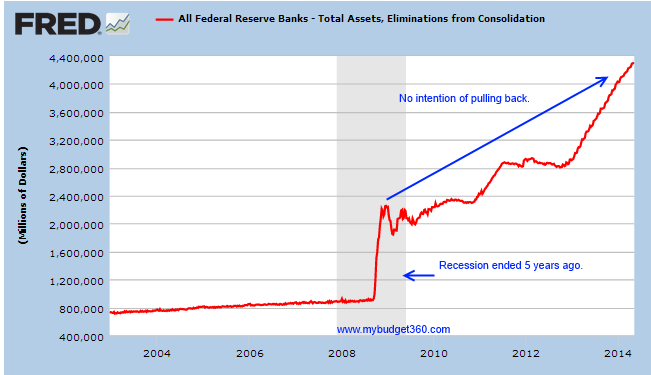
to the real economy. The Fed’s balance sheet is now well over $4.3 trillion
and while talks of tapering are made in public, there is no visible
action being taken to show this is the intended goal. At the core of the
global crisis was an expansion built on too much debt. Banks attacked
this issue as one of liquidity but in reality this was a crisis of
solvency. Banks never dealt with writing down assets but have decided to
use modern day inflation methods
to boost banking profits at the expense of working class families.
Global debt has now reached a terminal velocity mode and central banks
have no choice but to continue to expand their balance sheets.
Central banks follow one mandate
Some people act as if the crisis never happened. US stock markets are
at record levels and those with access to wealth continue to get
richer. The policies that are creating a massive low wage economy
in the US are also part of the other side of the coin expanding debt
based bubbles. It is no coincidence that items financed by debt (i.e.,
college, housing, cars, etc) are seeing inflation many times higher than
that of wages. In fact, wages are stagnant. Central banks realize that
keeping interest rates low through whatever means necessary is the only
endgame for their current charade.
Would you lend someone money if you knew you would never get paid
back? Probably not. Yet this is the trajectory being followed by central
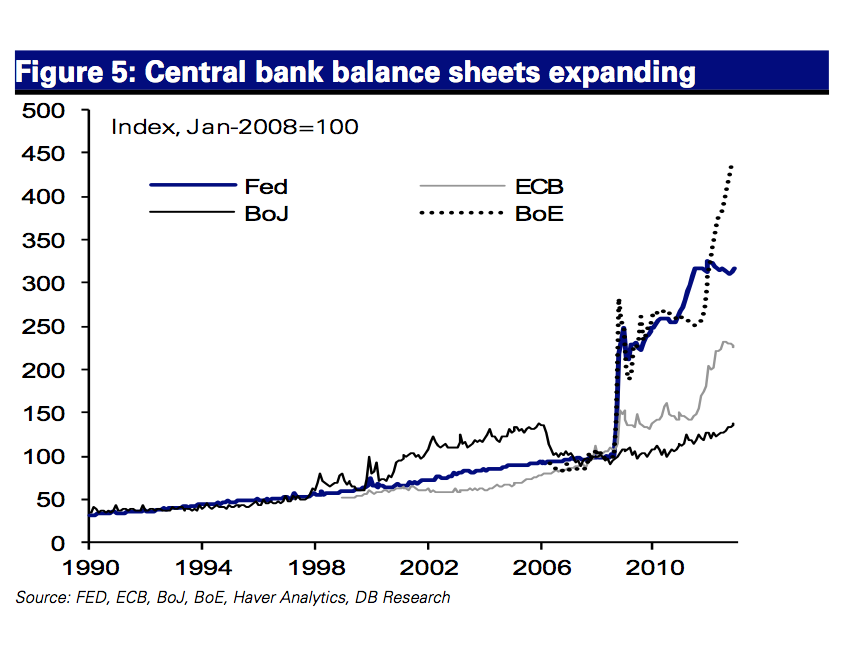
banks. Take a look at the below illuminating chart and tell me if
central banks are operating as if we are in a full recovery:
Central banks are taking on policies that appear to indicate a deep
and profound recession. The only issue with this is that the US
recession ended in 2009. Why continue expanding at such an aggressive
pace? The chart above shows continued aggressive expansion of central
bank balance sheets. First, many US banks were fully insolvent. That is,
they had overplayed their hand and were holding onto assets that were
way overvalued. This led to the foreclosure crisis. But a funny thing
happened. The US allowed these toxic assets to fall into the Fed’s
balance sheet and policy makers allowed mark to market accounting to be
suspended. Little by little banks inflated the housing market back up.
This dramatically helped banks stay afloat while fully manipulating the
market at the public’s expense. Keep in mind millions of people lost
their homes yet every large major bank actually has become bigger and
salaries of these financiers are back to where they once were. In an
incestuous twist, many of those foreclosures are now owned by the new
rentier class as they chase yields in every asset class.
The Fed’s balance sheet only continues to grow since they essentially own the US mortgage market:
Where is the taper talk being reflected in the chart above? The Fed
now has a $4.3 trillion balance sheet. The Fed is operating in full
crisis Great Recession mode. Don’t believe any of the hype that the Fed
is in control here. Look at the Bank of Japan and you will realize that
when you are a debt making hammer, everything looks like nail.
The global markets are controlled by central banks. This is a central
bank market rally. It is also, once again, causing global property
bubbles from Canada, China, Australia, to the United States (again). The
small globally connected elite realize this and that is why you have
foreign money buying condos in New York, flats in London, and single
family homes in California. They understand what is playing out and are
doing their best to purchase real assets before the public starts waking up to this slow inflationary robbery despite what official statistics show.
Central banks have no desire to taper. Once you give a market low
rates, an addiction takes hold. Similar to low wage capitalism, once
people get used to a low price good luck trying to push higher costs.
Everything gets driven down for the prosperity of the few. We live in a
world of limited assets and central banks dealt with this debt crisis by
creating more debt. So it is no surprise that global property bubbles
are once again raging.
The fact that tapering talks have been going on for some time with no
real reversal (take a look at the Fed balance sheet chart above), you
start to realize central banks are in full terminal velocity mode. They
only have one hand to play. Convince the public they have all of this
under control until it spirals out of control, again. Keep in mind Ben
Bernanke thought the housing market issues were confined to the subprime
market in 2007, right at the peak of all the global debt madness. All
central banks are playing out of the same rule book; keep pushing rates
lower for the main purpose of keeping wealth inflated for those that actually have wealth higher by simply going into deeper debt.
Famed
commodity investor Jim Rogers is on Kitco News to speak about the
Chinese and US economy, gold, and even bitcoin. Rogers has some very
interesting thoughts about the yellow metal and where he thinks it may
be headed. “Gold is still correcting… I expect there to be another
opportunity to buy gold sometime in the next year or two.” He also
shares his insights on the US economy and how he is not so confident in
the US dollar given the country’s elevated debt levels. “No country in
world history has got itself into this kind of situation and got out
without a crisis or semi-crisis.” He also shares some insights on
bitcoin and what he thinks of the cryptocurrency. Tune in now to watch
the latest edition of “On the Spot” with Daniela Cambone. Kitco News,
May 8, 2014.
Nearly half a billion dollars in federal money has been spent
developing four state Obamacare exchanges that are now in shambles —
and the final price tag for salvaging them may go sharply
higher. Each of the states — Massachusetts, Oregon, Nevada and
Maryland — embraced Obamacare, and each underperformed. All have
come under scathing criticism and now face months of uncertainty as
they rush to rebuild their systems or transition to the federal
exchange.
The federal government is caught between writing still more
exorbitant checks to give them a second chance at creating viable
exchanges of their own or, for a lesser although not inexpensive sum,
adding still more states to HealthCare.gov. The federal system is
already serving 36 states, far more than originally anticipated.
As for the contractors involved, which have borne most of the
blame for the exchange debacles, a few continue to insist that fixes
are possible. Others are braced for possible legal action or waiting
to hear if now-tainted contracts will be terminated. The $474
million spent by these four states includes the cost that officials
have publicly detailed to date. It climbs further if states like
Minnesota and Hawaii, which have suffered similarly dysfunctional
exchanges, are added.
MORENO
VALLEY, Calif. — The freeway exits around here are dotted with people
asking for money, holding cardboard signs to tell their stories. The
details vary only slightly and almost invariably include: Laid off. Need
food. Young children.
Mary
Carmen Acosta often passes the silent beggars as she enters parking
lots to sell homemade ice pops, known as paletas, in an effort to make
enough money to get food for her family of four. On a good day she can
make $100, about double what she spends on ingredients. On a really good
day, she pockets $120, the extra money offering some assurance that she
will be able to pay the $800 monthly rent for her family’s
three-bedroom apartment. Sometimes, usually on mornings too cold to sell
icy treats, she imagines what it would be like to stand on an exit ramp
herself.
“Everyone
here knows they might have to be like that,” said Ms. Acosta, 40,
neatly dressed in slacks and a chiffon blouse, as she waited for help
from a local charity in this city an hour’s drive east of Los Angeles.
Both she and her husband, Sebastian Plancarte, lost their jobs nearly
three years ago. “Each time I see them I thank God for what we do have.
We used to have a different kind of life, where we had nice things and
did nice things. Now we just worry.”
Photo
PATCHING TOGETHER A LIVING Mary
Carmen Acosta and her husband, Sebastian Plancarte, with their
daughter, Camila, outside their apartment in Moreno Valley, Calif.Credit
Emily Berl for The New York Times
Five
decades after President Lyndon B. Johnson declared a war on poverty,
the nation’s poor are more likely to be found in suburbs like this one
than in cities or rural areas, and poverty in suburbs is rising faster
than in any other setting in the country. By 2011, there were three
million more people living in poverty in suburbs than in inner cities,
according to a study released last year by the Brookings Institution.
As a result, suburbs are grappling with problems that once seemed
alien, issues compounded by a shortage of institutions helping the poor
and distances that make it difficult for people to get to jobs and
social services even if they can find them.
In
no place is that more true than California, synonymous with the
suburban good life and long a magnet for restless newcomers with big
dreams. When taking into account the cost of living, including housing,
child care and medical expenses, California has the highest poverty rate
in the nation, according to a measure introduced by the Census Bureau
in 2011 that considers both government benefits and living costs in
different parts of the country. By that measure, roughly nine million
people — nearly a quarter of the state’s residents — live in poverty.
Not
long ago, the Inland Empire, as the sprawling suburban area east of Los
Angeles is known, attracted people hoping to live out that good life.
Before the recession, it was booming; housing developments were cropping
up all the time, quickly followed by big box stores and strip malls to
cater to the new residents.
The
region was — and still is — the fastest growing in the state. But the
jobs have never really followed the people who come here looking for
cheaper housing. The median home value is $325,000 and the median rent
is $1,690, according to the real estate database Zillow. That compares
with $462,000 and $1,860 in Los Angeles.
For
many, those costs are still unaffordable. Unemployment in the region
hovers around 10 percent and nearly one-fifth of all residents live in
poverty, the highest rate among the largest metropolitan areas in the
country. By the official federal measure, nearly one-third of all
children here are poor. The number of poor in San Bernardino and
Riverside Counties nearly doubled over the last decade.
Many
would-be workers lack office skills or more than a basic education,
making minimum-wage jobs the norm for them. Many here are immigrants —
some living in the United State illegally, making them ineligible for
most government benefits. But like Ms. Acosta, many others came here
legally decades ago and had a strong foothold in the American economy — a
job, a house, cars and regular travel.
Photo
Ice pops being made at the family’s home for sale on the street.Credit
Emily Berl for The New York Times
“This
is where poor people live now, and this is where they are going to
live,” said Alan Berube, an author of the Brookings Institution study.
“When poverty moved out of the inner cities it didn’t just go next door,
it went 30 miles away. But at the time those families might not have
been poor — they were just chasing the middle-class dream. Then, boom,
that evaporated.”
Prosperity Slips Away
Most
mornings Sebastian Plancarte, 39, puts on a freshly laundered, collared
polo shirt, carefully tucked in. He gets his daughter, Camila, dressed
for kindergarten and makes sure his son, Sebastian, has his homework
ready for middle school. They are out the door by 7:30 a.m. and he is
home nearly two hours later, back to wander parking lots selling ice
pops before the afternoon pickup routine begins. He is happy to be
involved in his children’s lives, but this is hardly the kind of
fatherhood he once imagined.
For
years, the couple thought of themselves as wealthy. They bought a
five-bedroom house in a suburb just a few miles east of downtown Los
Angeles, where they both worked in the jewelry district — she inspected
diamonds and he designed bracelets and rings. Making $16 an hour, plus
commissions, they earned as much as $2,000 a week. They traveled to San
Diego and Las Vegas, they bought their two children the toys they asked
for. Just more than a decade after they had emigrated from Mexico, they
believed their hopes had become a reality.
But
in 2011, Ms. Acosta was laid off. So was Mr. Plancarte, just a few
months later. They soon sold the house for far less than they had paid.
They drove east, looking for something they could afford to rent, and
landed in Moreno Valley, a city 60 miles inland that has become a common
outpost for those priced out of Los Angeles. They live in a sprawling
apartment complex designated for low-income families.
The
paletas have become a centerpiece of their lives. The couple constantly
think about the best prices for ingredients and how many pops are in
their small freezer; they take orders by phone to deliver to backyard
parties. When their son asks to get hamburgers at the local In-N-Out,
they have a standard response: “The mathematics are very simple,” Ms.
Acosta said. “If you want to eat there, we need you to sell $25” of the
ice pops.
“The
hardest part is the shame,” Mr. Plancarte said, sitting at his kitchen
table as his wife and daughter ate mango paletas doused in chamoy, a
blood-red sugary hot sauce. “People say to me, ‘Why don’t you find a job
over there, or at that factory or that place?’ First of all, they
aren’t there, I’ve tried. But even if they have a job, it’s going to be
paying me $8 an hour. So I’ll spend no time with my family to make less
money than I make now selling these.”
By
Ms. Acosta’s calculation, the couple earned about $25,000 last year,
nearly all of it in cash. And while it is nearly $2,000 above the
official poverty line for a family of four nationally, it is hardly
enough to meet their basic needs. By the time they pay for rent, gas,
phone, electricity and food, they have spent about $2,000 a month, Ms.
Acosta said.
Her
husband is still looking for work; in the winter months they relied
mostly on whatever she could make selling cosmetics and costume jewelry
door to door. Their lives reflect the contradictions of many living on
the edge. They have a 2001 Jeep Cherokee, a small flat-screen television
and a few remaining pieces of jewelry. They don’t have health insurance
or any savings, and they have not bought new clothes for nearly two
years.
For the last year, Ms. Acosta spent much of her time at the local Catholic Charities office,
taking self-help classes with other women in similar circumstances. She
earned $100 a month enrolling women in courses on healthy diets,
balancing checkbooks and parenting skills. She keeps a folder thick with
certificates she has earned in such classes. A letter from President
Obama thanking her for volunteering at her son’s school, calling her a
“shining example,” is tucked in a protective plastic sleeve. The few
friends she has made here, she said, are the women she has met at
Catholic Charities.
“My friends in L.A., the ones who still have money, it’s like they forgot all about us,” she said.
The
family’s economic descent has proved most difficult for 12-year-old
Sebastian, who remembers Christmas trips to Universal Studios and
regular mall excursions. Camila, 5, cannot recall anything different
from what she has now. Neither child knows that their Christmas gifts
came from charity. They are all contributing to the piggy bank in the
kitchen; if they can save enough, Ms. Acosta has promised to take them
to Disneyland this year. For now, even going to the beach an hour west
would cost too much for gas. The local park is hardly a fun outing — it
reminds them of their work selling ice pops most weekends.
Photo
Jewelry that the couple sell door to door.Credit
Emily Berl for The New York Times
“We
have to be really good actors,” Ms. Acosta said. “But after they go to
bed, we just sit and worry about how we are going to pay for things we
want to give them.”
When
his son asked for pizza recently, Mr. Plancarte took a silver bracelet
he had given his wife to a pawnshop, where he was offered a fraction of
what he thought it was worth. He accepted, too embarrassed to tell his
son they could not have pizza. Ms. Acosta recently went back and saw the
bracelet priced at $90 — more than twice what her husband had received.
Traveling More to Make Less
Sitting
inside Catholic Charities offers a glimpse of the constant need: this
family needs extra cash to pay the utility bill; this single mother
cannot find child care to allow her to work a graveyard shift; that
elderly man who came from Mexico has no way to pay for his medication.
Imelda
Santana, whose desk is just a few feet away from the entrance, is often
the first stop for requests. Ms. Santana is empathetic — just a couple
of years ago she needed help after her husband left her and she lost her
job as a loan officer amid the housing crisis. After working as a
volunteer for months, Ms. Santana was hired to sift through requests to
see which families the organization might assist. Even on the best days,
she said, there are more demands than they can handle.
“We
have people here who used to make donations now knowing what it is to
run out of toilet paper in their house and not have the money to buy
more,” she said. “Even if they get food stamps, it does not cover
toiletries. There’s just never enough.”
Yadira
Rodriguez, 35, has traveled hundreds of miles looking for work in this
county, which is roughly the size of New Jersey. When her husband
stopped earning enough to pay for monthly expenses for their three young
children, she took a job in a factory packing boxes to be shipped to
retail stores. But the $8-an-hour job was 30 miles north of her Moreno
Valley apartment, taking her more than an hour in traffic, twice that if
she needed to take the bus.
Since
she was classified as a temporary worker, she would leave her home at 4
a.m. only to find out at 6 a.m. that she would not be hired for the
day. On days there was work, she would arrive back home 12 hours after
she left.
“I
could not understand how this was worth the money,” Ms. Rodriguez said.
“I would get home and the kids would be tired and cranky and I didn’t
have energy for them. How was this going to make my life better?”
After
three months, she quit. Her family relies on $800 a month from the
state’s temporary cash assistance program to pay for groceries and
utilities, and gets occasional help from charities. The landlord has let
the family slide on the rent at times, Ms. Rodriguez said.
Like
Ms. Rodriguez, many would-be employees see unpredictability as a fact
of life. Many social workers see more clients working two part-time
minimum wage jobs, juggling schedules to make sure they do not
disappoint any boss and hustling to cobble together child care for
shifts that can begin or end before dawn. Many are immigrants who speak
only basic English after years of living in Latino enclaves, first in
Los Angeles, and now here.
“This
is the edge of affordability; people came here because they were pushed
out to the only place where they could afford,” said John Husing, a
local economist who has studied the region for years. “When they came
here the primary wage earner could find a job to pay the bills. The
problem is that time has passed and we don’t have a lot of jobs that
allow that anymore.”
Photo
AD HOC AID A clothing giveaway at Victoria Elementary School in San Bernardino, Calif. The school also sponsors a medical clinic.Credit
Emily Berl for The New York Times
While
many of the state’s coastal areas have begun to see signs of an
improved economy, the inland region has continued to struggle.
Unemployment and foreclosure rates remain stubbornly high here and there
are few signs that the area will boom as it did a decade ago. Housing
prices have inched up as wages have stagnated, making it even more
difficult for families to stay afloat.
“What
we have out here is more need and fewer centers of resources,” said Dom
Betro, the executive director of Family Services, a nonprofit group
that provides child care and food to needy families in Riverside County.
“We have more working poor than anyone can know how to handle. People
travel further distances to work for less pay because they have to. Even
if there is help — and that’s not always — people who need it can’t get
to it.”
Social workers here often point to a 2009 study by the James Irvine Foundation,
which showed that the region has far fewer nonprofit groups per capita
than the rest of the state, with less money funneled in from local
foundations.
“There’s
all these new problems but no new philanthropic dollars there to
address them,” said Mr. Berube, from the Brookings Institution. “In many
places there are these de facto systems in place but not the kind of
leadership to really address what’s needed.”
When
Larry Ellwell became principal of Victoria Elementary School in San
Bernardino a few years ago, he was stunned by the number of families who
could not afford necessities like clothes and dental care. When he
worked with poor students closer to Los Angeles, he said, they knew
where to find aid. But in the Redlands school district, home to a
university and well-appointed mansions, there were few free clinics or
other outlets for assistance. So he began to offer them — now the school
hosts a roving clinic staffed by medical students and a clothing
giveaway known as Victoria’s Closet.
“It’s
a lot of triage work — who needs something the most and what do they
most need,” Mr. Elwell said. “There’s no stigma anymore, because so many
people are just trying to scrape by and make it work.”
For
Ms. Acosta, scraping by recently took a new turn: She moved to the
other side of the desk at Catholic Charities, taking a job as an intake
worker. She works about 30 hours a week at $12 an hour, giving people
the same kind of help she seeks. Even now, she is not earning enough to
stop selling ice pops.
Just
a couple of years ago, when the dry cleaner called reminding her to
pick up a pair of pants, Ms. Acosta told him to give them to charity.
“Now I am one of the people taking giveaways,” she said. “I see people
all the time in worse positions than we are in. The kids are healthy, we
have a roof. Maybe that’s the best we can hope for.”
A version of this article appears in print on May 10, 2014, on page A1 of the New York edition with the headline: Hardship Makes a New Home in the Suburbs. Order Reprints|Today's Paper|Subscribe
The U.S. government has been
trying for decades—and burning through billions—to replace Marine One,
the president’s helicopters. Will it finally get it right this time?
The Pentagon has awarded a contract to begin development of the most expensive helicopters ever made.
Each helicopter will probably cost at least $400 million. The entire project, to build at least 23 helicopters, has been estimated to eventually cost between $10 billion to $17 billion. By comparison, the project could pay the combined defense budgets of Finland, Norway, and Sweden for one year ($16.9 billion).
The passengers for this enormously expensive helicopter fleet? The President of the United States and his entourage.
The
first president to fly regularly in helicopters was Dwight Eisenhower.
Eisenhower faced a two-hour commute to and from his summer home in Rhode
Island, a commute that could be shaved down considerably if taken by
helicopter. In these early days of the Cold War the president needed to
be moved around quickly—the president could not be stuck on a ferry for
an hour in case the Soviet Union launched a nuclear attack.
The South Lawn of the White House was designated as the official
presidential helicopter landing pad, and official flights to Andrews Air
Force Base began.
A Marine Corps helicopter squadron, HMX-1 (“The Knighthawks”)
is responsible for flying and maintaining the fleet of presidential
helicopters. The current Marine One helicopters are derivatives of the
Sikorsky Sea King helicopter, which was phased out of the U.S. military
during the 1990s. Those currently flying were built somewhere around
1975, making them only 14 years younger than President Obama himself.
In 2002, the U.S. government solicited proposals for replacing the
Sea Kings with a new, modern helicopter. In the wake of 9/11, with
concerns about terrorist attacks against the president, the call went
out for a helicopter that could fend off a terrorist shoulder-fired
surface to air missile and keep functioning in the wake of a nuclear
attack on Washington, D.C.
In 2005, the Department of Defense announced that the team of
Lockheed Martin and the Anglo-Italian helicopter giant AgustaWestland
had won the contract to build 28 presidential helicopters. The
helicopters would be known as the VH-71 Kestrel. (The “V” stands for “VIP Transport”)
“The
helicopter I have seems perfectly adequate to me," Obama said. "Of
course, I've never had a helicopter before. Maybe I've been deprived and
I didn't know it.”
At the time the
contract was signed, the estimated cost of the program was $6.5 billion,
or $232 million per helicopter, including development costs.
Unfortunately, the Kestrel program spun rapidly out of control, dragged
down by the weight of program requirements and other “good ideas.”
Marine One helicopters must satisfy a number of requirements. The
president’s helos must be small enough to land on the South Lawn, but
large enough to lift 14 people and several thousand pounds of equipment a
distance of 300 miles. The helicopters must be armored, with a
bullet-resistant fuselage and glass.
The president’s helicopters must have a full suite of defensive
countermeasures to throw off the targeting and guidance systems of
missiles. They must be “hardened” against the electromagnetic pulse of a
nuclear blast that could fry electronics and knock out everything from
smartphones to helicopters.
Secure communications are must-haves. Marine One must be able to send
and receive encrypted communications and hold secure videoconferences
with U.S. military and government leaders worldwide, including those in
charge of U.S. nuclear forces.
Finally, the president’s helicopter must include a toilet.
So many requirements were piled on the Kestrel program that it was
decided the helicopters would need new engines, gear boxes, and drive
trains just to lift everything, not to mention a 180-pound President of
the United States. The program quickly became so expensive each
helicopter—then estimated to cost about $400 million in 2009 dollars—rivaled the cost of Air Force One, the president’s Boeing 747 jumbo jet.
Even President Obama seemed bewildered by the runaway program. “The
helicopter I have seems perfectly adequate to me," Obama said. "Of
course, I've never had a helicopter before. Maybe I've been deprived and
I didn't know it.”
The program was cancelled in 2009, with $3 billion already spent.
The
new, initial contract awarded to the American defense contractor
Sikorsky, is valued at $1.24 billion. Under the terms of the new
contract, the U.S. military will take delivery of two prototype
helicopters—based on the Sikorsky S-92 medium helicopter--in 2016.
Another 21 fully capable helicopters will follow.
Why so many helicopters, essentially for one person? Marine One
always flies with decoys—as many as five—when transporting the
president. Multiple helicopters are also needed when the president
travels outside Washington D.C., as fresh helicopters are cached along
the route ahead of time.
Time will tell if Sikorsky can hold down costs and deliver the
helicopter on time. One thing’s for sure, though: President Obama
himself will never ride on one, except as a guest. The fleet of new
presidential helicopters should be fully operational by 2022, long after Obama has left office.