Sunday, May 4, 2014

How did MAS track MH370? There’s an app for that

How did MAS track MH370? There’s an app for that

KUALA LUMPUR, May 2 — Malaysia Airlines (MAS) had believed Flight MH370 was over Cambodia hours after it turned around and flew west across peninsular Malaysia because it uses a common flight tracker programme similar to those available for smartphones.
MAS CEO Ahmad Jauhari Yahya said the flight tracker only used secondary data and projections, and had not been able to reliably determine the exact location of the MAS jetliner.
“It’s something that many of you have on your iPads and iPhones,” Ahmad Jauhari told a press conference on the missing plane here today.
Putrajaya yesterday issued the preliminary report on Flight MH370 that Prime Minister Datuk Seri Najib Razak pledged last week to release, along with other information regarding the missing flight.
But the release has renewed scrutiny over Malaysia’s response to the flight that disappeared in the early hours of March 8 while on its way to Beijing, China with 239 people on board.
Among others, it revealed that MAS’s operations centre told Kuala Lumpur air traffic controllers that it believed the plane to be in Cambodian airspace after it disappeared from civilian radar.
When Malaysian authorities brought this information to their Vietnamese counterparts, however, the latter pointed out that MH370’s plotted route would not have brought into Cambodian territory.
MAS operations also subsequently provided coordinates of where it believed the plane to be, and only conceded later on that the flight tracker it used was not reliable for aircraft positioning.
Searchers scouring the vast swathes of the remote Indian Ocean off the coast of Perth in Australia have yet to find any evidence of MH370, and have begun scaling back the search for the plane that has been missing for nearly two months.

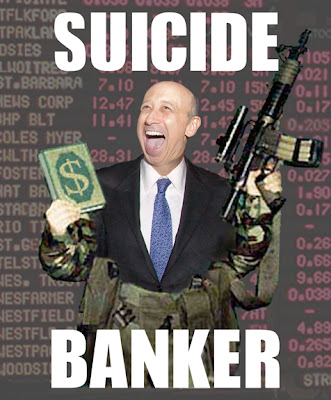
Banksters Pretend that Prosecuting Wall Street Crime Will Blow Up the Economy

https://lh3.googleusercontent.com/-d3tn0ZzcMTU/TM3rPQnUFqI/AAAAAAAAAGQ/9eo7P3nrymw/s400/suicide_banker.jpg

Wall Street Criminals Threaten that Economy Will Blow Up If They’re Prosecuted

The Department of Justice is “considering” initiating criminal charges against 2 banks.
In response, the normal cast of characters is saying – as they have for years – that prosecuting banks will cause a meltdown of the economy.
The U.S. attorney for the Southern District of New York recently mocked the silly claims of gloom and doom:
“Companies, especially financial institutions, will do almost anything to avoid a tough enforcement action and therefore have a natural and powerful incentive to make prosecutors believe that death or dire consequences await,” he said. “I have heard assertions made with great force and passion that if we take any criminal action, the skies will darken; the oceans will rise; nuclear winter will be upon us; and the world as we know it will end.”
As we’ve repeatedly noted, this is wholly untrue.
Indeed, prosecuting the individual Wall Street executives who knowingly committed criminal fraud won’t harm the economy.  After all, the main driver of economic growth is a strong rule of law. And numerous Nobel prize winning economists have said that prosecuting Wall Street white collar is necessary for a prosperous economy.
In response to the sky-is-falling spouting banking apologists, professor of law and economics – and chief S&L prosecutor – William Black  explains:
First, no banker is “too big to jail.” They are easily replaceable and removing a fraudulent bank CEO from power is the single most productive act that regulators and prosecutors can accomplish. [The Department of Justice's chief of criminal prosecutions] Breuer and Attorney General Eric Holder were involved in a con when they claimed that their failure to prosecute the senior bank officers leading the frauds was in any way related to “too big to fail.” Hilariously, they even applied the “rationale” for non-prosecution to former bank officers – as if a bank would fail “because” its former officers were prosecuted. It is a testament to the weakness of the reportage that this claim was not treated with ridicule.
Second, valid fraud prosecutions do not “cause” a business to fail. The fraud causes them to fail. They should fail when their “profits” arise from fraud. In particular, they should fail in the case of accounting control fraud because their “profits” are the fictional product of accounting fraud. The markets and the economy are greatly improved when fraudulent enterprises are destroyed. ***
Third, very little is actually “destroyed,” when we place a fraudulent bank in receivership, fire the crooked CEO, and sell the bank to an acquirer of integrity and competence. The new bank will, net, be greatly improved because it has been freed from control by the fraudulent leadership that was “looting” the bank (George Akerlof and Paul Romer, 1993, “Looting: The Economic Underworld of Bankruptcy for Profit”).
Fourth, there is rarely a need to prosecute a bank. In virtually every case in which the bank’s frauds cause serious harm senior officers of the bank will have led the fraud and profited from it. Everyone in law enforcement realizes that any effective deterrence will come from prosecuting those officers and not only removing their fraud proceeds but also imposing fines that will leave the officers bankrupt.
Fifth, the bank’s controlling officers are in an immense conflict of interest when their frauds are detected. They control the bank and its resources. Their first priority is to prevent their own prosecution. Their second priority is to prevent any substantial “claw back” of their compensation. Their third and fourth priorities are to do the same for less senior officers. This isn’t altruism (though it certainly has an aspect of class-based affinity). Fraudulent CEOs realize that it is risky to allow the prosecutors to gain any leverage over more junior officers who may “flip” and testify against the CEO. The fraudulent officers controlling the bank, therefore, will gladly trade seemingly huge fines in exchange for obtaining their top four priorities.
[Finally, the government's policy of not prosecuting Wall Street criminals] produceswhat Akerlof and Romer warned was the “sure thing” of CEO “looting” through accounting control fraud plus the assurance that the CEO will not be prosecuted, forced to surrender his fraud proceeds, or forced to pay fines that bankrupt him.Unsurprisingly, the result has been unprecedented accounting control fraud by elite banksters.***
None of this explains why they don’t prosecute bankers (much less ex bankers)
Indeed, the whole if-y0u-prosecute-the-economy-dies scam is like the 2008 bailouts. As we wrote at the time:
Congressmen Brad Sherman and Paul Kanjorski and Senator James Inhofe all say that the government warned of martial law if Tarp wasn’t passed.
***
As Karl Denninger wrote yesterday:
[S]ounds like “Bail me out or I will crash everything.”
Isn’t that analagous to walking into a bank, opening one’s coat to reveal an explosives-laced belt, and saying “gimme all the money or everyone dies!”
I noted in November:
In the 1974 comedy Blazing Saddles, Cleavon Little plays the new sheriff in an old Western town. The sheriff is African-American, and when he rides into town for the first time, the [racist] townspeople pull out their guns and are about to shoot him.
But he quickly puts a gun to his own head, pretends he’s scared of his own gun, and says “BACK OFF OR THE AFRICAN-AMERICAN GUY GETS IT!!!” The townspeople are dumb and fall for it, suddenly terrified that he’ll kill himself. Here’s the scene.
That’s what Wall Street is doing with the bailout.
The fat cats on Wall Street are saying “give us a lot of money, and buy all of our bad debt for a lot more than its worth, or Wall Street will get it and we’ll go into a depression!”
Are Americans stupid enough to fall for it?
In a recent interview, William K. Black uses the exact same Blazing Saddles sheriff-bank analogy.
***
Any way you look at it, the too big to fails are not needed and they are dragging our economy into a black hole. Like the sheriff in Blazing Saddles … they are playing us for fools.
[Yves Smith] shared another analogy with me: a man with 15lbs. of Semtex strapped to his waist. She says “any surprise people in the vicinity are very attentive to his desires?”

Indeed, it’s the old protection racket.

This Chart Is A Hair-Raising Picture Of Canadian Home Prices That Makes The Torrid Excesses Of The US Housing Bubble Look Banal

For years, home prices in Canada tracked those in the US, including during the crazy bubble years. But as US home prices peaked in 2006 and then skidded downhill unglamorously, Canadian home prices, after a brief swoon during the financial crisis, just continued to soar, unperturbed by reality and unhampered by any sense of gravity.
Now the average home price in Canada is $400,000, according to an analysis by BMO, one of the largest Canadian banks. In the US, where price bubbles are forming once again in a number of cities, the mean home price is $250,000. OK, we’re comparing average and mean, which aren’t the same thing, but the trends speak volumes (chart by OtterWood Capital Management):
The gap between Canadian and US home prices is at an all-time record, with the average price in Canada now 66% higher than the mean price in the US. Even when the prices are adjusted for fluctuations in the exchange rate, BMO points out, Canadian homes are still 50% more expensive than the already expensive US homes. What gives?
Ripples are already appearing. Housing starts and building permits in Canada have been lousy. Bubbles have the self-propagating effect of attracting ever more resources and jobs and assuming an ever larger role in the economy. Until they implode. Then it all reverses, often suddenly. During the housing bubble in the US, that’s exactly what happened. And when it popped, millions of people lost their jobs in the housing sector, investors lost money, banks got bailed out…. You know the story.
Canada has experienced the same shift of jobs and resources into the housing sector. The more the housing bubble grew, the more it has attracted jobs and resources which further inflated it. And so the bubble ballooned even more insanely that in the US. In the process, the economy has become much more dependent on housing-related activity and jobs than in the past – and has become more vulnerable to a correction in housing. A 20% downdraft in home prices, BMO’s senior economist Sal Guatieri warned, could throw the Canadian economy into a recession.
So can we already hear the distinct popping sound from the housing bubble in Canada? “Not just yet,” according to OtterWood Capital Management. But the housing market is “overpriced,” and a “bubble” it is. Now all it takes to keep it going forever is a miracle, and a big one at that, but miracles are rare in the housing sector, and if they do occur, they don’t last long, and eventually, all bubbles do the same thing: the hot air hisses out of them, and the bigger the bubble, the worse the consequences.
In the US, they’re not even trying to blame the weather this time. “Housing affordability is really taking a bite out of the market,” is how the chief economist for the California Association of Realtors explained the March home sales fiasco. “We haven’t seen this issue since 2007.” Read…. Housing Bubble 2.0 Veers Elegantly Toward Housing Bust 2.0


Almost 3 Times As Many People DROPPED OUT of Labor Force As Joined It

“Rarely Does A Monthly Report On The United States Job Market Look So Terrific On The Surface While Being So Disappointing Underneath”

The New York Times’ Neil Irwin gives a balanced view of the new jobs numbers:
Rarely does a monthly report on the United States job market look so terrific on the surface while being so disappointing underneath.
***
Employers added a whopping 288,000 jobs, the most in two years.
***
The number of people in the labor force fell by a whopping 806,000, wiping out the February and March gains and a bit of January as well. The labor force participation rate fell by 0.4 percentage points to 62.8 percent, returning to its December level.
And the number of people reporting they were unemployed fell by 733,000, which sounds good on its surface, but paired with the similar-sized decline in the labor force points to job seekers giving up looking rather than finding new employment.
In other words, 288,000 jobs were created, but 806,000 fell out of the labor force and gave up looking for work altogether.  So 2.8 times as many people dropped out as found jobs.
As CBS notes:
The unemployment rate dropped to 6.3 percent in April from 6.7 percent in March, the lowest it has been since September 2008 when it was 6.1 percent. The sharp drop, though, occurred because the number of people working or seeking work fell. The Bureau of Labor Statistics does not count people not looking for a job as unemployed.
***
The amount (not seasonally adjusted) of Americans not in the labor force in April rose to 92,594,000, almost 1 million more than the previous month.
The number of women not in the labor force has risen to an all-time high.  there was a loss of jobs in the 25-54 age group,  And – in 20% of American families – no one works.
Despite what you may have heard, the huge numbers of people dropping out of the labor force can’t be attributed to retiring baby boomers.
In reality, throwing money at the big banks has led to a  “jobless recovery” – a permanent destruction of jobs – which is a redistribution of wealth from the little guy to the big boys. (And see this.)
And most of the new jobs being created are low-wage or temporary jobs.

Gold Up On Friday, A Sustained Rally? — Chart This!

Gold prices were up on Friday, but is this a sustainable rally? Gary Wagner is on Kitco News to talk about the charts and where he sees the metal headed. “Everybody was eyeing the nonfarm payroll report that came out this morning,” he says. “Last time we spoke, I was looking for the beginning of a sustained rally in terms of the gold market…to be honest, I’ve been disappointed.” Wagner also comments on the silver market and shares some of his key technical trading tools with the viewers. Tune in now to learn more about trading, the gold market and more! Kitco News, May 2, 2014.
Join the conversation @ The Kitco Forums and be part of the premier online community for precious metals investors:http://kitcomm.com – Or join the conversation on social media: @KitcoNewsNOW on Twitter: http://twitter.com/kitconews — Kitco News on Facebook: http://facebook.com/kitconews — Kitco News on Google+: http://google.com/+kitco — Kitco News on StockTwits:http://stocktwits.com/kitconews

Job Numbers Collapse BIG TIME


10 Reasons Why the Economic COLLAPSE is Here!

#1 The homeownership rate in the United States has dropped to the lowest level in 19 years.
#2 Consumer spending for durable goods has dropped by 3.23 percent since November.  This is a clear sign that an economic slowdown is ahead.
#3 Major retailers are closing stores at the fastest pace that we have seen since the collapse of Lehman Brothers.
#4 According to the Bureau of Labor Statistics, 20 percent of all families in the United States do not have a single member that is employed.  That means that one out of every five families in the entire country is completely unemployed.
#5 There are 1.3 million fewer jobs in the U.S. economy than when the last recession began in December 2007.  Meanwhile, our population has continued to grow steadily since that time.
#6 According to a new report from the National Employment Law Project, the quality of the jobs that have been “created” since the end of the last recession does not match the quality of the jobs lost during the last recession…
#7 After adjusting for inflation, men who work full-time in America today make less money than men who worked full-time in America 40 years ago.
#8 It is hard to believe, but 62 percent of all Americans make $20 or less an hour at this point.
#9 69 percent of the federal budget is spent either on entitlements or on welfare programs.
#10 As I wrote about the other day, there are now 49 million Americans that are dealing with food insecurity.