Saturday, March 22, 2014

F-35 News. Spending frozen on the troubled jet.

via Gazetta El Sud
Rome, March 20 - Italy has frozen spending on its F-35 jet fighters program, pending a parliamentary review of military spending, says Defence Minister Roberta Pinotti. Her comments during a television interview with La7 Wednesday night, came several days after Premier Matteo Renzi said that defence spending - including the budget for the F-35 program - was under review. This could include three billion euros in potential savings for defence budgets. The government could decide to trim its Lockheed Martin F-35 fighter jets' budget, which is currently about 11.8 billion euros over 45 years beginning in 2015. "Today we suspended payment of installments," on the F-35, Pinotti told the program The Barbarian Invasion. "We are having a moratorium, pending the results of an inquiry by Parliament," she added.
A certain blogger I know told me I was full of shit when I posted news that the F-35 would be cut to 45 jets by the Italians.

He went through a long song and dance about how this was just a minor thing and that they would be back in the fold buying 90 odd jets shortly.

That blogger failed to take into account current economic conditions worldwide.

Globalization is breaking down.  Economies around the world are on the verge of bankruptcy.  In short.  Everyone is is in a hurtlocker and defense spending is the first sacrificial lamb of the masses.

The Netherlands was first, Italy is second, and I predict that the frugal Canadians will be third.  But they won't be the last.  Even the USAF will be hit with the reality bat and the F-35 order will be cut.

I say again.

The death spiral is here.

Peter Schiff: Government's War on Living Standards (1947 to now)


How Phony Inflation Numbers Mask GDP Weakness

 
Earlier this week, we wrote about how inflation is hidden both by the Feds and by corporations.
 
Why hide inflation? Well for one thing, understating inflation allows you to overstate GDP growth.
 
One of the biggest games played by the bean counters in Washington. in the US is the overstatement of GDP growth by understating inflation.
 
Consider this simple example. Let’s say that the US GDP grew by 10% last year. Now let’s say that inflation also grew by 10%.
 
In this scenario, real inflation adjusted GDP growth was ZERO. However, announcing ZERO GDP growth is a major problem politically.
 
So what do the Feds do? They claim that inflation was just 8%, and BOOM you’ve got 2% GDP growth announced for a year in which real GDP growth was actually zero.
 
This game is played all the time via a metric called the GDP “deflator.” Technically what this is meant to do is remove the effects of inflation from the GDP growth numbers to show what real growth was.
 
However, what it actually ends up being is an accounting gimmick that allows the numbers to overstate GDP growth.
 
By now, we all know that the CPI numbers understate inflation significantly. But the Federal Government uses a GDP deflator that is even lower the CPI.
 
This is like measuring your height in “inches” that are actually centimeters. In reality you’re still the same height, but nominally you look a lot taller.
 
Inflation is a very real problem for the economy and for the US financial system. We’ve been told to believe that it is a necessary evil, but the reality is that it concentrates wealth, weakens the US dollar and raises the cost of living.
 
None of those are beneficial to the US as a whole.
 
Since 2007, the world’s Central Banks have collectively put more than $10 trillion into the financial system since 2008. To put that number into perspective, it’s equal to roughly 15% of global GDP.
 
This kind of money printing is literally unheard of in modern history. And it has set the stage for a roaring wave of inflation to hit the financial system. Indeed, the first signs are already showing up… not in the “official” Government data (which is bogus) but in how those who run businesses around the globe are acting.
 
 
For a FREE Special Report on how to protect your portfolio from inflation, swing by
 
Best Regards
Phoenix Capital Research

Nearly one million Obamacare 'enrollees' have never paid any premiums

(NaturalNews) It won't be long before the March 31 Obamacare enrollment deadline arrives, and the latest data still show that very few people have signed up for the scheme. In fact, according to recent figures put out by the Obama administration, there have only been about 4.2 million total enrollments logged in healthcare exchanges across the country, and of these only 3.3 million enrollees have actually paid their premiums.

As of March 1, less than half of the sitting government's projected 7 million Obamacare enrollments have actually materialized, and fewer still have followed through with actually paying for their Obama insurance. Based on data collected from the Obamacare marketplaces in California, Connecticut, Maryland, Nevada, Rhode Island, Vermont and Washington, less than 80 percent of Obamacare enrollees have thus far paid their insurance premiums, with no system in place to actually track these payments.

According to the UK's Daily Mail, fewer than 1 million Americans signed up for Obamacare during the month of February, despite aggressive marketing campaigns that aired via television, radio and social media. Even a recent publicity stunt on the internet mini-show Funny or Die, where Obama hounded the public to sign up for Obamacare, failed to push enrollment numbers toward the administration's goal.

More than 80 percent of Obamacare enrollees previously had health insurance

Because of this, the administration has had to readjust its projected enrollment outcomes and even twist the numbers to make it look like more people are complying with the healthcare takeover than actually are. Obama and co. have also glossed over the fact that most of the people signing up for Obamacare are people who previously had insurance and were forced to adopt the new plan

"[O]nly 27 per cent [sic] of new enrollees -- or 1.14 million of the total announced Tuesday -- were uninsured before they signed up," writes political editor David Martosko for the Daily Mail. "Millions of insured Americans received cancellation letters from their insurers in October, November and December, spurred by the companies' recognition that their existing offerings didn't satisfy the Affordable Care Act's stringent minimum standards."

90 percent of eligible Americans refusing to sign up for Obamacare

Another zinger is the overall percentage of eligible enrollees who have actually signed up for Obamacare. According to an analysis conducted by the consultancy group McKinsey & Co., only about 10 percent of eligible Americans have opted to participate in the program thus far, a dismal figure that demonstrates the true extent of Obamacare's unpopularity.

"Of the 3.3 million people that the White House has touted as Obamacare exchange 'sign-ups,' less than 500,000 are actual uninsured people who have actually gained health coverage," writes Avik Roy for Forbes.com, noting that the most significant reason why people are deciding not to enroll under Obamacare is that they simply cannot afford the premiums.

Percentage of Americans with health insurance has dropped since Obama took office

With all this in mind, it is hardly surprising that the overall number of insured people in this country has actually dropped since Obama took office. The millions of hard-working Americans who were previously insured but who have now lost their coverage, as well as uninsured individuals everywhere who still cannot afford health insurance even under Obamacare, exceeds the number of people who are actually benefiting as a result of the scheme.

"[W]hile the percentage of uninsured Americans has dropped from 17.1 per cent at the end of 2013 to just 15.9 per cent now, that number stood at just 14.4 per cent before Obama took office," adds Martosko about the dilemma.

Sources for this article include:

http://www.dailymail.co.uk

http://www.cnbc.com

http://www.nj.com

http://www.forbes.com

EU Agrees Banking Union – Bail-Ins Cometh …

Today’s AM fix was USD 1,338.50, EUR 970.21 and GBP 810.57 per ounce.
Yesterday’s AM fix was USD 1,327.00, EUR 962.64 and GBP 802.78 per ounce.
Gold dropped $2.30 or 0.17% yesterday to $1,327.00/oz. Silver fell $0.28 or 1.36% to $20.29/oz.
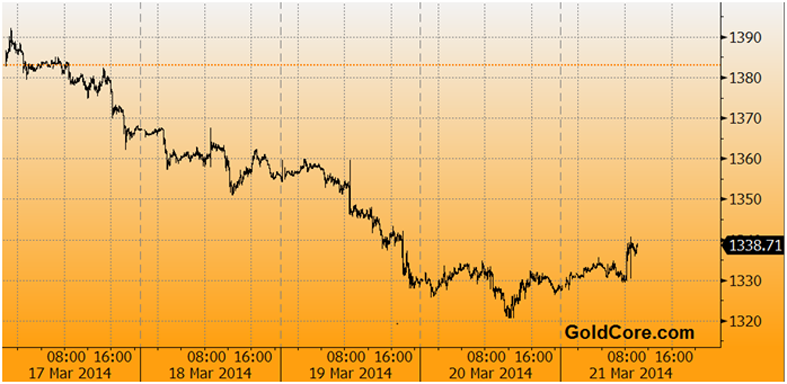
Gold in U.S. Dollars, 5 Days – (Bloomberg)
Gold rose 1%, it’s first rise in five days, trimming a weekly decline of 2.8%, as the crisis over Ukraine led to a renewed safe haven bid for gold. Palladium surged 3.1% to the highest since 2011 on concern supply from Russia may be restricted.
Gold had become overbought after its surge to 6 month highs and was due profit taking and a correction. A perception of an abatement of tensions between Russia and the West has contributed to the pullback this week. Momentum could lead to further falls next week but we expect weakness will be short lived.
Gold’s TechnicalsThere is a risk that gold could fall below immediate support at $1,320/oz and the next levels of support are at $1,300, $1,240 and then back where we started the year at $1,200. A 50% retracement would not be unusual after the speed of recent gains and that would take us to the psychological level of $1,300/oz again.

Gold in U.S. Dollars, 1 Year – (Bloomberg)
A political solution needs to be found as governments continue to opt for economic sanctions of various degrees, it could degenerate into a full blown trade and economic war. Were this to occur the benefits of free trade and globalization that we have seen in recent history would be at risk – creating real challenges for the global economy.
The premiums that risk assets such as stock markets command could quickly be lost as market participants reevaluate asset allocations in the light of the more risky economic and geopolitical situation.
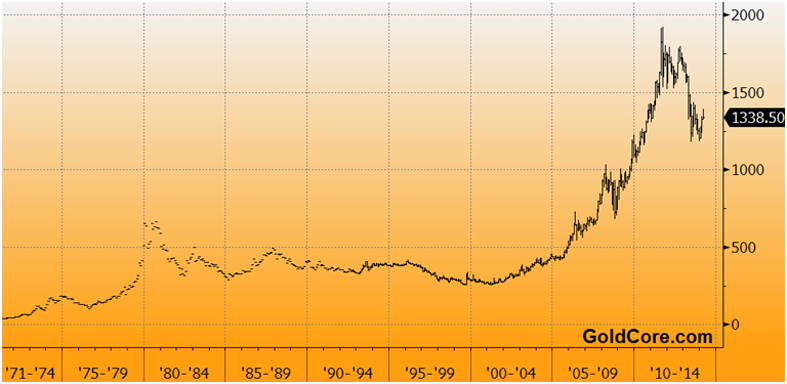
Gold in U.S. Dollars, 43 Years – (Bloomberg)
Hopefully, calm and wise counsel will prevail and a diplomatic political solution will be found. However, in the meantime, gold continues to be an important asset to own in order to hedge these and other geopolitical and economic risks.
Yellen At Fed – Print Baby Print
It was very welcome to see a woman taking over the helm of the Federal Reserve. However, we cannot allow our goodwill in this regard to cloud judgement and impact our analysis of her and the Fed’s performance and policies.
Yellen gave mixed messages, both on the economy and on monetary policy, but market participants have chosen to focus on some of the more hawkish comments that she made. She acknowledged that the Fed may have been too optimistic about the economic outlook recently. Yet, she and the Fed largely stuck to their projections for how growth and inflation will unfold in the coming years.
It is important to remember that the Fed did not predict or foresee at all the sub prime crisis, the housing bubble, Bear Stearns, Lehman, the global financial crisis and subsequent recession.
The dollar is set to be structurally weak in the coming years given the still significant imbalances in the U.S. economy and still very poor fiscal state of the economy. No amount of jaw boning or Fed tinkering with interest rates will change that.
While interest rates may rise from nearly 0%, they are set to remain low for the foreseeable future. At least until the bond markets decide to enforce fiscal discipline on the U.S. Then interest rates will likely rise substantially leading to a severe U.S. recession.
U.S. Govt 10 Year Yield, 1971 to March 2014 – (Bloomberg)
On a long term basis, it is likely that the dollar will remain weak and gold’s bull market will continue until the end of the interest rate tightening cycle which will likely be between 2020 and 2025.
This was seen in the 1970s when interest rates surged higher that decade from a low in March 1971, to a high in September 1981. The U.S. 10 Year went from 5.38% to 15.84% during that period and gold rose from near $35/oz to over $850/oz in January 1980 (see charts).
Thus, contrary to the popular perception, rising interest rates are not bearish for gold. High interest rates and real positive interest rates in a sound economy are very bearish for gold prices and will burst the coming gold bubble. However, that is a long way off – likely between 2018 and 2025 and likely when gold prices are well above their inflation adjusted high (CPI) of $2,500/oz. Indeed, longer term prices over $4,000/oz or $5,000/oz are quite feasible.
EU Agrees Banking Union – Bail-Ins Cometh …Early this morning European Union politicians struck a deal on legislation to create a single agency to handle failing banks and bail-ins in the Eurozone after another all night negotiating marathon ahead of a summit of EU leaders starting in Brussels today.
German Finance Minister Wolfgang Schaeuble was drawn into the talks around 0530 GMT as the negotiations dragged on into the night. The politicians emerged around 0715 GMT with the deal, which now will need formal approval by the European Parliament and by national governments.
Negotiators persuaded nations that had been opposed to the proposed Single Resolution Mechanism and the legislation for bail-ins to agree.
Insolvent banks will be treated equally regardless of the country they are based in. Failed banks creditors, both bond holders and depositors, will be subject to bail-ins in the same way in all countries.
“It’s a very good agreement,” European Central Bank President Mario Draghi said before the meeting of EU leaders in the Belgian capital. The banking union was shaped in part by Draghi and he hailed the compromise plan as “great progress for a better banking union. Two pillars are now in place.”
Plans for a single banking union were put together two years ago due to fears for the euro and the EU’s 6,000 banks. Countries wanted to break the link between sovereigns and insolvent banks to ensure taxpayers were not forced to bail out insolvent banks and to prevent contagion and a systemic crisis.
It had already been agreed that shareholders and importantly now depositors will be bailed in before the single resolution fund can be tapped. About 100 banks plus transnationals and those already bailed out will come under the direct supervision of the ECB from January.
While most of the coverage is on the European Union member states and the European Parliament agreeing the final details of a single resolution mechanism (SRM) to wind up failing banks, there is little coverage of the developing bail-in regimes and the heightened risk that depositors in the Eurozone now face.
Banks in the Eurozone remain extremely vulnerable. Our research on
bail-ins and the developing bail-in regimes clearly shows how banks remain very vulnerable and it is now the case that in the event of bank failure, your deposits could be confiscated as happened in Cyprus.
It is important to realise that not just the EU but also the UK, the U.S., Canada, Australia, New Zealand and most G20 nations all have plans for bail-ins in the event that banks and other large financial institutions get into difficulty.
The coming bail-ins will pose real challenges and risks to investors and of course depositors – both household and corporate. Return of capital, rather than return on capital will assume greater importance.
Evaluating counterparty risk and only using the safest banks, investment providers and financial institutions will become essential in order to protect and grow wealth.
It is important that one owns physical coins and bars, legally in your name, outside the banking system. Paper or electronic forms of gold investment should be avoided as they along with cash deposits could be subject to bail-ins.
Educate yourself about this emerging threat to your livelihood by reading:
Bail-In Guide: 
Protecting your Savings In The Coming Bail-In Era (10 pages)
Bail-In Research: 
From Bail-Outs to Bail-Ins: Risks and Ramifications (50 pages) 

NASA-funded study: Over 32 advanced civilizations have collapsed before us, and we’re next in line.

Collapse of civilization
As any long-time reader of this column knows, we routinely draw from historical lessons to highlight that this time is not different.
Throughout the 18th century, for example, France was the greatest superpower in Europe, if not the world.
But they became complacent, believing that they had some sort of ‘divine right’ to reign supreme, and that they could be as fiscally irresponsible as they liked.
The French government spent money like drunken sailors; they had substantial welfare programs, free hospitals, and grand monuments.
They held vast territories overseas, engaged in constant warfare, and even had their own intrusive intelligence service that spied on King and subject alike.
Of course, they couldn’t pay for any of this.
French budget deficits were out of control, and they resorted to going heavily into debt and rapidly debasing their currency.
Stop me when this sounds familiar.
The French economy ultimately failed, bringing with it a 26-year period of hyperinflation, civil war, military conquest, and genocide.
History is full of examples, from ancient Mesopotamia to the Soviet Union, which show that whenever societies reach unsustainable levels of resource consumption and allocation, they collapse.
I’ve been writing about this for years, and the idea is now hitting mainstream.
A recent research paper funded by NASA highlights this same premise. According to the authors:
“Collapses of even advanced civilizations have occurred many times in the past five thousand years, and they were frequently followed by centuries of population and cultural decline and economic regression.”
The results of their experiments show that some of the very clear trends which exist today– unsustainable resource consumption, and economic stratification that favors the elite– can very easily result in collapse.
In fact, they write that “collapse is very difficult to avoid and requires major policy changes.”
This isn’t exactly good news.
But here’s the thing– between massive debts, deficits, money printing, war, resource depletion, etc., our modern society seems riddled with these risks.
And history certainly shows that dominant powers are always changing.
Empires rise and fall. The global monetary system is always changing. The prevailing social contract is always changing.
But there is one FAR greater trend across history that supercedes all of the rest… and that trend is the RISE of humanity.
Human beings are fundamentally tool creators. We take problems and turn them into opportunities. We find solutions. We adapt and overcome.
The world is not coming to an end. It’s going to reset. There’s a huge difference between the two.
Think about the system that we’re living under.
A tiny elite has total control of the money supply. They wield intrusive spy networks and weapons of mass destruction. The can confiscate the wealth of others in their sole discretion. They can indebt unborn generations.
Curiously, these are the same people who are so incompetent they can’t put a website together.
It’s not working. And just about everyone knows it.
We’re taught growing up that ‘We the People’ have the power to affect radical change in the voting booth. But this is another fairy tale.
Voting only changes the players. It doesn’t change the game.
Technology is one major game changer. The technology exists today to completely revolutionize the way we live and govern ourselves.
Today’s system is just a 19th century model applied to a 21st century society. I mean– a room full of men making decisions about how much money to print? It’s so antiquated it’s almost comical.
But given that the majority of Western governments borrow money just to pay interest on money they’ve already borrowed, it’s obvious the current game is almost finished.
When it ends, there will be a reset… potentially a tumultuous one.
This is why you want to have a plan B, and why you don’t want to have all of your eggs in one basket.
After all, why bother working so hard if everything you’ve ever achieved or provided for your children is tied up in a country with dismal fundamentals?
If you agree with me, then feel free to share this article with your friends below so they also can get a plan B in place. They’ll be glad they did.


The Federal Reserve: Masters of the Universe or Trapped Incompetents?

Suppose the Fed was actually little more than a collection of incompetents trapped in a broken system that is beyond repair.
For a variety of reasons, the Federal Reserve is viewed by many as the financial Master of the Universe. Given how the media hangs on every pronouncement and the visible power of the Fed’s policies to move markets, this view is understandable.
But suppose rather than being masters of all things financial, the Fed was actually little more than a collection of incompetents trapped in a broken system that is beyond repair.
Many reasons have been proposed to explain the Fed’s policies,and most (including my own expressed here) focus on the Fed’s need to protect the banking sector and the Status Quo, lest the whole rotten contraption collapses in a heap of worthless derivatives and various Ponzi schemes.
An alternative view is that the members of the Fed have been selected for incompetence by a system that fosters incompetence by its very nature, i.e. a centralized power center.
Longtime correspondent Harun I. recently offered this explanation of the incompetence of those atop the heap:
Regarding the competence of the Deep State and Federal Reserve:When one merges the Peter Principle and Pareto Principle one realizes that, not only are they incompetent, it is inevitable. Complexity does not equal competence. And because complexity is a form of leverage it does not require a majority of systems inoperable to fail.
Modern developed civilizations rest upon several inverted pyramids. How many people out of any random sampling know how to produce their own food, make their own clothing, build their shelter, or tap into their own water source? As complexity increases and the division in labor grows increasingly in areas that have nothing to do with core survival the civilization becomes increasingly incompetent.
Since a civilization is a hierarchal system, its leaders (the vital few) will eventually be incompetent. Inverted pyramids and inept leadership are a toxic mix. As history would indicate this situation eventually disintegrates then reorganizes… to be repeated.
Another key characteristic of such centralized systems is the way they trap participants, even those at the top. Analyst Catherine Austin Fitts has discussed this attribute, for example, in this interview: Catherine Austin Fitts on Wall Street’s Corruption, the Austrian School and Who’s ‘Really’ in Charge.
One way to think about this is to ask: let’s say the voting members of the Fed knew that the best way to re-start sustainable growth was to normalize interest rates by ending the Fed’s zero-interest rate policy (ZIRP) and quantitative easing.
Even if they knew these changes would ultimately profit the banking sector and the economy as a whole, could they withstand the pressure that would be exerted by everyone benefiting from the Status Quo?
I have long maintained that the Fed’s vaunted independence is actually contingent, i.e. the Fed is a political entity and as a result it responds to political pressure like any other political entity. And like any hierarchy, it is prone to group-think and the urge to conform to norms.
This raises another question: even if the voting members of the Fed wanted to fix the nation’s broken financial system, do they have the ability to do so?
I have posited that whatever consensus/group-think dominated the various factions that comprise the Deep State has eroded, and the cracks of profound disunity are opening between powerful factions in the Deep State.
Rather than Masters of the Universe, the Fed’s governors are increasingly looking more like deer caught in the headlights of a transformation they cannot understand, much less control.