Wednesday, November 13, 2013

The Poverty of Capitalism and the struggle for another world.

The current global economic crisis has been covered extensively within academic literature and the wider (social) media alike. Few, however, have tackled the topic with the ambition of questioning capitalism itself. John Hilary’s book The Poverty of Capitalism: Economic Meltdown and the Struggle for What Comes Next(Pluto Press, 2013) is a welcome exception here. In this blog post, I will provide a critical engagement with this excellent analysis of capitalist crisis and moves towards alternatives. 
The power of transnational capital
John Hilary, Executive Director of the British NGO War on Want, looks in detail at three economic areas, which have been dominated by transnational capital at the expense of workers’ most basic human rights, extraction, garments and food production. ‘The Marikana massacre’, he argues, ‘is a brutal reminder that direct conflict with the extractive industries’ insatiable drive for profit remains a daily reality for millions of people across the world’ (P.99). While Western countries and increasingly emerging economies such as China continue to exploit the mineral wealth of developing countries, the dispossession of the local population often includes widespread human rights abuses.
The global garments industry is closely controlled by brand names and retailers, who relentlessly squeeze suppliers in producing more cheaply. Unsurprisingly, working conditions in this sector are characterised by super-exploitation with a disregard for issues such as health and safety.  The recent collapse of the Rana Plaza factory in Bangladesh, when more than 1000 people were killed is only one of the most extreme examples of the consequences of poor working conditions in this sector. In relation to food production, ‘as with the garments sector, the production, distribution and consumption of food are already dominated by a small number of giant transnational corporations who seek to determine what is grown and what is eaten in all corners of the globe. As with the extractive sector, capital has become increasingly aggressive in its attempts to appropriate the natural resources necessary for its further expansion: land, seeds, water and the genetic building blocks of life itself’ (P.118). In short, global capitalism has intensified exploitation across borders with the peoples of the Global South bearing yet again the brunt of the onslaught. 
The rise of the BRICS and CSR as hopes for alternatives?
John Hilary dismisses hopes that the rise of the BRICS, Brazil, Russia, India, China and South Africa, will result in a dramatic change in global capitalism. Yes, the balance of power in the global economy is changing, but capitalism itself has not been undermined. ‘Instead of the traditional division between the capital-exporting countries of the North and the capital-importing countries of the South, the increasing accumulation of capital in the semiperiphery has generated a new wave of imperialism from the emerging economies themselves’ (P.34). At the same time inequality across the globe is increasing between countries, but also within countries and the BRICS are no exception here. ‘In the emerging economies of India and China, similar increases in inequality have taken place against the backdrop of hundreds of millions living in absolute poverty (P.18). Interestingly, the position of transnational capital has actually been strengthened rather than weakened as a result of the rise of the BRICS. ‘The G20’s decision to resurrect the failed institutions of twentieth-century globalization in the interests of transnational capital represents the greatest structural continuity between the new world order and the old’ (P.29).
John Hilary is equally clear in his dismissal of Corporate Social Responsibility (CSR) schemes as a way of self-regulation by transnational capital. ‘For all its claims to be channelling the power of business in pursuit of humanity’s common goals, CSR has successfully undermined the very cause it purports to serve’ (P.59). Instead of constraining capital and ensuring good working conditions for workers, CSR actually legitimises current practices of exploitation. The fact that many NGOs have collaborated with capital in this area makes the situation worse. This ‘has contributed to the closing down of critical space, as corporations have been able to point to their partnerships with “respectable” civil society (especially NGOs from the global North) as a means of marginalizing more radical opposition to their operations or to the system as a whole’ (P.79).
What alternatives beyond capitalism?
Photo by seven-resist
Importantly, John Hilary does not stop with criticising hopes linked to the BRICS and CSR. He also attempts to identify real moments of alternatives. Unlike many liberal commentators of the current situation, he is fully aware of the impossibility of regulatory changes. Real change can only be brought about, if global capitalism itself is challenged (P.117). His thinking is organised around three concepts: popular sovereignty, common ownership, and social production. ‘The concept of sovereignty is essentially opposed to the disempowerment inherent in corporate globalization, in that it reclaims authority over natural resources and the means of production from transnational capital, relocating legitimate authority within the democratic structures of the community, however constructed and contested (P.131). Common ownership can galvanise the resistance against the new wave of enclosures reflected in ‘land grabbing’ and social production allows the production for use, not for profit. These concepts are positively supported with a whole range of examples from Latin American countries, where the so-called ‘pink tide’ of centre-left and left governments has resulted in measures of significant wealth re-distribution from Lula’s Brazil and Morales’ Bolivia to Hugo Chavez’s ‘new socialism’ in Venezuela. 
As important as all these examples of change are, it is this aspect of the book where I find myself in slight disagreement with John Hilary. I am not convinced that the majority of the ‘global justice movement’ has declared itself opposed to capitalism as such rather than criticising the most negative outgrowths of neo-liberalism. Nor does the re-emergence of the state as an important actor of development in Latin America point towards a future beyond capitalism. As John Hilary acknowledges himself, at the national level ‘several of the “pink” governments have actually augmented the power of capital both nationally and internationally, maintaining their socially progressive credentials through pro-poor welfare programmes, but at the expense of any structural change’ (P.146). Capitalism as such is not challenged. Is John Hilary slightly too optimistic when assessing the current potential for moves beyond capitalism? Perhaps, but then there are many studies simply re-asserting the dominance of capitalism. In a way, it is refreshing that The Poverty of Capitalism goes into the opposite direction.
Photo by Sterneck
When looking at all the examples of transformative change mentioned by John Hilary, perhaps it is the movement around food sovereignty, demanding that people can decide for themselves what to grow and for whom, which directly challenges corporate power and may include the seeds for a different world. The peasant farmers’ movement La Via Campesina organises 150 local and national organisations from 70 countries and ensures a strong presence of this movement at the international level. Demands for ecological, sustainable, local and self-determined agriculture find support in the Global North and South alike.
The struggle over the future world order is open ended. It is these struggles, which can function as vehicles, ‘by which to develop an international class consciousness over and against the very real challenges posed by globalization to transnational solidarity’ (P.116). Solidarity is always the result of concrete struggles, and it is in this respect, that John Hilary’s positive assessment of the current situation may be justified. Hence, to conclude with his words, ‘the struggle for alternatives beyond capitalism is what makes another world possible. Even in the midst of crisis, that world is already coming into view’ (P.161).  An impressive book, a must read for all those interested in transformative change beyond capitalism!
Prof. Andreas Bieler
Professor of Political Economy
University of Nottingham/UK
Personal website: http://andreasbieler.net
12 November 2013
The official blog can be found here.
Distributed by RINF Alternative News

Coming Pension Meltdown: The 10 Most Troubled City Systems


Image: Coming Pension Meltdown: The 10 Most Troubled City Systems
Monday, 11 Nov 2013 04:21 PM
By Jennifer G. Hickey


Voters in Cincinnati last week soundly defeated a ballot initiative which would have overhauled the pension system for public workers, leaving the city without a plan to deal with $872 million in unfunded liabilities.

Cincinnati is not alone.

Across the nation, cities and states are finding funding for basic services being crowded out of their budgets by the rising cost of retirees' pensions and healthcare.

The Cincinnati initiative would have turned the public pension system into a 401(k) style-plan and require the city to pay off its unfunded liabilities in 10 years.

Urgent: Do You Approve Or Disapprove of President Obama's Job Performance? Vote Now in Urgent Poll

It failed 78 percent to 22 percent, an example of the opposition that cities face when trying to tackle the politically sensitive issue of funding retirees' benefits.

More and more cities, counties, and even some states will face the harsh reality of having to fix their pension systems or deal with a Detroit-style bankruptcy.

"This is happening in too many cities and towns across America, where social services, because they can be cut, are cut. Because pensions and bonds constitutionally cannot be cut, they're the protected class," Wall Street financial analyst Meredith Whitney told CNBC.

"I think you're going to see a real issue of neighbor against neighbor on these very issues," said Whitney, who recently co-founded Kenbelle Capital LP, a New York hedge fund.

Whitney argues in her recently released book, "Fate of the States: The New Geography of American Prosperity," that cities and states which delay addressing the crisis will witness a continued decline in growth.


A study by the Pew Center earlier this year looked at 61 cities — those with populations over 500,000 plus the largest city in each state — and found a total gap of $217 billion between pension and retiree healthcare obligations and the funding saved to pay those costs.

According to Pew, those cities had a total pension liability of $385 billion, with 74 percent funded, leaving a $99 billion shortfall.

The situation regarding retiree healthcare benefits in those cities is far worse, with a total of $126.2 billion of liabilities that are only 6 percent funded.

But here’s the real rub: experts are warning that many pension systems, those claiming they are well funded and those who say they aren’t, have all been using rosy projections about future investment returns.

In a recent editorial in Barron’s, Thomas Donlan writes that pension funds have “hidden the results with dubious financial reporting.”

He cites as just one example Detroit, which claimed as late as 2011 that their pension funds were 80 percent fully funded. New auditors found a $3.5 billion shortfall, a hole that pushed the city into bankruptcy.

Detroit, he says, was using the standard 8 percent return on assets, widely used by other funds. Donlan argues that is foolhardy to claim an 8 percent rate of return.

Consider that since January 1, 2001, the Dow Jones has appreciated, on average, a paltry 2.2 percent, with the S&P growing just 1.36 percent.

Instead, Donlan suggests pension funds use a 4 percent rate, the blended rate for no-risk Treasuries or a 5.5 percent rate, consistent with current corporate bond payouts. But if pension funds were to be honest and use such numbers, real unfunded liabilities would jump by a third or more.


Here are the top 10 cities with the lowest percentage of funding for pension liabilities
City Total Liability % Funded
Charleston, W. Va. $270 million 24
Omaha, Neb. $1.43 billion 43
Portland, Ore. $5.46 billion 50
Chicago, Ill. 24.97 billion 52
Little Rock, Ark. $498 million 59
Wilmington, Del. $364 million 59
Boston, Mass. $2.54 billion 60
Atlanta, Ga. $3.17 billion 60
Manchester, N.H. $436 million 60
New Orleans, La. $1.99 billion 61

The Pew Charitable Trusts study further identified nine cities that underperformed on two pension indicators, levels of funding along with the annual contribution percentage: Charleston; Chicago; Fargo, N.D.; Jackson, Miss.; Little Rock; New Orleans; Omaha; Philadelphia, and Portland.

Equally startling, Pew found numerous cities were woefully unprepared to finance healthcare benefit obligations.

"Only Los Angeles, Calif., and Denver, Colo., had even half of the money needed to fulfill their promises to employees. Thirty-three cities had set aside nothing to pay for this bill coming due," the research noted. Cincinnati was not among the cities ranked.

Many localities are seeing their operating budgets squeezed to pay for pension and healthcare retirement benefits.

The country's 250 largest cities saw spending for pensions increase to 10 percent of their general budgets in 2012, an increase of 7.75 percent since 2007, according to The Wall Street Journal.

The situation is no better for the states, which are also facing high burdens associated with worker's retirement costs.

The Chicago Sun-Times reported that an analysis of pension reform scenarios under consideration by the Illinois legislature "make clear that no matter what legislators do, including major pension cutting, a significant portion of the state's budget for the next 20 to 25 years will go toward paying pension bills, consuming 16 to 24 percent of the state’s general revenue fund annually."

Reform: No Easy Solutions

Steven Stanek of the Heartland Institute says there are no easy solutions when you get into situations that are as bad as states like Illinois, which has saved just 43 cents to cover every dollar of what it needs to pay 350,000 retirees and 500,000 current workers who are counting on pension checks.

"Enacting reform is made even harder because all policy is politics ultimately," Stanek tells Newsmax.

Stanek said that while rankings may differ depending on who is doing the number crunching and which data they survey, some states are present on all rankings.

"I would say from what I have seen the worst are Illinois, California, West Virginia, Oklahoma, New Hampshire, Louisiana, Alaska, Connecticut — all make the list," said Stanek.

A September report by the think tank State Budget Solutions said that state public employee retirement promises are underfunded by $4.1 trillion nationally. In addition, the report concluded that when combined, state public pension plans are just 39 percent funded.

The study found the five most poorly funded states are Illinois (24%), Connecticut (25%), Kentucky (27%), and Kansas (29%), along with Mississippi, New Hampshire, and Alaska tied at 30% funded.

State Budget Solution's Cory Eucalitto said in the report that for years the methodology used to rate public pension systems in the states has been too generous, allowing states to spin a rosier picture than reality truly reflected.

The generosity of the standards resulted in decisions this year by the Governmental Accounting Standards Board and by Moody's Investors Services to change the way they calculate state burdens.

"GASB and Moody's have joined a chorus of financial economists and other observers warning that pension funding practices are dangerous for both taxpayers and public employees alike," he writes.

Pension reform not only is causing a strain on local governments, but also on long-held political alliances.

California: The Future Has Arrived

Reform efforts advocated by Democratic mayors in Chicago and Detroit have both been vocally opposed by teacher and labor unions. The fissures have also arisen in San Francisco, where pension reform was one of several issues which resulted in Bay Area Transit Authority (BART) workers striking.

San Jose Mayor Chuck Reed announced in early October he would support a ballot measure for November 2014 that would amend California's Constitution to allow local governments to reduce pension expenses associated with their current employees. The proposal would not affect retiree benefits, but could allow modifications to future beneficiary plans.

With other cities in the state laboring under the weighty costs of pension obligations and retiree benefits, San Bernardino Mayor Pat Morris and Santa Ana Mayor Miguel Pulido joined Reed in submitting the ballot initiative to the state Attorney General.

"Typically, reform is being led by Democratic mayors. It's being resisted by leaders of public employee unions, who are also Democrats. California state legislators tend to side with the unions over the mayors, preferring the status quo — and the campaign contributions from unions — to an intramural fight," says Carl Cannon of RealClearPolitics.

Richard Dreyfuss, senior fellow at the Manhattan Institute, suggests several reforms are needed to avoid going off the fiscal cliff, including prohibiting issuing new bonds to refinance existing liabilities.

Dreyfuss also advocates for comprehensive reform that will combine a transition to defined-contribution plans, such as a 401(k), with reforms to how pensions are funded. He believes the new pension plans should be funded as they are earned, to avoid burdening future employees and beneficiaries.

Dreyfuss is clear in stating that any reform is going to be politically unpalatable.

"The necessity for real reform is problematic for policymakers, who must deal with a workforce resistant to the loss of guaranteed monthly pension benefits; and for political constituencies, including government workers and their allies, whose support for defined-benefit pensions in the public sector stems as much from ideology as from financial self-interest," he wrote.

Related Stories:
© 2013 Newsmax. All rights reserved.

Europe's Scariest Chart Leaves 1 in 4 Young People Unemployed

While near record low sovereign bond spreads and near record high equity prices have been taken as vindication by the European elites that all is well and 'we just need a little less fauxsterity' to be done with this crisis; the data, as it so often does, says the exact opposite. European unemployment just broke above 12% for the first time ever and European youth unemployment remains miserably above 24%. And while 1-in-4 under-25s unemployed is a bad enough statistic in terms of likely emergence of social unrest, the individual countries are in general deteriorating once again at a faster rate. French youth unemployment has risen for 13 months in a row to a record 26.5%; Spain (at 57.2% of under-25s unemployed) is catching up fast to Greece's stunning 59.1%; but perhaps the most concerning for the broader economies is the fact that Italy's youth unemployment has now topped that of Portugal at 38.4%. The only nation to see a drop in its youth unemployment was Ireland - which fell back modestly to January levels. Not a rosy picture, but then again, it doesn't matter...
Ugly...


and even worse for the youth...


but does it matter?


Charts: Bloomberg

Peter Schiff: Central Bank Monetary Cures Cannot Work


How to Invest Gold In Your Pension Plan – Part 2

Today’s AM fix was USD 1,281.00, EUR 956.90 and GBP 807.03 per ounce.
Yesterday’s AM fix was USD 1,283.75, EUR 957.81 and GBP 801.54 per ounce.
Gold fell $3.90 or 0.3% yesterday, closing at $1,283.50/oz. Silver slipped $0.09 or 0.42% closing at $21.36. Platinum inched down $9.51 or 0.7% to $1,428.99/oz, while palladium fell $4.47 or 0.6% to $751.50/oz.
Gold dipped again in London on fears that a stronger U.S. economy will entice the U.S. Fed to taper its stimulus program and on positive economic data from China. Silver bullion slid to its lowest in four weeks, while gold is hovering at three week lows. In South Africa, the National Union of Mineworkers at Northam Platinum Ltd. continue their strike  that started on November 4th.
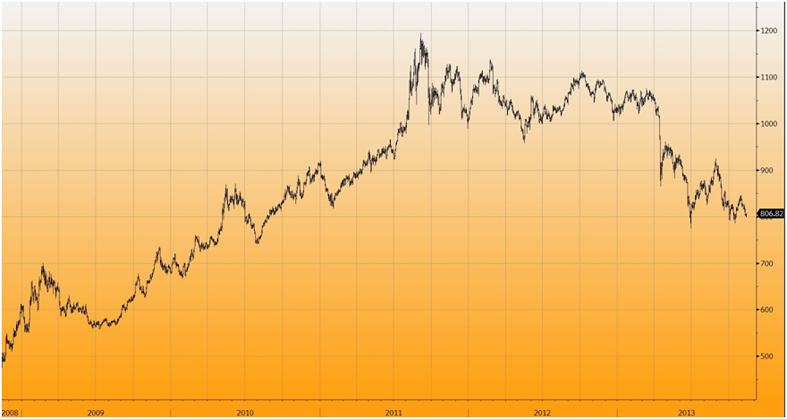
Gold in British Pounds, 10 Year – (Bloomberg)
SIPPs or Self-Invested Personal Pensions were launched by the UK government in 2006 in order to enable UK citizens to gain more control over their pension investment portfolio. The UK government also launched the Small Self-Administered Scheme known as a SSAS, an occupational pension scheme which is designed for up to 12 members.
From the perspective of the gold bullion industry this was welcome news, as the newly launched SIPP and SSAS permitted individuals or groups to invest in a range of approved types of gold bullion as part of their pension provision. To protect SIPPs and SSASs from inferior product, all gold must come in the form of ‘good delivery bars’ as per the London Bullion Market Association who maintains a list of approved bar manufactures such as the Perth Mint of Western Australia.
Gold bullion and pensions are a powerful combination. Pensions are extremely tax efficient investment structures that have been ignored by the general public for too long despite being very easy to set up. Gold is a form of financial insurance and essential diversification that empowers investors to hedge and therefore reduce the long term risks involved in all investment strategies.
Contributions into SIPPs and SSASs qualify for income tax relief up to the highest rate. Important to note that once invested in your SIPP or SSAS, all investments grow capital gains tax free and there is no further liability to income tax.
In times gone by it was common to stay in the one job with the same company for one’s entire working career. Today’s working environment is dramatically different and it is not uncommon for professionals to have more than one pension scheme which reflects their career to date; having worked in a variety of different positions with different companies, all who have different pension schemes.
The SIPP affords you the opportunity to consolidate your pension schemes into one scheme. As we have long advocated here at GoldCore, when taking advice on your financial affairs, particularly your pension, seek the advice of a fee based financial advisor.
Click Gold News For This Week’s Breaking Gold And Silver News
Click Gold and Silver Commentary For This Week’s Leading Gold And Silver Comment And Opinion
Like Our Facebook Page For Breaking News, Interesting Insights, Blogs, Prizes and Special Offers

1.3 Million Unemployed Americans may Lose Jobless Benefits by Year End. Mass layoffs expected in Chicago

More than 1.3 million unemployed Americans are set to lose their benefits with the looming expiry of federal jobless benefits.
The issue will be discussed in high-level budget talks on Capitol Hill, which are set to resume this week with a public hearing on Wednesday, the Financial Times reported.
Sandy Levin, the top Democrat on the House ways and means committee, said jobless benefit extension should be in these discussions.
“What we are doing is sounding the alarm clearly. When people realize what’s at stake, the need will carry the day,” Levin said.
Mass layoffs expected in Chicago
Chicago will lose more than 5,600 jobs by the end of the year as grocery giant Safeway has announced that it is exiting the city’s market, a report said on Monday.
DB

The Fed Has Juiced the System in 55.5 of the Last 60 Months

 
The markets have been extremely quiet the last few days. With the exception of the hard selling that occurred on Thursday it’s been a snooze fest.
The reason for this is that no one wants to commit heavily to a position at the moment. We’re all well aware of the negatives the market is facing, namely declining earnings, a weakening economy, the decreasingly marginal effect of Fed intervention, etc.
However, no one wants to commit heavily to shorting the markets because they’re all too afraid that the Fed or “someone” will step in to prop up the markets should any significant drop occur.
This has happened repeatedly in the last year: every time the market began to crumble and take out support, “someone” stepped in a started buying. And soon stocks were back off to the races.
At this point we all know that the “someone” is the Fed. Numerous Fed officials have pointed to the rising stock market as a sign that Fed intervention has been “successful.”
Moreover, the Fed has barely left the markets alone since 2008.
If you go back to the first announcement of QE 1 in November 2008, there have only been two periods in which the Fed wasn’t engaging in direct monetary interventions its balance sheet between the end of QE 1 and the launch of QE 2 (June 2010-November 2010) and from the end of QE 2 until the launch of Operation Twist (June 2011-September 2011).
A total of 60 months have passed since the Fed announced QE 1. The Fed was not engaged in major monetary interventions in only six months out of these 60. Put another way, the Fed has been actively intervening to the tune of billions of dollars in 90% of ALL months since it began QE 1.
Even during the brief periods in which the Fed wasn’t officially engaging in a major monetary program, it still routinely expanded its balance sheet during options expiration week every month.
If you remove those weeks from the periods in which the Fed wasn’t officially engaging in a program, you’re left with a total of just 4.5 months in which the Fed wasn’t actively pumping the markets.
That’s 4.5 months out of 60, or less than 8%.
However, this is not to say that this Fed intervention is not creating tremendous opportunities for stock pickers. After all with the Fed juicing stocks to this degree, there is no shortage of mis-pricings in high quality companies.

For more market insights and commentary, visit us at:
Best Regards
Graham Summers