Tuesday, September 3, 2013

San Bernardino Becomes 3rd California City to Get Bankruptcy Protection

E Street in San Bernardino, Calif.
AP/Grant Hindsley
San Bernardino on Wednesday became the third California city in recent years to be awarded bankruptcy protection by a judge.


San Bernardino on Wednesday became the third California city in recent years to be awarded bankruptcy protection by a judge, setting the stage for a battle between the Southern California city's creditors and its retirees -- a fight that could provide a playbook for other cities facing similar financial burdens.
San Bernardino follows Vallejo, which was awarded Chapter 9 protection in 2008, and Stockton, which was granted protection in April of this year. (Mammoth Lakes, a California resort town, filed for bankruptcy in 2012, but won dismissal of its case after settling the $43 million development lawsuit that initially forced the city to seek protection from its creditors.)
The California Public Employees' Retirement System (CalPERS) remains the lone objector to San Bernardino's Chapter 9 claim -- the local union withdrew its objection last month after the city dropped its effort to reject collective bargaining agreements. As the nation's largest retirement system, the $260 billion CALPERS fund presents a formidable opponent. Vallejo did not attempt to reduce its pension obligations when it declared bankruptcy, a decision many believe was made to avoid a fight with CalPERS.
In her ruling, Judge Meredith Jury said it had been obvious for months that the city's finances were beyond rescue. "I don't think anyone in this courtroom seriously thought the city was anything but insolvent," she said, according to news accounts.
Want more finance news? Click here.
San Bernardino, a city of 240,000 that is located one hour east of Los Angeles, has already gone where no city has gone before when it temporarily suspended its payments to CalPERS after declaring bankruptcy Aug. 1, 2012. It resumed payments this year, but the city's unfunded pension liability of about $143 million and the $50.4 million in bonds it issued in 2005 to help cover pension obligations and defaulted on, remain looming financial burdens. In its objection, CalPERS claimed that San Bernardino did not qualify for bankruptcy status largely because it ignored years of warnings about a looming financial crisis and was filing for Chapter 9 protection merely out of convenience.
Many observers believe that Wednesday's ruling is an important test for the federal law used by Detroit and other cities with overwhelming pension payment costs. Detroit Emergency Manager Kevyn Orr has called for cuts to current and future pension benefits in any bankruptcy plan it puts forth, should it win Chapter 9 status. (Detroit filed for bankruptcy on July 18, becoming the largest U.S. city to do so.) Labor unions are fighting the bankruptcy on the claim that workers' benefits are protected by Michigan's state constitution.
Pension liabilities are also an issue in Stockton's bankruptcy, which was given the green light by a judge in April to begin forming its restructuring plan. Stockton's Chapter 9 status was being challenged by its bond insurer, Assured Guaranty, which argued that the city of 300,000 did not attempt to renegotiate its pension debt with CalPERS and therefore did not exhaust all possible outlets before filing for Chapter 9.
By approving Stockton's bankruptcy protection, the judge essentially kicked that question to the restructuring hearings where Assured Guaranty is expected to continue challenging the notion that CalPERS is exempt from being treated like any other creditor.
Some court watchers say that the issues present in San Bernardino and Stockton could eventually lead to a U.S. Supreme Court decision on how bankrupt cities deal with their pension liabilities.

South African Gold Mining Strikes As Peak Gold Production Collapse Continues

by GoldCore
Today’s AM fix was USD 1,391.25, EUR 1,052.46 and GBP 893.14 per ounce.
Friday’s AM fix was USD 1,392.75, EUR 1,051.85 and GBP 899.19 per ounce.
Gold fell $12.80 or 0.91% Friday, closing at $1,394.30/oz. Silver fell $0.42 or 1.76%, closing at $23.43. Platinum rose $3.04 or 0.2% to $1,516.74/oz, while palladium was down $14.76 or 2% to $719.22/oz.

Gold in USD, 3 Day – (GoldCore)

For the week, gold and silver were both down 0.14% and 2.29% respectively.
Gold prices rallied $83.10, or 6.3%, in August. Silver surged 19.5% over the month.
Gold futures rose momentarily on the open in Asia prior to being hammered lower. Gold rose from Friday’s close at $1,395.05 to $1,397.20/oz prior to a wave of selling that sent gold plummeting.
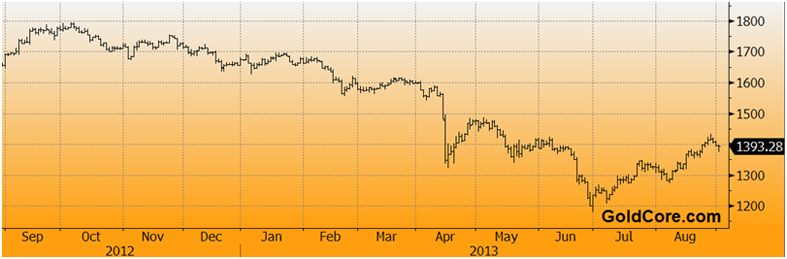
Gold fell for December delivery declined as much as 1.4% to 276.2 yuan/gram on the Shanghai Futures Exchange. Gold fell by more than $20 to $1,373.40/oz prior to a quick recovery in volatile trade (see chart). Silver saw similar trading action but has recovered all the initial losses and surged over 2.7% which bodes well for trading today.
The less imminent risk of a war with Syria has increased risk appetite and led to higher stock markets and some profit taking and selling by speculators with a focus on the short term.
Banks, hedge funds and other large speculators increased their net-long position in New York gold futures in the week ended August 27, according to U.S. Commodity Futures Trading Commission (CFTC) data.
Speculative long positions, or bets prices will rise, outnumbered short positions by 78,289 contracts on the Comex. Net-long positions rose by 17,893 contracts, or 30%, from a week earlier.
Miners, producers, jewelers and other commercial users were net short 87,638 contracts, an increase of 19,973 contracts, or 30%, from the previous week.
In silver futures, net long positions decreased last week according to the CFTC data.
Speculative long positions, or bets prices will rise, outnumbered short positions by 16,380 contracts on the Comex.  Net-long positions fell by 2,128 contracts, or 11%, from a week earlier.
Miners, producers, jewelers and other commercial users were net short 24,374 contracts, an increase of 1,100 contracts, or 5%, from the previous week.

Gold in USD, 1 Year – (GoldCore)

South Africa’s National Union of Mineworkers, which represents about two thirds of gold miners in the country, will start a strike over pay from tomorrow.
South African gold mining companies are liaising with police regarding the strikes which are set to start tomorrow.  The miners are liaising with police “on the highest level” to maintain peace, Charmane Russell, external spokeswoman for Chamber of Mines at Russell & Associates, told Bloomberg by phone.
There are concerns of unrest after the Marikana platinum massacre last year, when dozens of miners were shot dead by South African police in the worst mining violence in decades.
South Africa was throughout the 20th century and as recently as 1996, the world’s largest gold producer at almost  17 million ounces. South Africa has in recent years become less important to the  global gold industry. However, should supplies be further hampered it may impact the already, very tight physical gold market.

South African Journal of Science


South Africa now ranks sixth in gold production year to date, on a pace of  just more than 5 million  ounces of annual production,  just ahead of Papua New Guinea and behind China, Australia, United States, Russia and Peru.
South Africa produced over 1,000 tonnes of gold in 1970 but production has fallen an incredibly 75% , to below 250 tonnes in recent years (see chart above). This collapse sees gold production at levels last seen in 1922. This has happened despite the massive technological advances of recent years, more intensive mining practices and a far greater availability of capital.
Recently, the decline in South African gold production has been attributed to national electrical issues and power outages, operational delays, safety issues and industrial unrest. However, the scale of decline at a time when there has not been a corresponding decline in base metals mined in South Africa suggests that geological constraints may be leading to lower production of gold and other precious metals.
Other large gold producing nations are also seeing declines (see table below).
Peak oil is a phenomenon many will be aware of – peak gold remains a foreign concept to most.
Peak gold is the date at which the maximum rate of global gold extraction is reached, after which the rate of global production enters terminal decline. The term derives from the Hubbert peak of a resource.

Global Gold Production – (Bloomberg)

The geological evidence suggests that we may be close to peak gold. It is signalled in the fact that most of the larger gold producing countries (such as Australia, the U.S., South Africa, Canada, Peru, Indonesia) have all seen production drops in recent years. China and Russia are the two only large producers to have seen production increases.
Peak gold has yet to be considered and analysed by the international financial and investment community but there is a risk that it has happened or will happen soon with a consequent impact on the gold mining industry and on gold prices in the 21st Century.

“Labor Day” should be renamed “Corporation Day” or “War Day”

Labor’s Demise As A Countervailing Power
Dr. Paul Craig Roberts
Infowars.com
Sunday, September 4, 2011

 
It is Labor Day weekend, 2011, but labor has nothing to celebrate. The jobs that once gave American workers a stake in capitalism have left and gone away. Corporations in pursuit of near-term profits have moved labor’s jobs to China, India, Indonesia, Taiwan, South Korea and Eastern Europe.
Labor arbitrage, that is, the substitution of foreign labor that is paid less than its productivity for American labor, has enriched Wall Street, shareholders and corporate CEOs, but it has devastated American employment, household incomes, tax base, and the outlook for the US economy.
This Labor Day week-end’s job report, announced by the Bureau of Labor Statistics (BLS) on Friday, September 2, says zero net new jobs were created in August, a number 250,000 less than the amount of monthly job creation necessary to make progress in reducing America’s high rate of unemployment.
The zero figure is actually an optimistic number. As John Williams (shadowstats.com) has made clear, problems with the BLS’s seasonal adjustments and “birth-death” model during the prolonged downturn that began in December 2007 result in the BLS over-estimating new jobs and underestimating lost jobs.
Seasonal adjustments and the “birth-death” model were designed with a growing economy in mind and result in miscounts during downturns. For example, the “birth-death” model estimates new jobs that are created from new start-up companies that are not yet reporting, and it estimates the job losses from companies that have gone out of business. In a growing economy, start-ups exceed jobs losses, but the situation reverses during downturns or during periods of sub-normal job growth. For the past forty-four months, the “birth-death” model has overestimated the number of new jobs created. When the annual revisions are made to the job reports, the excess jobs are taken out, but it is seldom headline news.
The reason that nearly four years of economic stimulus, consisting of large federal budget deficits and near zero interest rates, hasn’t revived the economy is that the jobs that Americans once had have been moved offshore. Stimulus cannot put Americans back to work in jobs that have been given to foreign countries.
Post-World War II Keynesian economists, such as Paul Krugman and Robert Reich, think that if the federal government would add more stimulus by enlarging the already massive federal deficit, new jobs would somehow be created to take the place of those that have left. This is a delusion. Not only have the supply chains necessary to support US economic activity been disrupted and broken by offshoring, but also the same incentive–excess supplies of foreign labor that produces more value than it is paid–that sent jobs abroad is still operative.
In a word, the US economy has been de-industrializing, moving from a developed to an underdeveloped economy, for the past two decades. It has been the case for many years that when the US economy manages to eke out new jobs, they are in non-tradable domestic services, such as health care and social assistance, waitresses and bar tenders, retail clerks. Non-tradable employment consists of jobs that do not produce goods and services that could be exported to reduce the large US trade deficit.
The long-term deterioration in the US economy has been covered up by “reforming” the official measures of unemployment and inflation. The U3 measure of unemployment, the current 9.1% unemployment rate, only measures unemployment among those who are actively seeking a job. Those who have become discouraged by the inability to find a job and have ceased looking are not counted as being among the unemployed, and the U3 measure makes no adjustment for those who are forced into part-time jobs because there is no full-time employment.
The government knows that the U3 “headline” unemployment rate is seriously understated and provides a broader measure known as U6. This measure, which is seldom reported by the financial media, includes short-term discouraged workers (those who have not looked for jobs for six months or less) and an adjustment for those who wish full time employment but can only find part time work. Currently, this measure of unemployment stands at 16.2%.

In 1994 the Clinton “progressive” administration defined long-term discouraged workers out of existence. Consequently, no official unemployment rate includes long-term (more than six months) discouraged workers as unemployed. John Williams estimates this number and adds it to the U6 measure to produce a current rate of US unemployment of 22.7%, an unemployment rate 2.5 times higher than the official rate.
Similar understatement exists in the measure of inflation known as the Consumer Price Index. In order to reduce cost-of-living adjustments to Social Security checks and to hold down other inflation adjustments, the “progressive” Clinton administration accepted the Boskin Commission’s recommendation to introduce substitution into what had been a fixed, weighted, basket of goods used to measure the cost of a constant standard of living. In the new “reformed” measure, if the price of an item increases, say New York strip steak, the index assumes that consumers switch to a less expensive cut, such as round steak. Thus, the price increase doesn’t show up in the CPI.
Consumers, or a number of them, do tend to behave in this way. However, since the basket of goods comprising the CPI is no longer constant, but changes with price changes, the CPI has become a variable measure of the cost of living that reduces the inflation rate by measuring a lower standard of living.
John Williams estimates the CPI according to the previous official methodology that used a fixed basket of goods. He finds the rate of inflation to be much higher than is reported by the substitution-based methodology. http://www.shadowstats.com/alternate_data/inflation-charts
The understatement of inflation serves to boost real Gross Domestic Product growth. In order to compare how much larger (or smaller) the economy is this year compared to last year, the GDP figure has to be adjusted for inflation. If the economy grew 5% in nominal terms and inflation was 3%, then GDP grew 2% in real terms, that is, real goods and services, as opposed to mere price rises, increased 2% over the year.
When John Williams adjusts US GDP with the former or traditional measure of inflation, he finds that there has been no growth in real GDP for several years. In other words, during the period of “economic recovery” the economy has actually been declining.
American economic decline began with offshoring during the Clinton administration. Instead of addressing this threat, the Clinton administration launched the neoconservative program of American Empire with American and NATO naked aggression against Serbia, sending the Serbian leader off to be tried as a war criminal for resisting the dissolution of his country.
The Bush/Cheney regime elevated the pursuit of American Empire under cover of “the war on terror.” Based entirely on lies and falsified intelligence, Bush/Cheney launched wars against the Taliban, who were unifying Afghanistan, and against Saddam Hussein in Iraq.
In the 1980s Hussein was used by Washington to launch a war against the revolutionary government in Iran that had overthrown the American puppet government, headed by the Shah of Iran. Ever since Washington lost its puppet rule over the Iranians, Washington has refused diplomatic relations with Iran. In the place of diplomatic relations, Washington demonizes Iran in order to set the country up for another attack a la Serbia, Afghanistan, Iraq, Libya, Somalia, Pakistan, and Yemen. Syria is next.
Saddam Hussein’s service to Washington was overlooked when it became more important to eliminate support for Hamas and Hezbollah, two barriers to Israel’s expansion in the Middle East, than to maintain Washington’s gratitude to an Iraqi pawn.
Despite unequivocal reports from arms inspectors that Iraq had no weapons of mass destruction and most certainly had nothing whatsoever to do with 9/11, top Bush/Cheney regime officials demonized Iraq as the greatest threat to America. The imagery of mushroom clouds from nuclear weapons was evoked, A war was launched entirely on false pretexts that destroyed a country and left over one million Iraqis dead and four million displaced. What Washington did to Iraq is what the Nazis were tried and executed for at the Nuremberg Trials.
Obama was elected in order to stop the illegal and senseless wars. Instead, Obama both continued the wars in Iraq and Afghanistan and expanded the wars into Libya, Pakistan, and Yemen. Since the deregulation of the financial system under the Bush/Cheney regime and the “war on terror,” the entire economy of the US has been sacrificed for the benefit of the financial sector and the military/security complex.
Labor Day is an anachronism. It should be renamed Corporation Day or War Day to celebrate the success of Bush/Obama in eliminating labor unions as a countervailing power to corporate power and the elevation of War as the highest goal of the American state.
Dr. Paul Craig Roberts is the father of Reaganomics and the former head of policy at the Department of Treasury. He is a columnist and was previously an editor for the Wall Street Journal. His latest book, “How the Economy Was Lost: The War of the Worlds,” details why America is disintegrating.

Derivatives: The Unregulated Global Casino for Banks

SHORT STORY: Pick something of value, make bets on the future value of "something", add contract & you have a derivative.
Banks make massive profits on derivatives, and when the bubble bursts chances are the tax payer will end up with the bill.
This visualizes the total coverage for derivatives (notional). Similar to insurance company's total coverage for all cars.
LONG STORY: A derivative is a legal bet (contract) that derives its value from another asset, such as the future or current value of oil, government bonds or anything else. Ex- A derivative buys you the option (but not obligation) to buy oil in 6 months for today's price/any agreed price, hoping that oil will cost more in future. (I'll bet you it'll cost more in 6 months). Derivative can also be used as insurance, betting that a loan will or won't default before a given date. So its a big betting system, like a Casino, but instead of betting on cards and roulette, you bet on future values and performance of practically anything that holds value. The system is not regulated what-so-ever, and you can buy a derivative on an existing derivative.
Most large banks try to prevent smaller investors from gaining access to the derivative market on the basis of there being too much risk. Deriv. market has blown a galactic bubble, just like the real estate bubble or stock market bubble (that's going on right now). Since there is literally no economist in the world that knows exactly how the derivative money flows or how the system works, while derivatives are traded in microseconds by computers, we really don't know what will trigger the crash, or when it will happen, but considering the global financial crisis this system is in for tough times, that will be catastrophic for the world financial system since the 9 largest banks shown below hold a total of $228.72 trillion in Derivatives - Approximately 3 times the entire world economy. No government in world has money for this bailout. Lets take a look at what banks have the biggest Derivative Exposures and what scandals they've been lately involved in. Derivative Data Source: ZeroHedge.

One Hundred Dollars
$100 - Most counterfeited money denomination in the world.
Keeps the world moving.
Ten Thousand Dollars
$10,000 - Enough for a great vacation or to buy a used car.
Approximately one year of work for the average human on earth.
100 Million Dollars
$100,000,000 - Plenty to go around for
everyone. Fits nicely on an ISO / Military
standard sized pallet.

$1 Million is the cash square on the floor.
1 Billion Dollars
$1,000,000,000 - This is how a billion dollars looks like.
10 pallets of $100 bills.
1 Trillion Dollars
$1,000,000,000,000 - When they throw around the word "Trillion" like it is nothing, this is the reality of $1 trillion dollars. The square of pallets to the right is $10 billion dollars. 100x that and you have the tower of $1 trillion that is 465 feet tall (142 meters).

1 Million, 100 Million, 1 Billion, 1 Trillion
$2 Billion on Truck

$100 Million Dollars = 1 year of work for 3500 average Americans
It takes 3500 Americans 1 year of work to make $100 Million dollars. The 155 million Americans who worked with earnings in 2005 on average made $28,567 / year.

In front of the 3500 people is the $100 Million pallet that they all have to work for 1 year to earn.
Look carefully to see a stack of $1 Million and the 35 average Americans required to earn that $1 Million in 1 year.


Demonocracy.info - $100,000,000 - One Hundred Million Dollars
Bank of New York Mellon
BNY has a derivative exposure of $1.375 Trillion dollars.
Considered a too big to fail (TBTF) bank. It is currently facing (among others) lawsuits fraud and contract breach suits by a Los Angeles pension fund and New York pension funds, where BNY Mellon allegedly overcharged the funds on many millions of dollars and concealed it.

Bank of New York Mellon - Derivative Exposure
State Street Financial
State Street has a derivative exposure of $1.390 Trillion dollars.
Too big to fail (TBTF) bank. It has been charged by California Attorney General (among other) lawsuits for massive fraud on California's CalPERS and CalSTRS pension funds - similar to BNY (above).

Bank of New York Mellon - Derivative Exposure
Morgan Stanley
Morgan Stanley has a derivative exposure of $1.722 Trilion dollars.
Its a too big to fail (TBTF) bank. It recently settled a lawsuit for over-paying its employees while accepting the
tax payer funded bailout. Vice Chairman of Morgan Stanley had a license plate that said "2BG2FAIL" on his Porsche Cayenne Turbo. All this while $250 million of bailout money ended up in the hands of Waterfall TALF Opportunity, run by the Morgan Stanley's owners' wives-- Marry a banker for a $250M tax-payer cash injection.
The bank also got a SECRET $2.041 Trillion bailout from the Federal Reserve during the crisis, beyond the tax payer bailout.

Bank of New York Mellon - Derivative Exposure
Wells Fargo
Wells Fargo has a derivative exposure of $3.332 Trillion dollars.
Its a too big to fail (TBTF) bank. WF has been charged for its role in allegedly pursuing illegal foreclosures and deceptive loan servicing. Wells Fargo was just slapped with a $85 million fine by Federal Reserve for putting good credit borrowers into bad-credit rating (high rate) loans.
In March 2010, Wachovia (owned by Wells Fargo) paid $110 million fine for allowing transactions connected to drug ... and a $50 million fine for failing to monitor cash used to ship 22 tons of cocaine. It also failed to monitor $378.4 billion (that's $378400 millions dollars) worth of transactions to Mexican "casas de cambio" (think WesternUnion, anonymous cash transfer) usually linked to drug cartels. Beyond that, WF lets its' VIP employees live in foreclosed mansions. WF knows how to cash your legit check, then claim "fraud" and close your account. WF also re-orders your transactions to create more overdraft fees. Wells Fargo's Wachovia also got a SECRET $159 billion bailout from the Federal Reserve.

Wells Fargo paid NO taxes in 2008-2010 and had a tax rate of NEGATIVE 1.4% while making
$49 billion in profit during the same time.

Bank of New York Mellon - Derivative Exposure
HSBC
HSBC has a derivative exposure of $4.321 Trilion dollars.
HSBC is a Hong Kong based bank and its original name is
The Hongkong and Shanghai Banking Corporation Limited.

You will find HSBC working a lot with JP Morgan Chase.
Both HSBC and JP Morgan Chase have strong interest in gold & precious metals. HSBC and JP Morgan Chase are often involved together in financial scandals.
Lately HSBC has been sued for allegedly funneling more than $8.9 billion to the largest ponzi-scheme in his... - Bernie Maddof's investment business.
HSBC (along w/ JP Morgan Chase) has been sued for alleged conspiracy suppressing the price of silver and gold, partially through precious metal DERIVATIVES and making billions of dollars on it. State of Hawaii is suing HSBC (and other banks) for deceptive credit card lending practices.
DZ Bank in Germany is suing HSBC (and JP Morgan) for deceptive (lying) practices when selling home-loan-backed securities.
HSBC is also under investigation for laundering billions of dollars.

Bank of New York Mellon - Derivative Exposure
Goldman Sachs
Goldman Sachs has a derivative exposure of $44.192 Trillion dollars.
The $1 Trillion pillars towers are double-stacked @ 930 feet (248 m).
The White House is standing next to the Statue of Liberty.

Goldman Sachs has advantage over other banks because it has awesome
connections in US Government. A lot of former Goldman employees hold high-level
US Government positions (chart)
.

Mitt Romney's top donor is Goldman Sachs, and one of Obama's best donors.
Ex-CEO of Goldman Sachs, Hank Paulson became the Secretary of Treasury under Bush and
during the 2008 financial crisis authored the TARP bill demanding $700 billion bail-out.
In UK, Goldman Sachs escaped £10 million bill on a failed tax avoidance scheme with help of good connections.
The bank is the largest player in the food commodities market, earned $955m from food speculation in 2009" - That's your $$$.
Goldman Sachs employees are arming themselves with guns in case there is a populist uprising against the bank.
Goldman Sachs calls their investors "muppets". and use clients to make money for themselves, disregarding the clients.
The bank was fined $22 million for sharing valuable nonpublic information with top clients (Think insider trading with best clients).
Goldman Sachs was part-owner America's leading website for prostitution ads until the ownership stake was exposed.
Goldman Sachs helped Greece conceal its debt with secret loans, while simultaneously taking advantage of Greece.
Goldman Sachs got a $814 billion SECRET bailout from the Federal Reserve during the 2008 crisis.
Goldman Sachs got $10 billion of the 2008 TARP bailout, and in the same year paid $10.9 billion in employee compensation and "benefits", while paying a tax rate of 1%. That means an average of $327,000 to each Goldman Sach's employee.

Bank of New York Mellon - Derivative Exposure
Bank of America
Bank of America has a derivative exposure of $50.135 Trillion dollars.

BofA is sticking the tax-payers with a MASSIVE bill, by moving derivatives to
accounts insured by the federal government @ total of $53.7 trillion as of 06/2011.
During 2011-12 BofA has been in need of cash, so Warren Buffett gave BofA $5 billion.
Same year BofA sold its stake in China Construction Bank to raise $1.8 billion in cash.


Bank of America paid $22 million to settle charges of improperly foreclosing on active-duty troops
BofA recruited 3 cyber attack firms to attack WikiLeaks. but the Anonymous hacker group hacked the security firms first.
BofA was sued for $31 billion in home-loan losses in 2011, the bank is involved in many lawsuits, too many to document.
BofA also received a SECRET $1.344 trillion dollar bailout from the Federal Reserve.

Bank of New York Mellon - Derivative Exposure
Citibank
Citibank has a derivative exposure of $52.102 Trillion dollars.
The $1 Trillion dollar towers are double-stacked @ 930 feet (248 m).

Citibank customers have been arrested for trying to close their accounts, while in in Indonesia a man was interrogated to death in Citibank's special "questioning room". In 2011 Citibank paid a fine of $285 million for selling home-loan backed bonds to investors, while betting they would lose value (think derivatives/insurance). The man in charge of the unit at Citibank became Obama's Chief of Staff. 2 weeks before getting hired by Obama he got $900,000 from Citibank for great performance. This was after Citigroup took out $45 billion in bailout money.
Citibank knowingly passed over bad loans to the Federal Housing Administration to insure.

Citigroup also received a SECRET $2.513 trillion dollar bailout from the Federal Reserve.

Bank of New York Mellon - Derivative Exposure
JP Morgan Chase (JPM)
JP Morgan Chase has a derivative exposure of $70.151 Trillion dollars.
$70 Trillion is roughly the size of the entire world's economy.
The $1 Trillion dollar towers are double-stacked @ 930 feet (248 m).


JP Morgan is rumored to hold 50->80% of the copper market, and manipulated the market by massive purchases. JP Morgan (JPM) is also guilty of manipulating the silver market to make billions. In 2010 JP Morgan had 3 perfect trading quarters and only lost money on 8 days. Lawsuits on home foreclosures have been filed against JP Morgan. Aluminum price is manipulated by JP Morgan through large physical ownership of material and creating bottlenecks during transport. JP Morgan was among the banks involved in the seizure of $620 million in assets for alleged fraud linked to derivatives. JP Morgan got $25 billion taxpayer in bailout money. It has no intention of using the money to lend to customers, but instead will use it to drive out competition. The bank is also the largest owner of BP - the oil spill company. During the oil spill the bank said that the oil spill is good for the economy.
JP Morgan Chase also received a SECRET $391 billion dollar bailout from the Federal Reserve.
In 2012, JP Morgan (JPM) took a $2 billion loss on "Poorly Executed" Derivative Bets.

Bank of New York Mellon - Derivative Exposure
9 Biggest Banks' Derivative Exposure - $228.72 Trillion
Note the little man standing in front of white house. The little worm next to lastfootball field is a truck with $2 billion dollars.
There is no government in the world that has this kind of money. This is roughly 3 times the entire world economy. The unregulated market presents a massive financial risk. The corruption and immorality of the banks makes the situation worse.
Bank of New York Mellon - Derivative Exposure

If you don't want to bank with these banks, but want to have access to free ATM's anywhere-- most Credit Unions in USA are in the CO-OP ATM network, where all ATM's are free to any COOP CU member and most support depositing checks. The Credit Unions are like banks, but invest all their profits to give members lower rates and better service. They don't have shareholders to worry about or have derivatives to purchase and sell.

Keep an eye out in the news for "derivative crisis", as the crisis is inevitable with current falling value of most real assets.
Derivative Data Source: ZeroHedge

Monday, September 2, 2013

China data lifts Asian shares, Aussie dollar; yen retreats

By Dominic Lau
TOKYO (Reuters) - Asian shares climbed to a two-week high on Monday, and the Australian dollar and copper gained, as China said its manufacturing expanded in August at the fastest pace in more than a year.
A delay in potential U.S. military action against Syria, as U.S. President Barack Obama sought Congressional support, also helped boost short-term risk appetite.
China's bullish purchasing managers' index added to recent positive data from the U.S. and Europe, raising hopes the global economy was on a firmer footing.
European shares were expected to open firmer, with Britain's FTSE 100 (.FTSE) seen up as much as 0.7 percent and Germany's DAX (.GDAXI) up as much as 0.9 percent, according to financial spreadbetters.
MSCI's broadest index of Asia-Pacific shares outside Japan <.miapj0000pus> advanced 1 percent, hitting a two-week high and extending a 2.1 percent rise in the previous two sessions, and Tokyo's Nikkei (NIK:^9452) gained 1.4 percent in light trade. U.S. markets are closed for the Labor Day holiday.
Hong Kong's Hang Seng Index (.HSI) climbed 1.8 percent and China's CSI300 index <.csi300> was up 0.5 percent.
Steven Englander, Citi's global head of G10 FX strategy, recommended investors short the yen on the back of the Chinese figures, the Syrian news, and a panel supporting an increase in Japan's sales tax.
China's official purchasing managers' index (PMI) rose to the highest level since last April and topped market expectations.
"This will reinforce views of China stabilization. It is a risk positive, if only because it removes some of the short-term risk that the China slowdown could spiral further downwards," Citi's Englander wrote in a note.
A separate manufacturing PMI report from HSBC, released on Monday, showed activity in privately owned factories increased over August for the first time in four months.
But India's manufacturing PMI, also from HSBC, shrank in August for the first time in more than four years, adding to the country's deepening economic malaise as the central bank struggles to defend the battered rupee currency.
The Indian rupee edged down 0.3 percent to 65.90 to the dollar after two days of gains, and was not far from a record low of 68.80 per dollar hit last week.
Indonesia's rupiah, which has also been under pressure lately, was down 0.2 percent after the country logged a wider-than-expected trade deficit.
YEN OFF
The yen had risen recently on heightened geopolitical tensions and as investors dumped emerging market currencies to position themselves for the U.S. Federal Reserve to begin reducing stimulus, perhaps from its meeting later this month.
"I think the delay in the potential military strikes against Syria will help the global environment in terms of risk," said Mitul Kotecha, head of global foreign exchange strategy for Credit Agricole in Hong Kong.
On Monday, the yen slipped 0.5 percent to 98.62 yen to the dollar, pulling well away from last week's low of 96.81, and eased 0.3 percent to 130.21 to the euro.
The Australian dollar, which is seen as a proxy for Chinese growth because of the two countries' close trade ties, rose 0.7 percent to $0.8966.
Against a basket of major currencies, the U.S. dollar (.DXY) held steady at a four-week high.
Buoyed by the factory activity data from top-consumer China, copper prices rose 2.2 percent and were on track to end a four-day losing run.
Oil and gold prices fell as investors unwound their positions after the U.S. postponed a military strike against the Syrian government, which is accused of using chemical weapons against civilians.
Brent crude prices dropped 1.1 percent to below $113 a barrel, on track for a third day of declines. They touched a six-month peak of $117.34 last week on concerns that U.S. military intervention could lead to retaliation and disrupt crude supply in the Middle East region, which pumps a third of the world's oil.
Safe-haven gold dipped 0.3 percent to around $1,391 an ounce after falling as low as $1,379.44, a one-week trough, earlier in the session.
(Additional reporting by Ian Chua in Sydney and Masayuki Kitano in Singapore; Editing by Shri Navaratnam, Eric Meijer and Chris Gallagher)

BOJ to hold policy, debate emerging market risks

By Leika Kihara
TOKYO (Reuters) - The Bank of Japan may hold off on declaring the world's third-largest economy has cemented its recovery at a policy review this week as it waits to see the fallout on activity from slowing growth and capital outflows in emerging nations.
No change is expected in the massive monetary stimulus that the BOJ launched in April, which will see it nearly double the monetary base to 270 trillion yen ($2.75 trillion) by the end of 2014 to achieve its 2 percent inflation target.
Increasingly bright economic signs at home have been overshadowed by geopolitical risks in Syria and sharp outflows of capital from some emerging markets on expectations the U.S. Federal Reserve will soon start trimming its monetary stimulus.
The central bank is thus expected to maintain its view the economy is "starting to recover moderately," instead of offering a more upbeat assessment declaring that the recovery has already taken hold, according to sources familiar with its thinking.
The two-day board meeting will start on Wednesday.
"The global economic recovery remains fragile, so there's huge uncertainty on how a sharp outflow of funds could affect financial markets and global growth," BOJ board member Yoshihisa Morimoto said last week on the risk of a bigger capital withdrawal from emerging economies.
The Indian rupee and Turkish lira have hit record lows against the dollar, the Indonesian rupiah has fallen to four-year lows, and other currencies have tumbled as investor sentiment has soured on emerging markets.
Exacerbating the move has been a rush to safe-haven currencies, such as the yen, as investors worry about the risk of United States launching air strikes on Syria.
CAPEX PICK-UP EYED
Japan emerged from recession in 2012 and data for much of this year has shown the benefits of Prime Minister Shinzo Abe's reflationary policies and the BOJ's aggressive stimulus.
Recent data have been particularly encouraging for the BOJ's battle to end 15 years of grinding deflation.
The jobless rate is at the lowest in almost five years, consumer spending has been strong and core consumer prices rose at the fastest pace in nearly five years.
But many BOJ officials want to see clearer signs of increase in wages and capital expenditure before declaring that a sustained recovery has taken hold.
Corporate capital spending was steady in April-June from a year earlier after two straight quarters of declines, Ministry of Finance data (MOF) showed on Monday.
The data also showed companies' recurring profits rose 24 percent in the second quarter from a year earlier, boding well for the outlook of capital spending.
"This is a pretty strong reading. Companies reaping big profits would surely be more willing to spend on plant and equipment," said Yoshiki Shinke, chief economist at Dai-ichi Life Research Institute in Tokyo.
The MOF data will be used to calculate revised April-June gross domestic product (GDP) data, due on September 9, which the government has said would be among key factors in deciding whether to proceed with a planned sales tax hike from next year.
Many analysts expect second-quarter GDP growth to be revised up from a preliminary annualized rate of 2.6 percent, which may strengthen the case for Abe to go ahead with the tax hike.
"The revised GDP data will confirm the view Japan's economy is clearly heading for a recovery," said Junichi Makino, chief economist at SMBC Nikko Securities in Tokyo.
"The economy is likely to remain firm in July-September, so the dominant market view is that the environment for raising the sales tax is in place," he said.
Unless Abe changes the plan, the sales tax will be raised to 8 percent from 5 percent in April and to 10 percent in October 2015. Critics have called for a delay or watering down the tax increases for fear of undermining the economy's recovery. Abe is expected to make a final decision by early October.
($1 = 98.1150 Japanese yen)
(Additional reporting by Tetsushi Kajimoto; Editing by John Mair)

China factory activity up for first time in sour months in August: survey

BEIJING (Reuters) - China's factory activity expanded for the first time in four months in August as domestic demand rebounded, a private survey showed on Monday, the latest sign that the world's second-largest economy may have avoided a sharp slowdown.
The final Markit/HSBC Purchasing Managers' Index (PMI) climbed to 50.1 in August, up sharply from July's 47.7 and in line with last week's flash preliminary reading.
The survey came a day after China's official manufacturing PMI showed factory activity expanded at the fastest pace in more than a year in August with a jump in new orders.
Economists cheered the upbeat data as a sign that China's economy, which has cooled in 12 of the last 14 quarters, is finally steadying.
"We are definitely stabilizing, but it's going to be a pretty weak to flat recovery," said Stephen Green, an economist at Standard Chartered.
Asian shares climbed to a two-week high and the Australian dollar and copper gained after the report. (MKTS/GLOB)
Modest growth in China's factories should still comfort financial markets, however, offering hope that a run of encouraging data in July was not a fluke.
The official PMI, which came in at 51.0 versus expectations for 50.6, is more weighted towards bigger and state-owned firms, which have easier access to credit and the scale to cope better with downturns than the smaller private firms that form the backbone of the Markit/HSBC survey.
As recently as a month ago, investors had worried that China's economy was slipping into a deeper-than-expected downturn, especially after its money market was hit by an unprecedented cash crunch in June.
But policymakers have stepped in with a series of measures aimed at stabilizing the economy, including quickening railway investment and public housing construction and introducing policies to help smaller companies with financing needs.
EXPORTS STILL WEAK
Senior officials have also been talking up the economy, saying there are clear signs of stabilization emerging and that the government's annual GDP target of 7.5 percent is achievable.
Data for July had showed a pickup in trade and industrial output, while foreign investment into China also quickened, adding to confidence in the economy.
"We expect some upside surprises to China's growth in the coming months," said Qu Hongbin, an HSBC economist, noting that factory activity had picked up on firms rebuilding their stocks and on recent steps taken by authorities to boost activity.
However, any expectations for a strong rebound may be misplaced. As a PMI reading above 50 indicates growth while one below 50 demarcates contraction, the latest Markit/HSBC data suggests August's expansion was only modest.
Indeed, the survey showed new export orders dipping from July to stay well below the 50-point threshold. New orders, which include domestic orders, showed marginal growth by rising to 50.8, albeit a four-month high.
HSBC said lethargic export sales remained an Achilles' heel for China, with factories citing weak U.S. and European demand behind last month's fall in overseas orders.
Other downside factors linger, too. For example, most Chinese firms still face relatively high financing costs, in part due to Beijing's campaign to curb shadow banking. A strong yuan currency is also dampening the trade picture.
Major Chinese retailers are also more downbeat that official figures might suggest.
A Reuters review of first-half earnings showed that more than 20 Chinese companies selling everything from footwear to food were not convinced the economic slowdown had bottomed out, and neither were their traditionally thrifty customers.
Also a concern is that average input costs rose in August for the first time since February on the back of higher raw material prices, HSBC said.
At the same time, slowing growth has put pressure on China's heavily indebted companies and provincial governments, raising concerns that the country's explosion in credit since 2008 could be on the verge of a meltdown.
(Reporting by Koh Gui Qing; Writing by Jonathan Standing; Editing by Kim Coghill)