Tuesday, August 20, 2013

Obama Destroys the Middle-Class

According to a survey conducted by Gallup on August 15, 2013, Obama’s Economic Approval rating has slipped to 35%. A full two-thirds of the American people are now dissatisfied with Obama’s performance vis a vis the economy. The survey mirrors the results of an earlier poll (Aug 12) which found that a mere “Twenty-two percent of Americans say they are satisfied with the direction of the country… Three-quarters of Americans are now dissatisfied with the nation’s course.” (Gallup)
The surveys show that people are finally beginning to realize that Obama has been an unmitigated disaster and that the propaganda about economic recovery is just meaningless hype. To underline how bad things really are, consider this:
“Over the last six months, of the net job creation, 97 percent of that is part-time work,” said Keith Hall, a senior researcher at George Mason University’s Mercatus Center quoted by McClatchy Washington Bureau. Hall was head of the US Bureau of Labor (BLS) Statistics from 2008 to 2012.
Citing the BLS Household Survey, Hall said that over the past six months 963,000 more people reported that they were employed while 936,000 of them reported they were in part-time jobs. Hall continued, “That is a really high number for a six-month period. I am not sure that has ever happened over six months before.” (“Report: 97 percent of new US jobs are part-time”, World Socialist Web Site)
The only jobs being created under Obama are low-paying service sector positions that don’t pay enough to meet the rent. Which is why a record number of young people are living at home. Have you seen this?
“Last year, a record 36 percent of people 18 to 31 years old — roughly the age range of the generation nicknamed the millennials — were living in their parents’ homes, according to a new Pew Research Center analysis of Census Bureau data. …And despite the frequent stories of recent college graduates stuck on their parents’ couches (or in their basements or above their garages), it is actually young people without bachelor’s degrees who are most likely to be living at home….” (“Millennials, in Their Parents’ Basements”, Catherine Rampell, New York Times)
Don’t kid yourself, it’s nearly as bad for college grads. The only difference is that after you’ve wracked up $40,000 or $50,000 in student loans, you can proudly display your sheepskin on the wall in your Dad’s attic where you spend your days combing the internet for jobs that no longer exist in the good old USA.
And another thing: The only reason unemployment has gone down at all is because so many people have stopped looking for work altogether and fallen off the radar. If the BLS counted these lost souls, we’d be looking at 11.2% unemployment instead of the bogus 7.4 percent figure. But who cares what the numbers are at this point. What matters is that the economy stinks, and the smiling idiot at the top deserves a lot of the credit for that.
Did you know that according to the National Institute on Retirement Security, 45 percent of working-age households have no retirement savings at all? On top of that, high unemployment and hard times have forced more and more people to dip into their 401Ks just to make ends meet, which means that things are worse than the numbers indicate. Has Obama made any effort to address the pension catastrophe facing baby boomers and Generation Xers in the years ahead?
Sure, he has. He appointed a commission of deficit hawks (Bowles-Simpson) to figure out clever ways to cheat people out of their Social Security. That’s why Obama’s approval rating is circling the plughole, because people are finally wising-up to what a phony he is. Check this out from Dean Baker:
“It is unfortunate that President Obama has proposed a budget that has substantial cuts to Social Security. The vast majority of seniors are already struggling. The proposed cuts would be a reduction in their income of more than 2 percent. By contrast, his tax increase last fall cut the after-tax income of the typical wealthy household by less than 0.6 percent…
President Obama has accepted the agenda of the Washington elite, putting cuts to Social Security and Medicare at the center of his budget and offering little that will help to speed the growth of the economy and create jobs.” (“Obama Accepts the Agenda of Misguided Washington Elites”, Dean Baker, CEPR)
Amen, to that, Dean. And have you noticed the strong growth surge under Obama?
No, of course not, because there hasn’t been one. The second quarter (Q2) GDP just clocked in at a miserable 1.7 percent, most of which was due to an unexpected uptick in inventories. Absent that, GDP would have been below 1 percent which would be an embarrassment for anyone except the narcissist in chief. Get a load of this from Nick Beams at the WSWS:
“Over the past three quarters the US economy has grown at an annualized rate of only 0.96 percent, exposing the claims of the Obama administration that a “recovery” is underway. The fact that the US economy is able to achieve a growth rate just one sixth of the post-World War II average indicates that deep structural changes have taken place within the American economy and anything approaching previous growth rates will not be seen again.” (“US growth and jobs figures point to continuing economic breakdown”, Nick Beams, World Socialist Web Site)
Astonishing! Under 1 percent GDP for the last three quarters. What a joke.
The reason the economy isn’t growing is because the people in charge don’t want it to grow. It’s that simple. I mean, how hard is it to boost GDP: You spend a little money, you run up the budget deficits and “Viola”, the economy grows! It ain’t rocket science. What Obama and his paymasters want, is a subtler form of “structural adjustment”. (Subtler than the Euro-model, that is.) This is typical of the Democrats; they’re always trying to prove they can implement the same hard-right policies with more finesse than their blundering counterparts. But it all amounts to the same thing, doesn’t it? Everyone knows that the middle class is getting clobbered while all the gravy is flowing to the parasites on top.
Here’s something else from Beams article concerning the “disconnect between the level of profits and the rate of investment”:
“While pre-tax corporate profits are at record highs, amounting to 12 percent of GDP, net investment is barely 4 percent of output…. Increased profits are not being used to expand production, as took place in the past, but are increasingly being used to finance stock buybacks, so as to increase the rate of return on shareholders’ capital…
This result indicates that rising profits are no longer being produced by an expansion of the market, as they were in the past, but are increasingly the result of cost-cutting, as firms raise their bottom line by grabbing an increased share of a stagnant or contracting market from their rivals. In other words, the once “normal” process of capitalist accumulation—increasing investment leading to an expanding market, higher profits and further investment—has completely broken down.” (“US growth and jobs figures point to continuing economic breakdown”, World Socialist Web Site)
This is more than a minor technicality. If corporate profits are being recycled into stock buybacks and dividends instead of capital improvements and investment, then Obama’s deficit cutting policies are actually squelching growth rather than fueling it. Now take a look at this from Media Matters:
“The Congressional Budget Office has estimated that the sequester “will halve U.S. growth in 2013.” MarketWatch explained:
“U.S. economic growth in 2013 will be 1.4%, the Congressional Budget Office estimated on Tuesday….. CBO said however that growth would be about 1.5 percentage points faster in 2013 if not for fiscal tightening including the so-called budget sequester.” (“WSJ Ignores Experts To Downplay Harmful Economic Consequences Of Sequester”, Media Matters)
Looks like the CBO nailed it, doesn’t it? After all, there’s only a small difference between 1.7 percent and the predicted 1.4 percent. For all practical purposes, they’re the same. The economy is still not creating enough jobs, growth, or momentum. The world’s biggest economy is essentially dead-in-the-water, just where Obama wants it to be. That way he can compress wages, increase hardship, and further concentrate wealth and power at the top. Hurrah for Obama, Champion of the 1 percent!
Most people have figured out what’s going on by now. Our charismatic hologram president has led us down the primrose path. All the promises of hope and change were pure malarkey, not a word of truth to any of it. 10 million workers still can’t find a job, 47 million people are on foodstamps, 5 million borrowers are in some stage of default on their mortgages, the share of productivity gains going to workers is smaller now than anytime on record, “four out of 5 U.S. adults struggle with joblessness, near poverty or reliance on welfare for at least parts of their lives” (Associated Press), and according to the Fed’s 80-page tri-annual Survey of Consumer Finances, the median net worth of middle class families in the US fell by 38.9 percent between 2007 and 2010″ while “the median value of a US home dropped by 42 percent.”
Face it, Obama has been a disaster. Discretionary federal spending is lower than it’s been in a half-century, while the budget deficits are falling faster than anytime since WW2. What does that mean? It means Obama is sucking the stimulus out of the economy to put more pressure on wages and to reduce working people to grinding third-world poverty. It’s a stealth version of starve the beast, and it’s working like a charm. The middle class is taking it in the stern-sheets while Obama’s moneybags buddies laugh all the way to the bank.
MIKE WHITNEY lives in Washington state. He is a contributor to Hopeless: Barack Obama and the Politics of Illusion (AK Press). Hopeless is also available in a Kindle edition. Whitney’s story on declining wages for working class Americans appears in the June issue of CounterPunch magazine. He can be reached at fergiewhitney@msn.com.
…read more
Republished from: Counterpunch

Sheryl Sandberg’s LeanIn.Org Announces Paid Internship, But Only After Media Scrutiny

Days after reports that a nonprofit founded by billionaire and Facebook COO Sheryl Sandberg was seeking unpaid interns sparked criticism, the organization has announced that it will launch a paid internship program.
On Wednesday, Jessica Bennett, a staff member for Sandberg’s foundation LeanIn.Org, posted on Facebook that she was seeking an unpaid editorial intern to assist in her work for the group. Immediately the post drew criticism in cyberspace, with commentators and Silicon Valley blog Valleywag noting Sandberg’s recent stock sale, which netted her a cool $91 million days before her foundation began recruiting free labor.
Bennett quickly responded with an updated posting stating that the unpaid intern she was seeking was not an official LeanIn.Org position, and a spokeswoman, in an interview with She The People, defended the use of volunteers by LeanIn.Org and other nonprofit groups.
But by Thursday, as the criticism intensified, LeanIn.Org’s president, Rachel Thomas,  released a statement on Facebook that read  in part:
“The posting that prompted this discussion was for a position that doesn’t fall within LeanIn.Org’s definition of a ‘volunteer.’ As a startup, we haven’t had a formal internship program. Moving forward we plan to, and it will be paid. We support equality — and that includes fair pay — and we’ll continue to push for change in our own organization and our broader community.”
The posting, and LeanIn.Org’s reaction, generated widespread criticism  because unpaid internships have increasingly made it difficult for young people who are not wealthy to gain access to entry-level opportunities.
LeanIn.Org is not the only organization to grapple with the changing internship landscape. With unpaid internships increasingly becoming the subject of lawsuits and federal scrutiny, more for-profit and nonprofit entities are beginning to do away with them altogether. NBC News generated national headlines when it became one of the first major media organizations to announce it would pay its college interns, with its paid program beginning earlier this year.
Keli Goff is a Special Correspondent for The Root.com. Follow her on twitter @keligoff.

David Stockman: The Texas Gas Bubble Massacre

Wolf Richter www.testosteronepit.com www.amazon.com/author/wolfrichter
David Stockman, Budget Director under President Reagan and then a partner at private-equity firm Blackstone Group, has graciously permitted me to post excerpts from his bestseller, THE GREAT DEFORMATION: THE CORRUPTION OF CAPITALISM IN AMERICA. This is the first installment from Chapter 25, “DEALS GONE WILD: Rise of the Debt Zombies” – the titles alone are reason to read the book! In this chapter, he vivisects the LBO craze before the financial crisis, particularly the largest buyout ever, Texas mega-utility TXU Corporation, as it was called then, now in bankruptcy. The prior installments were from Chapter 23 (hedge funds) and can be found here.
The wildest speculators in Leo Melamed’s pork-belly rings at the Chicago Merc could never have dreamed up a commodity trade as fantastical as that underlying the $47 billion LBO of TXU Corporation. It was basically a bet on a truly aberrational price gap between cheap coal and expensive natural gas—a “fuels arb”—that couldn’t possibly last. So the largest LBO in history was the ultimate folly of bubble finance.
Electric power utilities are normally stable generators of cash flow, plodding along a tepid path of growth. But TXU’s financial results in the year before its February 2007 buyout deal had been mercurial, making its initially benign leverage ratios an illusion. Thus, TXU had posted about $11 billion of revenue and $4.5 billion of operating income prior to the buyout, but by fiscal 2011 the company’s sales were down by 35 percent, to $7 billion, and operating income was just $960 million. Its bottom line had plummeted by nearly 80 percent from the pre-LBO level.
Accordingly, the company’s leverage ratio has become a horror show. Its fiscal 2011 debt stood at $36 billion and thereby amounted to nearly thirty-eight times its reported operating income. In LBO land that ratio is beyond the pale—it’s a veritable financial freak.
How the largest LBO in history ended up this far off the deep end is a crucial question because it goes right to the heart of the great deformation of finance. The TXU deal is the financial “Vietnam” of the Greenspan bubble era, not some dismissible aberration from the main events. It was sponsored by the “best and brightest” in the private equity world including KKR, the founding fathers of LBOs, and David Bonderman’s TPG, which was also a successful LBO pioneer of legendary rank.
Since the equity portion of the financing at $8 billion was only 17 percent of the total capitalization, TXU’s existing $12 billion of conventional utility debt had to be tripled, to $38 billion, in order to close the deal. Accordingly, Wall Street had a money orgy coming and going. Fees on the new deal exceeded $1 billion, and at the LBO closing there was an epic $32 billion payday for selling shareholders, including the hedge funds which had front-run the deal.
At the time, the reckless wager embodied in the TXU buyout was rationalized as nothing special. The purchase price at 8.5 times EBITDA was purportedly in line with the 7.9X average for publicly traded utilities. Yet when the onion was peeled back by a year or two it became clear that the buyout was being set up at a lunatic multiple: an astonishing 18X the company’s EBITDA in 2004.
This jarring difference reflected the fact that TXU’s income was temporarily and drastically inflated by a utility deregulation bubble floating on top of a natural gas bubble. Under the Texas deregulation scheme, wholesale electric power prices were set by the marginal cost of supply, which was natural gas fired power plants. But TXU generated most of its power from lignite coal and uranium, so when natural gas prices soared its own fuel costs remained at rock bottom. The company’s revenue margin over the cost of fuel, therefore, also soared, rising from 38 percent in 2004 to nearly 60 percent in 2006. The gain was pure profit.
If deregulation meant a permanent increase in TXU’s profit margins, of course, the heady February 2007 LBO valuation of its current cash flow might have made sense. The underlying reality, however, was that the price of wholesale electric power in Texas at the moment had been inflated by a humongous natural gas price bubble which flared-up in the wake of Hurricane Katrina’s August 2005 disruption of offshore gas production.
Natural gas prices had soared to the unheard of range of $10 and $15 per thousand cubic feet (Mcf), compared to a band of $2–$5 per Mcf that had prevailed for years. So TXU’s fulsome cash flow was running on the afterburners, as it were, of one of the greatest commodity bubbles of recent times.
At the same time that TXU was booking revenues of 13.7 cents per Kwh based on natural gas prices, the fuels cost at its base-load nuke plants was 0.4 cents per kWh and just 1.2 cents in its lignite coal plants. Thus, at the coincident peaks of the Greenspan credit bubble and the natural gas price bubble in February 2007, TXU was selling electric power at 12X and 36X the cost of its lignite- and uranium-based power, respectively.
These markups were off-the-charts crazy. Even after absorption of modest fixed operating costs (labor and maintenance) at its power plants and corporate overhead, the profits were staggering. It was only a matter of time, therefore, until the natural gas bubble ruptured and TXU’s power margins came crashing back to earth.
Wolf here: Stay tuned for the next installment. For my review of David Stockman’s bestseller, see… “Money Printers And Wall Street Coddlers.” You can find his book at your favorite bookstore or at Amazon…. THE GREAT DEFORMATION: THE CORRUPTION OF CAPITALISM IN AMERICA.

Gold Lending Rates Drop Further On Supply Concerns

by GoldCore
Today’s AM fix was USD 1,375.25, EUR 1,031.39 and GBP 878.47 per ounce.
Friday’s AM fix was USD 1,360.75, EUR 1,020.59 and GBP 870.10 per ounce.
Gold rose $10.10 or 0.74% Friday, closing at $1,373/oz. Silver climbed $0.25 or nearly 1.09%, closing at $23.18. Platinum rose 0.2% to $1,524.49/oz, while palladium increased 0.3% or $2.47 to $761.47/oz.
Gold was up 4.60% and silver surged 13.3% for the week. Silver is up eight sessions in a row and is headed for the longest daily rally since March 2008.
Gold remains in backwardation and gold lending rates dropped further last week which is bullish for prices in the coming weeks.

Gold in USD and LBMA Gold Forward Offered Rate – Bloomberg Precious Metals Mining

Gold traded near a two-month high after holdings in the largest ETP posted the first weekly expansion this year and markets digested the very robust global physical demand data reported last week . Demand from China and India is projected to to soar to 1,000 tonnes each in 2013 and mixed U.S. data has boosted gold’s safe haven appeal.
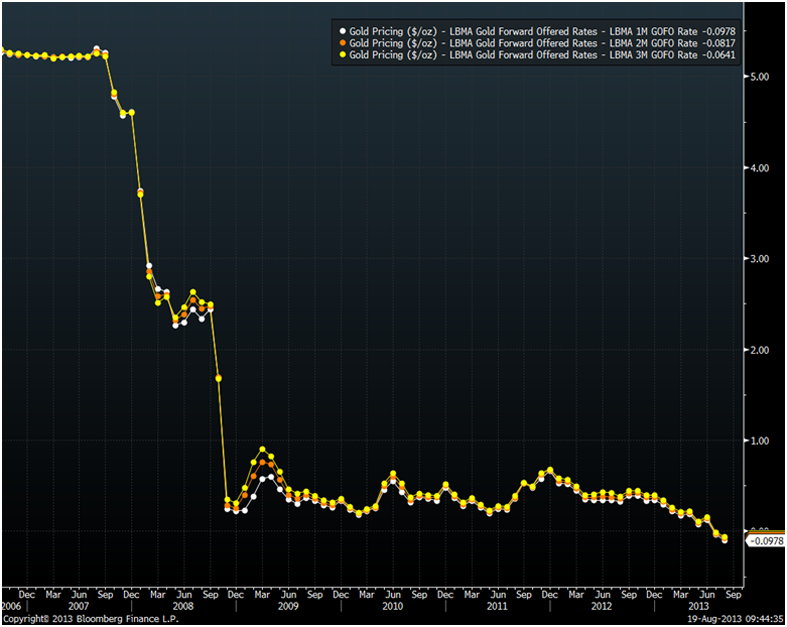
Gold forward offered rates (GOFO),  remain negative and are becoming more negative. This shows that physical demand is leading to supply issues in the highly leveraged LBMA gold market.
GOFO  rates are those which  contributors may use to lend  gold on a swap for  dollars, according to the  London Bullion Market  Association and the negative gold interest rates show a preference to own gold over dollars by bullion banks.

LBMA 1 Month, 2 Month, 3 Month GOFO Rates (2006 to Today) – Bloomberg Precious Metals Mining

Negative 1, 2 and 3 month GOFO rates mean that bullion banks lent their customers, including other bullion banks,  gold to obtain a positive return, thereby increasing the “paper” gold supply. Some may now may be struggling to get their gold  back which may explain the significant decline in COMEX gold holdings of certain bullion banks (see commentary).
This is creating significant supply demand issues in the physical gold market which should lead to higher gold prices.

Gold Prices/ Fixes/ Rates / Volumes – (Bloomberg)

In the futures market, hedge-fund managers and other large speculators increased their net-long position in New York gold and silver futures in the week ended August 13, according to the U.S. Commodity Futures Trading Commission data.
Speculative long gold positions outnumbered short positions by 53,926 contracts on the Comex. Net-long positions rose by 2,291 contracts, or 4%, from a week earlier.
Gold miners, producers, jewelers and other commercial users were net-short 60,874 contracts, an increase of 6,715 contracts, or 12%, from the previous week.
Speculative long silver positions outnumbered short positions by 12,709 contracts. Net-long positions rose by 7,242 contracts, or 132%, from a week earlier.
Miners, producers, jewelers and other commercial silver users were net-short 20,276 contracts, an increase of 9,976 contracts, or 97%, from the previous week.
The potential for a short squeeze remains high. Dollar, euro and pound cost averaging into positions remains prudent.
This is  especially the case as we are soon to enter the seasonally favourable autumn months.

James Rickards – Fed Money Printing Won’t Stop Because We Have 50 Million On Food Stamps, 24 Million Unemployed, 11 Million On Disability, And Everything Wrong In 2008 Is Worse Today!


http://usawatchdog.com/everything-wro… According to investment banker James Rickards, rumors of the Federal Reserve ending the money printing propping up the markets is not going to end anytime soon. Rickards predicts, “My view is they won’t. The economy is fundamentally weak. We have 50 million on food stamps, 24 million unemployed and 11 million on disability, and all these numbers are going up.” When the subject of gold confiscation came up, Rickards said, “I just don’t think it will happen because the government will find it will be very hard to enforce.” Join Greg Hunter as he goes One-on-One with Jim Rickards, the best-selling author of “Currency Wars.”

The FED’S Catastrophic Loss of Control = END GAME: Andy Hoffman


SGTbull07
Andy Hoffman joins us to cover the FED’s catastrophic breakdown and loss of control over the Bond market, interest rates and the PHYSICAL gold and silver markets. As Andy puts it, “Everyone in the world is starting to realize that the Fed is NOT in control. And God forbid when they announce QE5 and bonds go down, not up, you’ll know that the game is over and if you don’t have your gold and silver by then, you may not get it.”

A.M. Kitco Metals Roundup: Gold Steady, Near 2-Month High As Bulls Have Some Technical Momentum

(Kitco News) - Comex gold futures prices are near unchanged but did hit a two-month high in early U.S. trading Monday. The bulls have gained upside technical momentum to suggest prices can trade sideways to higher in the near term. December gold was last up $1.60 at $1,372.70 an ounce. Spot gold was last quoted down $3.40 at $1,374.25. September Comex silver last traded down $0.067 at $23.25 an ounce.
The “dog days” of summer are upon the market place to start the new trading week, as conditions are mostly calmer and quieter. The exception is the sharp drop in the Indian Rupee currency overnight. The Rupee has been on a sharp downslide recently, which has the world market place paying attention but not yet overly concerned.
Traders and investors are still watching the Egypt unrest, which was violent over the weekend. Any escalation in violence is likely to impact the market place, and could prompt a rise in demand for safe-haven assets, including gold.
Of importance to the entire market place is the continued rise in government bond yields worldwide, with the U.S. 10-year note fetching 2.87% and the German 10-year bund yield at 1.91% on Monday. Both rates are the highest in well over a year. The rising bond yields are an early clue that problematic inflation could creep back into the major world economies at some point down the road.
The U.S. dollar index is slightly lower Monday morning. The greenback bears still have the overall near-term chart advantage. Nymex crude oil futures prices are weaker Monday morning, supported on the Egypt unrest. The crude oil bulls have the solid overall near-term technical advantage.
There is no major U.S. economic data due for release Monday.
The London A.M. gold fix is $1,375.25 versus the previous London P.M. fixing of $1,369.25.
Technically, December gold futures prices hit a two-month high overnight. Gold bears still have the slight overall near-term technical advantage, but the bulls have made good headway recently. Last week’s price action established a seven-week-old uptrend on the daily bar chart. The gold bulls’ next upside near-term price breakout objective is to produce a close above solid technical resistance at $1,400.00. Bears' next near-term downside breakout price objective is closing prices below solid technical support at $1,300.00. First resistance is seen at the overnight high of $1,384.10 and then at $1,390.00. First support is seen at the overnight low of $1,369.00 and then at Friday’s low of $1,357.00.
September silver futures prices hit a three-month high overnight. Bulls have solid upside technical momentum and have the near-term technical advantage. Bulls’ next upside price breakout objective is closing prices above solid technical resistance at $24.00 an ounce. The next downside price breakout objective for the bears is closing prices below solid technical support at $22.00. First resistance is seen at the overnight high of $23.605 and then at $24.00. Next support is seen at the overnight low of $23.04 and then at Friday’s low of $22.755.
Follow me on Twitter to immediately get the very latest market developments. If you are not on board, then you are not getting key analysis and perspective as fast or as often as you could! Follow me on Twitter to get my very timely intra-day and after-hours briefs on precious metals price action. The precious markets will remain very active. If you want market analysis fast, and in after-hours trading, then follow my up-to-the-second precious metals market perspective on Twitter. It's free, too. My account is @jimwyckoff.

By Jim Wyckoff

Disclaimer: The views expressed in this article are those of the author and may not reflect those of Kitco Metals Inc. The author has made every effort to ensure accuracy of information provided; however, neither Kitco Metals Inc. nor the author can guarantee such accuracy. This article is strictly for informational purposes only. It is not a solicitation to make any exchange in precious metal products, commodities, securities or other financial instruments. Kitco Metals Inc. and the author of this article do not accept culpability for losses and/ or damages arising from the use of this publication.