Tuesday, July 30, 2013

Is This The Greatest Stock Market Bubble of All Time?

by Phoenix Capital Research

Some truly awful economic results were released over the last week.
First and foremost, we discovered that 80% of the US adults struggle with joblessless, are near poverty, or have a reliance on welfare for at least part of their lives.
This is truly extraordinary. I’ve noted before that the employment ratio (the number of Americans of working age who have jobs divided by the total number of Americans of working age) indicates that there has been little if any real recovery in the jobs market. But the fact that four out of five adults is struggling truly shows just how endemic economic weakness is in the system.
It’s also a stunning rebuke of the Federal Reserve’s claim that its policies help Main Street. Below is a chart indicating the impact of QE(s) 1,2,3, and 4 on the employment population ratio. All told, we’ve spent over $3 trillion… and the ratio has barely moved higher.

Despite this incredible amount of money printing, the US economy has failed to recover in any meaningful way. Indeed, we have not had a single year of 3% GDP growth since Bernanke took the help as Fed Chairman.

Instead, all we’ve got is a new stock market bubble. Investing legend Jim Chanos recently noted that today more companies are trading over 3X their book value than in March 2000 (at the height of the Tech Bubble).
I also want to note that the stock market today is more stretched over its 200-weekly moving average than it was at the height of the Housing Bubble. Once this market really begins to correct, we could easily fall to this line (currently 1300 on the S&P 500).

And if things get VERY ugly we’ll take this line out and crash to new lows.
It’s just like 2007 all over again. Only this time around, we know for a fact that the Fed hasn’t fixed things and has bankrupted itself and the financial system pretending that it can.
This is not doom and gloom. This is a fact. The Fed has created an even bigger bubble than the 2007 one.
The time to prepare for this is not once the collapse begins, but NOW, while stocks are still rallying. Stocks take their time moving up, but when they crash it happens VERY quickly.

For more market insights and commentary, visit us at:
www.gainspainscapital.com
Best Regards
Graham Summers

CHICAGOLAND: Cash reserves plunge, debt triples… WOONSOCKET ROCKET: City hikes taxes 23%

CHICAGOLAND: Cash reserves plunge, debt triples
Mayor Rahm Emanuel closed the books on 2012 with $33.4 million in unallocated cash on hand — down from $167 million the year before — while adding to the mountain of debt piled on Chicago taxpayers, year-end audits show.
Last week, Moody’s Investors ordered an unprecedented triple-drop in the city’s bond rating, citing Chicago’s “very large and growing” pension liabilities, “significant” debt service payments, “unrelenting public safety demands” and historic reluctance to raise local taxes that has continued under Emanuel.
http://www.suntimes.com/21552920-761/city-of-chicagos-cash-cushion-plummets-debt-triples-arrests-drop-water-use-rises.html
WOONSOCKET ROCKET: City hikes taxes 23%
WOONSOCKET — When about 30,000 supplemental tax bills are mailed out Tuesday, it will be, city officials hope, the last major part of a five-year plan to balance the city’s books, pay off an $8.1-million deficit and stabilize the pension fund.

The supplemental tax will raise $2.5 million from multifamily residential real estate and motor vehicles, and the money will be used to balance the 2012-13 budget, which ended June 30. That assessment is also built into the 2013-14 tax rate, along with a 4-percent tax increase and a cut in the homestead exemption, which means the average homeowner in the city will see a 23-percent increase in his or her tax bill.
Taxpayers aren’t the only ones who will take a hit. The state-appointed Budget Commission, which has been running the city since May 2012, said its plan cuts $4.7 million by reducing city employee health benefits and increasing employee and retiree contributions.
http://www.providencejournal.com/breaking-news/content/20130728-woonsocket-hopes-supplemental-tax-will-be-end-of-deficits.ece
AP: 4 out of 5 in USA face near-poverty, no work
http://bigstory.ap.org/article/exclusive-4-5-us-face-near-poverty-no-work-0
Whites below poverty line at 41%, twice number of poor blacks
http://hosted.ap.org/dynamic/stories/U/US_POVERTY_STRUGGLING_WHITES?SITE=AP&SECTION=HOME&TEMPLATE=DEFAULT&CTIME=2013-07-29-03-59-28

Exclusive: Signs of declining economic security


WASHINGTON (AP) -- Four out of 5 U.S. adults struggle with joblessness, near-poverty or reliance on welfare for at least parts of their lives, a sign of deteriorating economic security and an elusive American dream.
Survey data exclusive to The Associated Press points to an increasingly globalized U.S. economy, the widening gap between rich and poor, and the loss of good-paying manufacturing jobs as reasons for the trend.
The findings come as President Barack Obama tries to renew his administration's emphasis on the economy, saying in recent speeches that his highest priority is to "rebuild ladders of opportunity" and reverse income inequality.
As nonwhites approach a numerical majority in the U.S., one question is how public programs to lift the disadvantaged should be best focused - on the affirmative action that historically has tried to eliminate the racial barriers seen as the major impediment to economic equality, or simply on improving socioeconomic status for all, regardless of race.
Hardship is particularly growing among whites, based on several measures. Pessimism among that racial group about their families' economic futures has climbed to the highest point since at least 1987. In the most recent AP-GfK poll, 63 percent of whites called the economy "poor."
"I think it's going to get worse," said Irene Salyers, 52, of Buchanan County, Va., a declining coal region in Appalachia. Married and divorced three times, Salyers now helps run a fruit and vegetable stand with her boyfriend but it doesn't generate much income. They live mostly off government disability checks.
"If you do try to go apply for a job, they're not hiring people, and they're not paying that much to even go to work," she said. Children, she said, have "nothing better to do than to get on drugs."
While racial and ethnic minorities are more likely to live in poverty, race disparities in the poverty rate have narrowed substantially since the 1970s, census data show. Economic insecurity among whites also is more pervasive than is shown in the government's poverty data, engulfing more than 76 percent of white adults by the time they turn 60, according to a new economic gauge being published next year by the Oxford University Press.
The gauge defines "economic insecurity" as experiencing unemployment at some point in their working lives, or a year or more of reliance on government aid such as food stamps or income below 150 percent of the poverty line. Measured across all races, the risk of economic insecurity rises to 79 percent.
Marriage rates are in decline across all races, and the number of white mother-headed households living in poverty has risen to the level of black ones.
"It's time that America comes to understand that many of the nation's biggest disparities, from education and life expectancy to poverty, are increasingly due to economic class position," said William Julius Wilson, a Harvard professor who specializes in race and poverty. He noted that despite continuing economic difficulties, minorities have more optimism about the future after Obama's election, while struggling whites do not.
"There is the real possibility that white alienation will increase if steps are not taken to highlight and address inequality on a broad front," Wilson said.
---
Nationwide, the count of America's poor remains stuck at a record number: 46.2 million, or 15 percent of the population, due in part to lingering high unemployment following the recession. While poverty rates for blacks and Hispanics are nearly three times higher, by absolute numbers the predominant face of the poor is white.
More than 19 million whites fall below the poverty line of $23,021 for a family of four, accounting for more than 41 percent of the nation's destitute, nearly double the number of poor blacks.
Sometimes termed "the invisible poor" by demographers, lower-income whites generally are dispersed in suburbs as well as small rural towns, where more than 60 percent of the poor are white. Concentrated in Appalachia in the East, they are numerous in the industrial Midwest and spread across America's heartland, from Missouri, Arkansas and Oklahoma up through the Great Plains.
Buchanan County, in southwest Virginia, is among the nation's most destitute based on median income, with poverty hovering at 24 percent. The county is mostly white, as are 99 percent of its poor.
More than 90 percent of Buchanan County's inhabitants are working-class whites who lack a college degree. Higher education long has been seen there as nonessential to land a job because well-paying mining and related jobs were once in plentiful supply. These days many residents get by on odd jobs and government checks.
Salyers' daughter, Renee Adams, 28, who grew up in the region, has two children. A jobless single mother, she relies on her live-in boyfriend's disability checks to get by. Salyers says it was tough raising her own children as it is for her daughter now, and doesn't even try to speculate what awaits her grandchildren, ages 4 and 5.
Smoking a cigarette in front of the produce stand, Adams later expresses a wish that employers will look past her conviction a few years ago for distributing prescription painkillers, so she can get a job and have money to "buy the kids everything they need."
"It's pretty hard," she said. "Once the bills are paid, we might have $10 to our name."
---
Census figures provide an official measure of poverty, but they're only a temporary snapshot that doesn't capture the makeup of those who cycle in and out of poverty at different points in their lives. They may be suburbanites, for example, or the working poor or the laid off.
In 2011 that snapshot showed 12.6 percent of adults in their prime working-age years of 25-60 lived in poverty. But measured in terms of a person's lifetime risk, a much higher number - 4 in 10 adults - falls into poverty for at least a year of their lives.
The risks of poverty also have been increasing in recent decades, particularly among people ages 35-55, coinciding with widening income inequality. For instance, people ages 35-45 had a 17 percent risk of encountering poverty during the 1969-1989 time period; that risk increased to 23 percent during the 1989-2009 period. For those ages 45-55, the risk of poverty jumped from 11.8 percent to 17.7 percent.
Higher recent rates of unemployment mean the lifetime risk of experiencing economic insecurity now runs even higher: 79 percent, or 4 in 5 adults, by the time they turn 60.
By race, nonwhites still have a higher risk of being economically insecure, at 90 percent. But compared with the official poverty rate, some of the biggest jumps under the newer measure are among whites, with more than 76 percent enduring periods of joblessness, life on welfare or near-poverty.
By 2030, based on the current trend of widening income inequality, close to 85 percent of all working-age adults in the U.S. will experience bouts of economic insecurity.
"Poverty is no longer an issue of `them', it's an issue of `us'," says Mark Rank, a professor at Washington University in St. Louis who calculated the numbers. "Only when poverty is thought of as a mainstream event, rather than a fringe experience that just affects blacks and Hispanics, can we really begin to build broader support for programs that lift people in need."
The numbers come from Rank's analysis being published by the Oxford University Press. They are supplemented with interviews and figures provided to the AP by Tom Hirschl, a professor at Cornell University; John Iceland, a sociology professor at Penn State University; the University of New Hampshire's Carsey Institute; the Census Bureau; and the Population Reference Bureau.
Among the findings:
-For the first time since 1975, the number of white single-mother households living in poverty with children surpassed or equaled black ones in the past decade, spurred by job losses and faster rates of out-of-wedlock births among whites. White single-mother families in poverty stood at nearly 1.5 million in 2011, comparable to the number for blacks. Hispanic single-mother families in poverty trailed at 1.2 million.
-Since 2000, the poverty rate among working-class whites has grown faster than among working-class nonwhites, rising 3 percentage points to 11 percent as the recession took a bigger toll among lower-wage workers. Still, poverty among working-class nonwhites remains higher, at 23 percent.
-The share of children living in high-poverty neighborhoods - those with poverty rates of 30 percent or more - has increased to 1 in 10, putting them at higher risk of teenage pregnancy or dropping out of school. Non-Hispanic whites accounted for 17 percent of the child population in such neighborhoods, compared with 13 percent in 2000, even though the overall proportion of white children in the U.S. has been declining.
The share of black children in high-poverty neighborhoods dropped from 43 percent to 37 percent, while the share of Latino children went from 38 percent to 39 percent.
-Race disparities in health and education have narrowed generally since the 1960s. While residential segregation remains high, a typical black person now lives in a nonmajority black neighborhood for the first time. Previous studies have shown that wealth is a greater predictor of standardized test scores than race; the test-score gap between rich and low-income students is now nearly double the gap between blacks and whites.
---
Going back to the 1980s, never have whites been so pessimistic about their futures, according to the General Social Survey, a biannual survey conducted by NORC at the University of Chicago. Just 45 percent say their family will have a good chance of improving their economic position based on the way things are in America.
The divide is especially evident among those whites who self-identify as working class. Forty-nine percent say they think their children will do better than them, compared with 67 percent of nonwhites who consider themselves working class, even though the economic plight of minorities tends to be worse.
Although they are a shrinking group, working-class whites - defined as those lacking a college degree - remain the biggest demographic bloc of the working-age population. In 2012, Election Day exit polls conducted for the AP and the television networks showed working-class whites made up 36 percent of the electorate, even with a notable drop in white voter turnout.
Last November, Obama won the votes of just 36 percent of those noncollege whites, the worst performance of any Democratic nominee among that group since Republican Ronald Reagan's 1984 landslide victory over Walter Mondale.
Some Democratic analysts have urged renewed efforts to bring working-class whites into the political fold, calling them a potential "decisive swing voter group" if minority and youth turnout level off in future elections. "In 2016 GOP messaging will be far more focused on expressing concern for `the middle class' and `average Americans,'" Andrew Levison and Ruy Teixeira wrote recently in The New Republic.
"They don't trust big government, but it doesn't mean they want no government," says Republican pollster Ed Goeas, who agrees that working-class whites will remain an important electoral group. His research found that many of them would support anti-poverty programs if focused broadly on job training and infrastructure investment. This past week, Obama pledged anew to help manufacturers bring jobs back to America and to create jobs in the energy sectors of wind, solar and natural gas.
"They feel that politicians are giving attention to other people and not them," Goeas said.
---
AP Director of Polling Jennifer Agiesta, News Survey Specialist Dennis Junius and AP writer Debra McCown in Buchanan County, Va., contributed to this report.

© 2013 The Associated Press. All rights reserved. This material may not be published, broadcast, rewritten or redistributed. Learn more about our Privacy Policy and Terms of Use.

Hardwired Inequality in America

By Stephen Lendman
7-29-13

 
America's always been separate and unequal. Today it's worse than ever in modern times.
Wealth disparity between rich and poor is unprecedented. Annually it widens. Government complicity with business bears full responsibility. It's worse than ever under Obama.
Census data show half of US households impoverished or bordering it. People don't have enough to live on. Growing millions face unconscionable destitution. Force-fed austerity worsens things.
Obama mandates it. He calls it "shared sacrifice." Ordinary people and America's most disadvantaged sacrifice so rich ones can share.
It's official administration policy. It has bipartisan support. Expect much worse ahead. Back room deals assure it. America's social contract's on the chopping block for elimination.
Obama accelerated the process. He deplores social justice. His rhetoric rings hollow. On July 27, The New York Times headlined "Obama Says Income Gap Is Fraying US Social Fabric," saying:
Upward mobility "was part and parcel of who we were as Americans," he said. "And that's what's been eroding over the last 20, 30 years, well before the financial crisis."
"If we don't do anything, then growth will be slower than it should be. Unemployment will not go down as fast as it should. Income inequality will continue to rise. That's not a future that we should accept."
He bears full responsibility. He mandated force-fed austerity. He's uncompromising. Don't expect Times and other scoundrel media to explain.
"If the economy is growing, everybody feels invested," he said. Everybody feels as if we’re rolling in the same direction."
He lied calling the economy "far stronger" than four years ago. Recovery on his watch is none at all. Main Street Depression conditions affect most households. They're getting worse, not better.
Millions live from one paycheck to the next. They're one expensive illness or lost job away from impoverishment, homelessness, hunger and despair.
Obama cut back room deals with Republicans. He did it secretly. He claims otherwise. He lied saying:
"I will seize any opportunity I can find to work with Congress to strengthen the middle class, improve their prospects, improve their security."
"I'm not just going to sit back if the only message from some of these folks is no on everything, and sit around and twiddle my thumbs for the next 1,200 days."
A previous article said he's waging financial war on humanity. He's doing it at home and abroad. He's done it throughout his tenure. He supports capital's divine right. He's beholden to monied interests. They own him.
Whatever they want they get. Popular needs go begging. Obama claims he supports a "thriving middle class." He's destroying it. He's doing it systematically, willfully and maliciously.
He's on the hustings. According to Politico, he's "re-focus(ing) his oft-meandering message back on the economy."
It's old wine in new bottles. It's repackaged duplicity. He says one thing. He supports another. His approval rating's marginally down.
Months earlier, it was 53%. Now it's 45%. On July 27, his weekly address focused on a "better bargain for the middle class." It was typical Obama. Say one thing. Mandate another.
A White House press release said:
"In this week’s address, President Obama told the American people about his speech at Knox College on Wednesday, where he discussed the cornerstones of what it means to be middle class, including having a good job, a home that is your own, quality education, a secure retirement, and affordable health care."  
"While we have laid the foundation for stronger, more durable economic growth, there is more work to be done, and that is why over the coming weeks the President will continue to lay out his plan for growing the economy from the middle out, and create a better bargain for the middle class."
His full address reeked of duplicity, saying
"Hi everybody. On Wednesday, I spoke about what we need to do as a country to build a better bargain for the middle class - to make sure everyone who works hard has a chance to get ahead in the 21st century economy."
"You see, over the past four and a half years, America has fought its way back from the worst recession of our lifetimes. We saved the auto industry, took on a broken health care system, invested in new American technologies to reverse our addiction to foreign oil, and changed a tax code too skewed in favor of the wealthiest at the expense of working families."
"As a result, our businesses have created 7.2 million new jobs over the past 40 months. We produce more renewable energy than ever, and more natural gas than anyone. Health care costs are growing at the slowest rate in 50 years. Our deficits are falling at the fastest rate in 60 years."
"Thanks to the grit and resilience of the American people, we’ve cleared away the rubble of crisis and begun to lay a new foundation for stronger, more durable economic growth."
"But as any middle-class family will tell you, we’re not yet where we need to be. Trends that have been eroding middle-class security for decades - technology that makes some jobs obsolete, global competition that makes others moveable, growing inequality and the policies that perpetuate it - all these things still exist, and in some ways, the recession made them worse."
"Reversing these trends must be Washington's highest priority. It sure is mine. But over the past couple of years in particular, Washington has taken its eye off the ball. An endless parade of distractions, political posturing and phony scandals shift focus from what needs to be done."  
"And as Washington prepares to enter another budget debate, the stakes could not be higher. The choices we make now will determine whether or not every American has a fighting chance in the 21st century."
"If we don't make the investments necessary to make America a magnet for good jobs - in education, and manufacturing, and research, and our transportation and information networks - we might as well hit the 'pause' button while the rest of the world forges ahead in a global economy. And that's certainly not going to fix what ails the middle class."
"Here's what will: a strategy that builds on the cornerstones of what it means to be middle class in America, and what it takes to work your way into the middle class. Good jobs that pay good wages. An education that prepares our children and our workers for the global competition they’ll face."
"Homeownership that's based on a solid foundation, where buyers and lenders play by the same set of rules. Affordable health care that’s there for you when you get sick. A secure retirement even if you’re not rich. More chances for folks to earn their way into the middle class as long as they’re willing to work for it."
"Over the next several weeks, in cities and towns across the country, I'll continue to lay out my ideas in each of these areas.  Because reversing the forces that have conspired against the middle class for decades will require more than short-term thinking; it will require a long-term American strategy, based on steady, persistent effort."
"I know there are members of both parties who understand what's at stake, and I'm open to ideas from across the political spectrum, as long as they meet the test of strengthening the prospects of hard-working families."  
"But repealing Obamacare, gutting critical investments in our future, threatening to default on the bills this country has already racked up, or shutting down the government just because I'm for keeping it open - none of those thing add up to an economic plan. None of that will take this country where it needs to go."
"We can do this if we work together. It won't be easy, but if we take a few bold steps - and if Washington is willing to shake off its complacency and set aside some of the slash-and-burn partisanship we’ve seen in recent years - our economy will keep getting stronger."
"And as long as I have the privilege of holding this office, I will spend every minute of every day doing everything in my power to make this economy work for working Americans again; to build that better bargain for the middle class; to make sure that the American Dream is something that’s achievable for everybody - not just today, but for decades to come."
"Thanks, and have a great weekend."
Fact check
Obama spurns rule of law principles. He mocks democratic values. He's no job creator. He's a job destroyer. He supports offshoring high pay/good benefit ones abroad. Low pay/poor benefit part-time/temp ones replace them.
He's waging financial war on humanity. He wrecked the economy. He looted the nation's wealth. He stole it from ordinary Americans. He handed it to Wall Street, war profiteers, other corporate favorites and rich elites.
He's thirdworldizing America. Today's wealth gap is deplorable. Privileged elites want it all. Social inequality's unprecedented in modern times.
Poverty, unemployment, homelessness and hunger approach record levels. Inequality's institutionalized. Millions struggle to get by.
Neoliberal harshness is policy. Obama's dismissive of growing needs. He's ideologically over-the-top. His holy trinity is eliminating public services, crony capitalism writ large, and cracking down hard on nonbelievers.
He's waging war on organized labor. He's commodifying education. He wants it made another profit center. He targets Muslims, Latinos, African Americans, environmental activists, animal rights defenders, truth-tellers and whistleblowers.
He ruthlessly goes after anyone challenging rogue state power. He menaces humanity. He enforces police state harshness. He champions unfairness. He masquerades as progressive. He's a scourge in his own time.
According to New York TimesSpeak, he wants "budget austerity" ended. He wants spending for "infrastructure, education, clean energy, science, research and other domestic initiatives" replacing it.
He wants repackaged same old, same old. He's in lockstep with Republicans. He wants double downed harshness.
He supports trickle down nonsense. He's destroying America's social fabric. He's doing it to save it, he claims.
He believes corporate tax cuts and handouts work. They stimulate economic growth, he says. They lift all boats. They benefit most people. False on all counts.
Economist Kenneth Galbraith calls trickle down economics a sanitized version of "horse and sparrow" growth.
"If you feed enough oats to the horse," he said, "some will pass through to feed sparrows."
David Stockman was Reagan's budget director. Crony capitalism triumphed, he said. His new book is titled "The Great Deformation: The Corruption of Capitalism in America."
It's a searing critique of current policies. It counters conventional wisdom. Casino capitalism replaced free enterprise.
Ordinary Americans suffer horrifically. They're swindled. Their welfare and futures are stolen. Washington conspires against them. It's allied with business. It's criminal class is bipartisan.
Obama serves wealth, power and privilege. Few benefit at the expense of most others. It's official policy.
Democrats and Republicans are in lockstep. It's a sinister alliance. It targets fairness. America's on a slippery slope south. It's heading for backwater status. It's on a fast track toward dystopian hell.
New World Order harshness is baked in the cake. Things go from bad to worse. Equity and justice are four-letter words.
Obamanomics sells snake oil. Duplicitous supporters claim otherwise. Decades of hard won social gains are vanishing.
Millions are on their own sink or swim. Hard times are getting harder. Demagogic doublespeak can't hide reality.
A Final Comment
Obama's no match for Michael Hudson. He ripped apart his Galesburg, IL economic address. He sounded like Clinton saying "I feel your pain."
He omitted saying he caused it. "Most great fortunes in history have been carved out of the public domain," said Hudson. Wall Street's doing it writ large.
It's "using today's downturn as an opportunity to cloak a vast new monopoly grab as a 'solution' to the economic problem rather than looming as a new threat to price American labor and industry out of global markets."
Obama's in lockstep with its plan. He's "foam(ing) the(ir) runway." He's furthering America's ownership society. He's doing it at the expense of most Americans.
Government guarantees returns. Taxpayers cover losses. In other words, socialism for the rich. Free market capitalism sink or swim for others.
Obama's scamming ordinary Americans. He's a con man. His speech was "an exercise in political stealth," said Hudson.
"Trust me," he said. Hudson quoted George Burns, Groucho Marx, and others saying:
"The secret of life is sincerity and fair dealing. If you can fake that, you've got it made."
Obama's selling snake oil. It's "fairy tale" economics. He ignored what needs addressing:
"Today's debt deflation and economic shrinkage are pushing federal, state and local budgets into deficit," said Hudson.
"This is forcing public spending to be cut back proportionally. That cutting will push state, local and federal budgets even further into deficit."
"This is why we are hearing calls to start selling off public infrastructure - to buyers who will become new customers for Wall Street investment banks."
"It is the same phenomenon we are seeing in Europe. The newest economic prize is the right to buy rent-extraction rights to turn public roads into toll roads and similar rentier tollbooth installations."
"All this increases the cost of living and doing business, making the economy high-cost even as it is being impoverished."
"That is not a solution. It bears out the classic principle that the solution to every problem tends to create new, even larger problems."
"Often these are unforeseen. But today's problems in the making are all too foreseeable. What is needed is to keep translating the President's speeches into their subtext."
Key is exposing, denouncing, and becoming activist against policies destroying America's social fabric. The alternative's too grim to accept.
Stephen Lendman lives in Chicago. He can be reached at lendmanstephen@sbcglobal.net.
His new book is titled "Banker Occupation: Waging Financial War on Humanity."
Visit his blog site at sjlendman.blogspot.com.
Listen to cutting-edge discussions with distinguished guests on the Progressive Radio News Hour on the Progressive Radio Network.
It airs Fridays at 10AM US Central time and Saturdays and Sundays at noon. All programs are archived for easy listening.

Salma Hayek gives Penelope Cruz a lesson about sound Monetary Policy


In what is probably the only intelligent scene in the whimsical, forgettable, and D-grade 2006 film “Bandidas”, Salma Hayek’s character instructs her clueless heist colleague, portrayed by Penelope Cruz, about how the monetary system works in the United States prior to the Federal Reserve Act - See more at: http://www.ingeniouspress.com/2013/07/29/salma-hayek-gives-penelope-cruz-a-lesson-about-sound-monetary-policy/#sthash.whhYIL7b.dpuf

The resurgence of ARMs in the real estate market: Buyers taking on additional risk to squeeze into homes and increasing leverage in the housing market.

The amount of speculation occurring in the housing market is extremely high.  Not to the levels of what was seen between 2005 and 2007 but it is certainly getting close.  For example, the usage of adjustable rate mortgages is reaching multi-year highs.  This is an odd choice unless you have a fanatical belief that home values will continue to go up or that the Fed has god-like powers to control the mortgage markets into eternity.  Yet that perception is very real and perceptions drive a good amount of energy in the housing market.  The logic of people using ARMs is very similar to what was used only a few years ago during the heyday of the housing bubble.  Home prices are seen as never falling, income will only rise, and if everything goes off the financial cliff then you can simply refinance.  It is interesting to witness this for a second go around but the surge in ARM usage is very telling especially in such a low rate environment.

ARMs and Hope
Bloomberg had a really interesting piece on the jump in ARM usage.  As it happens, many of these users are in bubble-mania central, California:
“Jung Lim plans to offset the cost of rising mortgage rates by using an adjustable-rate loan to buy a home for his expanding family. For the California endodontist, the money he’ll save makes up for the ARM’s risky reputation.
Lim, 38, whose wife is expecting a second child in December, is leaving a two-bedroom condo in Los Angeles’s Hancock Park to buy a four-bedroom house in the city’s Sherman Oaks neighborhood for $1.12 million. His lender offered him a rate for an adjustable mortgage that is about a percentage point cheaper than a fixed loan.”
Wait, it costs $1.12 million for a decent home to shelter a family with 2 kids?  The California housing ladder is now fully in place.  Sell a smaller place, use the wild appreciation in home prices, and move into the dream home and re-leverage.  Of course, using an ARM is seeing as a logical step.  Of course they are planning on staying put for a very long-time right?
“If I could have gotten a 30-year fixed at the interest rate I’m getting the ARM for, I would have felt a lot more comfortable,” said Lim, who’s also a professor of endodontics at the University of California, Los Angeles. “But I’m hoping to refinance in five years or less. And we’ll be in the house for about 10 years so we could also sell. Hopefully prices have bottomed so we won’t be underwater then.”
Wait.  So they are getting an ultra-low rate loan so they can refinance later on in five years?  To what?  Heck, even the Fed is saying that they will taper off on QE and rates in the mortgage markets have already reacted because the Fed’s balance sheet is well over $3.4 trillion and we are already seeing the consequences of this action by causing a flood of banking money into the rental housing market.  What is interesting is the amount of speculation now permeating the market in various flips and also, the mentality being taken on by buyers like the case above.
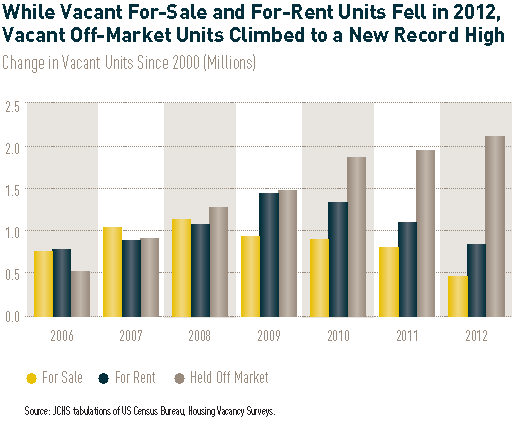
While the rigged market plays out, we have some concrete data showing the manipulation behind all of this.  In 2012, for sale units hit a decade low while units held off the market reached a new record high:
Vacanices
And people are doing what they do best and are trying to mimic Wall Street behavior and are itching to get a piece of this pie.
Massive jump in ARMs
According to the Bloomberg report, in June the dollar amount of ARM applications reached 16 percent of all mortgage requests.  This is the highest level since July 2008 or two months before Lehman Brothers bit the dust.
Of course many of the ARM borrowers are basing their decision on pure optimism:
“Another assumption of ARM applicants is that their income will be higher by the end of the loan’s fixed period so they can handle higher payments if they can’t sell, said Henry Savage, president of PMC Mortgage Corp.
“When you start making those calculations, you’re playing golf in the dark,” said Savage.
Borrowers like Baudler say they don’t have to worry where home prices will be when their loans adjust. He has the assets to weather rate changes at the end of his seven-year fixed period and plans to use his mortgage savings to pay off the loan in nine years. It was a cheaper alternative to using a 15-year fixed mortgage, he said.”
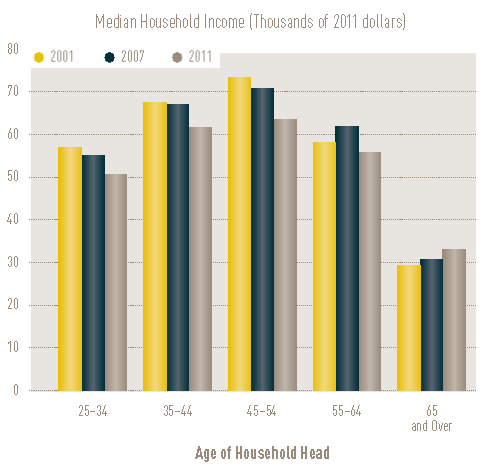
Really?  Let us look at how household income has done recently:
Real Incomes
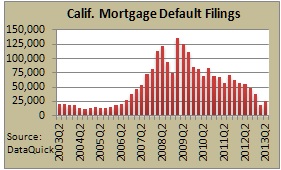
The mania is fully engaged.  People crowd into open houses as if they were fighting for entry into a posh Hollywood club.  And for what?  So they can over-bid by tens of thousands of dollars?  After the bid is taken, they close escrow with an ARM and the party begins.  Yet as we have mentioned there are multiple signs a tipping point is being reached.  For one, inventory is now finally rising.  Another major point is foreclosure starts in California went up strongly last quarter:
Forecl0613
California foreclosure starts went up by 38 percent in the last quarter.  One big reason has to do with the first chart in this article.  Now that banks and the Fed have manufactured an insane leveraged based mania, the crowd is now hungry to dive back in.  So banks are acting on these foreclosures trying to exit at a prime time.  A foreclosure start merely means a bank is moving on a non-paying “home-owner.”  Given the massive jump in prices in the last year, some banks are sensing this is a perfect time to unload some of the held off market inventory.
The usage of ARMs in SoCal was 9.2 percent last month (up from 6.7 last year).  This is a 34 percent increase in one year when fixed rates are still near all-time lows.  Yet people are trying to squeeze every little penny out of this leveraged game.  Many have to compete with flippers and the all cash Wall Street crowd.  Like the example in the story, the bet is that prices will only go up and that there will be easy refinancing options available in a few short years (there is no scenario for problems).
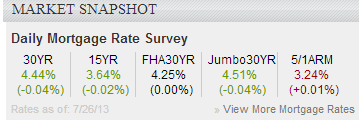
The difference is clear:
arm vs regular
Save yourself 100 to 125 basis points on a $600,000 to $1,000,000 loan and you are talking about a good chunk of change.  The leverage is real here.
What are your thoughts on the rise in ARM usage?

Chicago Next? Windy City Cash Balance Plummets To Only $33 Million As Debt Triples

While everyone's attention is focused on the Detroit bankruptcy, and just what assets the city will sell in lieu of raising a DIP loan, perhaps it is time to refocus attention to the city 300 miles west: Chicago. According to the Chicago Sun Timesciting year-end audits, Obama's former right hand man, Rahm Emanuel, closed the books on 2012 with $33.4 million in unallocated cash on hand — down from $167 million the year before — while adding to the mountain of debt piled on Chicago taxpayers. In addition to a liquidity problem, Chicago may also be quite insolvent as the city's total long-term debt soared to nearly $29 billion. That’s $10,780 for every one of the city’s nearly 2.69 million residents. More than a decade ago, the debt load was $9.6 billion or $3,338 per resident. Of course, in a world in which debt is "wealth", this is great news... at least until debt becomes "bankruptcy."
Ironically last year, now-retiring City Comptroller Amer Ahmad argued that the city’s debt load was not “troubling” because, "We still have a very strong bond rating. Our fiscal position is getting better every year and we are aggressively managing our liabilities and obligations" (very much awhat the ECB's Mario Draghi tells the world when he gives the periodic monthly update of European capital markets during the central bank's press conference). It is ironic because last week, Moody’s downgraded Chicago from Aa3 to A3 in an unprecedented three notch cut in the city’s bond rating, citing Chicago’s "very large and growing" pension liabilities, "significant" debt service payments, “unrelenting public safety demands” and historic reluctance to raise local taxes that has continued under Emanuel.
Moody’s noted that the city’s total fund balance at the close of 2012 was $231.3 million and that Chicago has just $625 million in “leased asset reserves.” Had the city fully funded its $1.5 billion “actuarially required contribution” to its four under-funded city employee pension funds in 2012 alone, “these two reserves would have been entirely depleted,” Moody’s said.
The “unassigned” balance is $33.4 million. Experts recommend a cash cushion of at least $200 million for a budget the size of Chicago’s, according to the Civic Federation. The city ended 2009 with an unallocated checkbook balance of just $2.7 million.
According to the Sun Times, Chicago budget Director Alex Holt blamed the $133.6 million drop in cash on hand balances on "honest" budgeting and ending the long-standing practice of carrying “ghost” vacancies. "We’re trying to be more transparent about what we’re really spending and taking in — not just carrying a bunch of people who took up money in the budget and left money on the table at the end of the year," Holt said. Well that's a welcome development - unfortunately the inevitable outcome of honest in the New Normal is bankruptcy.
"Let’s be straightforward about what we’ve got to spend and not pretend we’re gonna hire for a position we haven’t hired for, who know how many years when those resources are need to provide other services. ... This is about matching revenues with expenses. You don’t want to over-tax people."
Wait, did someone from Chicago just say that?
As also disclosed by the Sun Times, audits by the accounting firm of Deloitte & Touche provide a treasure trove of information about city finances and operations.
Interesting nuggets include:
  • Chicago’s principal private employers were: J.P. Morgan Chase (8,168 workers); United Airlines (7,521); Accenture LLP (5,590; Northern Trust (5,448); Jewel Foods (4,572) and Ford Motor Co. (4,187). The 2012 city payroll was 33,708 — down from 40,297 in 2006.
  • The number of “physical arrests” by Chicago Police officers declined again — from 152,740 in 2011 to 145,390 in 2012. That continues a six-year trend that coincides with the hiring slowdown that caused a dramatic decline in the number of police officers. Police made 227,576 arrests in 2006. The number of arrests has been dropping like a rock ever since. The Chicago Police Department has long argued that it doesn’t measure the success of crime-fighting strategies simply by the number of arrests.
  • Emergency responses continued their steady rise — to 472,752. That’s up from 300,971 in 2006.
  • O’Hare Airport operating revenues were up by $23.2 million, a 3.3 percent increase, thanks to rising terminal rental and use charges. Operating expenses rose $19.1 million because of rising personnel and contracting costs. Airline ticket taxes known as “passenger facility charges” generated $154.5 million in 2012.
  • The number of passenger “enplanements” rose by a modest 37,000 — to 33.24 million. That’s despite a continued decline by O’Hare’s two largest carriers — from 8.7 million passenger boardings in 2011 to 7.4 million in 2012 at United Airlines and from 7.6 million to 7.2 million by American.
  • In 2003, United and American together accounted for 67.7 percent of O’Hare enplanements. Now, it’s just 44 percent.
  • Budget-oriented Midway Airport is thriving, spelling potentially good news if, as expected, Emanuel chooses to revive the $2.5 billion deal to privatize Midway that collapsed for lack of financing.
  • Midway boardings rose from 9.45 million in 2011 to 9.78 million last year. Operating revenues were up just $462,000 because of decreased landing fees and terminal use charges. That’s even though concession revenues rose by $1.8 million due to an increase in parking, restaurant and auto rentals. Operating expenses rose by $4.2. Ticket taxes generated $43.9 million.
  • The 55 percent subsidy to retiree health care that Emanuel wants to phase out and retirees are suing to maintain cost the city $97.5 million in 2012.
  • Daily refuse collections declined from 3,983 tons in 2011 year ago to 3,763 in 2012. Last year’s 52-ton increase had reversed a five-year trend. The amount of garbage generated by the 600,000 Chicago households was 4,451 tons a day in 2006 to 4,240 in 2008.
  • Thanks to last year’s record heat and drought conditions, average daily water consumption rose by 23 million gallons — to 793 million gallons — reversing a steady decline. In 2006, Chicago’s 1.04 million households were guzzling 884.9 million gallons-a-day. Operating revenues in the city’s water fund were up by $122.1 million or 29.6 percent, thanks to Emanuel’s 25 percent increase in water rates.
  • Chicago’s 165 tax-increment-financing districts had a collective balance of $1.5 billion. Most of that money is uncommitted, fueling an aldermanic demand Emanuel has rejected: to declare a TIF surplus and use the money to reduce some of the 3,000 layoffs at Chicago Public Schools.
  • The condition of Chicago’s four city employee pension funds is growing ever more precarious. The firefighters pension fund has assets to cover just 25 percent of liabilities, followed by: Police (31 percent); Municipal Employees (38 percent) and Laborers (56 percent).
  • Chicago’s historical collections and works of art are valued at $13.2 million.
There's all that, and then there is the now traditional weekend slaughter of countless people as irrefutable proof that guns laws work, although maybe not in the city they were implemented.
By July 31, Emanuel must release a preliminary city budget. It’s almost certain to include another massive deficit — strengthening the city’s case in contract talks with city unions — that will have to be closed with more layoffs, service cuts and new revenues.
Since Emanuel’s 2013 budget held the line on taxes, fines and fees — beyond those set in motion the year before and annual increases in parking meter rates locked into the 75-year lease - what appears inevitable is another rise in the cost of Chicago living. The mayor also eliminated 275, mostly-vacant jobs while making strategic investments in tree-trimming, rodent control and children’s health and after-school programs.
But, aldermen warned that it was the calm before the storm: a painful solution to the city’s pension crisis that will require both new revenues and concessions from city employees.
Of course, now that Detroit has shown the way, and since he who defaults first, defaults best (and the second best and so on), there is a far more realistic outcome...