Friday, July 26, 2013

The Nightmare Ahead: 19 US Cities Have More Public Workers per Resident than Detroit

Detroit declared bankruptcy due in no small part to $3 billion in unfunded public employee pensions as a result of a massive city workforce that kept growing even as the city’s population shriveled, but a Washington Examiner analysis found that 19 major American cities have even bigger ratios of such workers to residents. Here's the report from WE showing the number of residents per municipal employee.

  1. WASHINGTON DC

    Residents per employee 25
    Population: 601,723
    Employees: 23,631
    Annual payroll: $1,738,914,588
    Average salary: $73,586
    What's not included?
    Back to map
  2. SAN FRANCISCO

    Residents per employee 28
    Population: 805,235
    Employees: 28,660
    Annual payroll: $2,564,000,376
    Average salary: $89,462
    What's not included?
    Back to map
  3. BATON ROUGE-EAST BATON ROUGE

    Residents per employee 30
    Population: 229,493
    Employees: 7,566
    Annual payroll: $336,309,768
    Average salary: $44,450
    What's not included?
    Back to map
  4. NEW YORK

    Residents per employee 32
    Population: 8,175,133
    Employees: 252,701
    Annual payroll: $18,645,049,116
    Average salary: $73,783
    What's not included?
    Back to map
  5. RICHMOND

    Residents per employee 39
    Population: 204,214
    Employees: 5,183
    Annual payroll: $245,372,376
    Average salary: $47,341
    What's not included?
    Back to map
  6. BALTIMORE

    Residents per employee 43
    Population: 620,961
    Employees: 14,438
    Annual payroll: $705,692,760
    Average salary: $48,877
    What's not included?
    Back to map
  7. NORFOLK

    Residents per employee 44
    Population: 242,803
    Employees: 5,512
    Annual payroll: $252,770,712
    Average salary: $45,858
    What's not included?
    Back to map
  8. BIRMINGHAM

    Residents per employee 44
    Population: 212,237
    Employees: 4,749
    Annual payroll: $230,290,992
    Average salary: $48,492
    What's not included?
    Back to map
  9. DENVER

Gold Defies “Key Reversal” as China Launches “Mini-Stimulus”, Miners De-Hedge

Gold Defies “Key Reversal” as China Launches “Mini-Stimulus”, Miners De-Hedge

WHOLESALE gold rallied from a drop to $1310 per ounce Thursday lunchtime in London, gaining as world stock markets also cut earlier losses.

Trading back above $1322 – a two-year low when hit by April’s gold crash – spot bullion also rallied 1.0% for Euro and Sterling investors.

The Pound meantime regained half a 1-cent loss on news the UK economy grew 0.6% in the second quarter, in line with analyst forecasts.

Of the €4 billion in bail-out funds due to reach Athens next Monday, says the Ekathimerini newspaper, “more than half will be kept aside to pay for maturing bonds held by the European Central Bank” and other Eurozone partners.

“The selling gained speed after support at $1321 broke once again,” Reuters quotes gold trader Alexander Zumpfe at German refinery group Heraeus.

“While the metal remains above key support at $1301,” says technical analysis from bullion and investment bank Scotia Mocatta, “it has now descended back below the downtrend that it had broken out of [Tuesday].

Wednesday’s action – opening higher but ending the day down – “formed a bearish reversal pattern called Key Reversal,” says gold price analysis from fellow London market-maker Societe Generale.

“Gold is therefore poised to correct lower to the previous congestion at $1303/1295.”

Commodities also reduced earlier losses in London trade Thursday, as did major government bond prices.

Ten-year US Treasury yields eased back from 1-week highs near 2.60%.

Silver bullion tracked and extended the moves in gold, rallying 1.9% from a 4-session low to trade at $20.18 per ounce.

After new data on Wednesday showed China’s manufacturing activity falling to an 11-month low, the State Council in Beijing last night unveiled what one analyst calls “a mini-stimulus.”

Aiming to “arouse the energy of the market,” the cabinet cut taxes on small business, reduced paper-work for exporters, and invited new investment in railway expansion.

“China’s leaders turned to credit-fueled investment…after export demand faded in the wake of the 2008 financial crisis,” says a Wall Street Journal report, noting that investment’s share of Chinese GDP rose from 42% to 48% in the six years to 2012.

“China’s world-renowned 8 to 12% growth rate is a myth,” writes financial author James Gorrie in London freesheet City AM today, “even as it now slips down towards 7%.

“China’s hard landing will…unfortunately be our hard landing as well.”

A cross-asset report from Societe Generale sees strong gold price volatility on a China hard landing, perhaps with “a sharp bounce from the initial sell-off if global central banks respond with further QE.”

Looking at US policy, “Recent communication by Fed officials has emphasized that the overall level of monetary accommodation will not be reduced significantly,” says a note from commodities analysts at investment bank Goldman Sachs.

Now forecasting an average gold price of more than $1400 per ounce for 2013 as a whole, the metal will average $1165 next year, the note says – repeating Goldman Sachs’ previous outlook – with a possible drop to $1050 by end-2014.

Dollar gold has so far averaged $1491 per ounce in 2013.

Gold mining companies took advantage of Jan-June’s drop in prices to reduce their hedge book, analysis from Thomson-Reuters GFMS said Thursday.

Building a total forward sale of nearly 3,000 tonnes by 2001, the gold mining industry then “de-hedged” that position as the price rose.

On top of the 11 tonnes bought back in the first 3 months of the 2013, “During the second quarter miners took the opportunity to reduce hedge cover further as the gold price fell sharply,” says the Global Gold Hedge Book Analysis, identifying another 17 tonnes of de-hedging between April and June.

Contrary to recent talk of a return to gold miner hedging by other analysts, “We forecast that producer activity will remain on the side of net de-hedging for the year,” GFMS adds, “despite the sharp fall in price.”

Adrian Ash

Ron Paul: The Detroit Bankruptcy Exemplifies What’s Wrong With The U.S. & Gold Will Go Higher


The Detroit bankruptcy has been called an American tragedy, and one of the most heart-wrenching financial stories of our time. But according to Ron Paul, America’s biggest-ever municipal bankruptcy could actually give gold bulls something to cheer about.
For Paul, the Detroit bankruptcy is the first of many municipal bankruptcies to come, and could even foretell what will happen to the United States as a whole.
“Long term, you can expect governments not to change,” said Paul, who predicts that the U.S. will print more and more money as it continues to take on debt.
“We’re going to see more Detroits, and eventually the government of the United States will be somewhat similar to Detroit, because people will give up their confidence in us, they’ll give up confidence in the dollar, and eventually they’ll give up confidence in our military. And then you’ll see some real, real changes in this system, which has been built on a fiat dollar for the last 40 years,” the former U.S. representative said on Tuesday’s “Futures Now.”
http://www.cnbc.com/id/100907995

China’s Yuan Set To Become Global Reserve Currency With Gold Backing?

by GoldCore
Today’s AM fix was USD 1,312.00, EUR 994.92 and GBP 857.63 per ounce.
Yesterday’s AM fix was USD 1,340.00, EUR 1,012.31 and GBP 872.40 per ounce.
Gold fell $22.50 or 1.68% yesterday and closed at $1,319.90/oz.
Silver slid $0.30 or 1.47% and closed at $20.16.
Gold is trading down after falling nearly 2% yesterday after challenging resistance at $1,350/oz.

Gold in USD, 1 Year – (GoldCore)

Resistance is at $1,350/oz and $1,400/oz and the first level of support is at $1,300/oz which may be tested today. Below that support is at $1,200/oz and the recent multi year low on June 28  at $1,180/oz.
Some positive economic data from the U.S. and the EU was cited as a reason for the move lower but the data was mixed and all the data is suggesting that major economies are very vulnerable to recessions which will support gold.
Goldman Sachs is leaving its estimate of $1,413/oz for gold this year unchanged as they do not see sharp reductions in the U.S. Fed’s stimulus program.
Newcrest Mining, the world’s number three producer, is forecasting no changes in its gold output from last year but said it has to cut operating costs.
Major gold miner Agnico Eagle Mines Ltd reported a net loss on Wednesday, hurt in part by a maintenance shutdown, and said it was “reviewing all aspects” of its business in light of the recent drop in gold prices.
The gold industry and people  in India are braced for a fall in supply and higher premiums ahead of festivals. The Indian Central Bank’s steps to restrict imports are expected to cut supplies for domestic consumption which is leading to huge black market activity and importation.
There have been numerous reports in recent days of Indians being arrested in airports carrying gold coins and bars.
Recent media reports in China and Russia suggest that China is continuing to consider backing the yuan with gold. Since 2005, we have said that such a move by China was likely as China seeks to become a superpower and lessen and undermine U.S political dominance – see here.

World Currency Ranker – G10 Currencies and Gold (10 Years)

This decision, if taken, may lead to huge volatility in foreign exchange markets, a depreciating dollar and ultimately an international monetary crisis.
John Butler in his book ‘Golden Revolution’ and Jim Rickards in his book ‘Currency Wars’ have warned that China and or Russia could move to back their currencies with gold which would then lead to the U.S. and EU having to follow suit in order to prevent currency crises thereby leading to a new gold standard.

According to media reports, the People’s Bank of China is considering phasing out the dollar as the reference currency or peg for the yuan, and to start using gold as the reference point.
The reports have not been confirmed officially, but there has been official comments to that effect in recent years and Chinese academics have advocated backing the renminbi or yuan with gold.
Beijing’s possible move to back the yuan with gold would be a strategic move in order to, lessen the risk of inflation, increase the yuan’s attractiveness as an investment medium and  create faith in the yuan as a reserve currency.

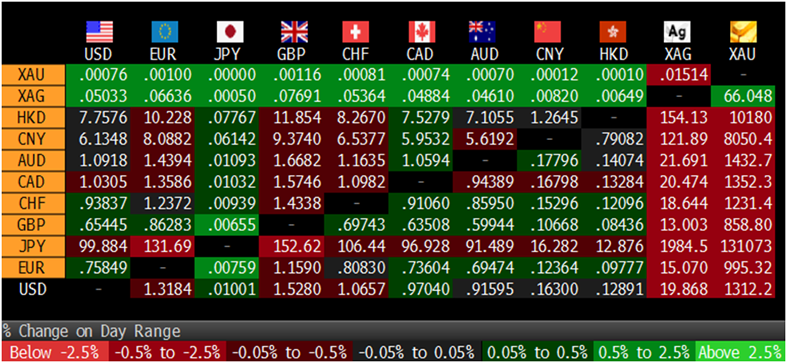
Cross Currency Table – (Bloomberg)

Besides being an important financial and geopolitical move it would also be a symbolic act intended to show the U.S. and the world that they are capable of taking the risks associated with a departure from the dollar standard.
It would be a strategic gamble and while it would cause much short term economic pain for China and indeed the world – it could lead to long term benefits. The Chinese tend to think long term rather than quarter to quarter.
The move could in time lead to more stable long term economic growth rather than the boom and bust cycles of recent years.
The Chinese authorities have been pushing for a more international role for their currency and as an alternate reserve currency to the embattled dollar and euro. Indeed the Bundesbank recently admitted that the yuan was becoming a global reserve currency.
With gold now traded in yuan, it appears to be only a matter of time before oil is traded in yuan thereby positioning the yuan as ‘petro yuan’ and a rival to the petrodollar as the global reserve currency.

MAX KEISER: “Deutsche Bank Is OFFICIALLY On SUICIDE WATCH….WILL Be The NEXT LEHMAN that Triggers COLLAPSE”

My Geneva fund contact: Deutsche Bank is officially on suicide watch. DB will be the next ‘Lehman’ moment that triggers new collapse..
https://twitter.com/maxkeiser/status/360017521753075713
Deutsche Bank Opaque Loans From Brazil to Italy Hide Risk
http://www.bloomberg.com/news/2013-07-11/deutsche-bank-opaque-loans-from-brazil-to-italy-hide-risk.html
Deutsche Bank’s Accounting Raises Questions
….In other words, these ‘secured’ loans are not really secured, unless one considers what is effectively a short position on the bonds that were provided as collateral to represent adequate security. In addition, DB apparently ‘spiced’ the deals up by writing credit default swaps, exposing it to even more credit risk.
As Bloomberg further reports, this isn’t the first time DB has obscured its true financial position by means of accounting practices that are not necessarily illegal, but certainly raise questions about how to properly evaluate the risks the bank is exposed to.
Meanwhile, the banks that have received the loans in question were able to continue to report ownership of the bonds DB has sold, allowing them to misrepresent their own financial health as well…..
….
http://seekingalpha.com/article/1549752-hidden-risks-at-german-banks?source=google_news
Banking insider: Deutsche Bank in danger zone and will go belly up
Deutsche Bank. Big bank. Biggest bank in Germany, and one of the biggest banks in the Euro Zone… they’re going to go belly up. Watch it. Watch it, I said it, it’s going to happen.
They are in such a danger zone, they don’t know what to do. Deutsche Bank’s derivative debt is greater than the global economy. That is one bank. $72 trillion in derivative exposure. The entire global economy, all the countries in the world is only $66 trillion GDP.
http://www.examiner.com/article/banking-insider-deutsche-bank-danger-zone-and-will-go-belly-up
JIM WILLIE: BREAKDOWN SIGNALS: CONTAGION LOOMS!
http://news.goldseek.com/GoldenJackass/1373582161.php
WE’RE ALWAYS ON THE VERGE OF ANOTHER FINANCIAL CRISIS: 3 MAJOR BANKS ARE UNDER CONSTANT THREAT OF FAILURE OVERNIGHT, EVERY NIGHT

http://investmentwatchblog.com/were-always-on-the-verge-of-another-financial-crisis-3-major-banks-are-under-constant-threat-of-failure-overnight-every-night/#8C35pszlqpsFPkAS.99
Exclusive: Deutsche Bank ‘horribly undercapitalized’ – U.S. regulator!!!
Moments ago the market jeered the announcement of DB’s 10% equity dilution, promptly followed by cheering its early earnings announcement which was a “beat” on the topline, despite some weakness in sales and trading and an increase in bad debt provisions (which at €354MM on total loans of €399.9 BN net of a tiny €4.863 BN in loan loss allowance will have to go higher. Much higher). Ironically both events are complete noise in the grand scheme of things. Because something far more interesting can be found on page 87 of the company’s 2012 financial report.
The thing in question is the company’s self-reported total gross notional derivative exposure.
And while the vast majority of readers may be left with the impression that JPMorgan’s mindboggling $69.5 trillion in gross notional derivative exposure as of Q4 2012 may be the largest in the world, they would be surprised to learn that that is not the case. In fact, the bank with the single largest derivative exposure is not located in the US at all, but in the heart of Europe, and its name, as some may have guessed by now, is Deutsche Bank.
The amount in question? €55,605,039,000,000. Which, converted into USD at the current EURUSD exchange rate amounts to $72,842,601,090,000….  Or roughly $2 trillion more than JPMorgan’s.
http://www.zerohedge.com/news/2013-04-29/728-trillion-presenting-bank-biggest-derivative-exposure-world-hint-not-jpmorgan
….

The Recovery is Collapsing… Are You Prepared?

by Phoenix Capital Research

The markets had a very weak session yesterday. With Bernanke’s final stand in front of Congress out of the way, along with options expiration and end of the quarter performance gaming, the bulls are running out of excuses to gun the market higher.
This is evident in the action of the last three days. All three days traders tried to push the market higher at the open. However, there was no follow through and every time the market retracted the early gains. As I’ve told subscribers of Private Wealth Advisory is not indicative of major buying power coming into the markets.

Yesterday we noted that the corrupt edifice that has sustained the “recovery” is crumbling. A big part of this edifice is the Fed and its role as regulator of monetary policy and the banking system.
The Fed publicly claims it wants to help the economy and Main Street. However, as we are now discovering, the Fed is more than willing to sacrifice the good of the people in order to prop up a few insolvent big banks.
Bernanke and other Fed doves continue to proclaim that QE is beneficial to the economy. However, we now know from the former head of the BLS that the Fed’s claims of job growth are incredibly inaccurate (real unemployment is over 10%) as well as its claims of low inflation (real inflation is around 8%).

Higher costs and lower job growth. Neither of those is pro-recovery or pro-Main Street.
Moreover, we now find that Wall Street has been manipulating the commodities market as well as the interest rate markets: both of which have major impacts on average Americans.
If the Fed didn’t know about this, then how can anyone trust the Fed to understand the financial system, let alone “save” it? And if the Fed did know about this, then it’s proof positive that Bernanke is happy to turn a blind eye to Wall Street’s pushing of commodity prices higher (hurting Americans across the board).
I’ve long said that this entire recovery was a sham. Real employment has yet to come back in any meaningful way. And the housing “recovery” has been dominated by large financial institutions (ones with close ties to the Fed) buying up tens of thousands of homes, pushing prices higher to the point that once again Americans can’t afford them.
It’s just like 2007 all over again. Only this time around, we know for a fact that the Fed hasn’t fixed things and has bankrupted itself and the financial system pretending that it can.
This is not doom and gloom. This is a fact. The Fed has created an even bigger bubble than the 2007 one.
The time to prepare for this is not once the collapse begins, but NOW, while stocks are still rallying. Stocks take their time moving up, but when they crash it happens VERY quickly.


For more market insights and commentary, visit us at:
www.gainspainscapital.com
Best Regards
Graham Summers