 Well, isn't that convenient? At the moment when the Obama administration is feeling more heat then ever before, it starts another war. Suddenly everyone in the mainstream media is talking all about Syria and not about the IRS scandal, Benghazi, NSA snooping
or any of the other political scandals that have popped up in recent
weeks. As if on cue, Obama made headlines all over the globe on
Thursday by claiming that the Syrian government has used chemical
weapons against the rebels "multiple times", and that the U.S. was now
ready to do more to assist the rebels. As far as the Obama administration is concerned, there is no such thing as a coincidence. The timing of this announcement regarding Syria was not an accident.
Saturday, June 15, 2013
Guest Post: Is Obama Starting A War With Syria Just A Distraction From All The Scandals?
Well, isn't that convenient? At the moment when the Obama administration is feeling more heat then ever before, it starts another war. Suddenly everyone in the mainstream media is talking all about Syria and not about the IRS scandal, Benghazi, NSA snooping
or any of the other political scandals that have popped up in recent
weeks. As if on cue, Obama made headlines all over the globe on
Thursday by claiming that the Syrian government has used chemical
weapons against the rebels "multiple times", and that the U.S. was now
ready to do more to assist the rebels. As far as the Obama administration is concerned, there is no such thing as a coincidence. The timing of this announcement regarding Syria was not an accident.
Document: Major resources needed for Obama Africa trip
 Washington Post – by Carol D. Leonnig and David Nakamura
Update: The White House has cancelled the safari for this trip.
Hundreds of U.S. Secret Service agents will be dispatched to secure facilities in Senegal, South Africa and Tanzania. A Navy aircraft carrier or amphibious ship, with a fully staffed medical trauma center, will be stationed offshore in case of an emergency.
 The
first family is making back-to-back stops from June 26 to July 3 in
three countries where U.S. officials are providing nearly all the
resources, rather than depending heavily on local police forces,
military authorities or hospitals for assistance.
The president and first lady had also planned to take a Tanzanian
safari as part of the trip, which would have required the president’s
special counterassault team to carry sniper rifles with high-caliber
rounds that could neutralize cheetahs, lions or other animals if they
became a threat, according to the planning document.
But officials said Thursday that the safari had been canceled in favor of a trip to Robben Island off the coast of Cape Town, South Africa, where Nelson Mandela was held as a political prisoner.
When The Post first asked White House officials about the safari last week, they said no final decision had been made. A White House official said Thursday that the cancellation was not related to The Post’s inquiries.
“We do not have a limitless supply of assets to support presidential missions, and we prioritized a visit to Robben Island over a two-hour safari in Tanzania,” said spokesman Josh Earnest. “Unfortunately, we couldn’t do both.”
Internal administration documents circulated in April show that the Obama family was scheduled to go to both Robben Island and the safari park, according to a person familiar with the plans.
Former presidents Bill Clinton and George W. Bush also made trips to multiple African nations involving similarly laborious preparations. Bush went in 2003 and 2008, bringing his wife on both occasions. Bush’s two daughters went along on the first trip, which included a safari at a game preserve on the Botswana-South Africa border.
the U.S. government at least $42.7 million. Most of that was incurred by the military, which made 98 airlift missions to transport personnel and vehicles, and set up temporary medical evacuation units in five countries.That figure did not include costs borne by the Secret Service, which were considered classified.Obama’s trip could cost the federal government $60 million to $100 million based on the costs of similar African trips in recent years, according to one person familiar with the journey, who was not authorized to speak for attribution. The Secret Service planning document, which was provided to The Post by a person who is concerned about the amount of resources necessary for the trip, does not specify costs.“The infrastructure that accompanies the president’s travels is beyond our control,” said Ben Rhodes, Obama’s deputy national security adviser for strategic communications. “The security requirements are not White House-driven, they are Secret Service-driven.” Current and former government security officials involved in presidential trips said White House staff also help determine what’s required, because they plan the visits and parameters. The Secret Service and military respond to that itinerary by providing what their agencies consider the required security.
White House officials said the trip was long overdue, marking Obama’s first visit as president to sub-Saharan Africa aside from a 22-hour stopover in Ghana in 2009. The emerging democracies on the itinerary are crucial partners in regional security conflicts, Rhodes said.
Obama will hold bilateral meetings with each country’s leader and seek to forge stronger economic ties at a time when China is investing heavily in Africa. He also will highlight global health programs, including HIV/AIDS prevention.
The first lady, who toured South Africa and Botswana without the president in 2011, will headline some events on her own during the week. The stops will add to the logistical challenges, because she will require her own security detail and vehicles, the planning document shows.
In much of the developing world, the U.S. Navy provides a “floating hospital” on an aircraft carrier or amphibious ship nearby, officials said.
“This is what you need to support the American presidency,” Atkiss said of the requirements, “regardless of who the president is.”
————————————
Bank America Mortgage Racket: We Were Told To Lie
Not that we needed any further evidence of the racketeering
enterprises run within the mortgage operations on Wall Street, but
with the recently delivered testimony of Simone Gordon, a senior
collection officer within Bank of America’s mortgage ‘racket’ .
. . we got it.
I first questioned whether the activities within the mortgage servicing enterprises on Wall Street rose to the level of racketeering in early 2011 after having becoming aware of Wall Street’s practice of robo-signing mortgage documents in order to engage in the fraudulent conveyance of countless mortgages.
Many individuals responded to my initial commentary and subsequent articles with incriminating details as to how they were being abused by the large banks supposedly charged with helping them modify their mortgages. In truth, the mortgage modification process under the guise of the Home Affordability Modification Program (HAMP) was in fact more often a charade, albeit a painful one at that.
Former Washington insiders Sheila Bair (past chair of the FDIC) and Neil Barofsky (Special Inspector General of the TARP) wrote extensively in their respective books about the complicit nature of the US Treasury under Tim Geithner in not holding the banks accountable in this process. Let’s not be so discreet. Tim was in bed with his Wall Street cronies, but it was all too many American homeowners who were really getting screwed.
In recent testimony shared in the U.S. District Court in Massachusetts, Simone Gordon pulls back the blanket on the ongoing Wall Street – Washington incestuous, crony, corruptible engagement. I recommend you wear a pair of high boots and/or waders and bring multiple barf bags as you experience the cesspool laid out by Gordon:
For those who would like to read and review the entire 5-page testimony, I welcome sharing:
 There you go, folks. Uncle Sam (aka President Obama and team) lays
out a program supposedly to help homeowners modify their mortgage and
stay in their homes and the Wall Street banks, in this case Bank of
America, out and out lie to American citizens so as to maximize their
own profit at their expense.
So I ask, where’s the justice? A token fine of a few billion dollars and pennies on the dollar to a smattering of our fellow citizens? Please.
Why isn’t Brian Moynihan summarily fired? Where are the major media outlets on this story?
The price we really pay as a nation is the continued erosion of any sense of integrity in the system along with a total decimation of trust and confidence in Wall Street and Washington at large.
I welcome comments, feedback, constructive criticisms. I would especially like to hear from people directly impacted.
I thank the reader who brought this story to my attention.
Navigate accordingly.
Larry Doyle
For those reading this via a syndicated outlet please visit my blog and comment on this piece of ‘sense on cents‘.
Please subscribe to all my work via e-mail, an RSS feed, on Twitter or Facebook.
I have no business interest with any entity referenced in this commentary. The opinions expressed are my own. I am a proponent of real transparency within our markets so that investor confidence and investor protection can be achieved.
This entry was posted on Friday, June 14th, 2013 at 9:02 AM and is filed under Bank of America, General, HAMP, Mortgage Crisis, Mortgages, Wall Street, Wall Street Washington Incest. You can follow any responses to this entry through the RSS 2.0 feed. You can skip to the end and leave a response. Pinging is currently not allowed.
I first questioned whether the activities within the mortgage servicing enterprises on Wall Street rose to the level of racketeering in early 2011 after having becoming aware of Wall Street’s practice of robo-signing mortgage documents in order to engage in the fraudulent conveyance of countless mortgages.
Many individuals responded to my initial commentary and subsequent articles with incriminating details as to how they were being abused by the large banks supposedly charged with helping them modify their mortgages. In truth, the mortgage modification process under the guise of the Home Affordability Modification Program (HAMP) was in fact more often a charade, albeit a painful one at that.
Former Washington insiders Sheila Bair (past chair of the FDIC) and Neil Barofsky (Special Inspector General of the TARP) wrote extensively in their respective books about the complicit nature of the US Treasury under Tim Geithner in not holding the banks accountable in this process. Let’s not be so discreet. Tim was in bed with his Wall Street cronies, but it was all too many American homeowners who were really getting screwed.
In recent testimony shared in the U.S. District Court in Massachusetts, Simone Gordon pulls back the blanket on the ongoing Wall Street – Washington incestuous, crony, corruptible engagement. I recommend you wear a pair of high boots and/or waders and bring multiple barf bags as you experience the cesspool laid out by Gordon:
Beginning in 2009, I regularly spoke to people who had received HAMP Trial Period Plans, made their trial payments, and who were calling to inquire about the status of their expected permanent loan modification.
Using the Bank of America computer systems I saw that hundreds of customers had made their required trial payments, sent the documents requested of them, but had not received permanent modifications. I also saw records showing that BoA employees had told people that documents had not been received when, in fact, the computer system showed that BoA had received the documents.
This was consistent with the instructions my colleagues and I were given.
We were told to lie to customers and claim that BoA had not received documents it had requested, and that it had not received trial payments (when in fact it had). (LD’s highlight)Why was it that they were told to lie?
My colleagues and I were supervised by “Team Leaders” who were, in turn, supervised by “Site Leaders.” Site leaders regularly told us that the more we delayed the HAMP modification process, the more fees Bank of America would collect.For added measure, in what can only be compared to a scene from a foreign sweatshop in a faraway land, Gordon lays out that:
Employees who were caught not carrying out the delay strategies that Bank of America instructed were subject to discipline including termination. Employees who were caught admitting that Bank of America had received financial documents or that the borrower was actually entitled to a permanent loan modification were disciplined and often terminated without warning.Can you spell R-A-C-K-E-T?
For those who would like to read and review the entire 5-page testimony, I welcome sharing:
So I ask, where’s the justice? A token fine of a few billion dollars and pennies on the dollar to a smattering of our fellow citizens? Please.
Why isn’t Brian Moynihan summarily fired? Where are the major media outlets on this story?
The price we really pay as a nation is the continued erosion of any sense of integrity in the system along with a total decimation of trust and confidence in Wall Street and Washington at large.
I welcome comments, feedback, constructive criticisms. I would especially like to hear from people directly impacted.
I thank the reader who brought this story to my attention.
Navigate accordingly.
Larry Doyle
For those reading this via a syndicated outlet please visit my blog and comment on this piece of ‘sense on cents‘.
Please subscribe to all my work via e-mail, an RSS feed, on Twitter or Facebook.
I have no business interest with any entity referenced in this commentary. The opinions expressed are my own. I am a proponent of real transparency within our markets so that investor confidence and investor protection can be achieved.
This entry was posted on Friday, June 14th, 2013 at 9:02 AM and is filed under Bank of America, General, HAMP, Mortgage Crisis, Mortgages, Wall Street, Wall Street Washington Incest. You can follow any responses to this entry through the RSS 2.0 feed. You can skip to the end and leave a response. Pinging is currently not allowed.
Thousands Strike Greek Gov't Pulling the Plug on State TV
Bio
Costas Lapavitsas is a professor in economics at the University of London School of Oriental and African Studies. He teaches the political economy of finance, and he's a regular columnist for The Guardian.Transcript
 JESSICA DESVARIEUX, TRNN PRODUCER: Welcome to The Real News Network. I'm Jessica Desvarieux in Baltimore.In
Greece on Thursday, there was a state-wide protest. Protesters were in
the street today demonstrating against the closure of the state
television station ERT. The public access channel was switched off in
the middle of the night by the government. It sounds so clandestine. But
we're here to discuss all of this with Costas Lapavitsas. Costas
is a professor in economics at the school of Oriental and African
Studies at the University of London, he is a member of the Research on
Money and Finance, and he's a regular columnist for The Guardian.Thanks for joining us, Costas.COSTAS LAPAVITSAS, PROFESSOR OF ECONOMICS, SOAS, UNIV. OF LONDON: It's a pleasure to be with here with you, Jessica.DESVARIEUX: So, Costas, can you explain the significance of how the government decided to close this state-run channel?LAPAVITSAS:
Well, there were rumors for a little while that something was going to
happen to the state television channel, something major was going to
happen, but no one quite knew what that was. And then suddenly, couple
of days ago, the government spokesman makes a public announcement, very
aggressive and very provocative public announcement, in which he accuses
the state television company for being all manner of corrupt and
nontransparent things and announces [incompr.] evening they were going
to shut it down, and that's it. The government had decided to cleanse
the Augean Stables of the public sector, and that's [incompr.] they were
going to make [incompr.] And that was that. So he announced that with
great audacity, I would say, in the morning. And then, lo and behold, in
the evening, around about 12 o'clock, the broadcasting systems went
out. The government sent the police, and they shut the station down, the
journalists made their last transmit, and everything went dark on the
television screens. Now, this was extraordinary, because
things like this, as you can imagine, happen only when there is a coup
d'état or when there is war. At least that's how the Greek people think
of these things. So quite naturally the people were shocked by this. It
wasn't so much the fact that two and a half thousand people would be
made redundant. It wasn't that this was simply a company that maybe
wasn't making its way in the world, perhaps, or anything like that. It's
just the extraordinary nature of it, which actually went to the heart
of democracy in Greece. Basically, people felt that their
fundamental democratic rights were being attacked. This is what explains
the flareup of anger and the mass participation in the protests against
it. People felt that their democratic rights were transgressed. And
they were right to feel so, because indeed they were transgressed. The
government announced that it was going to shut down the public
broadcasting corporation, keep it shut for an indefinite period of time,
and replace it with another outfit when it saw fit. It's
not a surprise that one after another the broadcasting authorities of
Europe and elsewhere have come out and castigated the Greek government
for this. The last person to do it is the director general of the BBC,
who came out today and said this was completely unacceptable and the
Greek government had to reopen the station as soon as possible.DESVARIEUX:
So if I'm hearing you correctly, it's not just the station that people
are protesting, because I've read that only 13 percent of the audience
share in Greece actually even watch the station. But it's more about the
transgression of people's rights and the government trampling on
people's rights.LAPAVITSAS: That's exactly right. You see,
the share of the public that watches the public broadcasting
corporation isn't very great. That's not uncommon, actually, in a
variety of countries. The quality, incidentally, is very, very high.
It's typically much higher than the private channels. But the proportion
of the population that watches it isn't very great. Nonetheless,
people feel that this is their own station. It's a public station. They
identify with it. As part of their character and identity. They think
it's part of being Greek, basically, having this public broadcasting
corporation. And the way in which it was shut down just like that and
the screens turned dark felt like an affront, an affront, and actually
something which made people very worried. You know, what
exactly is happening? People felt like it was some kind of act of war.
This was actually a national asset and something that people felt was
part of their national identity that was being attacked, hence the
response. And the response is very, very vivid. Something very deep has
been touched in people in Greece.DESVARIEUX: But this
isn't supposed to be the death of the public access channel. The prime
minister has come out and said that he wants to relaunch it. Is this
correct?LAPAVITSAS: That's the official declaration, that
the station will be relaunched at some point in the future, maybe
several months down, and it will be severely streamlined. They will
basically lose hundreds, possibly thousands of jobs, and it will be
relaunched on a new basis. Now, you've got to understand,
in Greece, things like this are never taken very well, because a
government such as this, which is authoritarian, which has ruled by
decree time and time again, is not to be trusted to reconstitute the
public sector broadcasting corporation on a democratic and open basis.
It gives all kinds of assurances, but no one believes the assurances. And,
actually, the way in which [incompr.] shut the station down is
absolutely no guarantee of a better station to come in the future. When a
government dictatorially shuts down a station like that and says,
that's it, you'd better get used to it, what credibility can you give it
that the new station it will create, when it does, if it does, will
operate democratically rather than be an offshoot of the government
itself? So Greeks are very, very mistrustful. They think
that when something emerges, if it emerges down the line, it will be in
the pocket of the government at that time.DESVARIEUX: And,
Costas, what does this have to say about just the policy in Greece, the
stabilization, these austerity measures, all of this? How does this fit
into that puzzle?LAPAVITSAS: Well, it's very much part of
the stabilization program and what has been happening to Greece the
last three years, you see. This isn't an arbitrary act at all. You've
got to understand the government, the Greek government has been making a
lot of noise recently about great Greek success. The threat of exiting
the Eurozone apparently has passed, and now Greece is set to make a
tremendous recovery. Now, no one quite believes that, and
they are right not to believe it, because Greece is lodged in a very,
very deep recession--actually, a depression. Every single bit of data
that comes out indicates that the economy has been destroyed. The last
batch of data to come out, yesterday, showed that unemployment in the
first quarter of this year is more than 27 percent. Believe it or not,
it's more than 27 percent. And youth unemployment is more than
60 percent over the three-month period. This is an economy that's been
destroyed. Now, as that has happened and because that has
happened, the government has managed to shrink the fiscal deficit,
because it doesn't spend any money, basically, and because it taxes
everybody ferociously, and it's managed to shrink the external deficit
of the country, because again, the economy has been destroyed and there
are no inputs. So the government is presenting this as some kind of
great success. The reality is, however, they cannot collect taxes, its
revenues are very weak, and Greece is teetering on the edge of a crisis
on a regular basis. Now, the troika's in Greece at the
moment, the people who designed the Greek program, and the troika is
demanding that the Greek government stands by its word to sack tens of
thousands of civil servants. That's why the government decided to go for
shutting down the public broadcasting corporation. It's their way of
saying, we will quickly sack more than 2,000 people, throw them out in
the streets, just like that, and present it as an act of cleansing the
Augean Stables of corruption in Greece and so on. So it's very much part
of the program that Greece has been going through the last three years.
Now, reaction and the response is very, very heartening,
because it shows that after about a year and more of passivity,
basically, in Greece, people have had enough and are prepared to react
strongly. Now, the left in particular has reacted very
strongly. And in my view there are two things that the left should do
right now, two things connected, but not the same. The first: the left
must take it upon itself to organize grassroots opposition. It's very,
very important that lots of people turn up at the site of the
broadcasting corporation, the place is organized, is strengthened, and
some kind of grassroots mechanisms emerge that allow the public
broadcasting corporation to survive and allow people to make broadcasts
even if officially they're not entitled to do it. They must establish
their own way of saying in practice that this will not pass, this will
not be accepted, this is a transgression of democratic rights and it
will not be accepted. That's the first thing. The second
thing that the left must also do would of course be to challenge the
government at the parliamentary and aggregate level. It's time this
government went. It's a very, very unstable government. It's an
authoritarian and actually I would argue essentially corrupt government.
He has been applying all the measures that the E.U. has imposed on
Greece ferociously. It's time it went. All it requires is a push,
really, to tip over, because there's such anger in the country. It's up
to the left to do it. And I think the left should feel the obligation it
has towards the Greek people, and actually towards history, and get on
with it.The conditions for forming a government of the
left in Greece are ripe. They are there. What is missing is a little bit
of decisiveness, some bravery. And I think it's about time we saw that
on the part of the left in the coming period.DESVARIEUX: Well, thank you for joining us, Costas.LAPAVITSAS: Thank you.DESVARIEUX: And thank you for joining us on The Real News Network.
End
Najib, Anwar in Jakarta, speculation mounts of possible meeting
By Jahabar Sadiq
Editor
KUALA LUMPUR, June 15 - Datuk Seri Najib Razak and
political arch-rival Datuk Seri Anwar Ibrahim are in Jakarta today,
fueling talk of a meeting that could help the prime minister face down
possible rivals in parliament and his own party after poor results in
Election 2013.Editor
The Malaysian Insider understands that the meeting has been in the works for at least a week, just as Najib is facing a likely challenge in the Umno elections this year end and a possible motion of no confidence after parliament convenes on June 24.
It is learnt that Home Minister Datuk Seri Ahmad Zahid Hamidi, who is close to both leaders, has been tasked to facilitate the meeting. He is in Jakarta for a bilateral visit.
"A meeting has been set up with Najib before Anwar meets Indonesian President Susilo Bambang Yudhoyono on Satuday," a source told The Malaysian Insider.
Aides to both leaders are tightlipped about the meeting but sources say the duo have a common interest in preventing other challengers for the prime minister's post.
Tengku Razaleigh Hamzah has been meeting disgruntled Barisan Nasional (BN) lawmakers this past week to discuss his leadership bid in the 222-seat Dewan Rakyat while Najib's deputy, Tan Sri Muhyiddin Yassin, has been coy about a possible challenge in Umno polls this year end.
Most political analysts say Najib is too popular, even more than his party, to lose his government and party posts.
"But Najib is facing twin strikes against him, so he needs to find some allies," another source told The Malaysian Insider, noting the irony that Anwar himself wanted the country's top post.
It is not known if the Indonesian president is aware of the talks in his capital city but former Indonesian vice-president Jusuf Kalla mediated between both leaders before the May 5 general elections for a peaceful electoral campaign.
But Kalla had said the deal broke after Anwar began a nationwide campaign to protest the Election 2013 results. The PKR leader said Najib never signed the pact despite a verbal agreement.
Malaysian leaders, especially Umno, have been known to hold private meetings in Jakarta, which is about two hours flight from Kuala Lumpur, to avoid publicity and gossip.
Najib and Anwar are known to have close ties with Indonesian leaders, who are keen to see stability in neighbouring Malaysia which employs some two million Indonesian professionals, workers and housemaids.
Both Anwar and Najib were part of the Team Wawasan or Vision Team that swept through top posts in the 1993 Umno polls, with Muhyiddin, Tan Sri Muhammad Muhammad Taib and Datuk Seri Abdul Rahim Thamby Chik.
Umno sacked Anwar in 1998 after he was fired on sodomy and corruption charges while Muhammad left the party before last month's general elections.
Zahid was the then Anwar ally and Umno Youth leader who used the Indonesian term KKN for corruption, cronyism and nepotism in a thinly-veiled attack against Malaysia's longest-serving prime minister Tun Dr Mahathir Mohamad in the 1998 Umno assembly.
He was briefly held under the Internal Security Act (ISA) while Anwar was fired as deputy prime minister and deputy Umno president on sodomy and corruption charges just months after that assembly.
HSBC’s Respected Steel Says Gold Over $1,600/oz In 2013
by GoldCore

Today’s AM fix was USD 1,379.75, EUR 1,035.54 and GBP 882.76 per ounce.
Yesterday’s AM fix was USD 1,386.25, EUR 1,039.71 and GBP 885.33 per ounce.
Gold fell $5.40 or 0.39% yesterday to $1,383.30/oz and silver and finished up 0.18%.
Gold is lower in most currencies today except sterling which has come under pressure.
Gold is lower in most major currencies again this week and very marginally lower in dollar terms – down 0.2% for the week. A lower weekly close would again be bearish technically and could signal further weakness.

Cross Currency Table – (Bloomberg)
The most recent increase in duties on gold, curbing of gold financing and restrictions on gold imports by banks and state-run trading companies to a consignment basis in India have led to the expected short term decline in demand which may be contributing the gold’s inability to close above $1,400/oz.

Gold Adjusted For Inflation (CPI) 1970 to Today
James Steel, chief commodities analyst at HSBC in New York continues to be constructive on gold in the medium and long term and sees gold rising to $1,600/oz in the second half of 2013.
In a Bloomberg audio interview, Steel said that this year the gold market has been under pressure and has experienced a rotational shift out of commodities in general driven by the constant chatter of a tapering off in QE and experienced very steep declines in mid April. He likens it to a rugby scrum pulling back and forth near the $1/400oz level, between ETF outflows and strong physical demand for coins and bars, notably from China.
Steel said that in the past few weeks the heavy ETF outflows have died down, and prior to this year they were mostly static. The peak for ETF’s was 85M ounces at the end of last year. He says most institutions have already exited that wanted to get out.
Market chatter has been nervous about the unwinding of QE3. Steel points out that unwinding or paring back is very different than an exit. The Fed many need to do tapering for a long time before it ends their program.
Steel mentions that it was the jewellery market that drove the gold market in the past and now it is investment demand and demand from China. He believes gold will average is $1,542/oz and he is predicting a rally in the second half of the year up to $1,600/oz. Longer term, he is on record as saying that gold will rise to over $2,000/oz.

Gold in USD, 3 Year – (Bloomberg)
Steel has specific responsibilities for precious metals in HSBC and is one of the more astute analysts of the gold market working in the banks. He knows his financial, economic and monetary history.
Prior to joining HSBC in 2006, he ran the New York research department for Refco, a large US commodities brokerage house. Jim also worked for The Economist in the Economist Intelligence Unit covering commodity producing nations.
Unlike some widely covered ‘celebrity economists,’ Steel has a deep knowledge and understanding of supply and demand and the other fundamentals driving the gold market.

Today’s AM fix was USD 1,379.75, EUR 1,035.54 and GBP 882.76 per ounce.
Yesterday’s AM fix was USD 1,386.25, EUR 1,039.71 and GBP 885.33 per ounce.
Gold fell $5.40 or 0.39% yesterday to $1,383.30/oz and silver and finished up 0.18%.
Gold is lower in most currencies today except sterling which has come under pressure.
Gold is lower in most major currencies again this week and very marginally lower in dollar terms – down 0.2% for the week. A lower weekly close would again be bearish technically and could signal further weakness.
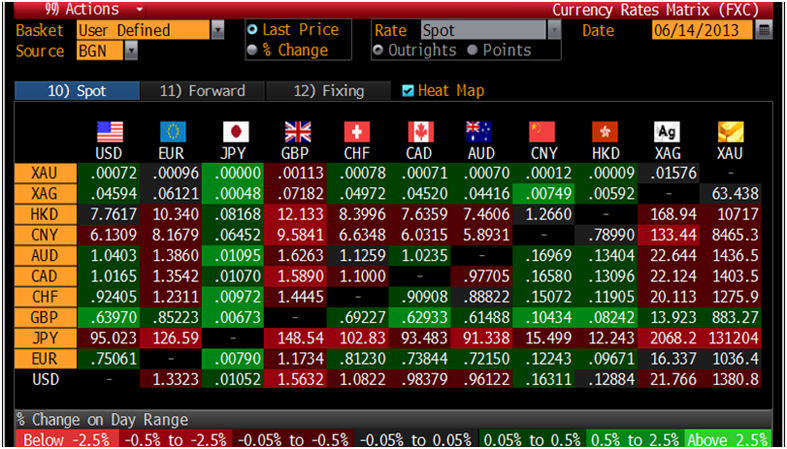
Cross Currency Table – (Bloomberg)
The most recent increase in duties on gold, curbing of gold financing and restrictions on gold imports by banks and state-run trading companies to a consignment basis in India have led to the expected short term decline in demand which may be contributing the gold’s inability to close above $1,400/oz.

Gold Adjusted For Inflation (CPI) 1970 to Today
James Steel, chief commodities analyst at HSBC in New York continues to be constructive on gold in the medium and long term and sees gold rising to $1,600/oz in the second half of 2013.
In a Bloomberg audio interview, Steel said that this year the gold market has been under pressure and has experienced a rotational shift out of commodities in general driven by the constant chatter of a tapering off in QE and experienced very steep declines in mid April. He likens it to a rugby scrum pulling back and forth near the $1/400oz level, between ETF outflows and strong physical demand for coins and bars, notably from China.
Steel said that in the past few weeks the heavy ETF outflows have died down, and prior to this year they were mostly static. The peak for ETF’s was 85M ounces at the end of last year. He says most institutions have already exited that wanted to get out.
Market chatter has been nervous about the unwinding of QE3. Steel points out that unwinding or paring back is very different than an exit. The Fed many need to do tapering for a long time before it ends their program.
Steel mentions that it was the jewellery market that drove the gold market in the past and now it is investment demand and demand from China. He believes gold will average is $1,542/oz and he is predicting a rally in the second half of the year up to $1,600/oz. Longer term, he is on record as saying that gold will rise to over $2,000/oz.

Gold in USD, 3 Year – (Bloomberg)
Steel has specific responsibilities for precious metals in HSBC and is one of the more astute analysts of the gold market working in the banks. He knows his financial, economic and monetary history.
Prior to joining HSBC in 2006, he ran the New York research department for Refco, a large US commodities brokerage house. Jim also worked for The Economist in the Economist Intelligence Unit covering commodity producing nations.
Unlike some widely covered ‘celebrity economists,’ Steel has a deep knowledge and understanding of supply and demand and the other fundamentals driving the gold market.
Subscribe to:
Posts (Atom)