Thursday, June 13, 2013

Beware of Patent Troll

By Katie Johnson
You’ve got options if a licensing agent demands a fee for scanning and e-mailing documents.
If your brokerage has been contacted by a company to pay a license for the right to scan a document to e-mail, you’re not alone. Real estate offices around the country have received letters from companies called AllLed, AdzPro, GanPan, and HeaPle, among others, claiming to have the exclusive right to send documents via e-mail from a multifunction copier machine, and demanding that you pay a licensing fee of $900 to $1,200 per employee before you can send a document.
Katie Johnson
Behind these demands is a company called MPHJ Technology Investments Inc., which owns several patents on the process of scanning or copying a document and sending it via e-mail from the same machine.
MPHJ is known as a nonpracticing entity, or patent troll, because it doesn’t produce anything; it merely asserts its rights to exclude others from using its patents. MPHJ has created about forty shell companies, usually with six-letter LLC names, to assert its patent rights.
Escalating Threats
It’s been widely reported that this patent troll has been targeting small and mid-sized businesses in a variety of industries in its effort to generate license fees by sending three standard demand letters through its shell companies. The initial letter is on company letterhead and requests a license fee. If that goes unanswered, a second letter is sent from a Texas law firm called Farney Daniels P.C. seeking a response and threatening legal action. If the second letter is ignored, a third letter is sent from the same firm and it contains a draft complaint that the firm threatens to file if a license agreement is not reached.
There is no evidence that MPHJ knows of any infringement before sending these letters. If you receive a letter, you should discuss your options with your legal counsel. Among the options to consider is:
  • Ignore the letter. We’re not aware of any case that has actually been filed against an alleged infringer.
  • Respond with a request for specifics. Ask why your equipment or software infringes the patents.
  • Deny in writing that there is any infringement.
  • Pay the license fee.
  • Challenge the patent’s validity. After all, the patented process of scanning a document and sending it via e-mail from the same machine is a common, widely accepted practice. To submit a challenge, you can file a declaratory judgment action against the patent troll in which you seek a ruling by a judge on the patents’ validity. One company in Louisiana is trying to do this right now with a lawsuit it filed in federal court in April.
However, a more effective approach might be to file what’s known as an inter partes review with the U.S. Patent and Trademark Office, asking it to invalidate the patents. The manufacturers of the machines that make this patented process possible have taken a great interest in MPHJ’s efforts because it is their customers who are being asked to pay the fee. So, Xerox, Ricoh, and Hewlett Packard have recently filed inter partes reviews.
In addition to these attempts to invalidate the patents, Vermont’s attorney general has recently filed a consumer fraud lawsuit against MPHJ, alleging the patent owner’s aggressive licensing campaign amounts to unfair and deceptive acts. Unfortunately, it could be a long time before there is an outcome to any of these legal proceedings. In the meantime, you’re encouraged to consult with your legal counsel and consider your options if this patent troll finds you.
Learn more in a 6-minute audio podcast presented by NAR Legal Affairs.

Everything Is Rigged: The Biggest Price-Fixing Scandal Ever

The Illuminati were amateurs. The second huge financial scandal of the year reveals the real international conspiracy: There's no price the big banks can't fix


Illustration by Victor Juhasz
April 25, 2013 1:00 PM ET
Conspiracy theorists of the world, believers in the hidden hands of the Rothschilds and the Masons and the Illuminati, we skeptics owe you an apology. You were right. The players may be a little different, but your basic premise is correct: The world is a rigged game. We found this out in recent months, when a series of related corruption stories spilled out of the financial sector, suggesting the world's largest banks may be fixing the prices of, well, just about everything.
You may have heard of the Libor scandal, in which at least three – and perhaps as many as 16 – of the name-brand too-big-to-fail banks have been manipulating global interest rates, in the process messing around with the prices of upward of $500 trillion (that's trillion, with a "t") worth of financial instruments. When that sprawling con burst into public view last year, it was easily the biggest financial scandal in history – MIT professor Andrew Lo even said it "dwarfs by orders of magnitude any financial scam in the history of markets."
That was bad enough, but now Libor may have a twin brother. Word has leaked out that the London-based firm ICAP, the world's largest broker of interest-rate swaps, is being investigated by American authorities for behavior that sounds eerily reminiscent of the Libor mess. Regulators are looking into whether or not a small group of brokers at ICAP may have worked with up to 15 of the world's largest banks to manipulate ISDAfix, a benchmark number used around the world to calculate the prices of interest-rate swaps.
Interest-rate swaps are a tool used by big cities, major corporations and sovereign governments to manage their debt, and the scale of their use is almost unimaginably massive. It's about a $379 trillion market, meaning that any manipulation would affect a pile of assets about 100 times the size of the United States federal budget.
It should surprise no one that among the players implicated in this scheme to fix the prices of interest-rate swaps are the same megabanks – including Barclays, UBS, Bank of America, JPMorgan Chase and the Royal Bank of Scotland – that serve on the Libor panel that sets global interest rates. In fact, in recent years many of these banks have already paid multimillion-dollar settlements for anti-competitive manipulation of one form or another (in addition to Libor, some were caught up in an anti-competitive scheme, detailed in Rolling Stone last year, to rig municipal-debt service auctions). Though the jumble of financial acronyms sounds like gibberish to the layperson, the fact that there may now be price-fixing scandals involving both Libor and ISDAfix suggests a single, giant mushrooming conspiracy of collusion and price-fixing hovering under the ostensibly competitive veneer of Wall Street culture.
The Scam Wall Street Learned From the Mafia
Why? Because Libor already affects the prices of interest-rate swaps, making this a manipulation-on-manipulation situation. If the allegations prove to be right, that will mean that swap customers have been paying for two different layers of price-fixing corruption. If you can imagine paying 20 bucks for a crappy PB&J because some evil cabal of agribusiness companies colluded to fix the prices of both peanuts and peanut butter, you come close to grasping the lunacy of financial markets where both interest rates and interest-rate swaps are being manipulated at the same time, often by the same banks.
"It's a double conspiracy," says an amazed Michael Greenberger, a former director of the trading and markets division at the Commodity Futures Trading Commission and now a professor at the University of Maryland. "It's the height of criminality."
The bad news didn't stop with swaps and interest rates. In March, it also came out that two regulators – the CFTC here in the U.S. and the Madrid-based International Organization of Securities Commissions – were spurred by the Libor revelations to investigate the possibility of collusive manipulation of gold and silver prices. "Given the clubby manipulation efforts we saw in Libor benchmarks, I assume other benchmarks – many other benchmarks – are legit areas of inquiry," CFTC Commissioner Bart Chilton said.
But the biggest shock came out of a federal courtroom at the end of March – though if you follow these matters closely, it may not have been so shocking at all – when a landmark class-action civil lawsuit against the banks for Libor-related offenses was dismissed. In that case, a federal judge accepted the banker-defendants' incredible argument: If cities and towns and other investors lost money because of Libor manipulation, that was their own fault for ever thinking the banks were competing in the first place.
"A farce," was one antitrust lawyer's response to the eyebrow-raising dismissal.
"Incredible," says Sylvia Sokol, an attorney for Constantine Cannon, a firm that specializes in antitrust cases.
All of these stories collectively pointed to the same thing: These banks, which already possess enormous power just by virtue of their financial holdings – in the United States, the top six banks, many of them the same names you see on the Libor and ISDAfix panels, own assets equivalent to 60 percent of the nation's GDP – are beginning to realize the awesome possibilities for increased profit and political might that would come with colluding instead of competing. Moreover, it's increasingly clear that both the criminal justice system and the civil courts may be impotent to stop them, even when they do get caught working together to game the system.
If true, that would leave us living in an era of undisguised, real-world conspiracy, in which the prices of currencies, commodities like gold and silver, even interest rates and the value of money itself, can be and may already have been dictated from above. And those who are doing it can get away with it. Forget the Illuminati – this is the real thing, and it's no secret. You can stare right at it, anytime you want.

“Somebody” Bought Stocks on Thursday Because “Somebody” is Terrified

by Phoenix Capital Research
“Somebody” moved in to support stocks last week on Thursday.

The 50-DMA has become the “line in the sand” on the S&P 500. Anytime the market has come close to breaching this level in the last few months, “someone” has stepped in and propped the market up.


It’s pretty clear who the “someone” is. Given that the Fed is openly citing the stock market as an indication that QE is working… and given that every other metric shows QE is a total failure…

With that in mind, last Thursday’s action and the follow through Friday should be seen as a clear intervention.

This will end very very badly.

·      Margin debt levels (meaning debt that investors take on to buy stocks) are at record highs.

·      Hedge fund stock ownership is at levels last seen before the 2008 Crash.

·      We’ve had multiple Hindenberg Omens (signs of a potential Crash).

All of the signs are in place: the market has become a complete bubble. When you compare the market to its fundamentals, it’s arguably an even worse than the bubble that brought about the 2008 collapse.
Take a look at the divergence between stocks and Copper. Stocks could fall over 20% before they’d realign.


For insights on how to prepare your portfolio for this, visit us at:
http://gainspainscapital.com/protect-your-portfolio/
Best Regards
Graham Summers

Goldman Sachs Predicts Bond Crash! “Quite Ugly Days Ahead”! Pimco Sees 60% Chance of Global Recession in Five Years!

Jim O’Neill: Get ready for 4% bond yields, ‘quite ugly days’
Bond yields are headed near 4% and not even Fed Chairman Ben Bernanke can stop the “inevitable shock” that’s coming.
That’s a fresh view from Goldman Sachs’ s former chief economist Jim O’Neill, writing an op/ed column for Bloomberg on Wednesday, entitled, “Can Bernanke avoid a meltdown in the bond market?”
His answer? Not really.
http://blogs.marketwatch.com/thetell/2013/06/12/jim-oneill-get-ready-for-4-bond-yields-quite-ugly-days/?mod=WSJBlog&utm_source=feedly
Pimco Sees 60% Chance of Global Recession in Five Years
“The global economy experiences a recession every six years or so, and the frequency of global recessions tends to increase when global indebtedness is high and falling as opposed to when indebtedness is low and rising,”

http://www.bloomberg.com/news/2013-06-11/pimco-sees-60-chance-of-global-recession-in-five-years.html

Market Update: Easy Come, Immediately Go!!! DOW JUST LOOSE +100 POINTS IN HALF AN HOUR!!! Greek Bonds On Verge of Bear Market!!!

zerohedge‏@zerohedge2 min
POMO begins: smallest of the month at $0.75 – $1.00 billion
zerohedge‏@zerohedge3 min
Banca Pop Milano halted down
Gregor Peter‏@L0gg0l2 min
reason for sell-off: $$ rumor — Greek govt in emergency cabinet meeting

zerohedge‏@zerohedge1 min
Greek bonds on verge of bear market

zerohedge‏@zerohedge3 min
Restart Greek TV or the Eurozone gets it
Gregor Peter‏@L0gg0l1 min
GREEK PM SAMARAS TO ASK FOR VOTE OF CONFIDENCE IN PARLIAMENT AS GOVT COALITION CRUMBLES — @stokokkino1055 h/t @YanniKouts

Market Update: Easy Come, Immediately Go 

everywhere…


The potential catalyst this morning (via ekathimerini):
Earlier, PASOK issued a statement saying that Samaras had raised the possibility of closing down ERT during a meeting with Kouvelis and Venizelos on Sunday. Samaras, PASOK, claimed said this was the only way Greece would meet its commitment to the troika to fire 2,000 civil servants this summer so it could qualify for more bailout loans.PASOK claims that Kouvelis and Venizelos voiced their objections. The legislative act has not been signed by any of their ministers. Sources at Democratic Left told Kathimerini that if the government collapses as a result of ERT’s closure, it would be Samaras’s fault.
Greek bonds are now -17% from their highs 2 weeks ago and Greek stocks -25%!!
http://www.zerohedge.com/news/2013-06-12/market-update-easy-come-immediately-go

Things In Greece Are Once Again Going Bump In The Trading Day
We have been gently reminding readers for the last few weeks that Greek bonds and stocks have not been dancing to the same tune as the European Union’s leaders’ proclamations of victory but today it seems the fears are spilling over into other assets. With the closure of the nation’s state-owned TV station ERT, it seems the coalition is rapidly coming unglued. The highest of high beta liquidity-fueled momentum dash-for-trash trades are discovering that large crowds and small doors don’t mix as the marginal ‘flow’ is slowing (or feared to slow). Greek stocks are now notably underwater for the year (after being up almost 28%) and Greek bonds are down almost 17% from their highs just a few weeks ago…


http://www.zerohedge.com/news/2013-06-12/things-greece-are-once-more-going-bump-trading-day
Luis

“Tug of War” in Gold and Silver, “Blame Bernanke” for Recent Volatility in Markets

London Gold Market Report
from Ben Traynor, BullionVault
Wednesday 12 June 2013, 08:45 EDT

“Tug of War” in Gold and Silver, “Blame Bernanke” for Recent Volatility in Markets

GOLD PRICES hovered just below $1380 an ounce Wednesday morning in London, with silver trading around $21.80, after the metals failed to break through $1380 and $22 respectively.

European stock markets ticked higher by lunchtime – with the exception of Germany’s DAX – regaining some of yesterday’s losses, which were followed by sell offs in the US and Asia.

Commodities ticked higher this morning while US Treasury bond prices fell ahead of an auction of 10-year debt later today.

“The gold price is unable to recover despite a weaker US Dollar and falling equity markets,” says this morning commodities note from Commerzbank.

“The dominant subject on the gold market continues to be the possibility of a premature withdrawal of bond purchases by the US Federal Reserve…in our view, the figures available so far do not constitute any reason to scale back QE3 in the near future.”

“There’s a tug of war between investors putting money into gold and taking it out,” adds Bernard Sin, head of currency and metal trading at Swiss refiner MKS, who also cited concerns among investors “worried about is if there’s no more quantitative easing”.

“With the Chinese out [on holiday] until Thursday,” adds a note from ANZ, “the [gold] market is lacking a key stabilizing factor.”

Since falling sharply in April, gold has swung either side of $1400 an ounce, with the gold price falling as low as $1337 and as high as $1478. Silver has also oscillated, while stock markets have retreated after hitting multi-year, or in some cases record, highs last month, with Japan’s Nikkei especially hard hit.

“We think the recent volatility can be mostly traced to [Fed] Chairman Bernanke’s rather unconvincing testimony in front of Congress a few weeks ago when he failed to clarify exactly when the Federal Reserve’s bond buying program will be pared back,” says a note from INTL FCStone metals analyst Ed Meir.

“Markets have been on edge ever since, with the global bond market in particular getting hammered.”

An auction of 10-year US Treasury bonds later today is set to see benchmark yields above the inflation rate for the first time in 18 months, the Financial Times reports.

The market yield on 10-year Treasuries has risen from 1.6% at the start of last month to nearly 2.3% yesterday. Treasury Inflation Protected Securities (Tips), the price of which is linked to inflation, have also seen yields rise sharply in recent weeks. Bond yields move inversely to bond prices, with rising yields indicating investor selling.

“We have known for some time that Tips were overvalued, and the reversal has happened very quickly,” James Evans, senior vice president at Brown Brothers Harriman, tells the FT.

“Rightly or wrongly, the bond market has pulled forward the end of QE and rate hikes coming as early as 2014. It does seem premature.”

“The bond market seems to be missing the point that the Fed’s policy of tapering [i.e. slowing the pace of QE asset purchases] depends on the tone of economic data,” adds Barclays interest rate strategist Michael Pond.

“The market has moved from pricing in less bond buying [by the Fed] to a full-on tightening cycle and we believe that is a different story than what the Fed is trying to communicate.”

“Recent weeks suggest that transparency [from the Fed] doesn’t mean clarity,” says Jim O’Neill, former chairman at Goldman Sachs Asset Management, in a column for Bloomberg View.

“The Fed can talk about ‘tapering’ QE all it likes; it can’t change the basic laws of economics and valuation. A rise in the benchmark yield to 4% would represent normality even if inflation expectations stayed well controlled.”

“While it might be easier to detail the ‘deserved’ casualties of the last month, or more, finding the undeserved casualties might not be quite so obvious,” says this morning’s note from the currencies team at Standard Bank.

“In our view these are assets where the selling has been more a function of position unwinding than any significant change in the fundamentals that underlie the market.”

India’s government does not see the need for any further measures to restrict gold imports, according to the country’s economic affairs secretary Arvind Mayaram.

India, the world’s biggest gold buying nation, raised import duties on gold to 8%last week, and has imposed restrictions on importing on consignment.

Ben Traynor

Banks Rig $4.7 Trillion A Day Currency Markets To Profit Off Clients

by GoldCore


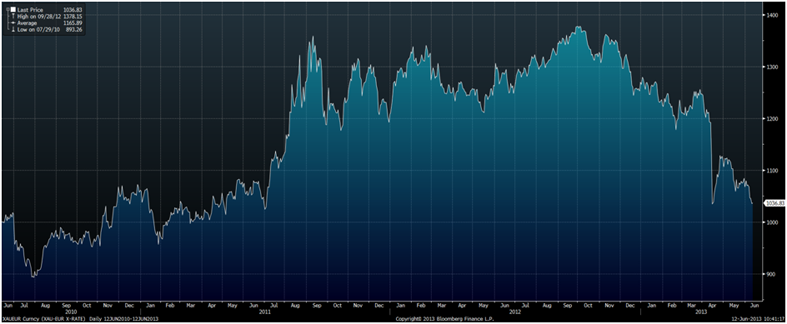
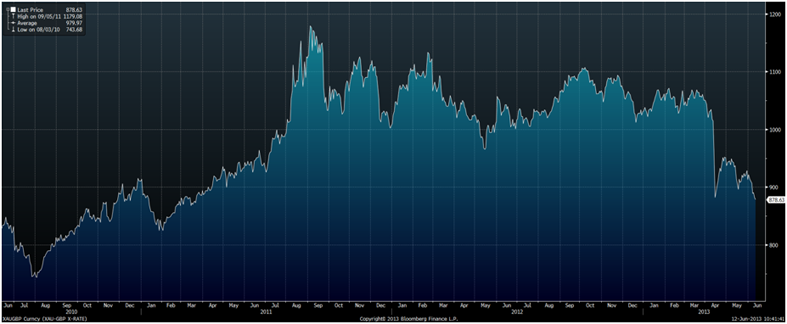
Today’s AM fix was USD 1,377.25, EUR 1,036.77 and GBP 878.40 per ounce.
Yesterday’s AM fix was USD 1,369.50, EUR 1,031.10 and GBP 880.93 per ounce.
Gold fell $6.70 or 0.48% yesterday to $1,378.70/oz and silver slid to $21.49 and finished down 1.19%.

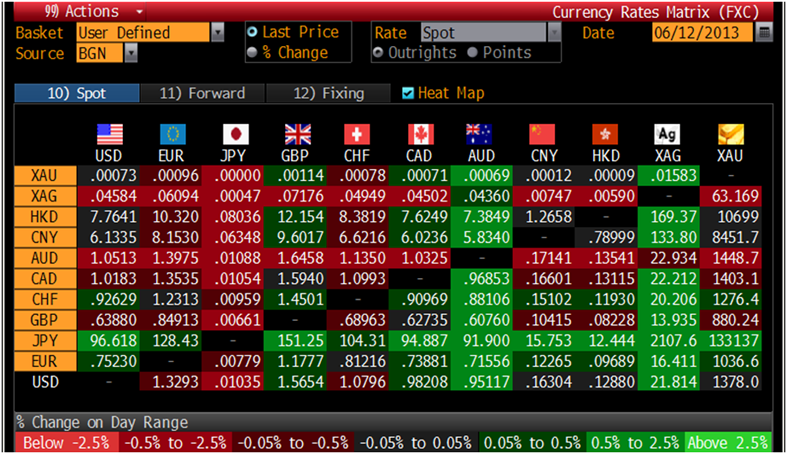
Cross Currency Table – (Bloomberg)

Gold prices are mixed today and while flat in US dollars are lower in Aussie dollars and higher in Japanese yen which has taken another pummelling on foreign exchange markets.
The world’s biggest banks have been manipulating benchmark foreign-exchange rates used to set the value of trillions of dollars of investments, according to a Bloomberg investigation.
Employees have been front-running client orders and rigging WM/Reuters rates by pushing through trades before and during the 60-second windows when the benchmarks are set, said five current and former traders, who requested anonymity because the practice is controversial.
Dealers colluded with counterparts to boost chances of moving the rates, said two of the people, who worked in the industry for a total of more than 20 years.
The behavior occurred daily in the spot foreign-exchange market and has been going on for at least a decade, affecting the value of funds and derivatives and all investments.
The Financial Conduct Authority, Britain’s markets supervisor, is considering opening a probe into potential manipulation of the rates, according to a person briefed on the matter.
Informed observers have long warned that the global $4.7-trillion-a-day foreign exchange market, the biggest in the financial system has all the hallmarks of a casino.
The inherent conflict banks face between executing client orders and profiting from their own trades is exacerbated because most currency trading takes place away from exchanges.

Gold in Euros, 3 Year – (Bloomberg)

The FCA already is working with regulators worldwide to review the integrity of benchmarks, including those used in valuing derivatives and commodities, after three lenders were fined about $2.5 billion for rigging the London interbank offered rate, or Libor. Regulators also are investigating benchmarks for the crude-oil and swaps markets.
“The price mechanism is the anchor of our entire economic system,” said Tom Kirchmaier, a fellow in the financial-markets group at the London School of Economics. “Any rigging of the price mechanism leads to a misallocation of capital and is extremely costly to society.”
The benchmarks are based on actual trades or quotes, rather than the bank estimates used to calculate Libor. Still, they’re susceptible to rigging, according to the five traders, who said they had engaged in or witnessed the practice.
The traders interviewed by Bloomberg News declined to identify which banks engaged in manipulative practices and didn’t specifically allege that any of the top four firms were involved. Spokesmen for Deutsche Bank, Citigroup, Barclays and UBS declined to comment.
It is becoming increasingly evident that many key financial markets are being rigged and manipulated by banks and central banks today. Some of the manipulation is overt, some is covert.
The world’s largest banks are fixing prices in many key markets and benchmarks which is affecting the value of money itself and will ultimately leading to the value of money in your pocket becoming worth much less.
It is distorting markets and leading to a false sense of security and unwarranted and dangerous risk appetite.
It leads to a heightened risk of market dislocations, market crashes and monetary crisis. It could also lead to the much anticipated default on the COMEX as more and more nervous investors, individual and institutional, opt to take delivery of physical bullion.
This makes owning physical gold in your possession or in a vault that you can ship from at will more vitally important than ever before.

Gold In British Pounds, 3 Year – (Bloomberg)

Comex, Nymex Gold Delivery Issues, Stops for June 11
The following is a table detailing daily issues and stops related to deliveries of gold against expiring contracts traded on the Comex or the New York Mercantile Exchange for June 11, according to CME Group Inc.
The notices reflect the movement of metals to offset each long or short futures position with supplies held in exchange-monitored warehouses. Issuers are making deliveries, and stoppers are taking deliveries.
=============================================================================
June 11    June 10      June 7   June 6     June 5    June 4
2013         2013        2013       2013       2013      2013
=============================================================================
————————– Gold —————————-
Issues/stops           18        195               132        318        826       333
Month to date      7,871      7,853           7,658      7,526      7,208     6,382
Settlement        1,377.0    1,386.2        1,383.0    1,415.7    1,398.4   1,397.1
Delivery date    06/13/13   06/12/13   06/11/13   06/10/13   06/07/13  06/06/13
Contract        June 2013  June 2013  June 2013  June 2013  June 2013 June 2013
=============================================================================
June 11    June 10     June 7     June 6     June 5    June 4
2013       2013       2013       2013       2013      2013
=============================================================================
SOURCE: CME Group Inc. via Bloomberg
Comex Issues and Stops of Silver by Firm for June 11 (Table)
The following is a table detailing daily issues and stops by company related to deliveries of silver against expiring contracts traded on the Comex, according to CME Group Inc.
The notices reflect the movement of silver to offset each long or short futures position with supplies held in exchange-monitored warehouses. Issuers are making deliveries, and stoppers are taking deliveries.
======================================================================
Account       Firm                               Issued    Stopped
======================================================================
———————-  June 11  ———————–
Daily Total                               55         55
Month to Date                                     90
———————————————————————
House         Nova Scotia                       0         21
Customer      JP Morgan                     36          0
House         JP Morgan                        19          0
Customer      ABN Amro                        0         34
======================================================================
Account       Firm                               Issued    Stopped
======================================================================
———————-  June 10  ———————–
Daily Total                                  2          2
Month to Date                                      35
———————————————————————
House         Nova Scotia                        0          2
Customer      JP Morgan                       2          0
———————-  June 5  ———————–
Daily Total                               11         11
Month to Date                                       33
———————————————————————
House         Nova Scotia                         0          8
Customer      JP Morgan                        0          3
Customer      ABN Amro                      11          0
———————-  May 31  ———————–
Daily Total                                  2          2
Month to Date                                      22
———————————————————————
House         Nova Scotia                       0          2
======================================================================
Account       Firm                               Issued    Stopped
======================================================================
Customer      PTG Div. Newedge          2          0
———————-  May 30  ———————–
Daily Total                                  20         20
Month to Date                                         20
———————————————————————
Customer      Merrill                                  5          0
House         Nova Scotia                          0         13
Customer      JP Morgan                          0          5
House         JP Morgan                           15          0
Customer      PTG Div. Newedge           0          2
======================================================================
SOURCE: CME Group Inc. via Bloomberg