Those who believe the economy is recovering are ignorant of the
facts. Other than the Great Depression no US recovery (and I don’t
believe we are in a recovery) taken longer. Eventually it may take more
than a decade like the 1930s. Or perhaps it will be like Japan which is
in its third decade of “recovery.”
Politics and Economics
The truth is that our economy is spent, exhausted and filled
with misallocations and distortions made much worse by government
interventions. There is no recovery, nor will there be one
until a massive purge (usually referred to as a depression) occurs. This
event will result in bankruptcies that release scarce, misallocated
physical capital from unproductive and unwanted areas to places where it
is needed and can be utilized efficiently.
Rather than allow this pre-condition to an economic recovery and a
growing, efficient economy, politicians want to prevent it. They use
smoke, mirrors and propaganda (lies) to hide the reality of our sick
economy. Their obfuscations continue, but the effective life is limited.
What politicians do to the country beyond their term in office means
nothing to them. Their concern is only for themselves and the short-term
that exists between elections. As a result they rob from the future to
hide the true conditions of the present. Those still unborn will be
paying for their criminal economic charade.
Wednesday, June 12, 2013

World from Berlin: Prism Spying 'Attacks Basic Civil Rights'


DPA
The National Security Agency (NSA) headquarters in Fort Meade, Maryland.
The world has been scandalized
to learn about Prism, the broad data surveillance program used by the US
at home and abroad. German commentators say that both Berlin and
Brussels must defend Europe from this invasion of privacy.
Revelations about a far-reaching intelligence program in the United
States leaked last week aren't just causing problems for President
Barack Obama at home. While American citizens are left wondering whether
their privacy has been violated by the Internet and phone surveillance,
officials abroad are expressing serious concerns too.
Germany, which has particularly strict data privacy laws, is reportedly one of the most heavily monitored countries in the surveillance program, and Justice Minister Sabine Leutheusser-Schnarrenberger demanded an explanation on Tuesday. "The suspicion of excessive surveillance of communication is so alarming that it cannot be ignored," she wrote in an editorial for SPIEGEL ONLINE. "For that reason, openness and clarification by the US administration itself should be paramount at this point. All facts must be put on the table." Merkel To Address Issue with Obama
The day before, Chancellor Angela Merkel's spokesman Steffen Seibert said the German leader would discuss the matter with President Obama when he makes his first state visit to Berlin as president later this month. Obama has defended the spying program as a "modest encroachment" on privacy.
German Consumer Protection Minister Ilse Aigner has also called for "clear answers" from the companies implicated in the government document leak, and the Green Party demanded an immediate investigation by the German government.
"Total surveillance of all German citizens by the NSA is completely disproportionate," Volker Beck, secretary of the Green Party group in parliament, said on Monday.
Strong Reaction from Europe
European politicians are also worried about the surveillance, which the European Parliament planned to debate on Tuesday. Officials in Brussels reportedly plan to discuss the matter with US diplomats at a trans-Atlantic ministerial meeting later this week in Dublin.
"It would be unacceptable and would need swift action from the EU if indeed the US National Security Agency were processing European data without permission," Guy Verhofstadt, a Belgian member of the European Parliament and a leader in the Alde group of liberal parties, told the Associated Press on Tuesday.
At issue is a large-scale, top-secret program, codenamed Prism, undertaken by the National Security Agency (NSA), an American foreign intelligence agency. It tracks suspicious messages from outside the United States that are transmitted through American providers such as Google, Yahoo, Facebook and Skype, including emails, phone numbers, videos, photos and other forms of online communication.
Details of the program were leaked by Edward Snowden, a 29-year-old former CIA employee who worked as a contractor for Booz Allen Hamilton at the NSA. There he had access to the documents about the counterterrorism surveillance, which he gave to the Guardian and Washington Post before going into hiding in Hong Kong, where he revealed his identity on Sunday. US authorities are now reviewing whether Snowden can be prosecuted for what some politicians there have called a treasonous act.
The scandal has revealed state surveillance of a previously unimaginable scope by the US both at home and abroad, the latter of which is of particular concern to German commentators on Tuesday.
Center-left daily Süddeutsche Zeitung writes:
"It may be that US citizens can defend themselves under the US Constitution. But that doesn't apply to foreigners. Facebook users in Germany have as little protection from the US Constitution as those in Afghanistan. Germany is the country in Europe whose telephone and Internet communications are being spied on the most intensely by the US. ... But even the best rulings from Germany's high court are useless because the majority of the Internet's architecture is located in the US. As a consequence, US authorities have the power of access, and this is stronger than basic German rights."
"The NSA case shows the expansiveness of preventive security state logic. Those who want to prevent crimes and terrorism -- whatever the cost -- can never know enough, and will always try to find out more in the name of security. Under the reign of terrorism, the legal system is changing. To track down the 'bad guys,' the entire population is being spied on with sophisticated methods in which intelligence agencies, police and possibly private networks are all cooperating. The US is a pioneer in introducing an infrastructure of surveillance."
"The only good thing about the NSA spying is that it exposes the principle tenet of domestic security that has been used to justify the rebuilding of the security system since Sept. 11, 2001: That those with nothing to hide have nothing to fear. This is simply a stupid idea."
Left-leaning Berliner Zeitung writes:
"The chancellor's spokesman Steffen Seibert has now officially announced that Merkel will question Obama when he visits about the apparent systematic spying, particularly of German Internet users, by US intelligence. This is the least that citizens should expect. But more than that, the issue here is the protection of the federal government from total surveillance by a foreign state, no matter how friendly it may be."
"Germany has strict privacy laws -- even if many people now flaunt their data in a practically exhibitionist fashion on social networks. But that is their choice, after all. The federal government must explain what they intend to do about the immoderate and unwarranted clandestine surveillance of its citizens by American intelligence agencies. And whether the German services know about and possibly use this illegally acquired knowledge."
Left-leaning Die Tageszeitung writes:
"Basic civil rights around the world, which are taken for granted far too naively in Western democracies, are being placed under attack by state 'security architecture' such as the US spying program Prism. In Germany -- where the relatively recent examples of two totalitarian state systems mean that the consequences of state monitoring in the private sector are still in living memory -- three things must result from this: clarification of the situation, defense and self-protection."
"It is right that the opposition has called for a radical review by the governmnent. But it is already foreseeable that the questions about what German intelligence knew will be rejected under the usual pretexts. The most popular argument is that the government best decides alone what kind of surveillance doesn't harm the public. Obama makes a similar argument about the need for monitoring measures by his intelligence agencies. But the German government shouldn't make the same argument. It may sound utopian, but it would be appropriate to offer fugitive whistleblower Edward Snowden political asylum in Germany."
Conservative daily Frankfurter Allgemeine Zeitung writes:
"Whether it's with Facebook, Google, Yahoo or Microsoft -- user
confidence has been shaken. According to statements made by the source
of the revelations, Snowden, all users should be asking whether they
themselves, and especially their personal data, are in good hands with
these companies."
"For years, German Internet providers have complained among
themselves about the tough data protection laws to which they are
subject in the European Union. At the same time, they looked enviously
at their American counterparts, who are obviously subject to very
flexible data protection rules. But these days could be over now.
European providers should take advantage of their data protection
requirements as a unique selling point."
"But not all consumers are responsible enough to consciously choose services with strict privacy policies -- many are far too complacent for that. And herein lies a challenge for European policy, which should reconsider agreements with the US such as the 'Safe Harbor' data protection program in light of recent events. It says that European companies can transfer personal data from their own customers to America without hesitation -- because until now the country was considered safe. Even if customers are not affected by the current scandal, this much is clear: America is no longer quite as secure as a secure data port."
-- Kristen Allen
Germany, which has particularly strict data privacy laws, is reportedly one of the most heavily monitored countries in the surveillance program, and Justice Minister Sabine Leutheusser-Schnarrenberger demanded an explanation on Tuesday. "The suspicion of excessive surveillance of communication is so alarming that it cannot be ignored," she wrote in an editorial for SPIEGEL ONLINE. "For that reason, openness and clarification by the US administration itself should be paramount at this point. All facts must be put on the table." Merkel To Address Issue with Obama
The day before, Chancellor Angela Merkel's spokesman Steffen Seibert said the German leader would discuss the matter with President Obama when he makes his first state visit to Berlin as president later this month. Obama has defended the spying program as a "modest encroachment" on privacy.
German Consumer Protection Minister Ilse Aigner has also called for "clear answers" from the companies implicated in the government document leak, and the Green Party demanded an immediate investigation by the German government.
"Total surveillance of all German citizens by the NSA is completely disproportionate," Volker Beck, secretary of the Green Party group in parliament, said on Monday.
Strong Reaction from Europe
European politicians are also worried about the surveillance, which the European Parliament planned to debate on Tuesday. Officials in Brussels reportedly plan to discuss the matter with US diplomats at a trans-Atlantic ministerial meeting later this week in Dublin.
"It would be unacceptable and would need swift action from the EU if indeed the US National Security Agency were processing European data without permission," Guy Verhofstadt, a Belgian member of the European Parliament and a leader in the Alde group of liberal parties, told the Associated Press on Tuesday.
At issue is a large-scale, top-secret program, codenamed Prism, undertaken by the National Security Agency (NSA), an American foreign intelligence agency. It tracks suspicious messages from outside the United States that are transmitted through American providers such as Google, Yahoo, Facebook and Skype, including emails, phone numbers, videos, photos and other forms of online communication.
Details of the program were leaked by Edward Snowden, a 29-year-old former CIA employee who worked as a contractor for Booz Allen Hamilton at the NSA. There he had access to the documents about the counterterrorism surveillance, which he gave to the Guardian and Washington Post before going into hiding in Hong Kong, where he revealed his identity on Sunday. US authorities are now reviewing whether Snowden can be prosecuted for what some politicians there have called a treasonous act.
The scandal has revealed state surveillance of a previously unimaginable scope by the US both at home and abroad, the latter of which is of particular concern to German commentators on Tuesday.
Center-left daily Süddeutsche Zeitung writes:
"It may be that US citizens can defend themselves under the US Constitution. But that doesn't apply to foreigners. Facebook users in Germany have as little protection from the US Constitution as those in Afghanistan. Germany is the country in Europe whose telephone and Internet communications are being spied on the most intensely by the US. ... But even the best rulings from Germany's high court are useless because the majority of the Internet's architecture is located in the US. As a consequence, US authorities have the power of access, and this is stronger than basic German rights."
"The NSA case shows the expansiveness of preventive security state logic. Those who want to prevent crimes and terrorism -- whatever the cost -- can never know enough, and will always try to find out more in the name of security. Under the reign of terrorism, the legal system is changing. To track down the 'bad guys,' the entire population is being spied on with sophisticated methods in which intelligence agencies, police and possibly private networks are all cooperating. The US is a pioneer in introducing an infrastructure of surveillance."
"The only good thing about the NSA spying is that it exposes the principle tenet of domestic security that has been used to justify the rebuilding of the security system since Sept. 11, 2001: That those with nothing to hide have nothing to fear. This is simply a stupid idea."
Left-leaning Berliner Zeitung writes:
"The chancellor's spokesman Steffen Seibert has now officially announced that Merkel will question Obama when he visits about the apparent systematic spying, particularly of German Internet users, by US intelligence. This is the least that citizens should expect. But more than that, the issue here is the protection of the federal government from total surveillance by a foreign state, no matter how friendly it may be."
"Germany has strict privacy laws -- even if many people now flaunt their data in a practically exhibitionist fashion on social networks. But that is their choice, after all. The federal government must explain what they intend to do about the immoderate and unwarranted clandestine surveillance of its citizens by American intelligence agencies. And whether the German services know about and possibly use this illegally acquired knowledge."
Left-leaning Die Tageszeitung writes:
"Basic civil rights around the world, which are taken for granted far too naively in Western democracies, are being placed under attack by state 'security architecture' such as the US spying program Prism. In Germany -- where the relatively recent examples of two totalitarian state systems mean that the consequences of state monitoring in the private sector are still in living memory -- three things must result from this: clarification of the situation, defense and self-protection."
"It is right that the opposition has called for a radical review by the governmnent. But it is already foreseeable that the questions about what German intelligence knew will be rejected under the usual pretexts. The most popular argument is that the government best decides alone what kind of surveillance doesn't harm the public. Obama makes a similar argument about the need for monitoring measures by his intelligence agencies. But the German government shouldn't make the same argument. It may sound utopian, but it would be appropriate to offer fugitive whistleblower Edward Snowden political asylum in Germany."
Conservative daily Frankfurter Allgemeine Zeitung writes:
"But not all consumers are responsible enough to consciously choose services with strict privacy policies -- many are far too complacent for that. And herein lies a challenge for European policy, which should reconsider agreements with the US such as the 'Safe Harbor' data protection program in light of recent events. It says that European companies can transfer personal data from their own customers to America without hesitation -- because until now the country was considered safe. Even if customers are not affected by the current scandal, this much is clear: America is no longer quite as secure as a secure data port."
Texas Gov. Rick Perry launches ad campaign to poach jobs from New York, Connecticut
 New York Post – by BETH DEFALCO
ALBANY — Them’s fightin’ words!
Texas Gov. Rick Perry is looking to lasso some East Coast business for his low-tax Lone Star State with a new $1 million ad campaign and trip next week to the Big Apple and Connecticut.
Perry has already begun airing ads on NY1 ahead of his June 16 visit.
“Texas is calling. Your opportunity awaits,” Perry says at the end of the spot, which is filled with testimonials from Texas workers.
The ad buy, paid for by a public-private organization controlled by the governor, features two 30-second spots which are also slated to run on ESPN, CNN and other cable channels in the tristate area for a week, according to a statement from Perry’s office.
The visit follows previous excursions to California and Illinois, where Perry also urged business owners there to relocate to Texas, the second-most-populous state.
The commercials feature Texans “from all walks of life — from small-business owners and doctors, to top researchers and filmmakers,” Perry said.
While here, Republican Perry — who ran for president in 2012 and may do so again in 2016 — will meet with business leaders in the firearms, pharmaceutical and financial industries to tell them about the lower taxes and costs of living in Texas.
New York businesses already know everywhere else is cheaper. The state ranks dead last in sales-tax climate, according to the non-profit Tax Foundation, while Texas breaks the Top 10.
Texas has no personal income tax, while New York levies a personal income tax ranging from 4 percent to 8.8 percent.
“The main challenge for Texas will be figuring what to leave out of the commercial,” said E.J. McMahon, of the Manhattan Institute. “How will they condense all those advantages into 30-second spots?”
McMahon joked that Perry won’t need a very creative ad agency, but said that the greatest advantages come not from relocating individual businesses, but from businesses branching out and opening facilities in new states.
In February, Perry began running ads in California and Illinois, trying to lure people with promises of fewer regulations, lower taxes and less red tape.
His Web site compares the cost of doing business in Texas with those in New York, Connecticut, Illinois and California.
Some of New York’s newest regulations are already making it hard for businesses. Gun manufacturers in New York may be even more eager than other businesses to move following Gov. Cuomo’s tough new gun-control laws passed in January.
Dayton T. Brown Inc., which has tested weapons, armor and other equipment for the military, government agencies and businesses, for decades on Long Island, has said that at least one gun manufacturer won’t ship weapons to it out of fear of breaking the new law against assault weapons.
The New York law has exemptions for manufacturers but not weapon testers.
Democratic California Gov. Jerry Brown quipped that Perry’s ads created “barely a fart,” saying they had no impact on the Golden State’s business economy.
Conservatives Pop the Bubbly: Obama Nominates America’s Biggest Walmart Enthusiast as Chief Economic Advisor
On June 10, 2013, President Obama announced his intention to nominate
Jason Furman to become the next Chairman of the Council of Economic
Advisers. This is a big-time, highly influential post. So what kind of
economist is Furman?
For Furman, Walmart is nothing short of a miracle for America’s poor and working class folks. For him, progressives should be cheering the firm: he even wrote a 16-page paper entitled: ” Wal-Mart: A Progressive Success Story,” which was posted on the Center for American Progress website. Here’s a sample of Furmanomics:
“By acting in the interests of its shareholders, Wal-Mart has innovated and expanded competition, resulting in huge benefits for the American middle class and even proportionately larger benefits for moderate-income Americans.”
Furman has championed the company’s low prices as a big boost to lower-income folks, and views WalMart jobs as good opportunities, never mind the low wages. In 2006, Jason Furman wrote a letter to author Barbara Erhenreich, published on Slate, in which he extolled the Walmart business model:
“A range of studies has found that Wal-Mart’s prices are 8 percent to 39 percent below the prices of its competitors. The single most careful economic study, co-authored by the well-respected MIT economist Jerry Hausman, found that grocery sales by Wal-Mart and other big-box stores made consumers better off to the tune of 25 percent of food consumption. That doesn’t mean much for those of us in the top fifth of the income distribution—we spend only about 3.5 percent of our income on food at home and, at least in my case, most of that shopping is done at high-priced supermarkets like Whole Foods. But that’s a huge savings for households in the bottom quintile, which, on average, spend 26 percent of their income on food. In fact, it is equivalent to a 6.5 percent boost in household income—unless the family lives in New York City or one of the other places that have successfully kept Wal-Mart and its ilk away.”
In Furman’s view, “the US productivity miracle and the emergence of Wal-Mart-style retailing are virtually synonymous.”
For the man who will have President Obama’s ear on vital matters like, well, jobs, the evidence of whether Walmart’s wages and benefits are substandard is “murky.” And he doesn’t much care for those who question WalMart’s approach: In the 2006 dialogue with Erhenreich on Slate, he upbraided activists who had pushed the firm to increase wages and offer better benefits:
“The collateral damage from these efforts to get Wal-Mart to raise its wages and benefits is way too enormous and damaging to working people and the economy more broadly for me to sit by idly and sing ‘Kum-Ba-Ya’ in the interests of progressive harmony.”
Unsurprisingly, most progressives do not share Furman’s rosy view of Walmart. As activist and philanthropist Leo Hindery, Jr. wrote in his article “ WalMart’s Giant Sucking Sound,” the company’s business model has been detrimental to the American economy and sucks the vitality our of our communities.
Progressives may be unhappy about Obama’s choice, but conservatives are tickled pink. Over at the American Enterprise Institute, home to the country’s most fervent free market fundamentalists, no less than eleven economists have announced their support for the Jason Furman nomination: “We are pleased that President Obama … nominated … Furman …Although we often disagree with the administration’s policies and differ with Jason on a number of issues, we respect him as a superb analytical economist. If the Senate confirms his nomination to be the president’s chief economic adviser, we are confident that he will serve the president and the nation with distinction.”
This article originally appeared on: AlterNet
Detroit pension funds adviser to pay $3.1 million to settle SEC case
A Florida businessman has agreed to pay nearly $3.1 million to
settle claims that he secretly stole millions of dollars from a City of
Detroit pension fund to buy two shopping malls in California, according
to a court filing today by the U.S. Securities and Exchange Commission.
The SEC announced the settlement on the same day it filed a civil lawsuit against Chauncey Mayfield and several others, alleging that in 2008, Mayfield stole $3.1 million in pension funds that “could have provided a year of benefits for more than 100 retired police officers, firefighters and surviving spouses and children.” But Mayfield, a former investment adviser to two City of Detroit pension funds and founder of MayfieldGentry Realty Advisers, didn’t do it alone, the SEC said.
Four other MayfieldGentry officials at his firm helped him cover it up, the SEC said:
■Blair Ackman, 42, of Livonia, chief financial officer.
■Marsha Bass, 59, of Bloomfield Hills, chief operating officer.
■W. Emery Matthews, 40, of Detroit, former chief investment officer.
■Alicia Diaz, 50, of Grosse Pointe, former general counsel, executive vice president and chief compliance officer.
None have been charged with any crimes. They are only defendants in a civil lawsuit.
According to the SEC, the four executives gradually became aware of Mayfield’s theft and devised a plan to secretly repay the pension fund by cutting costs at the firm and selling the two malls. But MayfieldGentry could not raise enough capital to put the stolen amount back into the pension fund.
Mayfield’s Washington, D.C., attorney, A. Scott Bolden, would only say, “Chauncey Mayfield is pleased to have put the DOJ (Department of Justice) matter and the SEC matter behind him as he continues to move forward with his life, which is his ultimate goal.”
In mentioning the DOJ, Bolden was referring to Mayfield’s other brush with the law.
In February, Mayfield, 56, of Ft. Lauderdale, Fla., pleaded guilty to conspiring with former Detroit Treasurer Jeffrey Beasley to pay him bribes in exchange for new business.
Beasley, a former fraternity brother of former Detroit Mayor Kwame Kilpatrick, is facing criminal charges on accusations of taking bribes in exchange for approving more than $200 million in pension fund investments.
The SEC announced the settlement on the same day it filed a civil lawsuit against Chauncey Mayfield and several others, alleging that in 2008, Mayfield stole $3.1 million in pension funds that “could have provided a year of benefits for more than 100 retired police officers, firefighters and surviving spouses and children.” But Mayfield, a former investment adviser to two City of Detroit pension funds and founder of MayfieldGentry Realty Advisers, didn’t do it alone, the SEC said.
Four other MayfieldGentry officials at his firm helped him cover it up, the SEC said:
■Blair Ackman, 42, of Livonia, chief financial officer.
■Marsha Bass, 59, of Bloomfield Hills, chief operating officer.
■W. Emery Matthews, 40, of Detroit, former chief investment officer.
■Alicia Diaz, 50, of Grosse Pointe, former general counsel, executive vice president and chief compliance officer.
None have been charged with any crimes. They are only defendants in a civil lawsuit.
According to the SEC, the four executives gradually became aware of Mayfield’s theft and devised a plan to secretly repay the pension fund by cutting costs at the firm and selling the two malls. But MayfieldGentry could not raise enough capital to put the stolen amount back into the pension fund.
Mayfield’s Washington, D.C., attorney, A. Scott Bolden, would only say, “Chauncey Mayfield is pleased to have put the DOJ (Department of Justice) matter and the SEC matter behind him as he continues to move forward with his life, which is his ultimate goal.”
In mentioning the DOJ, Bolden was referring to Mayfield’s other brush with the law.
In February, Mayfield, 56, of Ft. Lauderdale, Fla., pleaded guilty to conspiring with former Detroit Treasurer Jeffrey Beasley to pay him bribes in exchange for new business.
Beasley, a former fraternity brother of former Detroit Mayor Kwame Kilpatrick, is facing criminal charges on accusations of taking bribes in exchange for approving more than $200 million in pension fund investments.
Gold In Euros, Yen And Aussie Dollars May Outperform
by GoldCore

Today’s AM fix was USD 1,369.50, EUR 1,031.10 and GBP 880.93 per ounce.
Yesterday’s AM fix was USD 1,376.75, EUR 1,041.89 and GBP 887.37 per ounce.
Gold rose $6.70 or 0.49% yesterday to $1,385.40/oz and silver surged to a high of $22.083 and finished with a gain of 1.58%.

Gold has fallen another 1% today despite weakness in Asian and European stock markets prior to an important decision by the German constitutional court about the legality of the ECB’s debt monetisation.
Technically, gold looks vulnerable of a fall back to test support at $1,343/oz and a breach of these levels could see gold test support at the $1,300/oz level.

Gold in USD, 90 Days – (Bloomberg)
Global financial markets have been under pressure since Fed Chairman Ben Bernanke said last month that the Fed could decide to scale back buying at the next few meetings if the U.S. economy showed continued signs of strengthening.
However, much of the data and the fundamentals suggest that the U.S. is on the verge of a sharp recession. Therefore the Federal Reserve is unlikely to revert to conventional monetary policies anytime soon.

Global Money Supply Narrow YOY Growth – (Bloomberg)
Rising interest rates will be negative for most markets but not for gold which is correlated with interest rates as was seen in the 1970’s. During that decade, gold prices rose as interest rates rose and peaked as interest rates peaked.
Gold is vulnerable to rising interest rates towards the end of the interest rate tightening cycle when positive real interest rates are evident.
The surge in physical demand in Asia, seen in April after the unusual price plunge, has cooled off.
The drop set off a mad rush for bullion in India, China and Asia that pushed premiums higher amid a supply crunch. Dealers in Singapore confirmed to Reuters that demand for gold bars had eased and gold bars and coins were easier to obtain.
Meanwhile, holdings in SPDR Gold Trust ticked higher and the world’s largest gold-backed exchange-traded fund said its holdings rose 0.3% to 1,009.85 tonnes on Monday.
Gold priced in yen, euros or Australian dollars may outperform bullion priced in U.S. dollars in the coming months due to the financial and economic challenges facing Japan, the Eurozone and Australia according to Bloomberg Industries.
A pledge to double the size of the Bank of Japan’s balance sheet has already seen the yen fall sharply versus all major currencies and gold.
Actions by the ECB to potentially boost monetary stimulus amid weakness in the region have not led to material weakness in the euro yet.
A bursting property bubble, weakness in iron ore and coal prices in addition to lower benchmark rates have led to declines in the Aussie dollar in recent days and further weakness in the Aussie dollar is very likely – especially versus gold.

Global Money Supply YOY Growth – (Bloomberg)
However, financial and economic conditions in the UK and U.S. are not much better materially than those in the EU, Japan and Australia. Indeed the total debt levels, both public and private, are of a scale that may result in financial dislocations and will result in further currency debasement in the coming months.

Cross Currency Table – (Bloomberg)
Money supply in the U.S. continues to rise rapidly making the U.S. vulnerable to rising interest rates especially given the national debt has surged to nearly $16.75 trillion and the U.S. has unfunded liabilities of between $50 trillion and $100 trillion.
Contrary to some extremely optimistic analysis, the U.S. and Eurozone debt crisis is far from over and this is yet another interlude of calm before coming debt storms.

Today’s AM fix was USD 1,369.50, EUR 1,031.10 and GBP 880.93 per ounce.
Yesterday’s AM fix was USD 1,376.75, EUR 1,041.89 and GBP 887.37 per ounce.
Gold rose $6.70 or 0.49% yesterday to $1,385.40/oz and silver surged to a high of $22.083 and finished with a gain of 1.58%.

Gold has fallen another 1% today despite weakness in Asian and European stock markets prior to an important decision by the German constitutional court about the legality of the ECB’s debt monetisation.
Technically, gold looks vulnerable of a fall back to test support at $1,343/oz and a breach of these levels could see gold test support at the $1,300/oz level.

Gold in USD, 90 Days – (Bloomberg)
Global financial markets have been under pressure since Fed Chairman Ben Bernanke said last month that the Fed could decide to scale back buying at the next few meetings if the U.S. economy showed continued signs of strengthening.
However, much of the data and the fundamentals suggest that the U.S. is on the verge of a sharp recession. Therefore the Federal Reserve is unlikely to revert to conventional monetary policies anytime soon.
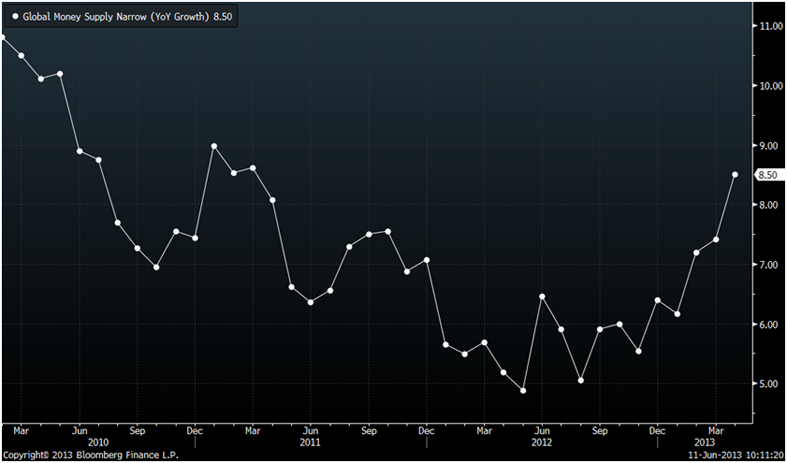
Global Money Supply Narrow YOY Growth – (Bloomberg)
Rising interest rates will be negative for most markets but not for gold which is correlated with interest rates as was seen in the 1970’s. During that decade, gold prices rose as interest rates rose and peaked as interest rates peaked.
Gold is vulnerable to rising interest rates towards the end of the interest rate tightening cycle when positive real interest rates are evident.
The surge in physical demand in Asia, seen in April after the unusual price plunge, has cooled off.
The drop set off a mad rush for bullion in India, China and Asia that pushed premiums higher amid a supply crunch. Dealers in Singapore confirmed to Reuters that demand for gold bars had eased and gold bars and coins were easier to obtain.
Meanwhile, holdings in SPDR Gold Trust ticked higher and the world’s largest gold-backed exchange-traded fund said its holdings rose 0.3% to 1,009.85 tonnes on Monday.
Gold priced in yen, euros or Australian dollars may outperform bullion priced in U.S. dollars in the coming months due to the financial and economic challenges facing Japan, the Eurozone and Australia according to Bloomberg Industries.
A pledge to double the size of the Bank of Japan’s balance sheet has already seen the yen fall sharply versus all major currencies and gold.
Actions by the ECB to potentially boost monetary stimulus amid weakness in the region have not led to material weakness in the euro yet.
A bursting property bubble, weakness in iron ore and coal prices in addition to lower benchmark rates have led to declines in the Aussie dollar in recent days and further weakness in the Aussie dollar is very likely – especially versus gold.
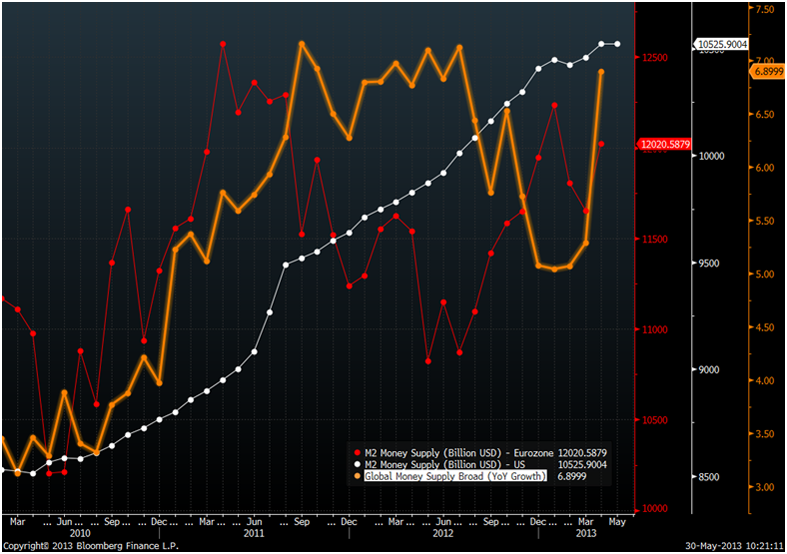
Global Money Supply YOY Growth – (Bloomberg)
However, financial and economic conditions in the UK and U.S. are not much better materially than those in the EU, Japan and Australia. Indeed the total debt levels, both public and private, are of a scale that may result in financial dislocations and will result in further currency debasement in the coming months.

Cross Currency Table – (Bloomberg)
Money supply in the U.S. continues to rise rapidly making the U.S. vulnerable to rising interest rates especially given the national debt has surged to nearly $16.75 trillion and the U.S. has unfunded liabilities of between $50 trillion and $100 trillion.
Contrary to some extremely optimistic analysis, the U.S. and Eurozone debt crisis is far from over and this is yet another interlude of calm before coming debt storms.
Gold Falls to 3-Week Low with “Talk of Slowing QE” Weighing on Markets
London Gold Market Report
from Ben Traynor, BullionVault
Tuesday 11 June 2013, 07:00 EDT
Gold Falls to 3-Week Low with “Talk of Slowing QE” Weighing on Markets
SPOT GOLD fell to three week lows below $1370 an ounce Tuesday, as stocks and commodities also fell amid ongoing speculation over when the US Federal Reserve might begin reducing the size of its quantitative easing program.
“Gold remains bearish while trading below the $1424 current June high,” reckons Commerzbank senior technical analyst Axel Rudolph.
Gold exchange traded funds tracked by Bloomberg saw their gold bullion holdings fall by 6.1 tonnes yesterday, although the world’s largest gold E.T.F. SPDR Gold Trust (ticker GLD) added metal for only the sixth day this year, raising its holdings by 2.7 tonnes to 1009.8 tonnes.
Silver meantime dropped back below $21.60 an ounce, falling towards three-week lo0ws touched yesterday.
Major European stock markets were down nearly 1.5% by Tuesday, after losses in Asia that followed the Bank of Japan’s decision to leave its QE program unchanged.
“Upbeat sentiment over the US economic outlook continues to feed concerns of increasing US yields and an easing pace to [quantitative easing],” says VTB Capital analyst Andrey Kryuchenkov.
“Volumes in Asia will be subdued due to holidays in China,” he adds, referring to tomorrow’s Dragon Boat Festival.
Ratings agency Standard & Poor’s raised its outlook for its AA+ US credit rating from ‘negative’ to ‘stable’ Monday.
“We do not see material risks to our favorable view of the flexibility and efficacy of US monetary policy,” said a statement from S&P.
A stable outlook implies the chance of a downgrade in the rating is less than one-in-three.
“The last time the rating agency moved to downgrade US credit in August of 2011, the markets were sent into a tizzy with equities plunging and gold soaring to a record high of $1920 an ounce a month later,” says a note from Ed Meir, metals analyst at brokerage INTL FCStone.
“However, this time around, the move by S&P did not cause much of a stir, as investors seemed to be more focused on erratic growth patterns evident across most industrialized economies, coupled with growing uncertainties with respect to what the Federal Reserve is going to do with regard to its stimulus program.”
So-called ‘Fed tapering’ – the potential reduction in the size of the Fed’s asset purchase from the current $85 billion a month – “is a big issue” former World Bank president Robert Zoellick said Tuesday.
“The question,” said Zoellick, “will be, as the Fed eventually moves away from the monetary easing policies, what will be the effect of [withdrawing]the wall of money that’s moved around the world?”
“[US] Labor market conditions have improved since last summer, suggesting the [Federal Open Market] Committee could slow the pace of purchases,” James Bullard, president of Federal Reserve Bank of St Louis, which is not an FOMC member this year, said Monday.
“But surprisingly low inflation readings may mean the Committee can maintain its aggressive program over a longer time frame.”
The Bank of Japan meantime left its main policy interest rate on hold at 0.1% Tuesday, while reiterating its quantitative easing commitment to grow the monetary base by an annual up to 70 trillion Yen ($720 billion).
UK industrial production meantime fell by 0.6% in the year to April, according to official figures published this morning, while manufacturing production, a subset of industrial production, down 0.5% over the same period.
Over in Europe, Germany’s Constitutional Court today began hearing testimony on the European Central Bank’s Outright Monetary Transactions program, by which the ECB has pledged to buy the debt of distressed sovereigns on the secondary market to mitigate borrowing costs.
Bundesbank chief Jens Weidmann, who has publicly criticized OMT, is expected to testify at the hearing, which has been added to an existing case before the Court over whether the European Stability Mechanism rescue fund breaches Germany’s constitution.
Weidmann’s fellow German Joerg Asmussen, who sits on the ECB’s Executive Board, is also expected to appear, as is finance minister Wolfgang Schaeuble.
Ben Traynor
from Ben Traynor, BullionVault
Tuesday 11 June 2013, 07:00 EDT
Gold Falls to 3-Week Low with “Talk of Slowing QE” Weighing on Markets
SPOT GOLD fell to three week lows below $1370 an ounce Tuesday, as stocks and commodities also fell amid ongoing speculation over when the US Federal Reserve might begin reducing the size of its quantitative easing program.
“Gold remains bearish while trading below the $1424 current June high,” reckons Commerzbank senior technical analyst Axel Rudolph.
Gold exchange traded funds tracked by Bloomberg saw their gold bullion holdings fall by 6.1 tonnes yesterday, although the world’s largest gold E.T.F. SPDR Gold Trust (ticker GLD) added metal for only the sixth day this year, raising its holdings by 2.7 tonnes to 1009.8 tonnes.
Silver meantime dropped back below $21.60 an ounce, falling towards three-week lo0ws touched yesterday.
Major European stock markets were down nearly 1.5% by Tuesday, after losses in Asia that followed the Bank of Japan’s decision to leave its QE program unchanged.
“Upbeat sentiment over the US economic outlook continues to feed concerns of increasing US yields and an easing pace to [quantitative easing],” says VTB Capital analyst Andrey Kryuchenkov.
“Volumes in Asia will be subdued due to holidays in China,” he adds, referring to tomorrow’s Dragon Boat Festival.
Ratings agency Standard & Poor’s raised its outlook for its AA+ US credit rating from ‘negative’ to ‘stable’ Monday.
“We do not see material risks to our favorable view of the flexibility and efficacy of US monetary policy,” said a statement from S&P.
A stable outlook implies the chance of a downgrade in the rating is less than one-in-three.
“The last time the rating agency moved to downgrade US credit in August of 2011, the markets were sent into a tizzy with equities plunging and gold soaring to a record high of $1920 an ounce a month later,” says a note from Ed Meir, metals analyst at brokerage INTL FCStone.
“However, this time around, the move by S&P did not cause much of a stir, as investors seemed to be more focused on erratic growth patterns evident across most industrialized economies, coupled with growing uncertainties with respect to what the Federal Reserve is going to do with regard to its stimulus program.”
So-called ‘Fed tapering’ – the potential reduction in the size of the Fed’s asset purchase from the current $85 billion a month – “is a big issue” former World Bank president Robert Zoellick said Tuesday.
“The question,” said Zoellick, “will be, as the Fed eventually moves away from the monetary easing policies, what will be the effect of [withdrawing]the wall of money that’s moved around the world?”
“[US] Labor market conditions have improved since last summer, suggesting the [Federal Open Market] Committee could slow the pace of purchases,” James Bullard, president of Federal Reserve Bank of St Louis, which is not an FOMC member this year, said Monday.
“But surprisingly low inflation readings may mean the Committee can maintain its aggressive program over a longer time frame.”
The Bank of Japan meantime left its main policy interest rate on hold at 0.1% Tuesday, while reiterating its quantitative easing commitment to grow the monetary base by an annual up to 70 trillion Yen ($720 billion).
UK industrial production meantime fell by 0.6% in the year to April, according to official figures published this morning, while manufacturing production, a subset of industrial production, down 0.5% over the same period.
Over in Europe, Germany’s Constitutional Court today began hearing testimony on the European Central Bank’s Outright Monetary Transactions program, by which the ECB has pledged to buy the debt of distressed sovereigns on the secondary market to mitigate borrowing costs.
Bundesbank chief Jens Weidmann, who has publicly criticized OMT, is expected to testify at the hearing, which has been added to an existing case before the Court over whether the European Stability Mechanism rescue fund breaches Germany’s constitution.
Weidmann’s fellow German Joerg Asmussen, who sits on the ECB’s Executive Board, is also expected to appear, as is finance minister Wolfgang Schaeuble.
Ben Traynor
Subscribe to:
Posts (Atom)