Tuesday, April 30, 2013

Everything Is Rigged: The Biggest Price-Fixing Scandal Ever

The Illuminati were amateurs. The second huge financial scandal of the year reveals the real international conspiracy: There's no price the big banks can't fix


Illustration by Victor Juhasz
April 25, 2013 1:00 PM ET
Conspiracy theorists of the world, believers in the hidden hands of the Rothschilds and the Masons and the Illuminati, we skeptics owe you an apology. You were right. The players may be a little different, but your basic premise is correct: The world is a rigged game. We found this out in recent months, when a series of related corruption stories spilled out of the financial sector, suggesting the world's largest banks may be fixing the prices of, well, just about everything.
You may have heard of the Libor scandal, in which at least three – and perhaps as many as 16 – of the name-brand too-big-to-fail banks have been manipulating global interest rates, in the process messing around with the prices of upward of $500 trillion (that's trillion, with a "t") worth of financial instruments. When that sprawling con burst into public view last year, it was easily the biggest financial scandal in history – MIT professor Andrew Lo even said it "dwarfs by orders of magnitude any financial scam in the history of markets."
That was bad enough, but now Libor may have a twin brother. Word has leaked out that the London-based firm ICAP, the world's largest broker of interest-rate swaps, is being investigated by American authorities for behavior that sounds eerily reminiscent of the Libor mess. Regulators are looking into whether or not a small group of brokers at ICAP may have worked with up to 15 of the world's largest banks to manipulate ISDAfix, a benchmark number used around the world to calculate the prices of interest-rate swaps.
Interest-rate swaps are a tool used by big cities, major corporations and sovereign governments to manage their debt, and the scale of their use is almost unimaginably massive. It's about a $379 trillion market, meaning that any manipulation would affect a pile of assets about 100 times the size of the United States federal budget.
It should surprise no one that among the players implicated in this scheme to fix the prices of interest-rate swaps are the same megabanks – including Barclays, UBS, Bank of America, JPMorgan Chase and the Royal Bank of Scotland – that serve on the Libor panel that sets global interest rates. In fact, in recent years many of these banks have already paid multimillion-dollar settlements for anti-competitive manipulation of one form or another (in addition to Libor, some were caught up in an anti-competitive scheme, detailed in Rolling Stone last year, to rig municipal-debt service auctions). Though the jumble of financial acronyms sounds like gibberish to the layperson, the fact that there may now be price-fixing scandals involving both Libor and ISDAfix suggests a single, giant mushrooming conspiracy of collusion and price-fixing hovering under the ostensibly competitive veneer of Wall Street culture.
The Scam Wall Street Learned From the Mafia
Why? Because Libor already affects the prices of interest-rate swaps, making this a manipulation-on-manipulation situation. If the allegations prove to be right, that will mean that swap customers have been paying for two different layers of price-fixing corruption. If you can imagine paying 20 bucks for a crappy PB&J because some evil cabal of agribusiness companies colluded to fix the prices of both peanuts and peanut butter, you come close to grasping the lunacy of financial markets where both interest rates and interest-rate swaps are being manipulated at the same time, often by the same banks.
"It's a double conspiracy," says an amazed Michael Greenberger, a former director of the trading and markets division at the Commodity Futures Trading Commission and now a professor at the University of Maryland. "It's the height of criminality."
The bad news didn't stop with swaps and interest rates. In March, it also came out that two regulators – the CFTC here in the U.S. and the Madrid-based International Organization of Securities Commissions – were spurred by the Libor revelations to investigate the possibility of collusive manipulation of gold and silver prices. "Given the clubby manipulation efforts we saw in Libor benchmarks, I assume other benchmarks – many other benchmarks – are legit areas of inquiry," CFTC Commissioner Bart Chilton said.
But the biggest shock came out of a federal courtroom at the end of March – though if you follow these matters closely, it may not have been so shocking at all – when a landmark class-action civil lawsuit against the banks for Libor-related offenses was dismissed. In that case, a federal judge accepted the banker-defendants' incredible argument: If cities and towns and other investors lost money because of Libor manipulation, that was their own fault for ever thinking the banks were competing in the first place.
"A farce," was one antitrust lawyer's response to the eyebrow-raising dismissal.
"Incredible," says Sylvia Sokol, an attorney for Constantine Cannon, a firm that specializes in antitrust cases.
All of these stories collectively pointed to the same thing: These banks, which already possess enormous power just by virtue of their financial holdings – in the United States, the top six banks, many of them the same names you see on the Libor and ISDAfix panels, own assets equivalent to 60 percent of the nation's GDP – are beginning to realize the awesome possibilities for increased profit and political might that would come with colluding instead of competing. Moreover, it's increasingly clear that both the criminal justice system and the civil courts may be impotent to stop them, even when they do get caught working together to game the system.
If true, that would leave us living in an era of undisguised, real-world conspiracy, in which the prices of currencies, commodities like gold and silver, even interest rates and the value of money itself, can be and may already have been dictated from above. And those who are doing it can get away with it. Forget the Illuminati – this is the real thing, and it's no secret. You can stare right at it, anytime you want.

CBC: Canada To Adopt the Cyprus Model of Depositor 'Bail-In' In Case of Bank Failure

The smugness of the Canadian politicians is reminiscent of the Bank of New Zealand. 

Perhaps that is what the political do when they are making plans for a gathering storm and they wish for everyone to remain on the beach in the meanwhile.

I could be wrong, but in my judgement nothing in the global banking system is safe if the massive derivative bubble collapses. 

It will not only take down the private banks, but quite a few sovereign countries as well.

I am of the opinion that in the States there will not be the same sort of 'bail in' but a 'print in' in which the Fed will supply as much money as is required, taking value from all who hold Dollars including foreign holders.  So in that sense, the US is 'safe.'  It is all the holders of dollars around the world who are not.

You may wish to take some protective measures if you have not done so already.   When the times comes, there will be no time.

Ottawa weighing plans for bank failures
By Neil MacDonald
April 3, 2013

Buried deep in last month's federal budget is an ambiguously worded section that has roiled parts of the financial world but has so far been largely ignored by the mainstream media.

It boils down to this: Ottawa is contemplating the possibility of a Canadian bank failure — and the same sort of pitiless prescription that was just imposed in Cyprus.

Meaning no bailout by taxpayers, but rather a "bail-in" that would force the bank's creditors to absorb the staggering losses that such an event would inevitably entail.

If that sounds sobering, it should. While officials in Ottawa are playing down the possibility of a raid on the bank accounts of ordinary Canadians, they chose not to include that guarantee in the budget language.

Canadians tend to believe their banks are safer and more backstopped than elsewhere in the world. The federal government enthusiastically promotes the notion, and loves to take credit for it.

It may well be true, even if Canada's six-bank oligopoly isn't terribly competitive, at least in comparison to the far more diverse American banking universe.

But in the ever-more insecure world that has unfolded since the financial meltdown of 2008, it is also increasingly clear that nothing is safe anymore, not even blue-chip bank stocks and bonds or even, in the case of the Cyprus bail-in, private bank accounts.

And now, Canada is making a bail-in official government policy, too...

Read the rest here.

TEXAS GETTING READY FOR COLLAPSE OF THE WORLD ECONOMY


TEXAS MINTING THEIR OWN MONEY…IS SECESSION FROM BARRACK`S FASCIST AMERICA IMMINENT?THE REPUBLIC OF TEXAS…THE LAST BASTION OF TRUE FREEDOM IN OBAMA`S KINGDOM.
God bless you persistent fearless bastards.TEXAS YOU ROCK!
Subscribe to RT today for the news American media is discouraged or forbidden to report.
Definition of BASTION
1: a projecting part of a fortification
2: a fortified area or position
3: stronghold
4: TEXAS!

Gold “Getting Key Support” from Retail Demand, But Investor Confidence “Has Been Dealt Severe Blow”

London Gold Market Report
from Ben Traynor, BullionVault
Monday 29 April 2013, 07:45 EST

Gold “Getting Key Support” from Retail Demand, But Investor Confidence “Has Been Dealt Severe Blow” 

GOLD started the week by edging higher Monday, trading around $1475 per ounce by lunchtime in London, as stocks also gained, US Treasuries were broadly flat and the Euro edged higher against the Dollar following news that Italy’s borrowing costs have fallen.

Strong demand for physical gold from private households meantime continues to cause bottlenecks and price premiums.

“The increased physical demand seen since the price correction supports the metal and affects the trading premiums,” says a note from German refining group Heraeus.

Gold traders in Dubai meantime continue to report premiums over the spot gold price of up to $10 an ounce for physical bullion.

“Retail demand…will be the key support for gold and is the main reason we expect prices to stabilize and move slowly higher,” says a note from HSBC, which this morning cut its 2013 average gold price forecast to $1542 an ounce, down from $1700 an ounce, while cutting its silver forecast from $33 an ounce to $26 an ounce.

“The capitulation in the gold price dealt a severe blow to investor confidence, which may take many months restore. Unless significant institutional demand returns to the market, we believe prices will struggle to get over the top end of our range of $1625.”

The world’s biggest gold exchange traded fund SPDR Gold Trust (ticker: GLD) saw a further 7.2 tonnes of outflows Friday, taking the total holding of bullion to back its shares to 1083.1 tonnes.

Since the starts of the year the GLD’s holdings have shrunk by nearly a fifth.

“In the past two weeks, as global economic data have generally underwhelmed, the ETF selling actually increased in velocity,” says a note from Nomura.

“This does not bode well for the remainder of 2013 for the ETF demand category…the recent downward move in inflation expectations and the lack of price reaction to both the Cypriot bailout and the changes in the Japanese monetary base have put gold’s investment rationale somewhat under pressure.”

On the New York Comex meantime, the so-called speculative net long position of gold futures and options traders fell to its lowest level since November 2008 in the week ended last Tuesday, weekly data published by the Commodity Futures Trading Commission show.

The spec net long – calculated as the difference between the number of ‘bullish’ long and ‘bearish’ short contracts held by traders classified by the CFTC as noncommercial – fell by 21% to the equivalent of 260.3 tonnes.

“The preceding week’s fall in net speculative length appeared relatively mild, so perhaps this past week’s decline was a catch-up,” says Standard Bank commodities strategist Marc Ground.

“Clearly, the futures market was not convinced that gold could sustain its upward momentum.”

The reported size of noncommercial futures and options positioning rose above 90,000 contracts for the first time since mid-February, only the second time this has happened since at least 2004.

Looking just at the CFTC’s Managed Money category, which includes players such as hedge funds, the Tuesday- reported number of short futures contracts in 2013 has averaged more than 50,000.
Between June 2006 and the end of 2012 the average was less than 16000 contracts.

“The key question in the near term is whether retail and jewelry demand can continue to counter [exchange traded fund] outflows and the rise in [Comex] gross shorts,” says a note from Barclays.

Silver meantime rose above $23.30 an ounce while the picture was mixed for other industrial commodities, with copper gaining but Brent crude oil down.

“We feel we are due for some sideways consolidation,” says the latest technical analysis note from bullion bank Scotia Mocatta.

“Resistance is at $24.25…[while] support is at the recent low of $22.07. If we breach support, the risk is an eventual target of $17.73, a full retracement back to August 2010.”

Italy saw its borrowing costs fall to their lowest level since October 2010 at an auction of 5 and 10-Year bonds this morning. The yield on 5-Year debt fell to 2.84%, down from 3.65% at a similar auction last month, while 10-Year yields fell from 4.66% to 3.94%.

Since last month, Italy’s parliament has re-elected Giorgio Napolitano as president, who in turn has nominated Enrico Letta as prime minister. Letta reached agreement on forming a government over the weekend, following a two-month deadlock after February’s inconclusive general election.

Any decision by Cyprus meantime to sell some of its gold bullion reserve would not necessarily be “the thin end of the wedge” that led to gold sales by other Euro members, according to  Rhona O’Connell, senior analyst at metals consultancy Thomson Reuters GFMS.

Ben Traynor

Greek bill opens way for 15,000 job cuts

The Greek parliament approved 15,000 civil service layoffs in return for more EU/IMF bailout money. (AAP)
The Greek parliament has passed a bill which will see 15,000 state employees lose their jobs by the end of next year.
The Greek parliament has voted to adopt a law providing for the dismissal of 15,000 civil servants as part of austerity measures imposed by the country's international creditors.
After heated debate during an emergency session on Sunday, 168 deputies voted for the bill, with 123 voting against and one abstaining as the opposition proved powerless to stop cuts the government insisted were needed to keep the country afloat.
The new law overturns what had been a guarantee of a job for life for workers in Greece's notoriously bloated civil service.
Around 800 people turned up outside the parliament to protest against the measure in a demonstration called by trade unions.
The bill provides for the dismissal of 15,000 civil servants by the end of 2014, including 4000 this year, to meet terms set by Athens's creditors for billions in bailout loans.
Civil service trade confederation Adedy condemned what it called the "politicians who are dismantling the public service and destroying the welfare state".
Private union GSEE said the bill would only worsen Greece's dire unemployment rate, which currently stands at 27 per cent.
Slashing an unwieldy public service is a condition set by Greece's so-called "troika" of creditors - the International Monetary Fund, European Union and European Central Bank - to unlock loans of 8.8 billion euros ($A11.23 billion).
The EU and IMF have committed a total of 240 billion euros in rescue loans since 2010, with the heavily indebted country obliged to pursue austerity measures in exchange for the international aid it needs to avoid bankruptcy.
The new law will speed dismissal procedures, which previously made it impossible to sack civil servants and saw the public sector swell over the years as every new administration brought in its own people.
Employees who have been disciplined for corruption or incompetence and those working for one of dozens of shuttered government agencies will be the main targets.
The law, which was written in a single article to force MPs to adopt all its provisions together, also extends weekly working hours for teachers, opens a number of professions to competition and reduces a controversial property tax by 15 per cent.
Another section creates new payment terms for unpaid taxes, intended to help the government recover billions of euros owed by indebted companies and households.
The main opposition, radical leftist party Syriza, tried unsuccessfully to block the use of an emergency session to adopt the law, which it argued was unconstitutional.
Finance Minister Yannis Stournaras said the emergency session was necessary because his eurozone counterparts "must come to a decision Monday on continuing loan disbursements ... that Greece needs to pay salaries and pensions".
Opposition parties also condemned what they said was a last-minute amendment introduced by Stournaras slashing the monthly minimum salary from 580 euros to 490 euros.
Eurozone finance ministers are expected to decide on the next instalment of aid for debt-ridden Greece at a meeting on May 16.
The government has imposed tough austerity measures in return for aid, including cuts in pay and pensions leading to numerous general strikes.

Jeff Sachs UNLOADS on Wall St., D.C, & Obama

If anybody were to think that the fight for decency and justice in our markets, our nation’s capital, and throughout our land were to have run its course . . .  well think again.
In a volley of invectives not often seen in the genteel world of liberal academia, Columbia University professor Jeffrey Sachs recently threw a string of verbal haymakers that would have made the noted NHL hitman Chris “Knuckles” Nilan proud.
Sachs was named one of the world’s 100 Most Influential people by Time magazine in 2004. His professional body of work speaks for itself.  At a symposium held recently at the Philadelphia Federal Reserve, Sachs dropped the gloves and unleashed the following:
“What has been revealed, in my view, is prima facie criminal behavior,” he said.
“It’s financial fraud on a very large extent,” the adviser to the World Bank and IMF added. “There’s also a tremendous amount of insider trading — you can even watch when you are living in New York how that works.”
What’s behind this, says the high-profile academic twice named one of Time magazine’s 100 Most Influential People in the World, is “a docile president, a docile White House and a docile regulatory system that absolutely can’t find its voice.”
Sachs not only bloodies those who have gamed our system for their own selfish personal and political gains but he then does a skate by and calls out other gutless members of the Wall Street-Washington Incest team:
“We have a corrupt politics to the core, I am afraid to say, and . . . both parties are up to their neck in this. This has nothing to do with Democrats or Republicans,” Sachs told the Philadelphia conference, “Fixing the Banking System for Good.”
Hedge fund titan John Paulson: “He worked together with Goldman Sachs to defraud, massively, many European banks which bought the toxic mortgages that Paulson put together.”
Goldman Sachs: Paid out a “small fine” [$550 million in 2010] to settle charges with the SEC in the controversial Abacus deal linked to John Paulson’s hedge fund, but Paulson wasn’t mentioned once in the proceedings.
Former US Treasury Secretary Larry Summers: “He continued to really institute moral-hazard policies, right and left, by fighting against any limits on [bankers’] compensation” as America grappled with the financial crisis.
Good for Sachs. While The New York Post ran coverage of his remarks where is the rest of the general media? Gutlessly cowering behind the bench, perhaps, hoping Sachs does not call them out as well? No doubt.
Keep punchin’!!
I thank the regular reader who brought this story to my attention. If you agree with Sachs’ assessment, do him the favor of spreading his invectives by sharing this story.
Larry Doyle
Isn’t  it time or overtime to subscribe to all my work via e-mail, an RSS feed, on Twitter or Facebook.
I have no business interest with any entity referenced in this commentary. The opinions expressed are my own. I am a proponent of real transparency within our markets so that investor confidence and investor protection can be achieved.

Monday, April 29, 2013

Gold And Silver Coin And Bar Shortages Globally

by GoldCore


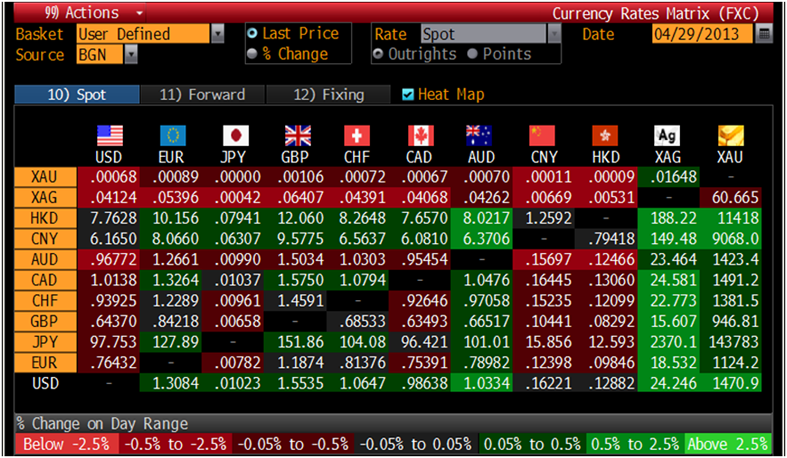
Today’s AM fix was USD 1,472.50, EUR 1,125.51 and GBP 947.80 per ounce.
Friday’s AM fix was USD 1,462.25, EUR 1,123.43 and GBP 947.79 per ounce.

Cross Currency Table – (Bloomberg)

Gold fell $7.00 or 0.48% Friday to $1,467.30/oz and silver finished down 1.65%. Gold and silver both gained for the week at 4.74% and 3.11%, respectively.
Gold rose another 1% overnight in Asia, consolidating on last week’s 4% gain.

Gold in USD, 1 Month – (Bloomberg)

The slight rebound in prices from multi-year lows has as of yet failed to dampen the global appetite for bullion, causing a shortage in the physical supply of gold coins and bars.
Recent bleak U.S., European and Chinese growth data is also supporting gold due to concerns of recessions and of a global depression.
Central banks including the Federal Reserve and the ECB are set to continue with ultra loose monetary policies which will support gold.

Gold in Euros, 1 Month – (Bloomberg)

The ECB has kept its main interest rate at a record low of 0.75% since July 2012 and may reduce interest rates to 0.5%, either this week or in June. This will further deepen negative real interest rates in most countries in the Eurozone.
The Fed alone is set to keep interest rates near 0% and continue its current pace of bond buying at a whopping $85 billion a month.
Ultra loose monetary policies will support gold as it is a hedge against currency devaluations and inflation and stagflation – all of which are real risks.

Gold in British Pounds, 1 Month – (Bloomberg)


Premiums for gold and silver bars have jumped higher all over the world. They have surged to multi-year highs in Asia. Reuters reports overnight that premiums are surging due to “strong demand from the physical market, which has led to a shortage in gold bars, coins, nuggets and other products.”
Shortages of gold and particular silver coins and bars is not confined to the small coin and bar market and there are also supply issues in the larger bar market with kilo bars being increasingly difficult to secure.
Swiss refineries are struggling to meet global demand for refined gold bars.  They have been cleared out of their stock of kilo gold bars – the preferred form of gold bullion amongst many store of wealth, affluent buyers in Europe and Asia. Buyers have been told that they will have to wait until late May prior to receiving delivery on paid for product.
Shortages are most prevalent in the silver coin and bar market where premiums have surged.
Silver coins and bars can now not be bought from the largest bullion dealers in the U.S. who have been cleared out of stock in recent days. Unlike after Lehman Brothers where there were shortages and delays of 3 to 4 weeks, there is no guidance being given as to when certain gold and silver coins and bars will be available again.