Tuesday, April 23, 2013

Merkel To Europe: "Prepare To Cede Sovereignty"

The liquidity tsunami that started in September of 2012 in the Marriner Eccles building and continued with the BOJ's own epic QEasing expansion three weeks ago, has so far provided the impetus for Europe to kick the can of its inevitable dissolution for a few more months, yet slowly but surely the market is starting to read through the artificial levels implied by Italian and Spanish bonds, driven by recycled ECB funding via bank and repo conduits and of course Japanese carry cash, and rumblings of a return to crisis conditions are back.
And as always happens, once the crisis talk is back, so is discussion of a fiscal union. Sure enough, earlier today Germany's Angela Merkel once again reminded everyone just what the stakes are in order to achieve a truly stable, and sustainable European union: nothing short of ceding sovereignty to Germany. And with that we are back to square one, because that has always been the trade off - want a unified, fiscally and monetarily, Europe? You can get it: just bow down to Merkel.
From Reuters:
German Chancellor Angela Merkel said on Monday that euro zone members must be prepared to cede control over certain policy domains to European institutions if the bloc is truly to overcome its debt crisis and win back foreign investors.

Speaking at an event hosted by Deutsche Bank in Berlin alongside Polish Prime Minister Donald Tusk, Merkel also defended her approach to the crisis against critics who argue she has put too much emphasis on austerity, saying Europe must find a way to deliver both growth and solid finances.

The comments came two months before European leaders are due to gather in Brussels to discuss moving towards a so-called "fiscal union".
The punchline:
"We seem to find common solutions when we are staring over the abyss," Merkel said. "But as soon as the pressure eases, people say they want to go their own way.

"We need to be ready to accept that Europe has the last word in certain areas. Otherwise we won't be able to continue to build Europe," she added.
Two conclusions here: Europe will be "staring over the abyss" very soon once again, and where Merkel says "Europe" she means Germany.
This is confirmed by the immediate denial of precisely this, adding "it would be "dangerous" if other countries in Europe felt Germany was imposing its own economic model across the entire bloc."
Oh, ok then.
So just what is Germany's vision for "Europe":
"We don't always need to give up national practices but we need to be compatible," Merkel said. "It is chaos right now."

"We need to be prepared to break with the past in order to leap forward. I'm ready to do this," she said.
So... just give up national practices sometimes. And yes, Merkel is of course ready to head the asset-stripmined continent. The question is who else in Europe is willing to hand over their liberties to the next iteration of the German Reich?

Lies, Damed Lies and Sadistics: The IMF’s Role As Bankster Enforcer

“We make or break human life every day of every year as probably no other force on earth has ever done in the past or will ever do again.”
The above rather dramatic quote comes courtesy of one Davison L Budhoo, a former International Monetary Fund economist who in 1988 broke ranks with the Fund, publishing a scathing 150-page resignation letter. In it he accused the organization of corruption, self-interest, and deceit.
Not that the Fund, then headed by Frenchman Michel Camdessus, was particularly fazed by the allegations. In those days there was no Internet, so the story didn’t exactly go “viral”; in fact, it barely got a mention in the mainstream or financial press. As such, following a spattering of articles in a few specialist newspapers and magazines, Buddhoo’s accusations were quickly forgotten.
The IMF breathed a sigh of relief, brushed off its Brook Brothers jacket and continued about its business. No inquiry or investigation was launched, no changes were made to the Fund’s operational policies and no heads rolled.
Such aversion to change has become a defining characteristic of the Fund. The result is that while the global economy may have changed beyond all recognition in the last 35 years, with countries like China, India and Brazil rising to the fore, the IMF’s role within it seems to have remained locked in time. The only difference of note (apart from the fact that, in the ballsy, perma-tanned Christine Lagarde, it has its first ever female managing director) is that instead of preying primarily on the world’s poorest, weakest and most defenseless nations — many of which have since become big creditors — the IMF, now a protagonist in Europe’s dreaded Troika, has its sights set on much bigger trophies.
The chicken, it seems, has finally come home to roost. Now it is Europe’s turn to feel the sharp taste of the Fund’s medicine. Slowly but surely the hapless inhabitants of struggling eurozone countries such as Greece, Portugal and Ireland are beginning to realize what many Africans, Asians, Latin Americans and Eastern Europeans learnt through bitter painful experience in the seventies, eighties and nineties — namely that when the IMF, armed with its balance sheets and a calculator, comes calling, you’d better hope you’re out.
For the IMF is, in plain speaking terms, the global banksters’ number one enforcer — a role it has executed (pun intended) with fervor and aplomb ever since the Bretton Woods agreement (though it wasn’t until Nixon’s launch of the floating exchange regime in 1971 that the organization began forcefully dictating economic policy to supposedly sovereign nations).
The Fund is essentially to the big global banks and corporations what Luca Brasi was to Vito Corleone or, to cite a real-world example, what Francesco Raffaele Nitto was to Al Capone. But rather than use real violence, or even the threat of violence, the IMF’s henchmen have far subtler means at their disposal, as John Perkins, the author of the best-selling book Confessions of An Economic Hitman, explains:
One of my jobs as an economic hit man was to identify countries that had resources like oil and arrange huge loans for those countries from the World Bank and sister organizations. But the money would never go to the actual country; instead it would go to our own corporations to build infrastructure projects in that country like power plants and industrial parks; things that would benefit a few very wealthy families.
So then the people of the country would be left holding this huge debt that they couldn’t repay… That’s when the IMF comes in [saying] ‘We’ll help you restructure your loan, but in order to do that you have to meet certain conditionalities. You have to sell your oil or whatever the coveted resource is at a cheap price, to the oil companies without restrictions.’ Or they would suggest the country sell electric utilities, water and sewage, maybe even its schools and jails to private multi-national corporations.
According to Perkins, it was only when a national leader took a rare principled stand, refusing to sell off all of their country’s resources to international conglomerates at bargain basement prices, that the real goons, or what Perkins calls “the Jackals,” would be sent in, as is alleged to have happened in the highly suspicious deaths, in the early eighties, of Panama’s leader Omar Efraín Torrijos Herrera and Jaime Roldos, the democratically elected president of Ecuador.
Read More...

Arizona Set To Use Gold & Silver As Currency

by GoldCore

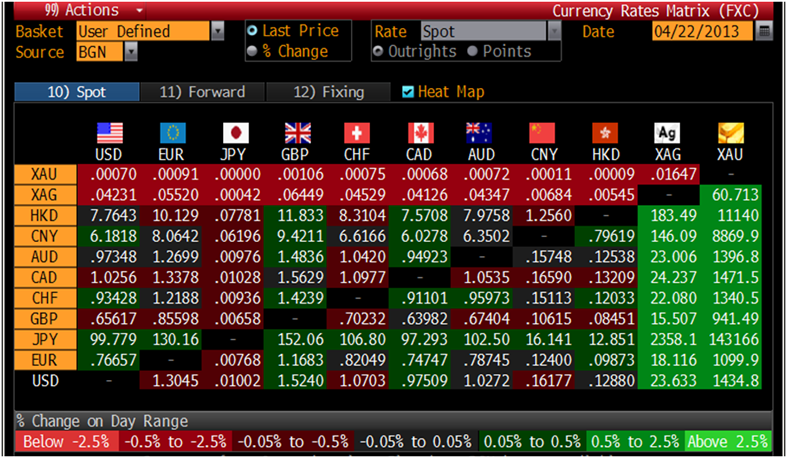
Today’s AM fix was USD 1,425.00, EUR 1,092.54 and GBP 935.04 per ounce.
Friday’s AM fix was USD 1,414.00, EUR 1,080.46 and GBP 920.63 per ounce.

Cross Currency Table – (Bloomberg)

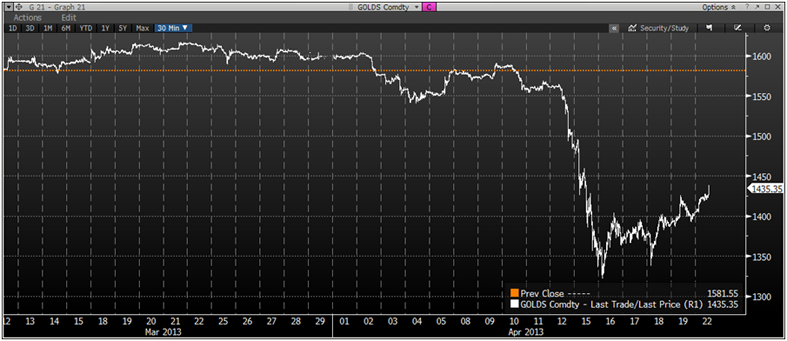
Gold climbed $12.90 or 0.93% on Friday to $1,400.90/oz and silver finished up 0.04%. Gold and silver both traded down for the week at 5.86% and 11.39%.
The state of Arizona may become the second state to use gold and silver coins as legal tender.
Last week, Arizona lawmakers passed a bill that makes precious metals legal tender. Arizona is the second state after Utah to allow gold coins created by the U.S. Mint and private mints to be used as currency. More than a dozen states have legislature underway to pass similar measures.
The move was launched by people who fear the Federal Reserve is not tackling the federal deficit and is thus debasing and devaluing the dollar. Some even fear, that if the Fed continues on the existing path it could lead to hyperinflation.
Miles Lester, who represents a group called Arizona Constitutional Advocates, said during a recent public hearing on legal-tender legislation that “the dollar is on its way out. It’s not a matter of if; it’s a matter of when.”
The upcoming U.S. FOMC meeting next week is April 30th and May 1st and will be closely watched by investors.
Supporters of the legislation look forward to a day when citizens can make purchases from debit cards linked to gold depositories.

Gold in USD, 1 Month, by 30 minutes – (Bloomberg)

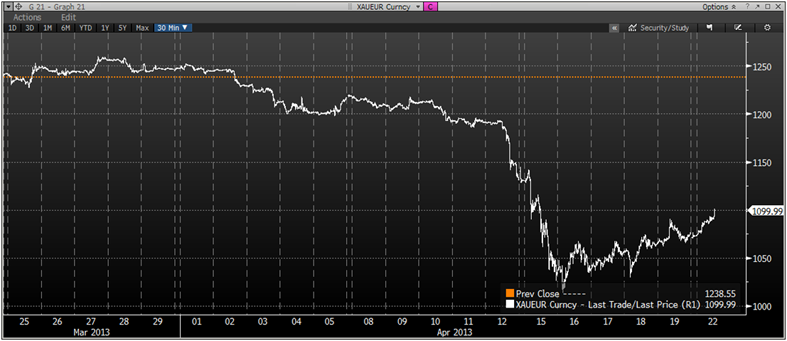
Opponents point to the volatility of gold and silver as currency after the fall in price that occurred last week. However proponents point out that the fall in gold prices last week was due to the speculative raid of Wall Street banks who the Federal Reserve is supporting and works closely with.
Using gold and silver as currency would protect people from inflation, currency debasement, predatory banks and an increasingly volatile and vulnerable financial system.
Utah has had the law on the books for the past 2 years and is working on a system for using the precious metals as currency.

Gold in Euros, 1 Month, by 30 minutes – (Bloomberg)

The Arizona Senate Bill 1439 would allow the holder of gold or silver coins or bullion to pay a debt.

However, the coins must be issued by the U.S. government or approved by a court, like an American Eagle Coin. Oddly the government does not require that persons or business must use or accept gold or silver as legal tender in contravention of the U.S. Constitution.
The sponsor of the bill, Republican Sen. Chester Crandell, would need a final state Senate vote after approval by the House, and if passed the law would not take effect until 2014.
Crandell said, “The whole thing came from constituents”.

Gold in British Pounds, 1 Month, by 30 minutes – (Bloomberg)

The debate on whether gold and silver should be used as an alternative currency will continue and deepen as people realise how fiat currencies are set to be devalued in the coming months – potentially sharply.
A 5-10% allocation to physical bullion in your possession or in allocated accounts remains crucial to all wishing to protect their wealth from wealth confiscation. Whether that be by inflation or by pension, brokerage account or deposit confiscation – all of which have been seen in recent months and will be seen again.
NEWS
Yen Drops Toward 100 as European Stock Futures Advance With Gold - Bloomberg
Hedge Fund Gold Wagers Defy Worst Slump in 33 Years - Bloomberg
Arizona set to OK gold, silver currency – USA Today
Russia’s Main Exchange Plans To Develop Gold Bullion Market – Fox Business
World Gold Council: Speculators in futures markets caused gold price crash – Business Today
COMMENTARY
10 Signs The Paper Gold Crash Unleashed An Unprecedented Demand For Physical Gold And Silver – The Economic Collapse
Swiss To Vote On Gold Repatriation – “Gold Is The Only Valuable Asset On The SNB’s Balance Sheet” – Zero Hedge
Video: The Secret World Of Gold - GoldSeek
Gold price drop divides opinions, hits central banks  - Al Aribiya
For breaking news and commentary on financial markets and gold, follow us onTwitter.

TransPacific Partnership Will Undermine Democracy, Empower Transnational Corporations

The leaders of the member nations of the Trans-Pacific Partnership (TPP) pose for a group photo, November, 2010.The leaders of the member nations of the Trans-Pacific Partnership (TPP) pose for a group photo, November, 2010. (Photo: Gobierno de Chile; Edited: JR / TO)Think the world needs an alternative to corporate media? Click here to make a tax-deductible donation to Truthout and keep independent journalism strong.
Our country's democratic values could be under threat if President Obama fast tracks the Trans-Pacific Partnership.
On critical issues, the massive Trans-Pacific Partnership (TPP) being negotiated in secret by the Obama administration will undermine democracy in the United States and around the world and further empower transnational corporations. It will circumvent protections for health care, wages, labor rights, consumers' rights and the environment, and decrease regulation of big finance and risky investment practices.
The only way this treaty, which will be very unpopular with the American people once they are aware of it, can be approved is if the Obama administration avoids the democratic process by using an authority known as "Fast Track," which limits the constitutional checks and balances of Congress.
If the TPP is approved, the sovereignty of the United States and other member nations will be dissipated by trade tribunals that favor corporate power and force national laws to be subservient to corporate interests.
Circumventing the Checks and Balances of US Democracy
President Nixon first developed the idea of "Fast Track" in 1973 as a way to secure Congressional approval of trade agreements, and it has been a key to passing many unpopular agreements such as the World Trade Organization (WTO) and NAFTA. As people have caught on to the offshoring of jobs and other detrimental consequences of these agreements, civil society now understands how important it is to not allow a president to circumvent the democratic role of Congress. Fast Track expired in 2007, so President Obama must have it re-instated in order to pass the TPP. His administration is moving to have Fast Track approved and hopes it will happen by this summer.
Under Fast Track, the president was allowed to negotiate and sign trade agreements with whatever countries the executive branch selected - all before Congress voted on the agreement. Fast Track meant that the Congressional committee processes were circumvented and the executive branch was empowered to write lengthy implementing legislation for each trade pact without Congress. These executive-only authored bills required US law to conform to the trade agreement. For example, Glass-Steagall had to be repealed under President Clinton to conform to the WTO. And, Fast Track empowered the president to submit the executive-branch written bill for a mandatory vote within a set number of days, with all amendments forbidden, normal Senate rules waived, and debate limited in both chambers of Congress. Fast Track clearly undermined democracy.
Indeed, Fast Track turned the US Constitution on its head. Under Article I Section 8, Congress has exclusive authority "to regulate commerce with foreign nations" and to "lay and collect taxes [and] duties." Under the Constitution, the president is empowered to negotiate treaties, but Congress must vote to approve them. Thus, Fast Track took constitutional power from Congress and prevented the checks and balances needed to prevent an imperial presidency.
For most of the history of the United States, treaties and trade agreements went through the normal congressional process described in the Constitution. Fast Track is a relatively new concept that coincides with an era of increasing presidential power, which includes the power to declare war and to murder US citizens without warning or judicial oversight. If Congress had reviewed agreements such as the WTO and NAFTA beforehand and civil society had been able to participate in a democratic process, would the United States have made the mistake of passing these laws that have so injured our economy and others?
Fast Track is very unpopular, so now President Obama and others who advocate for it do not use the term. Instead they call it by the euphemism "Trade Promotion Authority." But changing the name does not change what it is - a method of ceding the constitutional power of Congress and undermining the checks and balances built into the constitutional framework.
Congress needs to consider what agreements such as the TPP will do to jobs, trade balances and the environment. Since Nixon, Fast Track has been used by presidents to go way beyond trade and tariffs. These agreements have been used to change US law by establishing "rules related to domestic environmental, health, safety and essential-service regulations, including deregulation of financial services; establishment of immigration policies; creation of limits on local development and land-use policy; extension of domestic patent terms; establishment of new rights and greater protections for foreign investors operating within the United States that extend beyond US law; and even limitation of how domestic procurement dollars may be spent." Thus, not only has the constitutional power of Congress to regulate commerce with foreign nations been undermined, but a whole host of domestic laws have been rewritten to satisfy international trade.
The TPP Undermines US Law, Prevents Progressive Policy Around the World
The TPP is much broader than the usual trade agreement and will impact many aspects of society from the Internet to health care to regulation of risky bank speculation. For this reason alone, it is especially important to have a transparent, public debate on the agreement. The TPP contains 26 chapters, but only five of them concern traditional trade issues. The TPP has been negotiated in secret except for over 600 corporate representatives who have been advising the US trade representative on its language. In Washington, DC K Street lobby firms have been getting involved in the process, including pushing for Fast Track. Many of those corporations that have failed to get what they want from Congress are now getting their way through the secret back door of the TPP.
Though the TPP negotiations are being conducted in secrecy, portions of the text have been leaked. Here is what is known about some of the key issues that the TPP will affect:
Prevent Buy America Manufacturing Preferences: The TPP's procurement chapter ends 'Buy America' preferences by requiring that all firms operating in any signatory country are provided equal access to US government procurement contracts over a certain dollar threshold, the same access that domestic firms have. To implement this, the United States would agree to waive "Buy America" procurement policies.
Undermine Environmental Laws and Regulations: Similarly, governments who are seeking to encourage localization and green manufacturing through procurement preferences will be stopped. A recent example involved Ontario, Canada, which has employed a renewable energy program that requires energy generators to source solar cells and wind turbines from local businesses so as to cultivate a robust supply of green goods, services and jobs.  The program has earned acclaim for its early success in generating 4,600 megawatts of renewable energy and 20,000 green jobs. But, the WTO ruled that this violated WTO rules. In another case, a US company Lone Pine Resources is suing the Canadian government under NAFTA for more than $250 million due to lost profits from Quebec's moratorium on fracking, which prevents Lone Pine from fracking under the St. Lawrence River. This is not an isolated incident:
. . . corporations such as Chevron, Exxon Mobil, Dow Chemical, and Cargill have launched 450 investor-state cases against 89 governments, including the United States. Over $700 million has been paid to corporations under US free trade agreements and bilateral investment treaties, about 70 percent of which are from challenges to natural resource and environment policies. Corporations have launched attacks on a range of public interest and environmental regulations, including bans or phase-outs of toxic chemicals, timber regulations, permitting rules for mines, green jobs and renewable energy programs, and more.
Undermine Internet Freedom: The Electronic Freedom Foundation (EFF) argues that the intellectual property chapter (see the February 2011 draft US TPP IP Rights Chapter [PDF]) would have extensive negative ramifications for users' freedom of speech, right to privacy and due process, and hinder peoples' abilities to innovate. Its provision on copyrights will adversely affect the creator's ability to create content, the ability of technology companies to make innovative products, and the ability of users to use content in new ways. EFF summarizes the attack on Internet freedom by the TPP, writing:
In short, countries would have to abandon any efforts to learn from the mistakes of the US and its experience with the DMCA over the last 12 years, and adopt many of the most controversial aspects of US copyright law in their entirety. At the same time, the US IP chapter does not export the limitations and exceptions in the US copyright regime like fair use, which have enabled freedom of expression and technological innovation to flourish in the US. It includes only a placeholder for exceptions and limitations. This raises serious concerns about other countries' sovereignty and the ability of national governments to set laws and policies to meet their domestic priorities.
Destroy Food and Agriculture: Agriculture trade rules have both undermined US producers' ability to earn a fair price for their crops at home and in the global marketplace. Multinational grain-trading and food-processing firms have made enormous profits, while farmers on both ends have been hurt. The results are that hunger is projected to increase, along with illicit drug cultivation, and undocumented migration. Dairy farmers fear the TPP could decimate the US dairy industry and have urged Congress to refuse to Fast Track it. Failure to establish new agriculture terms would intensify the race to the bottom in commodity prices, pitting farmer against farmer and nation against nation to see who can produce food the cheapest, regardless of labor, environment or food-safety standards. Regarding food safety, current trade agreements contain language requiring the United States to accept imported food that does not meet our domestic safety standards and limiting inspection of imported foods and products. The TPP is expected to continue these practices.
Prevent Health, Safety, Environment, Consumer and Labor Laws: According to leaked documents, the TPP contains provisions with special rights for corporations. The provisions protect investors by providing them with compensation for loss of "expected future profits" from health, labor, environmental and other laws. The negative effect is that nations will not pass laws that threaten corporate profits in order to avoid lawsuits and heavy fines. Court cases in which corporations are suing governments over laws and regulations that cause loss of expected profit will be tried before a trade tribunal of three judges. These judges can include corporate lawyers on temporary leave from their corporate job while they serve as judges. Global Trade Watch reports that under previous trade agreements "Over $3 billion has been paid to foreign investors under US trade and investment pacts, while over $14 billion in claims are pending under such deals, primarily targeting environmental, energy, and public health policies." The right to sue governments will create a hurdle for governments considering actions to protect workers, consumers, health and the environment.
Privatize Health Care and Make it Unaffordable: Leaked documents show that the US Trade Representative is pressuring TPP member countries to expand pharmaceutical monopoly protections, which essentially trade away access to medicines. In a recent letter, Doctors Without Borders wrote that the TPP will be "the most harmful trade deal ever for access to medicines in developing countries." The TPP does this damage by inflating pharmaceutical prices through lengthy patent protections, as Doctors Without Borders writes:
One proposed TPP provision would require governments to grant new 20-year patents for modifications of existing medicines, such as a new forms, uses or methods, even without improvement of therapeutic efficacy for patients. Another provision would make it more expensive and cumbersome to challenge undeserved or invalid patents; and yet another would add additional years to a patent term to compensate for administrative processes. Taken together, these and other provisions will add up to more years of high-priced medicines at the expense of people needing treatment waiting longer for access to affordable generics.
There is also concern that the TPP will force public health systems to open up their medication programs to pharmaceutical corporations giving them greater access and greater control over the price of medications, effectively destroying the ability of the public health system to negotiate for a low price. The same may occur with public health systems in the US such as Medicare, Medicaid, Tricare and the Veterans Health Administration, making medications more expensive and potentially out of reach for their patient populations.
In addition, countries that provide health care through a national public health program, rather than a market-based system dominated by for-profit insurance, are threatened by provisions that oppose state-owned enterprises. Corporations view state provision of services as unfair competition and therefore a violation of free trade. This will make it more difficult for the United States to adopt a single-payer health system, and it will make it more difficult for countries with such systems to protect them from privatization and health insurance domination.
Prevent Public Banks and Banking Regulation: These same provisions about state-owned enterprises will affect public banking too. North Dakota is the only state in the US to have a public state bank, although over a dozen states and cities are considering them. Public banks are used to hold taxes that are collected, administer payroll for public employees and provide loans for public projects. The advantage is that all public dollars are managed in a public institution rather than having to pay fees and interest to a private bank. But the TPP would consider public banks to have unfair advantages and therefore violate free trade.
And trade agreements protect big finance by (1) preventing regulation of the finance industry by locking in a model of extreme financial service deregulation; and (2) allowing capital to move in and out of countries without restrictions. This prevents countries from controlling the flow of capital, which has many negative consequences. Over 100 economists wrote trade representatives urging them to ensure that the TPP, unlike other trade agreements, will allow governments to control and regulate capital without the threat of investor lawsuits, writing:
Authoritative research published by the National Bureau of Economic Research, the International Monetary Fund, and other institutions has found that limits on short-term capital flows can stem the development of dangerous asset bubbles and currency appreciations, grant nations more autonomy in monetary policy-making, and protect nations from the dangers of abrupt capital flight.
See 102 Economists Issue Statement on Capital Controls and TPP
Thus, the TPP and other corporate trade agreements will undermine the ability of governments to regulate health, safety, labor, environment and finance. The 600 corporate advisers to the TPP see this as an opportunity to do an end-run around laws and policies that they have been unable to put into effect through the normal democratic process. This is why the TPP is being called a global corporate coup that makes corporations more powerful than governments.
Corporate Trade Agreements Hurt the US Economy
The evidence is stark that so-called 'free' trade agreements, really corporate trade agreements, are bad for the US economy.
Newly-released government trade data for 2012 show job-eroding US trade deficits have ballooned in countries with which the US has a corporate trade agreement and have declined in the rest of the world. The numbers are stark. In countries where the US has a trade agreement, the trade deficit has grown by more than 440 percent, while in countries where there is no agreement, the deficit has declined by 7 percent. In fact, the aggregate US trade deficit with trade-agreement partners is more than five times higher than it was before the deals went into effect, while the aggregate deficit with non-trade-agreement countries has actually fallen slightly.
And, this means a tremendous loss of jobs. Using the Obama administration's net exports-to-jobs ratio, the FTA trade deficit surge means the loss of nearly one million American jobs.
We should have learned this lesson from NAFTA because what we are seeing with corporate trade agreements since NAFTA is more of the same. Under NAFTA, the US deficit with Canada ballooned and the small US surplus with Mexico turned into a $100 billion-plus deficit. As a result of NAFTA, the United States lost 692,000 jobs according to the Economic Policy Institute.
But, instead of learning from NAFTA, President Obama pushed a trade agreement with South Korea, promising it would result in economic benefits for the United States. One year has now passed since the Korean trade agreement was put into effect and the US ended up with the same result as it experienced with NAFTA. Eyes on Trade reports:
US goods exports to Korea have dropped 9 percent (a $3.2 billion decrease) since the Korea FTA took effect, in comparison to the same months in the year before FTA implementation. US imports from Korea have climbed 2 percent (an $800 million increase). The US trade deficit with Korea has swelled 30 percent (a $4 billion increase). The January data from the US International Trade Commission show that the US trade deficit with Korea skyrocketed 81 percent above December's level, topping $2.4 billion – the largest monthly US trade deficit with Korea on record. The ballooning trade deficit indicates the loss of tens of thousands of US jobs."
Exports are not as robust as advocates of trade agreements would like to believe. Between 2002 and 2012, US exports to trade-agreement partner countries grew annually at a rate of only 4.8 percent, while exports to non-trade-agreement countries grew at 6.6 percent per year on average. This has only worsened with the passage of the Central America Free Trade Agreement (CAFTA) in 2005, which nearly doubled the number of trade-agreement countries. Since then, average US export growth to non-trade-agreement countries has topped average export growth to trade-agreement partners by 46 percent.
Advocates for corporate trade agreements manipulate statistics in order to make a false claim of economic benefit from the agreements. They create obvious falsehoods by not counting many major trade agreements put in place before 2003. This would exclude big agreements like NAFTA, count "re-exports" - goods made elsewhere that are shipped through the United States en route to a final destination, omit imports in their calculations so people do not see the trade imbalance, and not correct for inflation in order to exaggerate exports.
Sadly, rather than being honest about the failure of corporate trade, the Obama administration works overtime to mislead the public. The recently released 2012 annual trade report leaves out critical details from the very beginning. Eyes on Trade analyzes the Obama report:
Take the first sentence: 'Trade is helping to drive the success of President Obama's strategy to grow the US economy and support jobs for more Americans.' Almost makes you forget that last year's non-oil trade deficit rose to a five-year high, implying the loss of millions of jobs, doesn't it?  How about the second sentence: 'The Obama Administration's trade policy helps US exporters gain access to billions of customers beyond our borders to support economic growth in the United States and in markets worldwide.'  That's an interesting way to frame a year whose sluggish two percent export growth rate put us 18 years behind schedule in achieving Obama's export-doubling goal."
Time for a Democratic Revolt Against the TPP
A unique feature of the TPP is that it contains a "docking agreement." This means that other countries can sign onto the agreement after it has been negotiated as long as they are willing to accept the previously negotiated terms. The US started the negotiations with allies such as Australia and New Zealand and a number of small countries such as Vietnam, Brunei, Malaysia, Chile and Peru. Larger countries are able to force smaller, more desperate countries to accept terms that are detrimental to them. As more countries sign on, the TPP could become an agreement that defines global trade.
The TPP has gone through 16 rounds of negotiations in almost total secrecy. Some portions of the text have been leaked, but most remain secret. Throughout the process more than 600 corporate advisers have been working with the US Trade Representative in shaping the proposals and specific language of the text. Civil society has only been marginally involved, not provided drafts and ushered into stakeholder meetings where they can ask questions but only receive vague answers.
Despite this effort at secrecy, civil society groups have been getting organized to oppose the TPP, stop Fast Track and prevent the global corporate coup. More than 400 organizations, including our own organization, It's Our Economy, representing a diverse range of issues including labor, environment, public health, famers, Internet freedom, banking regulation, human rights, faith, Native American and much more, have signed on to a letter to Congress emphasizing how the TPP negotiations have been "inconsistent with democratic principles," opposing Fast Track and outlining expectations of how key issues should be addressed in 21st century trade agreements.
Citizens Trade Campaign summarizes writing: "The letter includes eight broad categories that the TPP, a Trans-Atlantic Free Trade Agreement and any other US trade pact must address in order to improve quality of life for Americans and people throughout the world: (1) prioritization of human and labor rights; (2) respect for local development goals and the procurement policies that deliver on them; (3) no elevation of corporations to equal terms with governments; (4) protection of food sovereignty; (5) maintaining access to affordable medication; (6) safeguards against currency manipulation; (7) space for robust financial regulations and public services; and (8) improved consumer and environmental standards."
On February 27, the AFL-CIO released an executive council statement questioning the TPP saying "The United States cannot afford another trade agreement that hollows out our industrial base and adds to our substantial trade deficit." The executive council of the AFL-CIO went on to say, "We do not need another trade deal that simply boosts corporate profits by encouraging offshoring good jobs while undermining wages, benefits and worker rights. We must do better." Americans have clearly learned the lessons of previous trade agreements - they only work for the transnational corporations and oligarchs around the world, they undermine workers, and spur lower wages and environmental destruction.
Arthur Stamoulis of Citizens Trade Campaign summarizes the antidemocratic actions of the Obama administration with regard to the TPP saying, "This is a rollback in transparency, and an extremely undemocratic way to craft policy that is likely to influence jobs, health care costs, financial regulations, consumer safety, the environment and more for decades to come. The only way to prevent the public from being saddled with a bad agreement is for Congress to exert its authority."
The TPP is the battleground for defining democracy in the 21st century and setting up the rules for international commerce in the era of transnational corporate power. No matter what issues you are concerned about, if the TPP becomes law, it will undermine national sovereignty and hopes for progressive policies that put the people's needs before corporate profits. The time is now to get active, work to oppose the antidemocratic Fast Track approach in Congress and say "no" to the democracy-undermining Trans-Pacific Partnership. This is a trade agreement that will be opposed by most Americans and a battle on which the people can prevail, but only if they know it exists.
For more information and to get involved, visit:
The Citizens Trade Campaign
Public Citizen's Global Trade Watch
Eyes on Trade
Flush The TPP
You can listen to our interview with Arthur Stamoulis of Citizens Trade Campaign and Ben Beachy of Eyes on Trade on the TransPacific Partnership versus Democracy on Clearing the FOG.
Copyright, Truthout. May not be reprinted without permission.

The Tower of Basel: Secretive Plans for the Issuing of a Global Currency

Do we really want the Bank for International Settlements (BIS) issuing our global currency

The Tower of Basel: Secretive Plans for the Issuing of a Global Currency
This carefully research article by Ellen Brown was first published in April 2009. It sheds light on the current crisis of the World monetary system. (GR ed. M. Ch.)
In an April 7 [2009] article in The London Telegraph titled “The G20 Moves the World a Step Closer to
a Global Currency,” Ambrose Evans-Pritchard wrote:
“A single clause in Point 19 of the communiqué issued by the G20 leaders amounts to revolution in the global financial order.
“‘We have agreed to support a general SDR allocation which will inject $250bn (£170bn) into the world economy and increase global liquidity,’ it said. SDRs are Special Drawing Rights, a synthetic paper currency issued by the International Monetary Fund that has lain dormant for half a century.
“In effect, the G20 leaders have activated the IMF’s power to create money and begin global ‘quantitative easing’. In doing so, they are putting a de facto world currency into play. It is outside the control of any sovereign body. Conspiracy theorists will love it.”
Indeed they will.  The article is subtitled, “The world is a step closer to a global currency, backed by a global central bank, running monetary policy for all humanity.”  Which naturally raises the question, who or what will serve as this global central bank, cloaked with the power to issue the global currency and police monetary policy for all humanity?  When the world’s central bankers met in Washington last September, they discussed what body might be in a position to serve in that awesome and fearful role.  A former governor of the Bank of England stated:
“[T]he answer might already be staring us in the face, in the form of the Bank for International Settlements (BIS). . . . The IMF tends to couch its warnings about economic problems in very diplomatic language, but the BIS is more independent and much better placed to deal with this if it is given the power to do so.”1
And if the vision of a global currency outside government control does not set off conspiracy theorists, putting the BIS in charge of it surely will.  The BIS has been scandal-ridden ever since it was branded with pro-Nazi leanings in the 1930s.  Founded in Basel, Switzerland, in 1930, the BIS has been called “the most exclusive, secretive, and powerful supranational club in the world.”  Charles Higham wrote in his book Trading with the Enemy that by the late 1930s, the BIS had assumed an openly pro-Nazi bias, a theme that was expanded on in a BBC Timewatch film titled “Banking with Hitler” broadcast in 1998.2  In 1944, the American government backed a resolution at the Bretton-Woods Conference calling for the liquidation of the BIS, following Czech accusations that it was laundering gold stolen by the Nazis from occupied Europe; but the central bankers succeeded in quietly snuffing out the American resolution.3

Modest beginnings, BIS Office, Hotel Savoy-Univers, Basel

First Annual General Meeting, 1931
In Tragedy and Hope: A History of the World in Our Time (1966), Dr. Carroll Quigley revealed the key role played in global finance by the BIS behind the scenes.  Dr. Quigley was Professor of History at Georgetown University, where he was President Bill Clinton’s mentor.  He was also an insider, groomed by the powerful clique he called “the international bankers.”  His credibility is heightened by the fact that he actually espoused their goals.  He wrote:
“I know of the operations of this network because I have studied it for twenty years and was permitted for two years, in the early 1960′s, to examine its papers and secret records. I have no aversion to it or to most of its aims and have, for much of my life, been close to it and to many of its instruments. . . . [I]n general my chief difference of opinion is that it wishes to remain unknown, and I believe its role in history is significant enough to be known.”
Quigley wrote of this international banking network:
“[T]he powers of financial capitalism had another far-reaching aim, nothing less than to create a world system of financial control in private hands able to dominate the political system of each country and the economy of the world as a whole.  This system was to be controlled in a feudalist fashion by the central banks of the world acting in concert, by secret agreements arrived at in frequent private meetings and conferences.  The apex of the system was to be the Bank for International Settlements in Basel, Switzerland, a private bank owned and controlled by the world’s central banks which were themselves private corporations.”
The key to their success, said Quigley, was that the international bankers would control and manipulate the money system of a nation while letting it appear to be controlled by the government.  The statement echoed one made in the eighteenth century by the patriarch of what would become the most powerful banking dynasty in the world.  Mayer Amschel Bauer Rothschild famously said in 1791:
“Allow me to issue and control a nation’s currency, and I care not who makes its laws.”
Mayer’s five sons were sent to the major capitals of Europe – London, Paris, Vienna, Berlin and Naples – with the mission of establishing a banking system that would be outside government control.  The economic and political systems of nations would be controlled not by citizens but by bankers, for the benefit of bankers.  Eventually, a privately-owned “central bank” was established in nearly every country; and this central banking system has now gained control over the economies of the world.  Central banks have the authority to print money in their respective countries, and it is from these banks that governments must borrow money to pay their debts and fund their operations.  The result is a global economy in which not only industry but government itself runs on “credit” (or debt) created by a banking monopoly headed by a network of private central banks; and at the top of this network is the BIS, the “central bank of central banks” in Basel.
Behind the Curtain
For many years the BIS kept a very low profile, operating behind the scenes in an abandoned hotel.  It was here that decisions were reached to devalue or defend currencies, fix the price of gold, regulate offshore banking, and raise or lower short-term interest rates.  In 1977, however, the BIS gave up its anonymity in exchange for more efficient headquarters.  The new building has been described as “an eighteen story-high circular skyscraper that rises above the medieval city like some misplaced nuclear reactor.”  It quickly became known as the “Tower of Basel.”  Today the BIS has governmental immunity, pays no taxes, and has its own private police force.4  It is, as Mayer Rothschild envisioned, above the law.
The BIS is now composed of 55 member nations, but the club that meets regularly in Basel is a much smaller group; and even within it, there is a hierarchy.  In a 1983 article in Harper’s Magazine called “Ruling the World of Money,” Edward Jay Epstein wrote that where the real business gets done is in “a sort of inner club made up of the half dozen or so powerful central bankers who find themselves more or less in the same monetary boat” – those from Germany, the United States, Switzerland, Italy, Japan and England.  Epstein said:
“The prime value, which also seems to demarcate the inner club from the rest of the BIS members, is the firm belief that central banks should act independently of their home governments. . . . A second and closely related belief of the inner club is that politicians should not be trusted to decide the fate of the international monetary system.”
In 1974, the Basel Committee on Banking Supervision was created by the central bank Governors of the Group of Ten nations (now expanded to twenty).  The BIS provides the twelve-member Secretariat for the Committee.  The Committee, in turn, sets the rules for banking globally, including capital requirements and reserve controls.  In a 2003 article titled “The Bank for International Settlements Calls for Global Currency,” Joan Veon wrote:
“The BIS is where all of the world’s central banks meet to analyze the global economy and determine what course of action they will take next to put more money in their pockets, since they control the amount of money in circulation and how much interest they are going to charge governments and banks for borrowing from them. . . .
“When you understand that the BIS pulls the strings of the world’s monetary system, you then understand that they have the ability to create a financial boom or bust in a country.  If that country is not doing what the money lenders want, then all they have to do is sell its currency.”5
The Controversial Basel Accords
The power of the BIS to make or break economies was demonstrated in 1988, when it issued a Basel Accord raising bank capital requirements from 6% to 8%.  By then, Japan had emerged as the world’s largest creditor; but Japan’s banks were less well capitalized than other major international banks.  Raising the capital requirement forced them to cut back on lending, creating a recession in Japan like that suffered in the U.S. today.  Property prices fell and loans went into default as the security for them shriveled up.  A downward spiral followed, ending with the total bankruptcy of the banks.  The banks had to be nationalized, although that word was not used in order to avoid criticism.6
Among other collateral damage produced by the Basel Accords was a spate of suicides among Indian farmers unable to get loans.  The BIS capital adequacy standards required loans to private borrowers to be “risk-weighted,” with the degree of risk determined by private rating agencies; and farmers and small business owners could not afford the agencies’ fees.  Banks therefore assigned 100 percent risk to the loans, and then resisted extending credit to these “high-risk” borrowers because more capital was required to cover the loans.  When the conscience of the nation was aroused by the Indian suicides, the government, lamenting the neglect of farmers by commercial banks, established a policy of ending the “financial exclusion” of the weak; but this step had little real effect on lending practices, due largely to the strictures imposed by the BIS from abroad.7
Similar complaints have come from Korea.  An article in the December 12, 2008 Korea Times titled “BIS Calls Trigger Vicious Cycle” described how Korean entrepreneurs with good collateral cannot get operational loans from Korean banks, at a time when the economic downturn requires increased investment and easier credit:
“‘The Bank of Korea has provided more than 35 trillion won to banks since September when the global financial crisis went full throttle,’ said a Seoul analyst, who declined to be named.  ‘But the effect is not seen at all with the banks keeping the liquidity in their safes.  They simply don’t lend and one of the biggest reasons is to keep the BIS ratio high enough to survive,’ he said. . . .
“Chang Ha-joon, an economics professor at Cambridge University, concurs with the  analyst. ‘What banks do for their own interests, or to improve the BIS ratio, is against the interests of the whole society.  This is a bad idea,’ Chang said in a recent telephone interview with Korea Times.”
In a May 2002 article in The Asia Times titled “Global Economy: The BIS vs. National Banks,” economist Henry C K Liu observed that the Basel Accords have forced national banking systems “to march to the same tune, designed to serve the needs of highly sophisticated global financial markets, regardless of the developmental needs of their national economies.”  He wrote:
“[N]ational banking systems are suddenly thrown into the rigid arms of the Basel Capital Accord sponsored by the Bank of International Settlement (BIS), or to face the penalty of usurious risk premium in securing international interbank loans. . . . National policies suddenly are subjected to profit incentives of private financial institutions, all members of a hierarchical system controlled and directed from the money center banks in New York. The result is to force national banking systems to privatize . . . .
“BIS regulations serve only the single purpose of strengthening the international private banking system, even at the peril of national economies. . . . The IMF and the international banks regulated by the BIS are a team: the international banks lend recklessly to borrowers in emerging economies to create a foreign currency debt crisis, the IMF arrives as a carrier of monetary virus in the name of sound monetary policy, then the international banks come as vulture investors in the name of financial rescue to acquire national banks deemed capital inadequate and insolvent by the BIS.”
Ironically, noted Liu, developing countries with their own natural resources did not actually need the foreign investment that trapped them in debt to outsiders:
“Applying the State Theory of Money [which assumes that a sovereign nation has the power to issue its own money], any government can fund with its own currency all its domestic developmental needs to maintain full employment without inflation.”

When governments fall into the trap of accepting loans in foreign currencies, however, they become “debtor nations” subject to IMF and BIS regulation.  They are forced to divert their production to exports, just to earn the foreign currency necessary to pay the interest on their loans.  National banks deemed “capital inadequate” have to deal with strictures comparable to the “conditionalities” imposed by the IMF on debtor nations: “escalating capital requirement, loan writeoffs and liquidation, and restructuring through selloffs, layoffs, downsizing, cost-cutting and freeze on capital spending.”  Liu wrote:
“Reversing the logic that a sound banking system should lead to full employment and developmental growth, BIS regulations demand high unemployment and developmental degradation in national economies as the fair price for a sound global private banking system.”
The Last Domino to Fall
While banks in developing nations were being penalized for falling short of the BIS capital requirements, large international banks managed to escape the rules, although they actually carried enormous risk because of their derivative exposure.  The mega-banks succeeded in avoiding the Basel rules by separating the “risk” of default out from the loans and selling it off to investors, using a form of derivative known as “credit default swaps.”

However, it was not in the game plan that U.S. banks should escape the BIS net.  When they managed to sidestep the first Basel Accord, a second set of rules was imposed known as Basel II.  The new rules were established in 2004, but they were not levied on U.S. banks until November 2007, the month after the Dow passed 14,000 to reach its all-time high.  It has been all downhill from there.  Basel II had the same effect on U.S. banks that Basel I had on Japanese banks: they have been struggling ever since to survive.8
Basel II requires banks to adjust the value of their marketable securities to the “market price” of the security, a rule called “mark to market.”9  The rule has theoretical merit, but the problem is timing: it was imposed ex post facto, after the banks already had the hard-to-market assets on their books.  Lenders that had been considered sufficiently well capitalized to make new loans suddenly found they were insolvent.  At least, they would have been insolvent if they had tried to sell their assets, an assumption required by the new rule.  Financial analyst John Berlau complained:
“The crisis is often called a ‘market failure,’ and the term ‘mark-to-market’ seems to reinforce that. But the mark-to-market rules are profoundly anti-market and hinder the free-market function of price discovery. . . . In this case, the accounting rules fail to allow the market players to hold on to an asset if they don’t like what the market is currently fetching, an important market action that affects price discovery in areas from agriculture to antiques.”10
Imposing the mark-to-market rule on U.S. banks caused an instant credit freeze, which proceeded to take down the economies not only of the U.S. but of countries worldwide.  In early April 2009, the mark-to-market rule was finally softened by the U.S. Financial Accounting Standards Board (FASB); but critics said the modification did not go far enough, and it was done in response to pressure from politicians and bankers, not out of any fundamental change of heart or policies by the BIS.
And that is where the conspiracy theorists come in.  Why did the BIS not retract or at least modify Basel II after seeing the devastation it had caused?  Why did it sit idly by as the global economy came crashing down?  Was the goal to create so much economic havoc that the world would rush with relief into the waiting arms of the BIS with its privately-created global currency?  The plot thickens . . . .
Ellen Brown developed her research skills as an attorney practicing civil litigation in Los Angeles. In Web of Debt, her latest book, she turns those skills to an analysis of the Federal Reserve and “the money trust.” She shows how this private cartel has usurped the power to create money from the people themselves, and how we the people can get it back. Her earlier books focused on the pharmaceutical cartel that gets its power from “the money trust.” Her eleven books include Forbidden Medicine, Nature’s Pharmacy (co-authored with Dr. Lynne Walker), and The Key to Ultimate Health (co-authored with Dr. Richard Hansen). Her websites are www.webofdebt.com and www.ellenbrown.com.
NOTES
1.  Andrew Marshall, “The Financial New World Order: Towards a Global Currency and World Government,” Global Research (April 6, 2009). 
  2  Alfred Mendez, “The Network,” The World Central Bank: The Bank for International Settlements, http://copy_bilderberg.tripod.com/bis.htm.
  3  “BIS – Bank of International Settlement: The Mother of All Central Banks,” hubpages.com (2009).        
  4  Ibid.
  5  Joan Veon, “The Bank for International Settlements Calls for Global Currency,” News with Views (August 26, 2003).       
  6  Peter Myers, “The 1988 Basle Accord – Destroyer of Japan’s Finance System,” http://www.mailstar.net/basle.html  (updated September 9, 2008).
  7  Nirmal Chandra, “Is Inclusive Growth Feasible in Neoliberal India?”,  www.networkideas.org (September 2008).
  8  Bruce Wiseman, “The Financial Crisis: A look Behind the Wizard’s Curtain,” Canada Free Press (March 19, 2009).
  9  See Ellen Brown, “Credit Where Credit Is Due,” www.webofdebt.com/articles/creditcrunch.php  (January 11, 2009). 
  10 John Berlau, “The International Mark-to-market Contagion,” OpenMarket.org (October 10, 2008).


Switzerland Revises 1934 Banking Act to Allow Bail-in Deposit Confiscations!

The Swiss Financial Market Supervisory Authority (FINMA) has quietly joined the growing parade of western nations who have quietly re-written banking laws to allow depositor bail-ins upon the next banking crisis.
If Switzerland, the once ultimate safe haven for banking deposits across the world is preparing to confiscate depositors funds, there truly is no protection anywhere other than physical gold and silver in your own possession!
In the event that a bank is failing or where its capitalization is no longer adequate, the Swiss Financial Market Supervisory Authority (“FINMA”) may take measures to improve such bank’s financial viability rather than liquidating it. “Loss absorption” and “bail-in” are important instruments to support any such measures.

The Swiss document begins by advising that the FINMA now has legal authority to confiscate depositor funds, thanks to a revision of the Banking Act of 1934, completed in 2011, as well as the revision of the Bank Insolvency Ordinance completed Nov 1st 2012:
In the event that a bank is failing or where its capitalization is no longer adequate, the Swiss Financial Market
Supervisory Authority (“FINMA”) may take measures to improve such bank’s financial viability rather than
liquidating it. “Loss absorption” and “bail-in” are important instruments to support any such measures. This
is now possible as a result of a revision of the Banking Act of 8 November 1934 (the “Banking Act”) in 2011 and
the taking effect of a revised Bank Insolvency Ordinance on 1 November 2012 (the “Bank Insolvency Ordinance”)
and of a revised Capital Adequacy Ordinance on 1 January 2013 (the “Capital Adequacy Ordinance”).

The document states that The Banking Act now grants discretion to FINMA regarding depositor bail-in measures:
RELEVANT PROCEEDINGS
Under the Banking Act, if there are concerns that a bank is
over-indebted or if a bank does not meet liquidity or regulatory
capital requirements, the FINMA may as appropriate:
(i) take protective measures; (ii) initiate bank reorganization
proceedings; or (iii) order the liquidation of the bank
(bankruptcy). The Banking Act grants significant discretion
to FINMA in this context. This includes, inter alia, ordering
a bank moratorium, a maturity postponement or “bail-in”
measures.

And in the scope of bail-in measures, states that bail-ins are to be a measure of last resort (translation: we’ll make this sound unlikely until the banks lose their first franc):

BAIL-IN MEASURES
4.1 Scope
The loss absorption measures described above relate to
capital instruments issued by the bank. In addition, the
revised procedural rules as specified in the secondary legislation
to the Banking Act applicable in a bank reorganization
context (i.e. if FINMA believes that the bank may be successfully
reorganized or if at least part of the business of the failing
bank may be continued), as enacted by FINMA, provide
for the competence of FINMA to convert or write-off other
debt (even in the absence of any contractual provision to that
effect in the arrangement governing such debt) if and to the
extent necessary to allow the bank to meet its regulatory
capital requirements after completion of the reorganization
(“bail-in”).
Such bail-in is designed to be available as a
measure of “last resort” to be taken in the event that the
loss absorption under the capital instruments issued by the
bank is not sufficient to restore the required capitalization of
the failing bank and if the creditors are likely to be better off
than in an immediate insolvency of the bank.
The bail-in must be specified in the reorganization plan,
which must be approved by FINMA and – except for banks
of systemic importance – also by a majority of non-privileged
creditors (calculated on the basis of the claim
amounts). If such approval cannot be obtained, the bank
would be liquidated in bankruptcy proceedings.
In the event that FINMA only applies protective measures,
but does not consider any reorganization measures as necessary
or adequate, a bail-in could not occur as one of such
protective measures.

Still under the delusion that the DIESELBOOM Cyprus Template cannot happen here?
GOT PHYZZ???

Poverty in America: Millions of families too broke for bank accounts

Sabino Fuentes-Sanchez hid $25,000 all around his house because he didn't trust banks. Lasonia Christon receives her Walmart salary on a pre-paid debit card. Kim James was homeless for most of the past decade in part because she had no place to save money.
There are plenty of reasons people still live all-cash lives, but the sheer number who do it might surprise you. At a time when the majority of Americans use online banking, and some even deposit checks using their cellphone cameras, roughly eight percent of America's 115 million households don’t have a checking or savings account, according to census data compiled by the FDIC. 
The numbers are far higher among minorities: More than 20 percent of African-Americans and Hispanics are essentially left out of the American banking system.
Frozen in the cash-only past, they face myriad “kick-them-while-they-are-down” situations where getting money costs money. Banks typically charge $6 to cash checks. Want to secure an apartment? Fee-based money orders are the only option. Without credit cards, they must turn to triple-digit interest rate payday loans for emergencies.
Who are the unbanked? Many are poor – 56 percent earn less than $15,000 annually.  Some are homeless or undocumented workers, fearful of any system that might create a paper trail. But the majority of the unbanked have held checking accounts in the past, according to the FDIC, meaning their reasoning lies elsewhere. Ask them why they don't have a bank account, and one quarter will say they don't see the value in it. With savings account interest rates stuck at almost zero, that's hardly irrational.
Lasonia Christon of Jackson, Miss., tries to avoid getting paid in checks, but when her state tax refund for $231 arrived recently, she had to pay $7 to cash it at a nearby convenience store.
Christon works at Walmart. Her paychecks are deposited onto a prepaid debit card -- an improvement over old-fashioned paper paychecks, which led to high check-cashing fees. It’s hardly a good substitute for direct deposit, however. One cash withdrawal per period is free, but others cost $2. She can avoid the fee by shopping at Walmart and getting cash back at checkout.
She is among the 60 percent of unbanked American who previously had a checking account. Christon used to share one with her sister, but It cost her dearly.
"There was an overdraft here and an overdraft there, and it just didn't work out," she said.
Kim James at the Dove House, a half-way house in Durham, NC that helped her get back on her feet after struggles with poverty and addiction.
Fuentes-Sanchez made a fairly good living working for a tree removal company in Lumber Bridge, N.C., for about 10 years. But he was skeptical of banks, and when he tried to open an account, he was surprised by the cost.
"Instead of making money, I would have to pay fees," he said, through a translator. "(So) we used to keep money in the house. We were always trying to look for ways to hide the money in the house and keep it safe."
At one time, Fuentes-Sanchez had $25,000 stashed in different places throughout the house – his Latino community had been plagued by house burglaries because neighbors did the same. When his wife got cancer, her treatments devoured all their savings.
Down to their last $500, and before she passed away, she convinced him to open a bank account at Latino Community Credit Union, which was opened in part to help stem the burglary problem.
“She managed the money," and was disciplined enough to avoid spending it, said Fuentes-Sanchez, 37, who now raises five children alone. "(I) sometimes see something and I am tempted to buy it ... Now the money is in the bank.”
Saving -- putting money out of temptation's reach -- is the core concept of consumer banking. But the importance of participating in the financial system has stretched far beyond the quaint notion of interest, said Jennifer Tescher, CEO of the Center for Financial
Services Innovation, who is generally regarded as the person responsible for popularizing the term unbanked.
"A bank account in a way has become like a passport or a driver's license," said Tesch. "It's a kind of access device."
James, 55, has been in and out of homelessness for several years.  She now lives at a half-way house called Dove House in Durham, N.C., and figured she could never move into her own apartment unless she could stash away the money needed for a security deposit. Without a savings account, that was a challenge.
"Cash in hand is cash spent, my mother always said," she said.
Two years ago, she met Duke University student Janet Xiao, who was part of a group named the Community Empowerment Fund, which visited Dove House offering life skills training, including a class on personal finance where she nudged women to open a bank account.  James was reluctant.
"It's really demoralizing to open up an account and have it sitting in there with no money in it," Xiao said. “I think most folks want to take one step at a time, and get a job first. Also, there is this fear of being charged fees you don't understand.”
When James got a part-time job in January, she finally took up Xiao’s offer of help.  The two set up an account with the Self-Help Credit Union on Xiao’s laptop right at the Dove House kitchen table.
"She even put the first $5 in there for me," James said. After depositing her first paycheck in person at Self-Help, Xiao said, James did a little dance. 
“Now whenever I get even $10 or $20, I go to the bank and deposit it,” James said. Within a few months, she put together enough to pay her security deposit and first’s month’s rent. As soon as she saves enough for a bed, she’ll move in.

'Saving for the future' 
Self-Help is part of a growing set of financial companies called Community Development Financial Institutions (CDFIs). Supported by the U.S. Treasury Department, their mission is to help the unbanked get into the financial system.
”You make sure people are getting products and services they need,” said Mark Pinsky ,CEO of the Opportunity Finance Network, which helps fund CDFIs. “Banks may be the best place, they may not, but we don't want to just leave them vulnerable to the predators out there.”
Christon has recently been persuaded to open an account in a different way. Her 3-year-old twins’ day-care facility was recently visited by representatives of the Mississippi College Savings Account program, who helped her open a small account for the children. She then realized she needed her own savings account.
"I want to be a good role model for them, so they can learn about savings," she said.  "I know I need to be better and show them about saving for the future."