London Gold Market Report
from Ben Traynor, BullionVault
Friday 5 April 2013, 07:30 EST
Gold’s Fall “Exaggerated”, Another Big Move Down “Will Need to Break Through Big Support Level”
U.S. DOLLAR gold prices climbed
back towards $1556 per ounce Friday morning in London, the level that
was until yesterday’s falls the 2013 low, as stocks and commodities fell
ahead of the release of monthly US jobs data.
Gold in Sterling climbed back above £1020 an ounce, up from a
three-month low hit yesterday, while gold in Euros climbed back above
€1200 an ounce, after touching its lowest level since February.
Silver briefly edged back above $28 an ounce, having fallen to
eight-month lows yesterday, while longer-dated US Treasuries gained.
The latest US Employment Situation report, which includes the nonfarm
payrolls figures for the number of jobs added last month as well as the
latest unemployment rate, is due to be released at 08.30 Washington,
D.C. time.
A day earlier, gold sank to a 10-month low in Dollar terms Thursday, briefly touching $1540 an ounce.
“The fact that gold failed to hold the intraday lows in the $1540
area is a bit of a concern for the bearish trend in the short-term,” say
technical analysts at Scotia Mocatta.
“There is a big support level between $1522 and $1532 which will have
to be cleared before we see another large move down in gold.”
The gold price will average $1730 an ounce this year, trading in a
range between $1530 and $1850, according to forecasts published Thursday
by metals consultancy Thomson Reuters GFMS.
GFMS added however that an improving economic backdrop “could easily
entail the start of a secular bear market” in 2014. At the launch of its
Gold Survey 2013 report, GFMS also noted that gold exchange traded
funds saw outflows of 177 tonnes in the first three months of 2012,
equivalent to 63% of the amount they added over the whole of 2012.
As of Thursday, the volume of gold backing shares in the world’s
biggest gold ETF, SPDR Gold Trust (ticker: GLD), was down more than 10%
since the start of the year.
Hedge fund Paulson & Co., which latest available data show held
around 5% of the GLD, saw its Gold Fund fall by 27.9% in the first
quarter, the Wall Street Journal reports, with the firm citing “implied
volatility in the gold derivatives market”. The Dollar gold price was
down around 4% over the same period.
“The main driver behind gold’s weakness this year has been the focus
on global growth and that’s meant rotation out of defensive assets like
gold,” says UBS analyst Joni Teves.
“There’s this weak sentiment and it’s been feeding on itself. Central
banks continue to pursue exceptionally loose monetary policies and
create a still supportive environment for gold.”
“Investors are reshuffling commodity investments into equities,” adds Commerzbank analyst Daniel Briesemann.
“We find it somewhat hard to understand the current underperformance
of commodities given that the market environment is characterized by at
least some economic recovery. We think that the drop is exaggerated.”
Police in Italy on Sunday seized gold bars worth an estimated €4.5
million after stopping a car trying to cross the border into
Switzerland, according to press reports.
Friday marks the 80th anniversary of Executive Order 6102, the confiscation of privately-held gold by President Roosevelt in 1933.
Ben Traynor
Editor of Gold News, the analysis and investment research site from world-leading gold ownership service BullionVault, Ben Traynor was formerly editor of the Fleet Street Letter,
the UK’s longest-running investment letter. A Cambridge economics
graduate, he is a professional writer and editor with a specialist
interest in monetary economics. Ben can be found on Google+
(c) BullionVault 2013
Please Note: This article is to inform your thinking, not lead
it. Only you can decide the best place for your money, and any decision
you make will put your money at risk. Information or data included here
may have already been overtaken by events – and must be verified
elsewhere – should you choose to act on it.
Saturday, April 6, 2013

Car theft deterrent just a cash grab, expert says
Some dealerships telling buyers costly system is a required purchase
 Canadian car buyers may pay between $400 and $700
for a deterrent system that expert Mark Whinton says is a just a cash
grab. (Mathieu Belanger/Reuters)
Canadian car buyers may pay between $400 and $700
for a deterrent system that expert Mark Whinton says is a just a cash
grab. (Mathieu Belanger/Reuters)
Some Canadian car shoppers are getting duped into buying an expensive
and ineffective car theft deterrent, says one automotive expert.
During an investigation of Globali, a Canadian company touting itself as a leading “vehicle registration, protection and recovery network,” CBC’s Marketplace found car buyers may pay between $400 and $700 for a service that expert Mark Whinton says is a just a cash grab.
 Mark Whinton says the Globali system is a ‘totally ineffective’ deterrent to auto theft. (CBC)“It’s
ineffective, completely ineffective,” he said. “No thief worth their
salt is ever going to run up to a car, see it has a sticker on it and
say, ‘Geez, I’m not touching this one.’
Mark Whinton says the Globali system is a ‘totally ineffective’ deterrent to auto theft. (CBC)“It’s
ineffective, completely ineffective,” he said. “No thief worth their
salt is ever going to run up to a car, see it has a sticker on it and
say, ‘Geez, I’m not touching this one.’
“It’s about automotive dealers making some extra money at your expense.”
Whinton estimates the Globali service costs the dealership between $50-$70 to install per vehicle, but he's seen dealers charge the customer as much as $700.
He says the entire system misleads customers starting at the point of purchase, since some dealers tack it on as an extra cost without telling the buyer, or say that it’s a mandatory add-on.
“Most buyers are unaware of it completely,” he told Marketplace co-host Tom Harrington. “If they happen to notice that, they’re told, ‘Look, it comes with the car.’
“A lot of dealers are telling customers, ‘We can’t take it off the car, it’s on it now. And you have to purchase it.’”
Dan Ormond unwittingly paid $399 plus tax for Globali when he bought his Jeep in 2011.
“I would have questioned it because I have full-blown insurance and I don’t understand even what this is about,” he said. “I would not have purchased it if it was offered to me. “
Globali’s system consists of small stickers placed throughout the car which, if removed, leave unique registration numbers readable with an ultraviolet light.
 Globali’s ultraviolet registration numbers were easily rubbed off with a piece of sandpaper. (CBC)Marketplace’s investigation found multiple flaws in the system, starting with the stickers.
Whinton says the Globali numbers are essentially redundant.
“The car is marked in many many locations with a 17-digit vehicle identification number put on by the manufacturer. So it already has serial numbers all over it … And that clearly doesn’t deter thieves.”
Even if the numbers were useful, Marketplace also found they’re easy to remove; Whinton was able to erase the numbers with a quick rub of sandpaper.
Globali responded with an email statement which read, “We have never had a situation where one of our stickers, properly applied, has been removed and the imprint removed using ordinary means.”
The company also said it would be “quick to address any issue found with the performance of our marking system.”
The company’s website says it “unites vehicle owners, dealers and law enforcement agencies,” but Marketplace found that many police agencies aren’t even aware of the service.
“They’re trying to insinuate it … like, ‘We have a very close working relationship [with police],” Whinton says. “In fact, the police hardly know who they are.”
Marketplace contacted police departments in Winnipeg, Montreal, Regina, Halifax and Calgary, all of which said they’d never heard of Globali. A Toronto police spokesman said he was aware of it but never used it, while another in Vancouver said he would use as a last resort.
Globali’s email statement countered that the company “would not generally expect the average police force to be aware of Globali.com. Auto theft units are a specialized division within law enforcement.”
“I’m not sure what to make of [Globali’s] claim,” says Staff Sgt. Robert Rutledge, who works in the Calgary police’s auto theft unit. “I have 23 years of policing experience, including time as an auto theft detective … and until today, I’ve never heard of Globali.”
Watch Marketplace's episode, The Busted Edition, Friday at 8 p.m. (8:30 p.m. in Newfoundland and Labrador).
During an investigation of Globali, a Canadian company touting itself as a leading “vehicle registration, protection and recovery network,” CBC’s Marketplace found car buyers may pay between $400 and $700 for a service that expert Mark Whinton says is a just a cash grab.
Mark Whinton says the Globali system is a ‘totally ineffective’ deterrent to auto theft. (CBC)“It’s
ineffective, completely ineffective,” he said. “No thief worth their
salt is ever going to run up to a car, see it has a sticker on it and
say, ‘Geez, I’m not touching this one.’“It’s about automotive dealers making some extra money at your expense.”
Whinton estimates the Globali service costs the dealership between $50-$70 to install per vehicle, but he's seen dealers charge the customer as much as $700.
He says the entire system misleads customers starting at the point of purchase, since some dealers tack it on as an extra cost without telling the buyer, or say that it’s a mandatory add-on.
“Most buyers are unaware of it completely,” he told Marketplace co-host Tom Harrington. “If they happen to notice that, they’re told, ‘Look, it comes with the car.’
“A lot of dealers are telling customers, ‘We can’t take it off the car, it’s on it now. And you have to purchase it.’”
Dan Ormond unwittingly paid $399 plus tax for Globali when he bought his Jeep in 2011.
“I would have questioned it because I have full-blown insurance and I don’t understand even what this is about,” he said. “I would not have purchased it if it was offered to me. “
Redundant registration system
For all that extra cash, car owners are left with a weak deterrent.Globali’s system consists of small stickers placed throughout the car which, if removed, leave unique registration numbers readable with an ultraviolet light.
Globali’s ultraviolet registration numbers were easily rubbed off with a piece of sandpaper. (CBC)Marketplace’s investigation found multiple flaws in the system, starting with the stickers.Whinton says the Globali numbers are essentially redundant.
“The car is marked in many many locations with a 17-digit vehicle identification number put on by the manufacturer. So it already has serial numbers all over it … And that clearly doesn’t deter thieves.”
Even if the numbers were useful, Marketplace also found they’re easy to remove; Whinton was able to erase the numbers with a quick rub of sandpaper.
Globali responded with an email statement which read, “We have never had a situation where one of our stickers, properly applied, has been removed and the imprint removed using ordinary means.”
The company also said it would be “quick to address any issue found with the performance of our marking system.”
Police ‘never heard of it’
The numbers aren’t very useful even if they’re intact, since many police departments don’t use Globali to recover stolen vehicles.The company’s website says it “unites vehicle owners, dealers and law enforcement agencies,” but Marketplace found that many police agencies aren’t even aware of the service.
“They’re trying to insinuate it … like, ‘We have a very close working relationship [with police],” Whinton says. “In fact, the police hardly know who they are.”
Marketplace contacted police departments in Winnipeg, Montreal, Regina, Halifax and Calgary, all of which said they’d never heard of Globali. A Toronto police spokesman said he was aware of it but never used it, while another in Vancouver said he would use as a last resort.
Globali’s email statement countered that the company “would not generally expect the average police force to be aware of Globali.com. Auto theft units are a specialized division within law enforcement.”
“I’m not sure what to make of [Globali’s] claim,” says Staff Sgt. Robert Rutledge, who works in the Calgary police’s auto theft unit. “I have 23 years of policing experience, including time as an auto theft detective … and until today, I’ve never heard of Globali.”
Watch Marketplace's episode, The Busted Edition, Friday at 8 p.m. (8:30 p.m. in Newfoundland and Labrador).
Global Deposit Confiscation Called For By Influential CEO Of Italy's Largest Bank
Today’s AM fix was USD 1,552.75, EUR 1,201.35 and GBP 1,019.60 per ounce.
Yesterday’s AM fix was USD 1,545.25, EUR 1,207.42 and GBP 1,025,65 per ounce.
Gold fell $4.90 or 0.31% to $1,553.10/oz and silver fell 10 cents or 0.37% to $26.87/oz on the COMEX yesterday.

Cross Currencies Table – Bloomberg
Gold is higher in most currencies today except the Japanese yen. Gold surged over 3% to 0.149 million yen per ounce yesterday as markets shuddered due to the scale of currency debasement soon to be seen in Japan.
While the Nikkei has surged as expected, Japanese 10 year bonds sold off sharply with yields spiking from the all time record lows of 0.334% to over 0.6%.
The risks of a bond market crisis or currency crisis in Japan is something we have long warned of. The risk is now very high and hence strong demand for gold bullion in Japan with Reuters quoting sources in Japan who said that "the general public is buying."
Billionaire investor George Soros and Bill Gross, who runs the world’s biggest bond fund, said the Bank of Japan’s currency debasement risks weakening the yen. Indeed, Soros has warned of a currency "avalance".
“If the yen starts to fall, which it has done, and people in Japan realize that it’s liable to continue and want to put their money abroad, then the fall may become like an avalanche,” Soros said today in an interview on CNBC.
An interesting development in the precious metals market is the largest Dutch bank, ABN Amro, has said that they will no longer be providing physical delivery of precious metals including gold, silver, platinum, and palladium bullion coins and bars.
ABN AMRO, one of the largest banks in Europe announced in a letter to clients that it would no longer allow clients to take delivery of their metal and instead will pay account holders in a paper currency equivalent to the current spot value of the precious metal.
Thus, instead of legally owning a risk free, physical asset (a bullion bar or a bullion coin), the bank’s clients are now unsecured creditors and are now exposed to the bank and the financial system – somewhat defeating the purpose of owning precious metals.
The move highlights the importance of owning physical bullion either in your possession (be that be in a safe or vault in a house, in the attic, under the floorboards or elsewhere in your possession) or in a secure vault in a country that is stable and respects property rights.

Gold in USD (3 Year) – Bloomberg
Gold is again testing long term support at the $1,540/oz level and at the €1,200/oz and £1,000/oz levels (see charts).
While further weakness is possible and the short term trend remains down, current price levels will be seen as cheap in the coming years as fiat currencies continue to be devalued versus store of value gold.
Gold looks oversold and gold’s 14-day relative strength index has fallen to 28.4, below the level of 30 that indicates to some analysts who study technical charts that a rebound may be imminent.
Markets and many experts remain in complete denial about the ramifications of the EU, IMF, ECB deposit confiscation in Cyprus. The mantra is that Cyprus is different and unique. This is the same complacent and irresponsible mantra that was heard when the subprime crisis in the U.S. reared its ugly head and when Greece began to implode in 2009.
The CEO of Unicredit Federico Ghizzoni said yesterday that it is “acceptable to confiscate savings to save banks.” He said that the savings which are not guaranteed by any protection or insurance could be used in the future to contribute to the rescue of banks who fail and that uninsured deposits could be used in future bank failures provided global policy makers agree on a common approach.

Gold in EUR (3 Year) – Bloomberg
He called for “a common solution in Europe” saying that the “EU should pass laws identical and shared in different member states”. Indeed he went a step further and called for a global coordination of deposit confiscations to rescue failing banks.
Including deposits “is acceptable if it becomes a European solution,” said Ghizzoni, 57.
“What we cannot accept is differentiation country by country inside the same area. I would strongly suggest to make this decision not only within Europe but within the Basel Committee, where all countries are represented.
Ghizzoni is also a Member of the Board of Directors of Institute of International Finance in Washington, Member of the International Monetary Conference in Washington and Member of the Institut International d'Etudes Bancaires in Brussels. He attended the powerful Bilderberg Group meeting in Spain in 2010 and he a frequent attendee at Davos.
It is important to realise that the Cypriot deposit confiscation was not a "haircut" rather this is a confiscation of people's deposits - 60% of individual and companies hard earned cash saved in a bank.
Cyprus is not a tax haven or offshore. It is in the EU and the majority of the deposits were held by EU citizens - Cypriots, Greeks, British, German, Italian and citizens and companies of other nations.
Russian deposits made up just 8% of the total and of that only a tiny fraction was 'Oligarch money'.
This is an attack on capitalism itself and something that one would expect in North Korea. It is a very dangerous precedent and what is more concerning is that there are policy papers calling for similar confiscation of deposits in the UK, Canada and New Zealand in future "banker bail outs" or “bail ins”.
We do not have a “crystal ball” however we are keen students of economic history and of the history of debt and financial crises. This clearly shows that sovereign nations, be they led by kings and queens or democratically elected governments usually resort to printing money and debasing the currency or expropriating assets.

Gold in GBP (3 Year) – Bloomberg
Today, we have powerful supranational institutions who have little loyalty or affinity with ordinary people or businesses and whose primary aims seem to be to protect failing banks and a failing currency union.
The confiscation of deposits, especially deposits over the €100,000 level seems likely in other European countries and could be seen in indebted nations globally.
Individuals, families and companies need to diversify their assets and not have all their life savings and capital in banks.
For breaking news and commentary on financial markets and gold, follow us on Twitter.
Yesterday’s AM fix was USD 1,545.25, EUR 1,207.42 and GBP 1,025,65 per ounce.
Gold fell $4.90 or 0.31% to $1,553.10/oz and silver fell 10 cents or 0.37% to $26.87/oz on the COMEX yesterday.
Cross Currencies Table – Bloomberg
Gold is higher in most currencies today except the Japanese yen. Gold surged over 3% to 0.149 million yen per ounce yesterday as markets shuddered due to the scale of currency debasement soon to be seen in Japan.
While the Nikkei has surged as expected, Japanese 10 year bonds sold off sharply with yields spiking from the all time record lows of 0.334% to over 0.6%.
The risks of a bond market crisis or currency crisis in Japan is something we have long warned of. The risk is now very high and hence strong demand for gold bullion in Japan with Reuters quoting sources in Japan who said that "the general public is buying."
Billionaire investor George Soros and Bill Gross, who runs the world’s biggest bond fund, said the Bank of Japan’s currency debasement risks weakening the yen. Indeed, Soros has warned of a currency "avalance".
“If the yen starts to fall, which it has done, and people in Japan realize that it’s liable to continue and want to put their money abroad, then the fall may become like an avalanche,” Soros said today in an interview on CNBC.
An interesting development in the precious metals market is the largest Dutch bank, ABN Amro, has said that they will no longer be providing physical delivery of precious metals including gold, silver, platinum, and palladium bullion coins and bars.
ABN AMRO, one of the largest banks in Europe announced in a letter to clients that it would no longer allow clients to take delivery of their metal and instead will pay account holders in a paper currency equivalent to the current spot value of the precious metal.
Thus, instead of legally owning a risk free, physical asset (a bullion bar or a bullion coin), the bank’s clients are now unsecured creditors and are now exposed to the bank and the financial system – somewhat defeating the purpose of owning precious metals.
The move highlights the importance of owning physical bullion either in your possession (be that be in a safe or vault in a house, in the attic, under the floorboards or elsewhere in your possession) or in a secure vault in a country that is stable and respects property rights.

Gold in USD (3 Year) – Bloomberg
Gold is again testing long term support at the $1,540/oz level and at the €1,200/oz and £1,000/oz levels (see charts).
While further weakness is possible and the short term trend remains down, current price levels will be seen as cheap in the coming years as fiat currencies continue to be devalued versus store of value gold.
Gold looks oversold and gold’s 14-day relative strength index has fallen to 28.4, below the level of 30 that indicates to some analysts who study technical charts that a rebound may be imminent.
Markets and many experts remain in complete denial about the ramifications of the EU, IMF, ECB deposit confiscation in Cyprus. The mantra is that Cyprus is different and unique. This is the same complacent and irresponsible mantra that was heard when the subprime crisis in the U.S. reared its ugly head and when Greece began to implode in 2009.
The CEO of Unicredit Federico Ghizzoni said yesterday that it is “acceptable to confiscate savings to save banks.” He said that the savings which are not guaranteed by any protection or insurance could be used in the future to contribute to the rescue of banks who fail and that uninsured deposits could be used in future bank failures provided global policy makers agree on a common approach.
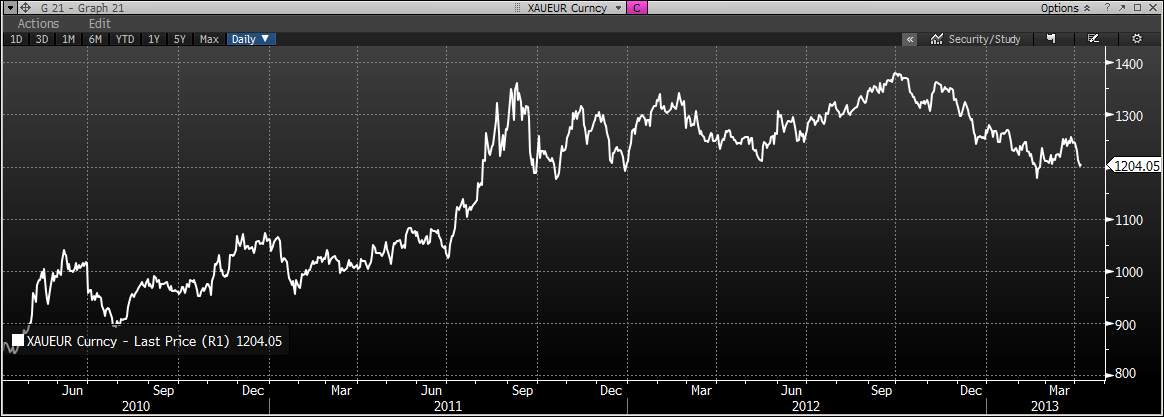
Gold in EUR (3 Year) – Bloomberg
He called for “a common solution in Europe” saying that the “EU should pass laws identical and shared in different member states”. Indeed he went a step further and called for a global coordination of deposit confiscations to rescue failing banks.
Including deposits “is acceptable if it becomes a European solution,” said Ghizzoni, 57.
“What we cannot accept is differentiation country by country inside the same area. I would strongly suggest to make this decision not only within Europe but within the Basel Committee, where all countries are represented.
Ghizzoni is also a Member of the Board of Directors of Institute of International Finance in Washington, Member of the International Monetary Conference in Washington and Member of the Institut International d'Etudes Bancaires in Brussels. He attended the powerful Bilderberg Group meeting in Spain in 2010 and he a frequent attendee at Davos.
It is important to realise that the Cypriot deposit confiscation was not a "haircut" rather this is a confiscation of people's deposits - 60% of individual and companies hard earned cash saved in a bank.
Cyprus is not a tax haven or offshore. It is in the EU and the majority of the deposits were held by EU citizens - Cypriots, Greeks, British, German, Italian and citizens and companies of other nations.
Russian deposits made up just 8% of the total and of that only a tiny fraction was 'Oligarch money'.
This is an attack on capitalism itself and something that one would expect in North Korea. It is a very dangerous precedent and what is more concerning is that there are policy papers calling for similar confiscation of deposits in the UK, Canada and New Zealand in future "banker bail outs" or “bail ins”.
We do not have a “crystal ball” however we are keen students of economic history and of the history of debt and financial crises. This clearly shows that sovereign nations, be they led by kings and queens or democratically elected governments usually resort to printing money and debasing the currency or expropriating assets.

Gold in GBP (3 Year) – Bloomberg
Today, we have powerful supranational institutions who have little loyalty or affinity with ordinary people or businesses and whose primary aims seem to be to protect failing banks and a failing currency union.
The confiscation of deposits, especially deposits over the €100,000 level seems likely in other European countries and could be seen in indebted nations globally.
Individuals, families and companies need to diversify their assets and not have all their life savings and capital in banks.
For breaking news and commentary on financial markets and gold, follow us on Twitter.
Russia And China Plan New Bank To Replace The IMF

Morning links. Scroll down for new video collection.
Russia And China Give $100 Billion To Create New Bank to Replace World Bank, IMF
The biggest emerging markets are uniting to tackle under-development and currency volatility with plans to set up institutions that encroach on the roles of the World Bank and International Monetary Fund.
The leaders of the so-called BRICS nations -- Brazil, Russia, India, China and South Africa -- are set to approve the establishment of a new development bank during an annual summit that began today in the eastern South African city of Durban, officials from all five nations say. They will also discuss pooling foreign-currency reserves to ward off balance of payments or currency crises.
“If they announce a BRICS bank it will be quite something,” O’Neill said in an e-mailed reply to questions on March 15. “At a minimum it symbolizes they can achieve something as political group and means lots of other things could follow in the future. It also means that they will have their own kind of special World Bank, which may aid infrastructure and trade projects.”
Finance ministers and central bank governors from the BRICS nations, who met in Durban today, agreed to set up currency crisis fund of about $100 billion, Brazilian Finance Minister Guido Mantega told reporters today. He didn’t give details of proposed funding for the new bank, which Brazil wants established by 2014. The nation’s leaders are due to sign a final accord tomorrow.
Cypus Banks to Open for First Time in 2 Weeks With Harsh Cash Curbs
Wells Fargo Paid Director’s Son $1.4 Million Last Year
Federal employees who don’t pay taxes would be fired if bill passes
Mini flash crashes: A dozen a day
Barclays announces £39 million in bonuses for execs on budget day
Icelandic bank's top executives indicted over fraud
Dylan Ratigan is running an organic hydroponic farm
Michele Bachmann faces congressional ethics probe
Is the student loan bubble about to pop? - Write-offs Hit Record High
How To Kill A Drone (Awesone...)
Ex-President Expenses Total $3.7 Million In 2012 - Bush Most Expensive
Biden Flying To Delaware On Weekends On Taxpayer Dime
IRS Star Trek Training Video - Latest Taxpayer Waste
Members of Congress Demand Investigation of Obama’s Ammo Stockpile
New York State Sets Up Gun Snitch Line With $500 Award
CIA Makes $600 million deal with Amazon to build cloud computing system for spies
White House moves to let Pentagon take over CIA drones
Mercedes unveils Tesla-powered electric car
Bulgarian man becomes 6th man in past month to set himself on fire
Stealing Frozen Bag Of Meatballs At West Point Brings Federal Charges
Man Gets 3 Years In Prison For Auburn Tree Poisoning - But Corzine Is Still Free - ESPN
Ecuador auctions off pristine Amazon jungle to Chinese oil firms
Why I'm leaving China
Mexico Horror: Men Executed And Bodies Arranged With Messages Nailed To Chests
A father's hoops dream: Minting an NBA millionaire includes lying about son's age
Videos
Ferrari FF: The World’s Only 200 Mph ‘Family’ Car
---
Consumers struggle with Cyprus banks closed.
---
Why Has Copper Dropped Out of the Mining Rally?
---
Global Outlook: Is Gold Losing Its Shine?
---
---
Why Has Copper Dropped Out of the Mining Rally?
---
Global Outlook: Is Gold Losing Its Shine?
---
Will consumers wear Apple Smartwatches, Google Glasses?
---
Chinese market may have peaked.
---
Dick Bove on Cyprus, Europe and U.S. banks.
No surprise. Bove says all Euro banks must be bailed out.
---
.
Steve Chen: No Regrets About Selling Youtube
Start watching at 45 second mark.
---
iFixit: The App for the Fix-It-Yourself Revolution
---
China - World's Most Profitable Bank
---
Chinese market may have peaked.
---
Dick Bove on Cyprus, Europe and U.S. banks.
No surprise. Bove says all Euro banks must be bailed out.
---
.
Steve Chen: No Regrets About Selling Youtube
Start watching at 45 second mark.
---
iFixit: The App for the Fix-It-Yourself Revolution
---
China - World's Most Profitable Bank
Argentina Desperate For Gold To Fight 25% Inflation
Interesting detail from Bloomberg. Runs 2 minutes.
Demand for gold is so strong in Argentina, the only bank that trades gold is looking to buy bullion directly from mining companies. A sign of things to come in other countries perhaps, as Argentina fights the highest inflation rate in the Western hemisphere. And government bonds are forced to pay 14% -- 3 times higher than the emerging market average.
Great clip from earlier today:
Texas Wants Its Gold Back From The Fed
European Shares Decline
By SARA SJOLIN
European stock markets dropped the most since October, extending losses after U.S. nonfarm payrolls saw a weaker-than-expected rise.The Stoxx Europe 600 index slid 1.6%, to 287.13, the lowest level in more than a month. On the week, the index dropped 2.3%.
"The recovery continues, but this is a reality check showing that the pace of recovery is slower than expected," said James Ashley, senior European economist at RBC Capital Markets. "Equity markets had been pricing in a too-strong recovery and growth in the U.S., and Europe is not particularly strong. It's hard to see how you'll get returns when you have weak underlying economic dynamics."
Data from the U.S. Labor Department showed just 88,000 jobs were added to the economy in March, far short of expectations for a gain of 190,000 and the smallest increase in nine months. While the unemployment rate ticked down to 7.6% from 7.7%, it reflected fewer Americans looking for work, according to the data.
"There had been some talk that the [Federal Reserve] would start to taper off their asset purchases because the data had started to improve, but these numbers show that any such move would be premature at this stage. Right now, based on our outlook, a fairly lackluster recovery is what we should expect in the next quarters," Mr. Ashley said.
In the U.S., stocks dropped in a broad selloff.
Employment data out earlier this week, including the ADP private-payrolls report and initial jobless claims, all painted a less optimistic picture of the recovery in the labor market than expected, which had already fueled fears that Friday's data would miss expectations.
In Europe, data showed retail sales for the euro area fell 0.3% in February month on month.
Airline stocks were among hardest-hit sectors on rising fears that the bird-flu virus would affect air travel. The death toll from the H7N9 virus in China rose to four people according to authorities in Shanghai.
Air France-KLM AF.FR -7.77% slumped 7.8%, Deutsche Lufthansa LHA.XE -5.23% fell 5.2% and International Consolidated Airlines Group IAG.MC -7.31% dropped 6.9%.
The U.K.'s FTSE 100 index dropped 1.5%, to 6249.78, with bank HSBC Holdings HSBA.LN -1.80% off 1.8%. The index posted a 2.5% weekly drop.
EasyJetlost 6.4%. The budget airline said it expects a first-half pretax loss of between £60 million and £65 million ($91.4 million and $99 million), compared with the previous projections of a £50-million-to-£75-million loss.
Fashion retailer Next gave up 3.6%, as Credit Suisse CSGN.VX +0.20% cut the firm to "neutral" from "outperform."
EZJ.LN -6.38% In France, the CAC-40 index dropped 1.7%, to 3663.48, with oil company Total down 1.5%, tracking lower oil prices. The index lost 1.8% on the week.
PPR lost 4.2%, as its Gucci unit said it has made an "irrevocable" offer of €13 million ($16.8 million) to save tableware company Richard Ginori from bankruptcy.
Banks BNP Paribas BNP.FR -1.42% fell 1.4% and Crédit Agricole ACA.FR -1.56% declined 1.6%.
In Germany, the DAX index slumped 2%, to 7658.75, sending it 1.8% lower on the week.
U.S. Stocks Fall as Payrolls Rise Less Than Estimated
U.S. stocks fell, capping the biggest weekly decline of the year for the Standard & Poor’s 500 Index, after data showed the nation added less than half the number of jobs economists forecast in March.
American Express Co. and Coca-Cola Co. slid at least 1.1 percent to pace losses among the largest companies. F5 Networks Inc. (FFIV) lost 19 percent, leading declines among technology shares, after reporting preliminary results below its forecast. Cisco Systems Inc. and Juniper Networks Inc., makers of communications equipment, fell more than 2 percent. Hewlett-Packard Co. fell 1.5 percent after announcing a shakeup of its board.
The S&P 500 (SPX) retreated 0.4 percent to 1,553.28 in New York, paring an earlier decline of as much as 1.3 percent. The equity benchmark lost 1 percent for the week. The Dow Jones Industrial Average fell 40.86 points, or 0.3 percent, to 14,565.25 today. Trading among S&P 500 shares was 1.2 percent higher than the three-month average. About 6.4 billion shares changed hands on U.S. exchanges, in line with the three-month average.
“The number is disappointing and moderately concerning, but one month does not make a trend,” David Roda, the Miami- based regional chief investment officer for Wells Fargo Private Bank, said in a phone interview. His firm manages $170 billion. “Yes, it’s a miss and it’s worth focusing on, but we don’t think it changes our forecast for a modest improvement in employment this year. It’s a good day to buy stocks because it made the markets nervous.”
Payrolls grew by 88,000 workers last month, the smallest in nine months, after a revised 268,000 gain in February that was higher than first estimated, Labor Department figures showed today in Washington. The median forecast of 87 economists surveyed by Bloomberg projected an advance of 190,000. The jobless rate fell to 7.6 percent from 7.7 percent.
‘On Vigil’
“It obviously means that the Fed will remain on vigil with regards to the highly accommodative monetary policy,” Mark Luschini, chief investment strategist at Philadelphia-based Janney Montgomery Scott LLC, which oversees $55 billion, said in a telephone interview.The bull market in U.S. equities entered its fifth year last month. The S&P 500 has surged 130 percent from a 12-year low in 2009 as companies reported better-than-estimated earnings and the Federal Reserve embarked on three rounds of bond purchases to stimulate the economy. The S&P 500 and the Dow closed at record highs on April 2.
The Fed has said it will continue its purchases of $85 billion a month of Treasuries and mortgage-backed securities until the jobs outlook has “improved substantially.” Fed Chairman Ben S. Bernanke on March 20 said further gains are needed for the central bank to consider reducing its record monetary easing.
Stimulus Plans
Equities climbed yesterday after the Bank of Japan strengthened its stimulus program, while European Central Bank President Mario Draghi signaled the bank will keep monetary policy loose for an extended period.Alcoa Inc. unofficially kicks off the first-quarter earnings season on April 8 when it reports its financial results after equity markets close.
Earnings at S&P 500 companies decreased 1.8 percent in the first three months of the year, according to analyst estimates compiled by Bloomberg. That would mark the first year-over-year decrease in profit since 2009. Energy company earnings fell the most with a drop of 6.3 percent, the estimates show, as oil traded at an average of $94.36 a barrel during the period compared with $103.03 in the first quarter of 2012. Profit at technology companies declined 4.1 percent for the second-biggest drop, the data show.
Cyclical Stocks
Seven out of 10 groups in the S&P 500 fell today, with technology, health-care and consumer-staples companies losing at least 0.6 percent. The Morgan Stanley Cyclical Index slid 0.6 percent, extending its decline for the week to 3.3 percent. Among the largest companies, Coca-Cola declined 1.1 percent to $40.08 and American Express tumbled 2.1 percent to $65.30.The Chicago Board Options Exchange Volatility Index, which measures the cost of using options as insurance against losses in stocks, added 0.2 percent to 13.92 after jumping as much as 13 percent earlier in the day. The gauge, known as the VIX (VIX), is down 23 percent for the year.
F5 Networks (FFIV) plunged 19 percent to $73.21 after the maker of equipment for managing data traffic said preliminary second- quarter revenue was $350.2 million, below its forecast of $370 million to $380 million, as North American sales slowed.
Cisco, the world’s largest maker of networking equipment, declined 2 percent to $20.61 and Juniper Networks, the second- biggest, slid 3.2 percent to $17.55.
Hewlett-Packard
Hewlett-Packard fell 1.5 percent to $21.97 after announcing Ray Lane is stepping down as chairman. Two other directors are also leaving the company in its second board overhaul in two years, underscoring shareholders’ dissatisfaction with the company’s performance and the botched acquisition of Autonomy Corp.The Bloomberg U.S. Airlines Index slid 0.7 percent after a JPMorgan Chase & Co. analyst said U.S. government spending on air travel probably fell as much as 30 percent in the past month amid congressionally mandated budget cuts that threaten to keep weighing on the industry.
Delta Air Lines Inc. fell 2.4 percent to $14.39, bringing its loss for the week to 13 percent, the most since May 2011.
Rigel Pharmaceuticals Inc., a drugmaker with no products on the market, plunged 40 percent to $4.50 after its experimental rheumatoid arthritis medicine being developed with AstraZeneca Plc showed mixed results in a trial.
Quarterly Dividend
Hanesbrands Inc. rose 3.8 percent to $46.84 after the apparel maker said it will pay a quarterly dividend of 20 cents a share in June, the first time it has made a payout to shareholders.NII Holdings Inc., which offers mobile-phone service under the Nextel brand in Latin America, rose 21 percent to $5.48 after agreeing to sell its Peru unit for $400 million.
The move by the Bank of Japan this week to embark on record easing means the world’s four biggest developed-market monetary authorities -- the BOJ, the Fed, the ECB and the Bank of England -- are aligned in their commitments to spur growth and return their economies to full strength.
Increased stimulus may bolster a global economy forecast by the World Bank in January to expand 2.4 percent this year, down from a previous projection of 3 percent. At the same time, the level of intervention carries the threat of inflation and asset bubbles as well as tension with emerging markets including China, Brazil and South Korea over exchange rates and capital inflows.
“This is unprecedented on many levels,” said Pippa Malmgren, president and founder of Principalis Asset Management LLP in London and a former financial-market adviser to President George W. Bush. “Not only do you have the most in terms of size of economy or number of central banks, but the effort is a record effort. We’ve never seen such unconventional methods used to create as much inflation as possible.”
Subscribe to:
Posts (Atom)