Sunday, March 17, 2013

An economy of peak food stamp usage, peak Dow, and peak Debt

Source: My Budget 360, Guest Post

It is a dichotomy that speaks to the current state of our economy. Food stamp usage has peaked at the very same time that the Dow Jones Industrial Average is setting new highs. Of course, the Dow is setting new nominal highs but still has a way to go to catch up to the eroding effects of inflation. You have to really ask how is it possible that at a time where so much financial wealth is available that so many people, over 47 million people in our country, are relying on food assistance just to get by. Where is all the wealth going? The financial system has been propped up with trillions of dollars of bailouts and loan programs and has allowed the same kind of speculation that caused our serial bubbles to once again emerge. Many people are speculating in places like Las Vegas and Arizona and crowding out your typical family simply looking to buy a simple home or find a rental. The fact that we are facing a peak in food stamp usage and seeing a new high with the Dow is very telling in the sense that it shows that we are truly becoming a society with a smaller middle class.

Food stamps hit a new peak
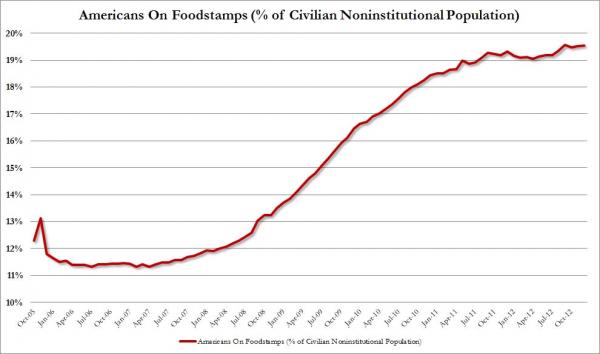
We have never had so many Americans on food stamps as a percentage of our population:
Percentage of Americans on Foodstamps_0
Source: ZH, SNAP
The actual number is 47,791,966 Americans that now receive food assistance. What the media does not convey is that the stock market is largely not a true indicator of health for the underlying economy. Few Americans own any significant amount of financial wealth. Most Americans rely on actual jobs to live and support their family. Many of these companies are increasingly earning higher profits by slashing wages, cutting benefits, and earning profits from their business abroad. What the press does not tell you is the standard of living for many Americans has moved backwards over the last few decades. Median household income is now back to levels last seen in the mid-1990s.
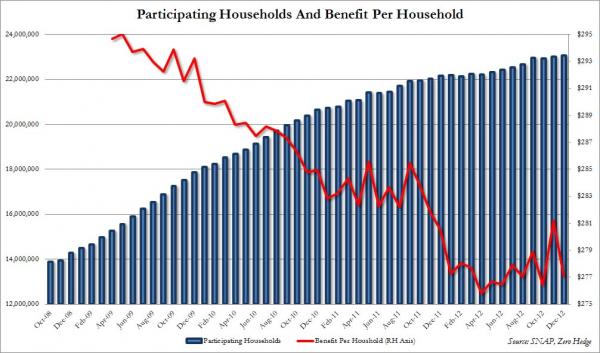
To get food stamps is really no easy task. You have to show that you are in poverty or on the verge of being in poverty. The typical amount given each month is not large:
Households on Foodstamps Dec_0
The typical amount given out is about $277 per month. A corollary impact of this is that it has boosted company stock in places like Family Dollar and the 99 Cents Store. The dollar economy is strong because it has 47,791,966 guaranteed customers and it seems that this figure has not gone back even though our recovery goes back to the summer of 2009. Many dollar stores also have a surprising number of higher income households trying to stretch their dollars.
The peaking stock market
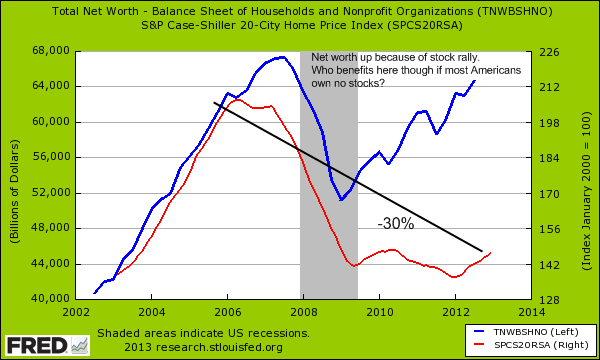
The stock market is not a good indicator for overall wealth of Americans. Most Americans have their wealth in home equity. So while net worth is heading back up near the peak, real estate values are still down about $5.5 trillion from their peak:
net-worth-and-real-estate
While overall net worth is nearing a top, the housing market is still down about 30 percent from its peak. The price rise in real estate right now is being driven not by healthy household balance sheets but by large Wall Street funds scooping up whatever properties they can find to turn into rentals or flip projects. They are crowding out your average American. Net worth figures are still hampered for most because of the fall in real estate values. But the recent rise seems to be spurred by hot money chasing another market which is exactly what set the foundation for the first housing bubble back in the early 2000s.
It should be an obvious question to ask by the press as to why it is that the Dow has peaked at a time when food stamp usage has peaked. Yet there is little market or advertising dollars from the poor. The dollar stores have their niche and reach out to this group but it is unlikely that they will spend big ad dollars to compete with debt based spending on cars or pharmaceutical ads. We also have record debt at $16.7 trillion and you are seeing record speculation in the stock market with people underpricing volatility. Not every peak is worth climbing.

Senate Democrats block effort to end USDA/Mexico food stamp promotion partnership


The Daily Caller – by Caroline May
During the Senate Budget Committee’s Thursday markup of the Senate budget resolution, Democrats prevented an effort to block funds for the Agriculture Department’s “partnership” with the Mexican government, which is aimed at promoting nutrition assistance programs among Mexican Americans, Mexican nationals and migrant communities in America.
In a party-line 12 to 10 vote, the Democrats on the committee rejected a proposal to prevent funding for such endeavors from ranking member Alabama Republican Sen. Jeff Sessions, who has spoken out against the program in recent months.  
“Contrary to sound policy, the United States is spending money advertising food stamp benefits in foreign consulates,” Session’s staff said in a Thursday evening press release. “This amendment would prohibit any funds from being spent on this controversial promotion campaign.”
Until recently, the USDA’s partnership was relatively unknown, with only a few mentions of it in public agency materials.
“USDA and the government of Mexico have entered into a partnership to help educate eligible Mexican nationals living in the United States about available nutrition assistance,” the USDA explains in a brief paragraph on its “Reaching Low-Income Hispanics With Nutrition Assistance” Web page. “Mexico will help disseminate this information through its embassy and network of approximately 50 consular offices.”
Last fall, Agriculture Secretary Tom Vilsack defended the program in a letter to Sessions, explaining that the partnership with the foreign government was one of many efforts to reduce hunger in America.
“The Mexico-U.S. Partnership for Nutrition Assistance Initiative is just one of a wide range of USDA partnership activities intended to promote awareness of nutrition assistance among those who need benefits and meet all program requirements under current law,” Vilsack wrote to Sessions.
In that letter, Vilack revealed that USDA personnel had met with Mexican government officials to promote nutrition initiatives more than 150 times since the program’s inception in 2004, under the Bush administration.
Read more: http://dailycaller.com/2013/03/15/senate-democrats-block-effort-to-end-usdamexico-food-stamp-promotion-partnership/#ixzz2Ni74zybt

Banker left Speechless by Irish Journalist


COMEDY: Drinking Your Way Through The Sequester


Satire meets the debt ceiling.
David Angelo of eEconomics on the sequester and debt ceiling fear-mongering.

Bernanke: 'I See No Evidence Of A Stock Bubble'


Bernanke on artificial markets.
"The equity premium associated with stock prices is quite wide.  Stocks don’t appear overvalued given earnings and interest rates.  Now if interest rates went up some, that would have a negative effect on stock prices."
The Bernank is conveniently forgetting about QE.  Without the Fed for the past 3 years, the Dow would likely be a few thousand points lower.
Fed Chairman testifies before the Senate Banking Committee.  Full summary here.
---
Analysis from Bloomberg:


Equity bubble?  Bond bubble?  Is Bernanke right?

Earlier today:

TALEB: 'If I Were President, I'd Fire Bernanke!'

Cyprus bailout talks set to start in Brussels

President Nicos Anastasiades has already held successive meetings with European leaders and officials on the sidelines of the European Council, in Brussels, ahead of the Eurogroup meeting.
 
FAMAGUSTA GAZETTE
TALKS ON a bailout for Cyprus will start later at the EU in Brussels.

Prime Minister of Luxembourg Jean Claude Juncker has said that, not only must progress be made, but a solution must be found for Cyprus at the Eurogroup meeting.

Nicosia is pushing for the European Union and International Monetary Fund to sanction a bailout worth up to 17bn euros.

Preseident of the European Parliament Martin Schultz said that Cyprus deserves the same treatment by its partners as other countries.

"The position of the EP is absolutely clear. Cyprus deserves the same treatment in the frame of the problems that the country is facing as other countries in the Eurozone and in the EU, this is the position of the overwhelming majority of Members of the EP and whatever we can do to support the country to overcome the problems, the EP will contribute too.”

The island has already accepted a condition set by international lenders for a money laundering audit following German accusations that Cyprus is a haven for Russian money launderers and tax evaders.

Nicosia has repeatedly rejected allegations that Cypriot banks engage in money-laundering activities and said it has "nothing to hide" ahead of the independent audit, which should be completed by the end of the month.

President Nicos Anastasiades has already held successive meetings with European leaders and officials on the sidelines of the European Council, in Brussels, ahead of the Eurogroup meeting.

Anastasiades met with European Council President Herman Van Rompuy and German Chancellor Angela Merkel.

We are looking for a fair not privileged treatment,” Anastasiades, said before the European Council meeting, in Brussels.

“I have undertaken the post (of the President of Cyprus) 15 days ago and I immediately got into negotiations with Troika representatives and we are looking forward to finding the best and most fair agreement,” he told the press.

Cyprus Radio has also reported that Russia might help finance the bailout by extending a 2.5bn-euro loan already made to Nicosia. It has been reported that Cypriot Finance Minister Michael Sarris will travel to Moscow for meetings next week.
 — Copyright © Famagusta Gazette 2012 All comments are now moderated

An economy of peak food stamp usage, peak Dow, and peak Debt


My Budget 360
What does it say about our economy that at the same time the Dow Jones hits a peak, we have the highest percentage of Americans on food stamps?
It is a dichotomy that speaks to the current state of our economy.  Food stamp usage has peaked at the very same time that the Dow Jones Industrial Average is setting new highs.  Of course, the Dow is setting new nominal highs but still has a way to go to catch up to the eroding effects of inflation.  
You have to really ask how is it possible that at a time where so much financial wealth is available that so many people, over 47 million people in our country, are relying on food assistance just to get by.  Where is all the wealth going?  The financial system has been propped up with trillions of dollars of bailouts and loan programs and has allowed the same kind of speculation that caused our serial bubbles to once again emerge.
Many people are speculating in places like Las Vegas and Arizona and crowding out your typical family simply looking to buy a simple home or find a rental.  The fact that we are facing a peak in food stamp usage and seeing a new high with the Dow is very telling in the sense that it shows that we are truly becoming a society with a smaller middle class.
Food stamps hit a new peak
We have never had so many Americans on food stamps as a percentage of our population:
Percentage of Americans on Foodstamps_0
Source: ZH, SNAP
The actual number is 47,791,966 Americans that now receive food assistance.  What the media does not convey is that the stock market is largely not a true indicator of health for the underlying economy.  Few Americans own any significant amount of financial wealth.  Most Americans rely on actual jobs to live and support their family.  Many of these companies are increasingly earning higher profits by slashing wages, cutting benefits, and earning profits from their business abroad.  What the press does not tell you is the standard of living for many Americans has moved backwards over the last few decades.  Median household income is now back to levels last seen in the mid-1990s.
To get food stamps is really no easy task.  You have to show that you are in poverty or on the verge of being in poverty.  The typical amount given each month is not large:
Households on Foodstamps Dec_0
The typical amount given out is about $277 per month.  A corollary impact of this is that it has boosted company stock in places like Family Dollar and the 99 Cents Store.  The dollar economy is strong because it has  47,791,966 guaranteed customers and it seems that this figure has not gone back even though our recovery goes back to the summer of 2009.  Many dollar stores also have a surprising number of higher income households trying to stretch their dollars.
The peaking stock market
The stock market is not a good indicator for overall wealth of Americans.  Most Americans have their wealth in home equity.  So while net worth is heading back up near the peak, real estate values are still down about $5.5 trillion from their peak:
net-worth-and-real-estate
While overall net worth is nearing a top, the housing market is still down about 30 percent from its peak.  The price rise in real estate right now is being driven not by healthy household balance sheets but by large Wall Street funds scooping up whatever properties they can find to turn into rentals or flip projects.  They are crowding out your average American.  Net worth figures are still hampered for most because of the fall in real estate values.  But the recent rise seems to be spurred by hot money chasing another market which is exactly what set the foundation for the first housing bubble back in the early 2000s.
It should be an obvious question to ask by the press as to why it is that the Dow has peaked at a time when food stamp usage has peaked.  Yet there is little market or advertising dollars from the poor.  The dollar stores have their niche and reach out to this group but it is unlikely that they will spend big ad dollars to compete with debt based spending on cars or pharmaceutical ads.  We also have record debt at $16.7 trillion and you are seeing record speculation in the stock market with people underpricing volatility.  Not every peak is worth climbing.
http://www.mybudget360.com/food-stamp-usage-record-high-dow-jones-record-high-national-debt-record-high/