Saturday, March 9, 2013

Maine Town Declares Food Sovereignty

If you're new here, you may want to sign up for FREE weekly updates delivered to your inbox featuring Real Food recipes, nutrition & health articles, and the latest in sustainable agriculture, food politics & philosophy.

Sedgwick, Maine has done what no other town in the United States has done. The town unanimously passed an ordinance giving its citizens the right “to produce, process, sell, purchase, and consume local foods of their choosing.” This includes raw milk, locally slaughtered meats, and just about anything else you can imagine. It’s also a decided bucking of state and federal laws.
From David Gumpert’s coverage:
This isn’t just a declaration of preference. The proposed warrant added, “It shall be unlawful for any law or regulation adopted by the state or federal government to interfere with the rights recognized by this Ordinance.” In other words, no state licensing requirements prohibiting certain farms from selling dairy products or producing their own chickens for sale to other citizens in the town.
What about potential legal liability and state or federal inspections? It’s all up to the seller and buyer to negotiate. “Patrons purchasing food for home consumption may enter into private agreements with those producers or processors of local foods to waive any liability for the consumption of that food. Producers or processors of local foods shall be exempt from licensure and inspection requirements for that food as long as those agreements are in effect.” Imagine that–buyer and seller can agree to cut out the lawyers. That’s almost un-American, isn’t it?
I applaud the residents of Sedgwick for making such a bold stand. Three other Maine towns are also slotted to vote on a similar ordinance in the coming weeks.
I wonder, though, about how enforceable such a law is if the state or federal government chose to challenge it. In response to a similar question, Edwin Shank (of Your Family Cow) commented on Gumpert’s post:
I’m not one of the “lawyers here” but my observation is that when the local law chooses to prohibit more than the rest of the state, nation or organization they will usually get by with it. It is when local law moves to allow more latitude that the trouble starts.
For example, I can imagine that if a county in PA would take a Humbolt CA position on raw milk, the state would take an it’s-up-to-them position. But if local law in an area moved to allow raw butter, cream, kefir & yogurt… I’m sure it would not get to first base.
Still, I say Kudos to the fine folks of Sedgwick Maine. Their common sense bravery warms the heart of every awake American. If nothing else, their move will bring the ridiculousness of the situation to the consciousness of another percent or so of Americans. One American at a time the tipping point will be reached.
Deborah Evans, one of the citizens of Sedgwick also commented:
The problem with your question is that nobody really knows the answer. In Maine, there are maybe ten or so “citizen-initiated rights-based” ordinances like ours, passed in various towns in recent years, on a variety of issues. For instance, Montville passed an ordinance forbidding the planting of GMO’s several years ago. ME’s Dept of Ag wrote them a letter saying they could not do that according to some legal point, whereupon Montville’s counsel wrote back that they could do it because of a different point of law. As far as we know, that was that.
Also, Maine has “home rule” for its towns in the statutes. The Maine Municipal Association published “Municipal Home Rule: Grassroots Democracy or A Symbolic Gesture,” (from Maine Townsman, January 1983) by Michael L. Starn, Editor. In this article, he writes:
Municipal home rule in Maine is both constitutional and legislative. The constitutional provision can be found in the Constitution of the State of Maine, Art. VII, Pt.2, §1, and was adopted in public referendum in 1969. The amendment reads:
“The inhabitants of any municipality shall have the power to alter and amend their charters on all matters, not prohibited by Constitution or general law, which are local and municipal in character. The legislature shall prescribe the procedure by which the municipality may so act.”
Our Local Food and Community Self-Governance Ordinance states:
(1) Producers or processors of local foods in the Town of Sedgwick are exempt from licensure and inspection provided that the transaction is only between the producer or processor and a patron when the food is sold for home consumption. . . .
(2) Producers or processors of local foods in the Town of Sedgwick are exempt from licensure and inspection provided that the products are prepared for, consumed or sold at a community social event.”
Therefore, we the radicals who concocted this mutinous act of infamy believe that according to the Home Rule provisions of our State Constitution, the citizens of Sedgwick have the right to enact an ordinance that is “local and municipal in character.”
David posted a link to our ordinance template so please feel free to read it over as I think some of your questions will be answered there. Having founded our legal position in the Declaration of Independence and the Constitution of the State of Maine, we feel that if a challenge is posed it can only be resolved in a court of higher authority.
The Farmer to Consumer Legal Defense Fund, the Community Environmental Legal Defense Fund and the Alliance for Democracy have all aided us in our efforts to construct this ordinance over the last year. We have had the civics lesson of our lives – and it all started with a few of us sitting around a farmhouse kitchen table, having been gobsmacked by our Dept of Ag over a “new interpretation” of the 1,000-bird processing exemption..
Regardless of the outcome when all the votes are counted, Sedgwick and the other three towns have stood up and taken a stand on what matters in our communities. We know of several other towns who are just waiting to see how this goes before they jump in the game. Our State Legislators and Senator are very excited about this as it gives them a mandate to begin to make the changes at the state level. Right now there are three bills in the Legislature’s Ag Committee that address our issues at the state level, largely because our issues are everyone’s issues when you get right down to it. If citizens in enough towns in enough states stand up and take a stand on their local food system based on their inalienable right to produce and choose the food they eat, the Fed might have to listen! What a concept.
As a country the majority of us have become politically lazy and complacent. If we want change we must take up the tools of the democracy bequeathed to us by the Founding Fathers, organize, and get the ball rolling.
If anybody thinks real change happens any other way, look at our history: Long before our Constitution was amended, individuals and small groups of outspoken people put their lives on the line to end slavery, to allow women the right to vote, to end racial discrimination, etc. Look at the struggles to legalize something as basic as the right to home school your own children. Real change comes from the people. Period.
So, Kudos to the fine citizens of Sedgwick, Maine. May you inspire many other municipalities to follow suit!
(photo by Mr. Ducke)

Silver Investment Demand Surges 30% As Silver ETF Holdings Robust

by Gold Core

Today’s AM fix was USD 1,577.00, EUR 1,049.10 and GBP 1,204.18 per ounce.
Yesterday’s AM fix was USD 1,580.50, EUR 1,213.25 and GBP 1,054.02 per ounce.
Silver is trading at $28.81/oz, €22.04/oz and £19.24/oz. Platinum is trading at $1,604.50/oz, palladium at $760.00/oz and rhodium at $1,200/oz.
Gold fell $5.70 or 0.36% closed at $1,577.70/oz. Silver slid $0.19 or 0.65% to $28.86.

Gold and Silver ETF Holdings

Gold appears to be consolidating just below the $1,600/oz level. It is 0.3% higher in dollar terms for the week, 0.4% higher in pound terms and 2.3% higher against the yen which has fallen sharply this week.
While it is 5% lower YTD in dollar and euro terms, it has risen nearly 2% and 4% in pound and yen terms so far in 2013.

Cross Currency Table – (Bloomberg)

Physical demand continues to be supportive of gold according to UBS. In their note today they say that physical demand prospects out of China remain positive in the weeks ahead. UBS said Asia remains a net buyer and although premiums on the Shanghai Gold Exchange have fallen, volumes remain elevated.
Meanwhile Chinese banks are also buying gold in international markets.  The spread between Shanghai and spot gold prices narrowed from about $20 an ounce over the past few days to below $15. Reuters reported that there was “strong buying from Chinese banks” in the overseas market which had helped push up the premium in onshore prices.
Silver is outshining gold in the market for exchange-traded products as global demand for the white metal gets a boost from industrial consumption amid signs of an economic recovery, CPM Group Inc. said.
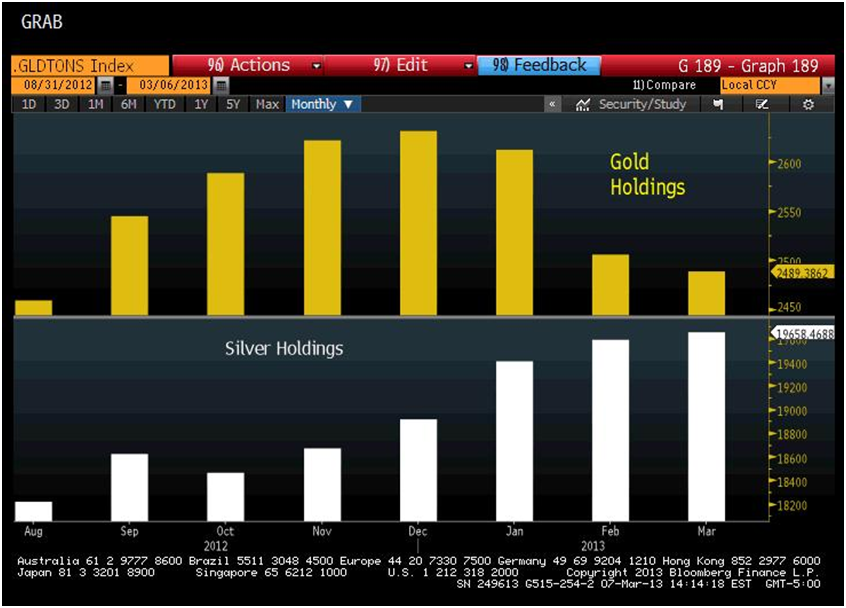
The Bloomberg Chart of the Day shows silver tonnage in exchange- traded funds backed by the metal rose for four straight months, while holdings for gold ETPs dropped in January and February.
Silver futures may jump 20 percent this year to $34.50 an ounce from yesterday’s settlement of $28.808 in New York on investment demand and industrial use, said Rohit Savant, a senior commodity analyst at the New York-based research company.
“People have been buying silver both as a base and precious metal,” Savant said in a telephone interview with Bloomberg. “Economic demand will push prices higher.”

Gold GBP YTD – (Bloomberg)

About 53% of silver is used in industrial products from televisions to batteries, according to the Silver Institute in Washington. Some investors may buy the metal as a “cheaper alternative to gold”, and investment demand has climbed 30% this year, Societe Generale said in a report on March 4.


Holdings in silver ETPs rose 3.6 percent in the two months ended Feb. 28, reaching a record 19,699 metric tons on Jan. 18, data compiled by Bloomberg show. Last month, assets in gold ETPs fell 4.1%.

Silver GBP YTD – (Bloomberg)

Sales of American Eagle silver coins by the U.S. Mint jumped to a record in January and more than doubled in February from a year earlier, the Mint’s website showed. China’s imports of the metal surged 14% in January, the biggest monthly gain since July.
Webinar: Everything you need to know about Silver in 60 minutes.
Date: 13th March, 2013, 1900 – 2000 GMT
Speakers: David Morgan publisher of the Morgan Report and GoldCore Research Director Mark O’Byrne
Do you want answers on why silver should be part of your investment portfolio and why silver is a form of saving and financial insurance? Do you want to know the safest way to own silver? Do you want the opportunity to put your own questions to two leading world authorities on silver? We’ll help you in this complimentary webinar, “Everything you need to know about Silver in 60 minutes.”
To register click here!
NEWS   
Gold hovers near $1580/oz; US jobs data in focus - Reuters
Gold Swings Between Gains and Losses Before U.S. Employment Data - Bloomberg
ECB’s Draghi: Systemic Risk From Cyprus Not Necessarily Small – Deutsche Börse Group
Fed ‘stress test’: banks would lose $460 Billion if crisis struck again – The Telegraph
COMMENTARY
Why you shouldn’t be selling gold – Market Watch
EU “doomed to decline until the boil of monetary union is lanced” – The Telegraph
Why Precious Metal’s Run Isn’t Finished Just Yet – Market Watch
Exchange Traded Funds ‘Dumping Gold’ – Does It Matter? – Zero Hedge
Silver & Gold To Spike As Oil To Surge A Stunning 63% – 82% - King World News
For breaking news and commentary on financial markets and gold, follow us onTwitter.

The Human Cost of Fiscal Mismanagement of Government

Jumper
During the Great Depression, there were countless suicides. People jumping out of buildings because they lost everything and could not face a future that was destitute. The photographs of such scenes will live forever. The same is taking place throughout Southern Europe today and it is a cry for fiscal responsibility upon government. In Italy, just since the start of the year, 23 entrepreneurs have committed suicide. Politicians are responsible for these economic declines. It was their corruption allowing NY bankers to do whatever they feel like as long as they fund their elections. These are people you would not give a $20 bill to and send to the store for an errand to by $5 of something because they sure as hell would not return with any change. Yet we elect these people who have NO experience whatsoever, make promises they have no intention to keep, and then they always blame us for their mess.
Weapons on Streets
They will say anything to get bills passed, pretend they would never do anything unconstitutional, and then when asked does the President have the authority to just kill Americans on the street, he and his staff refuse to respond. This is all about fiscal mismanagement. We are always attacked so they retain the power over us. It matters not what form of government – it is always the same ending. As Adam Smith wrote:
“It is the highest impertinence of kings and ministers to pretend to watch over the economy of private people and to restrain their expense, either by sumptuary laws, or by prohibiting the importation of foreign luxuries. They are themselves always, and without exception, the greatest spend thrifts in the society. Let them look well after their own expense, and they may safely trust private people with theirs. If their own extravagance does not ruin the state, that of their subjects never will.”
Adam Smith Wealth of Nations 1776, Book II, Chapter III,
Of the Accumulation of Capital, or of Productive and Unproductive Labour 
They are NEVER held responsible for the own mismanagement. Somehow, we always have to pay for their frauds. The price is often way too high.

60,000 Border and Customs Agents Told to Take Furloughs

Sixty-thousand federal employees responsible for securing the nation’s borders and facilitating trade will be furloughed for as many as 14 days starting next month because of $85 billion in cross-government spending cuts.

The federal government notified the workers on Thursday, CNN reports.

U.S. Customs and Border Protection officials said the furloughs and other austerity measures would cause delays at ports of entry, including international arrivals at airports, and would reduce the number of border patrol officers on duty at any one time, CNN reports.

Urgent: Obama or GOP: Who’s to Blame for Budget Crisis? Vote Now

David Aguilar, the agency's deputy commissioner, said it must cut about $754 million by Sept. 30, the end of the fiscal year.

The agency plans to institute furloughs throughout its departments, a hiring freeze — and to reduce or eliminate overtime, compensatory time, travel and training. Other federal agencies are following similar steps because of the spending cuts that took effect on March 1 through sequestration.

Customs “continues to evaluate further impacts of sequestration” on its operations, an agency spokeswoman, Jenny Burke, said in a statement reported by CNN.

“Even with these cuts, though, individuals apprehended illegally crossing the southwest border will still be processed as usual,” Burke said.

The Customs furloughs will begin in mid-April, with reductions in border patrol overtime starting on April 7, Burke said.

Homeland Security Secretary Janet Napolitano said on Monday that she expects customs wait times to increase to 150 to 200 percent of normal, CNN said.

"I don't mean to scare, I mean to inform,” Napolitano said. “If you're traveling, get to the airport earlier than you otherwise would. There's only so much we can do with personnel.”

Meanwhile, the union representing some 24,000 agency employees predicted on Thursday that the cuts would “undercut” national security and bring a loss of revenue.

Customs collects more money for the federal government than any agency other than the Internal Revenue Service, the National Treasury Employees Union said in a statement.

“There is no escaping the reality that sequestration is having serious effects on the traveling public and on vital commerce,” the union’s president, Colleen M. Kelley, said in the statement.

Late last month, Napolitano and other Obama administration officials came under fire — particularly from officials in Arizona — for the release of hundreds of illegal immigrants held in local jails to save money as the sequester neared.

Napolitano has since promised to release more illegals, primarily on supervised release, saying the sequester had left her no choice.

“We’re going to continue to do that for the foreseeable future,” Napolitano said at a March 4 breakfast meeting hosted by Politico. “We are going to manage our way through this by identifying the lowest-risk detainees, and putting them into some kind of alternative to release.”

Urgent: Obama or GOP: Who’s to Blame for Budget Crisis? Vote Now

However, internal Homeland Security documents quoted in news reports indicated that 2,000 illegals had already been released by the time of the sequester — and officials planned to let go 3,000 more.

As many as 11 million illegal immigrants are in the United States, about seven million of whom are working — primarily in low-skill jobs.

However, roughly 20 million Americans are without jobs, including several million Americans with few job skills, according to news reports.


© 2013 Newsmax. All rights reserved.

The 86 million invisible unemployed

Last year, 86 million Americans were not counted in the labor force because they didn't keep up a regular job search. Most of them were either under age 25 or over age 65.

NEW YORK (CNNMoney) -- There are far more jobless people in the United States than you might think.
While it's true that the unemployment rate is falling, that doesn't include the millions of nonworking adults who aren't even looking for a job anymore. And hiring isn't strong enough to keep up with population growth.


As a result, the labor force is now at its smallest size since the 1980s when compared to the broader working age population.
"We've been getting some job growth and it's been significant, but it hasn't yet been strong enough that you start to get people re-engaging in the labor market," said Keith Hall, a senior research fellow at the Mercatus Center and former commissioner of the Bureau of Labor Statistics.
A person is counted as part of the labor force if they have a job or have looked for one in the last four weeks. As of April, only 63.6% of Americans over the age of 16 fell into that category, according to the Labor Department. That's the lowest labor force participation rate since 1981.
It's a worrisome sign for the economy and partly explains why the unemployment rate has been falling recently. Only people looking for work are considered officially unemployed.
Jason Everett, for example, wouldn't be counted.
Out of work for nearly three years now, Everett has given up his job search altogether.
Instead, the unemployed plumber and Air Force veteran takes a few community college courses and looks after his two children while his wife is the primary breadwinner.
"I'm not even totally convinced the college degree is really going to help at this point, but I figure at least I'll be doing something," he said.
The unofficially unemployed
Last year there were 86 million people who didn't have a job and weren't consistently looking for one, according to Labor Department data.
Older people, ages 65 and over, account for more than a third. Young people between 16 and 24 make up another fifth. More than half don't have a college degree and more than two thirds are white.
Many of the teens and 20-somethings may be enrolled in either high school or college full-time. And many of the over 65 crowd are probably retired.
But what about the other 36 million folks who fall in between?
The truth is, the Labor Department simply doesn't know why they're not in the labor force. Many may be staying home with children or other relatives. Some may have gone back to school or retraining programs. Others could be disabled and unable to work, and some may have retired early.
"Even in the best of times, there are millions of people who don't want to work for a variety for reasons," Hall said.
But he suspects the number of "disengaged" Americans, like Everett, is higher than usual as a direct result of the recession.
About six million people claim they want a job, even though they haven't looked for one in the last four weeks. If they were to all start applying for work again, the unemployment rate would suddenly shoot up above 11%.
"At this point, the labor market is worse than people realize because people are discouraged. Certainly, a large number of workers have given up on the job market," Hall said.
That said, the decline in labor force participation is not a new problem. After peaking at 67.3% in early 2000, the rate has been falling ever since.
Researchers at the Chicago Federal Reserve attribute a large part of the decline to the recent recession and lackluster recovery, but the other half to long-term demographic trends.
For example, as more women entered the labor force between the 1960s and 1990s, the participation rate rose rapidly. That effect may have plateaued since then.
Meanwhile, as Baby Boomers entered their prime working years, they also drove the participation rate higher. Once they started hitting their 50s and 60s though, many started transitioning into retirement.
Finally, teenage jobs have been on the decline and college enrollment picked up in the last decade, leading more young people to not be counted in the labor force.
As these trends continue, the Chicago Fed expects the labor force participation rate will keep falling, hitting 62.4% by 2020.
That poses a problem for a variety of reasons.
It hits tax revenue and makes it harder to fund social safety nets like Social Security. Not to mention, it's likely to increase income inequality.
Most importantly though, it makes the U.S. economy less productive and weighs on growthTo top of page

Jobs Report: February Employment Surged By 236,000 Jobs Amid Housing Recovery

 PHOTO: A construction worker uses a hammer at a new housing development, Feb. 20, 2013, in San Mateo, Calif.
A construction worker uses a hammer at a new housing development, Feb. 20, 2013, in San Mateo, Calif. (Justin Sullivan/Getty Images)


The U.S. economy added a better-than-expected 236,000 jobs in February as the unemployment rate fell to 7.7 percent, the Labor Department reported Friday. The economy got a boost from the strengthening housing sector, which saw employment jump the most in six years.
Many economists like JJ Kinahan, chief derivatives strategist of TDAmeritrade, expected around 171,000 jobs would be added. Economists expected the jobless rate to drop back to the 7.8 percent it was in September.
"This was an outstanding employment report on many fronts," said Robert Johnson, director of economic analysis at Morningstar. "First the total employment gain of 236,000 was one of the larger in gains in the last 12 months. The gains were spread across a wide variety of industries with construction being a stand out performer. The payroll tax increase seemed to have no impact on employment with even the restaurant sector showing gains."
The February jobless rate was the lowest in five years but still not near the 5 percent rate recorded before the economic meltdown of 2007-2008. The jobs gain for January was revised down to 119,000 today.
"Private companies, which provide vast majority of new jobs, continue to grow, which is good news for the economy," said Brian Hamilton, chairman of the consulting firm Sageworks.
The Labor Department revised the number of jobs added in January to 119,000 from 157,000, and those in December to 219,000 from 196,000.
Kinahan said the 236,000 job additions are an amazing increase that took many by surprise. " What the number does do is solidify those that say the market is not just about the Fed and their support but that we are seeing real signs of recovery in the market overall."
"This is reflected in the fact that construction jobs were one of the fastest growing in today's report. This will also mean added pressure on the Fed to come up with a plan to unwind their fiscal stimulus."
The report, he said, helps "give confidence to many that the recovery is on its way and that we may have turned the corner."
Added Johnson, "In addition to the large gain in jobs, the unemployment rate was down more than anyone was thinking. To make things better, wages were up and the number of hours worked were up, both often good indicators of gains in the months ahead."
On Wednesday, private payroll processor ADP said it added 198,000 jobs in February, led by the transportation and trade sectors. The headline number was more than the 173,000 jobs some economists expected.
The Labor Department reported on Thursday that unemployment claims fell 7,000 in the week that ended March 2, near the five-year lows reached in January, the Associated Press reported.
The stock market reached record highs this week, with the Dow Jones Industrial Average beating the previous high of Oct. 9, 2007.
"There's tremendous momentum in the market right now," Kinahan said.
But with those highs comes an incentive to sell stocks and take profits, so even a little bit of negative news could cause a down day for the market.

Mexico wants to Physically Audit their Gold at Bank of England

Jan Skoyles gave me permission to reproduce her article about Mexico wanting an audit of their Gold at Bank of England.  The original article is here.

Late last month it was reported that Mexico is going to organise an audit of their gold stored at the Bank of England.
Financial journalist Guillermo Barba, writes that that the Mexican Superior Audit of the Federation (“ASF” in Spanish) has made an official ‘recommendation’ that the Bank of Mexico “should “make a physical inspection with the counterparty that has the gold under its custody, in order to be able to verify and validate its physical wholeness and the compliance with the terms and conditions of dealing with this Asset…” It was verified by the ASF that this has never been done by Banxico.”
It turns out the Banxico, isn’t really even that sure how many gold bars they own.
Barba’s concern, along with many other individuals and countries, is that the gold may not even be there. In documents received by Barba, from Banxico, reference is made to the London Bullion Market Association which he finds ‘disquieting.’ This is of course down to the fractional reserve system which large bullion banks operate on. This can, of course, only survive if the countries don’t come running for their gold at the same time.
The gold stored at the Bank of England came under (weak) media scrutiny at the beginning of the year when Germany announced that it would be bringing back some of its gold, not from the Bank of England, but from Banque de France and the Federal Reserve.
At the time many speculated that the gold held at the Bank of England was not being returned to Germany as storage was not being charged for and it ‘made economic sense’. In case anyone was in any doubt as to the existence of the gold the Queen of England was rolled out for a photo-op, just to reassure any doubters around the world.
It’s clear that Queen Elizabeth II’s visit did not do enough to put the Mexicans’ minds at rest.
The news of Germany’s repatriation, and now Mexico’s audit request should not be big news.
The fact that it is news shows what idiots central bankers have been. These various central banks are now thinking maybe they should have paid better attention to the quality, location or even existence of the gold.

Gold bullion storage on Threadneedle Street

Historically it seems a gentleman’s agreement has been enough to guarantee the existence of your gold in another central bank.
Mexico has, according to official figures, 125 tonnes of gold bullion, 95% of which is held abroad and 99% of this is held on Threadneedle Street. The gold represents a mere 4% of Mexico’s reserves, and works out at just over 1.12g per capita.
Mexico doesn’t just hold gold abroad it’s also increasing in the production stakes. Whilst silver is the country’s mining cash cow, Mexico is also the world’s tenth largest producer of gold. By 2014, the World Gold Council (WGC) estimate it will be producing approximately 75 tonnes a year – an 80% increase in production since 2007. Between 2010 and 2011 gold production increased by 22% meaning Mexico had the world’s highest growth rate in terms of production. At present gold production only accounts for 0.38% of GDP.
Back in 2011, the country made headlines when they bought nearly 100 tonnes of gold between the February and March. At the time it was, and remains, one of the largest single, monthly purchases by a central bank in recent history.
The Bank of Mexico indicated that the decision to invest in gold was as part of a decision to divest the country’s reserves which had rapidly expanded from approximately $75 billion to $120 billion between Q1 2007 and Q1 2011.
Buying up gold reserves is one thing, it is often explained away by it being good practice to diversify the country’s reserves. But nowadays increasing numbers of people see that as showing a concern for currencies – whether your own or the dollar.
But to ask for an audit or to repatriate it makes it almost personal that one country to another doesn’t have any trust.
What’s made the Mexican ASF decide now is the right time to start asking questions about their gold?
Along with all other fiat currencies across the world, the Mexican peso is rapidly losing value. But not a significant amount more than the British Pound.
As we wrote a while back, in 5 reasons why a country would repatriate their gold, one of the reasons to start checking up on your gold is when you don’t trust the custodian country to look after their own currency. Recent developments in the British pound may go some way to explaining ASF’s move.
Percentage change in MXN and GBP against gold

Perhaps Mexico foresaw the drop in the British pound, ahead of the Moody rating announcement and thought they should start paying more attention to their most precious assets. In fact this month gold is down against the MXN, compared to the pound in which it is up.
The Bank of England should be held solely responsible for the devaluation of the pound. Things are so bad, that the pound is only one of two currencies which is down against gold at the moment.
Despite the loss of the long-held and cherished triple-A rating, the Bank of England still remain set on weakening the British Pound, both the outgoing and incoming governor appear keen to carry on with QE, even discussing increasing it.

Can you trust the Bank of England?

Another reason we believe explains the investigations into gold holdings is that you don’t trust the gold might actually be there.
As Alasdair Macleod explained in a recent article, the Bank of England is one of the most trusted in the world and ‘oversees the largest bullion market by far.’
However, as Mr Macleod concludes (and Barba mentioned earlier), that , ‘on the basis of reasonable supposition it appears that the total amount of monetary gold at the Bank of England, including that of Germany, Austria and Mexico and the UK’s own stock, cannot be more than 3,320 tonnes, perhaps significantly less. The belief that the world’s central banks store a significant amount of their gold in London is therefore incorrect. This raises two interesting questions: where is it all, and does it actually exist?’
At the moment Mexico is at risk of non-payment, until the gold’s existence is at least verified and then brought back to home soil, how will they really know that their reserves are safe?

Mexico’s on-going gold investment

Last week it seemed we couldn’t read anything on gold that wasn’t declaring the end of the bull market. Yet when booming emerging economies are not only checking up on their gold, but also stocking up on it we have to wonder if these analysts in their dollar-funded towers really know what’s driving this bull-market.
Whilst the price might be lying low we should bear in mind that we shouldn’t just look at its price. We should also be looking at what the fundamentals to gold are doing. Central banks’ relationships with gold have been one of the top drivers for gold over the last few years, increasingly so. When they’re not buying up hundreds of tonnes, it doesn’t mean they’re no longer interested.
As chatter of currency wars hots up just look out for other central banks talking about getting their houses in order.