Tuesday, January 22, 2013

Goldman bankers get rich betting on food prices as millions starve

Bank criticised for making £250m after destructive spikes in global food market


Goldman Sachs made more than a quarter of a billion pounds last year by speculating on food staples, reigniting the controversy over banks profiting from the global food crisis.
Less than a week after the Bank of England Governor, Sir Mervyn King, slapped Goldman Sachs on the wrist for attempting to save its UK employees millions of pounds in tax by delaying bonus payments, the investment bank faces fresh accusations that it is contributing to rising food prices.
Goldman made about $400m (£251m) in 2012 from investing its clients' money in a range of "soft commodities", from wheat and maize to coffee and sugar, according to an analysis for The Independent by the World Development Movement (WDM).
This contributed to the 68 per cent jump in profits for 2012 Goldman announced last week, allowing it to push up the average pay and bonus package of its bankers to £250,000.
The extent of Goldman's food speculation can be revealed after the UN warned that the world could face a major hunger crisis in 2013, after failed harvests in the US and Ukraine. Food prices surged last summer, with cereal prices hitting a record high in September.
Christine Haigh of the WDM said: "While nearly a billion people go hungry, Goldman Sachs bankers are feeding their own bonuses by betting on the price of food. Financial speculation is fuelling food price spikes and Goldman Sachs is the No 1 culprit."
Goldman makes its "food speculation" revenues by setting up and managing commodity funds that invest money from pension funds, insurance companies and wealthy individuals in return for fees and commissions. The firm invented these kinds of funds and continues to dominate the market, together with Barclays and Morgan Stanley. Swiss trading giant Glencore hit the headlines in August when its head of agriculture proclaimed that the US drought will be "good for Glencore".
Goldman has always shrouded the breakdown of its profits in secrecy, but a WDM commodities derivatives expert has calculated the revenues it believes the bank makes from food speculation through an analysis of its recent results and market information.
The bank declined to comment on WDM's estimate or the impact of speculation on food prices. But Goldman Sachs is known to be advising clients that corn is one of its top trading tips for 2013, after the worst drought in US history whittled stockpiles down to their lowest level since 1974.
Although global food prices averaged seven per cent below 2011's record, prices in 2012 were 16 per cent higher than in 2010 and 2.3 times as expensive as a decade earlier, even after adjusting for inflation, according to the United Nations.
British consumers have not been spared the impact of rising food costs – prices have, on average, risen by nearly 40 per cent in the past seven years.
Rob Nash, Oxfam's private sector adviser, said: "Oxfam is very concerned about food speculation, especially in the light of increasingly extreme weather conditions which can reduce supply suddenly and severely deplete stocks. The last thing we need is for that volatility to be exacerbated by speculation and exploited for short-term profit."
Banks and hedge funds typically argue that speculation makes little or no difference to food prices and point out that no definitive link has been proved. But there is a growing consensus that the influx of cash into food has increased demand so much that it has inevitably pushed up the prices.
Since deregulation allowed the creation of the commodity funds that allowed many speculators to invest in agriculture for the first time, institutions such as Goldman have channelled more than $200bn of cash into the area. This investment has coincided with a significant and sustained rise in global food prices.

Repatriation Avalanche Gaining Momentum: Azerbaijan to Withdraw All Gold From JP Morgan Vaults

The State Oil Fund of Azerbaijan has withdrawn the first ton of its physical gold from JP Morgan vaults, and placed it in their own Central Bank vaults in Baku.
The Fund has announced it will withdraw all of its physical gold assets from JP Morgan warehouses in London.

The game of musical chairs known as bullion banking allocated (rehypothecated) gold storage appears to be rapidly coming to an end.


As  abc.az reports, the first ton of physical gold has already been transferred out of JP Morgan vaults via Brinks:
Baku, Fineko/abc.az. The State Oil Fund of Azerbaijan (SOFAZ) has placed today the first ton of physical gold in the safety vaults of the Central Bank in Baku, purchased at the London Stock Exchange of Precious Metals (LBMA) within the SOFAZ investment policy.
According to the Fund, today British company Brink’s Global Services delivered from London to Baku and placed 1 ton (32,150 ounces) of gold owned by SOFAZ in the CBA vaults.
The Oil Fund has been acquiring physical gold since February 2012 in batches of 10,000 ounces a week. By early 2013 SOFAZ brought its gold assets up to 14,934 kg (480,146 ounces).
Initially London-based warehousing units of JP Morgan were selected for storage, but now all the gold will be gradually transferred to storage in Azerbaijan. Prior to the completion of construction of a new residence of SOFAZ this gold will be stored in the CBA vaults, and then will be transferred to the Fund’s own store in its residence at Heydar Aliyev Avenue in Baku.
SOFAZ investment policy allows it to keep in gold up to 5% of assets.
The size of the gold withdrawal from the cartel bullion banking system is not the important thing in Azerbaijan’s announcement- rather the increasing liklihood that our bankster friends will soon be facing repatriation requests from every last rehypothecated gold bar owner.
Got PHYZZ??
Silver Bullet Silver Shield Slave Queen Collection  at SDBullion.com!!
Slave Queen 2

Did Reagan Warned Us About a Obama-like Scenario?

Pacific Group to Convert 1/3 of Hedge-Fund Assets to Gold

The Pacific Group Ltd., founded by a former PaineWebber Inc. trader, is converting one-third of its hedge-fund assets into physical gold, betting that prices will go up as governments print more money to pay off debt.
The Hong Kong-based asset manager plans to take delivery of $35 million worth of gold bars that can be traded on the London Bullion Market Association and other international markets, William Kaye, its founder and chief investment officer, said in a telephone interview on Jan. 18. It has secured vault space at Hong Kong International Airport to store the gold, he said.
Investors disillusioned with government money printing to service “insurmountable” public debt may seek alternatives to fiat currencies, Kaye said. Asset managers, including Soros Fund Management LLC, Paulson & Co. and Sprott Inc., are betting on the precious metal even after a 12-year rally has cemented the longest bull market in at least nine decades.
“Gold, the way we look at it, is anywhere from being undervalued to being seriously undervalued,” Kaye said. “We’re in the early stages, in our judgment, of what would likely be the world’s largest short squeeze in any instrument.”
Fiat currencies have no tangible backing, such as gold or silver, except governments’ good faith and can become worthless due to hyperinflation or loss of public faith.
Pacific Group’s $95 million Greater Asian Hedge Fund, which started trading in 2001, returned 2.8 percent last year, taking the cumulative net return since its February 2000 inception to 195 percent. It suffered two down years in 2008 and 2011, according to its December 2012 newsletter.

Soros, Paulson

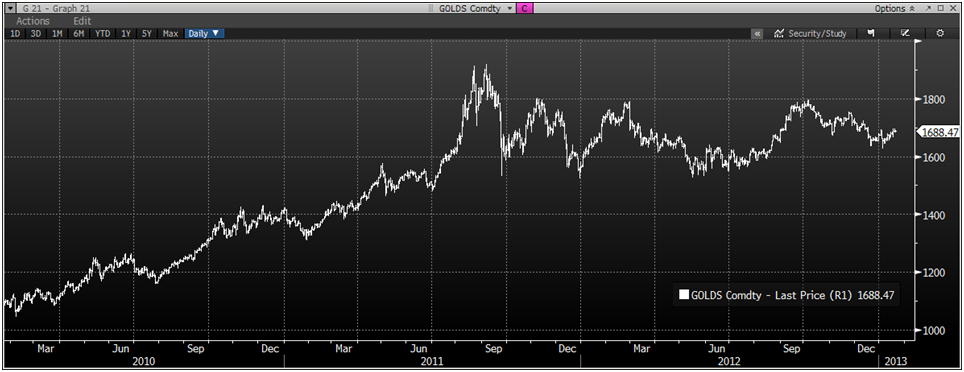
Gold for immediate delivery finished last year up 7 percent at $1,675.35 an ounce, off the high of $1,900.23 reached on Sept. 5, 2011. Prices retreated for three consecutive months to December, as the easing European debt crisis and faster growth from the U.S. and China spurred speculation that central banks will scale back stimulus. Spot gold finished last week up 1.3 percent at $1,684.30 an ounce, a second consecutive weekly advance.
Soros Fund Management, founded by the billionaire George Soros, raised its stake in the SPDR Gold Trust (GLD), the biggest gold-backed exchange-traded product by 49 percent in the third quarter to about $215 million, U.S. Securities and Exchange Commission filings show. Paulson & Co., led by John Paulson whose wager against the subprime mortgage market made him a billionaire in 2007, has a bet of about $3.6 billion through the trust, according to the filings.
Investors would seek the safest assets while governments spend to stimulate their economies, raising the risk of accelerating inflation, Eric Sprott, the founder and chairman of the Canadian fund manager said in July. Sprott manages funds that invest mainly in gold, silver and precious-metals equities.

‘Financial Catastrophe’

Central banks have so far been able to manipulate interest rates to allow governments to service their debt at low costs, averting market seizures, Kaye said. Still, the next big rally in precious-metal prices may be 18 months to two years away, triggered by a “financial catastrophe,” he added.
Ownership of gold through financial instruments based on it, such as Comex futures contracts, now represents more than 100 times the physical gold that exists above ground worldwide, Kaye said, citing the Pacific Group’s own analysis.
“All you actually need for a major upward revaluation of gold is for a small fraction of people to physically reclaim from major central banks or other depositories that are holding your gold and using it for their purposes,” he added.
The Pacific Group has just converted the first tranche of such investments, buying gold bars from local refineries, Kaye said without giving the exact value of the delivery.
Kaye was a manager of the arbitrage department of PaineWebber in New York and also worked in the mergers and acquisitions department of Goldman Sachs Group Inc., according to a biography posted on his company’s website. In 1991, he set up the Pacific Group, which also has made private-equity investments.

Greatest Truth Told To Congress

Pacific Group Becomes Latest Hedge Fund Converting Assets to Physical Gold

Today’s AM fix was USD 1,688.00, EUR 1,269.08, and GBP 1063.58 per ounce.
Friday’s AM fix was USD 1,690.00, EUR 1,265.82, and GBP 1,060.49 per ounce.
Silver is trading at $31.98/oz, €24.10/oz and £20.21/oz. Platinum is trading at $1,672.00/oz, palladium at $716.00/oz and rhodium at $1,200/oz.

Cross Currency Table – (Bloomberg)

Gold was up 1.26% for the week and silver was up 4.60%. Gold fell $2.80 or 0.17% in New York on Friday and closed at $1,684.10/oz. Silver surged to a high of $32.11 before it also edged off, but it still finished with a gain of 0.47%.
Gold inched up on Monday on concerns about currency debasement and even looser monetary policies to be announced from the Bank of Japan.
BOJ is examining an open-ended pledge to buy assets until a 2% inflation target is near which is pushing the yen to a 2 ½ year low. Gold bullion on the TOCOM soared to match a multiyear record of 4,911 yen a gram before giving up gains. 
Physical gold demand is also ramping up in Asia with the upcoming Lunar New Year festivities just around the corner on February 10th.
This week’s economic highlights include Existing Home Sales on Tuesday, the FHFA Housing Price Index on Wednesday, Initial Jobless Claims and Leading Economic Indicators on Thursday, and New Home Sales on Friday. Next week investors will closely watch to the U.S. Federal Reserve's policy meetings on the 29th and 30th.
Sweden’s central bank hasn’t carried out any physical checks of its gold reserves deposited with central banks abroad and relies on the respective authorities to do so, Dagens Industri reported, citing the Riksbank. 
Central banks internationally, from Ireland to Germany and now in Sweden, are being forced to answer legitimate questions about their gold reserves by concerned citizens.
Swedish gold reserves are 126 metric tonnes and are valued at almost 45 billion Swedish krone. 
The Riksbank confirmed that the majority of Swedish gold reserves are located abroad.
Another respected hedge fund, the Pacific Group, has decided to convert one third of its hedge-fund assets into physical gold.
The Pacific Group Ltd., which manages over a $100 million worth of assets, believes that gold will continue to rise as governments print more money to pay off debt, according to Bloomberg.
Thus, continues the trend of some of the smartest money in the world diversifying some of their holdings into physical gold.
Respected hedge fund managers and investors such as George Soros, John Paulson, Bill Gross, David Einhorn and Kyle Bass have diversified into gold - the latter two opting for the safety of allocated physical gold bars.
The Hong Kong-based asset manager plans to take delivery of $35 million worth of gold bars that can be traded on the London Bullion Market Association and other international markets, William Kaye, its founder and chief investment officer, said in a telephone interview on January 18. 
It has secured vault space at Hong Kong International Airport to store the gold, he said.
Investors disillusioned with government money printing to service “insurmountable” public debt may seek alternatives to fiat currencies, Kaye said.
Fiat currencies have no tangible backing, such as gold or silver, except governments’ good faith and can become worthless due to hyperinflation or loss of public faith.
Central banks have so far been able to manipulate interest rates to allow governments to service their debt at low costs, averting market seizures, Kaye said. Still, the next big rally in precious-metal prices may be 18 months to two years away, triggered by a “financial catastrophe,” he added.
Ownership of gold through financial instruments based on it, such as Comex futures contracts, now represents more than 100 times the physical gold that exists above ground worldwide, Kaye said, citing the Pacific Group’s own analysis.
“Gold, the way we look at it, is anywhere from being undervalued to being seriously undervalued,” Kaye said. “We’re in the early stages, in our judgment, of what would likely be the world’s largest short squeeze in any instrument.”
The likelihood of a massive short squeeze has been predicted for some years by GATA, the Gold Anti Trust Action Committee and by financial journalist, Max Keiser and many others, including GoldCore.
The idea appears to be becoming accepted in the wider investment world. 
“All you actually need for a major upward revaluation of gold is for a small fraction of people to physically reclaim from major central banks or other depositories that are holding your gold and using it for their purposes,” he added.
The Pacific Group has just converted the first tranche of such investments, buying gold bars from local refineries, Kaye said without giving the exact value of the delivery.
For breaking news and commentary on financial markets and gold, follow U.S. on Twitter.

NEWS
Pacific Group to Convert One-Third of Hedge-Fund Assets to Gold – Bloomberg
Gold Climbs With Silver on Outlook for Stimulus Amid Debt Talks - Bloomberg
Gold inches up on Japan easing hopes - Reuters
Goldman Forecasts Gold Rally Amid Debt-Ceiling Confrontation - Bloomberg
Gold prices recover on weaker rupee - Reuters
COMMENTARY
Visualizing Silver As An Investment
– Zero Hedge
Something Substantial Has Just Changed In The Silver Market – King World News
Currency Wars As Japan Turns "Revolutionary" – The Telegraph
The Mind-Bending Ignorance of the Bretton Woods Years – 24HGold

Best Buy closing Chicago store

Best Buy Co. Inc. is closing a store in the Chicago suburb of Skokie, the Chicago Tribune reported Friday.
A spokeswoman for Richfield-based Best Buy (NYSE: BBY) confirmed the closure, saying there were a "variety of factors" for the closure, including the location of other stores in the area.
There was no word that Best Buy was closing any other stores, although the spokeswoman declined to comment to the Tribune when asked if any other Chicago-area stores were closing.
The spokeswoman noted that Best Buy CEO Hubert Joly said in November that the company would routinely evaluate its real estate portfolio.
Best Buy announced last March it was closing 50 of its big-box stores, including six in Minnesota and six in the Chicago area. In the meantime, Best Buy has announced plans to open 100 smaller mobile stores.
>Click here to read the Tribune's story.
Ed Stych reports on Twin Cities breaking business news for mspbj.com, manages online features and writes the Workshop and Fast 50 Diary features for the print edition

Industries:

Retailing & Restaurants