It was reported recently that Senator Harry Reid thinks that the
fiscal cliff is coming, saying that Republicans would be to blame “if we
go over the cliff, and it looks like that’s where we’re headed.”[1]
The media has been talking up the fiscal cliff and making it seem as
if were going to be the end of the world, however, we should have
actively been expecting this, seeing as how last year the super
committee didn’t come to a deal[2] and thus effectively resigned the
nation to this fiscal cliff. Yet, there could be a silver lining to all
of this.
Before getting into what the benefits of going off this ‘cliff’ could
be, it must first be stated that the fact of the matter is that the
fiscal cliff itself is not a cliff; rather it is a mixture of tax
increases and spending cuts that will automatically go into effect on
January 1st of the new year.
The cliff gets rid of some of the tax breaks for the rich and for
corporations while also instituting “a 7.6 to 9.6 percent across the
board cut in all discretionary spending, except programs for low-income
Americans,” with the cuts being “evenly divided between defense and
nondefense programs.”[3]
While this would definitely hurt the agencies, we need that hurt as
it is defense that needs to be cut the most as it has been doubling
since 2001.[4]
The fact of the matter is that the US government has tried again and
again to get the debt and deficit under control, but each time they have
spectacularly failed, with the most recent failing in memory being the
debt ceiling debacle in which the US credit rating was downgraded. So it
seems that this is the only way for the country to get its act
together. Going over the so-called fiscal cliff would force Washington
to actually do something about its fiscal policies.
Yet the real silver lining to this lies in the American people.
After having been pulled hook, line, and sinker for several years by
politicians saying that they care about the American people and the
country, only to then turn around and do what is best for their
re-election chances and corporate donors, the American people will
hopefully come to the realization that the political class does not care
about them.
Republicans don’t care about the people and neither do Democrats. If
this occurs, the people will reject both major parties and involve
themselves in “the creation of an independent political movement –to
create the transformations needed in the United States.”[5]
That is where our hopes must lie during this time of crisis.
Not in politicians hashing out deals that don’t address the actual problems we as a nation are facing.
We must place our hope in the American people.
Notes
[1] Oliver Knox, “Reid says fiscal cliff dive likely; blasts Boehner for lacking leadership,” Yahoo! News, December 27, 2012 (http://news.yahoo.com/blogs/ticket/reid-says-fiscal-cliff-dive-likely-blasts-boehner-171600314–politics.html)
[2] Ted Barrett, Kate Bolduan and Deirdre Walsh, “’Super committee’ fails to reach agreement,” CNN Politics, November 21, 2011 (http://articles.cnn.com/2011-11-21/politics/politics_super-committee_1_deficit-reduction-republicans-committee?_s=PM:POLITICS)
[3] Suzy Khimm, Ezra Klein, Dylan Matthews and Brad Plumer, “The
Fiscal Cliff: Absolutely everything you could possibly need to know, in
one FAQ,” Washington Post, December 3, 2012 (http://www.washingtonpost.com/blogs/wonkblog/wp/2012/11/27/absolutely-everything-you-need-to-know-about-the-fiscal-cliff-in-one-faq)
[4] Judd Legum, “REPORT: U.S. Military Spending Has Almost Doubled Since 2001,” Think Progress, April 11, 2011 (http://thinkprogress.org/politics/2011/04/11/157596/military-spending-doubled-since-2001/?mobile=nc)
[5] Kevin Zeese, “The Fiscal Cliff, A Self-Created Bi-Partisan Drama. The Need to Mobilize Resistance,” Global Research, December 27, 2012 (http://www.globalresearch.ca/the-fiscal-cliff-a-self-created-bi-partisan-drama-the-need-to-mobilize-resistance/5316998)
Wednesday, January 2, 2013

War Spending and the ‘Fiscal Cliff’
The short-term danger of the “fiscal cliff” may be resolved either
before or after the New Year, but the longer-term threat to the Republic
is the never-ending demand from the Military-Industrial Complex for
more and more money to finance war and empire, says ex-FBI agent Coleen
Rowley.
By Coleen Rowley
As the final scene of Thelma and Louise seems to be playing out these last few days, it might be a good time to recall the dramatic end of that movie. It’s true that some think the fiscal cliff is real while others say it’s just a mirage.
Some in theU.S.want to just “keep goin’” as Thelma urges. But most of us probably don’t see much of a choice — it seems more like we are trapped in a car with its gas pedal stuck in the full speed ahead mode and someone has disabled the brakes. For even at this 11th hour, almost no one in the Punch and Judy Show inWashingtonis able to home in on, much less intelligently discuss, the real problem.
 However, as President Obama urges a last-ditch budget deal, one clarion voice, that of Rep. Dennis Kucinich, was heard on Democracy Now . Here are some of Kucinich’s parting words of wisdom about the phoniness of the entire fiscal cliff debate, ignoring as it does the terrible elephant in the room, the war machine:
“So, you know, this is — we really have to decide who we are as a nation. We’re spending more and more money for wars. We’re spending more and more money for interventions abroad. We’re spending more and more money for military buildups. And we seem to be prepared to spend less and less on domestic programs and on job creation.
“This whole idea of a debt-based economic system is linked to a war machine. … We’re increasingly dysfunctional as a nation because of our unwillingness to challenge the military-industrial complex, which Dwight Eisenhower warned about generations ago. And so, we really have to look atAmerica’s role in the world. We have a right to defend ourselves, but we have no right to aggress. And we’re continuing to aggress.
“And that’s coming at a cost to our domestic priorities here, this idea of guns and butter. We are now thoroughly mired in an economy that’s based on guns. We are not providing for the practical needs of the American people. And this budget — and this fiscal cliff — does in no way get into that debate.”
Also amidst the darkness comes a news flash of a way by which ordinary people can still make a difference: “DULUTH CITY COUNCIL JOINS SAINT PAUL AND MINNEAPOLIS PASSING THE MN ASAP RESOLUTION CALLING FOR PENTAGON SPENDING REDUCTIONS: the MN ASAP resolution connects the dots between federal military spending, cuts to city council budgets, and the debate about sequestration and the fiscal cliff.”
As part of the Minnesota Arms Spending Alternatives Project (MN ASAP), citizens in Minnesota have effectively begun pointing to U.S. war machine spending as the elephant in the room that needs to be noticed, then discussed and addressed. We have found that our city councilpersons and mayors, on the whole, seem more clear-headed, more approachable, less corrupted by the Military Industrial Complex and less defensive than the federal characters responsible for getting us into the costly wars and fiscal mess.
As a result, on Dec. 17, the Duluth City Council passed the resolution, calling on Congress for a reduction and redirection of Pentagon spending back to local communities. [Click here for TV news coverage.]
The resolution initiative is getting real traction not only in Minnesotabut around the country. The Saint Paul City Council unanimously passed a similar resolution, Oct. 10. And the Minneapolis City Council unanimously passed a similar version of the MN ASAP resolution on Dec. 7. (Just a few days before, Des Moines, Iowa joined a growing group of larger U.S. cities that have passed or are passing similar resolutions.)
We have to start somewhere and everyone can do this. For instance on Dec. 13, I requested, for the second time, that the MN ASAP resolution be put on (my own) Apple Valley City Council’s agenda warning that the wars are bankrupting America and that the “fiscal cliff” is unlikely to go away as long as the U.S. continues to spend more on the Pentagon, its wars abroad and its military occupations, than on programs of social uplift. I intend to keep knocking on my city’s door until they wake up and open it and put this discussion on their official agenda.
Guns or butter is, of course, the real issue. It’s unfortunate, all these decades after Eisenhower’s warning about the pernicious, corrupting influence of the Military Industrial Complex, that we cannot count on those in Washington to heed the dangers. In fact, their plan seems to raise taxes on everyone to pay for more wars.
More citizens and grassroots efforts like the successful actions of MN ASAP and the National Priorities Project are therefore necessary. People who care about their children and grandchildren’s future need to replicate these types of presentations in cities and state legislatures all over the country if we are ever to end the unethical, illegal wars and get our priorities back in order.
And if we citizens choose to do nothing but go along? Note that the old movie mercifully spared its audience of watching crazy Thelma and Louise hit rock bottom. Rest assured, however, that in real life,Washington’s collective euphoria and currently prevalent belief that war is the answer will undoubtedly come to a very sad crashing end.
Coleen Rowley is a retired FBI agent and former chief division counsel in Minneapolis. She’s now a dedicated peace and justice activist and board member of the Women Against Military Madness. [This article was originally posted at: http://www.huffingtonpost.com/coleen-rowley/only-one-good-way-to-brak_b_2384964.html]
By Coleen Rowley
As the final scene of Thelma and Louise seems to be playing out these last few days, it might be a good time to recall the dramatic end of that movie. It’s true that some think the fiscal cliff is real while others say it’s just a mirage.
Some in theU.S.want to just “keep goin’” as Thelma urges. But most of us probably don’t see much of a choice — it seems more like we are trapped in a car with its gas pedal stuck in the full speed ahead mode and someone has disabled the brakes. For even at this 11th hour, almost no one in the Punch and Judy Show inWashingtonis able to home in on, much less intelligently discuss, the real problem.
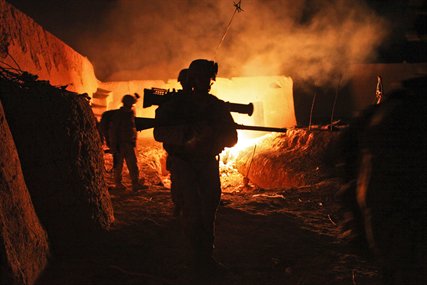
U.S. Marines leaving a compound at night in Afghanistan’s Helmand province. (Defense Department photo)
“So, you know, this is — we really have to decide who we are as a nation. We’re spending more and more money for wars. We’re spending more and more money for interventions abroad. We’re spending more and more money for military buildups. And we seem to be prepared to spend less and less on domestic programs and on job creation.
“This whole idea of a debt-based economic system is linked to a war machine. … We’re increasingly dysfunctional as a nation because of our unwillingness to challenge the military-industrial complex, which Dwight Eisenhower warned about generations ago. And so, we really have to look atAmerica’s role in the world. We have a right to defend ourselves, but we have no right to aggress. And we’re continuing to aggress.
“And that’s coming at a cost to our domestic priorities here, this idea of guns and butter. We are now thoroughly mired in an economy that’s based on guns. We are not providing for the practical needs of the American people. And this budget — and this fiscal cliff — does in no way get into that debate.”
Also amidst the darkness comes a news flash of a way by which ordinary people can still make a difference: “DULUTH CITY COUNCIL JOINS SAINT PAUL AND MINNEAPOLIS PASSING THE MN ASAP RESOLUTION CALLING FOR PENTAGON SPENDING REDUCTIONS: the MN ASAP resolution connects the dots between federal military spending, cuts to city council budgets, and the debate about sequestration and the fiscal cliff.”
As part of the Minnesota Arms Spending Alternatives Project (MN ASAP), citizens in Minnesota have effectively begun pointing to U.S. war machine spending as the elephant in the room that needs to be noticed, then discussed and addressed. We have found that our city councilpersons and mayors, on the whole, seem more clear-headed, more approachable, less corrupted by the Military Industrial Complex and less defensive than the federal characters responsible for getting us into the costly wars and fiscal mess.
As a result, on Dec. 17, the Duluth City Council passed the resolution, calling on Congress for a reduction and redirection of Pentagon spending back to local communities. [Click here for TV news coverage.]
The resolution initiative is getting real traction not only in Minnesotabut around the country. The Saint Paul City Council unanimously passed a similar resolution, Oct. 10. And the Minneapolis City Council unanimously passed a similar version of the MN ASAP resolution on Dec. 7. (Just a few days before, Des Moines, Iowa joined a growing group of larger U.S. cities that have passed or are passing similar resolutions.)
We have to start somewhere and everyone can do this. For instance on Dec. 13, I requested, for the second time, that the MN ASAP resolution be put on (my own) Apple Valley City Council’s agenda warning that the wars are bankrupting America and that the “fiscal cliff” is unlikely to go away as long as the U.S. continues to spend more on the Pentagon, its wars abroad and its military occupations, than on programs of social uplift. I intend to keep knocking on my city’s door until they wake up and open it and put this discussion on their official agenda.
Guns or butter is, of course, the real issue. It’s unfortunate, all these decades after Eisenhower’s warning about the pernicious, corrupting influence of the Military Industrial Complex, that we cannot count on those in Washington to heed the dangers. In fact, their plan seems to raise taxes on everyone to pay for more wars.
More citizens and grassroots efforts like the successful actions of MN ASAP and the National Priorities Project are therefore necessary. People who care about their children and grandchildren’s future need to replicate these types of presentations in cities and state legislatures all over the country if we are ever to end the unethical, illegal wars and get our priorities back in order.
And if we citizens choose to do nothing but go along? Note that the old movie mercifully spared its audience of watching crazy Thelma and Louise hit rock bottom. Rest assured, however, that in real life,Washington’s collective euphoria and currently prevalent belief that war is the answer will undoubtedly come to a very sad crashing end.
Coleen Rowley is a retired FBI agent and former chief division counsel in Minneapolis. She’s now a dedicated peace and justice activist and board member of the Women Against Military Madness. [This article was originally posted at: http://www.huffingtonpost.com/coleen-rowley/only-one-good-way-to-brak_b_2384964.html]
Senate passes fiscal cliff package
Brownfield Ag News for America – by Meghan Grebner
Certain portions of the 2008 Farm Bill would be extended as part of the fiscal cliff package being considered in Congress. Although details of the extension are still somewhat sketchy, it apparently does include language that will keep milk prices from rising.
Some of the details that have emerged:
Income Tax: Tax rates will permanently rise to Clinton-era levels for families with income above $450,000 and individuals above $400,000. All income below the threshold will permanently be taxed at Bush-era rates.
Estate Tax: Estates would be taxed at a top rate of 40 percent, with the first $5 million in value exempted for individual estates and $10 million for family estates. In 2012, such estates were subject to a top rate of 35 percent.
Capital gains, dividends: Taxes on capital gains and dividend income exceeding $400,000 for individuals and $450,000 for families would increase from 15 percent to 20 percent.
Farm Bill: A nine-month farm bill fix will be attached to the deal, and would avert the “dairy cliff”.
The measure passed the Senate with strong bi-partisan support (89-8) and could be voted on in the House later today.
http://brownfieldagnews.com/2013/01/01/senate-passes-fiscal-cliff-package/
Certain portions of the 2008 Farm Bill would be extended as part of the fiscal cliff package being considered in Congress. Although details of the extension are still somewhat sketchy, it apparently does include language that will keep milk prices from rising.
Some of the details that have emerged:
Income Tax: Tax rates will permanently rise to Clinton-era levels for families with income above $450,000 and individuals above $400,000. All income below the threshold will permanently be taxed at Bush-era rates.
Estate Tax: Estates would be taxed at a top rate of 40 percent, with the first $5 million in value exempted for individual estates and $10 million for family estates. In 2012, such estates were subject to a top rate of 35 percent.
Capital gains, dividends: Taxes on capital gains and dividend income exceeding $400,000 for individuals and $450,000 for families would increase from 15 percent to 20 percent.
Farm Bill: A nine-month farm bill fix will be attached to the deal, and would avert the “dairy cliff”.
The measure passed the Senate with strong bi-partisan support (89-8) and could be voted on in the House later today.
http://brownfieldagnews.com/2013/01/01/senate-passes-fiscal-cliff-package/
US fiscal cliff, a political jockeying: Dr Paul Craig Roberts
A former US Assistant Treasurer says the US Fiscal cliff is mainly
hoax and that it amounts to a mere one tenth of the growth of the US
public Debt per year. In the background of this, the fiscal cliff
deadline looms with politicians unable to strike a deal on a package to
prevent a 'potential crisis that could send the US back into recession'
according to American media. An agreement by Congress before the
deadline has been urged by US President Obama. The fiscal cliff concerns
whether it is necessary to implement tax hikes on middle class families
combined with cuts in government spending.
Press TV has interviewed Mr. Paul Craig Roberts, former Assistant Secretary of US Treasury, Atlanta about this issue.
Watch this video ..... http://shar.es/hLYk1 via@sharethis
Press TV has interviewed Mr. Paul Craig Roberts, former Assistant Secretary of US Treasury, Atlanta about this issue.
Watch this video ..... http://shar.es/hLYk1 via
You Know How This Ends Right? This Ends Through War.
In 2006, when Americans were flying high on ever-expanding credit and double digit real estate growth, hedge fund manager Kyle Bass
came to the conclusion that something was very wrong. He and his
investors determined that a massive real estate bubble was forming in
sub-prime mortgages. But rather than just making a prediction, they put
their money where their mouth was, and took a $4 billion gamble that the
real estate market was about to detonate.
At the time, many in the industry and within financial circles thought him crazy.
History, however, proves he was right.
When the real estate bubble did finally burst, stock markets plummeted and mortgage backed securities fell to pennies on the dollar. Bass and his hedge fund made billions in the process.
Bass’ foresight was 20/20, and now he has issued a warning so dire that it, like the real estate crisis and recession that followed, is unimaginable for most Americans.
At some point in the (near) future, the plug is going to be pulled and no one is going to lend anyone any more money. We saw this on a small scale in 2008 when credit markets around the world froze up. No one was lending money. There was so much risk that banks not only refused to lend money to individuals and businesses, but they refused to even lend each other money.
Central banks around the world, namely the U.S. Federal Reserve, calmed financial markets by pumping out trillions of dollars in emergency lending. This gave many a perception that things were returning to normal, but as Kyle Bass points out, we are in anything but a normal situation.
Debt has sky rocketed and we’re not going to pay it back – ever.
Like the mafia does when debts don’t get paid, our creditors are eventually going to resort to ‘breaking some legs.’
But we’re talking about debts of entire sovereign nations here, so the tools used to ‘take care of it’ won’t be crowbars or baseball bats, but rather, soldiers, tanks and intercontinental ballistic missiles.
War is coming – just as it has throughout history.
And the 99% of Americans who believe in a benevolent, all knowing, all caring government will be the last ones to get the memo.
Ignore the warnings at your peril.
Excerpts provided by Tekoa Da Silva of Bull Market Thinking
Sourced via Prepper Website /Don’t Tread On Me / Steve Quayle
http://www.shtfplan.com/headline-news/you-know-how-this-ends-right-this-ends-through-war_12312012
At the time, many in the industry and within financial circles thought him crazy.
History, however, proves he was right.
When the real estate bubble did finally burst, stock markets plummeted and mortgage backed securities fell to pennies on the dollar. Bass and his hedge fund made billions in the process.
Bass’ foresight was 20/20, and now he has issued a warning so dire that it, like the real estate crisis and recession that followed, is unimaginable for most Americans.
In many of these situations the quantitative analysis is already done. It’s just a question of when will this unravel and how will it unravel, which I think is the key when we’re thinking about the chronology of events and the likelihood of events going forward.The United States, Europe and the rest of the world have created more debt than has ever existed in the history of the world. Debt is nothing more than a representation (and expectation) of future earnings – future work. But, as many of us know, there has been so much money borrowed that we can’t possible every expect to pay it back. In fact, the only thing we can expect is that we will continue to take on even more debt.
—
Something that I think is really important to pay attention to, in the last 10 years debts around the world – this is total credit market debts, this is on balance sheets, sovereign obligations, corporate debt, household debt – has grown from $80 trillion to just over $200 trillion.
—
We sit today at the world’s largest peacetime accumulation of debt in world history…
…You know how this ends right?
This ends through war…
…I don’t know who’s going to fight who, but I’m fairly certain in the next few years you will see wars erupt, and not just small ones…
—
You’re going to see more social unrest.
You saw HUGE riots in Greece, and you’re seeing HUGE riots in other parts of the world over food (and lack of food) and those are actually derivatives of the financial problems that we’re seeing. We’re exporting inflation to some other nations. Going forward it’s going to be a problem.
—
They’re not going to tell you [that a collapse is coming]. You’re going to have to see it for yourself. [During the Tequila crisis], the Mexican government affirmed they would not default, that they would not devalue, almost daily. The day after they said “we wont devalue,” they devalued by 60%.
The government’s never going to tell you that it’s going to happen.
Greece’s Yunker said recently, ‘When it becomes serious—you have to lie’. These guys are never going to tell you the truth, because they can’t tell you the truth. Their job is to promote confidence, not to tell you the truth.
Watch Kyle Bass:
Full Speech at the AmerCatalyst 2012 Conference (Approx 1 hour)
At some point in the (near) future, the plug is going to be pulled and no one is going to lend anyone any more money. We saw this on a small scale in 2008 when credit markets around the world froze up. No one was lending money. There was so much risk that banks not only refused to lend money to individuals and businesses, but they refused to even lend each other money.
Central banks around the world, namely the U.S. Federal Reserve, calmed financial markets by pumping out trillions of dollars in emergency lending. This gave many a perception that things were returning to normal, but as Kyle Bass points out, we are in anything but a normal situation.
Debt has sky rocketed and we’re not going to pay it back – ever.
Like the mafia does when debts don’t get paid, our creditors are eventually going to resort to ‘breaking some legs.’
But we’re talking about debts of entire sovereign nations here, so the tools used to ‘take care of it’ won’t be crowbars or baseball bats, but rather, soldiers, tanks and intercontinental ballistic missiles.
War is coming – just as it has throughout history.
And the 99% of Americans who believe in a benevolent, all knowing, all caring government will be the last ones to get the memo.
Ignore the warnings at your peril.
Excerpts provided by Tekoa Da Silva of Bull Market Thinking
Sourced via Prepper Website /Don’t Tread On Me / Steve Quayle
http://www.shtfplan.com/headline-news/you-know-how-this-ends-right-this-ends-through-war_12312012
'Fiscal cliff' deal pleases few; House unlikely to vote Monday
WASHINGTON – Details of the emerging “fiscal cliff” deal ricocheted through the Capitol on Monday, appearing to please almost no one from either political party, as President Obama urged negotiators toward a conclusion. A House vote appears unlikely on Monday, even if a deal is finished.
The contours of the agreement between Vice President Joe Biden and the Republican leader of the Senate, Mitch McConnell, put into sharp focus the compromises that need to be stomached if a deal was to be struck. The outcome remained uncertain as the country prepared to go off the “fiscal cliff.”
Even if agreement could be reached to have a Senate vote before the midnight deadline, when taxes on all Americans would rise if nothing was done, Speaker John A. Boehner (R-Ohio) was unlikely to call a vote in the House until Tuesday.
“We are very, very close,” said an upbeat McConnell on the Senate floor after Obama spoke on the White House grounds and called on the country to urge lawmakers to finish. “We can do this.”
QUIZ: How much do you know about the fiscal cliff?
The emerging deal would raise taxes on income and investments for wealthier Americans – those households making more than $450,000 a year or individuals earning more than $400,000– although the two sides remain at odds over the automatic spending cuts that make up part of the “fiscal cliff.”
McConnell and Biden continued talking throughout the afternoon Monday, as lawmakers prepared to hunker down for a long New Year’s Eve under the dome. A final deal could be voted on first by the Senate, possibly late Monday.
One result became increasingly clear, though: With many issues still unresolved, Washington was poised to continue the partisan budget battles that have defined recent years well into 2013.
As the sun began to set over the capital on a chilly winter day, rank-and-file lawmakers, both Democrats and Republicans, bristled at what they were being asked to accept.
The office of Senate Majority Leader Harry Reid, the hardscrabble Nevada deal-maker who stepped aside for Biden to negotiate with McConnell, offered a view of the level of concern. A revolving door of lawmakers came and went throughout the day.
Liberal Democrats objected that the White House was ceding too much to Republican demands and missing the opportunity for a broader budget deal. Conservative Republicans were upset at being asked to raise tax rates without reducing the deficit with steep cuts.
PHOTOS: Notable moments of the 2012 presidential election
“Republicans should kill the compromise if there are no spending cuts,” said Erick Erikson, the conservative founder of the influential Red State blog, in a tweet.
Both parties were under enormous pressure from their political bases not to give in to what some, including Sen. Tom Harkin (D-Iowa), a liberal leader, characterized as simply a “bad deal.”
More than $660 billion in revenue would be raised – far less than the target Obama first set in talks with congressional leaders. The president sought $1.6 trillion in new revenue from a large deficit-reduction package, and at least $800 billion in earlier talks with Republicans over a deal on tax increases.
The agreement would set the top tax rates at 39.6% for income above $450,000 for households and $400,000 for individuals, which is a narrower definition of who is wealthy than Obama once sought, according to a source who was not authorized to discuss the negotiations. The president won reelection campaigning on asking those who earn above $250,000 to contribute more in taxes.
Investment income tax rates would also rise for those higher-income households, from the historic low 15% rate on capital gains and dividends to a new 20% rate. The president had sought to tax dividends at the same rate as ordinary income, and his earlier offer sought to initiate those taxes at the lower $250,000 income threshold.
The estate tax, which has been a key sticking point throughout the weekend of negotiations, appears to have been settled. The agreement splits the difference, setting the new rate at 40% on estates valued at more than $5 million – a compromise between today’s 35% rate and the 45% rate Democrats sought on estates of $3.5 million or more.
Americans would benefit from an extension of long-term unemployment benefits, which expired over the weekend, for one full year.
One area that hewed closer to Democratic priorities was Obama’s proposal to reinstate the phaseout of personal exemption tax credits and itemized deductions on upper-income households. They had been in place before the George W. Bush-era tax cuts began in 2001, but were done away with over the past decade and would fully expire, with the rest of the tax breaks, on New Year’s Eve.
The contours of the agreement between Vice President Joe Biden and the Republican leader of the Senate, Mitch McConnell, put into sharp focus the compromises that need to be stomached if a deal was to be struck. The outcome remained uncertain as the country prepared to go off the “fiscal cliff.”
Even if agreement could be reached to have a Senate vote before the midnight deadline, when taxes on all Americans would rise if nothing was done, Speaker John A. Boehner (R-Ohio) was unlikely to call a vote in the House until Tuesday.
“We are very, very close,” said an upbeat McConnell on the Senate floor after Obama spoke on the White House grounds and called on the country to urge lawmakers to finish. “We can do this.”
QUIZ: How much do you know about the fiscal cliff?
The emerging deal would raise taxes on income and investments for wealthier Americans – those households making more than $450,000 a year or individuals earning more than $400,000– although the two sides remain at odds over the automatic spending cuts that make up part of the “fiscal cliff.”
McConnell and Biden continued talking throughout the afternoon Monday, as lawmakers prepared to hunker down for a long New Year’s Eve under the dome. A final deal could be voted on first by the Senate, possibly late Monday.
One result became increasingly clear, though: With many issues still unresolved, Washington was poised to continue the partisan budget battles that have defined recent years well into 2013.
As the sun began to set over the capital on a chilly winter day, rank-and-file lawmakers, both Democrats and Republicans, bristled at what they were being asked to accept.
The office of Senate Majority Leader Harry Reid, the hardscrabble Nevada deal-maker who stepped aside for Biden to negotiate with McConnell, offered a view of the level of concern. A revolving door of lawmakers came and went throughout the day.
Liberal Democrats objected that the White House was ceding too much to Republican demands and missing the opportunity for a broader budget deal. Conservative Republicans were upset at being asked to raise tax rates without reducing the deficit with steep cuts.
PHOTOS: Notable moments of the 2012 presidential election
“Republicans should kill the compromise if there are no spending cuts,” said Erick Erikson, the conservative founder of the influential Red State blog, in a tweet.
Both parties were under enormous pressure from their political bases not to give in to what some, including Sen. Tom Harkin (D-Iowa), a liberal leader, characterized as simply a “bad deal.”
More than $660 billion in revenue would be raised – far less than the target Obama first set in talks with congressional leaders. The president sought $1.6 trillion in new revenue from a large deficit-reduction package, and at least $800 billion in earlier talks with Republicans over a deal on tax increases.
The agreement would set the top tax rates at 39.6% for income above $450,000 for households and $400,000 for individuals, which is a narrower definition of who is wealthy than Obama once sought, according to a source who was not authorized to discuss the negotiations. The president won reelection campaigning on asking those who earn above $250,000 to contribute more in taxes.
Investment income tax rates would also rise for those higher-income households, from the historic low 15% rate on capital gains and dividends to a new 20% rate. The president had sought to tax dividends at the same rate as ordinary income, and his earlier offer sought to initiate those taxes at the lower $250,000 income threshold.
The estate tax, which has been a key sticking point throughout the weekend of negotiations, appears to have been settled. The agreement splits the difference, setting the new rate at 40% on estates valued at more than $5 million – a compromise between today’s 35% rate and the 45% rate Democrats sought on estates of $3.5 million or more.
Americans would benefit from an extension of long-term unemployment benefits, which expired over the weekend, for one full year.
One area that hewed closer to Democratic priorities was Obama’s proposal to reinstate the phaseout of personal exemption tax credits and itemized deductions on upper-income households. They had been in place before the George W. Bush-era tax cuts began in 2001, but were done away with over the past decade and would fully expire, with the rest of the tax breaks, on New Year’s Eve.
Guest Post: When Priced In Gold, The US Economy Is At Depression-Era Levels
Submitted by Simon Black of SovereignMan blog,
As we slide into the end of yet another year in which the nominal price of gold has posted a positive return, I thought it would be interesting to take a look back on history to get a better understanding of where we are today.
It’s obvious that, for many reasons, the size of the global economy is far greater than it was decades ago. We learn in any basic economics course that, over the long run, enhanced productivity and increased technology drive long-term production gains.
Certainly, an economy can produce more widgets if you’re a lean, mean, automated machine… as opposed to a blacksmith with a hammer and forge.
But there are other factors as well. Population growth. Accounting standards. And of course, the continued inflation of the currency. $1 today buys a whole lot less today than it did a century ago, so when comparing, it’s important to find a better standard of measurement.
There are a number of pricing yardsticks we could use... like the cost of a New York City cinema ticket (25 cents in 1935, $20 today). But it would be awkard to calculate GDP in terms of billions of cinema tickets.
Gold is a much more appropriate (though still imperfect) long-term standard of pricing, with its history as a store of value dating back to the ancients.
With this in mind, I collected the appropriate data on gold prices, population, and GDP in the United States since 1791 and plotted GDP per capita denominated in ounces of gold.

This measurement smooths out changes in economic growth due to currency inflation and changes in the population, making it much easier to compares apples to apples.
The results are rather startling. In its earliest days, US GDP per capita was a mere 2.6 ounces of gold per person per year. But this grew quickly, effectively doubling in the 20 year period from 1791 to 1811.
Most of the 19th century proved difficult for growth, as it took another seven decades (over three times as long) for GDP per capita to double again. This makes sense given that the 19th century was marked by several costly wars (War of 1812, Mexican War, Civil War, etc.)
An industrialized American economy began to take off in the 20th century; GDP doubled from 12.00 ounces of gold per capita in 1892 to 23.55 ounces of gold per capita in 1916. And by 1929, it had almost doubled again to 41.12 ounces of gold per capita.
We know what happened after that– years of depression and economic stagnation. The economy bottomed in 1934 at 14.93 ounces of gold per capita, and then it began a multi-decade rise, peaking at 139.05 ounces of gold per capita in… 1970. This was right before Nixon closed the gold window. And the economy never touched that level again. How interesting.
Since 1970, it’s been a series of peaks and troughs. The economy boomed during the 1990s, then ran out of steam quickly in the ensuring dot-com/housing/sovereign bust.
We have just ended the year at 28.40 ounces of gold per capita (based on trailing twelve month GDP data). This is an astoundingly low figure.
To put it in perspective, since the end of the Great Depression, US GDP per capita has only been under 30 ounces of gold two times– this year, and 1980. That’s it.
In fact, the post-war average for the US economy is 72.83 ounces of gold per capita, so the economy today is an amazing 61% off this historical average.
Right now, the largest economy in the world is producing as much as it did in 1931, almost at the peak of the Great Depression. And no matter what the talking heads and politicians say, the data show that the trend is getting worse. Today’s figure is worse than last year, which was worse the year before. This trend of economic contraction goes back to 2001.
Curiously, this time period also coincides with the greatest expansion of debt and the monetary base in history. Hmmm. Coincidence?
This is truly incredible. With all of our modern advances in technology and productivity, our criminal Ponzi scheme debt-based fiat monetary system is so destructive that it’s turned the clock back seven decades on the economy. Mind blowing. If this doesn’t scream “SYSTEM RESET”, I don’t know what will.
Please share this with your friends and loved ones. It’s time for a wakeup call.
As we slide into the end of yet another year in which the nominal price of gold has posted a positive return, I thought it would be interesting to take a look back on history to get a better understanding of where we are today.
It’s obvious that, for many reasons, the size of the global economy is far greater than it was decades ago. We learn in any basic economics course that, over the long run, enhanced productivity and increased technology drive long-term production gains.
Certainly, an economy can produce more widgets if you’re a lean, mean, automated machine… as opposed to a blacksmith with a hammer and forge.
But there are other factors as well. Population growth. Accounting standards. And of course, the continued inflation of the currency. $1 today buys a whole lot less today than it did a century ago, so when comparing, it’s important to find a better standard of measurement.
There are a number of pricing yardsticks we could use... like the cost of a New York City cinema ticket (25 cents in 1935, $20 today). But it would be awkard to calculate GDP in terms of billions of cinema tickets.
Gold is a much more appropriate (though still imperfect) long-term standard of pricing, with its history as a store of value dating back to the ancients.
With this in mind, I collected the appropriate data on gold prices, population, and GDP in the United States since 1791 and plotted GDP per capita denominated in ounces of gold.

This measurement smooths out changes in economic growth due to currency inflation and changes in the population, making it much easier to compares apples to apples.
The results are rather startling. In its earliest days, US GDP per capita was a mere 2.6 ounces of gold per person per year. But this grew quickly, effectively doubling in the 20 year period from 1791 to 1811.
Most of the 19th century proved difficult for growth, as it took another seven decades (over three times as long) for GDP per capita to double again. This makes sense given that the 19th century was marked by several costly wars (War of 1812, Mexican War, Civil War, etc.)
An industrialized American economy began to take off in the 20th century; GDP doubled from 12.00 ounces of gold per capita in 1892 to 23.55 ounces of gold per capita in 1916. And by 1929, it had almost doubled again to 41.12 ounces of gold per capita.
We know what happened after that– years of depression and economic stagnation. The economy bottomed in 1934 at 14.93 ounces of gold per capita, and then it began a multi-decade rise, peaking at 139.05 ounces of gold per capita in… 1970. This was right before Nixon closed the gold window. And the economy never touched that level again. How interesting.
Since 1970, it’s been a series of peaks and troughs. The economy boomed during the 1990s, then ran out of steam quickly in the ensuring dot-com/housing/sovereign bust.
We have just ended the year at 28.40 ounces of gold per capita (based on trailing twelve month GDP data). This is an astoundingly low figure.
To put it in perspective, since the end of the Great Depression, US GDP per capita has only been under 30 ounces of gold two times– this year, and 1980. That’s it.
In fact, the post-war average for the US economy is 72.83 ounces of gold per capita, so the economy today is an amazing 61% off this historical average.
Right now, the largest economy in the world is producing as much as it did in 1931, almost at the peak of the Great Depression. And no matter what the talking heads and politicians say, the data show that the trend is getting worse. Today’s figure is worse than last year, which was worse the year before. This trend of economic contraction goes back to 2001.
Curiously, this time period also coincides with the greatest expansion of debt and the monetary base in history. Hmmm. Coincidence?
This is truly incredible. With all of our modern advances in technology and productivity, our criminal Ponzi scheme debt-based fiat monetary system is so destructive that it’s turned the clock back seven decades on the economy. Mind blowing. If this doesn’t scream “SYSTEM RESET”, I don’t know what will.
Please share this with your friends and loved ones. It’s time for a wakeup call.
Subscribe to:
Posts (Atom)