Tuesday, April 3, 2012

BRICs Bank To Rival World Bank and IMF and Challenge Dollar Dominance
Gold’s London AM fix this morning was USD 1,664.00, EUR 1,246.16, and GBP 1,037.54 per ounce. Friday's AM fix was USD 1,655.75, EUR 1,245.86 and GBP 1,041.22 per ounce.  Cross Currency Table – (Bloomberg) Cross Currency Table – (Bloomberg) Outgoing President of the World Bank, Robert Zoellick, after just three days ago dismissing the idea of a BRICs created, new global multi lateral bank, has come around and endorsed a BRICs bank in an interview with the FT. He acknowledged that a BRICs bank was being created and said that the World Bank supported such a bank. He said that not having Russia and China as part of "the World Bank system" would be a “mistake of historic proportions”.  BRICS leaders, from left, Brazil’s President Dilma Rousseff, Russian President Dmitry Medvedev, Indian Prime Minister Manmohan Singh, Chinese President Hu Jintao and South African President Jacob Zuma. Photo: AP The five countries now account for nearly 28% of the global economy, a figure that is expected to continue to grow. Left unsaid so far is the possibility that one of the BRICs or the BRICs in unison might peg the value of their respective currencies to the ultimate store of value and money - gold. Global diversification and owning the hard monetary asset of gold has never been more important. SILVER Silver is trading at $32.41/oz, €24.29/oz and £20.21/oz. PLATINUM GROUP METALS Platinum is trading at $1,634.50/oz, palladium at $651.96/oz and rhodium at $1,350/oz. | |
 Please click here to read the rest of GoldCore’s Market Update. Please click here to read the rest of GoldCore’s Market Update. |
Americans squeezed as inflation filters into the cost of daily life. The uncertain employment market of low wage work.
There are unintended consequences when policy aims at depreciating a currency in favor of bolstering an ailing banking system. The Federal Reserve has been on a multi-decade mission to lower the value of the US dollar. The primary purpose of this mission is to inflate banks into solvency as they try to work their way out of the massive financial crisis. The amount of troubled real estate loans is still impressive when we look at the temporary sanctuary being provided by the Federal Reserve on their overloaded balance sheet. This luxury is not afforded to your common household and consequently many Americans are now facing higher and higher costs in items like energy even though demand is slightly lower. This occurs for a variety of reasons but a main driver is the declining purchasing power of the US dollar. This permeates over into the employment market that is largely being driven by lower wage positions. Inflation is creeping back into the economy.
Consumer inflation now edging back up
Since our economy is fantastically debt based and debt is the medium of exchange, more debt is likely to produce higher prices given the same amount of goods. Typically this equation is leveled at the money supply but our system is one in which debt rules supreme. While households are in the painful process of deleveraging, debt has increased overall because of banking bailouts but also government spending. For this, we are seeing consumer inflation pickup:

The inflation rate has been moving up since the crisis hit a trough in 2009. Americans are facing higher prices in a variety of sectors including healthcare, energy, food, and higher education. Ironically inflation is hitting in many of the cornerstones of what was once thought to be part of a middle class lifestyle. The recent push in prices has largely come from the higher prices in energy:

Total energy costs are up 7 percent over the last 12 months while wages have gone stagnant. Gasoline has seen the largest push up in the last year moving up by 12.6 percent. Looking at food, the total cost of food has gone up by 3.9 percent over the last 12 months. Of course much of this is synergistic with the rise in energy given that food is transported and also produced with high levels of energy usage. The interesting point here is that energy usage overall has not necessarily surged in the US to justify this movement. This is largely being driven by an overall depreciation in the US dollar:

The US dollar has lost over 50 percent of its purchasing power since the 1980s. It is no coincidence that global goods like food and energy are now more expensive. This is problematic since Americans are seeing little growth in their wages. The stagnant wage dilemma has been in effect for well over a decade now.
Impact of low wage employment
Just take a look at some of the top employment sectors in our economy:

The top three employment fields in our country are:
Overall there are many challenges looming on the horizon. There is definitely a divide in the country where the middle class is shrinking. Many of the good paying jobs are in what are known as the STEM fields (science, technology, engineering, math) and on the flip side you have many colleges for example catering to fields that are lower paying yet charging absurd fees pushing many students into enormous debt. The for-profits in many cases produce degrees that yield very little return once students graduate.
This is why another interesting chart to examine is the number of positions opening up and those being hired:

While job opening have certainly moved higher up, I find it interesting that actual hires have been rather steady since the recession ended. Could it be that many of the jobs in demand are simply not finding the needed skills in the current market? This trend is likely to accelerate and many on the edge of the middle class are being pushed off into the working poor. 46,000,000 Americans are on food stamps even though we are years into a recovery. Since many of these people have less disposable income and a larger portion of their money goes to food and energy, the massive inflation in these two segments of our economy are going to hit them much deeper. If you look at banking profits thanks to generous bailouts by the Federal Reserve and subsequent depreciation of the dollar impacting the working poor, you should get a better sense which segment of our population is taking the brunt of this economic restructuring.
Consumer inflation now edging back up
Since our economy is fantastically debt based and debt is the medium of exchange, more debt is likely to produce higher prices given the same amount of goods. Typically this equation is leveled at the money supply but our system is one in which debt rules supreme. While households are in the painful process of deleveraging, debt has increased overall because of banking bailouts but also government spending. For this, we are seeing consumer inflation pickup:
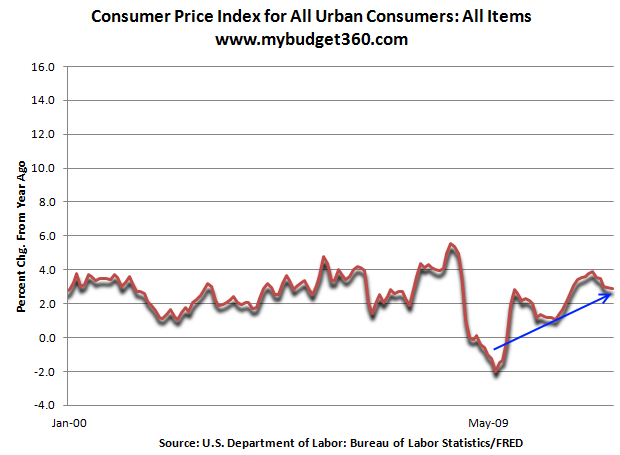
The inflation rate has been moving up since the crisis hit a trough in 2009. Americans are facing higher prices in a variety of sectors including healthcare, energy, food, and higher education. Ironically inflation is hitting in many of the cornerstones of what was once thought to be part of a middle class lifestyle. The recent push in prices has largely come from the higher prices in energy:
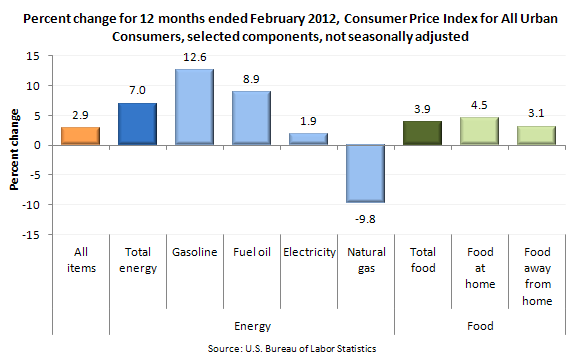
Total energy costs are up 7 percent over the last 12 months while wages have gone stagnant. Gasoline has seen the largest push up in the last year moving up by 12.6 percent. Looking at food, the total cost of food has gone up by 3.9 percent over the last 12 months. Of course much of this is synergistic with the rise in energy given that food is transported and also produced with high levels of energy usage. The interesting point here is that energy usage overall has not necessarily surged in the US to justify this movement. This is largely being driven by an overall depreciation in the US dollar:
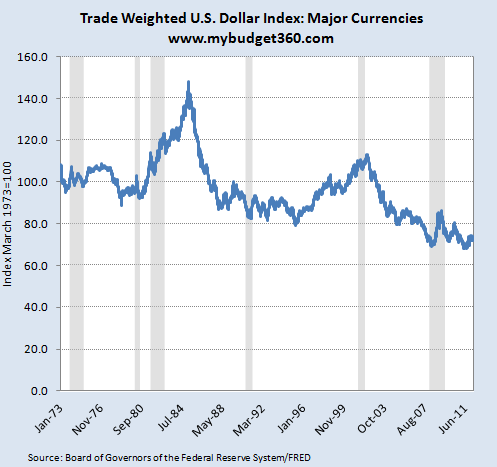
The US dollar has lost over 50 percent of its purchasing power since the 1980s. It is no coincidence that global goods like food and energy are now more expensive. This is problematic since Americans are seeing little growth in their wages. The stagnant wage dilemma has been in effect for well over a decade now.
Impact of low wage employment
Just take a look at some of the top employment sectors in our economy:
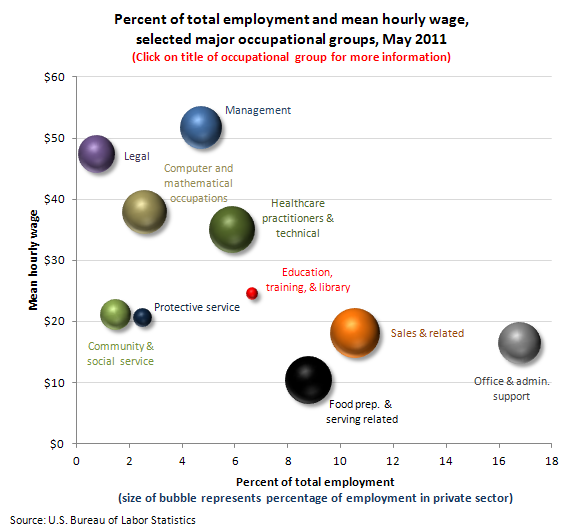
The top three employment fields in our country are:
1. Office and administrative support workIn the past, a large portion of our labor force was in good paying manufacturing positions. Now, the low wage labor force dominates. This is a major driving force for the slow disappearance of the US middle class. Some of the higher paying positions require high levels of specialization and schooling, certainly in healthcare and technology positions. These industries however employ a smaller part of the entire labor force as the chart above indicates.
2. Sales & Related
3. Food preparation and serving related
Overall there are many challenges looming on the horizon. There is definitely a divide in the country where the middle class is shrinking. Many of the good paying jobs are in what are known as the STEM fields (science, technology, engineering, math) and on the flip side you have many colleges for example catering to fields that are lower paying yet charging absurd fees pushing many students into enormous debt. The for-profits in many cases produce degrees that yield very little return once students graduate.
This is why another interesting chart to examine is the number of positions opening up and those being hired:
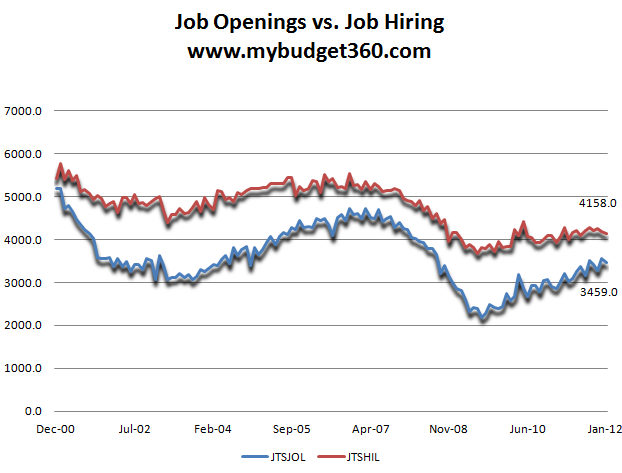
While job opening have certainly moved higher up, I find it interesting that actual hires have been rather steady since the recession ended. Could it be that many of the jobs in demand are simply not finding the needed skills in the current market? This trend is likely to accelerate and many on the edge of the middle class are being pushed off into the working poor. 46,000,000 Americans are on food stamps even though we are years into a recovery. Since many of these people have less disposable income and a larger portion of their money goes to food and energy, the massive inflation in these two segments of our economy are going to hit them much deeper. If you look at banking profits thanks to generous bailouts by the Federal Reserve and subsequent depreciation of the dollar impacting the working poor, you should get a better sense which segment of our population is taking the brunt of this economic restructuring.
Servers made to pay 'house charge' from tips
A restaurant server has filed a complaint with B.C.'s Employment Standards Branch against a high profile Vancouver restaurant group because management required her to hand over her tips at the end of shifts.
"The last night I worked I made $320 in cash tips, and I walked out of the restaurant with not a penny in my pocket," says Charlotte Zesati.
"The manager wouldn't let me go until I put [some cash from tips] in the envelope … faced this camera in the office and put it in the safe."
Zesati says that happened after she'd already cashed out and split some of her tips with the bartender and busser. She had given each of them cash equal to one per cent of her sales.
She says she was told the money she had to put in the safe would go to "the house."
"I asked [the manager] who was getting this ... I was pushed aside, told, this is how much you have to pay."
Zesati is a single mother who recently moved to Vancouver from California. She worked briefly at Black + Blue, a high-end steakhouse owned by the Glowbal Group, which runs seven prominent Vancouver restaurants, with the others being Glowbal Grill, Sanafir, Coast, Italian Kitchen, Trattoria and Society.
"I have never experienced that. And I have been working in this industry for over 20 years now," said Zesati. "For me, it's food on my daughter's plate. For me, it's clothes on her back. It's more than, you know, tips."
Zesati says after she quit, she learned all servers had to pay a "house charge," equal to 4.2 per cent of their net sales, on any given night. She said Black + Blue's general manager told her the money is later distributed to other staff, including managers.
To the customer, that means if they leave a $15 tip on a $100 restaurant bill, $4.20 of that tip goes to "the house," not to the staff member who served them.
"[The general manager] said the day before they did $47,000 in sales. If you times that by four per cent you've got yourself about $2,000 in one day going into that kitty," Zesati said.
After she complained to the owners, the Glowbal Group mailed her a cheque for the full amount she had handed over. "They actually just as quickly as possible sent a cheque in the mail," she said.
CBC News took a hidden camera into Black + Blue, and asked staff, as any customer might, what happens to the tips. We were also told servers must pay a percentage of their sales — out of their tips — to "the house."
Glowbal beverage manager Chris Ballas told us: "They tip us [the bar] out one per cent. They tip their busser out one per cent, and then 4.2% to be exact goes to the restaurant."
When asked where that money ends up, he said, "That goes to ... the house. Staff parties. Breakages. That kind of stuff. So that's to account for variable costs," he said.
He told us glass breakage costs at Black + Blue are $2,000 a month and "that's where that kind of stuff [tip money] goes."
He told us the practice is industry standard, at least in B.C. "All Glowbal sites. And I'm pretty sure ... I'm pretty safe to say all of Vancouver."
 Glowbal Group's high-end steakhouse, Black & Blue, is situated on Vancouver's toney Alberni St. (CBC)CBC News then sent a woman into several other prominent restaurants, posing as a server looking for work, to ask what happens to tips.
At the Keg, Cardero's and Joey's, managers said the money is pooled among staff based on a percentage of sales ranging from 2.5 to 5.5 per cent.
Unlike at Glowbal restaurants, though, we were told the business doesn't oversee the tip pool and managers don't take a cut.
B.C. employment standards law states restaurants can't use tip money for business expenses. Federal tax rules also dictate that if tips are "controlled" by the employer, if management collects and then redistributes the money, it is taxable and EI and CPP must be deducted.
"I don't keep a penny of it. We don't keep it … I have never, ever kept one penny of the tips for the restaurant."
He explained a manager, who is also a relative of his, picks up the cash from the restaurant safes every night. The cash manager then divides it up, according to set percentages, and distributes all of it later to hostesses, runners, kitchen staff and floor managers.
"We have one person that handles all the cash for all the restaurants," Yacoub said. "When it gets counted, we have on the record how much was the tip-out and how much goes back to everybody."
Yacoub said the restaurant handles the tip money on behalf of staff, simply to make sure everyone gets their fair share.
"What we do is we just take it and give it to them," he said.
 Emad Yacoub says none of the tip money collected from his servers is kept by him or his restaurant. (CBC)We then showed him the hidden camera tape of one of his managers calling the tip practice a "kickback" that goes to "variable costs," like breakage.
"We have never charged any of our staff for breakage or staff parties. We have never kept any of this money. I give it back again to all the staff that work that night," said Yacoub.
"I cannot explain [what the manager said] but I am telling you from the owner of this company … 100 per cent of it goes back to everybody."
Yacoub also insisted since the company doesn't "control" the tips, as tax rules prohibit, a server could refuse to pay the house charge if they wanted to.
"I would tell her, just tell the people you are working with that you don't want to share with them," he said. "I don't decide how it's divided up."
He also said when he realized how much trouble he may have caused the business, he offered to resign, but Yacoub refused to accept the offer.
CBC News then contacted two former high-level Glowbal Group managers, who had invested in the company and worked there for a significant period of time. One left because he had a falling out with Yacoub, and the other just moved on.
They both agreed to talk about the tip system under the condition they would not be named. Both said they had firsthand knowledge that Yacoub "pocketed" some of the money.
 The bar manager for Black & Blue, Chris Ballas, talks on hidden camera about the tip procedure at Glowbal. (CBC)"Emad [Yacoub] does keep it. He would probably keep half," said the disgruntled former manager. "It never touches [restaurant] expenses. It is used as cash."
Both sources told CBC News some of the house charge is given back to floor staff, as Yacoub indicated. However, they said those staffers received set amounts no matter what sales were – like $40 per hostess, per day.
On a good week, the former managers said after staff got their cuts, there was a lot of cash left over.
"Emad's cut is determined by whatever the profit is in tips," said one.
They also said servers had no choice but to pay the house charge. "Even if they were short [on tips] they had to pay out of their own pocket," said one of the ex-managers.
Yacoub said Glowbal Group's restaurant income for 2011 was $26.7 million, so the 4.2 per cent house charge to servers would have been approximately $1.12 million that year.
The disgruntled former manager suggested Yacoub may have kept up to half a million of that, in cash.
"The tip thing is huge. It becomes huge money by the end of the year," he said.
"This system is set up to create stability and fairness to the all the support staff, regardless of the month or work week, so they know themselves the approximate tips they are to receive per shift worked. This also motivates them to work any shift per week without requesting only the busy shifts," Yacoub said.
 B.C. Labour Minister Margaret MacDiarmid says it's illegal for an employer to use tips for business expenses. (CBC)He said sometimes the business goes into a deficit to pay staff. For example, he said last week staff at Italian Kitchen received a total of $6,100 from the tip pool, but the average house charge collected from servers each week is $5,000.
Yacoub repeated he doesn't keep any of the tip money, regardless of how good the sales are, and he has records to prove that.
"This system was set up in a way that every single penny that comes in is accounted for and every penny that gets paid out is signed for by all the staff," said Yacoub.
One of the former managers said when he worked for Glowbal, slow times were quite rare. He said, the few times it was slow and there wasn't enough to pay staff out of the tip pool, Yacoub would hand over cash from his pocket to make up the difference.
"He had rolls of cash in his pocket and he always tried to pay for everything with cash," he said.
B.C Minister of Labour Margaret MacDiarmid said Zesati's complaint about Glowbal Group's tipping system will be investigated.
"Tips cannot be used for business expenses," said MacDiarmid. "If there's money owing an employee, they [investigators] will leave no stone unturned to get that money."
"I hope if there's anybody else out there that's suffering through this, that it comes out," said Zesati.
"The last night I worked I made $320 in cash tips, and I walked out of the restaurant with not a penny in my pocket," says Charlotte Zesati.
"The manager wouldn't let me go until I put [some cash from tips] in the envelope … faced this camera in the office and put it in the safe."
Zesati says that happened after she'd already cashed out and split some of her tips with the bartender and busser. She had given each of them cash equal to one per cent of her sales.
She says she was told the money she had to put in the safe would go to "the house."
"I asked [the manager] who was getting this ... I was pushed aside, told, this is how much you have to pay."
Zesati is a single mother who recently moved to Vancouver from California. She worked briefly at Black + Blue, a high-end steakhouse owned by the Glowbal Group, which runs seven prominent Vancouver restaurants, with the others being Glowbal Grill, Sanafir, Coast, Italian Kitchen, Trattoria and Society.
Server got less than half
Records show a manager later gave her $124 back — for her $320 night — which is less than half of what customers tipped her."I have never experienced that. And I have been working in this industry for over 20 years now," said Zesati. "For me, it's food on my daughter's plate. For me, it's clothes on her back. It's more than, you know, tips."
Zesati says after she quit, she learned all servers had to pay a "house charge," equal to 4.2 per cent of their net sales, on any given night. She said Black + Blue's general manager told her the money is later distributed to other staff, including managers.
To the customer, that means if they leave a $15 tip on a $100 restaurant bill, $4.20 of that tip goes to "the house," not to the staff member who served them.
"[The general manager] said the day before they did $47,000 in sales. If you times that by four per cent you've got yourself about $2,000 in one day going into that kitty," Zesati said.
After she complained to the owners, the Glowbal Group mailed her a cheque for the full amount she had handed over. "They actually just as quickly as possible sent a cheque in the mail," she said.
CBC News took a hidden camera into Black + Blue, and asked staff, as any customer might, what happens to the tips. We were also told servers must pay a percentage of their sales — out of their tips — to "the house."
Glowbal beverage manager Chris Ballas told us: "They tip us [the bar] out one per cent. They tip their busser out one per cent, and then 4.2% to be exact goes to the restaurant."
When asked where that money ends up, he said, "That goes to ... the house. Staff parties. Breakages. That kind of stuff. So that's to account for variable costs," he said.
He told us glass breakage costs at Black + Blue are $2,000 a month and "that's where that kind of stuff [tip money] goes."
Described as 'kickback'
Then he added: "It's a kickback. Let's be honest … kickback or grease … or whatever you want to call it … they [servers] have to give the restaurant for the entitlement or the privilege to work within that restaurant."He told us the practice is industry standard, at least in B.C. "All Glowbal sites. And I'm pretty sure ... I'm pretty safe to say all of Vancouver."
Glowbal Group's high-end steakhouse, Black & Blue, is situated on Vancouver's toney Alberni St. (CBC)CBC News then sent a woman into several other prominent restaurants, posing as a server looking for work, to ask what happens to tips. At the Keg, Cardero's and Joey's, managers said the money is pooled among staff based on a percentage of sales ranging from 2.5 to 5.5 per cent.
Unlike at Glowbal restaurants, though, we were told the business doesn't oversee the tip pool and managers don't take a cut.
B.C. employment standards law states restaurants can't use tip money for business expenses. Federal tax rules also dictate that if tips are "controlled" by the employer, if management collects and then redistributes the money, it is taxable and EI and CPP must be deducted.
Owner says all goes back to staff
Glowbal Group owner Emad Yacoub insisted none of the cash handed over by servers is kept by him or the company, so he does not report it as income."I don't keep a penny of it. We don't keep it … I have never, ever kept one penny of the tips for the restaurant."
He explained a manager, who is also a relative of his, picks up the cash from the restaurant safes every night. The cash manager then divides it up, according to set percentages, and distributes all of it later to hostesses, runners, kitchen staff and floor managers.
"We have one person that handles all the cash for all the restaurants," Yacoub said. "When it gets counted, we have on the record how much was the tip-out and how much goes back to everybody."
Yacoub said the restaurant handles the tip money on behalf of staff, simply to make sure everyone gets their fair share.
"What we do is we just take it and give it to them," he said.
Emad Yacoub says none of the tip money collected from his servers is kept by him or his restaurant. (CBC)We then showed him the hidden camera tape of one of his managers calling the tip practice a "kickback" that goes to "variable costs," like breakage."We have never charged any of our staff for breakage or staff parties. We have never kept any of this money. I give it back again to all the staff that work that night," said Yacoub.
"I cannot explain [what the manager said] but I am telling you from the owner of this company … 100 per cent of it goes back to everybody."
Yacoub also insisted since the company doesn't "control" the tips, as tax rules prohibit, a server could refuse to pay the house charge if they wanted to.
"I would tell her, just tell the people you are working with that you don't want to share with them," he said. "I don't decide how it's divided up."
Manager recants
After his boss saw him on the hidden camera tape, Ballas called CBC News and insisted that what he told us when we spoke to him as a customer in the restaurant was all lies. The manager said he was just "talking trash" from behind the bar.He also said when he realized how much trouble he may have caused the business, he offered to resign, but Yacoub refused to accept the offer.
CBC News then contacted two former high-level Glowbal Group managers, who had invested in the company and worked there for a significant period of time. One left because he had a falling out with Yacoub, and the other just moved on.
They both agreed to talk about the tip system under the condition they would not be named. Both said they had firsthand knowledge that Yacoub "pocketed" some of the money.
The bar manager for Black & Blue, Chris Ballas, talks on hidden camera about the tip procedure at Glowbal. (CBC)"Emad [Yacoub] does keep it. He would probably keep half," said the disgruntled former manager. "It never touches [restaurant] expenses. It is used as cash."Both sources told CBC News some of the house charge is given back to floor staff, as Yacoub indicated. However, they said those staffers received set amounts no matter what sales were – like $40 per hostess, per day.
On a good week, the former managers said after staff got their cuts, there was a lot of cash left over.
"Emad's cut is determined by whatever the profit is in tips," said one.
They also said servers had no choice but to pay the house charge. "Even if they were short [on tips] they had to pay out of their own pocket," said one of the ex-managers.
Yacoub said Glowbal Group's restaurant income for 2011 was $26.7 million, so the 4.2 per cent house charge to servers would have been approximately $1.12 million that year.
The disgruntled former manager suggested Yacoub may have kept up to half a million of that, in cash.
"The tip thing is huge. It becomes huge money by the end of the year," he said.
Surplus kept for staff: owner
Yacoub responded to the allegation by explaining that during busy times, any extra cash left in the tip pool – after each employee got their set amount – is kept as cash on reserve. He said it is then drawn on later during slow periods to make sure staff still receive their set amounts."This system is set up to create stability and fairness to the all the support staff, regardless of the month or work week, so they know themselves the approximate tips they are to receive per shift worked. This also motivates them to work any shift per week without requesting only the busy shifts," Yacoub said.
B.C. Labour Minister Margaret MacDiarmid says it's illegal for an employer to use tips for business expenses. (CBC)He said sometimes the business goes into a deficit to pay staff. For example, he said last week staff at Italian Kitchen received a total of $6,100 from the tip pool, but the average house charge collected from servers each week is $5,000.Yacoub repeated he doesn't keep any of the tip money, regardless of how good the sales are, and he has records to prove that.
"This system was set up in a way that every single penny that comes in is accounted for and every penny that gets paid out is signed for by all the staff," said Yacoub.
One of the former managers said when he worked for Glowbal, slow times were quite rare. He said, the few times it was slow and there wasn't enough to pay staff out of the tip pool, Yacoub would hand over cash from his pocket to make up the difference.
"He had rolls of cash in his pocket and he always tried to pay for everything with cash," he said.
B.C Minister of Labour Margaret MacDiarmid said Zesati's complaint about Glowbal Group's tipping system will be investigated.
"Tips cannot be used for business expenses," said MacDiarmid. "If there's money owing an employee, they [investigators] will leave no stone unturned to get that money."
"I hope if there's anybody else out there that's suffering through this, that it comes out," said Zesati.
Just How Much Have and Are the International Elitists Stealing from the American People?
We often discuss the wealth of our country and where it has gone and so shall we do so again, starting from the beginning. In 1913 a group of international banker criminals, working in tandem with a small group of treacherous Congressmen and Senators, set up the Federal Reserve, which was then signed by the international elitist traitor Woodrow Wilson. By 1933 the government of the United States went bankrupt. That is, the United States government, not we the people. We the people were then and still are today filthy rich.
When the government went into receivership, they put up the wealth of our country as collateral for the bankruptcy, which did not represent the tiniest little speck of our wealth. And as we the people are the absolute owners of the United States and its resources, under Title 50 of the United States Codes, our birth certificates were and are used as the paper representation of the resources we own.
When the birth certificates were put up as collateral, they were leveraged, the same way these thieving banksters leverage one dollar so it can be lent out as thirty.
Now figure in the Federal Reserve and the dollar. When the first dollar was printed and borrowed from the Federal Reserve it had 3% interest attached to it. So no matter how many dollars we print and lend to ourselves, it is a mathematical impossibility to pay off the debt.
These fiat debt transfer dollars are then acquired by the international banksters, who turn around and cash them in for real tangible wealth in the form of our natural resources. Our natural resources belong to we the people and the international bankster gangsters are allowed to take them from us through the receivership, as in the end result the wealth gained from the leveraging of our birth certificates is not being used to pay off any debt, but rather is being funneled back to the banksters through the stock market, where our birth certificates are bought and sold literally every day.
The way I believe it works is like this. Whenever we as sovereigns wish to purchase anything, under Title 50 and through our Social Security Number, the personal account for our personal estate, and through our signature, the item is paid for in full. The wealth created through the transaction is then supposed to be put toward paying off the debt.
The problem is when we were born, those who were and are robbing us blind, made us dead on our birth certificates and turned our birth certificates into a non-living corporation in order to tap our personal estates.
I have not been able to study this matter as in depth as I would like, but a man by the name of Rod Class has. Watch this video and see what your fortune is.
You see the reason you feel like you do not have control over your life is that you have been reduced to the status of a corporation and big corporations naturally lord over small ones, whereas freeman citizens with full rights under our Bill of Rights are far and above any corporation.
The reality is each and every one of us has been born into about $200 million worth of real wealth through our resources as calculated in today’s fiat dollars. And this is without working or hitting one lick. This is your inheritance as a US sovereign. This is how much the international elite are stealing from each and every one of us.
Rod Class and his people have proven this and are working on finding out how these thieves are accessing our personal accounts and keeping us from doing the same.
This is why we must occupy every port in the United States and stop the flow of our natural resources, hence our wealth, out of this country.
We are being treated like the Indians were when the wealth of the United States belonged to them exclusively. They were put on reservations and left to eat rotten meat and flour with worms in it. They were called ignorant and lazy and their personal estates were taken over with the excuse being given that they were too stupid to manage their own affairs. Meanwhile, the international thieves became the powerful monster we now face today.
Our country is still the richest on this planet. We are wealthy as individuals and we are going to have to fight and win if we want our estates back. And when we are forced to do so we are not only going to stop the theft we are going to take back that which has been stolen.
Mr. Class has reasoned that if we were all just handed $200 million we would stop working and revert back to the Stone Age. I disagree. Some might, but I think most Americans need to work and to create. And let’s face it, the only real difference would be that the elite would be those that lawfully own the wealth, rather than those who have stolen and are stealing it.
As for all you people out there preaching socialism, tell me, would you rather be a part of a social collective working for room and board, or an individual multi-millionaire actually enjoying your life?
Brothers and sisters, American people of the American race, we are going to reinstate our Republic under our Constitution. We are going to stop the theft, punish the thieves, and recover our wealth. And then, we are going to live the rest of our lives with freedom, liberty, justice, and prosperity beyond our wildest dreams.
God bless this Republic, death to the international corporate mafia, we shall prevail.
When the government went into receivership, they put up the wealth of our country as collateral for the bankruptcy, which did not represent the tiniest little speck of our wealth. And as we the people are the absolute owners of the United States and its resources, under Title 50 of the United States Codes, our birth certificates were and are used as the paper representation of the resources we own.
When the birth certificates were put up as collateral, they were leveraged, the same way these thieving banksters leverage one dollar so it can be lent out as thirty.
Now figure in the Federal Reserve and the dollar. When the first dollar was printed and borrowed from the Federal Reserve it had 3% interest attached to it. So no matter how many dollars we print and lend to ourselves, it is a mathematical impossibility to pay off the debt.
These fiat debt transfer dollars are then acquired by the international banksters, who turn around and cash them in for real tangible wealth in the form of our natural resources. Our natural resources belong to we the people and the international bankster gangsters are allowed to take them from us through the receivership, as in the end result the wealth gained from the leveraging of our birth certificates is not being used to pay off any debt, but rather is being funneled back to the banksters through the stock market, where our birth certificates are bought and sold literally every day.
The way I believe it works is like this. Whenever we as sovereigns wish to purchase anything, under Title 50 and through our Social Security Number, the personal account for our personal estate, and through our signature, the item is paid for in full. The wealth created through the transaction is then supposed to be put toward paying off the debt.
The problem is when we were born, those who were and are robbing us blind, made us dead on our birth certificates and turned our birth certificates into a non-living corporation in order to tap our personal estates.
I have not been able to study this matter as in depth as I would like, but a man by the name of Rod Class has. Watch this video and see what your fortune is.
You see the reason you feel like you do not have control over your life is that you have been reduced to the status of a corporation and big corporations naturally lord over small ones, whereas freeman citizens with full rights under our Bill of Rights are far and above any corporation.
The reality is each and every one of us has been born into about $200 million worth of real wealth through our resources as calculated in today’s fiat dollars. And this is without working or hitting one lick. This is your inheritance as a US sovereign. This is how much the international elite are stealing from each and every one of us.
Rod Class and his people have proven this and are working on finding out how these thieves are accessing our personal accounts and keeping us from doing the same.
This is why we must occupy every port in the United States and stop the flow of our natural resources, hence our wealth, out of this country.
We are being treated like the Indians were when the wealth of the United States belonged to them exclusively. They were put on reservations and left to eat rotten meat and flour with worms in it. They were called ignorant and lazy and their personal estates were taken over with the excuse being given that they were too stupid to manage their own affairs. Meanwhile, the international thieves became the powerful monster we now face today.
Our country is still the richest on this planet. We are wealthy as individuals and we are going to have to fight and win if we want our estates back. And when we are forced to do so we are not only going to stop the theft we are going to take back that which has been stolen.
Mr. Class has reasoned that if we were all just handed $200 million we would stop working and revert back to the Stone Age. I disagree. Some might, but I think most Americans need to work and to create. And let’s face it, the only real difference would be that the elite would be those that lawfully own the wealth, rather than those who have stolen and are stealing it.
As for all you people out there preaching socialism, tell me, would you rather be a part of a social collective working for room and board, or an individual multi-millionaire actually enjoying your life?
Brothers and sisters, American people of the American race, we are going to reinstate our Republic under our Constitution. We are going to stop the theft, punish the thieves, and recover our wealth. And then, we are going to live the rest of our lives with freedom, liberty, justice, and prosperity beyond our wildest dreams.
God bless this Republic, death to the international corporate mafia, we shall prevail.
Six Survival Library Essentials Reviewed
One of the first steps I often suggest to new and budding preppers is to begin putting together a good library of essential reference materials. Frequently, people new to prepping feel overwhelmed at the amount of knowledge they feel they need to learn all at once. By acquiring hard copies of reference books, the necessary information can be at their fingertips when it is needed.
It is important that your survival library be in hard copy format, rather than just e-books or documents saved on a hard drive or disk. During many types of disasters, electricity is one of the first things to go. When that happens, you’ll be unable to pull up the information you may need at a moment’s notice.
Bug Out! by Scott B. WilliamsA decidedly unique approach to the more traditional survival manual, this book is a complete overview of the continental United States. Williams breaks up the country into several regions and for each one discusses the pros and cons of bugging out to those areas. He greatly details flora, fauna, climate, and other pertinent information. Williams then gets even more detailed and recommends specific natural parks and other locations that he feels would be ideal for an individual or family needing to fade a way for a while.
The Doom and Bloom(tm) Survival Medicine Handbok by Joseph Alton, M.D. and Amy Alton, A.R.N.P.The authors are known throughout the prepping community by their aliases of Dr. Bones and Nurse Amy. They have taught thousands of people through their various conference appearances as well as their Internet radio shows. Now, their combined medical knowledge has been distilled into one handy book. In the 400+ pages, they discuss just about every illness or calamity that may befall someone in a disaster, from broken bones to animal bites, athlete’s foot to seizures. What I really like about this manual over other “survival medicine” books is they go well beyond just immediate first aid and discuss the long-term recovery of these ailments. Further, in addition to providing the more traditional medical approaches, they also discuss herbal remedies for those who may not have access to a full pharmacy.
Build the Perfect Survival Kit by John D. McCannQuite simply, this is THE book you’ll want when it comes to putting together get home bags and other portable emergency kits. McCann has spent many years making his own kits out of just about anything you can imagine and shares his experience with the reader. He has specific recommendations on gear as well as some very innovative solutions to common problems.
Emergency Food Storage and Survival Handbook by Peggy Layton
It is important that your survival library be in hard copy format, rather than just e-books or documents saved on a hard drive or disk. During many types of disasters, electricity is one of the first things to go. When that happens, you’ll be unable to pull up the information you may need at a moment’s notice.
Bug Out! by Scott B. WilliamsA decidedly unique approach to the more traditional survival manual, this book is a complete overview of the continental United States. Williams breaks up the country into several regions and for each one discusses the pros and cons of bugging out to those areas. He greatly details flora, fauna, climate, and other pertinent information. Williams then gets even more detailed and recommends specific natural parks and other locations that he feels would be ideal for an individual or family needing to fade a way for a while.
The Doom and Bloom(tm) Survival Medicine Handbok by Joseph Alton, M.D. and Amy Alton, A.R.N.P.The authors are known throughout the prepping community by their aliases of Dr. Bones and Nurse Amy. They have taught thousands of people through their various conference appearances as well as their Internet radio shows. Now, their combined medical knowledge has been distilled into one handy book. In the 400+ pages, they discuss just about every illness or calamity that may befall someone in a disaster, from broken bones to animal bites, athlete’s foot to seizures. What I really like about this manual over other “survival medicine” books is they go well beyond just immediate first aid and discuss the long-term recovery of these ailments. Further, in addition to providing the more traditional medical approaches, they also discuss herbal remedies for those who may not have access to a full pharmacy.
Build the Perfect Survival Kit by John D. McCannQuite simply, this is THE book you’ll want when it comes to putting together get home bags and other portable emergency kits. McCann has spent many years making his own kits out of just about anything you can imagine and shares his experience with the reader. He has specific recommendations on gear as well as some very innovative solutions to common problems.
Emergency Food Storage and Survival Handbook by Peggy Layton
Subscribe to:
Posts (Atom)