A 101-year-old woman was evicted from the southwest Detroit home where she lived for nearly six decades after her 65-year-old son failed to pay the mortgage.
Friday, September 16, 2011
101-Year-Old Woman Evicted in Foreclosure
A 101-year-old woman was evicted from the southwest Detroit home where she lived for nearly six decades after her 65-year-old son failed to pay the mortgage.
Greenspan - Controlling Gov't Debt to Be Painful (13-Sept-11)(GLOBAL FOC...
Congressional Video - Greenspan Testifies on Debt, Deficit Issues - Sep. 13, 2011
Solid clip. Runs 90 seconds.
WASHINGTON - Former Federal Reserve Chairman Alan Greenspan warned of “devastating” damage to financial markets unless Congress quickly begins to address the soaring national debt. He also reiterated his call for an increase in taxes.
The biggest drivers of the U.S. debt, Greenspan said, are entitlement programs such as Medicare and Medicaid whose funding mechanisms are failing to keep up with their fast-rising costs. He also seemed to indicate that President Obama’s health-care overhaul in 2009 will make the problem worse by contributing to an increase in entitlement spending.
The longtime Fed chief did not predict an imminent budget crisis, but he said the rapidly expanding debt is likely to handcuff the government sooner rather than later. The situation is so worrisome to Greenspan that he is now urging higher taxes despite his longtime opposition to such measures.
“What I do know is that if we presume that we have a year or two before starting serious long-term restraint, and we turn out to be wrong in that optimism, the impact on financial markets could be devastating,” Greenspan told senators during a hearing by the Finance Committee on how to reform the U.S. tax code.
Greenspan said Congress could partly close the budget gap by letting tax cuts passed under President George W. Bush in 2001 and 2003 expire. The Fed chairman, who supported those tax cuts at the time, has previously suggested letting those tax cuts end. They were extended for two years by President Obama at the end of 2010.
At the same time, Greenspan also called for the elimination of most tax subsidies for business. Such tax expenditures are estimated to cost the federal government more than $1 trillion annually.
“Subsidies of whatever stripe, distort the optimum functioning of markets, and ultimately, the standard of living of society as whole,” he said.
To offset the increase in business taxes from the end of exemptions, Greenspan said lawmakers should lower corporate tax rates to help boost growth and job creation.
Yet Greenspan cautioned against cutting taxes before cutting spending, paying for the tax reductions with borrowed money.
The long-term growth of the U.S. is likely to taper off, he said, because America’s working-age population is also slowing. As a result, lawmakers can’t bank on faster growth to solve most of the nation’s financial problems, he cautioned.
During his testimony Greenspan put in a plug for the sweeping budget proposal by conservative Rep. Paul Ryan, R-Wisc., though he acknowledged it lacks the votes to pass.
Greenspan also praised the bipartisan Simpson-Bowles plan that calls for a combination of sharp spending cuts and higher taxes to address the long-term budget gap.
---
Stocks rally on support plan for European banks
The European Central Bank, the U.S. Federal Reserve and three other central banks said Thursday they would provide European banks with dollars in three loan installments.
"It's a pretty powerful action," said Brian Gendreau, senior investment strategist at Cetera Financial Group. "And it's another piece of news that leads you to think the crisis in Europe could be on the road to resolution."
Worries that European banks would struggle to raise dollars in short-term credit markets have hung over banks in recent weeks. European banks hold large amounts of debt backed by governments in Greece and Italy, the cause of the region's debt crisis. Banks use those bonds as collateral to borrow dollars. Investors have worried that banks could struggle to raise money because those bonds have lost value.
At 2 p.m., the Dow Jones industrial average was up 151 points, or 1.4 percent, at 11,398. The Standard & Poor's 500 index was up 16 points, also 1.4 percent, to 1,205. The Nasdaq rose 28 points, or 1.1 percent, to 2,600.
Europe's main stock markets jumped on the news. Germany's DAX and France's CAC-40 gained 3 percent.
Gold dropped 2 percent to settle at $1,781 an ounce. Treasury prices fell, pushing their yields up. The yield on the 10-year Treasury note, which is used to set interest rates on a wide variety of loans, rose to 2.08 percent.
A move by just the Fed or the European central bank alone wouldn't have been nearly as effective in restoring confidence in European lenders. Traders that had laid bets against European banks may now think twice about doing so again. "It's the rare speculator that wants to go up against a slew of central banks and all their resources," Gendreau said.
Bank stocks led the market higher. Goldman Sachs Group Inc. rose 3 percent and Bank of America Corp. 2 percent. Morgan Stanley jumped 5 percent after reporting that its chairman, John Mack, would step down at the end of the year.
The stock market's gains were tempered by a mixed batch of economic reports. First-time claims for unemployment benefits rose by 11,000 to 428,000 last week. Economists had forecast a decrease. The New York and Philadelphia branches of the Federal Reserve also reported weak manufacturing in their respective regions.
On the positive side, factory output rose 0.5 percent in August, after increasing 0.6 percent in July. Autos and related products increased 2.6 percent, evidence that supply chain disruptions stemming from the Japan earthquake continued to ease.
None of the reports was compelling enough to change anyone's view about the economy, Gendreau said. The market still appears evenly split between those who believe the US is headed for a long stretch of slow growth and those who think it's about to slide into a recession.
Among stocks making large moves, HCA Holdings soared 11 percent after the largest U.S. hospital chain said it would buy back more than $1 billion of its stock from Bank of America.
The Swiss bank UBS plunged 10 percent on news that a trader could cost the bank as much as $2.2 billion. Switzerland's largest bank warned that it could post a loss for the quarter as a result of the unauthorized trade.
Netflix fell 18 percent, the biggest drop among stocks in the S&P 500 index, after the company said it expects fewer people to subscribe to its DVD-by-mail service as well as its streaming movie service.
A show of support by Germany and France for Greece lifted stocks on Wednesday. The Dow has jumped 3 percent over three straight days of gains but is still down 2 percent for the month.
Economic crisis in 'dangerous new phase': IMF chief
![]() |
| Lagarde warned of a vicious cycle of weak growth and weak balance sheets © AFP/FIle Gerard Julien |
WASHINGTON (AFP) - IMF chief Christine Lagarde warned on Thursday that the economic crisis in developed economies has entered a "dangerous new phase" worsened by feeble political leadership.
A "vicious cycle" of weak growth and weak balance sheets is gaining momentum, she said, adding the cycle "has been exacerbated by policy indecision and political dysfunction."
"Uncertainty hovers over sovereigns across the advanced economies, banks in Europe, and households in the United States," she said in a speech in Washington.
"Weak growth and weak balance sheets -- of governments, financial institutions, and households -- are feeding negatively on each other, fueling a crisis of confidence and holding back demand, investment, and job creation," she said.
"Without collective, bold, action, there is a real risk that the major economies slip back instead of moving forward."
© AFP -- Published at Activist Post with license
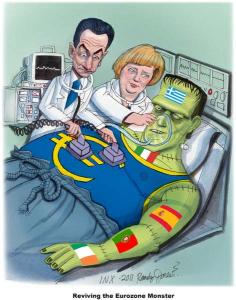
Make No Mistake–Europe is in Big Trouble
| Reviving the Eurozone monster |
USA Watchdog
Treasury Secretary Tim Geithner said yesterday that European states “are going to have to do more” to solve their enormous debt troubles. To that I ask, “more” of what? That can only be “more” money printing.
Mark my words, more debt and fiat currency will be the ultimate answer to the European debt problem. It is either that or let the banks and some countries in Europe go under. If Greece was the only country to default and leave the EU, then that would not be all that bad. The real problem is all the other heavily indebted countries that are levels of magnitude more of a problem than little Greece.
France24.com reported yesterday, “The Eurozone crisis could wreck the European Union, top EU officials warned on Wednesday as the leaders of Germany and France held talks with Greece to avoid a default and widespread chaos. The pressure rose on all fronts with United States again expressing great concern, with Treasury Secretary Timothy Geithner saying European states “now recognize they are going to have to do more” to resolve to the crisis. Highlighting the threat to the global economy, Geithner is to exceptionally attend talks between European Union finance ministers and central bankers in Poland on Friday.
French President Nicolas Sarkozy, German Chancellor Angela Merkel and Greek Prime Minister George Papandreou were to hold a teleconference late Wednesday as markets price in a default by the government in Athens, and credit rating giant Moody’s downgraded two major French banks given their exposure to Greek debt. “Europe is in danger,” Polish Finance Minister Jacek Rostowski, whose country currently chairs EU meetings, told the European Parliament in Strasbourg. “If the eurozone breaks up, the European Union will not be able to survive,” he added. At his most dramatic, Rostowski even warned that “war” could return to Europe if the crisis fatally weakens the EU, founded amid the rubble of World War II.
His underlying message was backed up by European Commission president Jose Manuel Barroso, who described the crisis as “the most serious challenge of a generation.”
Read Full Article
Ron Paul 1988 End the Drug War
Video - Ron Paul on the Morton Downey Jr. Show - 1988
Runs 1 minute. This is pretty funny.
It's 23 years and hundreds of billions later, as we've been trying to cut off drugs at their source for more than 2 decades. How's that working out for ya?