Sunday, July 31, 2011

The FEMA list of Presidential Executive Orders

On February 16, 1962, President John Kennedy signed several Executive Orders which would allegedly give certain dictatorial powers to appointed bureaucrats in the event a "National Emergency" should be declared by the President — whichever president is sitting in office at the designated time. At the president's discretion "in any time of increased international tension or economic or financial crisis", the E.O.'s could theoretically be enacted.
These E.O.'s signed by Kennedy would give authority to the Federal Emergency Management Agency to control: communications, energy, food, fuel, farms, transportation, highways, railroads, inland waterways and seaports, health, education and welfare, drafts citizens into work forces under government supervision; relocation of populations, designates areas to be abandoned as 'unsafe'; relocates communities, and controls all public storage facilities.
On February 27, 1962 Kennedy signed E.O. 11051 designating FEMA as the authorized agency to implement the above orders, and which authority can be re-designated by the original authority.
President Nixon signed E.O. 11490 combining all the above to be enacted in one fell swoop; on July 20, 1979 Carter added a few minor amendments to them; and, in June, 1994 then president Bill Clinton signed E.O. 12919, which appears to encompass all of the E.O.'s.
We have found no Executive Orders that would nullify any of the above, so it appears they are all considered to be on the books at the time of this posting.
Given there is no Constitutional authority for any president to declare a "National Emergency," we have wondered how the orchestraters of this plan expected to successfully execute the E.O.'s.
The plan for total control of every aspect of our lives has been under construction for a long time. As you read these executive orders, bear in mind that they mean nothing by themselves. They are not law, nor can they become law by and of themselves.
However, under legislation that is currently pending in most (if not all) states, they could potentially take on significant meaning.
The Emergency Health Powers legislation, pending in state capitols all across America — if passed — would give the governor the power to declare a state of health emergency by executive order. He then would be able to hand the reigns of power to whomever he chooses — including the state's emergency management agency, which could essentially act as an arm of the Federal Emergency Management Agency.
Apart from — and sometimes combined with — these Emergency Health Powers Acts are varying forms of "anti-terror" bills that are virtually redefining the words "terror," "terrorism," and "terrorist."
States are busy right now, creating their own versions of the federal Office of Homeland Security. These state offices will oversee the process and details of the implementation of these orders. That is why it is so critical to get the legislation stopped in the states. For more information, or to read the bills we've compiled, go to the War on Americans is in the States section of this website.
After you're done reading these executive orders, you might wish to print them out and take them to your state legislators, to emphasize to them the importance of defeating the bills that are currently pending, that would be the final piece needed to implement the controllers plans.
And now, the list:

162 LOCAL GOVERNMENTS, 14 HOUSING FINANCE PROGRAMS, AND ONE UNIVERSITY WITH COMBINED $69 BILLION OF DEBT AFFECTED

New York, July 28, 2011 -- Moody's Investors Service has placed under review for possible downgrade the Aaa ratings of 177 public finance credits, affecting a combined $69 billion of outstanding debt. The credits include 162 local governments in 31 states, 14 housing finance programs and one university. A complete list of affected securities and additional analysis is available at www.moodys.com/USRatingActions.

These actions relate to Moody's July 13 decision to place the Aaa government bond rating of the United States under review for downgrade, and reflect the rating agency's assessment that some Aaa public finance ratings would likely be indirectly affected by potential credit deterioration of the sovereign.
In the event the U.S. government's Aaa rating is downgraded, Moody's will determine the outcome of each review by evaluating the strength of the sovereign linkages to each affected credit, including direct and indirect reliance on federal spending, sensitivity to deteriorating macroeconomic conditions and vulnerability to disruptions in the financial markets. Moody's will also consider positive credit attributes of each issuer such as financial position, operating flexibility and management responsiveness.
In a previous action on July 19, Moody's placed the ratings of five Aaa U.S. state governments under review for possible downgrade, affecting approximately $24 billion of general obligation and related debt. Those states are Maryland, New Mexico, South Carolina and Tennessee and the Commonwealth of Virginia.
Some 400 other Aaa-rated public finance credits have not been placed on review for possible downgrade. At this time, Moody's considers their ratings to be resilient to a one-notch downgrade of the U.S. government's bond rating. Should the sovereign rating be downgraded by more than one notch, Moody's would likely assess whether these remaining Aaa ratings should also be placed on review for downgrade.

LOCAL GOVERNMENTS
The review for possible downgrade affects 162 Aaa-rated local governments and $63 billion of debt. Factors weighing on specific credits include high federal employment and exposure to capital markets disruptions.
The 162 local governments include 66 cities, 53 counties, 29 school districts and 14 special tax districts. The local governments are located in 31 states, with the heaviest concentrations in Virginia (15 credits) and Massachusetts (14 credits).
"The ratings of these local governments, particularly those with a high economic dependence on federal activity, would be vulnerable to a downgrade of the U.S. government" said Moody's Senior Vice President Matt Jones, a team leader covering local government ratings. In addition to the risk of federal job reductions, Moody's review following a U.S. government downgrade would focus on a local government's reliance on capital markets, its dependence on federal revenues, its sensitivity to macroeconomic cycles, and its available financial resources to offset these risks.

HOUSING FINANCE PROGRAMS

Today's action affects 14 Aaa-rated housing finance programs and $4.3 billion of debt. Factors weighing on specific credits include high levels of government mortgage insurance, and high delinquency and foreclosure rates.

The programs are:
* The Colorado Housing and Finance Authority's Single Family Mortgage Bonds and the Single Family Program Bonds, 2009 Class I;
* Idaho Housing and Finance Association's Single Family Mortgage Senior Bonds, Series 1996B, Series 1996C, Series 1998D, Series 1999F, Series 1999-I*, Series 2000A, Series 2000C, and Series 2000D;
* Kentucky Housing Corporation's Housing Revenue Bonds; and
* Utah Housing Corporation's Single Family Mortgage Senior Bonds, Series 1998G, Series 2000A and NIBP.

"These 14 state HFA programs have above-average exposure to sovereign risk factors, including high levels of loans more than 90 days delinquent or in foreclosure, or high levels of government mortgage insurance breakdown relative to their program asset to debt ratio (PADR)," said Moody's Senior Vice President Florence Zeman, team leader of the housing rating team. Following a U.S. government downgrade, Moody's would conduct a stress test of each program in light of potentially higher loan losses, reduced liquidity and the diminished credit quality of government mortgage insurance.

* Idaho Housing and Finance Association's Series 1999-I is already on review for possible downgrade due to potential loan losses arising from delinquencies and foreclosures and the resulting decline in PADR. Moody's will now also consider the program's exposure to the U.S. government.

HIGHER EDUCATION AND NOT-FOR-PROFITS
The University of Washington (UW), with $1.3 billion of debt affected, is the only Aaa-rated university that Moody's placed on review for possible downgrade. This action primarily reflects UW's unusually large share of revenues derived from federal research grants and Medicare and Medicaid reimbursements.
"Our review in the event of a U.S. government downgrade would focus on UW's ability to maintain balance sheet reserves and operating cash flow while reducing expenses or increasing revenues in response to potentially significant federal funding cuts," said John Nelson, Managing Director for healthcare, higher education and not-for-profits.
Additionally, Moody's placed the Aaa rating of the Smithsonian Institution ($108 million debt affected) on review for possible downgrade on July 13 due to its high dependence on federal operating appropriations. The linkage of the Smithsonian rating to the sovereign U.S. rating, however, has been changed from direct to indirect, which means it will not automatically change if the U.S. government's rating changes.
Moody's outlined its approach to determining each sector's exposure to sovereign risk was outlined in a July 13 special comment, "Implications of a U.S. Rating Action for Aaa-rated Municipal Credits."
For a complete list of affected securities and additional analysis, please visit www.moodys.com/USRatingActions.
REGULATORY DISCLOSURES

Please see the rating methodologies tab on the Credit Policy page on moodys.com for the relevant methodology for each action.

Please see the ratings tab on the issuer / entity page on moodys.com for the last Credit Rating Action and the rating history.


New York
Anne Van Praagh
Vice President - Senior Analyst
Public Finance Group
Moody's Investors Service, Inc.
JOURNALISTS: 212-553-0376
SUBSCRIBERS: 212-553-1653

New York
Naomi Richman
MD - Public Finance
Public Finance Group
Moody's Investors Service, Inc.
JOURNALISTS: 212-553-0376
SUBSCRIBERS: 212-553-1653

Moody's Investors Service, Inc.
250 Greenwich Street
New York, NY 10007
U.S.A.
JOURNALISTS: 212-553-0376
SUBSCRIBERS: 212-553-1653

Can Obama Raise the Debt Ceiling Alone?


Video - Judge Andrew Napolitano - July 25, 2011

Solid discussion. Runs approximately 2 minutes.

---

What's missing from the debt-ceiling discussion, albeit nothing new to DB readers, is spending on wars and the pentagon. It's not even being mentioned as a possibility in any of the competing debt plans, despite the following undeniably depressing and disgusting facts:

From Reddit:

I thought this kind of puts things in perspective. In 2010, the US government collected $898 billion in federal income tax revenues. The same year, we spent $847 billion on useless wars and national defense. That means that 94% of all federal income tax revenue is equivalent to what we spend on the Pentagon. Who out there thinks it was money well spent?

Also, just to piss you off a little bit more - defense spending is equivalent to 443% of what we collect in total corporate taxes.

One more link you need to see:

---

Paul Ryan gets booed for supporting wealthy tax breaks

Video - Paul Ryan in Wisconsin

CONSTITUENT: The middle class is disappearing right now. During this time of prosperity, the top 1 percent was taking about 10 percent of the total annual income, but yet today we are fighting to not let the tax breaks for the wealthy expire? And we’re fighting to not raise the Social Security cap from $87,000? I think we’re wrong.

RYAN: A couple things. I don’t disagree with the premise of what you’re saying. The question is what’s the best way to do this. Is it to redistribute… (Crosstalk)

CONSTITUENT: You have to lower spending. But it’s a matter of there’s nothing wrong with taxing the top because it does not trickle down.

RYAN: We do tax the top. (Audience boos). Let’s remember, most of our jobs come from successful small businesses. Two-thirds of our jobs do. You got to remember, businesses pay taxes individually. So when you raise their tax rates to 44.8 percent, which is what the president is proposing, I would just fundamentally disagree. That is going to hurt job creation.

Continue reading...

---

Food, Control and the Growing Police State

Dees Illustration
Szandor Blestman
Blitz

Food has always been a tool the elite have used to control the masses. When you control the food supply, you control everything, even life and death. A starving man is more likely to sell his soul for a potato then someone with a full tummy. The relatively free market of food production and distribution that has been in place in this nation for a few centuries now has led to unrivaled prosperity. Food can, in fact, be grown for practically nothing if you have the land, the time and can afford to buy just a few heirloom seeds to grow the organic vegetables necessary for good health. This will save you money, is better for you than grocery store vegetables which may be genetically modified or may contain unwanted chemicals, and helps you to become less dependent on the state for your survival.

It is the last part of the above statement that frightens government officials. They want you dependent on them. For some, it makes them feel important. Others may just want to feel needed or helpful. Still others may just want the paycheck. Whatever the case, they don't seem to just want to leave you alone to your own devices. Perhaps that's why they're attempting to pass laws making it illegal to grow your own garden. Perhaps that's why they want to make sure you're a compliant grass farmer just like your neighbors. Perhaps that's why they're trying to control the food necessary for life.

Read Full Article

The Buzz Around Gold is Growing Louder

Dees Illustration
Jeff Clark
BIG GOLD

I outlined last week the increasingly bullish consensus among analysts about gold stocks. The same pattern exists with gold itself; growing numbers of analysts have either joined the movement or have upped their bullish outlook.

The following comments and developments have all been reported just this month. It presents quite a convincing case when one strings them together like this. Keep in mind that this is what these analysts and managers are telling their clients.

SICA Wealth Management’s Jeffrey Sica: “Right now, I think gold looks better than ever.” He sees a “painfully high probability” of troubling events occurring in the months ahead. “There has been a general loss of confidence in the ability of central banks and governments to manage the economy. That will continue to give gold and other precious metals a boost.”

Empire Economics chief economist Clifford Bennett expects gold to come close to $2,000 an ounce this year and $2,200 an ounce within 18 months. “There is risk in the second half of the year of a bit of a ‘panic spike,’ if you like, as everyone thinks there isn’t enough to go around and starts to hoard. That’s when you’ll really see gold take off towards $2,000 an ounce.”

Franco-Nevada Chairman Pierre Lassonde said the coming mania in gold will make the 1970s run look like child’s play. “In 1980, the only players, or the dominant players, were the Americans. Today the dominant players are China and India; 58% of all the gold sold this year will be sold in these two countries. When we reach that mania phase… watch out, because it will truly make your head spin.”

Antaike analyst Shi Heqing had this to say about Chinese investors: “Record high prices won’t scare away investors… they are likely to chase the rally and continue to buy gold because paper money feels increasingly worthless and they are worried about inflation.” Shi expects China’s gold demand to rise about 20%, due in no small part to the country’s 6.4% inflation rate.

Reuters: “The case for gold in the longer term is still very strong,” said a Singapore-based trader. “Gold may appeal to new classes of investors who previously avoided the market in favor of more mainstream investments like bank deposits, bonds, and equities. Potentially there’s a whole new market for small-sized gold bars if these investors lose faith in paper.”

Newedge USA predicted gold will hit $1,800 and silver $70 by year-end due to investors seeking a haven asset and physical demand from Asia. “Gold is an excellent hedge in troubled times” said Mike Frawley. “Demand will be very strong long-term from Asia, and the economic trend in the West is improving.”

FX Concepts founder John Taylor: “Gold will climb to $1,900 by October.”

SMC Global: “Evidence of sluggish U.S. growth has shaken investor confidence. Concerns about rising inflation here have also boosted appetite for gold ETFs. Demand is high from small players.”

Minerals and Metals Trading Corp’s Ved Kumar Prakash reported “skyrocketing” demand for gold in India. He predicted that given the company’s brisk sales, gold imports would jump by more than 40% this fiscal year.

The Swiss Parliament is expected later this year to discuss the creation of a gold franc. “I want Swiss people to have the freedom to choose a completely different currency,” said Thomas Jacob, the man behind the gold franc concept. “Today’s monetary system is all backed by debt – all backed by nothing – and I want people to realize this.”

An “Iranian gold rush” is under way, according to an article by Reuters. “Usually as the price of an item increases, demand will decrease – but in the case of gold, it seems that higher prices are creating more demand,” said an unnamed Tehran gold retailer. “The reasons that people are drawn to these safe assets – gold coins and hard currency – are firstly a limited choice of investment opportunities, and secondly a fear from the weakness of the national currency,” said an economist who asked not to be named.

The Utah Legal Tender Act was signed into law by Governor Herbert last month. “Good monetary policy is an important part of a healthy and prosperous economy,” said Senator Mike Lee. He and other Republicans also introduced legislation to eliminate federal capital gains taxes on gold and silver coins. “Since the Federal Reserve Act of 1913, the dollar has lost approximately 98% of its value. This bill is an important step towards a stable and sound currency whose value is protected from the Fed’s printing press.”

CIBC World Markets’ Peter Buchanan remains bullish even if the debt ceiling talks resolve. “Even in the likely event Congress agrees to a debt ceiling rise, recent uncertainties are likely to reinforce central banks’ ongoing efforts to diversify from the dollar into gold and other assets.”

Citigroup Global Markets reported that silver may more than double to $100 an ounce if the current bull market follows similar patterns seen between 1971 and 1980. “If the final rally in the last bull market repeated, then we can expect $100 over the long term… While the high so far this year was at the same level as the peak in January 1980, we are not convinced that the long-term trend is over yet.”

Gold Forecaster analyst Julian Phillips: “This is not typical of a ‘bull’ market that will eventually fall back from whence it came. We believe gold is not in a ‘bull’ market, because it is changing its shape and nature permanently. Our reasoning is not academic posturing, but a reflection of the realities that have taken place over time and those that confront us now. Because it is perceived to be an alternative wealth-preserving asset, a counter to a failing monetary system, it is not a simple commodity moving up and down with the flows and ebbs of economic cycles; it is a valid measure of monetary values.”

American Precious Metals Advisors Managing Director Jeffrey Nichols: “A recent survey of 80 central bank reserve managers predicted that the most significant change in their official reserve holdings in the next 10 years will be their intentional build up in gold reserves. They also predicted that gold will be their best performing asset class over the next year, and sovereign debt defaults will be their principal risk.”

Gloom Boom and Doom editor Marc Faber: “I just calculated that if we take an average gold price of say around $350 in the 1980s and compare that to the average monetary base and the average U.S. government debt in the 1980s...and then if I compare this to the price of gold to today’s government debts and monetary base, gold hasn’t gone up at all. It’s actually gone against these monetary aggregates, and against debt it’s actually gone down. So I could make the case that gold is today probably very inexpensive.”

GoldMoney founder James Turk: “In reality there are very few participants currently in the gold market… when I look at the price action, it suggests to me that a lot of this big money on the sidelines wants to be in. Therefore we are seeing some aggressive bidding on any pullbacks.”

Reuters Money reports that eBay’s “gold and silver outpost” has seen gold bullion sales jump more than 60% from 2007 through 2010. More significantly, “almost half of the silver and gold buyers in the first quarter of 2011 never purchased these items on eBay before.”

Sprott Asset Management chief investment strategist John Embry: “I think it will be really exciting when silver clears $50, because then it will be in absolutely new ground. There is, without question, major physical shortages of physical silver, and demand is robust. Once silver gets rolling, it’s going to levels people cannot imagine.”

It’s hard to go one day without seeing comments like these. The chorus is growing, and as these bullish views spread further and further into the mainstream, the number of investors attracted to precious metals will swell and continue to drive prices higher.

Is this growing consensus the sign of a top? As I said about gold stocks, taking the contrarian view in response to this information would be the wrong move. Fiscal and monetary issues are getting worse, not better, and I think we’re simply seeing more investors recognize the inevitable. We’ll worry about exiting this sector when real interest rates are positive and the dollar is once again a revered currency. Until then, it’s hard to imagine a scenario that isn’t bullish for gold. Any pullback should thus be viewed as a sale price.

Is the impetus for a mania building? I don’t know if we’re on the doorstep of that phase or not, but the fundamental reasons to hold gold are as strong as they’ve ever been. Indeed, it’s getting more critical to have meaningful exposure to precious metals. Keep in mind that when the debt ceiling talks reach a resolution – whatever it may be – the fundamental problems of excessive debt and further deficits will still be unresolved.

Will gold correct if agreements are reached on the debt talks? Probably, but I think the more appropriate question to ask is this: If these analysts are correct, do I own enough ounces?

The double standard of American banking and opaque Federal Reserve policy.

While the American public is starring at a government that is more like an improv act in Chicago, the banking system continues to hide toxic assets from the view of the public.  An odd economic dance is taking place.  While the public is being beaten over the head about spending within its limits we have a shadow banking system that seems to have no debt limits at all.  While many Americans are losing their homes to foreclosure, are filing bankruptcy because of credit card debt, or face having to deal with massive amounts of student loans you have the Federal Reserve expanding its balance sheet all with complete media silence.  Why is there no spectacle here?  Where is the scrutiny for the banks?  The problem of course is that the Fed is mainly concerned with protecting the wealth of the small financial elites.  After all, we have the grand J.P. Morgan as one of the masterminds behind this hub of banking power.  As we continue down this circus, the even bigger absurdity of the Federal Reserve practices continues unquestioned in popular media.

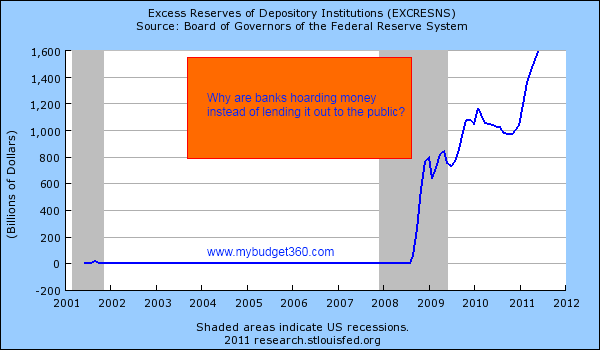
Growing those excess reserves
excess reserves
While we continue to hear about how we are running out of money, it would appear that banks in the United States are flush with funds.  These excess reserves are ready for lending to the American public and can go into small businesses to revive the economy.  The issue of course is that banks understand how toxic their balance sheets have become and they would rather keep this money under lock and key.  Plus, these banks earn interest at the Federal Reserve for an absolute risk free bet.  Did we also mention this only occurred because of the bailouts that were funded by taxpayers?  So you see, taxpayers are essentially allowing the too big to fail to have absolutely no debt ceiling yet somehow our politicians are trying to convince the public that they now need to tighten their belts.  This is the twisted world we now live in.
Aside from this, we already know that many working and middle class Americans have smaller household incomes.  Now that banks are using some due diligence they realize that they are unable to make too many loans without risking future damage yet again.  What I would argue is that banks knew this all along but the trillion dollar bailouts were predicated on the assumption that credit would dry up and banks needed this money to continue making loans.  The opposite occurred.  Banks are hoarding the money, taking on a taxpayer risk free bet, and are now lambasting the public for not being fiscally responsible.  There is no bigger double standard than the current American banking system.
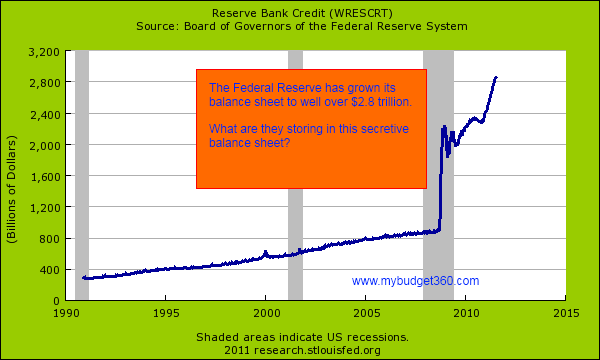
The Federal Reserve has no debt ceiling
reserve bank credit
While you were sleeping the Federal Reserve has grown its balance sheet to well over $2.84 trillion.  No public scrutiny, no media investigations, no deeper analysis, yet this has all occurred in the matter of a few years.  Keep in mind the Fed has taken on mortgage backed securities, luxury hotel loans, strip mall loans, and other dubious debt that is hidden from public analysis.  So while you and I need to operate within the fiscal laws of reality and not spend more than we earn, the Fed in conjunction with the U.S. Treasury can digitally print up as much money as is needed to protect the too big to fail banks.  Where does the average American have the option to dump onerous student loans, insane credit card debt, or other payday loans for that matter?  There is no mechanism for this outside of bankruptcy (and student loans are still with you even after that).  Many of the too big to fail banks have simply shifted toxic assets to the Federal Reserve.  And then people wonder why the U.S. dollar is plunging.
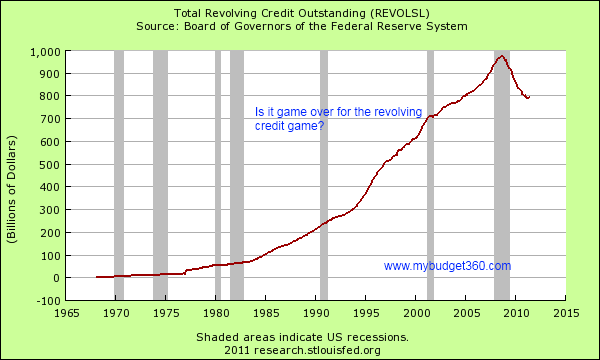
Peak credit?
revolving credit
The credit card is a fascinating device.  People are able to spend today with the promise of paying tomorrow.  This peaked in 2007 where we were quickly approaching $1 trillion in revolving debt in the American public.  As the chart shows, since 1965 credit card debt has only grown.  Through every recession and dip this movement never changed.  That is until this crisis hit.  Credit card debt has now fallen into the $700 billion range and has been surpassed by student loan debt that is quickly approaching $1 trillion itself.
It is clear that the American public does have a debt ceiling.  We have reached it for credit card debt, mortgage debt, and other forms of loans.  Ultimately incomes need to service this debt and with the economy losing steam this is harder to sustain.  The Federal government finds itself in a similar situation and needs to cut back as well.  Yet it is amazing that the first things on the table are programs that directly hit the working and middle class.
“Why not have the Fed charge banks for keeping funds in excess reserves so more money is used to start businesses even if they are small and local?  Why don’t we actually audit the Fed and see what is really going on?  Why not have hedge fund managers pay taxes just like every other middle class American?  Instead of these measures we get fear and mind games trying to stiff an old retiree with a $1,000 a month Social Security check.  The politicians want to game the CPI system to chop down COLAs and other forms of keeping up.  People need to wake up before the middle class is completely gone.”
There is no debt ceiling with the Fed or the too big to fail banks yet the public is being blamed for all of this.  Why not use those trillions of dollars to actually pay down our debt?  How about banks face the music and realize many of their hyper-inflated loans are actually worth less?  Of course that would be problematic for the financial banking elite so you will rarely hear about that in the press.  Remember this, debt ceiling for you, yes, debt ceiling for too big to fail banks, no.
If you enjoyed this post click he