Tuesday, May 24, 2011

GE Joins Intel to Advise Obama as Overseas Holdings Expand
Source: Bloomberg
Seven publicly traded U.S. corporations represented on President Barack Obama’s advisory council for jobs and competitiveness -- including General Electric Co. (GE) and Intel Corp. (INTC) -- have devoted a growing pool of their non-U.S. earnings to investments in other countries.
As a group, multinational companies with current or former chief executive officers on Obama’s jobs council have, over the past four years, almost doubled the cumulative amounts they’ve reinvested overseas, according to data compiled by Bloomberg.
By doing so, companies may be able to take advantage of faster-growing markets or lower production costs, and they can defer U.S. income taxes on profits from overseas sales. Underscoring the difference between corporate interests and the national interest, they’re also investing money elsewhere that could be helping the U.S. economy, said former U.S. Labor Secretary Robert Reich.
“That’s a signal that they are betting less on America,” Reich said. “We’ve got to understand there’s a fundamental difference between the competitiveness of these companies and the competitiveness of America and American workers.”
Read Full Article Here...
Day of reckoning for commercial real estate in 2012
largest amount of loans maturing next year as $150 billion in CRE debt comes due. Federal Reserve running out of options in hiding financially disastrous real estate loans.
The Federal Reserve has tried its best to hide the secrets of past banking blunders deep in its balance sheet. Commercial real estate (CRE) loans made in haste during the real estate bubble are part of this national disgrace in banking folly. As the Federal Reserve and U.S. Treasury digitally print the dollar into oblivion the bad CRE loans still linger in the Fed balance sheet. As it turns out the Fed has become the dumping ground for all things real estate and has traded toxic loans for quality liquidity to fuel the banks back up. CRE debt in the form of empty shopping malls, failed hotels, and tumbleweed occupied strip malls is only a flavor of what the Fed is taking on. Yet many of these loans are still occupying the balance sheet of many banks. As it turns out, there was so much junk in the CRE market that the Fed could only balloon their balance sheet and still not encompass one half of the CRE market. Many CRE loans are coming due in 2012. Is the day of reckoning for CRE coming in 2012?
$150 billion coming due in CRE loans in 2012
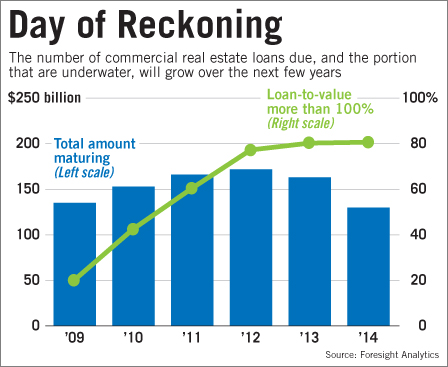
Over $150 billion in CRE loans are maturing in 2012 bringing the day of reckoning closer. Why is this a problem? First, the CRE market has completely imploded:
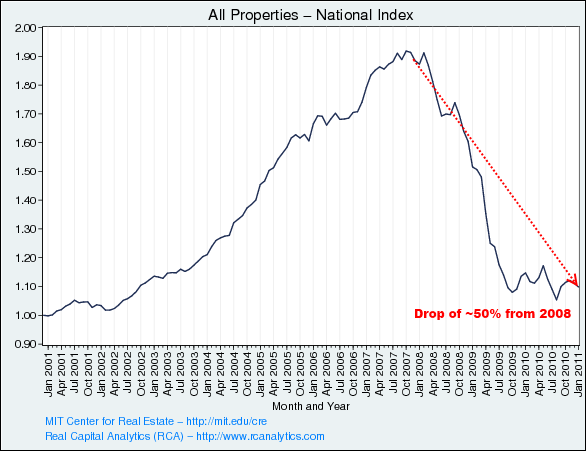
Source: MIT
CRE values just like residential real estate have cratered and are down over 50 percent since their peak. Much of these properties require actual economic streams of income coming in for example in strip mall rents or hotel occupancies to keep servicing the debt. Unlike a home that has other sentimental values a CRE property is strictly a business decision. The Federal Reserve is seeing the tanking of valuations at the absolute worst time. The Fed treating the crisis as one of liquidity simply exchanged U.S. Treasuries for toxic CRE debt to drinking buddy banks. After all what is the harm in keeping the junk for a few years and when prices recover, a simple hand off and the public has no idea what happened except they just have to contend with greater goods inflation as their purchasing power falls through the floor. However the bailouts of 2007 never helped the overall economy because the crisis is one of solvency, not liquidity. The working and middle class are struggling because their purchasing power has washed away over the decades and the bailouts were simply geared to the too big to fail banks.
CRE is a giant problem because the number of buyers vying for a strip mall is relatively small. Unlike a residential property, if the price drops low enough on a home the market will respond. If a strip mall was poorly built in a bad location you may have no buyers regardless of cost. And make no mistake banks have shut the door on CRE fairly hard:
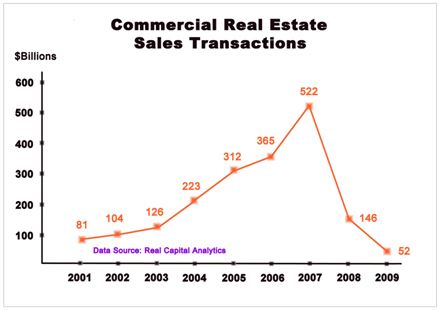
Source: World Property Channel
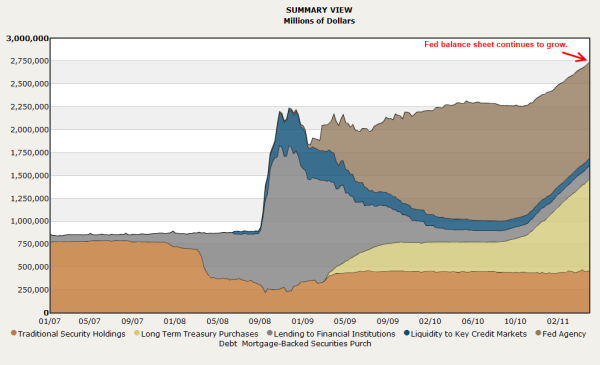
The fiasco in CRE can only last so long. The Fed balance sheet has exploded during this crisis and you can rest assured billions of dollars in CRE loans are floating in the un-audited figures:
CRE is merely following the pattern outlined by the residential real estate bubble effectively creating a situation where a double bubble developed:

Source: The American
2012 is looking like the day of reckoning for CRE debt. First, you have an American public that is absolutely frustrated by the ineffective handouts to the banking system of the country. The hunger for a full Fed audit is getting louder and louder. Politicians will sway in the way of their financial backers but only to the extent they feel they can get away with their smoke and mirrors and deceive the public. That shell game is becoming harder and harder to maintain. At what point does the government step in and do what is best for the economy and not the big banking interests? How does bailing out a failing hotel or empty strip mall really help the average working American? It doesn’t. Banks were eager to make these loans and profited handsomely during the bubble. Now they don’t want to deal with the consequences of taking on too much risk so they rather socialize the losses on the public. This is not capitalism but a banking corporatocracy. CRE debt will come due in large amounts in 2012 and unless prices soar to the sky in the next year, some major rebalancing will need to occur.
There is no inflating out of the real estate mess and CRE is no exception. Unless household incomes go up disposable income is going to get tighter. We are already seeing more money being eaten up by food and energy and baby boomers will definitely see more money flowing into the healthcare industry complex. From one frying pan to another it will become about priorities and CRE will move lower on the list. The day of reckoning for CRE is coming next year and only time will tell how the market will respond.
Obama ‘Clarifies’: 1967 Borders Didn’t Really Mean 1967 Borders
Speaking today at the AIPAC annual conference, President Barack Obama addressed the controversial suggestion he made that the peace process between Israel and a prospective Palestinian state start with the pre-1967 borders, before Israel occupied Palestine.

Rather Obama insisted that the “1967 lines” would need to be revised to account for what he referred to in the speech as “demographics changes” but what most people in the world refer to as the construction of settlements in the occupied territories. The expansion of settlements ever deeper into Palestine has been the chief reason the Palestinian Authority left the peace talks in September.
Obama’s speech was aimed primarily at placating the anger his unseemly call for peace caused among AIPAC and its affiliates, and wedged into a tight speech with pledges of more military aid to Israel and promises to move against Iran, he appears to have been successful in his task. Through the speech he was loudly cheered by attendees.
When Greece Finally Defaults, The Real Mayhem Will Begin

Must read from Euro Economist Andrew Lilico.
It is when, not if. Financial markets merely aren’t sure whether it’ll be tomorrow, a month’s time, a year’s time, or two years’ time (it won’t be longer than that). Given that the ECB has played the “final card” it employed to force a bailout upon the Irish – threatening to bankrupt the country’s banking sector – presumably we will now see either another Greek bailout or default within days.
What happens when Greece defaults. Here are a few things:
- Every bank in Greece will instantly go insolvent.
- The Greek government will nationalise every bank in Greece.
- The Greek government will forbid withdrawals from Greek banks.
- To prevent Greek depositors from rioting on the streets, Argentina-2002-style (when the Argentinian president had to flee by helicopter from the roof of the presidential palace to evade a mob of such depositors), the Greek government will declare a curfew, perhaps even general martial law.
- Greece will redenominate all its debts into “New Drachmas” or whatever it calls the new currency (this is a classic ploy of countries defaulting)
- The New Drachma will devalue by some 30-70 per cent (probably around 50 per cent, though perhaps more), effectively defaulting 0n 50 per cent or more of all Greek euro-denominated debts.
- The Irish will, within a few days, walk away from the debts of its banking system.
- The Portuguese government will wait to see whether there is chaos in Greece before deciding whether to default in turn.
- A number of French and German banks will make sufficient losses that they no longer meet regulatory capital adequacy requirements.
- The European Central Bank will become insolvent, given its very high exposure to Greek government debt, and to Greek banking sector and Irish banking sector debt.
- The French and German governments will meet to decide whether (a) to recapitalise the ECB, or (b) to allow the ECB to print money to restore its solvency. (Because the ECB has relatively little foreign currency-denominated exposure, it could in principle print its way out, but this is forbidden by its founding charter. On the other hand, the EU Treaty explicitly, and in terms, forbids the form of bailouts used for Greece, Portugal and Ireland, but a little thing like their being blatantly illegal hasn’t prevented that from happening, so it’s not intrinsically obvious that its being illegal for the ECB to print its way out will prove much of a hurdle.)
- They will recapitalise, and recapitalise their own banks, but declare an end to all bailouts.
- There will be carnage in the market for Spanish banking sector bonds, as bondholders anticipate imposed debt-equity swaps.
- This assumption will prove justified, as the Spaniards choose to over-ride the structure of current bond contracts in the Spanish banking sector, recapitalising a number of banks via debt-equity swaps.
- Bondholders will take the Spanish Banking Sector to the European Court of Human Rights (and probably other courts, also), claiming violations of property rights. These cases won’t be heard for years. By the time they are finally heard, no-one will care.
- Attention will turn to the British banks. Then we shall see…
---
Liberal State Council push to force elderly out of homes

Elderly people could be moved from public housing to smaller units under a plan to be debated by the Liberal Party State Council. Source: HWT Image Library
UPDATE 10.50am: ELDERLY residents should not be forced to give up their homes to make way for units if a policy proposal to be discussed at next week's Liberal State Council gains momentum, community housing advocates say.
The state motion, to be brought before the council next weekend, suggests older residents who occupy large blocks of land should subdivide their large blocks in exchange for a new unit within their original piece of land.
Residents could be forced from their homes to live in a unit a fraction of the size, on their old block of land, under the motion.
Community Housing Federation of Victoria spokesman Steve Staikos said no one should be forced to move if the measure was taken up by the Government and became policy.
"I would urge all delegates to remember that these are actually people we’re talking about. People who have been in their homes for many years and probably do not want to go," he said.
Mr Staikos said the idea of taking away people’s backyards to create more housing was questionable, because it could leave less family homes for future tenants.
"Community Housing Federation of Victoria believes that every person deserves long term security of tenure, especially older members of our community in social housing already battling with cost-of-living pressures and aging related health problems."
Council on the Ageing CEO Sue Hendy said the potential policy was insensitive to elderly residents and "not a good idea ... This sounds like a way to shoehorn people into smaller places to create more land," she said.
Ms Hendy said many older public housing residents had lived in their homes for decades, and relied on the support of their neighbours and local friends.
She said while the proposal suggested residents still live on the same site, a unit would not be suitable for people who looked after their grandchildren or had family visiting.
Any policy like this would be a concern for the elderly, who would feel they had no choice but to agree or face being moved to another neighbourhood where they had less support, she said.
The motion will discuss "the potential level of interest amongst older people with existing large blocks of land to further subdivide their large blocks of land in exchange for the 'free' acquirement of a new unit within their original piece of land".
Two years ago, the Herald Sun revealed pensioners were being forced from homes they had lived in for decades so the former Brumby government could cash in on their rising value.
Hampton great-grandmother June Smith, 73, was allowed to continue living in her public housing home after she publicly complained about being ousted from her home of 36 years.
"I'd be very disappointed if this started happening again," she said.
"Particularly for older people I think it's appalling. I know the housing situation is terrible but there's got to be something better than what they're proposing.
"People would have to get rid of all their furniture to squeeze into a unit and they wouldn't be able to have their grandchildren over."
A Government spokeswoman yesterday said: "As part of an ongoing review of the older stock program, the Coalition Government is looking at better ways to utilise older stock more effectively."
Desperately Needed: A New Political Party
May 22, 2011 "Information Clearing House" ---Count me among the growing number of people who believe support of the Democratic Party, as such, is not merely a waste of time but, worse, a deeply negative activity.
Support for the Democratic Party leads to continued degradation of the United States and great harm to all citizens who are not wealthy.
The same has to be said about support for the Republican Party, but that does not mean rational people must therefore throw in with the Democrats. In plain language, they’re about equally bad for America and its people.
We desperately need a new party, and there is a logical place to begin forming one: With the long list of genuine liberal organizations that were given birth by the Internet. More of that shortly.
Barack Obama should not be re-elected. At any time before the mid 1990s, his actions in office would have identified him clearly as a Republican who leans dangerously to the right. What he claims to believe in while campaigning and what he has done while in office have almost no positive connection. He has capitulated on major issuesbefore any “negotiations” have begun; he has, whenever possible, given the money elite what it wants on everything of importance.
He is as much a warmonger as the younger Bush; he has expanded the Bush wars, put us into the Libyan conflict, inflated the already insanely oversized Pentagon budget, reneged on all of his promises to curb military adventurism and war profiteering. He has enthusiastically supported extension of the grotesquely misnamed Patriot Act and otherwise continued the Bush program of diminishing individual freedoms.
Equally bad for all of us who are not very rich, Obama has actively supported or meekly acquiesced in most of the measures that are pushing us at breakneck speed toward the destruction of the middle class and the creation of a class of tens of millions of proles who will be locked hopelessly into a state of perpetual poverty.
There are five people looking for work in this country for every job that becomes available. Since the financial collapse of 2008, more than two million Americans have sunk into what is officially recognized as poverty -– which is to say, desperate poverty.
More than 43 million Americans now live below the official poverty line. More than one fifth of American children now live in poverty, which is more than twice the percentage of poor children in Great Britain or France. Five percent of Americans live with what is officially called “extreme food insecurity” — which simply means that they don’t know from day to day whether they will have anything to eat, and sometimes they don’t. That population is expanding daily.
A huge number of Americans have lost much or most of the wealth they accumulated through their working lives, because that wealth was invested in their homes.
In Minneapolis, my hometown, home values continue to fall, are down 8 percent from a year ago, and almost half of all homeowners are now “underwater” on their mortgages. Nationally, residential real estate has fallen in value by more than $6 trillion (trillion, with a tr) since 2008.
Our “liberal” president has yet to offer any serious programs or begin any crusades to turn any of those problems around.
He does continue to talk about “compromises” with the Republicans, who are desperately trying to placate and tame a constituency of utter nutcases and clowns, some of whom are multi-billionaires. He’s willing to talk about cuts in Medicare, Medicaid and other programs essential for relative security for millions of Americans. His “compromises” thus far have meant capitulation.
The great majority of Democrats in Congress are as bad or worse. And a substantial number of them care far more about preventing gay Americans from achieving full citizenship than they do about the millions who are facing homelessness and starvation.
(As just one of hundreds of examples, take the Minnesota Democrats’ “liberal” favorite, Sen. Amy Klobuchar. Please. She joined with 16 other Democrats and all Republicans in trying to gut the Clean Air Act. She votes for anything pushed by the National Rifle Association, no matter how far outside the realm of sense or decency, and she does the same for AIPAC, the American lobby for the right-wing government of Israel. She has never seen a “defense” bill she would not support and has few, if any, quarrels with the big banks. And that’s just for starters.)
Once again, we’re seeing the beginning of the flood of missives telling us that we MUST give money to and vote for the Democratic Party.
We are being told again, as we have been told during every election cycle for the past 30 years or more, that the Republicans are just ever so much worse and the country will go entirely to hell if we don’t do our part for the Democrats. Never mind that the majority of Democrats in office are in thrall to the corporate elite to the same degree as their Republican colleagues and the country already is headed rapidly to hell – hell for everyone but the rich.
Corporations and the very wealthy get everything they want from Democrats, though it may take just a little bit longer than when Republicans control everything. They pretend it’s otherwise (wink wink, nudge nudge) so that traditional Democratic voters can go on pretending there is a big difference.
There still are a few “liberal” Democrats. My own congressman, Keith Ellison – yes, the Muslim — is a marvel of honesty and courage in supporting positions that benefit the American people rather than war profiteers and other giant corporations. I haven’t made a count, but there may be 20 other Democratic members of Congress equally steadfast in doing what is right for the country and the people. Maybe. On a good day, possibly 30 or even 40.
The percentage seems to be higher in state legislatures, although those institutions also harbor an excessive number of Democrats who are owned by the economic elite. Again, I am blessed in having an outstanding liberal state representative, Frank Hornstein, and a pretty good state senator in Scott Dibble.
That is not enough, and they are too few.
We do desperately need a new political party at the state and national levels. And, no, it will not come from the various tiny socialist organizations.
“Socialist” is a negative word in this country, made so largely by the hunters for communist witches who held such a grip on this country in the 1940s and ’50s and well into the ’70s. In fact, the commie hunters are making something of a comeback recently –- see Newt Gingrich — even though you probably couldn’t find 100 avowed communists in the entire country.
The right wing long ago successfully equated “socialist” with “communist,” which meant Soviet-style communist, and that remains stuck in the national psyche. And that’s true even though a large and obviously growing number of people in this country favor (shhhhhhh) a goodly number of socialist policies and programs.
Social Security, Medicare, Medicaid, food stamps, Pell grants, among the surprisingly many. Just don’t tell the people who love them that they are practical socialist ideas.
Sadly, many Democrats of today are hell bent on joining Republicans in getting rid of as many of those programs as possible, except where it works (for the moment) to their electoral advantage to support them.
Anyway, socialist parties in this country generally have been pretty light on political sense, although I’ve been seeing more of the socialist press of late, and have to say they seem to have considerably more gravitas than they once had.
Clear-thinking individual socialists always have offered rational ideas, of course, but the parties frequently have wandered off into obscure byways, arguing odd doctrinal points when they should have been actively supporting workable programs for improved health care and citizen rights.
The politically and socially liberal organizations that were born of the Internet have a more obvious claim now to be the parents of a new party.
They have the advantage of already having enormous experience and talent at communicating with the public and with organizing hundreds of thousands and, in some cases, millions of people for political action.
Unfortunately, they also have the drawback that has been cited in dismissing socialists: Too many egos, with too many people who want to be top dog and are unwilling to take a lesser role.
In fact, we almost certainly wouldn’t have so many such organizations if it weren’t for the egos of their founders, a majority of whom could just as well have joined an existing organization.
Still, there are some first-rate organizers among them, and many are people of considerable courage, willing to stand up to the big-money power structure, far more honest than the corporate media moguls and their increasingly dimwitted troops, and eager to fight for what they believe is right for this country and its people.
Jim Fuller Desperately Needed: A New Political PartyIf anyone wanted a list, I probably could name two dozen organizations that would serve the purpose as a starting point, or as a piece of what could be the start, of a new party. And that leaves out the likes of MoveOn and other organizations that are barely camouflaged unofficial arms of the Democratic Party.
What I don’t know is how to get them together, get them into a conference specifically aimed at the formation of a new party. We need to think about that, but quickly, and to get them moving.
James Clay Fuller is a sort-of retired journalist who has worked in newspapers and magazines for more than 45 years. His day job for 30 years was at the Minneapolis StarTribune, where he was a business and economics reporter, features writer, and sometime music critic, as well as an editor in charge of several specialized sections of the newspaper and a number of investigative projects. He was nominated for Pulitzer Prizes in 1977 and 1992, and was the instigator and senior editor on a project that was nominated for a Pultizer in 1997. He has written for many national publications.
Support for the Democratic Party leads to continued degradation of the United States and great harm to all citizens who are not wealthy.
The same has to be said about support for the Republican Party, but that does not mean rational people must therefore throw in with the Democrats. In plain language, they’re about equally bad for America and its people.
We desperately need a new party, and there is a logical place to begin forming one: With the long list of genuine liberal organizations that were given birth by the Internet. More of that shortly.
Barack Obama should not be re-elected. At any time before the mid 1990s, his actions in office would have identified him clearly as a Republican who leans dangerously to the right. What he claims to believe in while campaigning and what he has done while in office have almost no positive connection. He has capitulated on major issuesbefore any “negotiations” have begun; he has, whenever possible, given the money elite what it wants on everything of importance.
He is as much a warmonger as the younger Bush; he has expanded the Bush wars, put us into the Libyan conflict, inflated the already insanely oversized Pentagon budget, reneged on all of his promises to curb military adventurism and war profiteering. He has enthusiastically supported extension of the grotesquely misnamed Patriot Act and otherwise continued the Bush program of diminishing individual freedoms.
Equally bad for all of us who are not very rich, Obama has actively supported or meekly acquiesced in most of the measures that are pushing us at breakneck speed toward the destruction of the middle class and the creation of a class of tens of millions of proles who will be locked hopelessly into a state of perpetual poverty.
There are five people looking for work in this country for every job that becomes available. Since the financial collapse of 2008, more than two million Americans have sunk into what is officially recognized as poverty -– which is to say, desperate poverty.
More than 43 million Americans now live below the official poverty line. More than one fifth of American children now live in poverty, which is more than twice the percentage of poor children in Great Britain or France. Five percent of Americans live with what is officially called “extreme food insecurity” — which simply means that they don’t know from day to day whether they will have anything to eat, and sometimes they don’t. That population is expanding daily.
A huge number of Americans have lost much or most of the wealth they accumulated through their working lives, because that wealth was invested in their homes.
In Minneapolis, my hometown, home values continue to fall, are down 8 percent from a year ago, and almost half of all homeowners are now “underwater” on their mortgages. Nationally, residential real estate has fallen in value by more than $6 trillion (trillion, with a tr) since 2008.
Our “liberal” president has yet to offer any serious programs or begin any crusades to turn any of those problems around.
He does continue to talk about “compromises” with the Republicans, who are desperately trying to placate and tame a constituency of utter nutcases and clowns, some of whom are multi-billionaires. He’s willing to talk about cuts in Medicare, Medicaid and other programs essential for relative security for millions of Americans. His “compromises” thus far have meant capitulation.
The great majority of Democrats in Congress are as bad or worse. And a substantial number of them care far more about preventing gay Americans from achieving full citizenship than they do about the millions who are facing homelessness and starvation.
(As just one of hundreds of examples, take the Minnesota Democrats’ “liberal” favorite, Sen. Amy Klobuchar. Please. She joined with 16 other Democrats and all Republicans in trying to gut the Clean Air Act. She votes for anything pushed by the National Rifle Association, no matter how far outside the realm of sense or decency, and she does the same for AIPAC, the American lobby for the right-wing government of Israel. She has never seen a “defense” bill she would not support and has few, if any, quarrels with the big banks. And that’s just for starters.)
Once again, we’re seeing the beginning of the flood of missives telling us that we MUST give money to and vote for the Democratic Party.
We are being told again, as we have been told during every election cycle for the past 30 years or more, that the Republicans are just ever so much worse and the country will go entirely to hell if we don’t do our part for the Democrats. Never mind that the majority of Democrats in office are in thrall to the corporate elite to the same degree as their Republican colleagues and the country already is headed rapidly to hell – hell for everyone but the rich.
Corporations and the very wealthy get everything they want from Democrats, though it may take just a little bit longer than when Republicans control everything. They pretend it’s otherwise (wink wink, nudge nudge) so that traditional Democratic voters can go on pretending there is a big difference.
There still are a few “liberal” Democrats. My own congressman, Keith Ellison – yes, the Muslim — is a marvel of honesty and courage in supporting positions that benefit the American people rather than war profiteers and other giant corporations. I haven’t made a count, but there may be 20 other Democratic members of Congress equally steadfast in doing what is right for the country and the people. Maybe. On a good day, possibly 30 or even 40.
The percentage seems to be higher in state legislatures, although those institutions also harbor an excessive number of Democrats who are owned by the economic elite. Again, I am blessed in having an outstanding liberal state representative, Frank Hornstein, and a pretty good state senator in Scott Dibble.
That is not enough, and they are too few.
We do desperately need a new political party at the state and national levels. And, no, it will not come from the various tiny socialist organizations.
“Socialist” is a negative word in this country, made so largely by the hunters for communist witches who held such a grip on this country in the 1940s and ’50s and well into the ’70s. In fact, the commie hunters are making something of a comeback recently –- see Newt Gingrich — even though you probably couldn’t find 100 avowed communists in the entire country.
The right wing long ago successfully equated “socialist” with “communist,” which meant Soviet-style communist, and that remains stuck in the national psyche. And that’s true even though a large and obviously growing number of people in this country favor (shhhhhhh) a goodly number of socialist policies and programs.
Social Security, Medicare, Medicaid, food stamps, Pell grants, among the surprisingly many. Just don’t tell the people who love them that they are practical socialist ideas.
Sadly, many Democrats of today are hell bent on joining Republicans in getting rid of as many of those programs as possible, except where it works (for the moment) to their electoral advantage to support them.
Anyway, socialist parties in this country generally have been pretty light on political sense, although I’ve been seeing more of the socialist press of late, and have to say they seem to have considerably more gravitas than they once had.
Clear-thinking individual socialists always have offered rational ideas, of course, but the parties frequently have wandered off into obscure byways, arguing odd doctrinal points when they should have been actively supporting workable programs for improved health care and citizen rights.
The politically and socially liberal organizations that were born of the Internet have a more obvious claim now to be the parents of a new party.
They have the advantage of already having enormous experience and talent at communicating with the public and with organizing hundreds of thousands and, in some cases, millions of people for political action.
Unfortunately, they also have the drawback that has been cited in dismissing socialists: Too many egos, with too many people who want to be top dog and are unwilling to take a lesser role.
In fact, we almost certainly wouldn’t have so many such organizations if it weren’t for the egos of their founders, a majority of whom could just as well have joined an existing organization.
Still, there are some first-rate organizers among them, and many are people of considerable courage, willing to stand up to the big-money power structure, far more honest than the corporate media moguls and their increasingly dimwitted troops, and eager to fight for what they believe is right for this country and its people.
Jim Fuller Desperately Needed: A New Political PartyIf anyone wanted a list, I probably could name two dozen organizations that would serve the purpose as a starting point, or as a piece of what could be the start, of a new party. And that leaves out the likes of MoveOn and other organizations that are barely camouflaged unofficial arms of the Democratic Party.
What I don’t know is how to get them together, get them into a conference specifically aimed at the formation of a new party. We need to think about that, but quickly, and to get them moving.
James Clay Fuller is a sort-of retired journalist who has worked in newspapers and magazines for more than 45 years. His day job for 30 years was at the Minneapolis StarTribune, where he was a business and economics reporter, features writer, and sometime music critic, as well as an editor in charge of several specialized sections of the newspaper and a number of investigative projects. He was nominated for Pulitzer Prizes in 1977 and 1992, and was the instigator and senior editor on a project that was nominated for a Pultizer in 1997. He has written for many national publications.
Subscribe to:
Posts (Atom)