Sunday, August 1, 2010

Trucking Industry Says Economy Is Slowing
ATA Chief Economist Bob Costello said that the two sequential decreases reflect an economy that is slowing. Furthermore, growth in truck tonnage is likely to moderate in the months ahead as the economy decelerates and year-over-year comparisons become more difficult. Nevertheless, Costello believes that tonnage doesn’t have to grow very quickly at this point since industry capacity has declined so much. “Due to supply tightness in the market, any tonnage growth feels significantly better for fleets than one might expect.”
This came on the back of yesterday’s data release showing the second consecutive month of declines in truck tonnage:
The American Trucking Associations’ advance seasonally adjusted (SA) For-Hire Truck Tonnage Index decreased 1.4 percent in June, although May’s reduction was revised from 0.6 percent to just 0.1 percent. May and June marked the first back-to-back contractions since March and April 2009. The latest reduction lowered the SA index from 110.1 (2000=100) in May to 108.5 in June.
Source: ATA
U.S. homes still too expensive for typical families. In 1970 the median home could be purchased with 657 ounces of gold. Today, it only requires 155 o
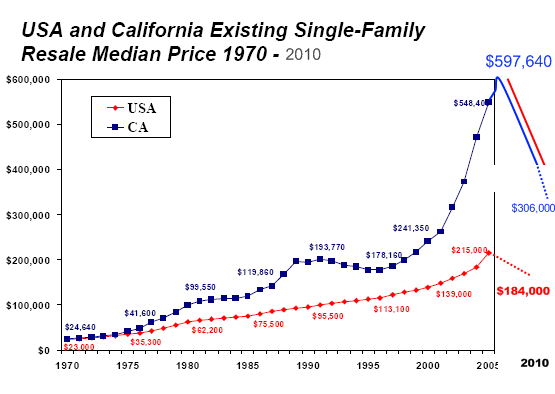
The last 40 years have seen the U.S. housing market transform into a market largely driven by incredible amounts of debt. The credit card companies understood the basic notion that the monthly payment drove most financial decisions. Even though people purchase a home with a 30 year mortgage, the implicit understanding was that in a few years the home would be sold again and yet another new mortgage would be taken out. Housing became like the national debt in that most realized we would never get around to paying it off. We would simply roll over the debt over and over apparently in an endless process. Yet this can only go on as long as average Americans have an increase in their standard of living and wages. The opposite has occurred. For that reason, housing is expensive in today’s market. The median sales price of an existing home is $184,000:
As the media reports that prices are going up, the underlying message is that somehow things are getting better. Yet the reasons for prices going up are largely due to government intervention into the market. The two main driving forces that have pushed prices up in the last few months are:
(-1) The new home buyer tax credit
(-2) Federal Reserve purchasing mortgage backed securities to force interest rates lower
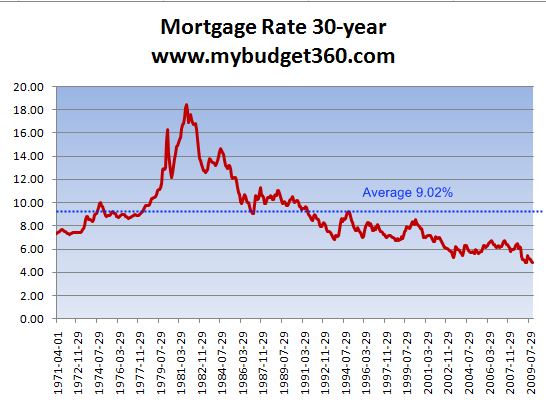
The outcome of this has pushed the existing sales price of homes up but Americans are not seeing improvements in their income. You can see that 30 year mortgage rates are at historical lows:
Let us go back to the first chart. Back in 1970 the median home price in the U.S. was $23,000. This means very little without context. Back in 1969 the median household income was $9,302. So it took 2.4 times the annual household income to purchase a home:
Median household income
1969: $9,302
2008: $57,000
Median home price
1970: $23,000
2010: $184,000
The ratio today is up to 3.2 so it is still more expensive to buy a home today than it was back in 1970 relative to income and home values. You also need to remember we have many more two income households today so we have more people working unable to purchase the same standard of living from four decades ago. This is an important distinction. We can even measure home values in terms of gold:
1970 gold price: $35
1970 median home price: $23,000
Ounces of gold needed to buy a home: 657 ounces
2010 gold price: $1,181
2010 median home price: $184,000
Ounces of gold needed to buy a home: 155 ounces
Regardless of your view on gold, it has gotten much more valuable in terms of home values over this time. You would need 4 times the amount of gold back in 1970 to purchase the median priced home. Today, 155 ounces is enough to purchase the typical home. What has occurred over this time is the slow decline of the U.S. dollar. Average Americans haven’t paid much attention to this because access to debt has hidden the real erosion of purchasing power. It is also the case that cheaper imported goods have hidden the weakness of the currency. But those things are now coming to fruition and we are starting to realize how much the U.S. dollar has fallen.
If U.S. home values were increasing due to a healthy job market with steady income growth then we can say price increases were justified. Yet the gain is currently artificial. We need only look at the jump in homeownership rates brought on by exotic mortgage financing:
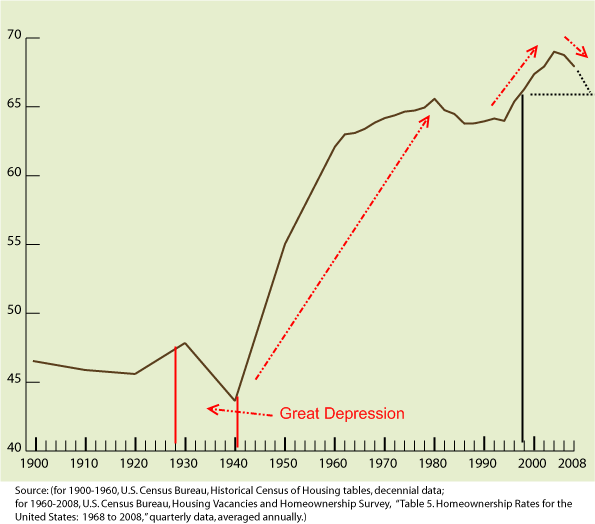
The homeownership rate is now back to levels not seen since the 1990s. Simply providing debt to someone without the means to sustain a long term payment is irresponsible. Yet the deeper problem stemmed from banks believing that home values would keep going up and up. In fact, some of the bigger banks saw this coming in 2005 and 2006 and started positioning their portfolio to take advantage of the coming collapse. There was no accident here but a deliberate funneling of debt to American consumers with housing as the main Trojan horse. Now that we know what has kept things propped up, do we want to continue down this road? Having a high homeownership rate shouldn’t be a mandated policy. If we have higher homeownership rates in this country based on healthy economics then that is fine. But simply putting people into homes for the sake of doing it is bad policy. It is also the case that many of the bailouts were ushered in under the guise of helping “homeowners” but it was really a way to fix the bad bets of banks.
The chart above shows that there were times in our past when homeownership was actually in the minority camp. The massive increase in the late 1940s and 1950s was for the right reasons. It came because of big increases in household formation and a booming economy. The push in the 1990s and 2000s was largely due to bubbles.
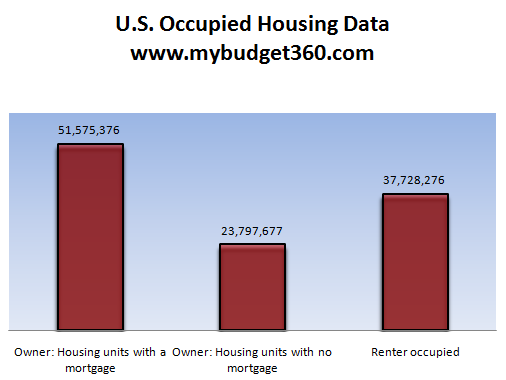
You wouldn’t know it from reading the mainstream press but a large part of our country actually rents:
Source: Census
37 million households in the U.S. rent. This works out to 1 out of 3 households. Yet government policy through tax incentives punishes those for renting. So it was no surprise that easy lending from banks and stated government policy created the perfect storm for the largest housing bubble the world has ever witnessed. Those that think the correction is over are wrong. Let us look at new home sales data:
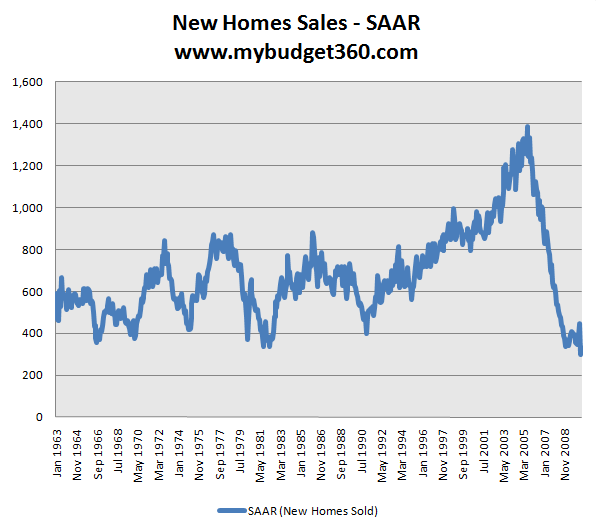
People aren’t buying new homes in large numbers because they don’t have the money to do so. When you have 40 million Americans on food assistance, purchasing a new home doesn’t exactly show up on the radar. For those with work, you have 4 out of 10 Americans workers employed in the lower paying service sector. Who will buy the more expensive newer homes? That is why most of the recent action has come in the existing home market. What constitutes an existing home sale? This would be a foreclosure resale or a pre-owned home being resold. In fact, in June only 30,000 new homes were sold in the entire country while 564,000 existing homes were sold. The gap is always big but this is near historical levels.
40 years of housing was built on more and more debt. Households even today are required to go massively into debt to purchase a home. The metrics are still off. It is still too expensive to buy given the current economic conditions of our market. Money is only as valuable as what you can buy with it. Would you rather have those 657 ounces of gold from 1970 or the median home from back then? That median priced home is now worth $184,000 while the 657 ounces of gold would be worth $775,917. The purchasing power of the dollar has gotten weaker but some fail to see it because of the large amounts of debt that mask the longer term problems. The housing market is in for a harrowing few years. Proceed with caution.
New taxes and new definition of your income under Obamacare
Here’s how your income will “increase” and so will your taxes, under the new Patient Protection and Affordable Care Act, or health care reform/Obamanationcare.
(Also, you should know that the DOJ is defending against the the 20 states’ suit against the above Act, saying it is a TAX, and Congress has the unlimited right to tax you for any reason.)
Should you want to verify this, go to <http://www.thomas.gov/>http://www.thomas.gov/, enter “HR 3590.” Or you can also search the Patient Protection and Affordable Care bill for Title IX Revenue Provisions-Subtitle A: Revenue Offset “(Sec. 9002) that requires employers to include in the W-2 form of each employee the aggregate cost of applicable employer-sponsored group health coverage that is excludable from the employee’s gross income (excluding the value of contributions to flexible spending arrangements).”
Starting in 2011, next year-the W-2 tax form sent by your employer will be increased to show the value of whatever health insurance you are provided. It doesn’t matter if you’re retired. Your gross income WILL go up by the amount of insurance your employer paid for. So you’ll be required to pay taxes on a larger sum of money that you actually received. Take the tax form you just finished for 2009 and see what $15,000.00 or $20,000.00 additional gross income does to your tax debt. That’s what you’ll pay next year. For many it puts you into a much higher bracket. This is how the government is going to buy insurance for 30,000,000 (including illegal aliens) who don’t have insurance and it’s only part of the tax increases. Also, you can go to Kiplinger’s and read about the thirteen (13) tax changes for 2010 that could affect you.
This change is a redefinition of your taxable income.
Maybe you remember that Mr. Obama as a candidate swore not to raise taxes on anyone making less than $250,000 a year, and iironically, one of the main reasons Obama was elected over McCain was that Democrats pointed out that McCain would tax medical insurance if elected.
Remember the words of Nancy Pelosi: ”We have to hurry and pass this HealthCare Bill ’so we will know what is in it.” NOW YOU KNOW.
The Hariri Tribunal Conspiracy

Saudi King Abdulaziz meets Pres. al -Assad of Syria
Saudi King Abdullah’s landmark visit to Syria on Thursday, his second since assuming the throne in 2005, mirrors Arab diplomacy at its finest hour.
The king is worried – just like his Syrian host President Bashar al-Assad – about two critical files in the Arab world: Iraq and Lebanon.
In Iraq, political rivalries have prevented creation of a cabinet for five months, signaling a political vacuum and security disaster in the weeks to come that would be very troubling for Syria and Saudi Arabia, two of Iraq’s main neighbors.
The situation in Lebanon is even more dangerous and if allowed to explode could shake the Middle East beyond repair. Earlier this summer, the deputy Israeli chief of staff, Gaby Ashkenazi said that an earthquake was in store for Lebanon later this year, when the Special Tribunal for Lebanon (STL) names Hezbollah figures in connection with the 2005 murder of former Lebanese prime minister Rafik Hariri.
Hezbollah, furious with the accusation, cried foul play, claiming that the entire investigation is flawed because it has relied on false witnesses (who were never arrested or questioned for their motives) and because it never considered Israel as a possible suspect in the Hariri affair.
Last week, Hezbollah chief Hassan Nasrallah came out accusing the tribunal of being “an Israeli project” that aimed at targeting the Lebanese resistance. What Israel failed to achieve through war in 2006, he added, it will try to attain through the STL.
The international community, with strong Israeli encouragement, tried to break Hezbollah through United Nations Security Council resolution 1559, in 2004. That clearly did not work and nor did the war of 2006, which promised – and failed – to annihilate Hezbollah.
Today, four years down the road, Hezbollah is stronger than ever and, even by testimony of Israeli military strategists, seems have been left almost unscratched by the war of 2006. The war rumored to take place this summer is no guaranteed success for the Israeli Defense Forces (IDF) and it cannot shoulder another defeat at the hands of the Lebanese guerrillas.
It seems only logical that Israel would try to nail the Lebanese group through the Hariri affair, hoping that this would shatter the current alliance between Hezbollah and Prime Minister Saad Hariri, the second son of Rafik, along with creating havoc between Lebanese Sunnis and Shi’ites.
The handwriting has been on the wall for nearly four years now, first surfacing in a French publication in 2006 then vibrating throughout upper echelons of power in Beirut. However, it has never been so bluntly debated in public and the media.
After an article in Le Figaro blamed Hezbollah for the Hariri murder, another report in a Kuwaiti daily was published in March 2009, followed by a very controversial report in Der Spiegel in May 2009. Der Spiegel, while refraining from naming a single source, said that a “special force” from Hezbollah had “planned and executed the diabolical attack” under orders from a certain Hajj Samil (no last name), who it described as Hezbollah’s second-in-command and head of a special operational unit.
Le Monde repeated the accusation in February 2010, followed by Ashkenazi last June. Hezbollah says that it can never take the tribunal seriously so long if Ashkenazi knew of its verdicts beforehand. This would only confirm what Nasrallah has been saying all along: that the international investigation is a vehicle aimed at tarnishing Hezbollah’s image and trying to finish what was started in 2004 and 2006 by resolution 1559 and the 33-day war respectively.
It seems a steady case is being prepared against Hezbollah by its opponents, both at home and in the international community. It started in November 2009 when a German ship was apprehended by the Israelis, who claimed that it was carrying Iranian arms to Hezbollah.
Then came the April 2010 affair when Israel said that Hezbollah had received long-range Scud missiles from Syria. Now comes the STL which will say that Hezbollah officials were responsible for Hariri’s murder.
Hezbollah claims that ultimately Israel is trying to create a situation where Lebanon erupts into chaos and becomes hostile territory for the group. If it is accused of killing Hariri, the premier would be forced to distance himself from Hezbollah, who are crucial pillars of his coalition cabinet. Perhaps – if Israel gets its way – he would need to revoke a cabinet pledge to “protect and embrace” the arms of Hezbollah.
Ultimately, many in Hezbollah fear that someone will resume political assassinations in Lebanon so as to blame them and set the stage for a thundering declaration of their guilt in the Hariri assassination.
If the predictions turn out to be correct, and such an indictment is released later in 2010, several options would be on the table. One is for the UN to place Lebanon under Chapter Seven, which gives the Security Council the right to take military action to maintain security. The UN could claim that the 23 Hezbollah figures earmarked for accusation are a threat to international peace.
If this happens, Hezbollah will certainly refuse the verdicts and so will the Lebanese state, perhaps prompting the international community to wage war on Lebanon. Another option would be for the Lebanese government to try talking Nasrallah into a trade-off; meaning the figures named would be accused of acting at their own will and not as members of Hezbollah.
Nasrallah has repeatedly said that such trade-off is absolutely not on the table, refusing to even discuss the option that his party had been infiltrated by undisciplined warriors. A third option – and this is where Syrian and Saudi Arabian diplomacy can come into play – would be for Saad Hariri to come to his senses and repeat what Nasrallah has said – that the STL is an Israeli project that needs to be drowned at any cost.
In his capacity as both son of the slain prime minister and the current premier of Lebanon, Hariri could deprive the STL from any legitimacy.
Both Syria and Saudi Arabia refuse to see Lebanon slip into chaos. The Saudis have too much at stake in Lebanon, politically, emotionally, financially and morally, to see their ally crash so abruptly. Saad simply cannot hold on to his post without full Hezbollah support and in order to maintain it, he needs to take sides against the STL and put his full weight behind Hezbollah.
If this means turning his back on the STL and anti-Hezbollah allies like the Lebanese Forces council president, Samir Geagea, then this is a price the premier would be – should be – willing to pay to keep Lebanon safe and united. The Syrians made it clear to Saad during his last visit to Damascus that Hezbollah is a red line that cannot be crossed.
They will never tolerate any international meddling with the arms, reputation, or future of Hezbollah. According to media reports, the Saudi king and Syrian president will head to Beirut on Friday to hammer out a solution to the boiling crisis in Lebanese politics. Only these two Arab heavyweights can talk Saad Hariri into a u-turn on the STL.
By Sami Moubayed
The Real Aim of Israel’s Bomb Iran Campaign
Reuel Marc Gerecht's screed justifying an Israeli bombing attack on Iran coincides with the opening of the new Israel lobby campaign marked by the introduction of House Resolution 1553 expressing full support for such an Israeli attack.
What is important to understand about this campaign is that the aim of Gerecht and of the right-wing government of Benjamin Netanyahu is to support an attack by Israel so that the United States can be drawn into direct, full-scale war with Iran.
That has long been the Israeli strategy for Iran, because Israel cannot fight a war with Iran without full U.S. involvement. Israel needs to know that the United States will finish the war that Israel wants to start.
Gerecht openly expresses the hope that any Iranian response to the Israeli attack would trigger full-scale U.S. war against Iran. "If Khamenei has a death-wish, he'll let the Revolutionary Guards mine the strait, the entrance to the Persian Gulf," writes Gerecht. "It might be the only thing that would push President Obama to strike Iran militarily...." Gerecht suggest that the same logic would apply to any Iranian "terrorism against the United States after an Israeli strike," by which we really means any attack on a U.S. target in the Middle East. Gerecht writes that Obama might be "obliged" to threaten major retaliation "immediately after an Israeli surprise attack."
That's the key sentence in this very long Gerecht argument. Obama is not going to be "obliged" to join Israeli aggression against Iran unless he feels that domestic political pressures to do so are too strong to resist. That's why the Israelis are determined to line up a strong majority in Congress and public opinion for war to foreclose Obama's options.
In the absence of confidence that Obama would be ready to come into the war fully behind Israel, there cannot be an Israeli strike.
Gerecht's argument for war relies on a fanciful nightmare scenario of Iran doling out nuclear weapons to Islamic extremists all over the Middle East. But the real concern of the Israelis and their lobbyists, as Gerecht's past writing has explicitly stated, is to destroy Iran's Islamic regime in a paroxysm of U.S. military violence.
Gerecht first revealed this Israeli-neocon fantasy as early as 2000, before the Iranian nuclear program was even taken seriously, in an essay written for a book published by the Project for a New American Century. Gerecht argued that, if Iran could be caught in a "terrorist act," the U.S. Navy should "retaliate with fury". The purpose of such a military response, he wrote, should be to "strike with truly devastating effect against the ruling mullahs and the repressive institutions that maintain them."
And lest anyone fail to understand what he meant by that, Gerecht was more explicit: "That is, no cruise missiles at midnight to minimize the body count. The clerics will almost certainly strike back unless Washington uses overwhelming, paralyzing force."
In 2006-07, the Israeli war party had reason to believed that it could hijack U.S. policy long enough to get the war it wanted, because it had placed one of its most militant agents, David Wurmser, in a strategic position to influence that policy.
We now know that Wurmser, formerly a close adviser to Benjamin Netanyahu and during that period Vice President Dick Cheney's main adviser on the Middle East, urged a policy of overwhelming U.S. military force against Iran. After leaving the administration in 2007, Wurmser revealed that he had advocated a U.S. war on Iran, not to set back the nuclear program but to achieve regime change.
"Only if what we do is placed in the framework of a fundamental assault on the survival of the regime will it have a pick-up among ordinary Iranians," Wurmser told The Telegraph. The U.S. attack was not to be limited to nuclear targets but was to be quite thorough and massively destructive. "If we start shooting, we must be prepared to fire the last shot. Don't shoot a bear if you're not going to kill it."
Of course, that kind of war could not be launched out of the blue. It would have required a casus belli to justify a limited initial attack that would then allow a rapid escalation of U.S. military force. In 2007, Cheney acted on Wurmser's advice and tried to get Bush to provoke a war with Iran over Iraq, but it was foiled by the Pentagon.
As Wurmser was beginning to whisper that advice in Cheney's ear in 2006, Gerecht was making the same argument in The Weekly Standard:
The idea of waging a U.S. war of destruction against Iran is obvious lunacy, which is why U.S. military leaders have strongly resisted it both during the Bush and Obama administrations. But Gerecht makes it clear that Israel believes it can use its control of Congress to pound Obama into submission. Democrats in Congress, he boasts, "are mentally in a different galaxy than they were under President Bush." Even though Israel has increasingly been regarded around the world as a rogue state after its Gaza atrocities and the commando killings of unarmed civilians on board the Mavi Marmara, its grip on the U.S. Congress appears as strong as ever.Bombing the nuclear facilities once would mean we were declaring war on the clerical regime. We shouldn't have any illusions about that. We could not stand idly by and watch the mullahs build other sites. If the ruling mullahs were to go forward with rebuilding what they'd lost--and it would be surprising to discover the clerical regime knuckling after an initial bombing run--we'd have to strike until they stopped. And if we had any doubt about where their new facilities were (and it's a good bet the clerical regime would try to bury new sites deep under heavily populated areas), and we were reasonably suspicious they were building again, we'd have to consider, at a minimum, using special-operations forces to penetrate suspected sites.
Moreover, polling data for 2010 show that a majority of Americans have already been manipulated into supporting war against Iran - in large part because more than two-thirds of those polled have gotten the impression that Iran already has nuclear weapons. The Israelis are apparently hoping to exploit that advantage. "If the Israelis bomb now, American public opinion will probably be with them," writes Gerecht. "Perhaps decisively so." Netanyahu must be feeling good about the prospects for pressuring Barack Obama to join an Israeli war of aggression against Iran. It was Netanyahu, after all, who declared in 2001, "I know what America is. America is a thing you can move very easily, move it in the right direction. They won't get in the way."