Sunday, July 11, 2010

Amnesty Will Cost U.S. Taxpayers at Least $2.6 Trillion

The Senate is currently considering a massive immigration reform bill, the "Secure Borders, Economic Opportunity and immigration Reform Act of 2007" (S. 1348). This bill would grant amnesty to nearly all illegal immigrants currently in the United States.

The fiscal consequences of this amnesty will vary depending on the time period analyzed. It is expected that many illegal immigrants who are currently working "off the books" and paying no direct taxes will begin to work "on the books" after receiving amnesty, and therefore tax payments will rise immediately. By contrast, under S. 1348, benefits to these immigrants from Social Security, Medicare, and most means-tested welfare programs (such as Food Stamps, public housing, and Temporary Assistance to Needy Families) will be delayed for many years. In consequence, then, the increase in taxes and fines paid by amnesty recipients may initially exceed slightly the increase in government benefits received. In the long run, however, the opposite will be true. In particular, the cost of retirement benefits for amnesty recipients is likely to be very large. Overall, the net cost to taxpayers of retirement benefits for amnesty recipients is likely to be at least $2.6 trillion.

Who Are the Illegal Immigrants?

According to the most widely accepted estimates, there were 11.5 million to 12 million illegal immigrants in the United States in the spring of 2006.[1] Because the number of illegal immigrants has, on average, increased by roughly 500,000 each year, the number of illegal immigrants in the U.S. in 2007 is probably around 12 million to 12.5 million; however, these estimates are uncertain, and the actual number of illegal immigrants may be higher.

As Chart 1 shows, some 49 percent of illegal immigrants are adult males, 35 percent are adult females, and 16 percent are foreign-born children. Living in illegal immigrant families are another 3.1 million U.S.-born children of illegal immigrant parents.[2] Because they were born inside the U.S., these children are considered citizens, not illegal immigrants.

Illegal immigrants now make up about 4 percent of the U.S. population, meaning that about one in twenty-five persons currently in the U.S. is here unlawfully. Illegal immigrants make up nearly one-third of the foreign-born population in the U.S.

As Chart 2 shows, more than half (56 percent) of illegal immigrants come from Mexico. Another 22 percent come from other Latin American countries, and 22 percent come from Asia, Europe, and Africa.[3]

education of Illegal Immigrants.Illegal immigrants generally have very low education levels. As Chart 3 shows, 61 percent of illegal immigrant adults lack a high school diploma, 25 percent have only a high school diploma, 5 percent have attended some college, and 9 percent are college graduates, according to the Center for immigration Studies' estimates.[4] The Pew Hispanic Center estimates slightly higher education levels: 49 percent without a high school diploma, 25 percent with a high school diploma only, 10 percent with some college, and 15 percent with college degrees.[5] Overall, 49 to 61 percent of adult illegal immigrants lack a high school diploma, compared to 9 percent of native-born adults.

Illegal Immigrants and poverty. Because of their low education levels, illegal immigrants have a poverty rate that is roughly twice that of native-born Americans. As Chart 4 shows, the poverty rate of children in illegal immigrant families is 37 percent, compared to 17 percent among children in non-immigrant families. The poverty rate among adult illegal immigrants is 27 percent, compared to 13 percent among non-immigrant adults.

S. 1348 and the amnesty Process

The Senate's immigration reform bill would offer amnesty and a path to citizenship to the 12 million to 12.5 million illegal immigrants currently in the U.S. In addition, its lax evidentiary standards would encourage millions more to apply for amnesty fraudulently. Because there is no numeric limit on the number of amnesties that could be granted under the bill, the actual number who would receive amnesty under the bill could be far higher.

In general, under S. 1348, any person who was illegally present inside U.S. borders on January 1, 2007, is eligible for Z visa status, amnesty, and ultimately citizenship. Excluded from this rule are illegal immigrants subject to a formal deportation order issued prior to enactment of the legislation and illegal immigrants convicted of a felony or three misdemeanors prior to enactment. The amnesty process consists of four stages leading to citizenship.

Stage One: Probationary Z Visas. Within 180 days of enactment of the bill, the Secretary of Homeland Security would begin accepting applications for Z visa status from illegal immigrants. The Secretary can accept applications for up to two years. The Secretary must grant "probationary Z visa" status to all amnesty applicants who pass a background check that must be completed within one business day. Except for those failing the one-day background check, applicants will automatically be granted probationary status and issued appropriate documents on the day after their application, even if the background check has not been completed.[6]

Stage Two: Permanent Z Visas. The Secretary must issue a permanent Z visa to every applicant who is determined to have met four conditions: the individual was inside the U.S. unlawfully on January 1, 2007; has not left the U.S. for more than six months since then; is employed or is the spouse or child of an employed applicant; and has passed more thorough criminal background checks that may be required. Each Z visa is good for four years and can be renewed indefinitely for the rest of the Z visa holder's life.[7] The Secretary cannot grant permanent Z visas unless the modest enforcement trigger provisions of S. 1348 have been met.[8]

Stage Three: legal Permanent Residence (LPR).All Z visa holders who pay a $4,000 fine and pass an English test would become eligible for legal permanent residence (also known as green card status). Z visa holders must go abroad to apply for LPR status but may return to the U.S. the same day. No later than 8 years after enactment, the Secretary of Homeland Security must determine the number of Z visa holders who are eligible for legal permanent residence and grant LPR status to all such persons over the following five years at a rate of 20 percent per year.[9]

During this process, Z visa holders would be granted their own special "supplemental allocation" of green cards and would not be required to compete with other visa seekers.[10] In the 13th year after enactment, the Secretary must provide an additional allotment of green cards to Z visa holders who are qualified for Z visa status.

Stage Four: Expanded Eligibility for Government Benefits. During the initial years an immigrant is in LPR status, access to government welfare programs may be limited; however, after five years in LPR status, individuals become eligible for nearly all welfare programs. legal permanent residents may also apply for U.S. citizenship at this point.

Eligibility for Government Benefits

The following outlines eligibility for government benefits at each stage of the amnesty process. In each case in the following text, eligibility for a benefit means that the former illegal immigrant or his family member obtains the same eligibility for that program as a U.S. citizen would have; that is, he will receive the benefits if income limits and other normal eligibility standards applying to U.S. citizens are met.

Probationary and Permanent Z Visa Status. All children born within U.S. borders to illegal immigrants, Z visa holders, or legal permanent residents are automatically U.S. citizens. As such, these children are potentially eligible for all U.S. welfare benefits from the moment of birth through the rest of their lives. All children of Z visa holders (both foreign- and native-born) have the right to attend U.S. public schools and to receive Head Start and daycare assistance.[11] In addition, adult Z visa holders and their foreign-born children will be eligible for medical care under the Medicaid Disproportionate Share Program.

All individuals placed in probationary Z visa status will be given lawful Social Security numbers,[12] which makes the Z visa holder immediately eligible for two refundable tax credits: the Earned Income Tax Credit (EITC) and the Additional Child Tax Credit (ACTC). These credits provide cash welfare assistance to low-income parents. Upon receipt of a lawful Social Security number, Z visa holders will also be granted the right to earn entitlement to future Social Security and Medicare benefits. After 10 years of employment, they will become fully eligible for Social Security and Medicare benefits, although in most cases the benefits will not commence until the individual reaches age 67.

legal Permanent Residence. Upon obtaining LPR status, the non-citizen children of former Z visa holders will become eligible for Food Stamp benefits.[13] All legal permanent residents who have a 10-year work history in the U.S. are automatically eligible for Food Stamps, Medicaid, Supplemental Security Income, Temporary Assistance for Needy Families (TANF), and other welfare programs.[14] Many legal residents without a work history are eligible for Medicaid in 22 states, including California and New York.[15] Irrespective of employment history, amnesty recipients will become eligible for 60 different federal welfare programs five years after receiving legal permanent residence.

Citizenship. After obtaining citizenship, individuals become eligible for Supplemental Security Income, a means-tested cash aid program for disabled and elderly persons.

To summarize this process, all Z visa holders will be eligible for medical care benefits under the Medicaid Disproportionate Share Program. Foreign-born children of Z visa holders will be eligible to attend public schools and receive Head Start and daycare assistance. Children born inside the U.S. to illegal immigrant parents and Z visa holders will be eligible for public schooling and all means-tested welfare programs. Many state and local governments may also provide benefits and services to Z visa holders.

Upon obtaining a probationary Z visa, amnesty applicants will receive a lawful Social Security number, which makes Z visa holders potentially eligible for the EITC and the ACTC. In addition, they will begin to earn entitlement to Social Security and Medicare benefits. Roughly eight years after enactment, amnesty recipients will begin to enter LPR status and non-citizen children will become eligible for Food Stamps. legal permanent residents with a 10-year work history in the U.S. will be eligible for most federal welfare programs subject to income limits and other admission criteria. No later than five years after receiving LPR status, amnesty recipients will be eligible for nearly all means-tested welfare programs.

The initial limitation on receipt of means-tested welfare will have only a small effect on governmental costs. welfare is only part of the benefits received by immigrant families. Moreover, the average adult amnesty recipient can be expected to live more than 50 years after receiving his Z visa. While recipients' eligibility for means-tested welfare will be constrained for the first 10 to 15 years, they will be fully eligible for welfare during the last 30 to 40 years of their lives. Use of welfare during these years is likely to be heavy.[16]

In addition, if S. 1348 is enacted, many state and local governments are likely to begin giving benefits and services to Z visa holders that are greater than those currently provided to illegal immigrants. State governors of both parties will pressure Congress to relax the eligibility restrictions barring Z visa holders from receiving most federal means-tested benefits as a way of relieving fiscal pressure on state and local governments. In the present political climate, these efforts are likely to prove successful.

The Net Retirement Costs of amnesty

Giving amnesty to illegal immigrants will greatly increase long-term costs to the taxpayer. Granting amnesty to illegal immigrants would, over time, increase their use of means-tested welfare, Social Security, and Medicare. Fiscal costs would rise in the intermediate term and increase dramatically when amnesty recipients reach retirement. Although it is difficult to provide a precise estimate, it seems likely that if 10 million adult illegal immigrants currently in the U.S. were granted amnesty, the net retirement cost to government (benefits minus taxes) could be over $2.6 trillion.

The calculation of this figure is as follows. As noted above, in 2007 there were, by the most commonly used estimates, roughly 10 million adult illegal immigrants in the U.S. Most illegal immigrants are low-skilled. On average, each elderly low-skill immigrant imposes a net cost (benefits minus taxes) on the taxpayers of about $17,000 per year. The major elements of this cost are Social Security, Medicare, and Medicaid benefits. (The figure includes federal state and local government costs.) If the government gave amnesty to 10 million adult illegal immigrants, most of them would eventually become eligible for Social Security and Medicare benefits or Supplemental Security Income and Medicaid benefits.

However, not all of the 10 million adults given amnesty would survive until retirement at age 67. Normal mortality rates would reduce the population by roughly 15 percent before age 67. That would mean 8.5 million individuals would reach age 67 and enter retirement.

Of those reaching 67, their average remaining life expectancy would be around 18 years.[17] The net cost to taxpayers of these elderly individuals would be around $17,000 per year.[18] Over 18 years, the cost would equal $306,000 per elderly amnesty recipient. A cost of $306,000 per amnesty recipient multiplied by 8.5 million amnesty recipients results in a total net cost of $2.6 trillion.

These costs would not occur immediately. The average adult illegal immigrant is now in his early thirties; thus, it will be 25 to 30 years before the bulk of amnesty recipients reaches retirement. At their peak level, it appears the amnesty recipients will expand the number of beneficiaries under Social Security by 5 to 10 percent. This will occur at a point when Social Security will already be running deficits of over $200 billion annually.

This is a rough estimate. More research should be performed, but policymakers should examine these potential costs very carefully before rushing to grant amnesty, "Z visas," or "earned citizenship" to the current illegal immigrant population.

Factors That Could Increase Future Costs

The $2.6 trillion figure is a rough estimate of future costs that would result from putting 10 million adult illegal immigrants on a guaranteed pathway to citizenship. There are a number of factors that could raise or lower these future costs. Among the factors that could increase the net cost (benefits received minus taxes paid) well above $2.6 trillion are the following:

  1. The actual number of illegal immigrants may be greater than 12 million. The estimated cost of $2.6 trillion in future retirement costs outlined above assumes that the number of illegal immigrants in the U.S. in 2007 was around 12 million, based on data from the Pew Hispanic Center. While the Pew Hispanic Center is the most widely used source for demographic information about illegal immigrants, its data assume that some 90 percent of illegal immigrants appear in the Census Bureau's Current Population Survey (CPS).[19] It is possible that many illegal immigrants do not appear in the CPS and that the total number of illegal immigrants is substantially higher than 12 million. Some estimates place the number of illegal immigrants as high as 20 million. Clearly, if the illegal immigrant population is greater than 12 million, then the net retirement costs resulting from amnesty would be, ceteris paribus, higher as well.
  1. There is a huge potential for amnesty fraud. In order to receive amnesty and a Z visa and be put on a pathway to citizenship, an illegal immigrant must demonstrate that he or she was in the U.S. illegally and employed on January 1, 2007. However, the standard to demonstrate residence is very loose. The illegal immigrant need merely produce two affidavits from non-relatives asserting that he or she was working in the U.S. on the appropriate date. The affidavits could even come from other illegal immigrants. It is doubtful that the Department of Homeland Security has any real capacity to separate true affidavits from bogus ones, especially in the crush of processing millions of applications in the space of a year or two. Consequently, the potential for amnesty based on fraudulent documents is very high. In the 1986 amnesty, an estimated 25 percent of the amnesties granted were fraudulent.[20] In the last 20 years, the underground industry producing fraudulent documents has grown vastly larger and more sophisticated. In this round of amnesty, the fraud rate could be as high as or higher than in 1986, resulting in millions of additional amnesties.
  1. Spouses and children living abroad may be added to the amnesty population. In its present form, the bill grants amnesty to employed illegal immigrants who were in the U.S. on January 1, 2007. Any spouses, children, and parents of employed illegal immigrants who were residing in the U.S. on that date will also receive Z visas and amnesty. However, many illegal immigrants have spouses and children living abroad; under S. 1348, while illegal immigrants and their families inside the U.S. are put on a path to citizenship, families living abroad are not. family members living abroad would be denied Z visas and would not be permitted to reside in the U.S. for the foreseeable future. Presumably, the Z visa holder could have his family join him when he achieves legal permanent residence, but this would not occur until eight years after he is initially given the Z visa.

    The designers of the bill appear to have excluded spouses and children living abroad from eligibility for Z visas in order to lower the apparent number of amnesty recipients, but pressure will build to eliminate this exclusion. At some point, either before or after the bill's passage, a "technical correction" will almost certainly be introduced allowing spouses and children living abroad to obtain Z visas and get on the pathway to citizenship. For every 10 illegal immigrants living in the U.S., there may be four dependents living abroad; if the current illegal population is 12 million, the number of additional dependents who could be brought permanently into the country should the exclusion be eliminated may be as high as five million.[21] The overall number of amnesty recipients and dependents could easily reach 17 million.
  1. Medicaid and Medicare costs are likely to rise faster than the rate of general inflation. To project the future governmental costs of amnesty recipients during retirement, this paper has used the current net governmental costs for elderly immigrants with skill levels similar to the amnesty population. These net governmental costs amount to $17,000 per person per year in 2004; half of this cost was medical care expenditures under the Medicare and Medicaid programs. The cost of government Medicaid and Medicare benefits has tended to escalate rapidly both because medical cost inflation has been greater than the general rate of inflation in the economy and because the range of medical services provided by these programs has expanded. The cost of Medicare and Medicaid services is likely to continue to increase more rapidly than inflation for the foreseeable future. As a consequence, the actual retirement costs for amnesty recipients will almost certainly be greater than $2.6 trillion, even after adjusting for general inflation.

Factors That Could Reduce Future Costs

By contrast, three factors could reduce the future costs estimated in this paper:

  1. Not all illegal immigrants will get amnesty. The cost estimate in this paper assumes that all illegal immigrants residing in the U.S. will receive amnesty. In reality, not every illegal immigrant who was present in the U.S. on January 1, 2007, will actually receive amnesty. Some will not apply for a Z visa. Some will be found ineligible due to lack of proof of residence, despite the lax evidentiary standards. Some illegal immigrants will fail the criminal background checks and be rejected.
  1. Some amnesty recipients will return to their native countries. Granting amnesty and creating a pathway to citizenship creates powerful financial incentives for illegal immigrants to remain in the U.S. permanently. Nonetheless, some Z visa holders and legal permanent residents will return to their native countries before reaching old age. Even in this case, some amnesty recipients will have earned eligibility for Social Security benefits and thereby will impose governmental costs even after leaving the nation. To the extent that amnesty recipients leave the U.S. at some point in the future rather than living out their full lives in the U.S., future governmental costs will be reduced. This, however, simply underscores the fact that illegal immigrants, on average, are a fiscal burden. The longer they remain in the U.S., the greater the burden.
  1. The net taxes paid by second-generation immigrants may offset some costs. The average amnesty recipient will reach retirement age in 30 to 35 years. By that time, many of the children of amnesty recipients will have reached adulthood and will be receiving benefits in their own right and paying taxes. This second generation will have better education and higher incomes than their parents. In consequence, their government benefits will be lower and their tax payments will be higher than those of their parents. It is possible that, on average, these second-generation immigrants will be net fiscal contributors; the taxes they pay could exceed the benefits they receive. If this is the case, their net tax payments may offset some the government retirement costs of their parents; however, in calculating the fiscal contributions of second-generation families, it is essential to count more than Social Security taxes paid. A family that pays $3,000 in Social Security taxes while receiving $30,000 in a variety of government benefits does not contribute to governmental solvency. At present, it is uncertain to what extent, if any, the children of potential amnesty recipients will be net fiscal contributors (paying taxes exceeding total benefits). Further, even if they are net contributors, these second-generation families would have to make very large contributions in order to significantly offset the $17,000 per year net cost of their parents.

One final factor should be considered: Some illegal immigrants may become citizens, and thereby impose costs on taxpayers, even without amnesty. Under current law, a child born inside the U.S. to illegal immigrant parents is deemed a U.S. citizen. Upon reaching age 21, this child can petition for his illegal immigrant parents to be given legal permanent residence. In most cases, the petition is automatically accepted. Upon receiving LPR, the parents could begin to gain eligibility to Social Security and Medicare; within five years, the parents would become eligible for most means-tested welfare programs.

This means that, even without amnesty, some current illegal immigrants could become eligible in their retirement years for the type of benefits described in this study. Consequently, some of the costs estimated in this paper may occur without amnesty. How many illegal immigrant parents would, under current law, be placed on the pathway to citizenship by the petitions of their native-born children is unknown. Certainly the path to entitlement through the amnesty provided in S. 1348 is easier and more attractive. Nonetheless, the fact that some illegal immigrants can obtain access to government benefits under current law does not reduce the fiscal costs estimated in this paper; it simply means that a portion of these costs may occur even if S. 1348 is not enacted.

Congressional Budget Office Estimate of S. 1348

At first glance, the figures presented in this paper appear to differ from the cost estimates of S. 1348 by the Congressional Budget Office (CBO).[22] However, the CBO has estimated only the changes in benefits and revenues that would occur in the first 10 years after enactment of S. 1348. By contrast, the retirement costs analyzed in this paper will not really begin until 25 to 30 years after passage of the legislation. The current paper and the CBO study thus analyze very different impacts from the bill.

Currently, very few illegal immigrants are elderly, and virtually none receive Social Security and Medicare. A major result of S. 1348 would be to make illegal immigrants eligible for Medicare, Medicaid, and Social Security during their retirement years. CBO does not address these retirement costs at all.

The CBO report does conclude that in the first 10 years after enactment of S. 1348, federal taxes and other revenues paid by Z visa holders would increase by $63 billion while federal benefits would increase by $33 billion. This should not be surprising since, as this paper has pointed out, under S. 1348, increases in tax revenues would occur immediately while increases in benefits, for the most part, would not begin for 10 years or more. However, in subsequent decades, benefits received by amnesty recipients would increase significantly. When the amnesty recipients reach retirement age, total benefits received will outstrip taxes paid by roughly seven to one. Thus, while amnesty may reduce government net costs slightly in the short run, in the long run, the fiscal effects will be substantially negative.

There are other limitations to the CBO study. First, it covers only federal benefits and revenues and ignores state and local government costs. Second, it covers only changes in spending and revenue that would result from S. 1348 and ignores the government benefits currently received by illegal immigrant families. Finally, the CBO report does not analyze the total fiscal balance of amnesty recipient families either before or after amnesty. (The total fiscal balance of a family equals total federal state and local benefits received by the family minus total taxes paid.) Similarly, it does not analyze the total fiscal balance of amnesty recipients either before or after retirement.

Policy Discussion: Reducing the Costs of immigration Reform

amnesty is not only very expensive, but it also violates the rule of law and is manifestly unfair. It gives the inestimable gift of U.S. citizenship to millions of individuals whose sole qualification for receiving citizenship is that they broke U.S. laws. Consider that on January 1, 2007, there were hundreds of thousands of foreigners in the U.S. on a variety of temporary visas. Because these individuals were here lawfully, none will be granted citizenship under S. 1348. By contrast those who were in the U.S. illegally on that same day will be given the privilege of citizenship.

Consider two foreigners who were in the U.S. on temporary visas that expired in December 2006. One of these individuals lawfully returned home upon expiration of his visa; the other chose to remain in the U.S. unlawfully. Under S. 1348, which of these individuals will be granted the privileges and benefits of citizenship? The one who broke the laws, while the individual who respected the law will have little chance for citizenship. Is this fair? Of all the people in the world who wish to come to America, why should any American feel compelled to place those who broke the laws on a guaranteed path to citizenship?

It is often argued that it is unfair to expect illegal immigrants who have spent years in the U.S. and have begun to raise families here to uproot their families and return home. But S. 1348 makes no distinction between illegal immigrants who have been in the U.S. for decades and those that have been here only a few days. Everyone who was here illegally on January 1, 2007, is potentially eligible for citizenship.

In order to constrain fiscal costs, immigration reform should include three policies:

  1. Emphasize enforcement. In 1986, the U.S. granted amnesty to some three million illegal immigrants as a quid pro quo for a prohibition on the future hiring of illegal immigrants. The amnesty was granted, but the prohibition on the future hiring of illegal immigrants was never enforced. S. 1348 repeats the same mistake; mass amnesty will be granted, but the border and employment enforcement provisions of the act are hollow and will probably never be enforced. To avoid repeating the mistakes of 1986, enforcement must come first.[23]
  1. Do not grant amnesty. amnesty is unfair and would be very expensive. Proponents of S. 1348 will argue that there is no feasible alternative to giving citizenship to all the illegal immigrants in the U.S. But serious, phased enforcement of a ban on hiring illegal immigrants would cause many, if not most, illegal immigrants to voluntarily leave the U.S. and return to their native countries. To minimize economic disruption, it might be possible to give some current illegal immigrants temporary work visas, with the explicit provision that they must return home over time. Such temporary visas would not grant access to welfare, Social Security, Medicare, or citizenship. If necessary, the exiting illegal workers could be replaced by legitimate temporary workers or by permanent immigrants who have never violated U.S. laws.[24]
  1. Close the "anchor baby" loophole. As explained above, under current law, when U.S.-born children of illegal immigrants turn 21, they can petition the government to grant their illegal immigrant parents legal permanent residence, thereby conferring an automatic path to welfare entitlements and citizenship upon the parents (hence the term "anchor baby"). The popular concept of "birthright citi­zenship"-that anyone born in the United States is automatically a U.S. citizen-is historically and legally inaccurate and ought to be corrected by Congress.[25] Regardless, this backdoor path to citizenship for illegal immigrant parents should be closed.[26]

Conclusion

There are currently at least 12 million illegal immigrants in the U.S. The immigration reform bill currently being debated in the Senate would grant amnesty to these individuals and would likely result in the entry of 4 to 5 million dependents living abroad into the U.S. as permanent residents. Illegal immigrants receiving amnesty will immediately begin earning eligibility for Social Security and Medicare benefits and, after approximately 10 years, gain access to a wide variety of means-tested welfare programs, such as Medicaid, Food Stamps, and public housing.

Because amnesty recipients have very low education levels (75 to 85 percent have only a high school diploma or less), they are likely to receive more in government benefits than they pay in taxes through most of their lives. When they reach retirement age, amnesty recipients will impose a large net cost on taxpayers, receiving each year at least $17,000 more per person in benefits than they pay in taxes. The illegal immigrants granted amnesty under S. 1348 are likely to impose a net cost of at least $2.6 trillion on U.S. taxpayers during their retirement years. Policymakers should carefully consider the potential long-term fiscal costs before enacting the amnesty provisions of this bill.

Proponents of S. 1348 will emphasize that amnesty recipients will pay Social Security taxes during their working years, thereby presumably helping to alleviate the great burden already on the government retirement system. Given their low skill levels, the Social Security tax payments of amnesty recipients will, on average, be modest. More important is the fact that, in future years, Social Security benefits will be funded by both Social Security taxes and general revenue. What matters is not the small amount of Social Security taxes that will be paid but the overall fiscal balance (total federal state and local benefits received minus all taxes paid) of amnesty recipients. If the net benefits taken by amnesty recipients and their families exceed the Social Security and other taxes paid, the amnesty recipients will undermine rather than strengthen the financial support for U.S. retirees, even before they reach retirement age themselves.

Finally, if S. 1348 is enacted, the public should expect to see a broad array of new spending proposals and programs designed to help amnesty recipients move upward economically and socially. Many of these programs are likely to be enacted into law, further increasing fiscal pressures.

Robert Rector is Senior Research Fellow in Domestic Policy Studies at The Heritage Foundation.

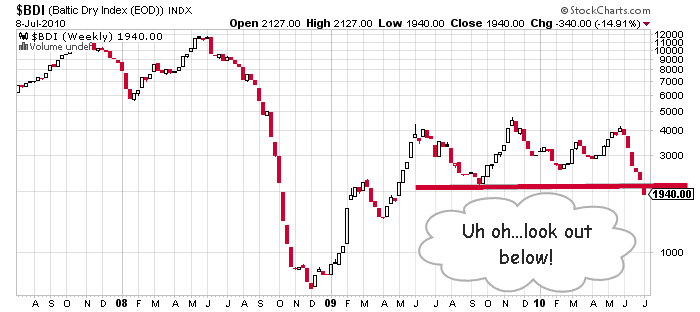
Look Out Below: The Baltic Dry Index Is in Freefall

Remember a few weeks ago, when the Baltic Dry Index was on the ropes?

Well, it's off the ropes - and in complete freefall. Support has NOT held for the BDI, a favorite leading indicator of many investors. And one, might I add, that has performed quite well since the equity markets topped in 2007 (in '09, the BDI turned up 3 months before stocks).

The short term prediction appears to be PAIN, as shipping rates plummet. Apparently not as much to ship as the global economy heads for a wicked "double dip"...

click to enlarge

Baltic Dry Index Chart July 2010

The Baltic Dry Index is in free fall...this is probably not a good sign for the global economy.

(Source: StockCharts.com)

Yet another reason to get OUT of stocks. Or, if you're feeling a bit frisky, you may want to consider shorting the S&P 500 (especially at the top of this mini-rally).

Government Stopping Charities From Feeding The Homeless

The National Coalition for the Homeless has issued a report detailing laws and ordinances in a couple of dozen localities across the nation that prohibit charities – churches, civic organizations, charities, etc. – from feeding the homeless. Or, at least, inhibit their ability to do so with burdensome regulation.

You can read the full report here. Some examples:

– Gainesville, Florida began enforcing a rule limiting the number of meals that soup kitchens may serve to 130 people in one day.

– Phoenix, Arizona used zoning laws to stop a local church from serving breakfast to community members, including many homeless people, outside a local church.

– Myrtle Beach, South Carolina adopted an ordinance that restricts food sharing with homeless people in public parks. …

– In Orlando, Florida the American Civil Liberties Union (ACLU) filed a lawsuit against the City of Orlando on behalf of local organizations, challenging a 2006 law requiring a groups sharing food with 25 or more people to obtain a permit that was only available twice a year per park. A federal district court found the law to be unconstitutional and in violation of Free Exercise of Religion and Freedom of Speech in October of 2008. The city has appealed the decision and the appeal is pending.

– In San Diego, California the zoning department attempted to prohibit a local church from serving a weekly meal to community members, many of them homeless.7 In 2008, attorney Scott Dreher successfully defended the church’s First Amendment right to practice its religion. The weekly meal continues to take place on church property and serves 150 to 200 people each week.

I did some Googling as well to flesh out more examples, and found communities all over the country who are essentially criminalizing or at least prohibiting/inhibiting private charity.

This seems like lunacy to me. There are people who are destitute and hungry. There are other people who are willing to give of their own time, talent and wealth to provide for those people. But the government is limiting their ability to do so, or in some instances stopping them.

Why? The motivation is hard to pin down. One chief motivation, no doubt, wanting homeless people out of parks and public areas. They believe that feeding them in a public place like a park only lures more homeless to that park. And some people just don’t want to see homeless people during their day-to-day lives. It’s the old “not in my back yard” attitude.

There is no doubt some truth to that, but I think there’s another motivation at work here as well.

But I think another motivation may well be that the government hates competition. Rather than allowing private charities like churches, etc. do their own part to feed the homeless I think the government would much rather homeless get help through government-sanctioned, government-funded, government-administered social programs.

Because that gives more power to the government. That justifies bigger budgets for the government. That means more bureaucrats employed by the government. And besides, the government always knows best right?

If we allow citizens to help one another, if we put the emphasis on individual acts of charity and families/friends taking care of their own, then we have a diminished need for government.

And the government isn’t in the business, these days, of promoting independence.

10 Ways We Are Being Tracked, Traced, and Databased


Are technological advances infringing on our right to privacy?


The war on terror is a worldwide endeavor that has spurred massive investment into the global surveillance industry - which now seems to be becoming a war on "liberty and privacy." Given all of the new monitoring technology being implemented, the uproar over warrantless wiretaps now seems moot. High-tech, first-world countries are being tracked, traced, and databased, literally around every corner. Governments, aided by private companies, are gathering a mountain of information on average citizens who so far seem willing to trade liberty for supposed security. Here are just some of the ways the matrix of data is being collected:
  • Internet -- Internet browsers are recording your every move forming detailed cookies on your activities. The NSA has been exposed as having cookies on their site that don't expire until 2035. Major search engines know where you surfed last summer, and online purchases are databased, supposedly for advertising and customer service uses. IP addresses are collected and even made public. Controversial websites can be flagged internally by government sites, as well as re-routing all traffic to block sites the government wants to censor. It has now been fully admitted that social networks provide NO privacy to users while technologies advance for real-time social network monitoring is already being used. The Cybersecurity Act attempts to legalize the collection and exploitation of your personal information. Apple's iPhone also has browsing data recorded and stored. All of this despite the overwhelming opposition to cybersurveillance by citizens.
  • RFID -- Forget your credit cards which are meticulously tracked, or the membership cards for things so insignificant as movie rentals which require your SSN. Everyone has Costco, CVS, grocery-chain cards, and a wallet or purse full of many more. RFID "proximity cards" take tracking to a new level in uses ranging from loyalty cards, student ID, physical access, and computer network access. Latest developments include an RFID powder developed by Hitachi, for which the multitude of uses are endless -- perhaps including tracking hard currency so we can't even keep cash undetected. (Also see microchips below).
  • Computer cameras and microphones -- The fact that laptops -- contributed by taxpayers -- spied on public school children (at home) is outrageous. Years ago Google began officially to use computer "audio fingerprinting" for advertising uses. They have admitted to working with the NSA, the premier surveillance network in the world. Private communications companies already have been exposed routing communications to the NSA. Now, keyword tools -- typed and spoken -- link to the global security matrix.
  • Public sound surveillance -- This technology has come a long way from only being able to detect gunshots in public areas, to now listening in to whispers for dangerous "keywords." This technology has been launched in Europe to "monitor conversations" to detect "verbal aggression" in public places. Sound Intelligence is the manufacturer of technology to analyze speech, and their website touts how it can easily be integrated into other systems.
  • Biometrics -- The most popular biometric authentication scheme employed for the last few years has been Iris Recognition. The main applications are entry control, ATMs and Government programs. Recently, network companies and governments have utilized biometric authentication including fingerprint analysis, iris recognition, voice recognition, or combinations of these for use in National identification cards.
  • Microchips -- Microsoft's HealthVault and VeriMed partnership is to create RFID implantable microchips. Microchips for tracking our precious pets is becoming commonplace and serves to condition us to accept putting them in our children in the future. The FDA has already approved this technology for humans and is marketing it as a medical miracle, again for our safety.
  • Facial recognition -- Anonymity in public is over. Admittedly used at Obama's campaign events, sporting events, and most recently at the G8/G20 protests in Canada. This technology is also harvesting data from Facebook images and surely will be tied into the street "traffic" cameras.
All of this is leading to Predictive Behavior Technology -- It is not enough to have logged and charted where we have been; the surveillance state wants to know where we are going through psychological profiling. It's been marketed for such uses as blocking hackers. Things seem to have advanced to a point where a truly scientific Orwellian world is at hand. It is estimated that computers know to a 93% accuracy where you will be, before you make your first move. Nanotech is slated to play a big role in going even further as scientists are using nanoparticles to directly influence behavior and decision making.

Many of us are asking: What would someone do with all of this information to keep us tracked, traced, and databased? It seems the designers have no regard for the right to privacy and desire to become the Controllers of us all.

2 comments:

pod said...

You could look at the attempts to identify people as something to fear, but there is no need to do so. None of the ID provided by governments identifies the man. The government has created a name which it owns and you volunteer to use this name. So they assume that you are attached to their property. If something is attached to your property you can claim that you own it. So they have already made slaves of everyone because most people do not know that they have pulled this little trick. All lawyers know about it so they won't help you.
As for the various means being used to track people, this is all just a way of making sure that they get every last ounce of sweat from you, their voluntary slave.
But there is hope and I know the Achilles heel to the whole set up.
They have boxed themselves in by using electricity for all that they do. The electrical system is very exposed with wires strung in plain view in many places. It would take someone like myself (an electrician) only a few minutes to figure out how a particular building or a particular area is supplied. Remember that the electricity come from "upstream" unless there is a local generator which needs fuel from "upstream".
All the data flies through telephone lines that are using glass fibre these days, although there are many miles of old lines. There may be some building that use a microwave dish to transfer data, but the microwave needs power to operate.
So do not worry too much about the ultimate plan because there are guys just like me who know how to nip it in the bud.
If you are afraid, do some studying to learn how electricity get to a building and how telephone systems work.
Now that I have said this, the fear has been transferred to those who are doing the tracking. They should be afraid of their whole economic system being routinely crashed.

Liberals' solar subsidy cut sparks fears of losing seats

Premier Dalton McGuinty is taking heat over a drastic cut in the subsidy for farmers who generate solar power, which some Liberals fear could cause an eclipse of the party’s rural seats.

Government insiders warn as many as a dozen Liberal seats could be in play due to what is shaping up as an urban-rural schism—and that could mean the difference between winning and losing the October 2011 election.

At issue is a policy change quietly announced last Friday, in the middle of an extended Canada Day long weekend, when the Ontario Power Authority (OPA) disclosed that a program for small producers of solar electricity had “vastly surpassed expectations” with 16,000 applicants, so the rate being paid would have to be slashed.

Most of the 16,000 applicants to the “microFIT” scheme are farmers hoping to cash in by building ground-mounted solar projects in their fields and selling electricity to the grid for a subsidized price of 80.2 cents per kilowatt hour. That’s 20 times the price paid for nuclear power.

But concerned the subsidy could cost Ontario electricity ratepayers an additional $1 billion over 20 years, the OPA now says only 58.8 cents per kilowatt hour can be paid for such power—while still forking out 80.2 cents for electricity generated from the roof-mounted solar panels more common in urban areas.

One Grit MPP said would-be solar entrepreneurs are calling MPPs at their homes, day and night, to vent their furor at what they see as a betrayal of a promise.

“We’re just getting the s--- beaten out of us,” complained another on Thursday.

During Wednesday’s Liberal caucus meeting, MPPs—who spoke to the Star on condition of anonymity because the session was in camera—pleaded with McGuinty to reconsider.

“This is a slap in the face to rural Ontario,” fumed one member.

“You’re just going to have to wear this,” the premier told his stunned caucus in the tense, three-hour, closed-door session, according to eyewitnesses.

“And I’m going to have to wear it, too,” McGuinty quickly added, after apparently reading the dismay on MPPs’ faces.

Energy Minister Brad Duguid, who sources say faced scathing questions about microFIT from his fellow Grit MPPs, said it is “ridiculous” to suggest the government favours urban entrepreneurs over rural generators.

“I recognize that they’re disappointed because they (the solar producers) were going to make a whack of dough,” Duguid said Thursday, insisting solar panels in fields are much cheaper to install than roof-mounted equipment.

The minister emphasized the rural producers will still make a healthy 11 per cent rate of return on their investment at 58.8 cents per kilowatt hour, compared to an “exorbitant” 25 per cent to 30 per cent at 80.2 cents.

“There’s close to five million consumers (of electricity) throughout the province that are being asked to foot the bill,” he noted.

However, the Liberal government may end up paying a hefty price, too.

In a two-hour conference call the OPA held Thursday to discuss the change with solar power investors, caller after caller complained they felt “betrayed” and “outraged” by the move and urged others to “bombard” their MPPs because the government “lied to” and “misled” them.

Hybrid Eco Watts’ Ralph Stephen, a solar equipment dealer in Thorndale, near London, said farmers spend an average of about $100,000 to buy the ground-mounted gear.

Stephen said it’s “poppycock” to say urban, roof-mounted systems are much more expensive, arguing the 80.2 cent price should be paid to everyone.

“The rural community does not have a big, powerful vote anymore, so I firmly believe rural Ontario was sacrificed,” he said.

Progressive Conservative MPP John Yakabuski (Renfrew-Nipissing-Pembroke), who opposes the microFIT program because he believes it is unsustainable, said people “feel like they’ve had the rug pulled from under their feet.”

“The government is now trying to cover its incompetence by changing the rules in the middle of the game,” said Yakabuski.

SEC: Government Destroyed Documents Regarding Pre-9/11 Put Options

Sources tell CBS News that the afternoon before the attack, alarm bells were sounding over unusual trading in the U.S. stock options market.

An extraordinary number of trades were betting that American Airlines stock price would fall.

The trades are called "puts" and they involved at least 450,000 shares of American. But what raised the red flag is more than 80 percent of the orders were "puts", far outnumbering "call" options, those betting the stock would rise.

Sources say they have never seen that kind of imbalance before, reports CBS News Correspondent Sharyl Attkisson. Normally the numbers are fairly even.

After the terrorist attacks, American Airline stock price did fall obviously by 39 percent, and according to sources, that translated into well over $5 million total profit for the person or persons who bet the stock would fall.

***

At least one Wall Street firm reported their suspicions about this activity to the SEC shortly after the attack.

The same thing happened with United Airlines on the Chicago Board Options Exchange four days before the attack. An extremely unbalanced number of trades betting United's stock price would fall — also transformed into huge profits when it did after the hijackings.

"We can directly work backwards from a trade on the floor of the Chicago Board Options Exchange. The trader is linked to a brokerage firm. The brokerage firm received the order to buy that 'put' option from either someone within a brokerage firm speculating, or from one of the customers," said Randall Dodd of the Economic Strategy Institute.

U.S. investigators want to know whether Osama bin Laden was the ultimate "inside trader" — profiting from a tragedy he's suspected of masterminding to finance his operation. Authorities are also investigating possibly suspicious trading in Germany, Switzerland, Italy and Japan.
On September 29, 2001, the San Francisco Chronicle pointed out:

"Usually, if someone has a windfall like that, you take the money and run," said the source, who spoke on condition of anonymity. "Whoever did this thought the exchange would not be closed for four days.

"This smells real bad."

***

There was an unusually large jump in purchases of put options on the stocks of UAL Corp. and AMR Corp. in the three business days before the attack on major options exchanges in the United States. On one day, UAL put option purchases were 25 times greater than the year-to-date average. In the month before the attacks, short sales jumped by 40 percent for UAL and 20 percent for American.

***

Spokesmen for British securities regulators and the AXA Group also confirmed yesterday that investigations are continuing.

The source familiar with the United trades identified Deutsche Banc Alex. Brown, the American investment banking arm of German giant Deutsche Bank, as the investment bank used to purchase at least some of the options.

***

Last weekend, German central bank president Ernst Welteke said a study pointed to "terrorism insider trading" in those stocks.
The Chronicle illustrated the story with the following chart:

On October 19, 2001, the Chronicle wrote:
On Oct. 2, Canadian securities officials confirmed that the SEC privately had asked North American investment firms to review their records for evidence of trading activity in the shares of 38 companies, suggesting that some buyers and sellers might have had advance knowledge of the attacks.
***

FMR Corp. spokeswoman Anne Crowley, said her firm -- which owns the giant Fidelity family of mutual funds in Boston -- has already provided "account and transaction" information to investigators, and had no objection to the new procedures announced yesterday. Crowley declined to describe the nature of the information previously shared with the government.

So the effort to track down the source of the puts was certainly quite substantial.

What were the results and details of the investigation?

Apparently, we'll never know.

Specifically, David Callahan - executive editor of SmartCEO - submitted a Freedom of Information Act request to the SEC regarding the pre-9/11 put options.

The SEC responded:
This letter is in response to your request seeking access to and copies of the documentary evidence referred to in footnote 130 of Chapter 5 of the September 11 (9/11) Commission Report.

***

We have been advised that the potentially responsive records have been destroyed.
If the SEC had responded by producing documents showing that the pre-9/11 put options had an innocent explanation (such as a hedge made by a smaller airline), that would be understandable.

If the SEC had responded by saying that the documents were classified as somehow protecting proprietary financial information, I wouldn't like it, but I would at least understand the argument.

But destroyed? Why? (See Afterword for additional details.)

Not the First Time

This is not the first destruction of documentary evidence related to 9/11.

I wrote in March:
As I pointed out in 2007:
The 9/11 Commission Report was largely based on a third-hand account of what tortured detainees said, with two of the three parties in the communication being government employees.

The official 9/11 Commission Report states:

Chapters 5 and 7 rely heavily on information obtained from captured al Qaeda members. A number of these "detainees" have firsthand knowledge of the 9/11 plot. Assessing the truth of statements by these witnesses-sworn enemies of the United States-is challenging. Our access to them has been limited to the review of intelligence reports based on communications received from the locations where the actual interrogations take place. We submitted questions for use in the interrogations, but had no control over whether, when, or how questions of particular interest would be asked. Nor were we allowed to talk to the interrogators so that we could better judge the credibility of the detainees and clarify ambiguities in the reporting.

In other words, the 9/11 Commissioners were not allowed to speak with the detainees, or even their interrogators. Instead, they got their information third-hand.

The Commission didn't really trust the interrogation testimony. For example, one of the primary architects of the 9/11 Commission Report, Ernest May, said in May 2005:

We never had full confidence in the interrogation reports as historical sources.
As I noted last May:

Newsweek is running an essay by [New York Times investigative reporter] Philip Shenon saying [that the 9/11 Commission Report was unreliable because most of the information was based on the statements of tortured detainees]:

The commission appears to have ignored obvious clues throughout 2003 and 2004 that its account of the 9/11 plot and Al Qaeda's history relied heavily on information obtained from detainees who had been subjected to torture, or something not far from it.

The panel raised no public protest over the CIA's interrogation methods, even though news reports at the time suggested how brutal those methods were. In fact, the commission demanded that the CIA carry out new rounds of interrogations in 2004 to get answers to its questions.

That has troubling implications for the credibility of the commission's final report. In intelligence circles, testimony obtained through torture is typically discredited; research shows that people will say anything under threat of intense physical pain.

And yet it is a distinct possibility that Al Qaeda suspects who were the exclusive source of information for long passages of the commission's report may have been subjected to "enhanced" interrogation techniques, or at least threatened with them, because of the 9/11 Commission....

Information from CIA interrogations of two of the three—KSM and Abu Zubaydah—is cited throughout two key chapters of the panel's report focusing on the planning and execution of the attacks and on the history of Al Qaeda.

Footnotes in the panel's report indicate when information was obtained from detainees interrogated by the CIA. An analysis by NBC News found that more than a quarter of the report's footnotes—441 of some 1,700—referred to detainees who were subjected to the CIA's "enhanced" interrogation program, including the trio who were waterboarded.

Commission members note that they repeatedly pressed the Bush White House and CIA for direct access to the detainees, but the administration refused. So the commission forwarded questions to the CIA, whose interrogators posed them on the panel's behalf.

The commission's report gave no hint that harsh interrogation methods were used in gathering information, stating that the panel had "no control" over how the CIA did its job; the authors also said they had attempted to corroborate the information "with documents and statements of others."

But how could the commission corroborate information known only to a handful of people in a shadowy terrorist network, most of whom were either dead or still at large?

Former senator Bob Kerrey of Nebraska, a Democrat on the commission, told me last year he had long feared that the investigation depended too heavily on the accounts of Al Qaeda detainees who were physically coerced into talking ....

Kerrey said it might take "a permanent 9/11 commission" to end the remaining mysteries of September 11.

Abu Zubaida was well-known to the FBI as being literally crazy. The Washington Post quotes "FBI officials, including agents who questioned [alleged Al-Qaeda member Abu Zubaida] after his capture or reviewed documents seized from his home" as concluding that he was:
[L]argely a loudmouthed and mentally troubled hotelier whose credibility dropped as the CIA subjected him to a simulated drowning technique known as waterboarding and to other "enhanced interrogation" measures.
For example:

Retired FBI agent Daniel Coleman, who led an examination of documents after Abu Zubaida's capture in early 2002 and worked on the case, said the CIA's harsh tactics cast doubt on the credibility of Abu Zubaida's information.

"I don't have confidence in anything he says, because once you go down that road, everything you say is tainted," Coleman said, referring to the harsh measures. "He was talking before they did that to him, but they didn't believe him. The problem is they didn't realize he didn't know all that much."

***

"They said, 'You've got to be kidding me,' " said Coleman, recalling accounts from FBI employees who were there. " 'This guy's a Muslim. That's not going to win his confidence. Are you trying to get information out of him or just belittle him?'" Coleman helped lead the bureau's efforts against Osama bin Laden for a decade, ending in 2004.

Coleman goes on to say:
Abu Zubaida ... was a "safehouse keeper" with mental problems who claimed to know more about al-Qaeda and its inner workings than he really did.

***

Looking at other evidence, including a serious head injury that Abu Zubaida had suffered years earlier, Coleman and others at the FBI believed that he had severe mental problems that called his credibility into question. "They all knew he was crazy, and they knew he was always on the damn phone," Coleman said, referring to al-Qaeda operatives. "You think they're going to tell him anything?"

ACLU, FireDogLake's Marcy Wheeler and RawStory broke the story yesterday that (quoting RawStory):

Senior Bush administration officials sternly cautioned the 9/11 Commission against probing too deeply into the terrorist attacks of September 11, 2001, according to a document recently obtained by the ACLU.

The notification came in a letter dated January 6, 2004, addressed by Attorney General John Ashcroft, Defense Secretary Donald H. Rumsfeld and CIA Director George J. Tenet. The ACLU described it as a fax sent by David Addington, then-counsel to former vice president Dick Cheney.

In the message, the officials denied the bipartisan commission's request to question terrorist detainees, informing its two senior-most members that doing so would "cross" a "line" and obstruct the administration's ability to protect the nation.

"In response to the Commission's expansive requests for access to secrets, the executive branch has provided such access in full cooperation," the letter read. "There is, however, a line that the Commission should not cross -- the line separating the Commission's proper inquiry into the September 11, 2001 attacks from interference with the Government's ability to safeguard the national security, including protection of Americans from future terrorist attacks."

***

"The Commission staff's proposed participation in questioning of detainees would cross that line," the letter continued. "As the officers of the United States responsible for the law enforcement, defense and intelligence functions of the Government, we urge your Commission not to further pursue the proposed request to participate in the questioning of detainees."

Destruction of Evidence

The interrogators made videotapes of the interrogations. The 9/11 Commission asked for all tapes, but the CIA lied and said there weren't any.

The CIA then destroyed the tapes.

Specifically, the New York Times confirms that the government swore that it had turned over all of the relevant material regarding the statements of the people being interrogated:

“The commission did formally request material of this kind from all relevant agencies, and the commission was assured that we had received all the material responsive to our request,” said Philip D. Zelikow, who served as executive director of the Sept. 11 commission ....

“No tapes were acknowledged or turned over, nor was the commission provided with any transcript prepared from recordings,” he said.

But is the destruction of the tapes -- and hiding from the 9/11 Commission the fact that the tapes existed -- a big deal? Yes, actually. As the Times goes on to state:
Daniel Marcus, a law professor at American University who served as general counsel for the Sept. 11 commission and was involved in the discussions about interviews with Al Qaeda leaders, said he had heard nothing about any tapes being destroyed.

If tapes were destroyed, he said, “it’s a big deal, it’s a very big deal,” because it could amount to obstruction of justice to withhold evidence being sought in criminal or fact-finding investigations.

Indeed, 9/11 Commission co-chairs Thomas Keane and Lee Hamilton wrote:
Those who knew about those videotapes — and did not tell us about them — obstructed our investigation.
The CIA also is refusing to release any transcripts from the interrogation sessions. As I wrote a year ago:

What does the fact that the CIA destroyed numerous videotapes of Guantanamo interrogations, but has 3,000 pages of transcripts from those tapes really mean?

Initially, it means that CIA's claim that it destroyed the video tapes to protect the interrogators' identity is false. Why? Well, the transcripts contain the identity of the interrogator. And the CIA is refusing to produce the transcripts.

Obviously, the CIA could have "blurred" the face of the interrogator and shifted his voice (like you've seen on investigative tv shows like 60 Minutes) to protect the interrogator's identity. And since the CIA is not releasing the transcripts, it similarly could have refused to release the videos.

The fact that the CIA instead destroyed the videos shows that it has something to hide.

Trying to Create a False Linkage?

I have repeatedly pointed out that the top interrogation experts say that torture doesn't work.

As I wrote last May:

The fact that people were tortured in order to justify the Iraq war by making a false linkage between Iraq and 9/11 is gaining attention.

Many people are starting to understand that top Bush administration officials not only knowingly lied about a non-existent connection between Al Qaida and Iraq, but they pushed and insisted that interrogators use special torture methods aimed at extracting false confessions to attempt to create such a false linkage.

Indeed, the Senate Armed Services Committee found that the U.S. used torture techniques specifically aimed at extracting false confessions (and see this).

And as Paul Krugman wrote in the New York Times:

Let’s say this slowly: the Bush administration wanted to use 9/11 as a pretext to invade Iraq, even though Iraq had nothing to do with 9/11. So it tortured people to make them confess to the nonexistent link.

[A]ccording to NBC news:
  • Much of the 9/11 Commission Report was based upon the testimony of people who were tortured
  • At least four of the people whose interrogation figured in the 9/11 Commission Report have claimed that they told interrogators information as a way to stop being "tortured."
  • One of the Commission's main sources of information was tortured until he agreed to sign a confession that he was NOT EVEN ALLOWED TO READ
  • The 9/11 Commission itself doubted the accuracy of the torture confessions, and yet kept their doubts to themselves
In fact, the self-confessed "mastermind" of 9/11 also confessed to crimes which he could not have committed. He later said that he gave the interrogators a lot of false information - telling them what he thought they wanted to hear - in an attempt to stop the torture. We also know that he was heavily tortured specifically for the purpose of trying to obtain false information about 9/11 - specifically, that Iraq had something to do with it.

***

Remember, as discussed above, the torture techniques used by the Bush administration to try to link Iraq and 9/11 were specifically geared towards creating false confessions (they were techniques created by the communists to be used in show trials).

***

The above-linked NBC news report quotes a couple of legal experts to this effect:

Michael Ratner, president of the Center for Constitutional Rights, says he is "shocked" that the Commission never asked about extreme interrogation measures.

"If you’re sitting at the 9/11 Commission, with all the high-powered lawyers on the Commission and on the staff, first you ask what happened rather than guess," said Ratner, whose center represents detainees at Guantanamo. "Most people look at the 9/11 Commission Report as a trusted historical document. If their conclusions were supported by information gained from torture, therefore their conclusions are suspect."...
Karen Greenberg, director of the Center for Law and Security at New York University’s School of Law, put it this way: "[I]t should have relied on sources not tainted. It calls into question how we were willing to use these interrogations to construct the narrative."
The interrogations were "used" to "construct the narrative" which the 9/11 Commission decided to use.

Remember (as explored in the book The Commission by respected journalist Philip Shenon), that the Executive Director of the 9/11 Commission was an administration insider whose area of expertise is the creation and maintenance of "public myths" thought to be true, even if not actually true. He wrote an outline of what he wanted the report to say very early in the process, controlled what the Commission did and did not analyze, then limited the scope of the Commission's inquiry so that the overwhelming majority of questions about 9/11 remained unasked (see this article and this article).

***

As constitutional law expert Jonathan Turley stated:

[The 9/11 Commission] was a commission that was really made for Washington - a commission composed of political appointees of both parties that ran interference for those parties - a commission that insisted at the beginning it would not impose blame on individuals.

Other Obstructions of Justice

[Other examples of obstructions of justice include the following:]
  • The chairs of both the 9/11 Commission and the Joint Inquiry of the House and Senate Intelligence Committees into 9/11 said that government "minders" obstructed the investigation into 9/11 by intimidating witnesses
  • The 9/11 Commissioners concluded that officials from the Pentagon lied to the Commission, and considered recommending criminal charges for such false statements
  • Investigators for the Congressional Joint Inquiry discovered that an FBI informant had hosted and even rented a room to two hijackers in 2000 and that, when the Inquiry sought to interview the informant, the FBI refused outright, and then hid him in an unknown location, and that a high-level FBI official stated these blocking maneuvers were undertaken under orders from the White House. As the New York Times notes:
    Senator Bob Graham, the Florida Democrat who is a former chairman of the Senate Intelligence Committee, accused the White House on Tuesday of covering up evidence . . .

    * * *

    The accusation stems from the Federal Bureau of Investigation's refusal to allow investigators for a Congressional inquiry and the independent Sept. 11 commission to interview an informant, Abdussattar Shaikh, who had been the landlord in San Diego of two Sept. 11 hijackers.

    In his book "Intelligence Matters," Mr. Graham, the co-chairman of the Congressional inquiry with Representative Porter J. Goss, Republican of Florida, said an F.B.I. official wrote them in November 2002 and said "the administration would not sanction a staff interview with the source.'' On Tuesday, Mr. Graham called the letter "a smoking gun" and said, "The reason for this cover-up goes right to the White House."

We don't need to even discuss conspiracy theories about what happened on 9/11 to be incredibly disturbed about what happened after: the government's obstructions of justice.

Indeed, the 9/11 Commissioners themselves are disturbed:
  • The Commission's co-chairs said that the CIA (and likely the White House) "obstructed our investigation"
  • The Senior Counsel to the 9/11 Commission (John Farmer) - who led the 9/11 staff's inquiry - said "At some level of the government, at some point in time...there was an agreement not to tell the truth about what happened". He also said "I was shocked at how different the truth was from the way it was described .... The tapes told a radically different story from what had been told to us and the public for two years.... This is not spin. This is not true."
Afterword: Footnote 130 to chapter 5 of the official 9/11 Commission Report states:
Highly publicized allegations of insider trading in advance of 9/11 generally rest on reports of unusual pre-9/11 trading activity in companies whose stock plummeted after the attacks. Some unusual trading did in fact occur, but each such trade proved to have an innocuous explanation. For example, the volume of put options- investments that pay off only when a stock drops in price-surged in the parent companies of United Airlines on September 6 and American Airlines on September 10-highly suspicious trading on its face. Yet, further investigation has revealed that the trading had no connection with 9/11. A single U.S.-based institutional investor with no conceivable ties to al Qaeda purchased 95 percent of the UAL puts on September 6 as part of a trading strategy that also included buying 115,000 shares of American on September 10. Similarly, much of the seemingly suspicious trading in American on September 10 was traced to a specific U.S.-based options trading newsletter, faxed to its subscribers on Sunday, September 9, which recommended these trades. These examples typify the evidence examined by the investigation. The SEC and the FBI, aided by other agencies and the securities industry, devoted enormous resources to investigating this issue, including securing the cooperation of many foreign governments. These investigators have found that the apparently suspicious consistently proved innocuous. Joseph Cella interview (Sept. 16, 2003; May 7, 2004; May 10-11, 2004); FBI briefing (Aug. 15, 2003); SEC memo, Division of Enforcement to SEC Chair and Commissioners, "Pre-September 11, 2001 Trading Review," May 15, 2002; Ken Breen interview (Apr. 23, 2004); Ed G. interview (Feb. 3, 2004).
Did the Commission have full access to information regarding put options? Was the Commission misled, as it was on other issues? Was evidence destroyed or fabricated? We will never know, as the underlying documents have - according to the SEC - been destroyed.