Sunday, June 20, 2010

Walkout Closes Another Toyota Supplier in China

Workers at an auto parts factory in Tianjin, China, run by a Chinese subsidiary of Toyoda Gosei, which is 42 percent owned by Toyota Motor, went on strike Thursday and have not returned to their jobs, a Toyoda Gosei spokesman said Friday.

The factory, one of two run by Tianjin Toyoda Gosei, produces plastic parts for a FAW assembly plant operated by Toyota in Tianjin. It has been closed since Thursday morning, when some of the company’s 1,700 workers staged a walkout, the spokesman, Shingo Handa, said. Tianjin Toyoda Gosei’s other factory in the city, as well as its six other plants across China, are operating normally, Mr. Handa said.

Talks are under way between the company and the striking workers in Tianjin, who are demanding higher pay, Mr. Handa said. It is unclear when production will resume, he said.

See also: “Toyota Shuts China Plant as Workers at Honda Affiliate Return” from Bloomberg, and “Supplier Strike Affects Toyota China Plant” from the Wall Street Journal.

Saturday, June 19, 2010

Gold rises as U.S. dollar falls

The price of gold hit $1,261.90 on Friday, a record high.
The price of gold reached $1,261.90 on Friday, its highest price level.

The euphoria which has sent gold rocketing began to simmer at the week's end as the U.S. dollar rally finally appeared to be waning.

Gold is priced in U.S. dollars so the price tends rise when the currency falls. The euro, quoted at near 1.18 not more than a week ago, was flirting with 1.24 Friday.

Gold is regarded as a safe-haven asset and its demand has been boosted by recent sovereign debt concerns particularly in Europe.

The precious metal was quoted near its record-high at $1,256.65 an ounce at 3:20pm Friday, a $13.25 gain on the previous day's close.

"I think it is a case of gold's ability to compete with both credit and equity markets for investments. Competing with credit markets has been in play for a long time, because of low interest rates and low opportunity cost of holding gold," Tom Pawlicki, precious metals analyst at MF GLOBAL in Chicago told Reuters Thomson.

"The (economic) data yesterday from initial claims and Philadelphia Fed was another thing indicating to investors that the economic recovery will be subpar compared with other recession recoveries. That makes gold more attractive," he said.

Gold is up nearly 15% this year. "Sovereign debt worries, central banks raising their holdings and record low interest rates keep attracting new buyers to gold," Saxo Bank senior manager Ole Hansen was quoted as saying by Reuters Thomson.

"The Goldilocks scenario continues. Risk-off helps gold through safe haven (buying), risk-on helps it as well through a weaker dollar."

Medvedev Pushes Ruble Reserve Currency to Cut Dollar Dominance

June 19 (Bloomberg) -- Russia wants the ruble to be one of the world’s reserve currencies as President Dmitry Medvedev renews his push to reduce the dollar’s dominance and make Moscow a global financial hub.

“Only three, five years ago it seemed like a fantasy” to create a new reserve currency, Medvedev said yesterday in a speech in St. Petersburg, Russia. “Now we are seriously discussing it.”

Medvedev, who has repeatedly called for a supranational currency to match the dollar, said discussions with China are continuing on broadening the global options. Russia sold U.S. Treasuries for a fifth consecutive month in April, the U.S. Treasury Department said June 15. The world may need as many as six reserve currencies, Medvedev said.

“It’s something that’s obviously needed,” he said at the St. Petersburg International Economic Forum. “Developing a financial center in Moscow will considerably help to strengthen the ruble’s position as one of the reserve currencies.”

Medvedev’s comments underline Russia’s ambition to reassert its global power following the financial crisis. Gross domestic product shrank 7.9 percent last year, the worst contraction since the fall of communism in 1991, after the credit crunch sent commodity prices plunging.

If a country wants to alter the world economic order, including the number of reserve currencies, it must become an international financial center, Bank of Israel Governor Stanley Fischer said in an interview yesterday.

‘Don’t Emerge by Fiat’

“For a currency to be a reserve currency, you have to have capital markets in which you can sell it and buy it very easily,” Fischer said. “New reserve currencies don’t emerge by fiat. They emerge as countries change.”

Medvedev said he envisages a new economic hierarchy allowing emerging-market giants such as Russia and China to drive the global agenda as the world emerges from the first global recession since the 1930s.

“We really live at a unique time, and we should use it to build a modern, prosperous and stron Russia, a Russia that will be a co-founder of the new world economic order,” he said.

The BRIC countries -- Brazil, Russia, India and China -- were net sellers of U.S. assets in April, driven mainly by Russian divestments, Brown Brothers Harriman & Co. Senior Currency Strategist Win Thin said in a June 15 note.

Russia may add the Australian and Canadian dollars to its international reserves as the central bank diversifies the world’s third-largest stockpile away from the greenback, central bank First Deputy Chairman Alexei Ulyukayev said in a June 16 interview.

Though Russia is “very carefully monitoring what’s happening in the euro zone,” the emergence of the euro as a currency to rival the dollar’s dominance helped soften the impact of the global crisis, Medvedev said.

“If the world depended completely on the dollar, the situation would have been more difficult,” Medvedev said.

--Editors: Tasneem Brogger, Willy Morris.

How the ultimate BP Gulf disaster could kill millions

Disturbing evidence is mounting that something frightening is happening deep under the waters of the Gulf of Mexico—something far worse than the BP oil gusher.

Warnings were raised as long as a year before the Deepwater Horizon disaster that the area of seabed chosen by the BP geologists might be unstable, or worse, inherently dangerous.

What makes the location that Transocean chose potentially far riskier than other potential oil deposits located at other regions of the Gulf? It can be summed up with two words: methane gas.

The same methane that makes coal mining operations hazardous and leads to horrendous mining accidents deep under the earth also can present a high level of danger to certain oil exploration ventures.

Location of Deepwater Horizon oil rig was criticized

More than 12 months ago some geologists rang the warning bell that the Deepwater Horizon exploratory rig might have been erected directly over a huge underground reservoir of methane.

Documents from several years ago indicate that the subterranean geologic formation may contain the presence of a huge methane deposit.

None other than the engineer who helped lead the team to snuff the Gulf oil fires set by Saddam Hussein to slow the advance of American troops has stated that a huge underground lake of methane gas—compressed by a pressure of 100,000 pounds per square inch (psi)—could be released by BP's drilling effort to obtain the oil deposit.

Current engineering technology cannot contain gas that is pressurized to 100,000 psi.

By some geologists' estimates the methane could be a massive 15 to 20 mile toxic and explosive bubble trapped for eons under the Gulf sea floor. In their opinion, the explosive destruction of the Deepwater Horizon wellhead was an accident just waiting to happen.

Yet the disaster that followed the loss of the rig pales by comparison to the apocalyptic disaster that may come.

A cascading catastrophe

According to worried geologists, the first signs that the methane may burst its way through the bottom of the ocean would be fissures or cracks appearing on the ocean floor near the damaged well head.

Evidence of fissures opening up on the seabed have been captured by the robotic submersibles working to repair and contain the ruptured well. Smaller, independent plumes have also appeared outside the nearby radius of the bore hole itself.

According to some geological experts, BP's operations set into motion a series of events that may be irreversible. Step-by-step the drilling

Greenspan Says U.S. May Soon Reach Borrowing Limit

Former Federal Reserve Chairman Alan Greenspan said the U.S. may soon face higher borrowing costs on its swelling debt and called for a “tectonic shift” in fiscal policy to contain borrowing.

“Perceptions of a large U.S. borrowing capacity are misleading,” and current long-term bond yields are masking America’s debt challenge, Greenspan wrote in an opinion piece posted on the Wall Street Journal’s website. “Long-term rate increases can emerge with unexpected suddenness,” such as the 4 percentage point surge over four months in 1979-80, he said.

Greenspan rebutted “misplaced” concern that reducing the deficit would put the economic recovery in danger, entering a debate among global policy makers about how quickly to exit from stimulus measures adopted during the financial crisis. U.S. Treasury Secretary Timothy F. Geithner said this month that while fiscal tightening is needed over the “medium term,” governments must reinforce the recovery in private demand.

“The United States, and most of the rest of the developed world, is in need of a tectonic shift in fiscal policy,” said Greenspan, 84, who served at the Fed’s helm from 1987 to 2006. “Incremental change will not be adequate.”

Rein in Debt

Pressure on capital markets would also be eased if the U.S. government “contained” the sale of Treasuries, he wrote.

“The federal government is currently saddled with commitments for the next three decades that it will be unable to meet in real terms,” Greenspan said. The “very severity of the pending crisis and growing analogies to Greece set the stage for a serious response.”

Yields on U.S. Treasuries have benefitted from safe-haven demand in recent months because of the European debt crisis, a circumstance that may not last, said Greenspan, who now consults for clients including Pacific Investment Management Co., which has the world’s biggest bond fund.

Benchmark 10-year Treasury notes yielded 3.20 percent as of 12:11 p.m. in Tokyo today, down from the year’s high of 4.01 percent in April and compared with as high as 5.32 percent in June 2007, before the crisis began. Yields have remained low “despite the surge in federal debt to the public during the past 18 months to $8.6 trillion from $5.5 trillion,” Greenspan said.

The swing in demand toward American government debt and away from euro-denominated bonds is “temporary,” he said.

“Our economy cannot afford a major mistake in underestimating the corrosive momentum of this fiscal crisis,” Greenspan said. “Our policy focus must therefore err significantly on the side of restraint.”

Hyperinflation or Deflation? Dramatic Fiscal Austerity Measures: "Deficit Terrorists" Strike in the UK -- The USA is Next

Last week, England’s new government said it would abandon the previous government’s stimulus program and introduce the austerity measures required to pay down its estimated $1 trillion in debts. That means cutting public spending, laying off workers, reducing consumption, and increasing unemployment and bankruptcies. It also means shrinking the money supply, since virtually all “money” today originates as loans or debt. Reducing the outstanding debt will reduce the amount of money available to pay workers and buy goods, precipitating depression and further economic pain.

The financial sector has sometimes been accused of shrinking the money supply intentionally, in order to increase the demand for its own products. Bankers are in the debt business, and if governments are allowed to create enough money to keep themselves and their constituents out of debt, lenders will be out of business. The central banks charged with maintaining the banking business therefore insist on a “stable currency” at all costs, even if it means slashing services, laying off workers, and soaring debt and interest burdens. For the financial business to continue to boom, governments must not be allowed to create money themselves, either by printing it outright or by borrowing it into existence from their own government-owned banks.

Today this financial goal has largely been achieved. In most countries, 95% or more of the money supply is created by banks as loans (or “credit”). The small portion issued by the government is usually created just to replace lost or worn out bills or coins, not to fund new government programs. Early in the twentieth century, about 30% of the British currency was issued by the government as pounds sterling or coins, versus only about 3% today. In the U.S., only coins are now issued by the government. Dollar bills (Federal Reserve Notes) are issued by the Federal Reserve, which is privately owned by a consortium of banks.

Banks advance the principal but not the interest necessary to pay off their loans; and since bank loans are now virtually the only source of new money in the economy, the interest can only come from additional debt. For the banks, that means business continues to boom; while for the rest of the economy, it means cutbacks, belt-tightening and austerity. Since more must always be paid back than was advanced as credit, however, the system is inherently unstable. When the debt bubble becomes too large to be sustained, a recession or depression is precipitated, wiping out a major portion of the debt and allowing the whole process to begin again. This is called the “business cycle,” and it causes markets to vacillate wildly, allowing the monied interests that triggered the cycle to pick up real estate and other assets very cheaply on the down-swing.

The financial sector, which controls the money supply and can easily capture the media, cajoles the populace into compliance by selling its agenda as a “balanced budget,” “fiscal responsibility,” and saving future generations from a massive debt burden by suffering austerity measures now. Bill Mitchell, Professor of Economics at the University of New Castle in Australia, calls this “deficit terrorism.” Bank-created debt becomes more important than schools, medical care or infrastructure. Rather than “providing for the general welfare,” the purpose of government becomes to maintain the value of the investments of the government’s creditors.

England Dons the Hair Shirt

England’s new coalition government has just bought into this agenda, imposing on itself the sort of fiscal austerity that the International Monetary Fund (IMF) has long imposed on Third World countries, and has more recently imposed on European countries, including Latvia, Iceland, Ireland and Greece. Where those countries were forced into compliance by their creditors, however, England has tightened the screws voluntarily, having succumbed to the argument that it must pay down its debts to maintain the market for its bonds.

Deficit hawks point ominously to Greece, which has been virtually squeezed out of the private bond market because nobody wants its bonds. Greece has been forced to borrow from the IMF and the European Monetary Union (EMU), which have imposed draconian austerity measures as conditions for the loans. Like a Third World country owing money in a foreign currency, Greece cannot print Euros or borrow them from its own central bank, since those alternatives are forbidden under EMU rules. In a desperate attempt to save the Euro, the European Central Bank recently bent the rules by buying Greek bonds on the secondary market rather than lending to the Greek government directly, but the ECB has said it would “sterilize” these purchases by withdrawing an equivalent amount of liquidity from the market, making the deal a wash. (More on that below.)

Greece is stuck in the debt trap, but the UK is not a member of the EMU. Although it belongs to the European Union, it still trades in its own national currency, which it has the power to issue directly or to borrow from its own central bank. Like all central banks, the Bank of England is a “lender of last resort,” which means it can create money on its books without borrowing first. The government owns the Bank of England, so loans from the bank to the government would effectively be interest-free; and as long as the Bank of England is available to buy the bonds that don’t get sold on the private market, there need be no fear of a collapse of the value of the UK’s bonds.

The “deficit terrorists,” however, will have none of this obvious solution, ostensibly because of the fear of “hyperinflation.” A June 9 guest post by “Cameroni” on Rick Ackerman’s financial website takes this position. Titled “Britain Becomes the First to Choose Deflation,” it begins:

“David Cameron’s new Government in England announced Tuesday that it will introduce austerity measures to begin paying down the estimated one trillion (U.S. value) in debts held by the British Government. . . . [T]hat being said, we have just received the signal to an end to global stimulus measures -- one that puts a nail in the coffin of the debate on whether or not Britain would ‘print’ her way out of the debt crisis. . . . This is actually a celebratory moment although it will not feel like it for most. . . . Debts will have to be paid. . . . [S]tandards of living will decline . . . [but] it is a better future than what a hyperinflation would bring us all.”

Hyperinflation or Deflation?

The dreaded threat of hyperinflation is invariably trotted out to defeat proposals to solve the budget crises of governments by simply issuing the necessary funds, whether as debt (bonds) or as currency. What the deficit terrorists generally fail to mention is that before an economy can be threatened with hyperinflation, it has to pass through simple inflation; and governments everywhere have failed to get to that stage today, although trying mightily. Cameroni observes:

“[G]overnments all over the globe have already tried stimulating their way out of the recent credit crisis and recession to little avail. They have attempted fruitlessly to generate even mild inflation despite huge stimulus efforts and pointless spending.”

In fact, the money supply has been shrinking at an alarming rate. In a May 26 article in The Financial Times titled “US Money Supply Plunges at 1930s Pace as Obama Eyes Fresh Stimulus,” Ambrose Evans-Pritchard writes:

“The stock of money fell from $14.2 trillion to $13.9 trillion in the three months to April, amounting to an annual rate of contraction of 9.6pc. The assets of institutional money market funds fell at a 37pc rate, the sharpest drop ever.

“’It’s frightening,’ said Professor Tim Congdon from International Monetary Research. ‘The plunge in M3 has no precedent since the Great Depression. The dominant reason for this is that regulators across the world are pressing banks to raise capital asset ratios and to shrink their risk assets. This is why the US is not recovering properly,’ he said.”

Too much money can hardly have been pumped into an economy in which the money supply is shrinking. But Cameroni concludes that since the stimulus efforts have failed to put needed money back into the money supply, the stimulus program should be abandoned in favor of its diametrical opposite -- belt-tightening austerity. He admits that the result will be devastating:

“[I]t will mean a long, slow and deliberate winding down until solvency is within reach. It will mean cities, states and counties will go bankrupt and not be rescued. And it will be painful. Public spending will be cut. Consumption could decline precipitously. Unemployment numbers may skyrocket and bankruptcies will stun readers of daily blogs like this one. It will put the brakes on growth around the world. . . . The Dow will crash and there will be ripple effects across the European union and eventually the globe. . . . Aid programs to the Third world will be gutted, and I cannot yet imagine the consequences that will bring to the poorest people on earth.”

But it will be “worth it,” says Cameroni, because it beats the inevitable hyperinflationary alternative, which “is just too distressing to consider.”

Hyperinflation, however, is a bogus threat, and before we reject the stimulus idea, we might ask why these programs have failed. Perhaps because they have been stimulating the wrong sector of the economy, the non-producing financial middlemen who precipitated the crisis in the first place. Governments have tried to “reflate” their flagging economies by throwing budget-crippling sums at the banks, but the banks have not deigned to pass those funds on to businesses and consumers as loans. Instead, they have used the cheap funds to speculate, buy up smaller banks, or buy safe government bonds, collecting a tidy interest from the very taxpayers who provided them with this cheap bailout money. Indeed, banks are required by their business models to pursue those profits over risky loans. Like all private corporations, they are there not to serve the public interest but to make money for their shareholders.

Seeking Solutions

The alternative to throwing massive amounts of money at the banks is not to further starve and punish businesses and individuals but to feed some stimulus to them directly, with public projects that provide needed services while creating jobs. There are many successful precedents for this approach, including the public works programs of England, Canada, Australia and New Zealand in the 1930s, 1940s and 1950s, which were funded with government-issued money either borrowed from their central banks or printed directly. The Bank of England was nationalized in 1946 by a strong Labor government that funded the National Health Service, a national railway service, and many other cost-effective public programs that served the economy well for decades afterwards.


In Australia during the current crisis, a stimulus package in which a cash handout was given directly to the people has worked temporarily, with no negative growth (recession) for two quarters, and unemployment held at around 5%. The government, however, borrowed the extra money privately rather than issuing it publicly, out of a misguided fear of hyperinflation. Better would have been to give interest-free credit through its own government-owned central bank to individuals and businesses agreeing to invest the money productively.

The Chinese have done better, expanding their economy at over 9% throughout the crisis by creating extra money that was mainly invested in public infrastructure.

The EMU countries are trapped in a deadly pyramid scheme, because they have abandoned their sovereign currencies for a Euro controlled by the ECB. Their deficits can only be funded with more debt, which is interest-bearing, so more must always be paid back than was borrowed. The ECB could provide some relief by engaging in “quantitative easing” (creating new Euros), but it has insisted it would do so only with “sterilization” – taking as much money out of the system as it puts back in. The EMU model is mathematically unsustainable and doomed to fail unless it is modified in some way, either by returning economic sovereignty to its member countries, or by consolidating them into one country with one government.

A third possibility, suggested by Professor Randall Wray and Jan Kregel, would be to assign the ECB the role of “employer of last resort,” using “quantitative easing” to hire the unemployed at a basic wage.

A fourth possibility would be for member countries to set up publicly-owned “development banks” on the Chinese model. These banks could issue credit in Euros for public projects, creating jobs and expanding the money supply in the same way that private banks do every day when they make loans. Private banks today are limited in their loan-generating potential by the capital requirement, toxic assets cluttering their books, a lack of creditworthy borrowers, and a business model that puts shareholder profit over the public interest. Publicly-owned banks would have the assets of the state to draw on for capital, a clean set of books, a mandate to serve the public, and a creditworthy borrower in the form of the nation itself, backed by the power to tax.

Unlike the EMU countries, the governments of England, the United States, and other sovereign nations can still borrow from their own central banks, funding much-needed programs essentially interest-free. They can but they probably won’t, because they have been deceived into relinquishing that sovereign power to an overreaching financial sector bent on controlling the money systems of the world privately and autocratically. Professor Carroll Quigley, an insider groomed by the international bankers, revealed this plan in 1966, writing in Tragedy and Hope:

“[T]he powers of financial capitalism had another far-reaching aim, nothing less than to create a world system of financial control in private hands able to dominate the political system of each country and the economy of the world as a whole. This system was to be controlled in a feudalist fashion by the central banks of the world acting in concert, by secret agreements arrived at in frequent private meetings and conferences.”

Just as the EMU appeared to be on the verge of achieving that goal, however, it has started to come apart at the seams. Sovereignty may yet prevail.


Ellen Brown is a frequent contributor to Global Research. Global Research Articles by Ellen Brown

FDIC flashes code red

Banking system insolvent and expecting more bank failures. Since 2008 247 banks with $616 billion in assets have failed. History of Federal Reserve designed to protect the big banks.


The FDIC which technically supports the nation’s banking system is for all practical purposes insolvent. I’m not sure the magnitude of this problem has sunk into the psyche of the American public. The FDIC insures accounts at banks that include checking, saving, and CD accounts from a bank failure. This has occurred with regular frequency since the recession started 29 long months ago. Some 247 banks have failed since 2008 with a total asset base of $616 billion. The government has tried to calm the unsettled waters by raising the regular deposit coverage from $100,000 to $250,000 even though the FDIC deposit insurance fund is in the negative. This seems to have calmed the nerves of people since the days of long lines at IndyMac Bank in California but nothing has really changed at least at the core of the financial system. To the contrary things have worsened for the banking system.

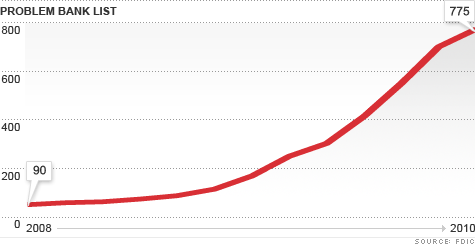
The list of troubled banks continues to grow:

Source: Fortune, FDIC

This chart tells us that we should be gearing up for another round of bank failures. The increase of deposit insurance from $100,000 to $250,000 is largely a charade. 1 out of 3 Americans have absolutely no savings whatsoever. We have 17 percent unemployed or underemployed and another 20 to 25 percent working in the low paying service sector. Nearly 50 percent of Americans have nowhere close to $100,000 in liquid assets to insure, so increasing the insurance to $250,000 is merely a public relations move to show strength.

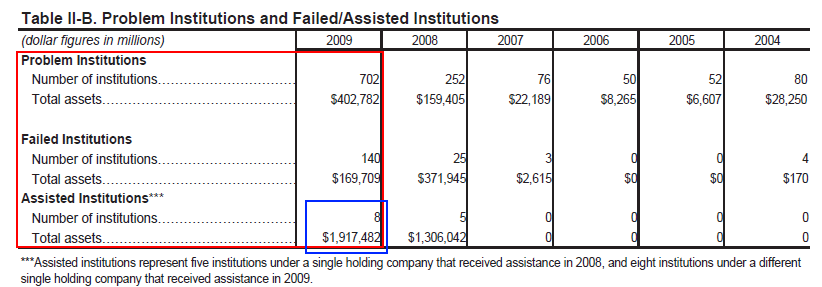
The current amount of assets at troubled banks is over $400 billion but since the FDIC doesn’t list all troubled banks this is much larger:

Source: FDIC

Now the above survey only goes up to the end of 2009. Since the start of the year another 82 banks have failed and the FDIC is probably at some undisclosed location somewhere in the United States right now getting ready to close another few banks since Fridays have become synonymous with bank closings. The list of troubled banks increasing is a reflection of the massive amount of troubled loans. These loans wouldn’t be in such deep trouble if the economy was healthy and Americans were servicing their loans. But the middle class isn’t really participating in this shadow recovery.

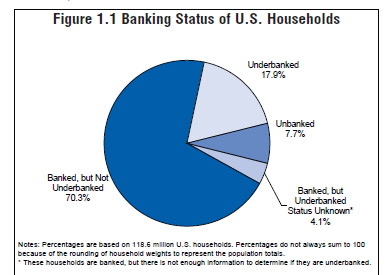
A recent survey by none other than the FDIC shows that a good portion of Americans don’t even participate in the banking system:

A substantial percentage of lower-income households are unbanked. Nearly 20 percent of lower income U.S. households—almost 7 million households earning below $30,000 per year—do not currently have a bank account. Households with earnings below $30,000 account for at least 71 percent of unbanked households.

Not having enough money to feel they need an account is the most common reason why unbanked households are not participating in the mainstream financial system.

Do these people care that accounts are insured up to $250,000? Who are we really protecting here? You also need to ask how we are going to pay for all these additional bank failures if the deposit insurance fund is already in the negative. That is where the Federal Reserve and U.S. Treasury step in with more of your taxpayer money.

The Federal Reserve attempts to paint this image as a government agency but they are not. They serve the purpose to protect the banking system. Even the Fed website gives us a nice little history on this:

“(Fed history) From December 1912 to December 1913, the Glass-Willis proposal was hotly debated, molded and reshaped. By December 23, 1913, when President Woodrow Wilson signed the Federal Reserve Act into law, it stood as a classic example of compromise—a decentralized central bank that balanced the competing interests of private banks and populist sentiment.”

There is much more back history to this but suffice it to say that this move helped consolidate the power of banks into a few hands instead of having many more banks competing for your business. Keep in mind when this past, the public was heavily against it just like the public was against TARP when this crisis rolled around. Yet the Fed listens to their big banks and protects them at all costs even if it means robbing the public blind (a sort of reverse Robin Hood). In the end after nearly 100 years of the Federal Reserve, the main purpose is nearly accomplished:

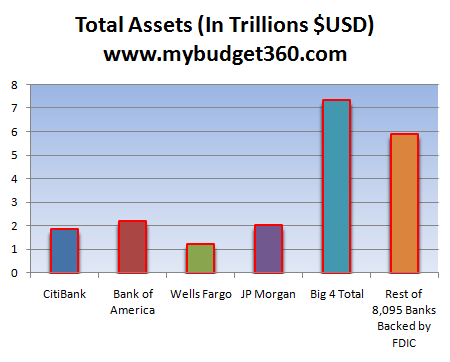
“The top 4 banks of Bank of America, JP Morgan Chase, Wells Fargo, and Citibank make up 55 percent of all banking assets.”

And banking assets across the country are enormous. The FDIC backs 8,000 banks that carry over $13 trillion in assets. These big four banks have their hands in over 50 percent of this amount. Who controls the wealth in this country controls the levers of political power. The way the system is currently setup we find that the banks have an incredible amount of power. Actually, it is the biggest banks that have the big power since they are fine with hundreds of little bank failures since that opens up the market for bigger banks to step in and open up shop. Smaller banks don’t have access to the easy money Federal Reserve window and certainly did not get handouts like many of the biggest banks did.

Foreclosures remain at record levels and this means banks are facing more and more loans that enter into default. This costs money. As we have mentioned, the FDIC is insolvent so where is this money coming from?

“(US Banker) Treasury likes it, the Federal Deposit Insurance Corp. likes it, and the banking industry likes it—that is, S. 541, introduced last week by Sen. Chris Dodd (D-Conn.) The bill would permanently increase the FDIC’s ability to borrow from the Treasury for its Deposit Insurance Fund, raising the cap to $100 billion from $30 billion, the limit set back in 1991. The Depositor Protection Act would also temporarily allow the FDIC to borrow up to $500 billion after consultations with Treasury, the Federal Reserve, and the President.

FDIC chairman Sheila Bair voiced enthusiasm in a letter to Dodd, noting “the FDIC believes it is prudent to adjust the statutory line of credit proportionally to leave no doubt that the FDIC can immediately access the necessary resources to resolve failing banks and provide timely protection to insured depositors.” Passage of the increased borrowing ability “would give the FDIC flexibility to reduce the size of the recent special assessment, while still maintaining assessments at a level that supports the DIF with industry funding.”

And there you have it. I am certain that the banks are spending large amounts of money creating a way to couch this additional bailout as a helping hand for middle class Americans but in the end if we don’t change the system, the money will flow through the same rivers as of those from the last decade. With so many bank failures lined up because of horrible commercial real estate and residential loans, we can expect to bailout indirectly failed casinos in Las Vegas and owning shopping malls in random parts of the country. The FDIC is flashing code red and they are lining up with hat in hand for taxpayer money. If after 29 months you still haven’t gotten it, this money is likely to funnel up to the top 1 percent in an incredibly unbalanced fashioned.