Saturday, June 19, 2010

In jail for being in debt


You committed no crime, but an officer is knocking on your door. More Minnesotans are surprised to find themselves being locked up over debts.

As a sheriff's deputy dumped the contents of Joy Uhlmeyer's purse into a sealed bag, she begged to know why she had just been arrested while driving home to Richfield after an Easter visit with her elderly mother.

No one had an answer. Uhlmeyer spent a sleepless night in a frigid Anoka County holding cell, her hands tucked under her armpits for warmth. Then, handcuffed in a squad car, she was taken to downtown Minneapolis for booking. Finally, after 16 hours in limbo, jail officials fingerprinted Uhlmeyer and explained her offense -- missing a court hearing over an unpaid debt. "They have no right to do this to me," said the 57-year-old patient care advocate, her voice as soft as a whisper. "Not for a stupid credit card."

It's not a crime to owe money, and debtors' prisons were abolished in the United States in the 19th century. But people are routinely being thrown in jail for failing to pay debts. In Minnesota, which has some of the most creditor-friendly laws in the country, the use of arrest warrants against debtors has jumped 60 percent over the past four years, with 845 cases in 2009, a Star Tribune analysis of state court data has found.

Not every warrant results in an arrest, but in Minnesota many debtors spend up to 48 hours in cells with criminals. Consumer attorneys say such arrests are increasing in many states, including Arkansas, Arizona and Washington, driven by a bad economy, high consumer debt and a growing industry that buys bad debts and employs every means available to collect.

Whether a debtor is locked up depends largely on where the person lives, because enforcement is inconsistent from state to state, and even county to county.

In Illinois and southwest Indiana, some judges jail debtors for missing court-ordered debt payments. In extreme cases, people stay in jail until they raise a minimum payment. In January, a judge sentenced a Kenney, Ill., man "to indefinite incarceration" until he came up with $300 toward a lumber yard debt.

Global warming book withdrawn

Millard Public Schools will stop using a children's book about global warming -- but only until the district can obtain copies with a factual error corrected.

A review committee, convened after parents complained, concluded that author Laurie David's book, "The Down-to-Earth Guide to Global Warming," contained "a major factual error" in a graphic about rising temperatures and carbon dioxide levels.

Mark Feldhausen, associate superintendent for educational services, this week sent a letter to parents who complained, including the wife of U.S. Rep. Lee Terry of Nebraska, outlining the committee's findings.

"Although the authors have pledged to correct the graph in subsequent editions, the committee recommends that this correction be made to all MPS-owned texts before using it with students in the future," Feldhausen wrote.

Corrected versions will continue to be used in Millard's sixth-grade language arts curriculum, he wrote.

However, the district will cease to use a companion video about global warming, narrated by actor Leonardo DiCaprio, he wrote.

The committee found the video "without merit" and recommended that it not be used.

Robyn Terry, the congressman's wife, had described the video as a "political commercial."

Lee and Robyn Terry released a statement saying they were pleased with the decision and "impressed" by the district’s handling of the case.

"We are pleased with their decision not to use the politically natured global warming video as a classroom instruction tool and that they have set a standard that information-based texts must be factually correct to be put in front of our children," they wrote.

A committee of five middle school parents, three teachers and one administrator met to determine whether the book and video served a proper purpose within the curriculum.

The book, new to the Millard curriculum this year, was part of "Plugged in to Non-Fiction," a collection of books on a variety of subjects. Parts of the book were required reading for sixth-graders in Millard reading and language-arts classes.

Three parents, including Robyn Terry, complained to the district. The Terrys’ 12-year-old son attended Beadle Middle School last year. Mrs. Terry said that the materials used in his class portrayed global warming as fact when scientists disagree.

In the video, DiCaprio attributes global warming to mankind’s "destructive addiction" to oil. He says "big corporations" and politicians gained too much money and power "on our addiction," making them "dangerously resistant to change."

In the letter to parents, Feldhausen said the committee recognized there are "multiple viewpoints" on global warming. The committee recommended that all teachers using the book "make students aware of both sides of the global warming theory," he said.

Nearly one million US workers cut off unemployment benefits

With 12 Democrats joining a unanimous Republican bloc, the US Senate voted Wednesday to defeat a proposed extension of unemployment benefits for workers who have been jobless for nearly two years. The bill would have extended unemployment benefits for those out of work more than six months, until November 30.

In the two and a half weeks since June 1, when the last extension expired, some 903,000 workers have seen their benefits cut off. By June 26, that number will top 1.2 million.

Meanwhile, the Labor Department reported that the number of new claims for unemployment compensation jumped to 472,000 last week, the highest figure in several months.

The result is that a Congress that rushed through a $700 billion bailout of Wall Street in October 2008 in a matter of days, and authorized a further financial windfall to the banks and speculators five months later, cannot bring itself to support even the most meager subsistence for the unemployed workers who are the victims, not the perpetrators, of the economic crisis.

The vote was taken under Senate rules, not to pass the legislation itself, but to “waive budgetary discipline” and allow passage by a simple majority rather than 60 votes out of 100. The result was 45 in favor and 52 against, with three senators absent. Senate Majority Leader Harry Reid had already abandoned an effort to adopt a cloture motion, closing debate, for lack of the necessary 60 votes. Three months ago a similar extension bill passed the Senate easily.

The unemployment extension is part of a larger bill that includes additional aid to state governments to cover Medicaid, the healthcare program for the poor, and to offset a potential 21 percent cut in reimbursements to doctors who treat Medicare patients.

The House of Representatives passed a version of the bill May 28 costing $113 billion, but without the Medicaid assistance to the states. The Senate version includes the Medicaid support, and costs a total of $140 billion, which sparked the unanimous no vote of the Republicans, as well as the opposition of the 12 Democrats, mainly conservatives, but including liberals like Russ Feingold of Wisconsin.

According to press reports, leading Senate Democrats are seeking to win votes from the bill’s opponents by eliminating a $25 a week increase in jobless benefits that was part of the 2009 stimulus package. In other words, either all 10 million jobless workers would see a $25 cut in benefits, from checks averaging $309 a week, or benefits for the 5.7 million long-term unemployed would be cut off completely. Either way, those deprived of work by the economic crisis of capitalism, the most vulnerable section of the working class, will be made to pay.

One of the dozen right-wing Democrats who voted against the bill, Senator Ben Nelson of Nebraska, reiterated his opposition to Capitol Hill reporters. He cited concerns about the federal deficit, after rejecting a new version of the bill that would cost $20 billion less.

“Borrowing and deficit spending at the point of an economic crisis—and we were in a severe one in late 2008 and early 2009—is one thing,” Nelson said. “But when you’re in an economic recovery, as we are today, borrowing and deficit spending is another thing.”

Another Democratic “no” vote, Senator Mary Landrieu of Louisiana, told Fox News through a spokesman that she was particularly opposed to a provision in the bill that would have raised taxes on the oil and gas industry from 8 cents a barrel to 49 cents, raising $18.3 billion to replenish the Oil Liability Trust Fund.

Besides the oil industry tax, there is enormous business opposition to a proposed increase in the tax on the compensation of hedge fund managers—much of it currently taxed not as income but at the much lower capital gains rate—as well as a tax increase on investment partnerships. Lobbying against this provision was said to be especially heavy on the part of companies like Blackstone.

A Republican alternative, introduced by Senator John Thune of South Dakota, would have extended jobless benefits and selected tax credits for business, but at the price of a 5 percent across-the-board cut in all federal discretionary spending (with the military-intelligence apparatus excluded, of course). This was defeated by a 41 to 57 margin.

Big business politicians of both parties have expressed their disdain for the unemployed, suggesting that extended unemployment benefits, now set at 99 weeks, are encouraging jobless workers to stay home and not look for work. Georgia Republican Congressman John Linder said that extended benefits were “too much of an allure.”

Senator Diane Feinstein, a multi-millionaire Democrat from California, complained, “We have 99 weeks of unemployment insurance. The question comes, how long do you continue that before people just don’t go back to work at all?” California has a 12.6 percent unemployment rate, with 880,000 workers unemployed for 27 weeks or more, and receiving extended benefits.

Senator Claire McCaskill, a Missouri Democrat with particularly close ties to the White House, voted against the unemployment extension and backed the $25 a week cut. “This is not something that can go on indefinitely,” she said. Otherwise, “it begins to look like a brand-new level of entitlement program, which is something that we really can’t afford to do right now.”

Reports in the corporate-controlled media invariably cite mass popular opposition to higher federal deficits as the reason for the shift by a section of the Democratic Party to opposing extended unemployment benefits. However, the claim that working people are up in arms over deficit spending is a spurious one, identifying the media-promoted antics of the Tea Party and other right-wing groups as a genuine popular movement.

The same polls that document overwhelming popular hostility to the bailout of Wall Street and the Obama administration’s kid-glove treatment of BP show that the vast majority believe that jobless benefits should be extended and that emergency measures should be taken to provide jobs for the unemployed.

While the White House and Congress wrangle over the smallest of subsistence measures for the jobless, neither party nor the corporate elite as a whole propose to do anything to provide jobs for the unemployed. The Wall Street Journal reported last week that American corporations have increased their cash reserves to $1.84 trillion, the highest figure in history.

In other words, big business and the banks, after an unprecedented bailout by the public treasury, are hoarding the funds that could put millions back to work. The cash reserves of major corporations have jumped 26 percent in one year, the largest percentage increase in nearly 60 years. The cash reserves of working people, and particularly the unemployed, have not been so fortunate.

While the treatment of the unemployed is the most glaring expression of the callousness and indifference of the wealthy, the opposition to the Medicaid assistance to the states is not far behind. Medicaid, which pays for medical care for the poor, is the largest single budgetary item in most states, with 80 percent of the cost borne by the federal government and 20 percent by the states.

Most US states must balance their books for a fiscal year that ends June 30, and many have already included the promised Medicaid assistance as part of their financial planning. After the House stripped the Medicaid spending from its version of the bill, Obama sent a letter to House and Senate leaders on June 13, urging them to restore the aid to the states and warning that without it there would be “massive layoffs of teachers, police and firefighters.”

According to the National Governors Association, total state government spending has dropped for two years in a row, the first time such a decline has been recorded. State governments eliminated $300 billion in cumulative deficits over this two-year period, through a combination of spending cuts and tax increases, usually in regressive sales and excise taxes.

A report issued by the Center on Budget and Policy Planning, a liberal Washington study group, warned that without federal aid, as many as 34 states could impose drastic and unprecedented budget cuts beginning July 1, cutting as many as 900,000 jobs in education and other public services.

Already, 28 states have ordered across-the-board budget cuts, 22 states have imposed payless furloughs on employees, and 25 states and Puerto Rico have laid off state workers.

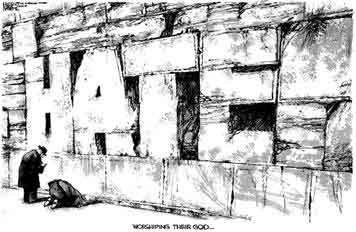
‘HOLOCAUST INDUSTRY’ UNDER ATTACK

HATE SPEECH OR TRUTH?
And just who is doing the hating??


German legislator: Stop ‘thriving Holocaust industry’

Extreme right leader carries hate speech against Israel; calls to cut ties, issue economic sanctions

Dor Glick


BERLIN “Stop cooperation with the state of Jewish scoundrels”, “Don’t give in to the thriving Holocaust industry.” These statements were not said in the Tehran parliament, but in the German city of Dresden, during a parliament meeting in the state of Saxony.

Leader of the extreme right National Democratic Party (NPD) Holger Apfel stirred up a storm in the parliament on Thursday when he carried a speech titled “no to cooperation with scoundrel countries – and end cooperation between Saxony and Israel.”

Most parliament members urged Apfel to change the title, fearing it would damage Saxony’s image – but to no avail. Apfel, a former neo-Nazi, stepped up to the podium and carried out his hate speech, while being booed by other parliament members.

Even after his time was up, Apfel refused to step down from the stage and continued to denounce the “Jewish terror state.” His speech was finally stopped after the chairman turned off his microphone and instructed ushers to escort Apfel out of the hall.

President of the Saxony Parliament Matthias Roessler instructed to keep Apfel out of parliament hearings until December.

This is not the first time Apfel has expressed his harsh feeling toward Israel, and the need to cut ties with it. On NPS’ official website, the former neo-Nazi published his reaction to the recent flotilla incident, saying: “Today’s attack, with at least 10 fatalities, demonstrates a new ‘characteristic’ of ‘state terror’ employed by Israel.

“Since the establishment of the state in 1948 and the expulsion of millions of Palestinians – the history of Israel has been accompanied by bloodshed.”

Apfel called to “cut off Germany’s political ties with Israel and issue economic sanctions against it.”


NOTE FROM DESERTPEACE…..

The above in no way is meant to applaud the neo nazi that uttered those words…. it is posted here to point out the EVEN the neo nazis in Germany and elsewhere, who have until now been ardent supporters of the zionist state no longer do because of the policies practiced in Israel.

Visualizing the BP Oil Spill Disaster

Click this link ..... http://tinyurl.com/2u5rfu7

The “Snowball” Scenario Sinks Sovereigns

A blockbuster draft report from the European Commission saw the light of day recently, thanks to some reporting from Bloomberg. It highlights an incredibly dangerous Catch-22 facing many sovereign nations — the “Snowball Scenario.”

Let me give you an example how this works …

Suppose country A’s economy goes into the tank. The government responds by borrowing boatloads of money and spending like mad on stimulus packages.

The markets allow it to go on for a while. But then investors start to get antsy about all the debt being added to the government’s balance sheet. So they start dumping its bonds, driving prices lower and rates higher. That, in turn, forces the country to implement austerity measures to get its debt and deficit under control.

The problem?

Those moves send the economy BACK into the crapper! Government spending has to rise yet again to pay for things like unemployment insurance, new stimulus packages, and so on … at the same time tax revenues fall. That drives debts and deficits even higher.

The end game in this snowball scenario? A sovereign default!

And that’s not just a theory. In fact …

Snowballs Are Already Rolling Downhill in Spain, Greece, and Portugal

Spain is trying to slash its budget deficit from 11.2 percent to 9.3 percent in 2010 and 6 percent in 2011. Portugal wants to cut its deficit from 9.4 percent to 7.3 percent this year and 4.6 percent next year. They plan to do so by some combination of pension freezes, wage cuts, new taxes, and other measures.

But the European Commission, which is the executive arm of the European Union, says that probably won’t be enough. Its conclusion?

“While the newly announced measures are significant and the targets imply impressive budgetary consolidation, more measures are needed to meet those targets.”

The EU has told Spain and Portugal to get their budgets back in shape.

In plain English, the message is “Get even tougher! Crack down more! Slash spending! Raise taxes!”

But as the Commission admits, the governments it is counseling face “low GDP growth, poor competitiveness, stable or declining prices and wages and high real interest rates.” So it’s virtually impossible to avoid a “snowball effect on the government debt.”

Stay Cautious! Stay Safe!

Bond traders aren’t dumb. They can see this coming from a mile away. Yields on Spanish 2-year notes shot up recently, then eased a bit. But now they’re rallying yet again — hitting a new cycle high just this week.

Spanish borrowing costs have skyrocketed from 1.51 percent in March to 3.29 percent, the highest in 17 months! It now costs more on a relative basis for Spain to borrow than it does the euro-area’s main economy, Germany. And it’s the highest that the 10-year Spanish/German yield spread has been since 1999 — when the euro currency debuted.

Portugal is seeing costs rise, too. It’s paying 5.58 percent to borrow money for 10 years, up from 4.15 percent back in April.

Reports are surfacing that Spain may need a 250 billion euro ($307 billion) credit line from the International Monetary Fund, the European Union, and possibly the U.S. Treasury.

Naturally, policymakers are denying that anything is in the works. But what do you expect them to do? These guys said the same thing about Greece, claiming it wasn’t at risk of defaulting. Then they pushed through a $135 billion bailout!

Use market rallies as selling opportunities.

In short, this sovereign debt crisis is playing out just like the private credit market crisis did before. It comes in waves — with periodic sharp drops triggered by some event, then some kind of bailout that makes everybody breathe a temporary sigh of relief, and finally yet another plunge as another hole appears in the dike.

My advice?

Don’t get suckered in by the short-term rallies. This sovereign debt crisis is nowhere near over, and that means you have to stay cautious and safe in your investments.

Consider using inverse ETFs to hedge risk, keeping positions small, and dumping stocks into sharp rallies if you’re lucky enough to get them.

Until next time,

Mike

Medvedev Says He ‘Cannot Rule Out’ Collapse of Euro (Update3)

(Updates with comments quote on BP in seventh paragraph. Click EXT5 for more on the St. Petersburg forum.)

By Lyubov Pronina

June 18 (Bloomberg) -- Russian President Dmitry Medvedev says he can’t rule out the collapse of the euro as the European Union struggles to contain the sovereign debt crisis.

Asked if the emergency could threaten the single currency, Medvedev said, “So far, no. But one cannot rule out this danger because at least a unique situation has emerged,” according to the text of an interview with the Wall Street Journal that was provided by the Russian government.

Russia will help lead the effort to recast the world economic hierarchy after the global financial crisis, Medvedev said today at the St. Petersburg International Economic Forum. The government will use tax incentives and other free-market economic policies to attract investment, he said, as Russia seeks to diversify its economy away from natural resources.

“We really live at a unique time, and we should use it to build a modern, prosperous and strong Russia, a Russia that will be a co-founder of the new world economic order,” Medvedev told an audience that included Citigroup Inc. Chief Executive Officer Vikram Pandit and French Economy Minister Christine Lagarde.

Medvedev, 44, travels to the U.S. next week for talks with U.S. President Barack Obama before heading to Canada for a meeting of the Group of 20 nations. The Wall Street Journal interview touched on issues ranging from the BP Plc oil spill in the Gulf of Mexico to Iran and recent violence in Kyrgyzstan.

BP Concerns

The Russian president suggested the oil spill, which forced London-based BP to set aside $20 billion for potential damages, could lead to the breakup of the company and said he wanted to make sure the interests of Russian shareholders in TNK-BP are safeguarded, according to the interview text. TNK-BP, which accounts for almost a quarter of BP’s output, is half-owned by Russian billionaires, including Viktor Vekselberg.

“How they will be able to digest these losses, whether it will lead to annihilation of the company itself, to its break up, this is a feasibility issue,” Medvedev said of BP. “We would like, speaking frankly, the interests of Russian investors that created a joint business with BP to somehow be ensured.”

Medvedev backed the sanctions against Iran that were passed by the UN Security Council on June 9. The measures, which call for a tighter arms embargo, authority to seize cargo that could be used in nuclear weapons, and restrictions on financial transactions with Iran, represent a balanced approach, he said.

“The sanctions that have been imposed are strict enough, yet at the same time they do not harm the Iranian people,” Medvedev said in the interview. “They may push the Iranian leadership to, at some point, take a decision on closer cooperation with the global community” and the International Atomic Energy Agency.

‘Unilateral Sanctions’

The U.S. and EU have further than the UN resolution, with European leaders approving penalties that target the oil and gas industry, including the prohibition of new investment, technical assistance and technology transfers.

“Unilateral sanctions, be it U.S. sanctions or those of the EU or any other countries, would worsen the situation because they are not agreed upon with anyone,” Medvedev said.

Medvedev also said that the U.S. air base in Kyrgyzstan, a key installation for American operations in Afghanistan, should be closed down once its job is done.

Kyrgyzstan, a former Soviet republic, has been the scene of sporadic violence since April, when President Kurmanbek Bakiyev was ousted and replaced by an interim government. At least 189 people have died in fighting between Kyrgyz and Uzbek groups in the Central Asian nation over the past seven days.

If the base “is needed for fighting terrorism, for bringing order, then OK,” Medvedev said. “But it is obvious, and it is my position and I speak openly about it, that it should not exist forever. It should, in my opinion, resolve concrete tasks and complete its work.”

--With assistance from Lucian Kim in St. Petersburg. Editors: Willy Morris, John Simpson