Wednesday, May 5, 2010

Fisherman have to work 17 times harder to catch fish than they did in the 19th century

Fishing stocks around Britain are so devastated that modern trawlerman have to work an average 17 times harder than their Victorian counterparts to land the same size catch, a new study claims.


Marine scientists have discovered that despite modern trawlers being 50 times more effective than their sailing equivalents in the 19th century, they only catch a third more fish.

Stocks of some varieties of fish such as halibut are so decimated that it takes 500 times as much effort to pull them from the sea as it did in 1889

Britain's fleet of trawlers – mostly powered by sail – netted 300,000 tons a year in the 1880s compared with 150,000 tons now.

The fishing fleet in England and Wales was much larger then but each vessel still netted 80 tons of fish a year. This compares with 110 tons on average per boat now despite advances in technology and far more powerful boats.

The "dramatic" and "worrying" drop is due to extreme and aggressive overfishing and researchers from York University said the problem is "far more profound" then previously thought.

Ruth Thurstan, lead researcher from the university's Environment Department, said: "Fishermen have to work 17 times harder than a 100 years ago to get the equivalent catch.

"And this is despite more powerful boats, more durable and wider nets, freezing facilities – technology that is far more sophisticated than in the last century.

"Now UK fishing trawlers are bringing in about 150,000 tonnes a year, compared to double that 100 years ago.

"The availability of certain bottom living fish like halibut, turbot, haddock and plaice has also dropped by 94 per cent.

"We were astonished to discover that we landed over four times more fish into England and Wales in 1889 than we do today.

"For all its technological sophistication and raw power, today's trawl fishing fleet has far less success than its sail-powered equivalent of the late 19th century because of the sharp declines in fish abundance."

The researchers, who also worked with the Marine Conservation Society used UK Government data on the amount of fish caught and the size and number of boats involved – the fleet's fishing power – to analyse the change in fish stocks since 1889.

The findings suggest that the damage to fisheries is greater and has taken place over a much longer period than previously thought

Professor Callum Roberts, co-author, said: "This research makes clear that the state of UK bottom fisheries – and by implication European fisheries, since the fishing grounds are shared – is far worse than even the most pessimistic of assessments currently in circulation.

"We need to build up stocks so that we can take more sustainable fish, more easily from the sea. Fish stocks are a bit like bank accounts. The more money you have in the bank the more interest you get from it."

The research is published in the journal Nature Communications.

Mayor Bloomberg: NYC Bomb Suspect Could Be Someone Who “Didn’t Like Health Bill”

Chief amongst the many questions that that still are left unanswered regarding the failed car bomb last Saturday night is who would do such a thing. While the Pakistan Taliban have claimed responsibility, experts remain skeptical. Some have surmised that the car’s proximity to the headquarters of Comedy Central’s parent company Viacom is a clue. But on tonight’s CBS Evening News Mayor Mike Bloomberg suggested that it may be someone who simply didn’t like the health care bill.

Follow us on Twitter.

Zionists named the bogeyman on 9-11

Click this link ..... http://www.youtube.com/watch?v=SE34OpcTY0I

Middle class getting pushed into poverty and working poor status The cloaked recovery for the middle class. How 30 percent of the poor are unemployed

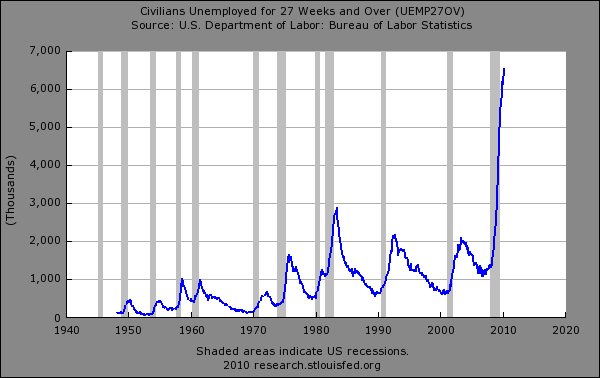
Over 6.5 million of the 15 million unemployed Americans have been out of work for 27 weeks or more. As a percent, this is the highest number of long-term unemployed we have had since the Great Depression. What is not discussed in this recession is the working poor and middle class have taken on the burden of this financial calamity disproportionately. We are not all in this equally. When was the last time you heard on the mainstream press that 40 million of your fellow Americans are now receiving food assistance? And when was the last time you heard that jobs for the middle class are still largely disappearing? Since much of the media represents the top 1 percent they assume all is well because Wall Street has been on a record breaking bailout rally. At the same time, we have 30 percent unemployment at the lower end of our income scale.

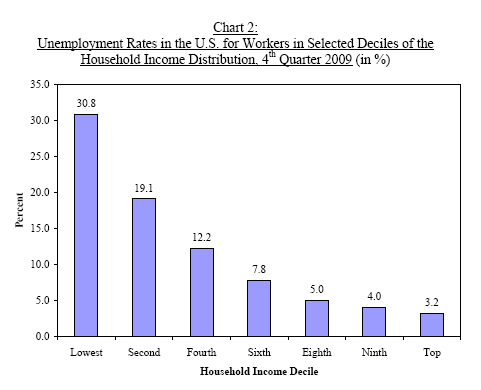
The lower 30 percent are seeing depression like unemployment rates:

Source: Center for Labor Market Studies, Northeastern University

This chart really is a reflection of the current recovery. For the bottom 40 percent, this recession is still extremely painful and realistic. Yet the top 10 percent have an unemployment rate of 3.2 percent which isn’t necessarily a bad number. When we break down the numbers, we realize that the middle class in this country is struggling to get by. The 40 million on food assistance are scraping by. The Wall Street stock market casino is merely a far away distraction to this group. It would be one thing if the rally actually reflected a large boost in job growth in the real economy. Yet last month a large part of the actual added jobs came from Census hiring from the government. This is unsustainable.

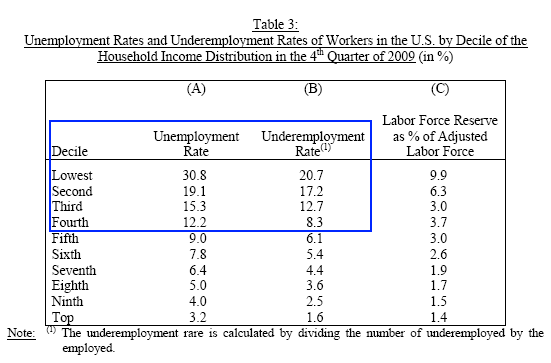
If we break down the numbers further, we realize that employment is only good for the top 20 percent:

Many economists argue that a 5 percent unemployment rate is typically where a steady economy would hover around. Yet look at the above chart. You have to be in the top income deciles to even see this rate. Anyone from the seventh all the way down to lowest cutoff point is feeling unemployment rates that are elevated from the “normal” point. And part of this has to do with the top 1 percent controlling over 42 percent of all financial wealth. While most have to work to pay their bills or stay current with their mortgage, we have a tiny percentage of our country that largely make money from watching their stock portfolio throw off dividends. In fact, this has become a zero sum game. The trillions in bailout money that went to Wall Street are trillions that didn’t go to creating jobs for working poor and middle class Americans. How many jobs can you create with $13 trillion? Apparently not many if you give Wall Street most of it.

Most of the funds have been channeled into outrageous bonuses and keeping the fragile casino going further so they don’t have to go out and actually work like most Americans. The long-term unemployed are enormous and the below chart is incredible:

The chart just goes off the normal path in this recession because many of these jobs are gone forever. Many of these jobs were essentially support positions for the Wall Street casino. Now that Wall Street siphoned off enough money from the productive economy, they are now looking for other bubbles to expand. It doesn’t matter if it comes at the expense of the working poor and middle class. In fact, this is what they want people to believe. They want you to believe that they barely have enough to get by yet at the same time, are able to reward each other with billion dollar bonuses each quarter now that they have taxpayer money in hand. This kind of hypocrisy and corruption is primarily why most Americans are simply not buying the nonsense perpetrated on Wall Street any further.

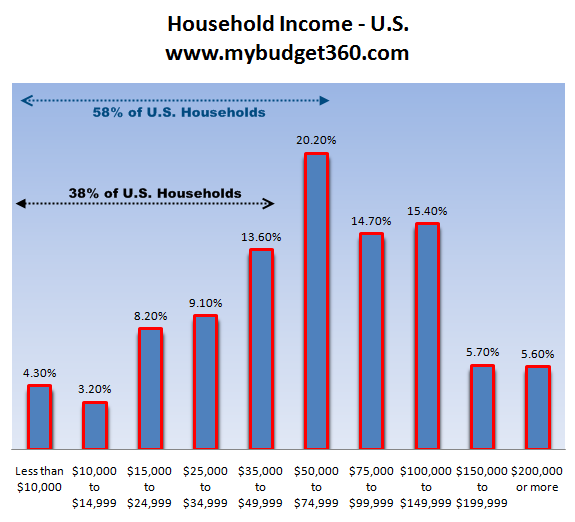
And U.S. households are making due with a lot less:

“65% of American households get by with $65,000 a year or less. This number is going to be lower once we get the 2009 Census data in September but after rising health care costs, more expensive education, and rising food costs many Americans are seeing their fixed costs go up while their wages move in the opposite direction. But keep in mind there is a group that is actually benefitting from this entire cost cutting. After all, the stock market isn’t up by 70+ percent by accident.”

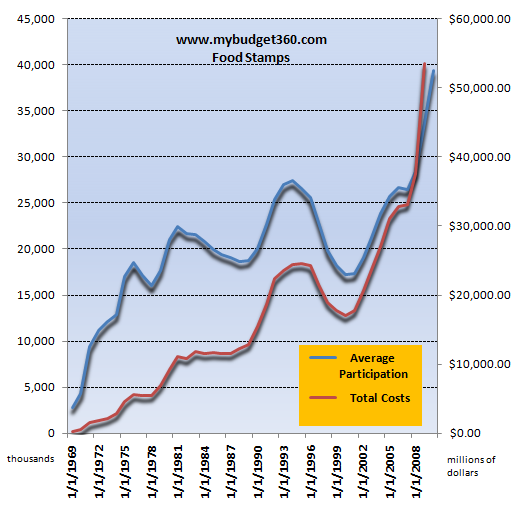
Since the recession started, we have added close to 500,000 per month needing food assistance:

How does this translate to a recovery? The trend hasn’t even reversed yet those on Wall Street and the mainstream press being so out of touch with most Americans thinks all is now well because their dividends are still coming in. That is clearly not the case and we stand at a crossroads to protect the middle class. If we allow Wall Street to operate unchecked and like a casino, we are only setting ourselves up for another financial crisis that will be coming up in a short time. Why wouldn’t it? We’ve been in this boom and bust casino for the last few decades and each time this happens, someone gets rich. The Goldman Sachs case is about a hedge funder who placed a major bet that American housing would collapse and made billions off of that bet. What did this add to our economy? Clearly the working poor and middle class don’t find amusement that you can bet on their failure and laugh all the way to the bank.

Congressional Hypocrites Were Betting Against Stocks As Country Collapsed

Remember all that scorn in Congress about evil shortsellers betting against America and bringing the country down?

Well, it turns out Congress-people did it, too. And they used derivatives to do it, which they now say they abhor.

(For the record, we have no problem with shortselling or derivatives, and we find the routine scapegoating of both after market crashes ludicrous. But if you're going to complain about how awful shortselling is and how evil and venal people are for doing it, you should probably abstain from the practice yourself.

And, yes, most of the folks here were just betting against stocks, not actually selling stocks short. But it's the same idea. To use their own tortured, populist logic, they were betting against the country and their 401k-holding constituents!)

Jason Zweig, Tom McGinty, and Brody Mullins in the WSJ:

Some members of Congress made risky bets with their own money that U.S. stocks or bonds would fall during the financial crisis, a Wall Street Journal analysis of congressional disclosures shows.

Senators have criticized Goldman Sachs Group Inc. for profiting from the housing collapse. And Congress is considering legislation to curb Wall Street risk-taking, including the use of financial instruments known as derivatives and of leverage, or methods that amplify returns.

According to The Journal's analysis of congressional disclosures, investment accounts of 13 members of Congress or their spouses show bearish bets made in 2008 via exchange-traded funds—portfolios that trade like stocks and mirror an index. These funds were leveraged; they used derivatives and other techniques to magnify the daily moves of the index they track.

Plunge in state revenue dashes hopes of an easy budget fix

Legislators were hoping revenue would continue to exceed projections, forestalling deeper cuts and further tax hikes. But April's total was 30% below what was expected, leaving them with few options.


State tax collections plummeted unexpectedly in April, wiping out months of steady gains that legislators hoped would ease their budget troubles and restore California's economy faster than experts predicted.

Such hope is now fading fast.

Revenue for April, the biggest revenue month because it is when most Californians pay their taxes, lagged projections by nearly 30% — roughly $3 billion, according to state officials. The drop was steep enough to erase improvements recorded in each of the four previous months.

Receive breaking news alerts on your mobile device. Register »

Economists and finance officials are scurrying to analyze the data to determine what caused the April swoon. Some suspect it sprang from new laws that changed the rhythm of tax payments. It could also reflect the growth in unemployed residents eligible for refunds.

The April collections came almost entirely from personal income taxes. Most corporate and sales taxes have not yet been reported. If they, too, come in below projections, the state's budget problem would grow worse.

The decline sets Sacramento back as next month's deadline for passing a budget approaches. Lawmakers face a deficit of $18.6 billion — about 20% of general fund spending — with no easy options left for addressing it, as they have already cut state services severely and temporarily raised income, sales and vehicle taxes.

"One pillar of the budget solution just got destroyed, and there's nothing that can happen between now and June that can get back the $3 billion," said Stephen Levy, director of the Center for Continuing Study of the California Economy.

The retraction could mean even deeper cuts in government services — schools, healthcare for the poor and services for the elderly. Lawmakers may also be forced to consider more reductions in funds for public universities, as well as tax hikes.

"It's hard to imagine how we're going to [balance the budget] without doing more severe damage to the economy," said state Sen. Denise Moreno Ducheny (D-San Diego), who chairs the Senate's budget committee.

For months, the Democrats who dominate the Legislature have hoped they would be able to balance the state's books with the help of an upswing in revenue, delaying any substantial budget cuts.

"Folks were starting to be pretty optimistic that we were going to be able to bounce our way back from a big chunk of the problem," said Michael Cohen, a deputy in the state's nonpartisan Legislative Analyst's Office. Taxes came in above expectations each month from December through March.

"April basically wiped out those" gains, Cohen said.

He said the state's economy, though on the mend, has been sending "all sorts of mixed messages." Corporations announced higher profits, but the state's stubborn unemployment rate reached a new high in March, 12.6%. Without jobs, Californians are paying fewer taxes and buying fewer goods, which depresses sales taxes.

To balance last year's budget, lawmakers tinkered heavily with the state tax code, speeding up the collection of taxes on businesses and individuals. One theory about the April revenue plunge is that those accelerated collections meant some taxes rolled into the Treasury months earlier.

"The more changes that you make, the more unpredictable it is," said Assembly Budget Committee Chairman Bob Blumenfield (D-Woodland Hills).

Another possibility, economists said, is that many Californians were owed larger-than-expected income tax refunds after losing their jobs in 2009.

Whether the revenue drop augurs an especially sluggish recovery is unclear. Fred Silva, a budget analyst with the good-government group California Forward, said the woeful April returns may reflect taxpayer income from the previous year's recession — not an up-to-date snapshot of the economy.

Ted Gibson, a former state economist, said this was not the first time rising revenue has been followed by a plunge. The flow of state tax revenue, he said, is notoriously hard to predict.

He said the jolt earlier in the year merely "gave everybody an excuse to take a timeout on dealing with the budget. Now they are pretty much back to where they were. And unfortunately, very little has been done in the meantime."

Senate budget committee Vice Chairman Bob Dutton (R-Rancho Cucamonga), who has been critical of Democrats' approach, said, "It's creating a lot of pain the longer you wait to make the necessary changes."

The Legislature's top two Democrats, Senate President Pro Tem Darrell Steinberg (D-Sacramento) and Assembly Speaker John A. Pérez (D-Los Angeles), spent Monday in Washington, pleading for aid from congressional and Obama administration officials. Steinberg said before leaving that their goal was to gather federal commitments for $3 billion to $4 billion.

Gov. Arnold Schwarzenegger is scheduled to update his proposed budget on May 14. The new fiscal year begins July 1.

Stop Dodd's Devastating Financial "Reform" Bill

Click this link .... http://bytestyle.tv/content/stop-dodds-devastating-financial-reform-bill