Monday, August 31, 2009

FDIC Insured Institutions have $13.3 Trillion in Assets. 8,195 Banks and 116 Institutions Hold $10.2 Trillion of Those Assets. One out of Four Institu

The banking system has taken the country to the financial edge of the greatest recession since the depression. The enormous number of bad loans floating out in the economy only complicates the unemployment situation. When we look into the latest banking data, we realize that over 1,000 of current banks will fail or merge with a too big too fail bank. In fact, the total number will be over 1,000 simply because the “not too big” to fail banks heavily bet on commercial real estate loans that amount to $3 trillion.

Recent data shows that approximately 25% of all the banks insured by the FDIC are unprofitable. That number tells us that some 2,000 banks cannot turn a profit. Let us first look at the current data:

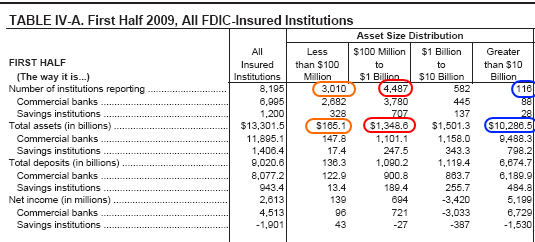
fdic top banks

This is probably one of the more telling charts. We have 8,195 institutions. 3,010 of those have less than $100 million in assets. 4,487 have between $100 million to $1 billion. 582 fall between $1 billion and $10 billion. Those over $10 billion? 116. This is incredibly disturbing and shows the monopoly that a few big banks have. 116 banks make up 77 percent of all total banking assets in the United States! So you can have the lower 8,079 banks fail and you wouldn’t even lose 25 percent of the total assets of the banking system.

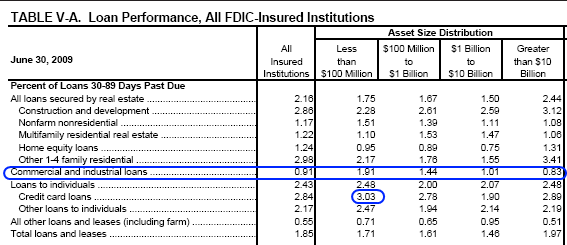
To show you the heavy weight of commercial real estate loans in the lower rung of banks, take a look at this data:

loans-non-current-by-bank-size

For commercial and industrial loans the banks with the lowest assets seem to have the highest non performing loans. This is bad news since there are $3 trillion in commercial loans floating out in the market and the U.S. Treasury has already mentioned plans to bail these loans out. Bad news of course for the taxpayer but more money thrown to the bigger banks. It would seem that politically we are letting smaller banks fail to placate the public with bread and circuses while the big banks get the real money. You’ll also notice that the banks with smaller assets are also facing higher credit card non-current loans. Given that many of these banks are small enough to fail by our government standards, you can expect that many will fail in the upcoming months. The government seems to be following one path right now. That path includes protecting those 116 banks.

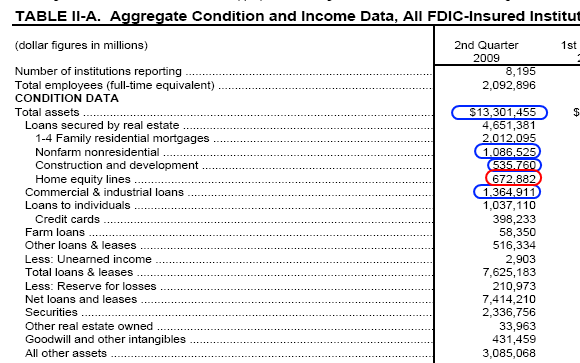
$13 trillion is a large number of total assets. It equates to approximately one year of our national GDP. The number is even more daunting when you realize much of the assets are secured by real estate. In addition, the 8,195 institutions employ over 2 million people. More bank failures mean more layoffs that will add to the already 26 million unemployed and underemployed Americans. But let us look at that balance sheet:

fdic-bank-balance-sheet

$1 trillion in non-farm residential loans

$535 billion in construction and development loans

$672 billion in home equity lines

$1.3 trillion in commercial and industrial loans

$398 billion in credit cards

Do you think these loans will do well in the current recession? But a more curious data point, in 2004 there were 8,976 FDIC insured institutions. Now it is down to 8,195. What has happened? The big banks keep swallowing up the smaller banks. Since 2004 we have 781 fewer FDIC insured banks. Not all these are failures. What is happening is that the banking sector is consolidating with the too big to fail. Did we not learn any lessons with the gigantic trusts in the early part of the 1900s? Monopolies are not good but it would appear that is our current philosophy. Let the small fail or be eaten up while the big banks are protected at all taxpayer costs. Recently, the FDIC started charging big and smaller banks, even those that were prudent higher fees because they need more money. More money to help the bigger banks not fail while closing the door on smaller banks. This is selective crony capitalism here. Lehman Brothers collapses yet Goldman Sachs remains. Now tell me, who has more political connections?

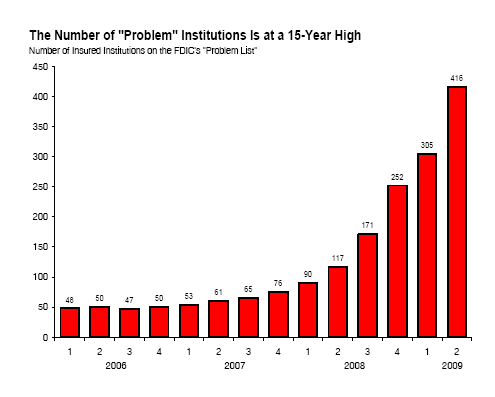
The number of problem institutions is steadily growing:

problem-institutions

The FDIC has 416 institutions listed as “problem” banks. Keep in mind some of the biggest failures like IndyMac did not appear on this list. It is becoming clear that we may have over 1,000 bank failures since it has little consequence in the total asset size of the banking system of the country and our government seems set on protecting the big banks only.

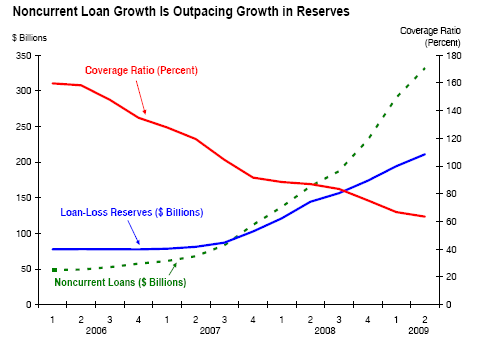
So far, the non-current loans are growing at a steady pace. This chart does not look like a green shoot:

noncurrent-loans

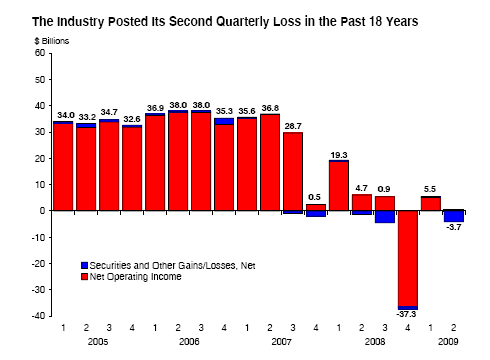
Over $300 billion in loans are currently non-current. The trend is still heading higher. So the obvious conclusion is more money is going to be launched at banks. Until we start seeing stability in this area we can expect more and more banks to fail. The banking sector posted its second quarterly loss in the last 18 years:

quaterly profits

I find the Q1 data incredible. The only way banks turned a profit here was because of the trillions in taxpayer bailouts. This is where your mega banks started stating they turned profits even though they had taxpayer handouts and suspended mark to market accounting.

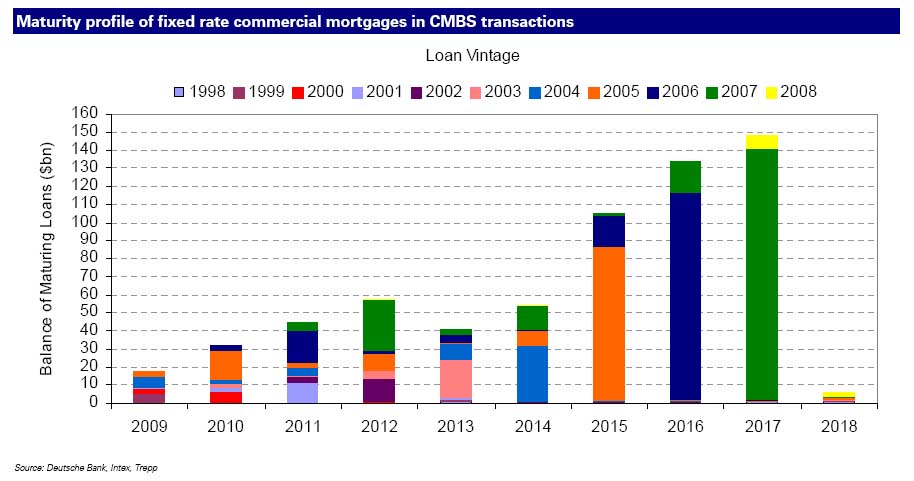
The charts above tell us that we are going to see a large number of bank failures. Many of those commercial real estate loans come up for refinancing in the next few years:

mbs

Source: Zero Hedge

Now you tell me who is going to refinance an empty strip mall in Arizona? Some of these are going to have massive losses. Many banks are carrying these toxic mortgages at close to face value. As the months go along, we are going to become very accustomed to bank failure Fridays. Get used to it.

by mybudget360 in FDIC, banks, commercial real estate, debt, economy, government, i-banking, us treasury

Lehman UK arm to sue for $100bn

Administrators of the London arm of Lehman Brothers, the Wall Street bank that collapsed a year ago, are preparing a $100 billion (£61.5 billion) claim against its former parent company in America.

The demand, which is being finalised by Price Waterhouse Coopers (PWC), Lehman’s UK administrator, will be lodged in the next few weeks. It will mark an acrimonious new stage in the international battles by creditors to recover billions still tied up in the largest corporate collapse in history.

Lehman owed $613 billion when it imploded last September. Liquidators in New York have since been sorting through the wreckage to set up a system to repay creditors and collect money from debtors. The US bankruptcy court has set a September 22 deadline for all creditors to file their claims.

John Suckow, president of Lehman Brothers Holdings — the remains of the US parent company — and a managing director at liquidator Alvarez & Marsal, is braced for a deluge of claims. The one from the London arm, which was the largest operation outside America, is likely to be the biggest.

Tony Lomas, one of the partners at PWC leading the case, said he will file on behalf of “more than 100” Lehman units that fall under the London umbrella. “On the face of it guaranteed most of the obligations of other subsidiaries so we’re going to be filing claims in the many tens of billions. It will be close to $100 billion,” he said.

The London claim will add to tensions between American and British administrators. Earlier this month, Alvarez & Marsal brokered an agreement with 13 other Lehman liquidators around the world.

The deal sets a protocol to share information on claims and assets with the hope of speeding up the reconciliation process and avoiding litigation. PWC declined to participate.

“Why you’d enter into an agreement with a bunch of other parties that you’ll probably end up litigating against is beyond conception,” said Steve Pearson, another PWC partner working on the case.

“We’re talking about billions of dollars. To sit in a room and say, ‘we’re all going to be nice to each other’, is almost certainly the wrong thing to do.”

Alvarez & Marsal’s Suckow added: “A lot of this case will come down to resolving claims made by other Lehman entities. We’re expecting a lot of duplicates. There’s a good chance that the parts will be greater than the whole.”

When the US parent filed for bankruptcy protection, it in effect severed relations with its businesses outside America.

Subsidiaries of the group famous for its “One Firm” ethos were transformed into creditors and debtors that were hit with claims running in the billions — there are 76 different court proceedings taking place around the world.

As the ultimate guarantor of the deals they did, including billions on inter-company loans and share trades, the former Lehman businesses will argue that the US parent should pay.

At the time of its collapse, Lehman had $639 billion in assets on its books. These included everything from real estate to office equipment. The most tangled element is the more than 1.7m “hung trades” to which Lehman was a party — transactions in shares or instruments such as derivatives that were frozen when the company collapsed.

The process of establishing the aggregate claim of any one entity, which may have had thousands of trades, some in the money, some showing a loss, is monumentally involved. Creditors have until November 2 to file more complex derivatives claims.

“We’re an asset management company now,” said Suckow. “Come September 22, it will be a question of sorting the good claims from the bad.”

The Case for Deflation

As Absolute Return Partners wrote in its July newsletter:


The most important investment decision you will have to make this year and possibly for years to come is whether to structure your portfolio for deflation or inflation.

So which is it, inflation or deflation?


I've analyzed this issue in
numerous posts, but every day there are new arguments one way or the other from some very smart people.

The biggest deflation bears are rather pessimistic:

  • David Rosenberg says that deflationary periods can last years before inflation kicks in

The Best Recent Arguments for Deflation


Following are some of the best arguments for deflation.


Wall Street Journal's Scott Patterson
writes that we won't get inflation until unemployment is down below 5%:


A rule of thumb is that inflation doesn't become sticky until the unemployment rate dips below 5%...

"I see very little prospect of accelerating inflation" partly because of the employment outlook, said Mark Zandi, chief economist of Moody's Economy.com. "I don't think the risk shifts toward inflation until 2011, or even 2012."


It could take
a lot longer for unemployment to go back down to 5%.


Pension expert Leo Kolivakis
writes:


The global pension crisis is highly deflationary and yet very few commentators are discussing this!!!


Hoisington's Second Quarter 2009 Outlook
states:


One of the more common beliefs about the operation of the U.S. economy is that a massive increase in the Fed’s balance sheet will automatically lead to a quick and substantial rise in inflation. [However] An inflationary surge of this type must work either through the banking system or through non-bank institutions that act like banks which are often called “shadow banks”.

The process toward inflation in both cases is a necessary increasing cycle of borrowing and lending. As of today, that private market mechanism has been acting as a brake on the normal functioning of the monetary engine.

For example, total commercial bank loans have declined over the past 1, 3, 6, and 9 month intervals. Also, recent readings on bank credit plus commercial paper have registered record rates of decline. The FDIC has closed a record 52 banks thus far this year, and numerous other banks are on life support. The “shadow banks” are in even worse shape. Over 300 mortgage entities have failed, and Fannie Mae and Freddie Mac are in federal receivership. Foreclosures and delinquencies on mortgages are continuing to rise, indicating that the banks and their non-bank competitors face additional pressures to re-trench, not expand. Thus far in this unusual business cycle, excessive debt and falling asset prices have conspired to render the best efforts of the Fed impotent.


Ellen Brown
argues that the break down in the securitized loan markets (especially CDOs) within the shadow banking system dwarfed other types of lending, and argues that the collapse of the securitized loan market means that deflation will - with certainty - continue to trump inflation unless conditions radically change.

Mish writes:


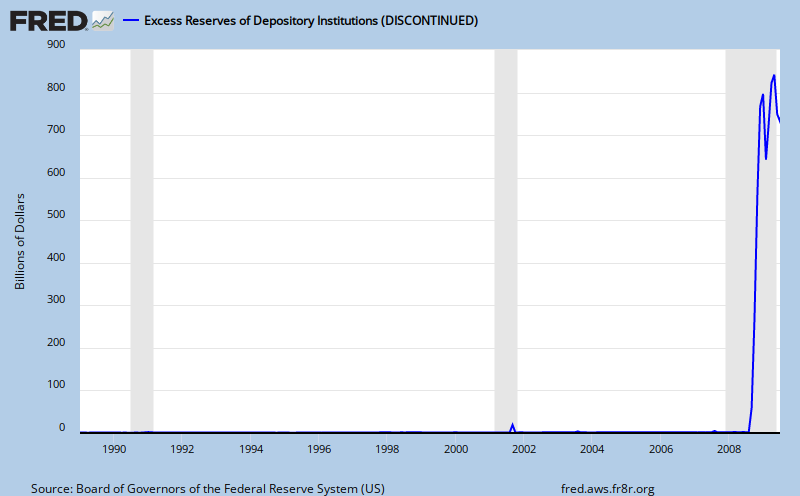
Conventional wisdom regarding money supply suggests there is massive pent up inflation in the works as a result of the buildup of those reserves. The rationale is that 10 times those excess reserves (via fractional reserve lending) will soon be working its way into the economy causing huge price spikes, a collapse in the US dollar, and possibly even hyperinflation.

However, conventional wisdom regarding the money multiplier is wrong. Australian economist Steve Keen notes that in a debt based society, expansion of credit comes first and reserves come later.

Indeed, this is easy to conceptualize: Banks lent more than they should have, and those loans are going bad at a phenomenal rate. In response, the Fed has engaged in a huge swap-o-rama party with various banks (swapping treasuries for collateral of dubious value) in addition to turning on the printing presses.

This was done so that banks would remain "well capitalized". The reality is those excess reserves are a mirage. Banks need those reserves for credit losses coming down the pike, as unemployment rises, foreclosures mount, and credit card defaults soar.

Banks are not well capitalized, they are insolvent, unwilling and unable to lend...

Total U.S. debt as a percent of GDP surged to 375% in the first quarter, a new post 1870 record, and well above the 360% average for 2008. Therefore, the economy became more leveraged even as the recession progressed.

An over-leveraged economy is one prone to deflation and stagnant growth. This is evident in the path the Japanese took after their stock and real estate bubbles began to implode in 1989.

Leverage is increasing again, according to an article in Bloomberg:

Banks are increasing lending to buyers of high-yield company loans and mortgage bonds at what may be the fastest pace since the credit-market debacle began in 2007...

“I am surprised by how quickly the market has become receptive to leverage again,” said Bob Franz, the co-head of syndicated loans in New York at Credit Suisse...

Indeed, as I have repeatedly pointed out, Bernanke, Geithner, Summers and the chorus of mainstream economists have all acted as enablers for increasing leverage.

Mish continues:

Creative destruction in conjunction with global wage arbitrage, changing demographics, downsizing boomers fearing retirement, changing social attitudes towards debt in every economic age group, and massive debt leverage is an extremely powerful set of forces.

Bear in mind, that set of forces will not play out over days, weeks, or months. A Schumpeterian Depression will take years, perhaps even decades to play out.

Thus, deflation is an ongoing process, not a point in time event that can be staved off by massive interventions and Orwellian Proclamations "We Saved The World".

Bernanke and the Fed do not understand these concepts, nor does anyone else chanting that pending hyperinflation or massive inflation is coming right around the corner, nor do those who think new stock market is off to new highs. In other words, almost everyone is oblivious to the true state of affairs.

And Naufal Sanaullah writes:


So if all of this printed money is being used by the Fed to purchase toxic assets, where is it going?


Excess reserves, of course. Counting for $833 billion of the Fed's liabilities, the reserve balance with the fed has skyrocketed almost 9000% YoY. Excess reserves, balances not used to satisfy reserve requirements, total $733 billion, up over 38,000%!


The Fed pays interest on these reserves, and with an interest rate (return on capital) comes opportunity cost. Banks hoard the capital in their reserves, collecting a risk-free rate of return, instead of lending it out into the economy. But what happens as more loan losses occur and consumer spending grinds to a halt? The Fed will lower (or get rid of) this interest on reserves.

And that is when the excess liquidity synthesized by the Fed, the printed money, comes rushing in and inflates goods prices.

Of course, most people who are arguing we will have deflation for a while believe that we might eventually get inflation at some point in the future.

Roubini: “When Governments Reach the Point Where They Are Borrowing to Pay the Interest on Their Borrowing They Are … Running a Ponzi Scheme”

In a new essay in Forbes, Nouriel Roubini writes:

Net public debt is going to double as a share of GDP between 2008 and 2014. Even using the very optimistic forecasts of the Congressional Budget Office, which anticipate growth of around 4% over the next few years, the net debt burden will rise from 40% of GDP to 80%–that’s an increase in the debt stock of about $9 trillion. The interest charge alone on that increased debt will be in the region of $300 billion to $400 billion a year, which in turn may mean more borrowing to pay the interest if primary deficits are not reduced. When governments reach the point where they are borrowing to pay the interest on their borrowing they are coming dangerously close to running a sovereign Ponzi scheme.

Ponzi schemes have a way of ending unhappily…

Roubini: “When Governments Reach the Point Where They Are Borrowing to Pay the Interest on Their Borrowing They Are ... Running a Ponzi Scheme 150709banner2

Roubini also touches on the issue of the credit ratings of sovereign nations:

Independent rating agencies have already downgraded the sovereign risk rating of countries like Greece and Ireland, and it cannot be ruled out that core economies of the OECD, including the U.S., could eventually be downgraded.

Now much too big to fail

A report by David Cho in today's Washington Post tells of the great advances now being made in restoring the banking sector and financial markets to their pre-2008 glory.

Banks 'Too Big to Fail' Have Grown Even Bigger
When the credit crisis struck last year, federal regulators pumped tens of billions of dollars into the nation's leading financial institutions because the banks were so big that officials feared their failure would ruin the entire financial system.

Today, the biggest of those banks are even bigger.

The crisis may be turning out very well for many of the behemoths that dominate U.S. finance. A series of federally arranged mergers safely landed troubled banks on the decks of more stable firms. And it allowed the survivors to emerge from the turmoil with strengthened market positions, giving them even greater control over consumer lending and more potential to profit.

J.P. Morgan Chase, an amalgam of some of Wall Street's most storied institutions, now holds more than $1 of every $10 on deposit in this country. So does Bank of America, scarred by its acquisition of Merrill Lynch and partly government-owned as a result of the crisis, as does Wells Fargo, the biggest West Coast bank. Those three banks, plus government-rescued and -owned Citigroup, now issue one of every two mortgages and about two of every three credit cards, federal data show.
Now that's a sweet deal - boost your market share in originating what are essentially "no-risk" loans because, either wards of the state Fannie Mae and FreddieMac will buy the loans or you'll get bailed out if things again go awry.

If you're a big bank, what's not to like about that?

It seems that the lines between the U.S. Government, the Federal Reserve, and the nation's largest banks are becoming even more irreparably blurred.
A year after the near-collapse of the financial system last September, the federal response has redefined how Americans get mortgages, student loans and other kinds of credit and has made a national spectacle of executive pay. But no consequence of the crisis alarms top regulators more than having banks that were already too big to fail grow even larger and more interconnected.

"It is at the top of the list of things that need to be fixed," said Sheila C. Bair, chairman of the Federal Deposit Insurance Corp. "It fed the crisis, and it has gotten worse because of the crisis."

Regulators' concerns are twofold: that consumers will wind up with fewer choices for services and that big banks will assume they always have the government's backing if things go wrong. That presumed guarantee means large companies could return to the risky behavior that led to the crisis if they figure federal officials will clean up their mess.

This problem, known as "moral hazard," is partly why government officials are keeping a tight rein on bailed-out banks -- monitoring executive pay, reviewing sales of major divisions -- and it is driving the Obama administration's efforts to create a new regulatory system to prevent another crisis. That plan would impose higher capital standards on large institutions and empower the government to take over a wide range of troubled financial firms to wind down their businesses in an orderly way.

"The dominant public policy imperative motivating reform is to address the moral hazard risk created by what we did, what we had to do in the crisis to save the economy," Treasury Secretary Timothy F. Geithner said in an interview.

The worry for consumers is that the bailouts skewed the financial industry in favor of the big and powerful. Fresh data from the FDIC show that big banks have the ability to borrow more cheaply than their peers because creditors assume these large companies are not at risk of failing. That imbalance could eventually squeeze out smaller competitors. Already, consumers are seeing fewer choices and higher prices for financial services, some senior government officials warn.
It's all good - if you're a big bank.

The Federal Government has even been so kind as to waive the long-standing anti-trust laws that prohibited J.P. Morgan, Bank of America, and Wells Fargo from each holding more than 10 percent of the nation's deposits.

Goldman Busted Again

Goldman Sachs Group Inc. research analyst Marc Irizarry’s published rating on mutual-fund manager Janus Capital Group Inc. was a lackluster “neutral” in early April 2008. But at an internal meeting that month, the analyst told dozens of Goldman’s traders the stock was likely to head higher, company documents show.

The next day, research-department employees at Goldman called about 50 favored clients of the big securities firm with the same tip, including hedge-fund companies Citadel Investment Group and SAC Capital Advisors, the documents indicate. Readers of Mr. Irizarry’s research didn’t find out he was bullish until his written report was issued six days later, after Janus shares had jumped 5.8%.

via Goldman Sachs Trading Tips Reward Big Clients – WSJ.com.

More good news for Goldman Sachs, which now has the WSJ taking a bite out of its posterior. Here it is reported that Goldman was handing out tips to favored clients that one of its analysts was about to publish favorable ratings of a mutual fund, giving those clients the opportunity to buy in six days before the analyst’s rating was published.

This is a practice that’s apparently been going on forever. You give an investment bank enough business, they will throw bon mots like this your way. Here’s Jim Cramer, CNBC’s yipping rumor-poodle who is formerly of Goldman and then of course a hedge fund manager in his own right, describing how his wife and partner Karen Backfisch taught him to butter up investment banks with commissions:

How she did it was by gaming Wall Street, trying to anticipate moves of analysts before they were made, and placing big bets on the direction that analysts were going to go. That way, she said, you always had an edge, you never owned anything idly, and you always had an exit strategy…

Karen explained to me that the analyst game was a game of sponsorship. Analysts like to get behind stocks and bull them. You have to get in on the ground floor when they start their sponsorship campaign. If Merrill is the sponsor of a stock, it could be good for 5 points. If Goldman sponsored something, it could be good for 10. You want to buy something and flip it—sell it immediately—into the sponsorship. That’s the only sure thing on Wall Street.

When I asked her how we could find out about all of these wonderful things when I was jut a little hedge fund manager, she said one word: ‘commish.’… Commissions, she explained, determined what you are told, what you will know, and how much you can find out. If you do a massive amount of commission business, analysts will return your calls, brokers will work for you, and you will get plenty of ideas to make money, on both a short- and long-term basis… Commissions greased everything.

This comes on the same day that the New York Times ran a big story on Sergey Aleynikov, the guy who stole Goldman’s high-frequency trading program.The story is about the use of technology that banks use to make trades in fractions of milliseconds, taking advantage of tiny price discrepancies in the market.

Both of these stories have a common theme. The people who are actively innovating on Wall Street are all involved in the business of gaming the system to take advantage of short-term price swings. The people who invest money for the long-term and stick with their investments are punished in this environment.

Swine Flu: Natural Pandemic or Man-Made Pandemonium?

The latest in the barrage of media reports on swine flu is a Bloomberg news report (August 25, 2009) that it might hospitalize 1.8 million patients in the US and over-burden hospital intensive care units.

This comes from a planning scenario released by the President's Council of Advisers on Science and Technology

The Bloomberg story cites some theatrical numbers:

  • Half of the US population infected (that is, over 150 million people)
  • 300,000 people in hospital intensive care units
  • 30–90,000 people dead
  • By-pass surgery emergency operations disrupted

But hidden in paragraph 5 of the Bloomberg piece is the most pertinent part:

These numbers are only "scenario projections" that were "developed from models put together for planning purposes only," says a Centers for Disease Control spokesman.

So.

  • Statistical projections.
  • Projections from models of past pandemics. (And not the past, as in 1968 or 1957, but way back, as in 1918.)
  • Projections developed for planning purposes only.

That's three stages removed from anything you could call reality.

But perish this tenuous link with facts, PCAST wants Obama to rush through vaccine production so that 40 million people can be infect – er – injected by mid-September.

And who should make that decision?

A doctor? The surgeon-general? A medical team?

Why, the homeland security adviser!

That's John Brennan, a former CIA station chief in Saudi Arabia, deputy executive director of the CIA under George Tenet, and the director of the National Counterterrorism Center (CTC) from 2004 to 2005 during the exact period when the CIA became most heavily involved in torture practices in Iraq and elsewhere.

(Question: Why not Janet Napolitano, Secretary for Homeland Security?)

Item: The results of the first trials of the vaccines will be available only in mid-October...

Item: According to UK's Daily Mail, a letter was sent by the UK government to about 600 neurologists on July 29 expressing concern that the vaccine itself could cause serious complications, specifically, the deadly nerve disease Guillain-Barre syndrome. GBS was one of the side-effects when a similar swine-flu vaccine was used in the United States in 1976.

Item: More people died from vaccine-induced GBS than from the 1976 flu.

Item: The current vaccine, which is going to be given to children, hasn't been specifically tested on infants.

Question: Why the rush?

Also hidden way, way down in the Bloomberg piece is the opinion of the chief medical officer of a New Jersey university hospital. He says the PCAST estimates are "overblown."

Also hidden is the admission that normal flu season kills about 36,000 people anyway. And that the normal flu shot is taken by 100 million people.

Question: Then why all the hysteria?

The answer seems to boil down to two things:

  • H1N1 targets healthier and younger (12–17 years) people.
  • H1N1 seems related to the Spanish flu of 1918, which, reportedly, killed 50 million people – a flu that was displaced by other strains some fifty plus years ago.

(Note: What caused the deaths is not undisputed).

On the surface, at least, it looks like we've got ourselves a plague not seen around for half a century... and it goes in for kids.

Talk about intelligent design. If someone wanted a Friday-the-13th horror story to stir up panic in the population, they couldn't have done better.

Children are already the easiest part of the population to target. Mom and dad might not scare on their own behalf, but let junior sneeze and every parental gene jumps into action.

How hard is it for the government to get involved when most of a child's life is lived on government property anyway, under the eye of government employees – teachers, counselors, nurses, principals, supervisors?

Still, it's a giant step from finding something suspicious to proving it's fraudulent. And that goes double when the thing you suspect is a virus. But while we should hesitate to play amateur virologist, there's no reason at all why we shouldn't question the bureaucrats behind the viruses.

Who are they and what's in it for them?

The first part is easily answered.

The President's Council of Advisers on Science and Technology, the creators of the swine-flu scenario, has three co-chairs:

1. John Holdren (Director, White House Office of Science & Technology)

2. Eric Lander, head of the Broad Institute (MIT)

3. Harold Varmus (CEO of Memorial Sloan-Kettering Center, NY)

A little digging fills in the details.

1. John Holdren:

Holdren isn't just any old scientist. He's a climate change expert who holds the Teresa and John Heinz Professor of Environmental Policy at Harvard's Kennedy School of Government

(The 'Teresa' is, of course, John Kerry's wife when she was spouse of Ketchup king, John Heinz)

The support for climate change policies goes hand in hand with support for nuclear technology, which Holdren believes is needed for those policies. He also believes all nuclear energy should be under the monitoring of the International Atomic Energy.

Note: Climate change and "peaceful nukes" have been the beneficiaries of a huge PR effort over the last twenty odd years, largely stemming from the Pentagon, specifically, from Andrew Marshall, a charismatic theorist of American dominance whose Office of Net Assessments is the most influential outfit you never heard of.

This PR typically derides any dissent from climate orthodoxy and downplays the enormous costs and risks involved in the global move to nuclear energy. It also involves a lot of fear-mongering over states with "ancient rivalries" (read, India-Pakistan, Israel-Palestine) that carries a sub-text of racial anxiety. The underlying horror is masses of starving people (read, brown and black people) threatening the resource-rich (read whites).

That's also the subtext of much population alarmism, including Holdren's.

As early as 1969 Holdren teamed up with neo-Malthusian doomsdayer Paul Ehrlich to advocate population control to "fend off the misery to come." In 1977, he and Ehrlich, as well as Anne H. Ehrlich, co-authored a textbook ("Ecoscience"), in which they discussed "a wide variety of solutions to overpopulation from voluntary family planning to enforced population controls."

Ehrlich, with whom Holdren associated until as late as 2003, is known to have advocated compulsory birth control and to have been part of FAIR, deemed a hate group by the Southern Poverty Law Center. (To be fair to Ehrlich, some people think the SPLC is something of a hate-monger itself.)

For a run-down of the most alarming comments in "Ecoscience," check this webpage.

"Ecoscience" approvingly describes a "planetary regime" that would use a "global police force" to actively control people who "contribute to social deterioration."

An example of Holdren's eco-alarmism:

In 2006 he claimed that global sea levels could rise by 13 feet by the end of the century, whereas the IPCC (Intergovernmental Panel on Climate Change) 4th Assessment Report (2007) suggested a potential rise in the same period 0.6–1.9 feet.

2. Eric Lander:

Lander's work is also suggestive. The Broad Institute, which he heads, has for its goal the mapping of the human genome, with an eye to linking specific genetic markers to diseases in the population.

Put that next to the ongoing rush to digitalize medical information, the rapid development of an "electronic police state" in the US, and the increasing dominance of the insurance industry over all markets (recall the global fall-out when insurance giant AIG threatened to collapse), and you have to wonder whether health insurers wouldn't find genetic markers very, very useful in creating insurance policies...and whether Homeland Security couldn't find uses for that information too.

3. Harold Varmus:

The third co-chair, Harold Varmus, is a Nobel Prize winner in Physiology who's also done work in genetics. As director of the National Institute of Health, Varmus is credited with doubling its budget

More worrisome, Varmus is on the advisory board of something called the Campaign to Defend the Constitution, a group that actively opposes the influence of the religious right on science and policy. He's also on the board of "Scientists and Engineers for America" (SEA), another group which advocates for "sound science."

But though SEA is a non-profit and calls itself non-partisan, it appears to be no more than a revamp of an outfit created in 2004 to support John Kerry's election.

["Scientists and Engineers for Change" – please note the word, "change."]

SEA is far from being non-ideological.

As Wesley Smith writing in The Weekly Standard (October 5, 2006) noted:

"It [SEA] further demands that the government "remove inappropriate limits on stem cell research," meaning dramatic increases in NIH grants for ESCR and public funding of human-cloning research. It urges that public policy "promote new partnerships between government-funded researchers and industry, including the biotechnology and pharmaceutical sectors" – in other words, time to ratchet up the corporate welfare! And it seeks "an aggressive program of research and innovation incentives," to promote more efficient energy use, which would, not coincidentally, provide substantial financial benefits to an increasingly powerful science-industrial complex." ("A New Political Action Committee Enters the Fray")

Most intriguingly, SEA is affiliated with another non-profit, the SEA Action Fund, which is headed up by Michael Stebbins, a bio-weapons expert. Stebbins is also on the Obama team, as a liaison to the science and technology committee.

Bottom line: The Obama "objective science" team has at least two proven ideologues with axes to grind.

It gets more unsettling.

The week before PCAST came up with its H. G. Wells scenario, Varmus was taking part in a Brookings Institution forum on policies to advance science and technology.

The forum was attended by Robert Rubin, Treasury Secretary under Bill Clinton, and Rubin's protégé, Lawrence Summers, chief Obama economic adviser, a former President of Harvard (where PCAST co-chair Holdren teaches) and a former Treasury Secretary, also under Bill Clinton,

Rubin is Mr. Wall Street, ex co-chair of kleptocrat megabank, Goldman Sachs, and ex-chairman of corrupt drug money launderer, Citigroup, a man as responsible as anyone for the deregulation of the financial industry and the consolidation of the banks that snow-balled a crisis of cheap money into a global depression, a man who never met a door he couldn't revolve through, a man who's bailed out of enough corporate-state ships to sink an armada.

Summers, for his part, defends the perfect economic logic of dumping the toxic waste of multinational corporations in Africa.

The outfit that put these power players together, the Hamilton Project, also deserves scrutiny.

HP is the brainchild of its co-chairmen, Bob the Bailer, and another revolving banker of high caliber, Roger Altman, CEO of Evercore, a boutique investment bank.

Altman has had stints at Lehman Brothers (before and after its merger with Shearson) as well as at Treasury, first as an assistant secretary and then as deputy secretary (under Clinton). He's been an adviser of both John Kerry and Hillary Clinton. In fact, he resigned from Treasury after admitting he tipped off the Clintons about criminal referrals arising from an investigation into the Clintons' Whitewater investments.

In other words, Altman is not only a Wall Street insider, he's a Clinton confidante.

Also telling is the fact that Altman has headed up Mergers & Acquisitions and international outreach for the secretive and huge private-equity firm, Blackstone.

Blackstone, as Wall Street watchers know, has a strange way of sneaking into just about everything going on of any importance.

[An aside: Blackstone's CEO is Pete Peterson, commerce secretary under Reagan and also the creator of the Peterson Foundation, the Peterson Institute, and the Concord Coalition. All three outfits present themselves as disinterested policy advocates, but all three betray a focus on budgetary issues that just happens to tally wondrously with Peterson's own financial advantage].

Besides Altman's ties with Blackstone, the Hamilton Project has another link with Peterson. Along with Obama economic adviser and former Federal Reserve chairman, Paul Volcker, Rubin is a vice-chairman of Peterson's Concord Coalition, which gave him its Economic Patriotism award in 2006.

How are any of these ties relevant to swine flu?

Both Blackstone and Evercore have powerful ties to big pharma.

I. Blackstone:

Blackstone entered the huge Indian drug market in 2006, buying shares in Emcure, which produces antiretroviral drugs, antiviruses and antibiotics. Besides pharmaceuticals, Blackstone is also heavily invested in hospitals, nursing homes, health insurance and health care packaging, among other things. So while drug companies don't want Americans buying cheaper generic drugs abroad, companies like Blackstone are investing in foreign drug companies and profiting.

II. Evercore:

Evercore, which Altman now heads, is a big player in the drug industry too.

In July (just one month after swine-flu was declared a pandemic) Evercore concluded its second multi-billion dollar health care deal of this year when it advised leading vaccine maker Sanofi-Aventis (SASY. PA) in its acquisition of the other 50% of Merial from joint owner, Merck. Evercore's previous multi-billion dollar deal was advising Wyeth on its acquisition by Pfizer, the biggest pharma deal of the year when it took place.

Sanofi-Aventis is described as the world's leading flu vaccine maker and is rushing to create a swine-flu vaccine that it began testing on August 6.

Industry analysts have noted that sales of swine-flu vaccine will add billions of dollars to drug company revenues in 2009 and 2010. ("Sanofi-Aventis Starts Swine Flu Shot Trials," Reuters, August 7, 2009).

Meanwhile, the Sanofi-Aventis and Pfizer deals have pushed Evercore ahead of Credit Suisse in volume of mergers & acquisitions in US rankings.

Both deals were put through by Altman and a former Credit Suisse banker who joined Evercore two years ago, after concluding some of the decade's biggest health-care deals for clients like Johnson & Johnson, Schering-Plough, Wyeth, GlaxoSmithKline, Roche Holding and Teva Pharmaceutical.

("The Pharmaceuticals Banker That Helped Evercore Land a $4 Billion Mandate," Deal Journal, July 31, 2009)

Note: Roche Holdings and GlaxoSmithKline are producers respectively of Tamiflu and Relenza, two popular vaccines that retard the spread of swine-flu in the body. The two companies have ramped up their production in anticipation of the pandemic. ("The Quest for a Swine Flu Vaccine," BBC, April 29, 2009)

III. Big pharma has its fingers in the Obama administration in another way.

Billy Tauzin, the former Louisiana congressman, chief of Pharmaceutical Researchers and Manufacturers Association (PhRMA), the biggest pharmaceutical trade group, has recently managed to enlist Obama's support in protecting drug prices. The White House has agreed to stymie congressional efforts to allow drugs from Canada to be imported or bargain for lower drug prices, among other concessions. In exchange, PhRMA has agreed to cut $80 billion in projected costs to taxpayers over ten years

("The White House Deal with Big Pharma Undermines Democracy," Robert Reich, Salon, August 10, 2009)

IV. And where are the insurance companies in all this? The five largest private health insurers and their trade association, lobbied Congress to the tune of over $6 million in Q1 2009 alone.

("It's Robbery," Alternet, August 24, 2009).

It's not swine-flu Americans should be worried about. It's swine-at-the-trough flu, a much more lethal condition.

Symptoms

1. Infiltration of the body politic by activists and unknown agents.

2. Extremism about rising temperatures, feverish statements, and predictions bordering on the delusional.

3. Monopolistic conditions requiring constant monitoring.

4. Frequent and massive collapses needing bailing out and mopping up by supervisors.

5. Ongoing influenz(a)-peddling, symptomatic lobbying, and borderline-racketeering disorder.

6. Reliance on questionable and intrusive foreign bodies.

Diagnosis:

Moderate-Severe Pandemonium

Aetiology:

Cases of pandemonium often tend to be stirred up by government hacks, corporate flacks, and welfare kings interacting with the media, causing acute inflammation in the population. This one is no different.

Note: One of Obama's chief flu-viators, the director of the Center for Disease Control (CDC), Andrew Besser, left to become a correspondent for ABC this past July.

Item:

The team that wants to vaccinate tens of millions of people, with vaccines not yet tested for safety, for a plague that even the government admits is unpredictable consists of the following:

1. An environmental and population alarmist with a forty-year track-record of making apocalyptic predictions that are flat-out wrong. A guy who's spent his whole life convinced that there are too many people, that people are destroying the universe, and that we should actively reduce the number of people on the planet.

2. Another guy who's creating genetic ID's for people prone to disease – a genetic profiler whose work would be invaluable to health insurance companies and to government surveillance.

An aside: What if they come up with a gene for right-wing attitudes?

3. A third guy who doesn't like religious values in public policy and works with ideological and activist "science" groups, one of which is affiliated with bio-weapons. A lobbyist for the science-industrial complex.

4. One of the top five miscreants of the global economic collapse, a big-time Wall Street player responsible for using the government, first, to consolidate the mega-banks; then, to bail those banks out when they blundered; and finally, to eviscerate less powerful banks. An insider with ties to the insurance industry.

5. Another Wall Street and government player with a track record of consolidating big pharmaceutical companies, several of which will directly profit from the swine-flu scare. Also an insider with ties to the insurance industry.

Prognosis:

In the scheme of things, swine-flu is no more than a one-off bonanza for the drug companies.

Far more lucrative over the long-haul is the continuing and increasing use of vaccines of all kinds, especially vaccines subsidized and pushed by the government.

Example: In January 2009, the Department of Health and Human Services awarded a $487 Million contract to Novartis to make avian flu vaccine. Novartis is one of five companies (along with GlaxoSmithKline and Sanofi) that are making both seasonal and swine-flu vaccines for the government.

Conclusion:

Just as the avian flu scare ended up being a dry-run for the current round of medical hysteria, the current panic will likely be most significant as a dry-run for an expansion of the police state and for greater consolidation of the big banks, big insurance, and big pharma. In fact, that's just what Homeland Security adviser Brennan said in remarks to the very influential Center for Strategic and International Studies (CSIS) on August 6, 2009.

Quote:

"Our coordinated response to the H1N1 virus – across the federal government, with state and local governments, and with the private sector and the public – and our extensive preparations for the coming flu season will ensure that we are better prepared for any future bio-terrorist attack."

Health care, anyone?

Prescription:

Turn off the TV, stay out of crowds, wash your hands often, drink plenty of water, and if you do feel sick, check out Dr. Grattan Woodson's website.

by Lila Rajiva

Lila Rajiva [send her mail] is the author of the ground-breaking study, The Language of Empire: Abu Ghraib and the American Media (MR Press, 2005), and the co-author with Bill Bonner of Mobs, Messiahs and Markets (Wiley, 2007). Visit her blog. All responses to email are posted at my blog in the comment section after the relevant article, with personal information omitted to ensure privacy.